




Abstract
While entrepreneurial ecosystems research has increasingly discussed inclusivity and systemic barriers facing women or racial minorities, it has largely overlooked how invisible inequalities restrict marginalized entrepreneurs. In this study, we focus on Dalits, a historically marginalized community in India facing invisible inequality (on caste lines), to examine how such inequalities manifest in the entrepreneurial ecosystem, turning the ecosystem into a non-cooperative space, and how marginalized entrepreneurs navigate such non-cooperative spaces. Drawing on qualitative interviews with entrepreneurs and other ecosystem actors within the Dalit community, we identify three ways in which invisible inequalities manifest in the entrepreneurial ecosystem: moral disqualification in economic opportunities, relational gatekeeping in entrepreneurial networks, and undermining social credibility. Furthermore, we find that marginalized entrepreneurs navigate this non-cooperative space by implementing three micro-practices: advocacy for targeted efforts, creation of alternate spaces, and clientelism. We contribute to research on the entrepreneurial ecosystem, entrepreneurship by marginalized groups, and caste in management.
Keywords
Entrepreneurial ecosystem research has predominantly focused on high-growth and innovative entrepreneurship (Wurth et al., 2022). An emerging stream of research within it explores the systemic barriers and inequalities that marginalized groups, 1 including racial minorities, immigrants, and female entrepreneurs, face in accessing resources such as professional networks and funding, which can limit their ability to thrive within ecosystems (Brush et al., 2019; Chowdhury, 2021a; Dabić et al., 2020; Murzacheva et al., 2020). However, we know significantly less about how deep-rooted, invisible inequalities, such as those driven by caste, structure these ecosystems.
Invisible inequalities, such as caste, a form of social identity-based marginalization that is different from race or class, have been underexplored in management research in general and within entrepreneurship research in particular (Bapuji et al., 2024; Mukherjee, 1999; Soundararajan et al., 2025). Dalits face invisible inequality, wherein they are discriminated against in accessing resources and opportunities based on attributes and characteristics that are not readily apparent (Bapuji et al., 2023). 2 For example, while race-based marginalization often involves visible identity markers, caste operates through invisible yet pervasive structures, such as occupation-based hierarchies, endogamy, and social norms (Bapuji et al., 2023, 2024). Such restrictions turn the entrepreneurial ecosystem into a non-cooperative space 3 for communities like Dalits, preventing individuals from realizing their full potential and skills in engaging with entrepreneurship (Chowdhury, 2021b; Muzanenhamo & Chowdhury, 2022).
Research on the resistance and navigational practices of the marginalized in non-cooperative spaces has predominantly focused on the role of intermediary organizations, such as social enterprises or non-governmental organizations (Bruton et al., 2023; Soundararajan et al., 2025). The relatively lesser focus on resistance and navigational practices of marginalized entrepreneurs themselves contributes to the misguided perception that they are passive actors, lacking agency or strategies to engage with the structural disadvantages holding them back (Lewis & Crabbe, 2024; Scott, 1985; Simarasl et al., 2022). This perspective presents a limited view of entrepreneurship by marginalized individuals and fails to recognize the micro-practices (Roundy & Lyons, 2023) through which marginalized entrepreneurs exercise agency and challenge hierarchical norms to reshape ecosystems. Thus, building on the literature on invisible inequalities (Bapuji et al., 2023), non-cooperative spaces (Chowdhury, 2021b; Muzanenhamo & Chowdhury, 2022), marginalized entrepreneurs (Lewis & Crabbe, 2024; Simarasl et al., 2022), and micro-foundations of entrepreneurial ecosystems (Felin & Foss, 2023; Roundy & Lyons, 2023), we study: how do invisible inequalities manifest in the entrepreneurial ecosystem, turning it into a non-cooperative space, and how marginalized entrepreneurs navigate such non-cooperative spaces?
We examine this through 55 in-depth qualitative interviews with Dalit entrepreneurs and various key ecosystem actors—including business owners, government officials, bank officials, and advisors to Dalit-owned enterprises—supplemented by extensive secondary materials such as policy reports and sectoral documents, thereby providing a rich and triangulated empirical foundation for the analysis. Our study reveals that invisible inequalities manifest in three ways in the entrepreneurial ecosystem: moral disqualification in economic opportunities, relational gatekeeping in entrepreneurial networks, and undermining social credibility, which turn the ecosystem into a non-cooperative space for Dalit entrepreneurs. We find that Dalit entrepreneurs navigate this non-cooperative space using three micro-practices: advocacy for targeted efforts, creation of alternate spaces, and clientelism.
Our study contributes to the existing literature on entrepreneurial ecosystems, entrepreneurship by marginalized groups, and caste within organizational settings. Drawing on Chowdhury’s (2021b) concept of non-cooperative spaces and inequality literature (Amis et al., 2018; Bapuji, 2015; Bapuji et al., 2023), we argue that for marginalized groups, the ecosystem functions less as a neutral support system and more as a hostile environment—one that reproduces invisible inequalities through informal codes of exclusion, denial, and misrecognition. These exclusions are not random; they are systemic outputs of an uncooperative caste order marginalizing communities such as Dalits, much like the elite-controlled market logic (Chowdhury, 2021b). We also address calls for research on the micro-foundations of entrepreneurial ecosystems (Felin & Foss, 2023; Roundy & Lyons, 2023; Wurth et al., 2022) by identifying the micro-level practices and interactions through which invisible inequalities become embedded in ecosystem structures, turning them into non-cooperative spaces for marginalized entrepreneurs.
Our findings also extend existing research on entrepreneurship by marginalized groups by demonstrating how social stratification systems, such as caste, demand unique adaptive strategies. Furthermore, by examining how Dalit entrepreneurs navigate these barriers, we reveal the dynamics that shape ecosystem experiences for marginalized groups, contributing to an understanding of ecosystem heterogeneity and differential outcomes (Stam & van de Ven, 2021). Finally, we contribute to research on caste within organizational settings by showcasing how Dalit entrepreneurs are not merely passive recipients of discrimination but rather are resilient agents who actively reshape the ecosystem from within.
The rest of this paper is structured as follows: First, we provide a theoretical background on entrepreneurial ecosystems and the challenges faced by marginalized individuals within them. Next, we outline our research context, data collection, and analysis methods. Following that, we present our research findings. Finally, we conclude by discussing the contributions, limitations, and recommendations for future research.
Theoretical Background
Entrepreneurial Ecosystems
In recent decades, entrepreneurial ecosystems have gained prominence as drivers of regional economic growth (Felin & Foss, 2023; Wurth et al., 2022). Spigel (2017, p. 50) offer a relational definition of ecosystems as “combinations of social, political, economic, and cultural elements within a region that support the development and growth of innovative start-ups and encourage nascent entrepreneurs and other actors to take the risks of starting, funding, and otherwise assisting high-risk ventures.” More broadly, ecosystems comprise interconnected actors, resources, and environmental conditions that collectively foster entrepreneurial activity within a specific geographic context (Stam, 2015). Entrepreneurship thus emerges not in isolation but within a complex system in which entrepreneurs, investors, government bodies, educational institutions, and cultural norms interact to shape the opportunities, resources, and support available to new ventures (Sahasranamam & Nandakumar, 2020; Wurth et al., 2022).
However, this system-based perspective often assumes that all actors within an ecosystem benefit equally from its resources and interactions, but given the heterogeneity in actors’ social positions and access to networks, ecosystems frequently distribute opportunities unevenly and can even reproduce existing inequalities (Brown and Mason, 2017; Spigel & Harrison, 2018; Stam, 2015). Such assumptions risk homogenizing diverse entrepreneurial realities and overlooking how power, hierarchy, and institutional arrangements shape who is included in or excluded from access to ecosystem resources.
Furthermore, entrepreneurial ecosystem research predominantly focuses on the macro-level dynamics, such as formal institutions, government policies, availability of finance, and physical infrastructure. This emphasis often sidelines the micro-level aspects of entrepreneurship, including the day-to-day practices and organizing activities through which entrepreneurs engage with and respond to their ecosystems (Felin & Foss, 2023; Roundy & Lyons, 2023). Attention to these micro-level dynamics is essential because entrepreneurs do not encounter ecosystems uniformly. Those from marginalized communities must often mobilize specific practices to navigate exclusion, prejudice, and resource barriers—processes that remain largely invisible in macro-level accounts. Understanding these practices is therefore critical for capturing how inequality is reproduced or resisted within entrepreneurial ecosystems. Thus, we build on the calls for more research on the micro-foundations of ecosystems and navigational practices of the marginalized. Micro-foundations of the entrepreneurial ecosystems focus on understanding the granular mechanisms—individual-level actions, behaviors, and interactions that underpin and shape organizational and entrepreneurial outcomes within ecosystems (Felin & Foss, 2023; Pankov et al., 2021; Roundy & Lyons, 2023).
Entrenched social hierarchies and associated exclusionary norms could turn the ecosystems into a non-cooperative space—a highly restrictive and disadvantageous space—marginalizing participation and access to resources (Chowdhury, 2021b; Muzanenhamo & Chowdhury, 2022). Economic geographers also highlight the need to focus on such contextual aspects as cultural and social norms to understand entrepreneurial ecosystems (Stam & van de Ven, 2021). This recognition emphasizes the importance of locally embedded institutions and the need for place-based approaches to ecosystem development (Roundy et al., 2017). One such entrenched historical social hierarchy, predominant in South Asia, is caste, which profoundly structures access to networks, capital, and legitimacy (Bhardwaj et al., 2021; Bhatt et al., 2023; Chrispal et al., 2021).
While a growing body of literature examines the intersection of caste and entrepreneurship in the Indian context—focusing largely on ownership disparities (Audretsch et al., 2013; L. Iyer et al., 2013; Thorat & Newman, 2010), entry barriers such as credit discrimination and network exclusions (Jodhka, 2010), and divergent economic outcomes for different caste groups (Deshpande & Sharma, 2016)—there are limited studies that move beyond these statistical aggregates to explore the processual dynamics within the ecosystem. Specifically, few studies examine how ecosystem actors (including policy frameworks and networks) interact with Dalit entrepreneurs, or with entrepreneurs from other marginalized communities within India, such as scheduled tribes (STs), and shape their experiences within the ecosystem. We focus on understanding how this marginalization manifests in entrepreneurial ecosystems and how Dalit entrepreneurs navigate such non-cooperative spaces.
Understanding these aspects is critical as ecosystem research largely assumes ecosystem inclusivity while overlooking how structural inequalities create exclusionary mechanisms and differential access for marginalized entrepreneurs (Stam, 2015). By examining invisible inequalities in ecosystems, we extend entrepreneurial ecosystem literature beyond its current inclusivity assumptions to understand exclusionary mechanisms that create non-cooperative spaces for marginalized entrepreneurs. Furthermore, focusing on these questions can help inform more inclusive ecosystem designs, policies, and targeted interventions that genuinely support marginalized entrepreneurs rather than perpetuating exclusionary practices. In this regard, we first offer a brief background of the literature on marginalization, including a focus on the presence of invisible inequalities aggravating marginalization for Dalit communities.
Marginalization, Invisible Inequalities, and Entrepreneurship
Research on marginalization in entrepreneurship examines how discrimination based on social identity, such as race, caste, and gender, hampers access to market opportunities, resources, and capabilities (Soundararajan et al., 2025). For instance, Younkin and Kuppuswamy (2018) show that African Americans are less likely to receive funding than similar White founders, and their products are seen to be of lower quality than those of White entrepreneurs. Similarly, female entrepreneurs from deprived areas are observed to experience a double disadvantage (gender and locational disadvantage), leading to lower entrepreneurial intention (Murzacheva et al., 2020). Immigrant entrepreneurs also face distinct challenges stemming from their identity in host countries, which affect their access to resources and market opportunities (Dabić et al., 2020). However, these studies have largely examined marginalization at the individual or organizational level without explicitly theorizing how such barriers are embedded within and reproduced by entrepreneurial ecosystem structures (Roundy, 2018).
To navigate these challenges, marginalized entrepreneurs use different strategies, including cultivating a stronger digital presence (Attri & Bapuji, 2021; Fuller et al., 2022), engaging in hybrid organizing that tries to advance social justice and commercial interests (Lewis & Crabbe, 2024), or engaging in the creation of allies and co-optation (Simarasl et al., 2022).
Building on recent research, we argue that caste poses a unique form of marginalization in the ecosystem for certain groups, such as Dalits. Caste poses a case of invisible inequalities, as it cannot be seen and is not apparent from physical features (Bapuji et al., 2023). However, it can be inferred from a combination of factors, such as a person’s last name and dietary habits. Caste inequalities discriminate against lower castes, such as Dalits, and are often perpetuated by tacit mechanisms, such as following practices rooted in the norms of established business communities (who are predominantly from other dominant castes) within the ecosystems, which exclude lower-caste individuals. This manifests in exclusion from access to education, land, credit, and public institutions for lower castes (Audretsch et al., 2013; Bapuji et al., 2024; Soundararajan et al., 2023). These practices are observed to operate both formally, through institutional inertia, and informally, via everyday practices of exclusion, humiliation, and denial of dignity (Guru, 2009). As a result, socio-economic mobility is curtailed, and low-caste individuals are forced into precarious, stigmatized, and often invisible positions within society.
We argue that such practices normalize exclusion and turn the entrepreneurial ecosystem into a non-cooperative space: a highly restrictive, disadvantageous, or even harmful space because of institutional arrangements that inhibit the marginalized individual’s voice (Chowdhury, 2021b). In such a space, individuals cannot use their real skills to identify and exploit entrepreneurial opportunities (Chowdhury, 2021b; Muzanenhamo & Chowdhury, 2022). Such spaces are also likely to simultaneously block marginalized entrepreneurs’ voices from achieving meaningful structural transformations within the ecosystem (cf. Muzanenhamo & Chowdhury, 2022).
Emerging research on Dalit entrepreneurs reveals this differential access to entrepreneurship opportunities and income (Audretsch et al., 2013; Bapuji et al., 2024; Soundararajan et al., 2023). For instance, individuals from lower castes were observed to be less inclined to become entrepreneurs than their high caste peers (other backward castes [OBC] are 5% less likely, ST 11% less likely, and scheduled castes [SC] 22% less likely; Audretsch et al., 2013). This trend arises from social mechanisms that “compel(ed) (them) to believe that it is socially unacceptable for them to start businesses” (Audretsch et al., 2013, p. 780). Similarly, Jodhka (2010) finds that societal prejudice impacts Dalits’ ability to run and grow businesses. Jodhka’s work highlights how businesses owned by Dalits are publicly identified by their owners’ caste names (e.g. “Chamaron ki dukan or Chuhdon ki factory [Chamar’s shop or factory of the Chuhra 4 ],” Jodhka, 2010, p. 46) rather than by business names or services they provide, which can negatively affect their earnings and reputation. For instance, Dalit entrepreneurs frequently encounter market discrimination as upper-caste customers and partners deliberately steer clear of Dalit-owned enterprises because of caste prejudices (Prakash, 2015).
Furthermore, the underrepresentation of lower castes in entrepreneurship results from deep-seated exclusionary social mechanisms. Vissa (2011) highlights that network formation is driven by intentions and agency, with actors often gravitating toward peers who are socially similar. This tendency facilitates “social closure,” where dominant caste groups actively consolidate resources and opportunities within their own networks to exclude marginalized groups (Bhardwaj et al., 2021). Further, studies highlight these social processes, arguing that caste operates as a system of inequality that restricts access to markets and legitimacy through subtle yet pervasive exclusionary practices such as delayed or reduced payments (Raj et al., 2024; Soundararajan et al., 2023). In essence, caste influences the unequal possession of and access to resources and opportunities for engaging in value creation and appropriation (Bapuji et al., 2024). However, there is a lack of research on how Dalit entrepreneurs, despite these challenges, manage to survive, that is, how they navigate them.
Methodology
Research Context: Dalit Entrepreneurship
The caste system dates to 1500 to 500 BCE and is a deeply entrenched social stratification system in India that determines an individual’s social standing from birth (Bapuji et al., 2024; Chrispal et al., 2021). The varna system has four primary hierarchical groups: Brahmins (priests or scholars), Kshatriyas (warriors or rulers), Vaishyas (traders or businesspeople), and Shudras (working classes, sometimes also referred to as other backward classes, OBCs). Dalits (SCs) and Adivasis (STs) were outside the varna system and have traditionally occupied the lowest hierarchical position in Indian society (Attri et al., 2021).
“Dalit” means broken or oppressed, reflecting their ongoing struggle against systemic oppression. Dalits, positioned at the bottom of the hierarchical system, were confined to the most stigmatized and menial tasks, such as manual scavenging, leatherwork, and street cleaning (Bapuji et al., 2024). However, in recent decades, Dalits have been taking on entrepreneurship as a mechanism to counter discrimination and become job givers (DICCI, n.d.), which is referred to as Dalit entrepreneurship (Jodhka, 2010; Prakash, 2015). While traditionally confined to caste-ascribed occupations in the informal economy, Dalit entrepreneurs have increasingly been participating in a wider range of sectors, often using enterprise as a tool for social mobility, dignity, and caste resistance (DICCI, n.d.).
Between 1990 and 2005, there was a minimal shift in Dalit representation in entrepreneurship (L. Iyer et al., 2013). The 2005 Economic Census reveals that Dalits in India own about 9.8% of businesses, while they comprise 16.4% of the population. By 2015, Dalits’ share in ownership rose to 11.4% (Government of India, 2016), and by 2019 their share was 12.45% (Government of India, 2019).
Considering the increasing presence of Dalits in entrepreneurial activity and the historically invisible inequalities they face, it is essential to understand manifestations of these inequalities in the Indian entrepreneurial ecosystem and the strategies Dalits employ to navigate them. We draw on the lived experiences of Dalit entrepreneurs and other actors in the ecosystem to explore these. Building on Medina’s (2013) assertion that marginalized groups develop heightened epistemic sensitivity to structural barriers because of their lived experience of exclusion, centering Dalit entrepreneurs’ perspectives is essential for revealing the invisible inequalities (i.e. caste inequality) that upper caste ecosystem actors do not generally face. This approach also addresses the theoretical blind spots in entrepreneurial ecosystem research regarding exclusionary mechanisms.
Data Collection
We chose a qualitative research approach to achieve our research objectives, as it is best suited for exploring the understudied phenomenon, such as caste in the entrepreneurial ecosystem (McCracken, 1988). Using the first author’s extensive engagement with the ecosystem, we prepared a list of informed participants relevant to the study, including entrepreneurs and other ecosystem actors. We began by talking to known contacts in Dalit entrepreneurial associations such as the Dalit Indian Chamber of Commerce and Industry (DICCI). From these initial connections, we were introduced to other Dalit entrepreneurs across sectors and regions, enabling us to capture a diverse range of experiences.
To gain deeper insights, we excluded early-stage entrepreneurs and focused only on ventures that had achieved a certain degree of scale, using a three-point selection criterion. First, the venture's turnover must be at least INR 1 crore (about $120,000). Second, they must have been in operation for more than 5 years. Third, the business must employ at least three people. Overall, we interviewed 49 Dalit entrepreneurs. By targeting ventures with a certain degree of scale and at least 5 years of operational history, we sought to examine businesses that had demonstrated sustainability beyond the initial startup phase. This approach allowed us to analyze entrepreneurial practices that had withstood market pressures and economic fluctuations, providing more reliable insights into persistent barriers within the entrepreneurial ecosystem. Additionally, entrepreneurs with five or more years of experience could provide retrospective insights into both initial barriers to entry and ongoing business development challenges, offering a more comprehensive view of the entrepreneurial journey.
Furthermore, to understand the entrepreneurial ecosystem better, we also approached six bank officers dealing with loans to Dalits, four advisors to Dalit entrepreneurs and DICCI, and seven government officials dealing with micro, small, and medium enterprises and social welfare, such as skill development and subsidies. Of these 17, 9 agreed to participate in interviews; however, we selected only those with at least 10 years of experience and conducted six interviews (two bank officers, two DICCI advisors, and two government officials). The government and bank officials we interviewed were specifically those responsible for either designing policies for Dalits or implementing those policies (e.g. access to loans). Bankers, DICCI advisors, and government officials with extensive experience provided valuable historical context regarding policy shifts, institutional adaptations, and changing social attitudes toward Dalit entrepreneurs over time, which individuals with fewer years of experience might not have witnessed. These seasoned professionals had witnessed multiple economic cycles and policy regimes, allowing them to evaluate the effectiveness of various interventions designed to support Dalit entrepreneurs. Their institutional memory helped illuminate both persistent obstacles and meaningful progress in reducing caste-based barriers in India’s entrepreneurial ecosystem.
We also used secondary data for our research, including data from various government agencies such as Start-up India, government surveys/reports, and Dalit association websites. We also collected data from Dalits involved in diverse businesses to gain broad sectoral experience. In total, the secondary data comprised approximately 750 pages of reports, archival records, and published materials.
Overall, we conducted 55 semi-structured interviews lasting 55 to 90 min. Eight of the study participants were either founding members of business chambers serving Dalits or active members of such chambers. Despite our extensive efforts, we found very few Dalit women entrepreneurs in the ecosystems who met our selection criteria, so of the 55 participants, 53 were men, and 2 were women. Please refer to Appendix I in the Supplemental File for participant characteristics. The interviews were conducted between December 2023 and March 2024, following institutional ethical approval. 5 All participants were provided with detailed information sheets outlining the study’s purpose, risks, and voluntary nature.
There was no reward, and participation in the research was voluntary. We prepared the interview guide and refined questions after the pilot study with two participants (Kim, 2011). The interview guide covered questions on life history, business experiences, and experiences related to caste, among others (see Appendix II in the Supplemental File for the interview questions). We conducted all interviews in person and, after obtaining participants’ permission, recorded them to ensure we did not miss any important aspects. We were mindful of our positionality throughout the data collection and analysis (Lincoln & Guba, 1985). We also ensured the anonymity of participants’ responses. They were informed of their right to opt out of the research or decline to answer any potentially distressing questions. The interviewing author belonged to the Dalit community and was actively involved in Dalit issues, which helped to build rapport and collect deeply reflective data. The other two authors have also been involved in studying entrepreneurship by marginalized and have been part of various initiatives to promote entrepreneurship in India. To minimize potential biases resulting from our social identities and previous work with marginalized communities, we reviewed our findings with scholars who were not involved in this study. Specifically, we shared our emergent themes and illustrative excerpts with two qualitative researchers experienced in caste inequality and labor studies but external to the project. They provided independent feedback on the coherence and interpretive rigor of our analysis, which we incorporated into subsequent rounds of coding and theme refinement.
As the interviewing author belonged to the Dalit community, the participants did not show hostility during data collection, except for a few complaints that the research had not brought any practical changes to Dalits’ lives and questions about how this research could help them. Unfortunately, as we found during the study, the lack of research in this area is significant, making it challenging to provide satisfactory answers to these concerns. We listened to and interacted with empathy, conferring the dignity marginalized individuals deserve but are often denied (Chowdhury, 2022). To reduce the informal power difference between participants and the interviewer, we maintained contact and built rapport with participants for months through an online messaging service. This informal socialization also provided us with richer data and helped us glean further information as we analyzed the data. Our rapport with participants helped us create a comfortable and relaxed environment, encouraging them to open up and provide richer and more detailed accounts, which helped us better understand the nuances of their experiences (Poland, 1995).
Furthermore, interviews were mostly conducted in Hindi, the language the participants were most comfortable conversing in, except for two conducted in English. The interviewing author was a Hindi speaker. Interviews were conducted until we reached data saturation, that is, until no further new information or themes emerged from subsequent interviews (Saunders et al., 2018).
Data Analysis
We transcribed the interviews that were in Hindi, translated those interviews into English, and checked them for accuracy (Poland, 1995). The second author, who was not involved in conducting the interviews, listened to the selected recordings, reviewed all the transcripts, and raised questions, which the interviewing author followed up with the participants. It helped us to ensure data integrity and minimize bias.
We engaged in open coding (Corbin & Strauss, 2015) to identify emergent themes and patterns within our interview transcripts without imposing preconceived categories. This inductive approach allowed us to remain sensitive to the unique contextual factors affecting Dalit entrepreneurs that might not be captured in the existing entrepreneurship literature. During this phase, we meticulously analyzed transcripts line-by-line, assigning preliminary conceptual labels to segments of data that represented distinct phenomena, actions, or perceptions expressed by participants.
One author coded all the data to maintain consistency, but the whole team reviewed the coding. We started by identifying the subtle manifestations of caste discrimination that Dalit entrepreneurs face. This led us to develop first-order codes such as “challenges in being seen as credible,” “being not trusted,” and “bureaucrats doubt the capability of Dalit entrepreneurs.” The first-order codes were subsequently aggregated into more abstract second-order themes through a process of theoretical coding, where we integrated our findings with existing theoretical constructs in marginalization, non-cooperative spaces, and entrepreneurship literature. This systematic approach to qualitative data analysis strengthened the credibility of our findings while allowing the unique aspects of Dalit entrepreneurial experiences to emerge organically from the data rather than being forced into predetermined conceptual frameworks. We then grouped these second-order themes to develop aggregate theoretical constructs that revealed the manifestations of caste that made the entrepreneurial ecosystem a non-cooperative space for Dalits. We followed a similar coding approach to identify the practices that Dalit entrepreneurs employed to navigate such a non-cooperative space.
To ensure the trustworthiness of our findings (Lincoln & Guba, 1985), we employed several measures, including prolonged engagement and researcher triangulation. We met regularly to discuss emerging themes, and whenever there were disagreements, we reached an agreement after extensive discussion. Please see Table 1 for the analytical coding. We developed a narrative based on the identified themes to summarize our findings, which are presented in the following sections. We anonymize participant details and label them P1, P2, P3 . . . to P55. Please see Appendix III in the Supplemental File for additional participant quotes.
Analytical Codes.
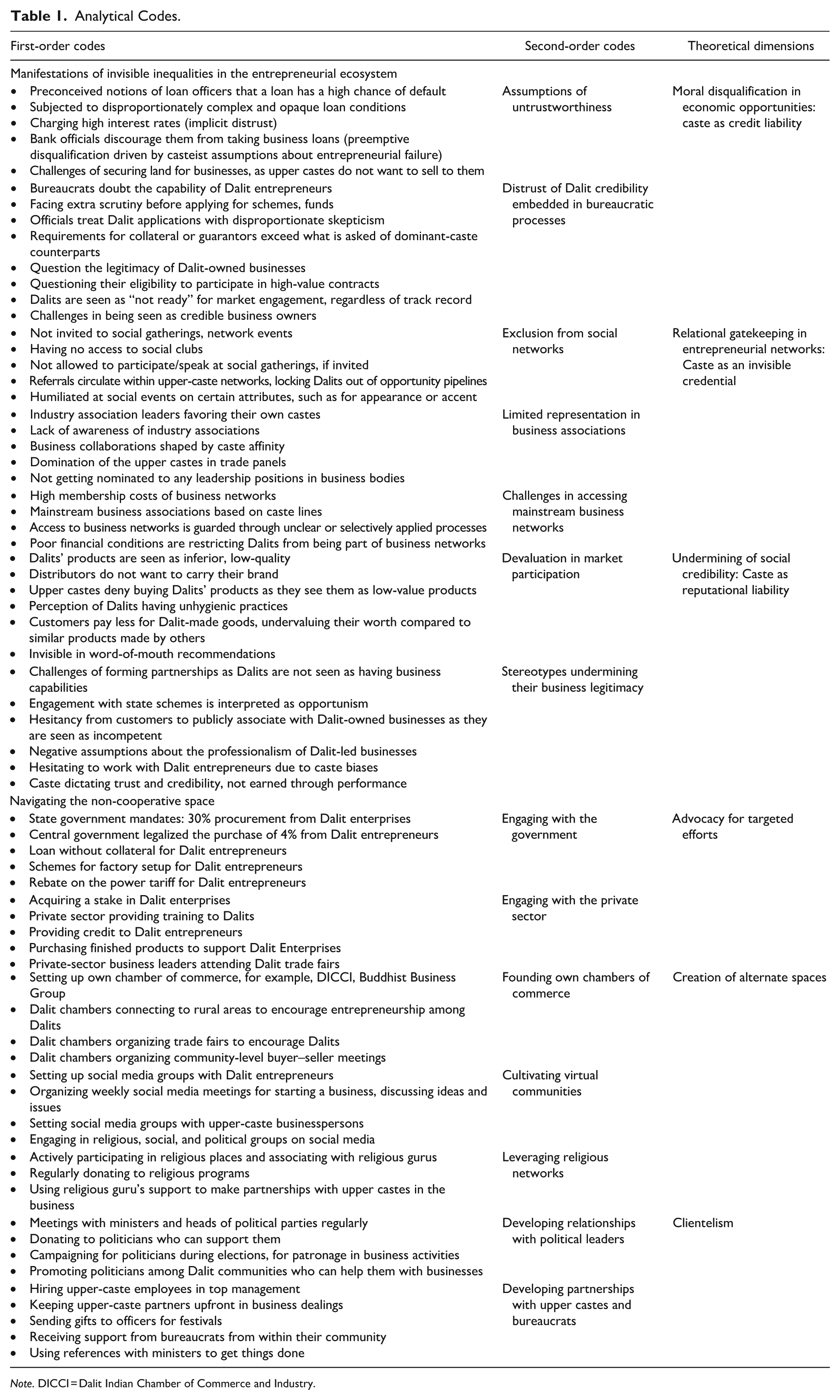
Note. DICCI = Dalit Indian Chamber of Commerce and Industry.
Findings
We present our findings in two parts. First, we discuss the manifestations of invisible inequalities in the entrepreneurial ecosystem that make it a non-cooperative space for Dalits, and then present the practices Dalits implement to overcome and navigate this non-cooperative space.
Manifestations of Invisible Inequalities in the Entrepreneurial Ecosystem
We observed three key manifestations of invisible inequalities in the entrepreneurial ecosystem, namely (a) moral disqualification in economic opportunities; (b) relational gatekeeping in entrepreneurial networks; and (c) undermining of social credibility, which we elaborate on below.
Moral Disqualification in Economic Opportunities: Caste as Credit Liability
One stream of entrepreneurship literature suggests that access to financial capital, such as land, credit, equity funding, and material assets, is a matter of merit or economic efficiency (Baum & Silverman, 2004; Drover et al., 2017). However, for Dalit entrepreneurs, access to financial capital is shaped not by formal criteria, but by an invisible caste calculus—a form of moral disqualification rooted in institutionalized suspicion of Dalit competence and worthiness. Caste-based moral suspicion leads to conditionalities and delays not imposed on dominant-caste applicants, and Dalit entrepreneurs are morally disqualified from being seen as trustworthy borrowers. In essence, we find that caste-based prejudice restricted access to financial capital on an equal footing for Dalit entrepreneurs relative to others in entrepreneurial ecosystems, owing to assumptions of untrustworthiness and distrust of Dalit credibility embedded in bureaucratic processes.
Assumptions of Untrustworthiness
Rather than evaluating loan applications on business merit, Dalit entrepreneurs are subject to discretionary and discriminatory assessments by loan officers, who presume Dalits to be financially irresponsible and more likely to default. Both bank officers (P50, P51) whom we interviewed agreed that “such notions are very much prevalent” (see also Baland et al., 2019; Prakash, 2015). Participants highlighted that questions were raised about their “abilities to pay back the loan amount (P17)” and they believed that “caste identity overshadows the quality of their business proposals (P23)” and “bank officers look for ways to say no because we belong to [Dalit] community that has no previous history of running businesses (P12).” Such questioning went to the extent that Dalit entrepreneurs felt discouraged from taking business loans.
Dalit entrepreneurs are not simply seen as inexperienced or under-resourced; they are deemed morally unqualified to exercise authority, command trust, or participate as equals in business ecosystems. This leads to a form of moral gatekeeping, where caste-based assumptions about discipline and trustworthiness implicitly govern access to credit. Bank officials we interviewed mentioned that such caste-based presumptions were normalized within lending institutions: Yes, there is a perception that loans to Dalits are riskier. That mindset still exists; people do not say it openly, but it shapes decisions. (P50)
Dalit entrepreneurs and bank officials also mentioned that there were “fewer to no success stories that could help build trust or break preconceived notions” (P45) that loans to Dalits would be less risky. Participants also highlighted that mainstream media have ignored or had limited coverage of successful Dalit entrepreneurs, thus continuing the perception that Dalit businesses are risky. These discourses function not as rational evaluations but as caste-coded disqualifications that delegitimize Dalits’ claims to entrepreneurial activities, highlighting that moral legitimacy is unequally distributed and policed through dominant cultural schemas.
Distrust of Dalit Credibility in Bureaucratic Processes
The assumptions of untrustworthiness manifest concretely through discriminatory bureaucratic processes that systematically disadvantage Dalit entrepreneurs. Participants stated that their applications were not looked at or approved unless they brought upper-caste colleagues or partners to the bank with them while applying for a loan (see also Prakash, 2015). These are not isolated events but part of a broader epistemic and institutionalized distrust in Dalit entrepreneurship.
Dalit entrepreneurs expressed their frustration that when they were offered loans, they got loans with higher interest rates, or amounts approved were much lower than their upper-caste counterparts (see also Baland et al., 2019; Patel et al., 2022), adding additional burden on Dalit businesses at the outset and affecting their profit margins and long-term sustainability (see also Fisman et al., 2017). Such high interest rates were sometimes justified through vague terms and conditions or policies for small businesses, which was a major concern for the participants. Dalit entrepreneurs expressed their frustration at the complex terms and conditions of loans, which they believed were influenced by caste. Sometimes, they faced “terms and conditions that were impossible to meet, such as substantial collateral or several guarantors, even when government regulations did not specify those” (P38). They believe that such institutional hurdles were deliberately obstructive and were set to drive them out of business. Another Dalit entrepreneur revealed his frustration thus: [Abusive words for loan officers] kept adding new clauses and conditions each time we went to the bank . . . [another abusive word] every time there was something different . . . finding ways to make it harder for us to get the loan . . . putting conditions that they do not put on others. (P35)
Participants also highlighted that upper-caste individuals often refused to sell land to Dalit entrepreneurs, citing various “excuses” (P9) and sometimes “overtly expressing caste as the primary reason for denial” (P23). As participants mentioned: We tried to buy land for our factory, but the owners suddenly backed out when they learned we were Dalits. They told us outright they could not sell to “people like us.” (P23)
These restrictions limited Dalit entrepreneurs’ ability to set up businesses in prime industrial areas, forcing them to operate on the outskirts and further isolating them from mainstream ecosystems. In agreement with these participants, the social welfare officer in our study also stated that “the land is like a mother to many and is a tool to maintain dominance, and if Dalits start acquiring land, that will challenge the dominance of others . . . who wants to lose their power . . . that is why they do not want to sell land to Dalits” (P54).
These forms of moral and material obstruction reveal that Dalit entrepreneurs are not just financially under-capitalized—they are institutionally disqualified from being seen as deserving of capital, reinforcing their marginalization within the ecosystem.
In sum, accusations that Dalit entrepreneurs are not competent not only misrepresent their struggles but also demoralize their efforts to succeed. This moral othering renders their entrepreneurship socially suspect, limiting their ability to build trust and legitimacy within the ecosystem.
Relational Gatekeeping in Entrepreneurial Networks: Caste as an Invisible Credential
Entrepreneurial ecosystems are built not only on tangible resources but also on relational infrastructures—informal gatherings, business associations, and peer networks—that are critical for sharing information, building partnerships, and gaining credibility. Yet, we find that, for Dalit entrepreneurs, these spaces were structured by caste-coded gatekeeping practices that regulate who belongs, who speaks, and who thrives, leading to an unequal footing for Dalit entrepreneurs relative to other entrepreneurs in the ecosystem. This involved exclusion from social networks, limited representation in business associations, and challenges in accessing mainstream business networks.
Exclusion From Social Networks
Our findings show that there were subtle and often unspoken ways Dalit entrepreneurs were excluded from key social and business networks. For instance, in social gatherings where business knowledge was shared, crucial connections were forged, deals were initiated, and investors were present, Dalits were often either “excluded from such gatherings” (P32): I see upper caste colleagues attending these events where deals are made, but I am never invited. It is like they do not want us in those spaces. (P32) How do you even begin to network when, as a Dalit, you are not allowed into the room to begin with? The exclusion starts long before the event. (P14)
Sometimes, caste-based business networks also “made [Dalits] to feel unwelcome” (P14). Many participants also mentioned that even when they were invited to social events, they were often marginalized and not allowed to speak or participate meaningfully. Dalit entrepreneurs perceived a degree of replication of social hierarchies and tokenism in such spaces, restricting them from becoming integral parts of these groups. Their presence was often tolerated but not welcomed; they were silenced through subtle dismissals or relegated to the margins. When they tried to share their knowledge, “upper-caste members dismiss[ed] as if they have nothing meaningful to share” (P30). Another participant also stated: Even when I, as a Dalit, am invited to certain events, it’s clear I am not meant to speak or engage—just to be seen. It feels like I am there as a token to showcase diversity, not as someone whose voice matters. (P23)
Furthermore, the exclusion also manifested through caste-coded signaling, including humiliations based on appearance, speech, or place of origin—each invoked to remind Dalits of their “improper fit” in elite business spaces: I have been humiliated for my appearance and Dalit identity. They say things that cut deep and remind me of my place in society [caste order], that I am not considered their equal, no matter my qualifications. (P16)
Limited Representation in Business Associations
Such relational exclusions are not merely social slights—they are structural, affecting access to clients and investors. Participants noted how caste-based business associations—whether formal (such as industry bodies) or informal (such as caste-based business circles)—operated through implicit codes of caste affinity, making it difficult for Dalit entrepreneurs to gain entry or recognition. For instance, a significant barrier Dalit entrepreneurs faced was accessing industry associations that were dominated by upper castes, for example, the Confederation of Indian Industry survey of member companies indicates that the proportion of lower castes is 25% to 50% lower than their representation in the total population (V. P. Iyer, 2011). Even at the local level, these associations prioritized relationships within the same caste, excluding Dalit entrepreneurs.
Participants also mentioned that industry association leaders favored their own caste in business collaborations, referrals, subcontracting, and associations, reflecting long-standing patterns of caste homophily and organizational gatekeeping that not only limited Dalit entrepreneurs’ ability to form strategic alliances but also reinforced their peripheral position within local markets. Participants also noted the domination of upper-caste groups in trade panels, where decisions on industry priorities and resource allocation were made. Moreover, participants agreed that a lack of awareness of industry associations among Dalit entrepreneurs underscores how information asymmetries, social distance, and historical exclusion limited their visibility within mainstream business networks.
Challenges in Accessing Mainstream Business Networks
Beyond formal associations, Dalit entrepreneurs faced broader systemic barriers to accessing mainstream business networks, which served as critical conduits for resources and legitimacy. Mainstream business networks—comprising industry forums and entrepreneurial clubs—were characterized by multiple overlapping barriers that systematically excluded Dalit entrepreneurs from accessing the social capital crucial for entrepreneurial success.
A significant barrier was the high membership costs of business networks, which placed them beyond the reach of many Dalit entrepreneurs. Participants highlighted that prestigious business associations charged substantial membership fees, annual dues, and event participation costs that were prohibitive given their limited financial resources. One entrepreneur explained: The membership fee for these business groups is quite high. How can I afford that when I am struggling to keep my business afloat? These networks are only for those who already have money. (P33)
These financial barriers were compounded by the reality that mainstream business associations were often organized along caste lines, creating informal segregation within entrepreneurial ecosystems. Participants noted that even ostensibly professional associations reflected caste homophily, with upper-caste entrepreneurs dominating leadership positions and membership rolls. Several participants described opaque application procedures, sponsorship requirements, and vetting processes that functioned as gatekeeping mechanisms. These business networks were crucial to networking with clients and mentors, accessing resources, and gaining credibility; however, many participants mentioned the challenges of gaining membership because of the “selective membership practices that gave preferences to people similar to those already in the associations . . . upper castes . . . and Dalits were not there so none was there to invite you in” (P6) or “opaque application process” (P17).
In sum, caste operates as a credential in entrepreneurial networks—not through official policy, but through invisible, relational exclusions. These forms of gatekeeping do not announce themselves; they function through silences, non-invitations, microaggressions, and an unspoken understanding of who “belongs.” For Dalit entrepreneurs, relational capital is not absent—it is withheld.
Undermining of Social Credibility: Caste as Reputational Liability
Social credibility, defined as the degree of trustworthiness, legitimacy, and acceptance an individual is perceived to have within a particular social context, is critical for building partnerships, attracting customers, and accessing institutional resources. Under the influence of caste, such social credibility is not distributed equally. Rather, we find that it was deeply structured by caste hierarchies. For Dalit entrepreneurs, caste operates as a reputational liability, not simply a background identity. Our findings indicate that Dalits faced devaluation in market participation and stereotypes undermining their business legitimacy, delegitimizing their entrepreneurial claims, irrespective of their actual capabilities or offerings.
Devaluation in Market Participation
Dalits had to deal with a reputational deficit, which emanated from the widespread belief that their products are of inferior quality, limiting their ability to compete in the marketplace, regardless of the quality of their offerings. Participants shared that customers’ caste knowledge shaped their consumption behavior, often to the detriment of Dalit-run enterprises. For instance, a participant highlighted: Once customers know we are Dalits, they hesitate to buy from us, assuming that our products are of lower quality. (P26)
This stigma reflects a broader symbolic economy, where goods are judged not just on quality but also on the social standing of their producers. Some upper-caste customers perceived associating with Dalit businesses as socially diminishing, thus reducing the symbolic value of such transactions. Several participants also noted that there is a persistent perception that “Dalits engage in ‘unhygienic practices’” (P12), leading customers to question the cleanliness, safety, and quality of their products, regardless of actual standards. This stigma—rooted in entrenched caste ideologies—functioned as a symbolic barrier that positioned Dalit-owned enterprises as inherently inferior. This not only limited Dalits’ access to markets but also actively constrained their ability to scale their ventures.
Stereotypes Undermine Their Business Legitimacy
Moreover, the presumption of incompetence hampered Dalit entrepreneurs’ ability to form collaborations and build credibility. As we highlighted above, questioning their capabilities, for example, when availing loans, created an environment in which they faced challenges building a reputation among customers, suppliers, or potential employees. The perception and stereotypes that Dalits lacked entrepreneurial acumen remained prevalent, affecting both peer and institutional engagements. Participants highlighted that upper castes “doubt their abilities to run a successful business” (P39) and “do not trust them to be capable entrepreneurs” (P42).
People avoid working with me because they assume I do not have the necessary skills or experience, even though my business has been running for years. (P23)
These stereotypes also influenced how Dalits were treated by state institutions, especially when seeking access to government welfare or entrepreneurship schemes. For instance, when they wanted to avail themselves of government schemes, they mentioned that government officials and bank officers saw them as “availing free money” (P29), so they should share a part with officials. Dalit entrepreneurs mentioned that such bribery was required to access various government schemes specific to them because such an impression and reputation had been created around them that they just wanted to get money and do nothing, that is, Dalits are “benefit seekers” (P18). Many participants shared how their entrepreneurial efforts were viewed with suspicion, as though any success must be the result of manipulation, corruption, or undeserved advantage, particularly when they accessed state-supported Dalit-specific schemes. Officials and peers alike often framed their participation as exploitative rather than enterprising, reinforcing the moralized stereotype of the “undeserving beneficiary” (P29). For example, one participant noted: “They think we are just here to take free money and disappear. No one says that to upper castes who take subsidies” (P29).
Most of the time, bribery often took the form of unofficial “fees” that created a pay-to-play culture, limiting Dalit entrepreneurs’ access. A Dalit woman entrepreneur mentioned: It is known that if you want to avail of schemes encouraging Dalit women to start a business, 10–15 percent of the amount you must pay in bribes; otherwise, your file will not move ahead for months and months. (P29)
Another participant (P36) shared that he had to “gift” an Apple iPhone to a bank officer to secure a loan under a government scheme. While corruption could take different forms, participants emphasized how caste marked them as “soft targets.” Participants mentioned that caste social hierarchies influenced who was asked for bribes and who was more vulnerable and could not afford delays in the application processing. The selective enforcement of red tape (e.g. additional documentation requirements for Dalits) capitalized on the vulnerability of Dalits, indirectly pressuring them to pay bribes. If Dalit entrepreneurs refused to pay bribes, they risked retaliation, such as further delays or outright rejections. Furthermore, to avail of any scheme, they required multiple documents from various offices; however, securing appointments with government officials was a significant hindrance as they were denied such appointments. These retaliatory delays or rejections faced by those who refuse to engage in corrupt practices underscore the coercive consequences of lacking social credibility. Furthermore, all these aspects (e.g. denial of appointments and the requirement of extra documentation) compounded to signal that Dalit entrepreneurs were not considered legitimate claimants of state support. Without dominant-caste networks or patronage, Dalit entrepreneurs were left vulnerable to institutional apathy.
In sum, this account shows that social credibility is not just interpersonal—it is structurally caste-bound. It shapes who is trusted, who is heard, and who is granted smooth passage through the labyrinths of power. The unequal distribution of this credibility reinforces material exclusion and symbolic devaluation, thereby perpetuating caste hierarchies in entrepreneurial ecosystems.
These three findings—moral disqualification in economic opportunities, relational gatekeeping in entrepreneurial networks, and undermining of social credibility—turn ecosystems into non-cooperative spaces, compelling Dalit entrepreneurs to develop distinct navigating practices that resist, adapt to, or circumvent such structurally hostile terrains, which the next section of findings focuses on.
Navigating the Non-Cooperative Space
Having identified the three practices that restricted market access for Dalit entrepreneurs within the ecosystem, making it a non-cooperative space, we next discuss the three practices that Dalit entrepreneurs employ to navigate this non-cooperative space. This involves advocacy for targeted efforts, creation of alternate spaces, and clientelism.
Advocacy for Targeted Efforts
One critical ecosystem practice that emerged from our study was Dalit entrepreneurs’ strategic engagement in caste-conscious advocacy for targeted efforts, which was aimed at highlighting the challenges faced by entrepreneurs within the ecosystem and nudging the larger ecosystem to make changes. This advocacy was not simply about generic business support but specifically focused on recognizing caste as a foundational axis of marginalization, responding to the challenges we documented earlier, and demanding mechanisms to counteract its impact on entrepreneurship. In contrast to broader, caste-neutral entrepreneurial policy discourse, these interventions underscored the urgent need for caste-responsive frameworks. This meant engaging in advocacy with the government and private sector to develop initiatives that help to overcome the challenges faced within the ecosystem.
Engaging With the State
To address the moral disqualification in accessing financial capital, Dalit entrepreneurs engaged in sustained advocacy for caste-responsive policy interventions. One participant, who was also active in Dalit politics, leveraging community and political networks, initiated dialogue with the state’s ruling party, highlighting to the government the challenges they faced in doing business. This advocacy led to a significant response, wherein the state government agreed to address their concerns and launched a conference for Dalit entrepreneurs and intellectuals, now known as the Bhopal Conference, a state-level policy event designed specifically for Dalit entrepreneurs and intellectuals.
A key outcome of this conference was the formulation of a new government policy mandating that 30% of total state procurement be sourced from businesses owned by SCs and STs. Such a public procurement policy has benefited Dalit entrepreneurs by creating guaranteed market access that counters the moral gatekeeping that institutionally disqualifies Dalits from economic opportunities regardless of business merit. Otherwise, “without this kind of state support, it would be very difficult to get into business and survive” (P42). This also reflects that market forces alone do not correct for caste-based exclusions; state intervention to support marginalized groups is crucial too (Thorat & Newman, 2010). A decade later, the Indian Union Government introduced a similar nationwide policy—the Public Procurement Policy for SCs, STs, and women. Under this scheme, 4% of total government procurement was allocated to these marginalized groups.
Participants also shared how such advocacy led to the introduction of caste-sensitive financial mechanisms, such as collateral-free loans. These mechanisms challenged the traditional caste-coded logic of creditworthiness that excluded Dalits through assumptions of untrustworthiness and distrust embedded in bureaucratic processes. For instance, one of our interview participants who had maintained a good credit record shared that they have “easily accessed these loans from both government and private banks” (P23). Another pointed out the role of state schemes in addressing structural operational barriers, such as high energy costs and rental expenses: “We got access to cheaper electricity for factory operations” (P47), and “lower-cost spaces for rent” (P42). These interventions countered the discriminatory loan terms—including higher interest rates and lower approved amounts—that burdened Dalit businesses and affected their profit margins and long-term sustainability.
Engaging With the Private Sector
While the state has been a key site of caste-conscious advocacy, Dalit entrepreneurs have also strategically engaged with private-sector actors to counteract the market’s implicit caste hierarchies. Through advocacy with the private sector, the ecosystem actors had secured the support of prominent private-sector companies for Dalit entrepreneurs. Some entrepreneurs in our study described meaningful collaborations emerging through sustained advocacy. For example, in 2013, the Tata Group had committed to investing 1 crore rupees (about $120,000) in a Dalit-owned enterprise, a symbolically powerful move from India’s corporate sector. Some Dalit entrepreneurs have also been able to avail opportunities to conduct business with the private sector, as one participant who is doing business with the Tata Group reflected on the significance of such engagement: We are now supplying crane parts and electric meters to both public and private-sector companies. Due to our strong track record and quality products, our business has attracted more interest from private-sector buyers. (P3)
Such collaborations helped counter the reputational deficit and stereotypes of inferior quality that had previously led customers to hesitate to buy from Dalit-owned businesses. Participants also mentioned that some of the private-sector companies had initiated various training programs aimed at Dalits, providing them with the skills required to successfully run businesses or become employed. These programs often include basic training in business operations, marketing, compliance, and supply chain integration. One participant who had benefited from one such program mentioned: These programs are good as they provide basic training on various aspects of business and help build connections with prospective sellers and buyers. (P18)
Beyond skill development, these programs provided pathways to access mainstream business networks that excluded Dalits through high membership costs, unclear application processes, and selective practices that privileged upper-caste entrepreneurs. In addition to training, participants also opined that the advocacy efforts were now translating into private-sector companies sourcing finished goods from Dalit-owned businesses. Through such engagements, Dalit entrepreneurs reported enhanced knowledge and visibility.
In addition to direct engagement, Dalit entrepreneurs have invited prominent corporate leaders to participate in Dalit trade fairs and networking events. These events served as platforms to counter stereotyping—showcasing Dalit excellence, professionalism, and innovation. By providing visibility for successful Dalit entrepreneurs, these events challenged the widespread assumptions that Dalit businesses were of inferior quality or that Dalits lacked business acumen. As participants shared, this helped gain credibility not only in the eyes of corporate actors but also within Dalit communities, generating hope and aspiration. Some of these events have been featured in mainstream media, offering symbolic capital that they can leverage. Such media coverage countered the problem wherein mainstream media had ignored or provided limited coverage of successful Dalit entrepreneurs.
In sum, it illustrates how Dalit entrepreneurs have worked to reframe caste not just as a social issue but as a material economic barrier requiring redress through formal policy instruments and support from private businesses. These advocacy practices represent strategic efforts to introduce countervailing institutional forces that directly challenge the three exclusionary mechanisms identified earlier.
Creation of Alternate Spaces
Another ecosystem practice that we observed was the creation of alternate spaces. Recognizing that mainstream entrepreneurial ecosystems operated through exclusionary relational infrastructures, Dalit entrepreneurs created parallel institutional structures to bypass these barriers. These were aimed at creating safe and comfortable spaces where Dalit entrepreneurs could express themselves, bypass traditional, exclusionary structures, and receive the support they needed. This involved building supportive networks such as founding their own chambers of commerce, cultivating virtual communities, and leveraging religious networks. These strategies reflect a bottom-up approach to creating opportunities and resources for Dalit entrepreneurs, enabling them to overcome caste-based barriers and gain access to markets, capital, and knowledge.
Founding Own Chambers of Commerce/Business Associations
One of the most significant ways Dalit entrepreneurs navigated invisible inequalities in the entrepreneurial ecosystem was by establishing their own chambers of commerce or business associations. These organizations, such as the DICCI, the Buddhist Business Group, and other Dalit-led networks, served as essential support systems that enhanced networking and improved access to information and resources. A participant, who was an active member of DICCI and state head, mentioned: Creating DICCI was necessary as it gives us space to shape policies and programs that benefit the community . . . it is like we have a voice now, which was missing earlier. (P6)
They believed that building their own institution rather than relying on structures that prioritize dominant-caste members would have a lasting impact on the way entrepreneurship is seen among lower castes, how others see them, and would “leave a long-lasting legacy inspiring a new generation of marginalized [Dalit] entrepreneurs” (P1). Furthermore, in recent years, after DICCI and other Dalit-led associations emerged, the government of India also helped shape and bring similar groups, such as the SC-ST Hub and National Small Industries Corporation, to support them and fulfill obligations under the Central Government Public Procurement Policy for Micro and Small Enterprises Order 2012.
Multiple participants agreed that through these associations and groups, Dalit entrepreneurs have expanded their reach to rural areas, aiming to encourage entrepreneurship among rural Dalits by providing them with mentorship and networking opportunities. In 2023, DICCI also launched DICCI NextGen—“a platform for young SC-ST entrepreneurs and youth under 35 years, to work toward realizing a dream of an equitable and developed nation” (www.dicci.in/dicci-nextgen).
These chambers have organized trade fairs and buyer–seller meetings to facilitate market access and visibility for Dalit-owned businesses. These platforms provided space to share business knowledge, forge crucial connections, and initiate deals. For instance, one such event in Delhi gave Dalit entrepreneurs opportunities to showcase their products to the international market, and for “Dalit entrepreneurs, such opportunities are rare and hard to find elsewhere” (P1). By creating their own networking spaces, Dalit entrepreneurs circumvented the non-invitations and unspoken understandings of who “belongs” that characterized mainstream business networks. We must mention that participants also noted that having such caste-specific associations “sometimes [we] end up talking only to each other . . . without connections to mainstream networks, [our] growth remains limited” (P7), and “buyers often categorize us only as Dalit businesses, which can close some doors while opening others” (P12).
Cultivating Virtual Communities
Due to their exclusion from mainstream entrepreneurial networks, Dalit entrepreneurs have created online communities to share resources, knowledge, and support. These virtual platforms provided a cost-effective and accessible way for Dalit entrepreneurs from various regions to connect, fostering collaboration and collective problem-solving. These also provided them with “safe spaces to seek advice and share their failures without judgment” (P20). These spaces countered the tokenism and silencing that Dalits experienced in mainstream networks. Such virtual support networks also helped them overcome their isolation in mainstream networks and organize events where they could share their knowledge.
Some participants mentioned that regular virtual meetings work like a think-tank and informal support network, where they could get feedback, build connections, and ask for help to get things done through the network. In these virtual networks, they also sometimes strategically included dominant-caste business people, giving them opportunities to foster alliances, bridge social divides, and build credibility. One participant who runs such an online group on WhatsApp mentioned: Having a group open to all like-minded individuals, without any caste restrictions, gives us opportunities to get to know each other and build relationships that will be helpful in future business. (P45)
By creating these inclusive virtual spaces, Dalit entrepreneurs could build relationships with upper-caste entrepreneurs on more equal footing than in physical spaces where caste-coded humiliations based on appearance, speech, or place of origin reminded them of their improper fit in elite business circles.
Leveraging Religious Networks
In caste-stratified markets where Dalit entrepreneurs face structural exclusion from dominant social and business networks, religious institutions and spiritual affiliations have emerged as critical avenues for social legitimacy, credibility, and economic opportunity. Religion, in this context, is not merely a site of faith or identity but becomes an infrastructural mechanism through which Dalits tactically negotiate visibility, belonging, and partnership. Many Dalit entrepreneurs have been actively participating in religious gatherings and have sought to be seen with religious gurus (leaders) who significantly influence the region where they operate. One of the participants, who has been an active supporter of one such guru, mentioned: Religion and business go together hand in hand . . . associating with respected gurus gives not only credibility but also access to the huge market that these gurus influence. (P38)
Through regular donations, sponsorship of religious events, and visible presence in religious gatherings, Dalit entrepreneurs cultivate relational proximity to larger community structures, countering their exclusion from dominant-caste kinship and business networks. Furthermore, by leveraging these gurus and their connections, Dalit entrepreneurs could partner with other castes in business. Multiple interview participants believed that by participating in religious networks, they gained social legitimacy and created opportunities to expand their businesses while reinforcing community solidarity. Religious networks have also opened doors to global markets that would otherwise be inaccessible to Dalits. One of the participants had built relationships with some Buddhist organizations in Japan, which led to one Japanese company visiting them and placing orders: A Japanese company has given the order to produce one of the parts for their final product. They visited us multiple times and found our product up to the standards . . . it would not have been possible without our involvement in Buddhist organizations . . . as first-generation entrepreneurs, it gives immense pleasure to be chosen by such a big firm. (P16)
This example reveals how religious networks can bypass dominant-caste brokerage structures and act as alternative epistemic and economic channels, especially in contexts where Dalits are deemed “not credible.” By accessing international markets through religious networks, some Dalit entrepreneurs circumvented the domestic market devaluation, where customers hesitated to buy from them, and the referral systems that systematically denied them access to lucrative contracts. Importantly, these religious organizations provide not just spiritual affiliation but also international legitimacy that Dalit entrepreneurs leverage to escape local caste stigma.
In sum, Dalit entrepreneurs actively create alternative spaces, such as trade fairs, community-led conferences, and caste-based business associations, to counter invisible inequalities in mainstream markets. These spaces serve as platforms for visibility, networking, and knowledge exchange among Dalit entrepreneurs. They foster collective identity, allow for peer learning, and challenge dominant narratives that equate business acumen with upper-caste status.
Clientelism
The third ecosystem practice we observed being employed by the entrepreneurs was clientelism, wherein they strategically build and leverage relationships with political figures, bureaucrats, and upper-caste partners to navigate invisible inequalities and access critical resources.
Developing Relationships With Political Leaders
In caste-stratified political economies, where access to state support and dispute resolution mechanisms is often mediated by social location and influence, Dalit entrepreneurs have developed strategic alliances with political actors to navigate systemic barriers. These relationships are not merely instrumental but are embedded in historically entrenched patronage structures, in which political backing becomes a form of social insurance within a discriminatory ecosystem. Participants highlighted that they often meet local political leaders to establish rapport and secure political backing that helps Dalits overcome discriminatory practices, such as challenges in availing schemes or resolving business disputes. One participant, who had land disputes with dominant castes, “used the support of the local minister” to resolve it and mentioned that “without this backing, running a business would be twice as hard” (P28).
Such political intervention was necessary because, as documented earlier, upper-caste individuals often refused to sell land to Dalit entrepreneurs, forcing them to operate on the outskirts and isolating them from mainstream ecosystems. These links with the local leaders also helped them get work contracts, reduce the demand for bribes, and ensure fairer treatment by local officials; in return, Dalit entrepreneurs promoted politicians in their communities by telling their communities “who is on our side. These politicians then know we support them, and they support us in return” (P34).
The entrepreneurs also donated to political campaigns and led campaigns for politicians who could support their business activities. By contributing to these politicians’ campaigns or causes, they secured goodwill and considered them as “investments in a safety net for the business.” This mutual dependency reflects a form of political brokerage, where entrepreneurs exchange electoral support and legitimacy among Dalit voters for political protection and access to state resources. By positioning themselves as political intermediaries, Dalit entrepreneurs gain symbolic capital that can be converted into economic advantage, such as securing public contracts or being invited to government-organized procurement fairs. However, this political engagement is not free from contradictions or vulnerabilities. While it provides tactical advantages, it also reproduces clientelist structures where the state’s accountability is contingent on partisan and caste loyalties, rather than universal entitlement.
Developing Partnerships With Upper Castes and Bureaucrats
To address the moral disqualification and reputational challenges discussed earlier, in which Dalit businesses and products are not seen as credible or considered of lower quality, one prominent strategy used by Dalit entrepreneurs was to employ or partner with upper-caste individuals, especially in client-facing roles, to counter the stigma attached to Dalit businesses. Dalit entrepreneurs hired upper-caste employees to give them credibility in clients’ eyes. In some instances, upper-caste partners were asked to be in the forefront of business dealings to “break through business barriers and make it easier to get contracts” (P43).
Furthermore, to build and have “smooth working relationships” (P8), Dalit entrepreneurs sent gifts to bureaucrats for various religious and cultural festivals. These festival gifts also allowed them to bring the bureaucrats’ attention to updates about the business. These gifts were also strategically selected and sent, based on the caste of the bureaucrat and the nature of the festival; for instance, participants mentioned that to get the support of Dalit bureaucrats, they sent them gifts of Buddha statues on Buddha Purnima. While seeking assistance from bureaucrats within their own caste, Dalit entrepreneurs tried to build alliances based on shared experiences and mutual understanding, as one participant highlighted: Having someone from our own community in a public office is a big help. They understand our struggles and are more likely to help with faster approvals. (P36)
Such practices are not mere acts of corruption or patronage, but rather tactics of negotiation and survival within a bureaucratic regime that privileges dominant groups. The gift economy here performs a dual function—navigating cultural codes of reciprocity and recognition, while also reasserting Dalit presence within exclusionary structures.
In sum, Dalit entrepreneurs strategically engage in clientelism to navigate caste-based barriers in India’s entrepreneurial ecosystem. By building reciprocal relationships with political leaders, bureaucrats, and dominant-caste actors, they secure access to state schemes and gain entry into restricted markets.
Discussion
To gain insights into how invisible inequalities manifest in the entrepreneurial ecosystem, turning the ecosystem into a non-cooperative space, and how marginalized groups navigate in non-cooperative spaces, our research examined the lived experiences of Dalit entrepreneurs. We find that invisible inequalities manifest in three ways in the entrepreneurial ecosystem: moral disqualification in economic opportunities, relational gatekeeping in entrepreneurial networks, and undermining social credibility, which turn the entrepreneurial ecosystem into a non-cooperative space for Dalit entrepreneurs. To navigate this non-cooperative space, our research finds that they implement three micro-practices: advocacy for targeted efforts, creation of alternate spaces, and clientelism. This study’s findings have important theoretical implications for scholars interested in understanding entrepreneurial ecosystems, entrepreneurship among marginalized groups, and caste in organizational settings.
Theoretical Implications
First, research on entrepreneurial ecosystems has traditionally focused on top-down models, where government support, venture capital networks, and institutional resources play critical roles in fostering a flourishing ecosystem (Isenberg, 2010). Furthermore, most research on entrepreneurial ecosystems has predominantly focused on high-growth ventures, well-resourced ecosystems, celebrating individual agency and resilience, and the success factors that promote business development (Audretsch & Belitski, 2017; Spigel, 2017; Wurth et al., 2022). However, this emphasis on top-down enablers and high-growth success narratives has meant that far less attention is paid to the structural barriers and unequal access that make these spaces non-cooperative and shape how marginalized groups experience and navigate these ecosystems.
As we documented, Dalit entrepreneurs are routinely subjected to moral disqualification, where their caste identity triggers perceptions of untrustworthiness, undeservingness, or incompetence, leading to heightened scrutiny, denial of credit, and the presumption that any success is either fraudulent or the result of state patronage. The romanticization of individual agency in mainstream ignores the reality that in non-cooperative spaces, marginalized individuals “do not encounter those aspects (these include opportunity recognition, resource access, or serendipitous moments—concepts that ecosystem scholars often take for granted) typically considered by entrepreneurship literature as success factors” (Chowdhury, 2021b, p. 917). The concept of non-cooperative space reorients our attention to how entrepreneurship is shaped not only by the absence of resources but also by the deliberate design of exclusion. In the case of Dalit entrepreneurs, our findings indicate that this takes the form of institutional arrangements that withhold legitimacy, obstruct access, and deny cooperation, rendering the ecosystem structurally unwelcoming. Dalit entrepreneurship, therefore, is structured less by meritocratic opportunity and more by entrenched caste boundaries, highlighting how social hierarchies continue to regulate access to economic resources.
Furthermore, present entrepreneurial ecosystem frameworks insufficiently interrogate the power-laden institutional configurations that obstruct cooperation, that is, the role of powerful actors (e.g. upper-caste networks, state bureaucracies) in obstructing access to capital and markets (Chowdhury, 2021b; Spigel, 2017; Stam, 2015). We find evidence of what Chowdhury (2021b, p. 915) calls “uncooperative sociostructure—a network of powerful actors” that make entrepreneurial activities among the marginalized harder. Our analysis reveals that the caste-coded hierarchies of cooperation persist, and Dalit entrepreneurs were routinely denied trust, mentorship, and contracts unless they affiliate with dominant-caste intermediaries or engage in moral performances of worthiness. Such caste-based cooperation leads to elites dominating market interactions. Dalit entrepreneurs often have to repackage their ideas through upper-caste legitimacy to be seen as credible. In this light, we highlight that the ecosystem is not a neutral system, but a contested terrain shaped by power, hierarchy, and selective cooperation. This underscores the need to interrogate not only structural barriers but also the subtle, relational mechanisms that perpetuate inequities in entrepreneurial ecosystems.
Our study also highlights how manifestations of invisible inequality compel marginalized entrepreneurs to develop alternative practices. Thus, we add a new perspective to the micro-foundations of the ecosystem literature (Wurth et al., 2022) by documenting the micro-practices that shape marginalized entrepreneurs’ experiences within ecosystem and their navigation of invisible inequalities in entrepreneurial ecosystems, such as advocating for targeted efforts, creating alternative spaces, and engaging in clientelism. As we have shown, they actively forge political ties, leverage religious networks, develop alternative trade platforms, and create new associations such as DICCI to contest and bypass the dominant actors and norms in the entrepreneurial ecosystem. However, these efforts often entail compromises of clientelism, symbolic appeasement, or assimilation into dominant-caste business cultures.
Importantly, for Dalit entrepreneurs, these may not be entirely strategies of choice but rather shaped by coercion, emerging from the structural compulsion to survive in a non-cooperative ecosystem designed to deny cooperation. This illustrates coerced navigations in an ecosystem where epistemic legitimacy (Fricker, 2007) is monopolized by dominant castes and elite control market logics (Chowdhury, 2021b). Through these adaptive practices, Dalit entrepreneurs sidestep traditional ecosystem support channels and build independent support structures. By highlighting these dynamics, our study bridges the gap between macro-level ecosystem theories and the lived realities of marginalized entrepreneurs, demonstrating how structural barriers, individual agency, and economic, cultural, and policy factors intersect to shape entrepreneurial participation and outcomes.
Second, we contribute to research on entrepreneurship by the marginalized. Entrepreneurship research talks about the importance of different forms of capital, predominantly social, human, and financial capital, for leveraging entrepreneurial opportunities (Estrin et al., 2016; Sahasranamam et al., 2021). We find that caste-based liabilities restricted Dalit entrepreneurs' access to certain forms of entrepreneurial capital, such as financial and social capital. However, we observe that Dalit entrepreneurs instead attempted to leverage other forms of capital, such as political capital (i.e. clientelism, advocacy, developing connections with politicians) and cultural capital (i.e. developing networks with religious leaders, and involvement in religious festivals) to gain legitimacy and access market opportunities.
In entrepreneurial research, clientelism is often conceptualized as a mechanism by which powerful groups sustain their influence through informal networks (Ahlstrom & Bruton, 2006; Welter & Smallbone, 2011). However, our findings show that clientelism also acts as a survival strategy for marginalized entrepreneurs, especially those excluded from formal systems due to deep-rooted biases or discrimination. For Dalit entrepreneurs, securing political backing and fostering relationships with bureaucrats are crucial adaptations to counter caste-based exclusion. This perspective reframes clientelism from a symbol of inequality to a potentially empowering strategy, especially for marginalized entrepreneurs, offering a more nuanced understanding of how they navigate socio-political landscapes. These findings call for a reconceptualization of clientelism in entrepreneurship by marginalized research. Researchers should examine how marginalized groups use informal networks and clientelist practices as adaptive strategies rather than merely viewing clientelism as a power sustenance tool. Similarly, Dalit entrepreneurs used religious networks and collaborated with Buddhist leaders to build credibility and partnerships with upper-caste individuals. To understand the long-term value of such relationships, we need further research. In essence, our findings suggest that political capital and cultural capital should be recognized as valuable resources for marginalized entrepreneurs to navigate exclusion.
Furthermore, most research on entrepreneurship by marginalized groups remains Western-centric, focusing on race, gender, and socio-economic aspects (Jennings & Brush, 2013; Murzacheva et al., 2020). This study of Dalit entrepreneurs brings to the fore caste-based marginalization, expanding the geographical and contextual scope of entrepreneurship literature, highlighting the significance of understanding Eastern context-specific social stratifications, a valuable addition in response to calls for non-Western context-specific theorizing in management research (Sahasranamam et al., 2024; Wickert et al., 2024). This focus not only highlights the unique structural barriers faced by Dalit entrepreneurs but also challenges researchers to integrate non-Western forms of social stratification into broader theories of entrepreneurship by the marginalized.
Third, our research contributes to research on caste within organizational settings. While much research has focused on the challenges Dalit entrepreneurs face (L. Iyer et al., 2013; Jodhka, 2010; Sarkar et al., 2018), there is limited research on how they resist, overcome, and navigate those challenges. Furthermore, we also address the call of inequality scholars to understand the manifestations of invisible inequalities (Bapuji et al., 2023). While much of the literature on entrepreneurial ecosystems and inequality focuses on observable disparities, such as funding gaps or representation, we respond to Bapuji et al.’s (2023) invitation by foregrounding caste as a deeply embedded yet systematically invisibilized form of inequality for Dalits within the ecosystems. Dalit entrepreneurship unfolds within caste-based non-cooperative spaces, where hostile markets and institutions reproduce socio-economic immobility, mirroring the structural marginalization identified by Derakhshan and Chowdhury (2025) in their study of undocumented migrants. Caste inequalities that Dalits face are not always openly declared exclusionary practices; rather, they tend to be subtle, relational, and symbolic (Bapuji et al., 2024; Vaid, 2014).
We present caste-based structures and associated boundaries not merely as background social identities, but as active structuring forces that shape how access, cooperation, and recognition are negotiated. Our analysis shows that caste dictates who entrepreneurs can approach for resources, whose cooperation they can secure, and whose recognition their ventures receive. It governs interactions with suppliers, investors, and clients, influencing trust, credibility, and legitimacy. At the same time, navigating these caste-based networks requires strategic adaptation: Dalit entrepreneurs selectively leverage caste-based solidarity while managing the risks of exclusion from mainstream markets. Thus, caste simultaneously enables certain forms of collective support and constrains broader integration, highlighting its dual role in structuring both opportunities and barriers. By framing caste as an active structuring force, we can better understand how social hierarchies are reproduced within ostensibly neutral economic spaces, showing that entrepreneurial agency is exercised within—and sometimes against—deeply embedded social constraints.
Limitations, Policy Implications, and Future Research Directions
Our research has some limitations. First, despite our efforts, we could not add more than two female Dalit entrepreneurs. We believe future research on the intersection of gender and caste would add much value, as Dalit women face multiple forms of discrimination, and the manifestations of invisible inequalities they face may vary by context. Second, our research findings are context-specific, as caste is predominantly a characteristic of South Asian society. While this research focused on Dalits, future research needs to focus attention on other marginalized groups within the Indian entrepreneurial ecosystem, such as the STs and entrepreneurship among dominant castes, which are not traditionally business-oriented, such as Brahmins.
Our findings provide actionable insights for Dalit entrepreneurs and other marginalized practitioners by identifying the subtle and systemic ways caste operates as an invisible barrier in entrepreneurial ecosystems. By highlighting mechanisms such as moral disqualification and relational gatekeeping, this research offers tools for recognizing, naming, and navigating exclusionary structures. Dalit entrepreneurs may use these insights to build counter-strategies. Our study underscores that policymakers need to move away from the assumption that the entrepreneurial ecosystem is universally accessible. Instead, our work suggests the importance of designing policies that tackle not only access to credit and capital but also the informal, relational, and symbolic exclusions that marginalized communities such as Dalits face. Our research also calls for more attention to relational dynamics within ecosystems to explore how power, exclusion, or structural inequality shape ecosystem activities.
Moreover, investigating how marginalized-led ecosystems (like those established by Dalit entrepreneurs) could integrate with mainstream ecosystems may help to bridge gaps in accessibility and foster collaboration across social divides. This is an important stream of inquiry from a practice perspective too, as we heard concerning voices from our respondents suggesting how alternate spaces created by Dalit entrepreneurs, such as DICCI, while giving safe spaces, were also turning into Dalit enclaves and echo chambers, polarizing beliefs of victimization, diminishing the capacity for critical reflection and integration with mainstream entrepreneurial ecosystem for scaling up. Future research can also explore how marginalized entrepreneurs utilize clientelism differently from non-marginalized groups, particularly in contexts with entrenched social hierarchies.
Supplemental Material
sj-docx-1-bas-10.1177_00076503251407016 – Supplemental material for Invisible Inequality in Entrepreneurial Ecosystems: The Micro-Foundations of Navigating Marginalization
Supplemental material, sj-docx-1-bas-10.1177_00076503251407016 for Invisible Inequality in Entrepreneurial Ecosystems: The Micro-Foundations of Navigating Marginalization by Pankaj Anand, Pardeep Singh Attri and Sreevas Sahasranamam in Business & Society
Footnotes
Acknowledgements
We extend our sincere gratitude to the Dalit entrepreneurs who generously shared their time, experiences, and insights for this research. Without their voices, this work would not have been possible. We extend our sincere gratitude to the reviewers and editor, who helped us develop this paper. We are also grateful to Hari Bapuji, Paul Lassalle, Carolyn McMillan, Amparo Merino de Diego, Vaibhav Surwade, and Sumeet Mhaskar for thoughtful discussions and insightful comments on research. An earlier version of the work was presented at the 1st Global Conference on Caste, Business and Society (2023) and at EGOS 2025. We are thankful to the participants whose feedback and engagement enriched the development of this research.
Declaration of Conflicting Interests
The authors declared no potential conflicts of interest with respect to the research, authorship, and/or publication of this article.
Funding
The authors received no financial support for the research, authorship, and/or publication of this article.

Supplemental Material
Supplemental material for this article is available online.
Notes
Author Biographies
References
Supplementary Material
Please find the following supplemental material available below.
For Open Access articles published under a Creative Commons License, all supplemental material carries the same license as the article it is associated with.
For non-Open Access articles published, all supplemental material carries a non-exclusive license, and permission requests for re-use of supplemental material or any part of supplemental material shall be sent directly to the copyright owner as specified in the copyright notice associated with the article.

