




Abstract
Although diversity initiatives are considered prominent vessels for addressing inequality and despite massive investments in them, inequality inside organizations persists. Assessments of diversity initiatives often center on economic inequality and view organizations as closed systems to explain why they fail. Building on a 19-month field-level ethnography of the diversity field in Israel targeting Palestinian employment, we examine political inequality and show how it is perpetuated even as economic inequality is dealt with. Our findings reveal that the field is complicit in creating a chasm between the economic and political spheres by positioning diversity initiatives as a means to tackle economic inequality. The field’s infrastructure and dominant discourse reinforce this chasm and thereby make political inequality invisible, generating false consciousness. Our study challenges the preoccupation of diversity scholarship with universal best practices, suggests avenues for assessing and managing diversity initiatives while taking stock of political inequality, and directs future research to delve into the relationship between the economic and the political in organizations and our societies.
Diversity initiatives, promoting diversity and inclusion in the workplace, are considered prominent organizational vessels for tackling inequality (Bezrukova, Spell, Perry, & Jehn, 2016; Ng & Stamper, 2018). By facilitating social and economic mobility for persons from underprivileged group categories and by stimulating contact among members of adversary groups around common goals and professional identities (Desivilya Syna, 2020), they are seen as carrying the potential to break with a range of social inequalities of our societies (Nkomo, Bell, Roberts, Joshi, & Thatcher, 2019; Zanoni, Janssens, Benschop, & Nkomo, 2010). Yet, an unsettling gap prevails: While investments and hopes in diversity initiatives are on the rise, inequalities in our societies persist and deepen (Amis, Brickson, Haack, & Hernandez, 2021).
Questions around the effectiveness of well-intended diversity initiatives in promoting equality have spurred a large body of research (e.g., Gotsis & Kortezi, 2014; Oswick & Noon, 2014; Zanoni et al., 2010). Much of the recent literature has criticized social–psychological approaches for their overemphasis on individual inner processes, stressing the “structurally unequal access to and distribution of resources” (Zanoni et al., 2010: 14). As an alternative, researchers suggest addressing inequality at the system level (Kalev & Dobbin, 2020; Nkomo et al., 2019). This research has yielded an array of organizational best practices that enhance equality, such as establishing mentoring programs and diversity task forces, appointing diversity officers, and combating subtle discrimination that manifests itself in interactions (see Janssens & Steyaert, 2019; Kalev & Dobbin, 2020; Shore, Cleveland, & Sanchez, 2018). Indeed, such practices have been shown to “lead to significant and persistent increases in workforce diversity and opportunity” (Kalev & Dobbin, 2020: 3). Yet, the systemic approach that scholars adopt resembles a closed-system approach (Burrell & Morgan, 1979), looking inside organizations but ignoring external influences at the societal and field levels.
In particular, the research on diversity initiatives has paid little attention to the role of the diversity field, defined as the ecosystem of organizations sharing a concern for promoting diversity initiatives, including nongovernmental organizations (NGOs), governmental agencies, philanthropists, and academic researchers (Hoffman, 1999). The diversity field functions at the mesolevel (Wooten & Hoffman, 2008; Zilber, 2016), mediating between the macrolevel (societal, political) and microlevel (specific diversity initiatives). It affects how diversity in the workplace is conceived of and eventually how it is promoted. The dearth of research on the field level therefore limits our understanding of the success and failure of diversity initiatives.
Applying a system perspective (Mair & Seelos, 2021) to understand why well-intended diversity initiatives fail also calls attention to the sociopolitical system where disparities were created in the first place (Andersen, 1999; DiTomaso, 2021) and thus to political inequality (Dubrow, 2014) that may perpetuate inside organizations. However, the prolific literature on diversity initiatives has largely overlooked this aspect. While studies use improvements related to economic inequality as a standard marker of success of diversity initiatives, political inequality and the relationship between economic and political inequality have been largely ignored.
In this study we ask whether and how diversity initiatives reproduce and conceal political inequality even as they battle economic inequality. We conducted a 19-month ethnographic study in the diversity field in Israel, focusing on efforts to integrate Palestinian citizens of Israel into the predominantly Jewish workforce. This is an extreme case to study, given the protracted and intractable nature of the conflict between the sides. Yet, studying this context bears significance more generally for diversity initiatives aiming to integrate members from group categories that are systemically discriminated against at the social and political levels. Under the large methodological umbrella of field-level ethnography, we conducted observations in cross-organizational meetings, as well as interviews with key actors from the field. In addition, we collected and analyzed research reports, training materials, and website materials of various actors, as well as media coverage of diversity efforts and social media interactions.
Our findings show that the diversity field in Israel builds on the best practices discovered in the diversity literature. Initial indicators suggest that diversity initiatives based on these practices succeed in alleviating the economic inequality faced by Palestinian citizens of Israel. However, we also show that these same efforts are complicit with and perpetuate political inequality in the diversity field and its related organizations. Political inequality is reflected in the dominance of Jewish-Zionist symbols, practices, and language and the lack of recognition of Palestinian ones. We observed that Palestinian participants in diversity initiatives often feel that they need to hide their national identity (Palestinian), even as their ethnic identity (Arab) or religious one (Muslim or Christian) is recognized. We demonstrate that the diversity field in Israel is built on the distinction between the economic and political spheres and how the field's infrastructure and discourse create and reinforce this chasm. Consequently, field actors challenge economic aspects of inequality while making political inequality invisible and facilitating its perpetuation.
Our study contributes to literature on diversity and inequality that focuses on the persistence of inequality in organizations and society (Amis, Mair, & Munir, 2020; Bapuji, Ertug, & Shaw, 2020). We show how the chasm created by the diversity field—separating the economic sphere from the political sphere, situating diversity initiatives within the former—explains the systemic blindness to political inequality, even as progress is made against economic inequality.
Unveiling political inequality as a perpetuated and hidden consequence of well-intended diversity initiatives bears theoretical and practical implications. It challenges the diversity literature's focus on systemic best practices that are confined to organizations as systems but do not relate to organizations and fields as part of political systems. The universal application of such best practices runs the risk of confining efforts of diversity initiatives to “comfortable” social categories and group narratives that have already gained social legitimacy and recognition, while ignoring more socially challenging identity categories and reproducing entrenched patterns of inequality. Our study also informs future efforts to assess political inequality in diversity research and practice. On the basis of our findings, we suggest going beyond the common indicators of group representation and wages as baseline markers of inequality and instead paying attention to aspects such as language, symbolic objects, and recognition of the political group identity. Overall, our study opens avenues for future research about the relationship between the economic and the political in organizations and in society.
Diversity Initiatives and Inequality
Diversity initiatives establish and manage diversity and inclusion in the workplace, striving to integrate members from particular group categories (e.g., gender, race, ethnicity, class) into the hegemonic workforce (Ashley & Empson, 2013; Nkomo & Hoobler, 2014). Diversity initiatives advance interventions that range in scope from one-off diversity trainings to transformation of core organizational components, such as policy, structure, and culture (Benschop, Holgerson, van den Brink, & Wahl, 2015). Some interventions focus on diversity in the workplace—the representation of members from disadvantaged social identity categories in the organization in general and in various levels of the organizational hierarchy (Harrison & Klein, 2007; Nadiv & Kuna, 2020). These initiatives highlight equal opportunity in hiring, role allocation, promotion, and compensation (Amis et al., 2020; Kalev, Dobbin, & Kelly, 2006). Other interventions target workplace inclusion—striving to ensure that the treatment received by employees from different social identity categories enhances their sense of safety and comfort and their involvement and influence in critical organizational processes (Adamson, Kelan, Lewis, Śliwa, & Rumens, 2021; Van Eck, Dobusch, & van den Brink, 2021). Interventions for enhancing inclusion may involve efforts to transform organizational cultures, common practices, and day-to-day interactions among individuals in the workplace (Shore et al., 2018). Although diversity and inclusion are distinct concepts (Roberson, 2006), we follow Nkomo et al. (2019) in including both types of interventions under the large umbrella of diversity initiatives.
Diversity initiatives, targeting inequality at the organizational level, often presume to help resolve social inequalities in society at large (Amis et al., 2021; Zanoni et al., 2010). By advancing the representation of people from excluded identity categories in high-paid, high-status, and influential positions and by reducing prejudice, stereotyping, and other biases, diversity initiatives carry the potential to “mobilize collective change in favor of equal opportunities” (Holck, 2018: 242) and “contribute to the advancement of human well-being and society” (Bezrukova et al., 2016: 1227).
Why Diversity Initiatives Fail to Break With Inequality
Despite the great promise of diversity initiatives, research has suggested that “equality isn’t improving” (Dobbin & Kalev, 2016: 4). Meta-analytic evidence does find some positive outcomes at the individual level, showing that some of the knowledge that trainees acquire in diversity trainings is sustained over time (Bezrukova et al., 2016; Roehling, Wu, Choi, & Dulebohn, 2022). However, diversity trainings are unsuccessful in reducing expressions of stereotypes or achieving attitudinal or affective–behavioral change, and they can even backfire (Bezrukova et al., 2016; Duguid & Thomas-Hunt, 2015). Diversity initiatives are often also ineffective in increasing targets’ representation or achieving other organization-level outcomes (Kalev et al., 2006). Moreover, the discussion around diversity initiatives’ outcomes for individuals and organizations is often coupled with a general concern about their incapacity to combat inequality in our societies more broadly (e.g., Nkomo et al., 2019).
Seeking to discern why diversity initiatives fail to reduce workplace inequality, existing literature has presented several lines of explanation. Studies have demonstrated that diversity initiatives are sometimes nothing more than window dressing (Embrick, 2011; Zanoni et al., 2010). They may serve as managerial rhetoric to increase legitimacy while gaps persist between organizational policies and their implementation (Ahmed, 2004), and they may tackle representation numerically while disregarding other manifestations of inequality (Ahmed, 2007; Gotsis & Kortezi, 2014). Other explanations pertain to organization-level power dynamics (e.g., Nadiv & Kuna, 2020; Oswick & Noon, 2014), showing that internal opposition from those in power positions, coupled with societal-level power and identity dynamics, may hinder sincere efforts for change (Holck, 2018).
An increasingly dominant voice in the literature, evaluating the effectiveness of diversity practices and structures (e.g., Dobbin & Kalev, 2016; Leslie, 2019; Nishii, Khattab, Shemla, & Paluch, 2018), contends that failure to reduce inequality in the workplace stems from the methods used to tackle it and the assumptions underlying these methods. This literature challenges the assumption that inner psychological changes are the key to transforming entrenched inequalities, offering “practical systemic changes” instead (Kalev & Dobbin, 2020: 3; Zanoni et al., 2010). These include “resource practices” that offer support and opportunities for targets (e.g., diversity mentoring and sponsorship programs) and “accountability practices” (Leslie, 2019: 541) that aim to increase the sustainability of diversity initiatives (e.g., appointing a chief diversity officer; Nishii et al. 2018). These methods are currently considered “best practices” and offered as a remedy for inequality (Kalev & Dobbin, 2020), applied at the system rather than individual level.
While this approach shifts the attention from the individual to the organization, it misses out on the crucial role that the organizational field, as embedded in a broader sociopolitical system, plays in shaping diversity initiatives and efforts to redeem inequality.
Bringing in the Field Level
Attending to field-level dynamics (Hoffman, 1999) enables us to add a crucial layer to the analysis and theorizing of diversity initiatives, complementing closed-system approaches that look inside organizations. The diversity field, we recall, typically includes NGOs, governmental agencies, business organizations, diversity consultants, and philanthropic and academic actors, all concerned with promoting diversity in the workplace. The field is “analytically and socially discerned between organizations and societies” (Zilber, 2016: 86), intermediating the effects of society on organizations and persons. It is also an important source of influence on organizations, since practices, structures, and discourses concerning diversity are designed and circulated by field actors. Field-level events and encounters, such as conferences, trainings, and media campaigns, are where such norms of conduct are negotiated, shaped, endorsed, and made available for organizations to adopt (Wooten & Hoffman, 2008). Thus, the field critically affects the content and effectiveness of diversity initiatives.
Despite the importance of the field, writings on diversity initiatives or their determinants of success rarely consider it. When they do, they usually show how field-level actors, especially diversity consultants and “practitioner-facing academics” (Oswick & Noon, 2014: 23), play a key role in shaping, legitimizing, and spreading diversity practices and discourses in the form of management fashions (Kirton & Greene, 2019; Oswick & Noon, 2014). Our article adopts a field-level perspective to attend to political inequality in diversity initiatives.
Making Political Inequality Visible
Organizations are embedded in political and economic systems and historical circumstances (Holck & Louise Muhr, 2017; Omanović, 2009) that not only shape how inequality is manifested at the societal level but also influence the efficacy and capacity of diversity initiatives to challenge inequality (Andersen, 1999; DiTomaso, 2021; Muhr & Salem, 2013).
Economic inequality at the societal level is defined as the unequal distribution of resource endowments (i.e., wealth and other sorts of capital) and access to resources and opportunities, including basic entitlements in society, such as health care, education, markets, and institutions (Bapuji et al., 2020). Political inequality refers to the unequal distribution of political resources and privileges, including “the law, symbols, policy or other output that is the result of the political process” (Dubrow, 2014: 12). Discriminatory legislation and violation of rights (Andersen, 1999; DiTomaso, 2021), as entangled with social group membership, may be reflected within organizations’ mundane routines (Acker, 2006) and constitute the basis for resistance and conflict (Acker, 2006; DiTomaso, 2021). As an example, recent research on police brutality in the United States has started to reveal the relationship between Black Americans’ personal experiences of diversity and political inequality (Leigh & Melwani, 2019; McCluney, Bryant, King, & Ali, 2017). Political and economic inequalities are tied by “a debilitating feedback cycle” (Bartels, 2016: 345) in which political elites use their power to amass greater financial resources and opportunities (Domhoff, 2006), influencing “assumptions about who deserved what and who was capable of what” (DiTomaso, 2021: 2028). Iteratively, economic inequality influences political inequality, shaping political engagement (Gilens & Page, 2014) and making the interests of powerful economic stakeholders more visible and influential in myriad ways (Cole, 2018).
While organization and management research has identified economic inequality as a relevant object of study, scant attention has been given to political inequality. Conceiving of inequality in organizations as connected to the economic sphere (Amis et al., 2020; Bapuji et al., 2020), organization and management scholarship has developed a robust set of empirical markers to assess progress with respect to organization-level economic inequality—for example, metrics of employment discrimination, including access to high-salary or high-status jobs, hierarchy levels, and income inequality (e.g., Alamgir & Cairns, 2015). In contrast, a systematic review of political inequality across disciplines found no articles in the business and organizational literature that appear to engage with this concept (Dubrow, 2014). Thus, we know little about how it is manifested in organizations. As a result, widely praised diversity “best practices” might be politically blind.
Given that organizations must contend with the pervasive power of sociopolitical conflicts (Jakob Sadeh & Zilber, 2019) and that the political context influences diversity initiatives (Desivilya Syna, 2020), the neglect of political inequality is surprising. One reason why political categories and differences are hidden or repressed could be that diversity practitioners and scholars are entrenched in social orders in which some categories of difference are socially prevalent, accepted, and thus unquestioned. Another related reason is that diversity practitioners and theorists are simply not comfortable with integrating political categories and differences that are not in line with dominant theoretical paradigms or go against professional conventions.
In this article we apply a field-level perspective to understand whether and how diversity initiatives reproduce and conceal political inequality even as they battle economic inequality.
Research Context
To address the aforementioned question, we conducted field-level ethnography in the diversity field in Israel 1 focusing on efforts to integrate Arab/Palestinian citizens 2 into the predominantly Jewish workforce. We first elaborate on the sociopolitical context of these efforts and then describe the field and its development.
The Sociopolitical Context
The macro, sociopolitical, context of our research is the decades-long conflict between Palestinians and Jews in Israel and the institutionalized inequality privileging the Jewish national majority in the state of Israel over the Palestinian minority. This conflict preceded the founding of Israel in 1948 and has intensified ever since—revolving, on one hand, around the legitimacy of existence of the two nations in the geographic space that they both inhabit and, on the other, around human rights and justice (Nyhan & Zeitzoff, 2018). The groups impart different “master narratives” and ascribe blame to the other nation (Rouhana & Bar-Tal, 1998). Palestinian citizens of Israel are a national minority, representing approximately one-fifth of Israel's population. They are caught between their citizenship in a Jewish-Zionist state and their sense of national identity and belonging to the Palestinian people—within the 1948 borders, in the occupied West Bank, in the besieged Gaza Strip, and in the diaspora (Ghanim, 2009). Israel defines itself as a democracy, acknowledging individual human rights and equality (Herman, Anabi, Cubbison, & Heller, 2019), yet it is also established on an institutionalized commitment to the Jewish people, rooted in Zionist (Jewish-nationalist) ideology. 3 This commitment is manifest in Israel's self-definition as a Jewish state, the exclusivity of Jewish symbols and the Zionist narrative, the state's flag and national anthem, and laws that enshrine Jewish privilege. Recent years have seen a marked rise in political inequality favoring Jewish ethnonationalism (Jamal, 2019; Jamal, 2020). The 2018 Jewish Nation-State Bill, for example, legally enshrines the primacy of Israel's “Jewishness” (Séguin, 2013). The 2011 Nakba Law penalizes public institutions that question the definition of Israel as a “Jewish and democratic state” or commemorate the Nakba, the Palestinian catastrophe that came in the wake of the 1948 war and the establishment of the state of Israel.
Under these circumstances, Palestinians in Israel have a variety of imposed labels, including “Israeli Arabs,” “the Arab sector,” and “minorities.” Many identify as “Palestinians,” “Palestinian citizens of Israel,” or “48 Palestinians,” but this self-determinative terminology is often viewed by Jewish Israelis as “straightforward treachery” (Shalev, 2016: 5).
Exclusion and discrimination in the political sphere are reflected in the socioeconomic sphere. Segregation and stark gaps between the populations are apparent in education, economic opportunity, and places of residence (Jamal, 2020). As for the job market, although Arabs make up 21% of the population, in 2015 only 5% worked in the large corporations in Israel, and only 0.3% of the managers in these companies were Arabs (Shaldor, 2015). Palestinian citizens are also overrepresented in low-skilled, physical, part-time, and low-wage labor, while being significantly underrepresented in most advanced industries and professions (Hai, 2013).
The Diversity Field in Israel
While political inequality in Israel has deteriorated over the past two decades, the diversity field has developed robustly over the same period. Israel's entry into the Organisation for Economic Co-operation and Development (OECD) in 2010 was accompanied by a commitment to raise the quality and level of life of the Arab population. Government decision 922 in 2015 followed, allocating nearly 10 billion new Israeli shekels for the “economic development of the minority population.” In the same year, Israeli president Reuven Rivlin launched “Israeli Hope,” a program aimed at unifying diverse groups in Israel, including an objective to advance Arab employment in predominantly Jewish companies. These developments provided impetus for increased government budget allocations and media coverage, as well as the development of organizations, programs, work methods, research, and intense interactions and learning processes among emerging actors in the diversity field. For example, while the first organization promoting diversity and targeting Arab employment was founded in 2006, six more had been established by 2012, and between 2013 and 2020, 16 additional organizations or departments joined the effort (Figure 1). Similarly, we found that only 10 research reports on the subject of diversity were issued from the establishment of the state of Israel in 1948 to 2014 but 27 additional research reports were written from 2015 to 2020. See Table 1 for an elaboration of field-level actors.
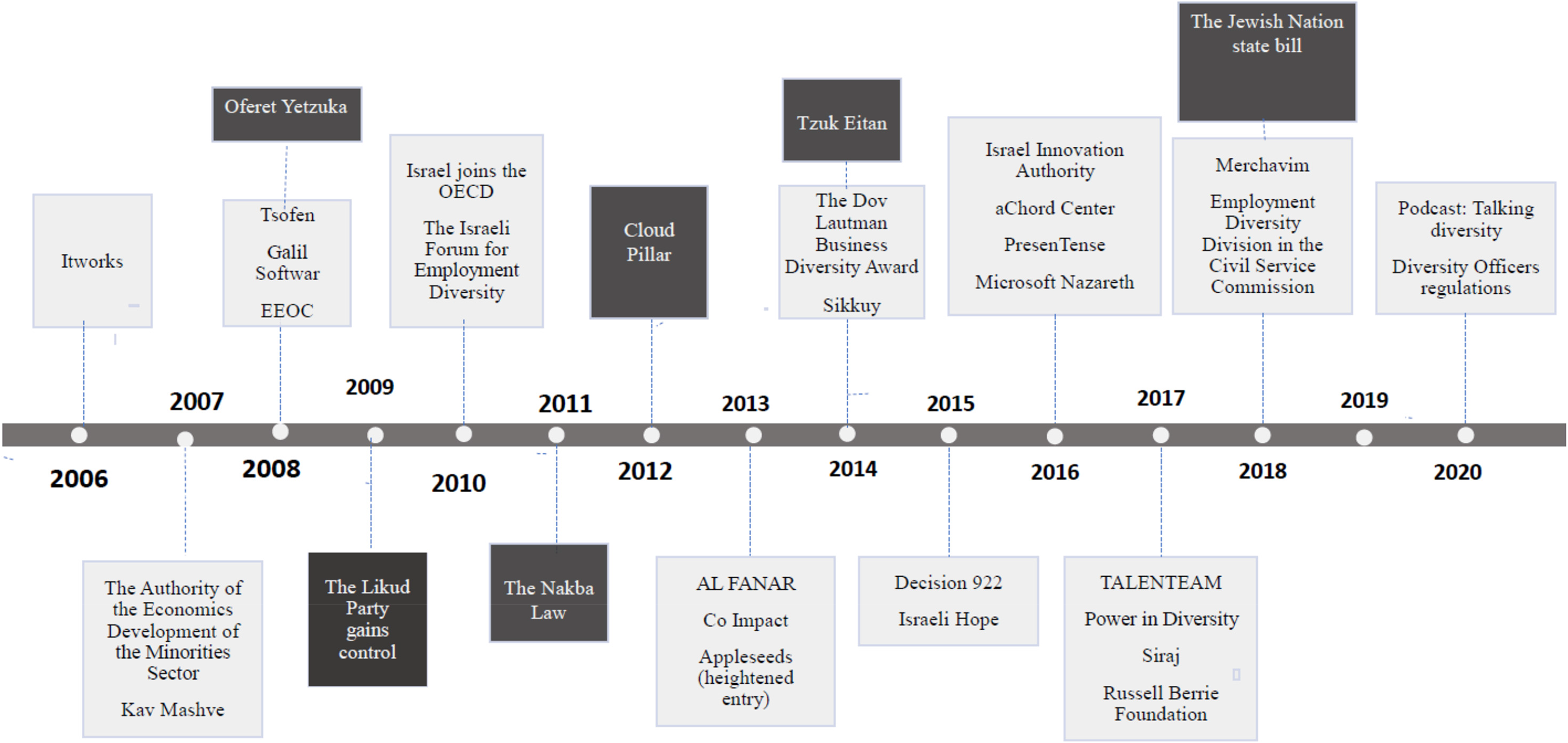
Timeline: The Diversity and Inclusion Field Development and Major Sociopolitical Events
Actors in the Israeli Diversity Field: Their Goals and Practices—December 2018 Through June 2020
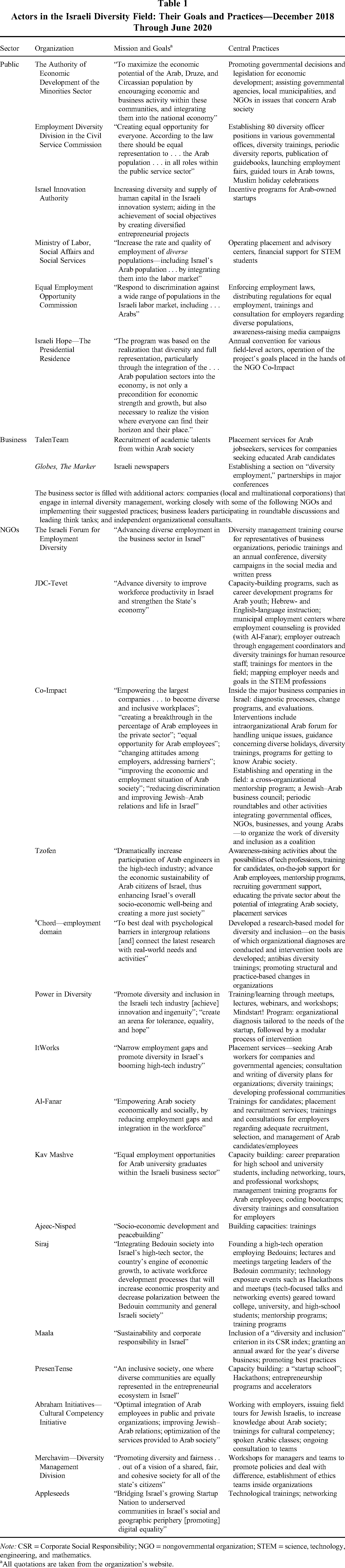
Note: CSR = Corporate Social Responsibility; NGO = nongovernmental organization; STEM = science, technology, engineering, and mathematics.
aAll quotations are taken from the organization's website.
Research Approach and Methods
Our research is based on a 19-month field-level ethnography conducted between 2018 and 2020. The ethnography was also the starting point for identifying relevant materials, such as media sources (traditional and social), research reports, and training materials, which were important to our research objectives and on which we conducted multiple sets of analysis.
Capturing the Field
We build on the definition of the field as an ongoing interaction among heterogeneous actors, across multiple platforms, around a common issue (Hoffman, 1999; Wooten & Hoffman, 2008; Zilber, 2014). Accordingly, we view the diversity field as a social arena in which conversations about “diversity,” “Arab employment,” “Arab integration,” or “Arab representation” (in predominantly Jewish workplaces) take place. We identify field-level actors to be (1) organizations or individuals who communicated with one another via conferences, trainings, and other forums, as well as through interorganizational collaborations or the media, and (2) actors who tried to influence the meanings given to the concept of “diversity” in the local Israeli context or the practices or policies implemented therein.
As our research progressed and our acquaintance with the field increased, we realized that field-level actors differed in their levels of participation and connection to the field. Some organizations were involved in direct conversations with other actors, participated in learning processes or joint actions, and used the term diversity widely. We labeled these organizations central actors. Other organizations participated rarely or not at all in activities with other field-level actors, and mostly refrained from using the term diversity, instead using Arab employment or related terms. We labeled these organizations peripheral actors. The relatively small size of the field—bound by Israel's small borders and population—enabled us to capture the majority of interactions and other forms of communication that occurred within the field during the time frame of the research and to collect information about all actors involved.
The Ethnographic Approach
The ethnographic approach lends itself more readily than other methods to this kind of field-level research (Zilber, 2014) and for unraveling otherwise invisible aspects (Locke, 2011). First, ethnography is grounded in a commitment to gaining a deep understanding of routine actions and established habits through which organizing is enacted (Ybema, Yanow, Wels, & Kamsteeg, 2009). It is also about getting close to the subjective point of view of those studied (Van Maanen, 2011; Watson, 2011), making sure that researchers’ insights, albeit potentially critical, are not estranged from the experiences of organizational inhabitants (Locke, 2011). For these purposes, ethnographic work is anchored in fieldwork, involving “talking to people, watching them, and sharing tasks with them over a period of time in the varying settings or circumstances that are relevant to our investigation” (Watson, 2011: 204). In our study, the close observation in and of the field allowed us to break the discourse/practice dichotomy that often characterizes the diversity literature (e.g., Janssens & Steyaert, 2019) and pay simultaneous attention to discourses, practices, and structures involved in the promotion of diversity. It also allowed us to unravel the perpetuation of aspects of political inequality that are often taken for granted and therefore transparent to people in the field.
Second, field ethnography allowed us to capture other contexts that are reflected within or take part in the field (Mauksch, Dey, Rowe, & Teasdale, 2017; Ybema et al., 2009). Serving as a “big tent” for various research methods (observations, interviews, collection of documents, etc.), ethnography allowed us to observe discursive elements (e.g., language use, narratives, material symbols) in their context (e.g., interactants in the context of a conference or inside a particular organization), thus detecting the societal, historical, and political influences that are embedded in or challenged at field, organizational, and individual levels (Zilber, 2016). Furthermore, as the field consists of organizations and individuals, it serves as a site through which these elements are also visible for data collection.
Third, the ethnographic endeavor is a process of discovery that helps us gain insights into “unappreciated and misappreciated processes that are important to how work is accomplished” (Locke, 2011: 613). Thus, it is particularly suitable for exploring invisible aspects of inequality and for developing knowledge on (unintended) ways in which it is perpetuated.
Data Gathering
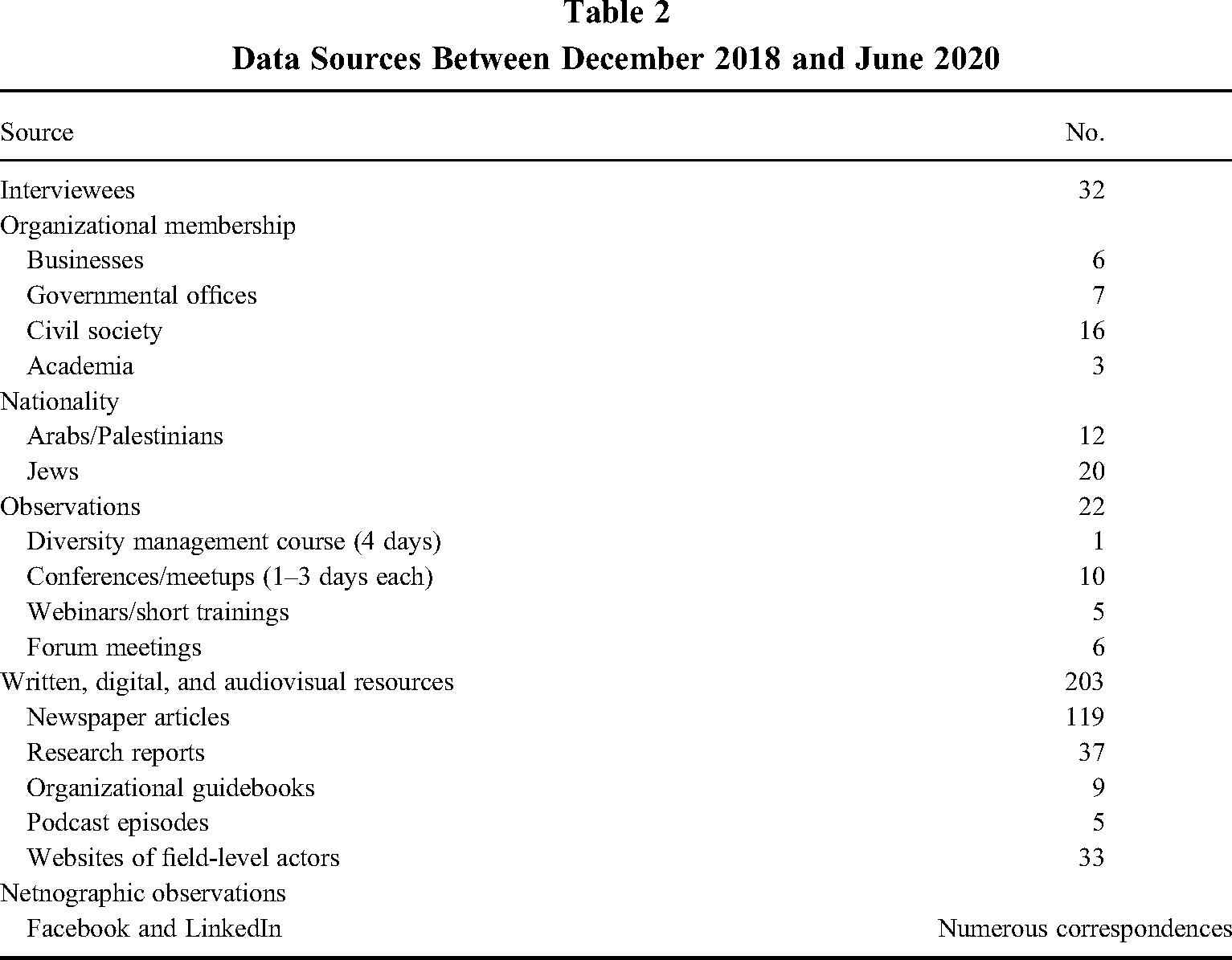
To directly observe diversity practices and perceptions, the actions that promote them, and the conversations that surround them among interested constituents (Wooten & Hoffman, 2008), we utilized a variety of research methods: observations of field-level activities bringing together different actors (e.g., trainings, conferences), interviews with diverse field-level actors, collection of written materials (e.g., newspaper articles, research reports) as well as digital and audiovisual materials (e.g., podcasts, organizational websites), and “netnographic” observations (Kozinets, 2015: 67) conducted in online Facebook communities (Table 2).
Data Sources Between December 2018 and June 2020
Observations of activities
During the time frame of the research, the first author attended every event that included more than one field-level actor that she heard about and had access to. Beginning her field research at a 4-day diversity management training, in which members from a variety of field-level organizations participated, she gathered information and built relationships that allowed her access to a variety of other events, both closed and open to the public. Information about meetings was also obtained through Facebook via the mailing lists of some of the organizations. Observing the various events, the first author recorded formal activities (lectures, conversations) and took notes about the actors, the physical dimensions of social interaction, and spatial arrangements.
Interviews
Interviews were semistructured and lasted 75 minutes on average. They explored interviewees’ understanding of the concepts of diversity and inclusion; their role inside the organization where they worked; the practices that their organizations engaged with and their assumptions and beliefs; their understanding of the diversity field in Israel, from its history, actors, and interactions to its activities, achievements, and setbacks; the connection between the political circumstances in Israel and diversity efforts; and their visions for the future of their organizations and the field.
We made sure that our sample included Palestinian and Jewish interviewees, mostly from leading positions of the organization or department, so that we could learn about the different practices and views of the field. Interviewees were selected primarily according to their organizational affiliation to represent the various organizations operating in the field and the various types of actors (NGOs, governmental organizations, businesses, consultants, academia, philanthropy). We also made sure to interview central actors in the field (i.e., those who defined their actions in terms of diversity and participated in conferences that served as a meeting point for field-level actors) and peripheral actors (i.e., those who did not use the term diversity and did not participate in field-level events).
The first author interviewed representatives from all central field-level actors (mostly organizations) as well as representatives from some peripheral actors. We stopped interviewing once no new codable themes emerged (Fusch & Ness, 2015).
Written, digital, and audio materials
We collected various types of written, digital, and audiovisual materials, documenting all newspaper articles, research reports, organizational websites, presentations, and training materials that had to do with diversity, inclusion, or Arab employment and were published throughout our time in the field. A series of podcasts on the topic, produced in Israel, was also transcribed. We acquired access to these materials during observations, through informants, and by a systematic review and download of materials published on the organizational websites of all the actors in the field. For newspaper articles, we also conducted a systematic search covering the time frame of our research, in all the major newspapers in Israel and their digital sections (11 newspapers altogether), searching for articles that mentioned the words diversity, inclusion, or employment and that related to different identity categories or to the Arab population in Israel specifically.
Netnographic observations
Following Kozinets’s (2015: 67) conception of “netnography” (i.e., “observational research based in online hanging out, download, reflection and connection”), we conducted netnographic observations in the three Israeli diversity online groups on Facebook. Over the course of the research period, we were able to follow diversity digital campaigns, questions and answers, various posts, and information sharing.
Data Analysis
Data analysis proceeded in three interrelated stages.
First stage: Identifying and mapping practices
We began by systematically analyzing the practices in the field. First, we mapped the practices that each field-level organization engaged in (Table 1), building on Leslie’s (2019) three categories of diversity practices (nondiscrimination practices, resource practices, and accountability practices), and discussed our categorization choices as a team. Some of the practices that emerged from our research did not fit with Leslie's categories, as they targeted field-level engagement rather than organizational- or individual-level changes. These practices mostly established legitimacy and support for diversity initiatives (e.g., the production of public knowledge regarding diversity or the promotion of governmental support). Therefore, we decided to add a fourth category: “awareness-raising practices” (Table 3). To grasp the most central practices in the field, we identified the practice categories for each organization. We based our assessment on information presented in websites, generated through interviews, and published in reports, learning that the majority of practices and the ones most prevalent in the field were identified in the literature as effective.
Common Practices in the Diversity Field in Israel
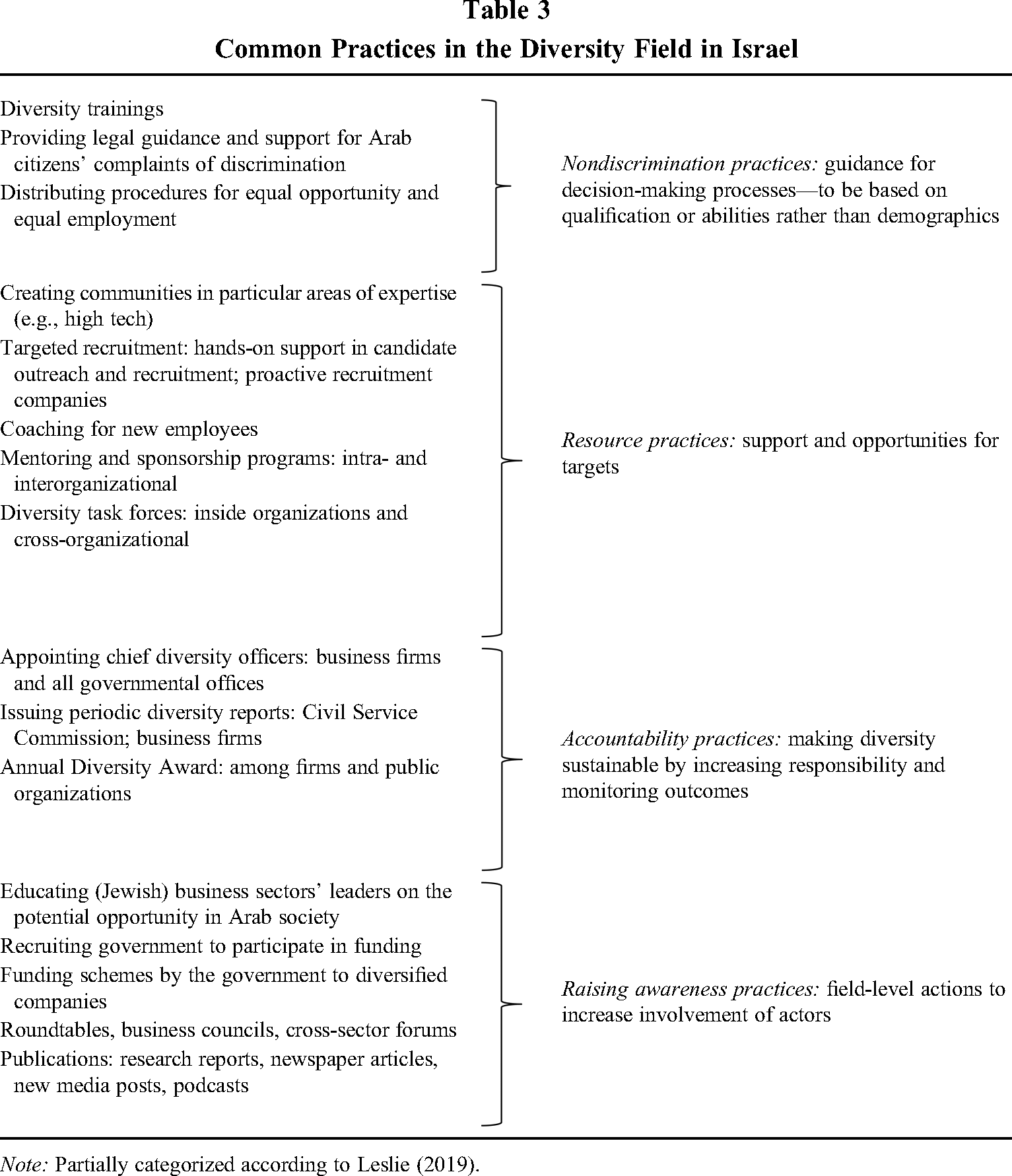
Note: Partially categorized according to Leslie (2019).
Second stage: Capturing political inequality
Wishing to explore how political inequality is implicated in diversity initiatives, we tracked if, when, and how the intractable national conflict between Palestinians and Jews and the political inequality at the state level were approached by these initiatives, be it in their promoted practices, in their organizations’ daily operation, or in field-level encounters and documents. Noting symbolic manifestations that mirrored state-level political inequality, we systematically collected, coded, and grouped explicit references to inequality in vocal and written texts, as well as their expressions during observations. From these we generated inductive categories of political inequality at the field, organizational, and individual levels. For example, we coded large posters with Zionist symbols hung on the walls of a diversity training course as “graphic symbols”; this became an indicator for the second-order category “political inequality at the field level.” In another example, we coded the celebrating of national Jewish holidays in work organizations as “organizational practices,” which became an indicator for the second-order category “political inequality at the organization level.” In yet another example, we coded the dominance of the Hebrew language as “language use,” representative of the second-order category “political inequality” in organization and field levels. We discussed coding and the specification of categories in our team. This analytic process allowed us to establish the perpetuation of state-level political inequality at the meso- and microlevels and theoretically articulate our definition of political inequality at these levels.
Our analysis in this stage helped to identify avenues for further examination of how political inequality was perpetuated. We noticed the absence of relevant players, such as the thriving Palestinian civil society organizations (Jamal, 2017). We also noticed the lack of references to the conflictual national context, as well as the frequent use of economic vocabulary.
Third stage: Uncovering the perpetuation of political inequality
In this stage we systematically analyzed each of the initial interpretive avenues that emerged in the previous stage. We examined two questions thoroughly: First, who are the actors involved in the field? Second, where are conversations taking place? To answer the first question, we made a list of all actors involved in the field, mapping their characteristics and distinguishing between central and peripheral actors. We defined central actors as those who defined their mission as directly involving diversity, remarking that all these actors interacted with other actors through field-level gatherings and collaborations in projects. We also mapped actors with interest in this field but who did not participate in it, calling them “peripheral actors.” To answer the second question of where the conversation is taking place, we turned to systematically analyzing newspaper articles published during the time frame of our research. We tagged each article according to the newspaper and specific section in which it was published. This analysis showed that central field-level actors and publication forums where diversity was discussed were related almost exclusively to the economic sphere. To construct a theoretical category that captured these findings, we found Hinings, Logue, and Zietsma’s (2017) conceptualization of field infrastructure to be most fitting.
To unpack and establish our initial observation of the disconnection between diversity initiatives and their political context, we also systematically reviewed how diversity was conceptualized and promoted. We categorized the meanings given to diversity, goals, and justifications given for diversity initiatives and the dimensions of inequality that were focused on. Beyond the analysis of explicit articulations, we analyzed the “languages of the unsayable” (Rogers et al., 1999: 77)—tracking moments of norm breaches, preoccupation with issues that hint at the forbidden, and explicit talk about that which had been denied and distanced, mostly by peripheral actors who criticized “diversity talk.” Through this phase, several themes reemerged, giving us a window into how political inequality was concealed. These included the focus on financial justifications and economic inequality, an explicit correlation between “national”/“Zionist” interests and diversity or Arab employment, the lack of reference to the nationality-based conflict, and a complete absence of the word Palestinian. We then analyzed the research reports and newspaper articles according to these themes. The defined textual scope allowed us to present quantitative figures supporting our qualitative observations. Due to the role of framing and silence (Alvesson & Karreman, 2000) in concealing the relevance of politics for diversity initiatives, we came to label these aspects “discursive disconnections.”
Findings
We organize our findings as follows. First, we reveal that most practices employed in the Israeli case were in accordance with the diversity literature's latest recommendations; as such, we elaborate on their success in economic terms. Second, we demonstrate that despite utilizing all the “right” practices, field-level efforts for generating diversity were complicit with and reproduced political inequality. Third, we show that this dynamic was enabled and concealed by the creation of a chasm between the economic and political, constituted on structural and discursive pillars of the field. To conclude, we offer a conceptual framework that visualizes our findings. To indicate the origins of the data, we label formal interview quotes as Int., document quotes as Doc., and verbatim extracts from meetings’ recordings or the field journal as Obs.
Employing All the “Right” Practices
Diversity initiatives in Israel target economic inequality by employing practices that are supported and recommended in diversity scholarship. The most common diversity practices target what Kalev and Dobbin termed “systemic changes” (2020: 3)—changes in structures and practices that are deemed sustainable, including “resource” and “accountability” practices (Leslie, 2019). We found that, together, these two types account for 79% of the practices promoted in the field.
Resource practices, offering support and opportunities for targets, make up 46% of the overall activities promoted. For example, Tsofen, an NGO aiming to promote Arab integration and participation in Israeli high tech, provides practical trainings for candidates. Having identified that the lack of community support is a central barrier for integration of young Arabs in Israeli high tech, Tsofen established a local Arab tech community to build legitimacy for participation in the field. Co-Impact, an NGO aiming to create a breakthrough in Arab employment by bringing together stakeholders from all sectors, leads interorganizational mentorship programs, which connect early-stage Arab managers with Jewish or Arab mentors, and intraorganizational mentorship programs for large organizations.
Accountability practices, aimed at sustaining the impact of diversity initiatives, constitute 33% of the field's promoted activities. For instance, Israel's Civil Service Commission established a diversity department, which then appointed a chief diversity officer for each of the government's ministries and agencies, securing the officers' status through formal state regulation. Following these steps, an annual report by each ministry is now mandatory and is based on periodic evaluations of the status of diversity in the ministry. Table 1 presents an elaboration of practices per organization, and Table 3 elaborates all the major practices in the field and their categorization.
Reports that we discovered in our fieldwork indicate that these efforts bear fruit. According to Tsofen, the Arab employment rate in Israeli high tech increased by >1,000% between 2008 and 2020: from 350 employed in the industry to 5,000. Co-Impact's 2020 annual report stated that >4,300 new Arab employees had been hired by the largest companies in Israel, which had participated in their program since its inception in 2013; 17% of these were skilled employees. Finally, Israel's Civil Service Commission, in its 2021 Annual Diversity and Representation Report, reported an increase of 2.7% in Arab representation in the civil service between 2017 and 2021.
The Perpetuation of Political Inequality as Economic Inequality Is Confronted
In a rare moment for the diversity field, during a podcast interview, university professor Eran Halperin and his podcast interviewer Fadi Elobra discussed the duality of the massive investments in diversity initiatives while political inequality persists: Halperin: One of the most racist and extreme governments in the history of the state . . . promoting the most extreme, harsh, excluding, racist laws that have ever been legislated in the state of Israel, is also one of the governments that has invested the largest amounts in promoting the Arab population in Israel's history.
Elobra: How does this happen?
Halperin: . . . Members of the majority group wish to stay dominant and to discriminate, but also to feel good about themselves. . . . They pour money on minority members while they sterilize/shatter any possibility for the development of a collective identity, of a [shared] narrative, of pride among the minority group. It is assimilation, not significant social mobility. . . . The minority group . . . must accept the status quo, which is harsh and discriminating.
Whereas Halperin discussed state-level inequality, his interpretation implies the endurance of political inequality in diversity initiatives as well. Indeed, despite the array of practice-based interventions tackling economic inequality and the success rates just cited, we find that political inequality is perpetuated within the diversity field—by organizational actors and during field-level events.
Political inequality exposed: Graphic symbols and use of language
Within the diversity field and the organizations adopting diversity initiatives, political inequality is conspicuous through the exclusive use of Jewish-nationalist (Zionist) symbols and the Hebrew language and the absence of symbols and lack of recognition of the Palestinian identity.
A virtual conference in August 2020 titled “Changing the Codes: Sprouting High-Tech in Arab Society” exemplified the simultaneous promotion of economic equality and the perpetuation of political inequality through the aforementioned manifestations. Organized by the Israeli financial magazine Globes and the NGO Tsofen, the conference aimed to “promote significant growth in the employment of workers from Arab society in Israeli high-tech” (Doc., conference invitation). It placed important issues on the table, such as the government's role in stimulating integration of Arabs in the high-tech sector and the role of the local and global high-tech industry in narrowing the gaps between Jewish and Arab societies. A double entendre is embedded in the conference title, “Changing the Codes.” Codes are associated with the programming profession, and at the same time they hint at a social promise to change some fundamental aspects of our understandings of reality. The second part of the title, “Sprouting High-Tech in Arab Society,” provided a straightforward albeit partial explanation, but the question remained: Which codes did the conference aim to change?
By looking at the program and the conference itself, an interpretive answer emerges. The presence of an equal number of Arab and Jewish panelists and the explicit and implicit assumption that Arabs should be included in high-status positions as executives, entrepreneurs, venture capitalists, engineers, and programmers all suggested a revolution, or at least an attempt at one, to enhance the social, professional, and economic standing of Arab employees. Moreover, the discussion that took place around the responsibility of the government and business organizations indicated a shift from the assumption that Arab citizens each had personal responsibilities for changing the current state of inequality to stressing the responsibilities of the state, business organizations, and civil society.
Alongside these fundamental changes, some “codes” persisted. The language of the conference was Hebrew—in the written invitation and in the spoken lectures or conversations. English words flickered from time to time, while Arabic was completely absent, except for the words “hello and welcome” uttered in Arabic by one Jewish speaker. The absence of Arabic became glaringly visible on a few occasions. In one instance, a Palestinian panelist who was not fluent in Hebrew spoke in English, a decision that was known to the panel's chair in advance. In another, three Palestinian entrepreneurs presented their “pitches” to two venture capitalists, one Palestinian and one Jewish; this session was held in Hebrew, even though four of five participants were Arabic speakers and in spite of the widely acknowledged disadvantage in business circles of pitching to investors in a foreign language. In both incidents, practical constraints could have made room for the utilization of Arabic, particularly in the context of this well-funded program, where simultaneous translation could have been provided. Therefore, the absence of Arabic in these cases was prominent. More broadly, by viewing language as a salient symbol of national identity (Halabi & Zak, 2004), the absence of the Arabic language from a conference that focused on “Arab society” suggests that recognition of the national identity in play was lacking.
Another societal code that remained intact throughout the conference was the erasure of Palestinian identity. Although Arab was widely used as an identity marker, coupled with the words minority, sector, community, and society, there was no mention of the word Palestinian to identify Palestinian citizens of Israel. 4 Similarly, in the conference program, small Israeli flags, which contain entirely Jewish symbols, appeared under the presenters’ names and titles. The disparity between the large representation of Arab speakers in high-status positions and the focus on Arab economic growth, on one hand, and the complete absence of Arabic language and Palestinian identity, on the other, exposed a dissonance between the desire to promote equality and the disregard for prevailing political aspects of inequality.
The features of this conference are emblematic of many of the field-level encounters that we observed (conferences, training courses and sessions, and other types of meetings centering on diversity): Palestinian identity was never mentioned or represented symbolically in these encounters; Hebrew was always the dominant language, with an Arabic word or sentence mentioned only rarely; in 40% of the encounters, Jewish-Zionist symbols were displayed; and at some point, diversity or Arab employment was linked to “national” or “Zionist” motives. As graphic symbols, language use, and recognition of identity are “implicated in representational power struggles” (Zanoni et al., 2010: 18), we understand them as reproducing state-level political inequality.
Political inequality expressed: Organizational practices and discourses
Political inequality is also unveiled through organizational practices that highlight the Zionist narrative—celebrating or acknowledging Israeli formal national days while disregarding national Palestinian concerns and memorial days. “We celebrate Independence Day every year” said a Jewish human resource manager of a large Israeli company: “Everyone enjoys themselves, including the Arab workers. . . . We also hang flags inside the building and send notifications about the celebration” (Obs.). In Israel, the celebration of independence reflects the Jewish national narrative of winning the 1948 war, also titled “War of Independence” by Jews, and “Nakba” (“catastrophe” in Arabic) by Palestinians. The Day of Independence may therefore raise negative sentiments among Palestinian members, such as grief. Nevertheless, as the quote suggests, there is often no awareness or recognition of the perpetuated inequality, as diverse organizations note Jewish-nationalist days, recognized by the state, while the absence of Palestinian parallel days is taken for granted.
Political inequality unveiled: Experiences of “passing.”
Beyond the visible manifestation of political inequality, more covert manifestations are unveiled in private interviews. Palestinian employees shared that while they felt that their religious identities as Muslims or Christians were recognized in the context of diversity initiatives, they experienced their Palestinian identity as delegitimized, echoing the lack of recognition of their collective rights and interests in government decisions and state laws. Under such circumstances, Palestinian employees in “diverse” organizations expressed the need to separate national from professional identities to maintain their positions, recounting painful experiences of rejection, alienation, loneliness, and insecurity at work. Shams, a Palestinian diversity officer in a high-tech company, shared the following: Dotcom has this Israeli pride. Israeli-Zionist. They emphasize that all the time. . . . I think that there are some who wouldn’t agree to work in a place like this [but] I think it is the majority who say, “OK. I finally found a job, a decent job. OK then. [Shams shrugs.] If this is what they [the company] believe in, so be it. I won’t make any statements and so on. . . . I’ll stay out of this.” Arab employees develop this mechanism, they learn how to talk to themselves, to say, “this, or my promotion. I finally got this chance. I’m not going to blow it.” . . . This is a schizophrenic situation. [She holds her palms up, as if surrendering.] True schizophrenia. . . . For the Arabs [closes her eyes for a moment]—they just developed this mechanism. They say to themselves, “let's make a separation now. I’m at work. I’m not in this safe space where I can really say something.” . . . I think this is the most common thing that [Arab] people do. (Int.)
Aha, it's an extremely sensitive point. [Shams covers her mouth with her fingers.] It's taboo [shrugs, purses her lips]. It's like this thing that you keep circling around but no one touches. Because it's like opening a Pandora's box. If the organization wants peace, it doesn’t want to go there. I think it has to do with . . . the political discourse in the general society.
Shams is herself a diversity officer in the high-tech firm about which she speaks. Throughout the interview she detailed with enthusiasm the various activities that she is involved in to advance diversity in her firm, including hiring and promotion practices relating to Arab employees and ones recognizing Muslims’ and Christians’ needs. Nevertheless, when it comes to Palestinian identity, it is clear that there are neither discourses nor practices to tackle its exclusion.
Shams and others’ experiences have been described as passing (Fanon, 2008), defined as the performative adoption of the hegemonic identity for the sake of legitimacy, sometimes as part of a process of internalizing and justifying inequality by the oppressed group members. The demand to pass—to engage in surface or deep acting (Hochschild, 1979) that ensures that private feelings are concealed—has been linked to depression, burnout, and emotional exhaustion (Grandey, 2003). Passing is a behavioral form that complies with and ratifies the existing, unequal, social order. The inability or refusal of some Palestinians to pass may also exclude them from predominantly Jewish work settings or hinder their promotion at work. Thus, passing perpetuates the disadvantage of Palestinian candidates and workers.
All in all, the perpetuation of political inequality at the individual, organizational, and field levels reflects and interacts with political inequality at the societal level. Zohar, the CEO of an NGO on the margins of the field,
5
was able to critically articulate what is mostly taken for granted by actors in the center of the field: For the politicians, it's kind of a package deal. They call on Arabs: Come, integrate economically, and put aside your Arab, Palestinian identity, and all the other things. Just become ordinary Israelis. What's embedded in this saying is: Come on, accept that this is a Jewish state. You are a minority. You have personal rights. You don’t have collective rights. (Int.)
See Table 4 for additional examples of the perpetuation of political inequality within diversity initiatives.
Perpetuation of Political Inequality Through Jewish-Nationalism Exclusivity and Palestinian-Nationality Erasure
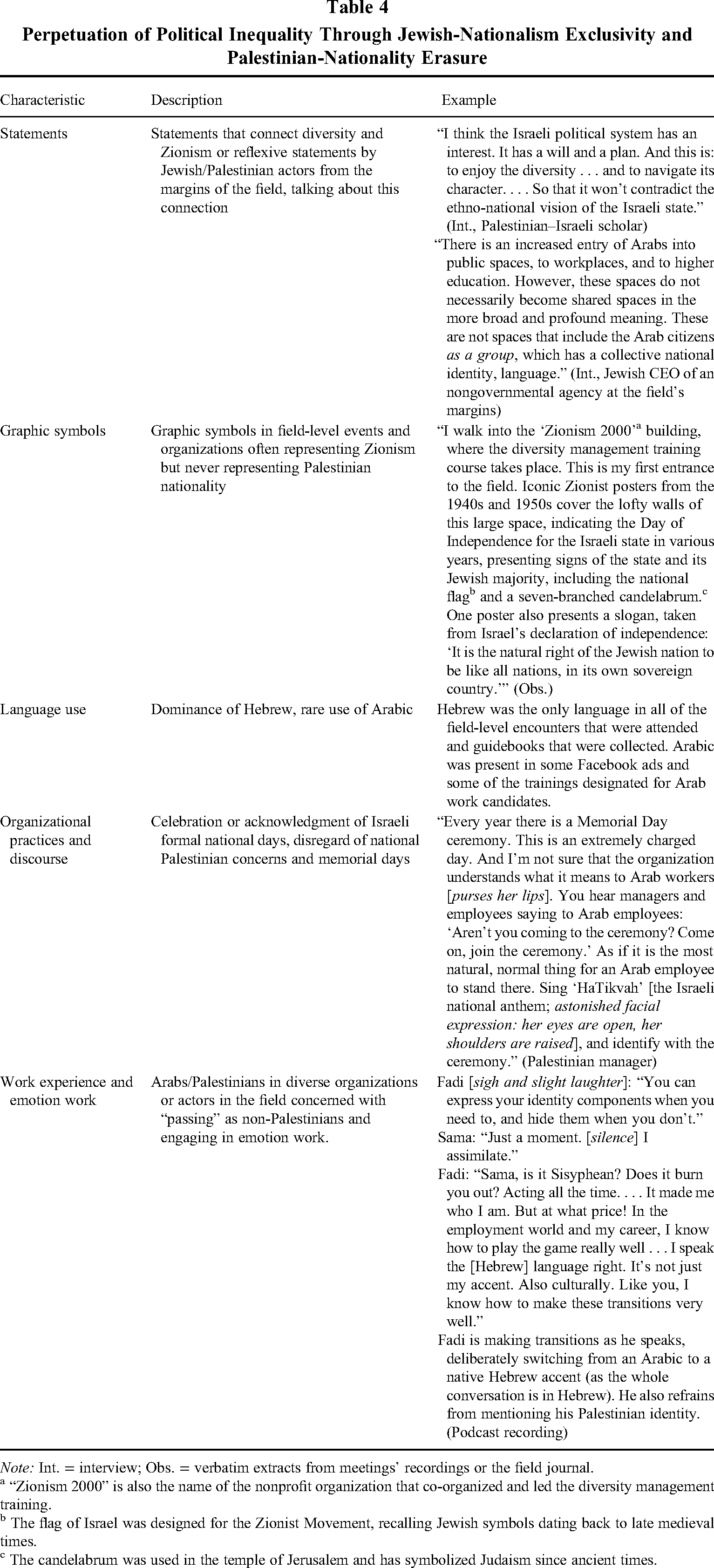
Note: Int. = interview; Obs. = verbatim extracts from meetings’ recordings or the field journal.
a “Zionism 2000” is also the name of the nonprofit organization that co-organized and led the diversity management training.
b The flag of Israel was designed for the Zionist Movement, recalling Jewish symbols dating back to late medieval times.
c The candelabrum was used in the temple of Jerusalem and has symbolized Judaism since ancient times.
The Role of the Diversity Field in Concealing Political Inequality
We found that the divide between the economic and political spheres, rendered visible through Zohar's statement, plays a role in the concealment of political inequality. Moreover, this divide creates a state of false consciousness whereby the struggle to enhance economic equality is foregrounded and the perpetuation of political inequality remains hidden. Our field-level analysis reveals that this political/economic chasm, concealing political inequality, is tied to the infrastructure and discourse of the field.
The infrastructure of the field
We identified two relevant elements of the field infrastructure, which establish the “rules of the game” that enable and constrain field-level dynamics (Hinings et al., 2017). The first is actors’ identities and the second is publication stages. Both are associated with the economic sphere, generating a taken-for-granted understanding of diversity initiatives as an economic rather than political endeavor. The actors promoting diversity initiatives in Israel are not from the Arab political parties that claim to represent Arab citizens’ interests, nor are they from the two extraparliamentary Arab leadership organizations that function as coordinating and representative bodies for Palestinian citizens of Israel.6 Both of these are in fact conspicuously absent from the field. Instead, diversity initiatives are promoted by businessmen and businesswomen; by nonprofit organizations or subunits of NGOs that are dedicated to this goal; and by governmental offices that concentrate on the economy, such as the Finance Ministry, the Employment Ministry, and the Israel Innovation Authority (Table 1). Similarly, we found that 85% of newspaper articles that refer to diversity or Arab employment are published in Israel's central economic newspapers—The Marker, Globes, and The Economist—or in economic sections of other newspapers, such as “Economy.” Moreover, half the articles about employment issues in noneconomic newspapers or sections do not refer directly to diversity or inclusion.
Discourse
The ways that people in the diversity field talk about diversity and justify it—their arguments and their words—play a fundamental role in positioning diversity initiatives within the economic realm and disconnecting them from the political context. First, diversity initiatives in Israel are established solely on economic justifications related to the Israeli economy, the business case, or economic inequality. The financial value of integrating Arabs into the predominantly Jewish work setting—be it the value of having fewer unemployed or low-income workers, the value of keeping high-income jobs (e.g., those in the high-tech industry) inside of Israel, or the business case cited globally—constitutes the dominant discursive theme in the diversity field. Serving as a justification for diversity initiatives, it is reflected in the press, research reports, diversity management training sessions, organizational workshops, and field-level encounters among actors, as well as in the interviews conducted during our research. For example, Dan, a former senior official in the Ministry of Finance, noted that in the case of Arab participation in the labor market, “You have a population that doesn’t blend into the economy sufficiently. This isn’t good for anything, not for the economy, and not for society.” Having taken a central part in the process that led to the dramatic Government Decision 922 (earmarking nearly 10 billion New Israeli Shekels for the economic development of the Arab population in Israel), Dan stressed that “there is a one-to-one correlation between equality and efficiency and growth.” This equation made it “very easy to explain” and convince politicians from the far right and left parties to support the decision. Thus, according to Dan, the key to understanding the paradox of a government that simultaneously invested in Arab society in an unprecedented scope and passed the Nation-State Bill is the economic “interest” (Int.).
Palestinian actors also bank on economic justifications, as explained by Muhammad: Let's try to show the Jews and the State of Israel that investing in Arabs is financially good! Not for the Arabs! For the Jews. Investing in them because it's good for the Arabs doesn’t interest anybody. Because Arabs don’t have political power, or power in the media. So we started searching: What's in it for the Jews? Where do we find a win-win situation? . . . The OECD advised Israel: As long as you treat the Arab citizens as a detached market, a parallel market and economy, you maintain levels of poverty and have no chance of advancing, becoming a modern economy. No chance whatsoever. The Jewish economy, as long as it preserves these islands—the Arab economic island and the Jewish ultra-Orthodox [economic] island—it cannot move forward. Compared to the OECD it will always be very very low. So there's an interest. There's a Jewish interest, an Israeli interest, and the Arab community says—We’re in. Out of self-interest. Not for the sake of reconciliation. (Int.)
Muhammad painfully recognizes the power imbalance between Jews and Palestinians in Israel. Framing the economic sphere as a middle ground where Jewish and Arab interests meet, he can see hope for his community.
Business firms also rely on economic justifications to legitimize diversity initiatives. They justify “investments” in diversity by articulating the “business case.” For example, Fadi Elobra, founder and CEO at TalenTeam, made the following statement during the HRevolution conference, which was later quoted in The Marker newspaper: “Employers must know that incorporating Arab workers in the company will grant them values of creativity and agility—values that lead the business sector in the new world.” In another example, a research report, the author leaned on academic research concerning the business case to justify diversity: “The advantage of such policies arises from studies . . . revealing that ethnically diverse teams are more creative and efficient in solving problems than homogenous teams. Thus, diversity has the potential to contribute to economic productivity” (Doc.).
Situating diversity initiatives in the economic sphere is further established as discursive connections are made among diversity, its economic benefits, and Zionism or the “national mission” (Doc.). For example, a report titled “The Economic Benefits of Social Inclusion and Arab-Jewish Equality” quoted a senior economist as saying that “the integration of the Arab population in the economy . . . is designed to realize national targets of rapid growth.” Ofir, a Jewish NGO director, reflected on these processes: The public governmental discourse that speaks of Arab employment as an economic interest is so central. The Marker [economic newspaper] has practically gone on a crusade for Arab employment. Any businessman who reads The Marker has read Meirav Arlosoroff [reporter] screaming hysterically every other day—I’m exaggerating, but barely—that if Arabs aren’t part of the job market, the economy will collapse. That's good. It affected us. It affected a lot of people. Because suddenly they say—I may hold stereotypes, but today, employing Arabs is Zionism. [He smiles.] (Int.)
Alongside financial gains, field-level actors justify diversity initiatives as a means for addressing economic inequality, mainly employment discrimination. The following example is taken from the website of a nonprofit that advances opportunities for marginalized groups to enter the entrepreneurial ecosystem. While Tel Aviv is ranked as the sixth global startup ecosystem, Israel is rated poorest among the OECD countries. This paradox is evident in Gini's financial inequality index, which places Israel in the lower third. While the “Startup Nation” thrives, these socio-economic inequalities rapidly increase . . . we level the playing field, create inclusiveness, and reduce socio-economic inequalities in Israel. (presentense.org; emphasis in original)
The discursive situatedness of diversity initiatives in the economic sphere is complemented by their disregard for and silence around the historical or contemporary conflictual context characterizing the relationships between Jews and Palestinians. Given the salience of national identity in Israel, this disconnection from the political context stood out in the majority of conferences, training sessions, guidebooks, and social media that we attended or analyzed.
At a human resource conference, two founders of a placement company for Arabs exemplified political erasure through framing, as they narrated the current unequal situation: It is frustrating to see qualified, talented Arab academics who cannot find suitable jobs, while my Jewish friends get accepted. Over sixty thousand Arab academics who graduated from fields such as high-tech, bio-med, finance, law, and business, are forced to work in occupations that do not accommodate their talents. These numbers are sad, especially when on the other side there is real competition over talents, but complete disregard of Arab society. . . . The encounter between the sides simply does not happen because Arab candidates can’t deal with the recruitment and selection processes.
There is complete disregard of Arab academics . . . this is in complete contrast to the market's demand. In the high-tech sector, for example, over fifteen thousand new workers are in demand. (Doc., The Marker, February 21, 2019)
Frustrated by the exclusion of Arabs from the Israeli quality-employment market, these two speakers frame the problem underlying this exclusion as a market failure, camouflaging the broader political context leading to this situation. Even when it seems that this carefully hidden context is about to be discussed—for example, when a lecture carries the title “The Elephant in the Room”—lecturers focus on biases and stereotypes as universal psychological phenomena, refraining from touching on the Jewish-Palestinian intergroup conflict and its particular effects on managers and employees at work.
Mainstream newspapers, as well as academic and professional research reports about Arab employment and discrimination in Israel, follow the same patterns of silence. We found that 93% of newspaper articles concerning Arab employment or diversity and 82% of all research reports completely disregarded the historical and contemporary national conflict. In these articles and research reports, inequality is always economic, mostly relating to employment discrimination. Furthermore, it is described either in a political vacuum, without explaining the reasons that led to the unequal state, or by citing reasons such as the lack of economic infrastructure, insufficient enforcement of labor laws, the need to enhance the professional capacities and qualifications of Arab candidates, and cultural barriers. The Israeli–Palestinian conflict—specifically, its effect on work-related inequality—is ostensibly nonexistent.
Another aspect that remains hidden in the diversity discourse is Palestinian identity. We found that in 100% of written materials produced by organizations, 96% of mainstream newspaper articles, 97% of research reports, and 100% of field-level interactions that we participated in, Palestinian identity was not mentioned when referring to Israeli citizens. In cases when the first author used the “P word” (Shalev, 2016: 1), she was approached by some conference attendees who wanted to verify their hunch that this usage reflected her affiliation with other organizational fields, such as the “shared society” organizational field—in other words, a stranger. Alternatively, she was asked to define the precise population that she was referring to, implying that Palestinian identity is to be used in relation to people living in the West Bank or the Gaza Strip and not to Arabs who are Israeli citizens. During her fieldwork, she rarely mentioned Palestinian identity, as she constantly felt that it would be improper and would delegitimize her and her research.
When we asked our interviewees explicitly about the relevance of the political context and their agendas to their actions and the field, those who mentioned political agendas explained why the disconnection between the economic and political was essential: It would exclude all the most powerful players. All the most powerful companies would refuse to work with us if I would present even the slightest sprinkling of politics. It would exclude all the business firms . . . because most people working with us are not on the Left. . . . Some of the people that were the biggest obstacles for what we’re trying to do—very religious, right-wing people, with very clear agendas—we managed to bypass this. Because it isn’t political. (Int., Jewish founder of an NGO)
Another interviewee revealed the threat that lies in directly tackling political inequality and the benefits of divorcing the diversity field from this context and vocabulary: If Dana [a social entrepreneur who founded an NGO in the field] would have related to the political context—the Ministry of Economy would have decided not to fund her programs. . . . It's good for us [the disconnect from the political]. Because it makes this field less of a niche. There are many people promoting diversity, and it surprises me how little they know about the Jewish–Arab context. (Int., Jewish head of an NGO in the field)
Thus, even for politically conscious actors, discursively disconnecting from the political is a matter of survival, of gaining legitimacy for battling economic inequality at the expense of perpetuating political inequality. (See Table 5 for additional examples.)
Discursive Disconnections Dividing the Economic and the Political and Concealing Political Inequalities
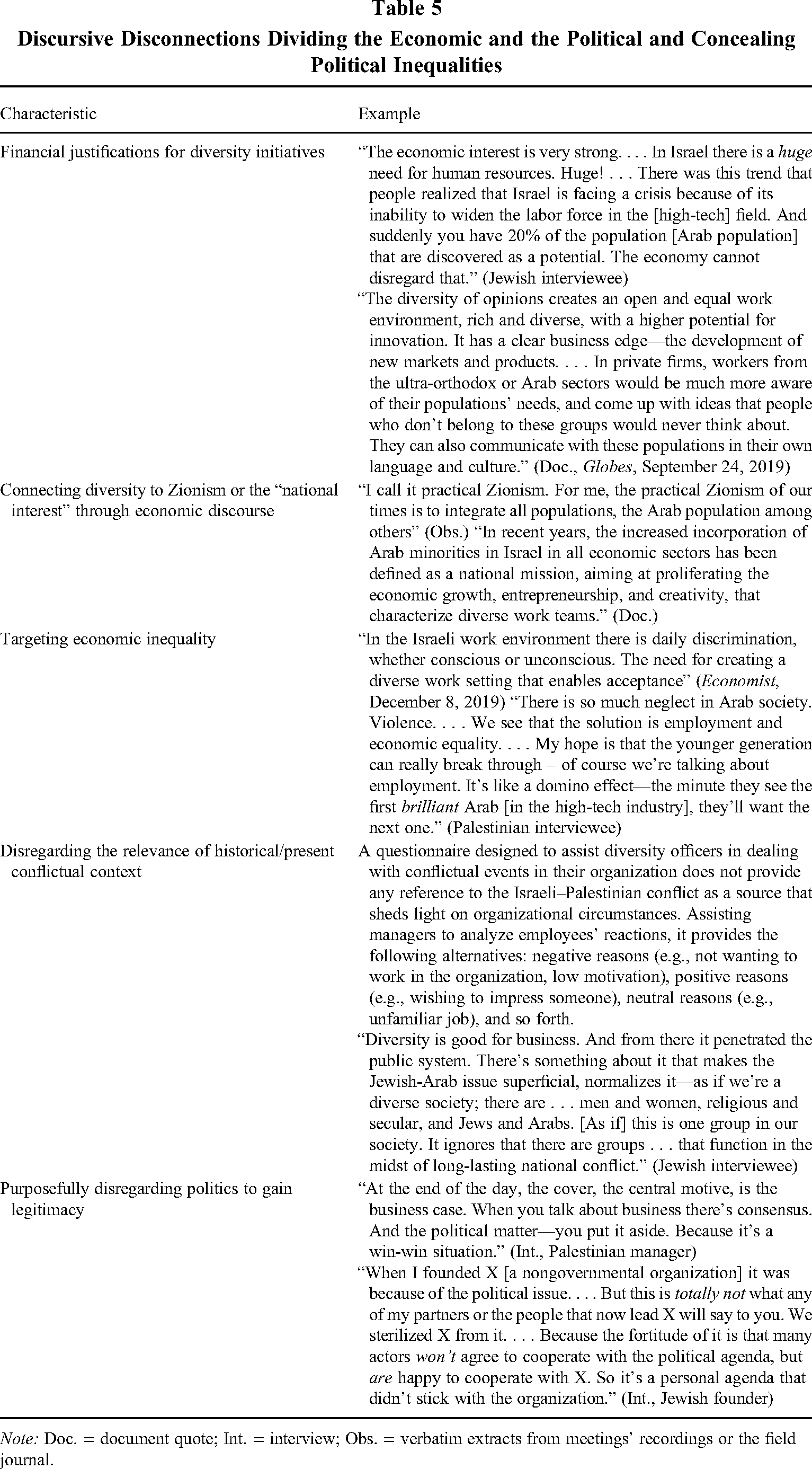
Note: Doc. = document quote; Int. = interview; Obs. = verbatim extracts from meetings’ recordings or the field journal.
All in all, the myriad oral and written texts disconnect the economic sphere from the political. They stress the economic value of diversity initiatives, frame the problem of inequality in economic terms, and maintain silence with respect to Palestinian identity and the Jewish-Palestinian conflict. This discursive pattern perpetuates political inequality by concealing it.
The Perpetuation and Concealment of Political Inequality via the Political–Economic Divide: A Process Model
The objective of our analysis was to explain how diversity initiatives may reproduce and conceal political inequality even as they battle economic inequality. In Figure 2 we offer a conceptual summary in the form of a model that captures this process.
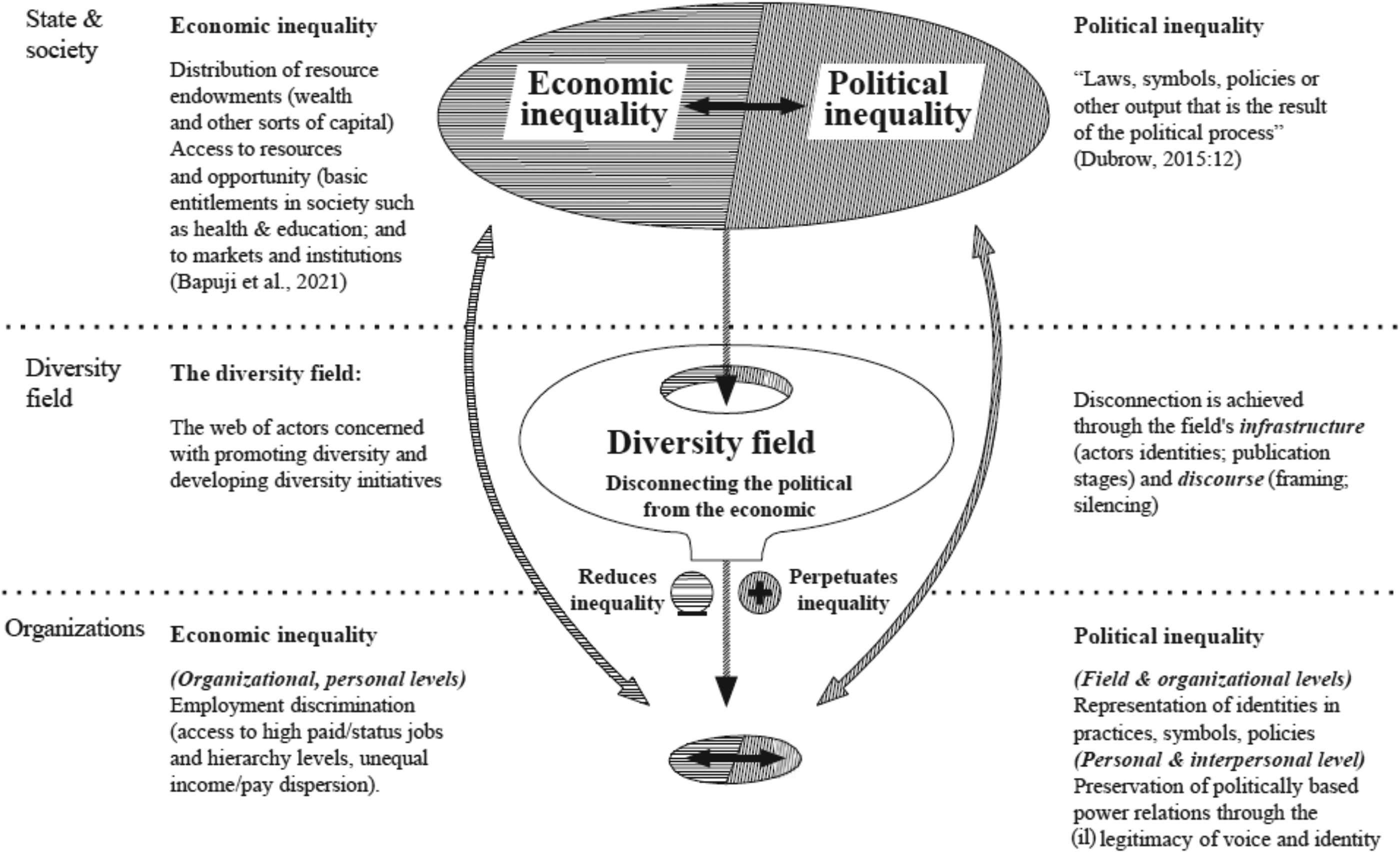
The Perpetuation and Concealment of Political Inequality
Economic and political inequalities are manifest in societal–political systems. In our context, they are reflected in the self-definition of Israel as a Jewish state, in the state's national symbols, and in laws favoring Jewish nationalism (Jamal, 2020). Economic inequality at the level of society is reflected in the severe underrepresentation of Palestinian citizens of Israel in the dominant job market, in high-skilled and high-income professions, and in managerial positions, among others (Shaldor, 2015). We separate economic and political inequality for analytic purposes, while recognizing that they are mutually constitutive (Bartels, 2016; Cole, 2018). Moreover, societal inequality influences the microcontexts within it, determining access to resources and establishing taken-for-granted understandings and norms (Amis et al., 2021; Bapuji et al., 2020).
The mesolevel in our case is constituted by the diversity field, which aims to resolve or mitigate the prevailing inequality in society by designing and implementing diversity initiatives. We find that the field's infrastructure and its dominant discourse constitute a disconnection between the economic and political spheres, locating diversity initiatives within the former while disconnecting them from the latter.
Our model also considers the consequences of these macro- and mesolevel dynamics for the organizations implementing diversity initiatives and for the individuals taking part in them. It highlights the reproduction of political inequality as an outcome of the chasm constructed between the economic and political spheres at the field level.
Discussion
Our study was motivated by the puzzling mismatch between the extensive investment in diversity in the workplace, on one hand, and the perpetuation of inequality in organizations and societies, on the other (Nkomo et al., 2019). Our empirical setting matched this exact pattern on a small scale: widespread efforts to include Palestinian citizens of Israel in the predominantly Jewish workforce, conducted against the backdrop of a continuous conflict between the two nations, and a country context in which political inequality at the state level is particularly blatant. Building on ethnographic data and observing political and economic inequalities revealed that political inequality is not only present but perpetuated in the diversity field in Israel. It also enabled us to capture how political inequality is expressed and how it is experienced by persons taking part in diversity initiatives. Most important, this study allowed us to explain what enabled the dynamic of battling economic inequality while perpetuating political inequality: We showed that the diversity field in Israel separates the economic from the political, positioning diversity initiatives aiming to include Palestinian citizens of Israel in predominantly Jewish workplaces as a solely economic endeavor. We further showed that this is achieved both passively (through structural characteristics of the field) and actively (through its discourse). Studying diversity initiatives in this extreme context helped to gather insights that are portable to other contexts (Yin, 2003) where systemic discrimination, inequalities, or conflicts at the societal level persist while diversity in the workplace is applied.
Our main contribution is revealing why and how the diversity field may reproduce and conceal political inequality—highlighting the chasm sustained by the field between the economic and political spheres. Field-level actors such as governmental agencies, NGOs, academics, and the media gain the legitimacy needed to thwart economic inequality through diversity initiatives. The established disconnect between the spheres allows participants to celebrate the mitigation of inequality writ large, even as they are in fact perpetuating fundamental (political) aspects of it. This represents what critical philosophers conceptualized as false consciousness (Lukács, 1967)—a state of systemic blindness to inequality and the sources reproducing it.
Exposing how the diversity organizational field creates and fortifies the ostensible distinction between the economic and political spheres, we specify two facets: the field's infrastructure and its discourse. The infrastructure of the field refers to the structural arrangements that construct taken-for-granted understandings even before the conversation begins. It relates to the following questions: Who is involved? Where is the conversation taking place? As we found in the Israeli case, when the central actors are exclusively those focusing on economic issues and conversations are conducted among them or in the pages of economic magazines and sections, an unspoken, taken-for-granted understanding of diversity as an economic endeavor emerges and is maintained.
The discourse of the field refers to the shared meanings conveyed through writing and talking, which “‘rule in’ certain ways of talking about a topic” and also “‘rule out,’ limit and restrict other ways of talking, of conducting ourselves in relation to the topic or constructing knowledge about it” (Hall, 2001: 72). It is therefore the “most effective,” as it is “least observable” in establishing power (Lukes, 2005: 1). Studies of diversity have extensively examined discourse—for example, following the changes in diversity discourse throughout historic periods (Nkomo & Hoobler, 2014), observing the role of discourse in the construction of identities (e.g., Zanoni et al., 2010), and studying discursive strategies used by practitioners to negotiate the meaning of diversity (e.g., Ahmed, 2007). Our study draws attention to the role of discourse in masking political inequality in those same initiatives that aim to tackle inequality. We further specify how this is achieved—by framing diversity in exclusively economic terms and eradicating the words that remind us of the fraught historical and political context.
Further Theoretical and Practical Implications
Our findings bear implications for scholars of diversity initiatives and for organizations that are looking to design successful diversity initiatives.
First, our study shows that political inequality may be perpetuated by the same diversity field that promotes systemic best practices (e.g., Kalev & Dobbin, 2020; Leslie, 2019). In the Israeli case, a focus on “best practices” by diversity practitioners generated a movement toward increased representation and inclusive treatment of religious identity categories (Muslim, Christian) and cultural ones (Arab), while ignoring the national and political identity category (Palestinian). The invisibility of the Palestinian identity of participants re-created dynamics at the sociopolitical level, thus sustaining the disadvantaged position of members who identified with this social category. Applied to other social and political contexts, our study reminds researchers and practitioners of the risk of confining diversity practices to social categories that are recognized as legitimate (e.g., cultural or ethnic identity), shying away from less comfortable categories (e.g., racism; Andersen, 1999). Similarly, our study encourages scholars and practitioners to embrace a system lens (Mair & Seelos, 2021), which looks beyond the organization as a system and considers societal aspects, including historical legacies and enduring conflicts that have led to inequality in the first place.
Second, our study is a reminder not only that “the personal is political” (Hanisch, 2006: 3) but that the organizational is political too. If we want diversity efforts to address contemporary societal challenges, we cannot afford to lose sight of political inequality. In particular, our research elaborates on indicators of political inequality in organizations: material symbols, language use, recognition of excluded identities, and personal experiences of “passing.” Specifying indicators helps scholars to assess the effectiveness of diversity initiatives in mitigating political inequality. The indicators that we highlighted also suggest that to target political inequality, oppressed social identity categories ought to be recognized as part of diversity initiatives. Future studies and theorizations may extend the indicators of political inequality and our understandings of them.
We are aware that confronting political and social inequalities through diversity initiatives means entering contested territory, which requires a degree of daring and risk. Examples from across the globe include organizations adopting paternity leave policies without the law mandating it, hoisting pride flags, participating in struggles for abortion rights, or publicly expressing support for the Black Lives Matter movement as they recognize and resist police brutality against Black Americans (see, e.g., Leigh & Melwani, 2019; McCluney et al., 2017). Once organizations acknowledge that they are part of a complex political–social reality, diversity management needs to confront the discomfort that may arise (Ferdman, 2017). This implies that diversity management trainings should help participants recognize and tackle economic aspects of inequality as well as political ones.
To conclude, our study captures only the early phases of diversity initiatives in Israel. The next decade will reveal whether the detachment between the economic and political spheres, created at the level of the field, will continue to perpetuate political inequality; whether it will also limit diversity initiatives’ ability to enhance economic equality; or whether it will serve as “scaffolding” toward a future change in political inequality terms. “Scaffolding,” a “process that enables and organizes . . . transformation,” entails mobilizing change while concealing desirable goals, to create the conditions that may lead to future change (Mair, Wolf, & Seelos, 2016: 2023). Seen in this light, diversity initiatives that detach from their historical–political embeddedness may be sacrificing political inequality in the short run to gain social legitimacy and advance economic mobility, which in a later stage advance a political change as well On the other hand, assuming that the political and the economic are mutually dependent (Bartels, 2016; Zingales, 2017), can diversity initiatives situated exclusively in the economic sphere achieve their economic goals in the long run, as political inequality persists? These questions and theories of change concern the power relations between the political and economic spheres. Only future studies will be able to provide us with answers.
Footnotes
Acknowledgments
We are grateful for the excellent editorial guidance of Jason Shaw. We also wish to thank our reviewers, as well as the conveners of the subtheme “Boundaries as the Key: Organizing for Inclusion & Exclusion” in EGOS 2021—Lotte Holck, Gazi Islam, and Stephanie Schreven—for their helpful comments and suggestions. The first author thanks the Truman Institute for the Advancement of Peace for its generous support. We also thank Tal Kaptur for her assistance with the research and Tamar Cohen for her language editing.
