



Abstract
Workers in the low-wage service sector represent a sociodemographically heterogeneous and particularly vulnerable group in terms of job security, job quality and health implications. However, organizational inclusion research has largely neglected this group. In contrast, this article builds on a qualitative study of a Dutch aircraft cleaning company in order to assess the ‘inclusivity of inclusion approaches’ for less privileged groups of employees. By reconstructing how managers and cleaners draw/rework boundaries, we identify certain configurations of inclusion and exclusion that can unfold more or less ‘inclusive’ consequences for historically disadvantaged group members, and more or less exclusionary repercussions for particularly privileged and/or majority group members. We stress the need to say goodbye to a linear narrative of organizations becoming ‘inclusive as such’. Furthermore, we argue that the presence of decent working and employment conditions and the absence of steep differences in those conditions between groups represent the ‘silent foundation’ of creating inclusivity. Consequently, we ask: does inclusion research reach its ‘natural limits’ by tiptoeing around the topic of equality?
Introduction
After more than 50 years of organizational diversity research, scholars stress that despite increasing knowledge on the (re-)production of organizational inequalities, there is little progress and even stagnation or regress in actually reducing them (e.g. Amis et al., 2020; Janssens and Zanoni, 2021; Nkomo et al., 2019). The emerging field of organizational inclusion research (Adamson et al., 2021; Oswick and Noon, 2014) addresses this conjuncture by shifting the focus from analyzing why and how inequalities persist in organizations (e.g. Acker, 2006b, 2012; Avent-Holt and Tomaskovic-Devey, 2019) to how organizations can become inclusive environments as such (Shore et al., 2018). The core idea is that it is the organization as a whole – its practices, processes, structures and norms – that needs to change in order to cater to the different interests and needs of a diverse workforce (Ferdman, 2014; Holvino et al., 2004; Nishii and Rich, 2014). Thereby – one would assume – a win–win situation for minority as well as majority employees can be created, as everyone is able to develop their full potential (e.g. Ferdman and Deane, 2014; Mor Barak, 2016; Nishii, 2013; Shore et al., 2011, 2018; compare to Dobusch et al., 2021).
Such an approach seems particularly useful for investigating questions of inclusion (and exclusion) within the service sector, which has been a fast-growing industry in the Global North (Davis, 2017). It is characterized by sociodemographically heterogeneous workforces (e.g. Andersson et al., 2019; Duffy, 2007; Van Doorn, 2017; Wright and Clibborn, 2019) who face particularly precarious working and employment conditions (Forde and Mackenzie, 2009; Jacobs and Padavic, 2015; Ravenswood and Harris, 2016; Van den Borre and Deboosere, 2018). Despite the great vulnerability of service sector workers, this group has been neglected by the large majority of organizational inclusion research, which has focused on professional occupations in knowledge-based contexts (Van Eck et al., 2021). Therefore, it is questionable whether the dominant conceptualizations and measures of inclusion (see, for example, Shore et al., 2011, 2018) are applicable to the service industries.
Against this background, we conducted a qualitative study of the inclusion and exclusion dynamics unfolding at an aircraft cleaning company (CleanCo) and their consequences for creating inclusivity 1 among the workforce of aircraft cleaners. The company has established itself as a sector-specific ‘inclusion champion’, having won several prizes for its diversity and inclusion management, and is indeed characterized by a sociodemographically heterogeneous workforce in terms of gender, ethnicity/migration background and dis-/ability. At the same time, a significant proportion of the (migrant) cleaners face temporary contracts, poor working conditions and a more or less precarious status in general, which does not permit us to describe what is going on in the company as a win–win situation for all its members.
In view of this ambivalent picture, and being aware of the fact that the public presentation of diversity and inclusion programs often does not match the needs and interests of those for whom they are officially designed (Ahmed, 2012; Dobbin and Kalev, 2016), we decided that research in the form of participant observation among the cleaners and additional semi-structured interviews with management – all conducted by the first author – would allow us to investigate the limits and opportunities of creating inclusivity in low-wage service sector work contexts of the Global North. In particular, we analyzed the everyday modes of boundary work and their processual interrelatedness existing at CleanCo.
Following the definition of Langley et al. (2019), we understand boundary work as deliberate acts by individuals or groups to influence boundaries within and around organizations; drawing or reworking boundaries means (trying) to determine which distinctions become relevant for accessing financial, social, spatial, symbolical and temporal resources (Weber, 1947/1968) in an organization. Bringing a processual boundary work lens and issues of inclusion and exclusion together is particularly fruitful, as drawing a boundary represents in its essence an act of both inclusion and exclusion (Luhmann, 1993). Furthermore, it allows us to acknowledge both the (latent) power relations shaping the boundary work and the agency of those groups involved in this kind of work (e.g. Helfen, 2015).
We contribute to organizational inclusion research with two crucial insights: first, we introduce the service sector work context with its particularly heterogeneous and vulnerable workforce as a central reference point for assessing the ‘inclusivity of inclusion approaches’. Thereby, we arrive at emphasizing the role of working and employment conditions as a ‘silent foundation’ for the creation and experience of inclusivity. Furthermore, it is not only the working/employment conditions as such, but also related intraorganizational differences – between hierarchy levels – that negatively impact the creation of inclusivity.
Second, by applying a boundary work lens, we show that inclusion and exclusion are mutually constitutive, processual and relational. This has serious consequences for assessing organizational inclusion measures in terms of their impact on creating inclusivity, as it means immediately looking for their co-constitutive exclusionary effects. As a consequence, we stress the need to say goodbye to a linear narrative of organizations eventually getting rid of exclusion and becoming ‘inclusive as such’. Rather, we argue that certain configurations of boundary drawing – relying on forms of inclusion and exclusion – can have more or less ‘inclusive’ consequences for historically disadvantaged group members and more or less exclusionary repercussions for particularly privileged and/or majority group members.
Organizational inclusion research and low-wage service sector work
Over the last decade, inclusion research has established itself as a more or less coherent field within organizational diversity studies (Adamson et al., 2021; Oswick and Noon, 2014). Instead of focusing on identifying organizational inequalities and the reasons for their persistence (e.g. Acker, 2006b, 2012; Avent-Holt and Tomaskovic-Devey, 2019), its key concern is how organizations can become inclusive environments as such (Shore et al., 2018). The notion of inclusion is framed as a win–win situation for minority as well as majority employees, as an inclusive organization – one would assume – enables everyone to develop their full potential (e.g. Ferdman and Deane, 2014; Mor Barak, 2016; Nishii, 2013; Shore et al., 2011, 2018). Meanwhile, a canonical definition of inclusion emphasizes that both the need to experience belongingness as well as the need to preserve one’s uniqueness have to be well balanced (Shore et al., 2011). In particular, based on a literature review of recent studies on organizational inclusion, Shore et al. (2018) identify six themes they deem generally relevant for creating an inclusive workplace: (1) Psychological Safety; (2) Involvement in the Work Group; (3) Feeling Respected and Valued; (4) Influence on Decision Making; (5) Authenticity; and (6) Recognizing, Honoring and Advancing Diversity.
This focus of organizational inclusion on ‘the quality of work life for employees’ (Gilbert and Ivancevich, 2000: 93, emphasis added) instead of simply counting the historically disadvantaged group members present in an organization seems particularly useful for investigating questions of inclusion (and exclusion) in the context of service sector work. This is because service industries have become an increasingly key source of jobs and productivity (measures) in the Global North (Davis, 2017). Moreover, they are characterized by the disproportionally high employment of women, ethnicized minorities and migrant workers at lower hierarchy levels (e.g. Andersson et al., 2019; Duffy, 2007; Jacobs and Padavic, 2015; Van Doorn, 2017; Wright and Clibborn, 2019). In order to reduce the costs of labor-intensive service sector work, management tries to organize the division of labor in a manner that is as standardized and routinized as possible (Forde and Mackenzie, 2009; Vidal, 2011). This leads to temporary and/or part-time contracts, few opportunities for professional development, a tightly controlled working schedule and the widespread view of service work as low-skilled and of little value in general (e.g. Acker, 2006a; Jacobs and Padavic, 2015; Ravenswood and Harris, 2016). Additionally, the majority of service work activities are physically demanding and very likely have negative effects on one’s health (Van den Borre and Deboosere, 2018).
Against this background, it is quite surprising that organizational inclusion research has more or less neglected this heterogeneous and particularly vulnerable group of workers and hitherto focused on work contexts dominated by professional occupations (Van Eck et al., 2021). Furthermore, this implies that the inclusion themes identified by Shore et al. (2018) might not fit the needs and interests of workers in the service industries and contexts with similar working conditions (Van Eck et al., 2021).
While this neglect of service sector workers indicates an insufficient inclusivity of organizational inclusion conceptualizations (see also Dobusch, 2021), some critical scholars challenge ‘the inclusion approach’ as such. They argue that organizational inclusion attempts are in fact heavily exclusionary, as being included is conditional upon fitting into dominant organizational norms (Adamson et al., 2021; Ahmed, 2012; Tyler, 2019).
For instance, both Burchiellaro (2021) and Priola et al. (2018) argue that organizational attempts to deliberately include LGBTIQ employees actually result in disguised exclusion, as such attempts depend on performing gender and/or sexuality in the ‘right way’: that is, according to neoliberal as well as homo- and heteronormative standards. Tyler and Vachhani (2021) show with the case of the fashion discounter Primark and its Pride-based clothing line that profit-oriented organizations affirmatively engage with differences that can be easily commodified and reject those that seem incompatible with creating additional value, as reflected in a discrimination case against a trans employee. Similar dynamics – although different in their consequences – seem to be at play in Philippine call centers, which provide outsourced service work for the Global North: David (2015: 188) found that the inclusion of workers identifying as trans was actually perceived as desirable; however, this was dependent on producing a certain ‘queer value’, which means radiating ‘a lightheartedness that yields comfort among workplace teams’. Moreover, in their study of Austrian companies aiming to enhance the labor market participation of refugees after the ‘long summer of migration’ in 2015, Ortlieb et al. (2021) observe that the organizational inclusion of refugees is bound to the invention of the subject position of the ‘good, glorious and grateful refugee’.
Two insights follow from these studies: first, inclusion attempts of organizations are perceived as conditional upon a presumed compatibility with a surplus ideology, meaning that differences become accepted as ‘desirable diversity’ when they are assumed to facilitate the organizations’ goal achievement (e.g. profit maximization in the case of a company). Second, organizations more or less create the to-be-included subject positions and their desired characteristics, attitudes and behavior, which they pretend to ‘only discover’ in the first place. Both aspects are crucially influenced by the predominance of capitalist modes of ‘doing economy’: ‘Capitalism does not simply register preexisting differences between workers. Rather, it produces difference in ways that allow the extraction of as much value as possible by virtue of that same difference’ (Romani et al., 2021: 15, emphasis in original).
When looking at the conditions in the service industries of the Global North, a particular configuration of difference production and connected extraction surfaces: the service sector organizations tend to be governed by an hourglass structure, where a group of well-paid, high-status professionals at higher hierarchy levels faces a(n) – oftentimes larger – group of uncredentialed, low-status, low-wage and sociodemographically heterogeneous workers in the bottom half of the organization (Craypo and Cormier, 2000). This leads to a ‘labor force being polarized between highly valued employees and generally devalued workers’ (Craypo and Cormier, 2000: 23), whose respective conditions of inclusion differ quite substantially.
Certain groups of professionals (e.g. women, LGBTIQ employees, highly skilled migrants) in higher positions may indeed be targeted by organizational inclusion attempts that try to evoke and extract those parts of their ‘uniqueness’ that appear compatible with the dominant surplus ideology (e.g. Mor Barak et al., 2016). At the same time, they are forced to remain in the position of ‘the Other’ (Litvin, 1997; Zanoni et al., 2010). In contrast, the sociodemographically heterogeneous composition of service sector workers in the bottom half of the organization is not created through deliberate inclusion attempts aiming at attracting so-called ‘diverse employees’ and their ‘unique talents’, but is owed to the voluntary self-exclusion of native workers from these types of – unwanted – jobs (e.g. Ortlieb et al., 2013; Orupabo and Nadim, 2020; Refslund and Thörnquist, 2016). The (migrant) women and men as well as members of ethnicized minority groups who take on these unwanted jobs are denied negotiation power to access other jobs within the labor market (Mackenzie and Forde, 2009). They are basically constructed as easily exchangeable – if not disposable – by the specific interlinkage of capitalist economies and migration regimes of the Global North (Romani et al., 2021; Zanoni, 2011).
As a consequence, in order to investigate the limits but also the opportunities of creating organizational inclusivity in low-wage service sector work, we can neither rely on the inclusion themes identified by Shore et al. (2018) based on professional occupations, nor seamlessly build on the research of critical inclusion scholars, who have focused their analyses mostly on inclusion strategies with an explicit diversity target group orientation and their non-/intended exclusionary effects. Thus, we suggest looking at the everyday boundary work present in low-wage service sector work in order to avoid taking the occupational boundaries between management and cleaners for granted and thereby contributing to the naturalization of a classed hierarchy (Romani et al., 2021). This also allows us to avoid stripping the service sector workers of their agency a priori, and instead to investigate empirically how they can (not) engage in which forms of boundary work and thus influence the creation of organizational inclusivity themselves.
Boundary work and its consequences for creating inclusivity
Bringing a boundary work lens and organizational inclusion research together is particularly fruitful, as in its core sense, drawing a boundary is basically an act of inclusion and exclusion: it means cutting through the ‘thicket of the social’ and differentiating one side that is made explicit (the included side) from its counterpart (the excluded side), which often remains implicit (Luhmann, 1993; see also Goodin, 1996). However, the boundary in itself is not necessarily a problem for the creation of inclusivity, as becoming ‘more inclusive’, measured by the advancement of historically disadvantaged groups, can imply drawing boundaries more strictly, for instance, when implementing preferential treatment or anti-harassment rules (Dobusch and Dobusch, 2019; Janssens and Zanoni, 2014). Rather, it is important what rationale is fueling the drawing of boundaries: is it based on a binary logic or is it a rationale that allows for multiple equal options? And is it more disjunctive or conjunctive in its consequences (Lamont and Molnár, 2002)? By adopting a boundary work lens, we can investigate exactly how boundaries are drawn or reworked, what inclusion–exclusion configurations evolve as a result and what they imply for creating inclusivity.
In the most recent integrated literature review of boundary work, Langley et al. (2019: 704) define boundary work as ‘purposeful individual and collective effort to influence the social, symbolic, material or temporal boundaries, demarcations and distinctions affecting groups, occupations and organizations’. They identify three types of boundary work: competitive, collaborative and configurational boundary work. In brief, competitive boundary work involves efforts to create or strengthen boundaries to protect resources and exclude others. Collaborative boundary work involves efforts to align boundaries to enable cooperation. And, lastly, configurational boundary work represents efforts to work from outside existing boundaries in order to rearrange the sets of boundaries.
These various modes of boundary work indicate that there are different ways of drawing boundaries or (re-)working existing boundaries, but what cannot be determined without empirical investigation is what consequences those modes of boundary work have for the actors involved. For instance, looking at a study (Johansson and Lundgren, 2014) on competitive boundary work in a Swedish supermarket, it shows a strict segregation of work(ers), where women were excluded from job rotation in the supermarket but included in the pre-store that required the enactment of service-oriented ‘femininity’. The consequence was a reproduction of stereotypical gender roles as well as little prospect for the women pre-store workers to advance to other work tasks. Thus, the strict boundary drawing resulted in a consolidation of binarily gendered access to financial (salary, career opportunities), social (networks and behavioral scope), spatial (front- vs. back-office jobs), symbolical (de-/valuation of service work) and temporal (working full-time vs. part-time) resources; in short: a certain inclusion–exclusion configuration that mainly hindered the experience of inclusivity on many levels by the women supermarket workers.
Against this background, we argue that a boundary work lens is promising for the study of the limits to and opportunities for creating inclusivity in the service sector work context, as it gives priority to the ongoing daily activities of individuals and groups by which they try to influence the way work is divided, allocated and rewarded. This is particularly important in a low-wage labor context, where organizational boundaries are often temporary owing to increasing forms of precarization (Alberti et al., 2018), and extended beyond national borders by outsourcing or subcontracting labor to migrant workers owing to their ‘good work ethic’ (Dawson et al., 2018; Grimshaw et al., 2019).
With all this in mind, we investigate the case of an aircraft cleaning company (CleanCo), where both its management (the managing directors, duty managers and supervisors) and cleaners (permanent and temporary cleaners, forewo/men), draw and rework boundaries when it comes to dividing, allocating and rewarding (everyday) work. In particular, we ask two research questions: what inclusionary and exclusionary effects are connected to the boundary work performed by managers and cleaners? And subsequently: how are these modes of boundary work interrelated, and what consequences result from them for the creation of inclusivity? Before we engage with these questions, we will describe the case study in more depth and outline our data collection and data analysis.
Methodology
Research site
Our analysis draws on a qualitative study of one of the largest cleaning companies in the Netherlands, which employs about 10,000 people in 50 branches. ‘CleanCo’ offers services in different functional (e.g. general cleaning or specialist cleaning) and industry-specific (e.g. offices, transport, hospitals) areas. The company is known for its ‘diversity and inclusion management’, for which they have received several awards. For instance, CleanCo hosts initiatives such as yearly ‘integration dinners’, where migrant and Dutch minority 2 employees cook and eat each other’s meals. Also, they have several programs offering people a job within CleanCo who usually face poor prospects in the primary labor market. At the same time, most cleaners earn minimum wages, and many have temporary contracts.
The specific branch we focused on offered the service of aircraft cleaning and employed about 300 employees at the time of research. The setting of the airport means that CleanCo is competing in a field of consistent and efficient ‘throughput’ (Salter, 2008), which entails the number of passengers and aircrafts passing through per hour. In order to cover the fluctuation in demand in peak and slower times but also to keep the costs of this labor-intensive work as low as possible, CleanCo is relying increasingly on subcontractors, who take over the recruiting of temporary migrant cleaners from Eastern Europe.
Data collection
After getting access to the airport branch of CleanCo via its HR manager, the first author entered the organization in a similar way to newly employed aircraft cleaners: (1) screening by the Dutch national security service (AIVD); (2) an airport safety test; and (3) one day training at the aircraft cleaning company. After that, the first author was allowed to work as an aircraft cleaner, which she did unpaid, overtly as a researcher, and only as an ‘additional’ cleaner to the regular cleaning crews. For seven months, the first author worked at least two days a week in both the four-hour as well as the eight-hour shifts, between 7 and 1 a.m. Altogether, the data include about 250 hours of participant observations. The value of participant observations here lies in getting access to the daily work routines, as well as to ‘ethnographic small-talk’ (Driessen and Jansen, 2013) with aircraft cleaners, which allows the researcher to capture their experiences of and involvement in everyday boundary work. The fieldnotes are supplemented by semi-structured interviews with supervisors (N = 4), aircraft cleaners (N = 4) and the HR manager, recruiter and Diversity and Inclusion manager of CleanCo nationwide, as well as by internal and external documents such as newsletters, personal photographs and CleanCo’s website to further contextualize the empirical observations. All interviews were recorded and transcribed, and lasted from 1 to 2.5 hours.
Data analysis and representation
The first step in analyzing the large amount of field notes, interview transcripts and internal and external documents was inductively identifying different modes of boundary work in which actors in the aircraft cleaning company were involved. Three issues emerged as the most pressing ones targeted by the boundary work of management and/or cleaners: (1) access to the organization; (2) access to relations among cleaners; and (3) access to upward mobility. To reconstruct each of these issues, we focused on the explicit sayings and observable doings that organizational members engaged in to preserve, question or reconfigure the distribution of connected financial, social, spatial, symbolical and temporal resources for certain groups (see Weber (1947/1968) on the relevance of boundary drawing for securing resources). Through this focus on the access to resources available at CleanCo, we aimed at both conceptually anchoring and capturing the inclusionary and exclusionary effects of the identified modes of boundary work.
The second step in analyzing the data comprised looking for the interrelatedness of these modes of boundary work: do the different modes of boundary work interact with each other? Do they reinforce or perhaps weaken each other? By asking these questions we could pay attention to the co-constitutive relationship between inclusion and exclusion and the fact that the inclusionary/exclusionary effects of a specific mode of boundary work could trigger other forms of boundary work aimed at counteracting those effects (Langley et al., 2019).
In this way, we were able to reconstruct inclusion–exclusion configurations resulting from interrelated modes of boundary work, which we – in a final analytical step – investigated with respect to the types of inclusivity they produced. In order to assess the consequences of these configurations for the creation of inclusivity, we built on both critical and mainstream conceptualizations of inclusivity (e.g. Janssens and Steyaert, 2020; Shore et al., 2018; Tyler, 2019) and complemented them with ‘incidents of inclusivity’ emerging in the field data.
In order to present the findings of our data analysis, we made use of vignettes (Jarzabkowski et al., 2014) as well as interview excerpts. Vignettes are particularly helpful, as they allow the description of not only the discursive, but also the material, physical and temporal elements of the actions related to boundary work that were witnessed.
Positionality
Presenting the collected data through vignettes and interview excerpts, we discussed at length the positioning of the participant researcher in the data (re-)presentation. Thereby, we found ourselves facing the paradox of the reflexive researcher (Alvesson et al., 2008): while openness about the positionality of the researcher is crucial in (re-)presenting participatory field work, we do not want to make the researcher herself into the ‘main story’ at the expense of the empirical case at hand. Therefore, in our findings section the daily sayings and doings of the actors within the aircraft cleaning company are foregrounded, while the participant researcher is mentioned in the third person (Bell and Vachhani, 2020). Even though being an inexperienced and temporary cleaner exposed her firsthand to the boundary work among CleanCo’s workforce, she could not feel, by any means, ‘what it is like’ to work as an aircraft cleaner for a longer period of time, while barely making a living wage.
Additionally, the positionality of the participant researcher did influence her field access in both restricting and supportive ways: being perceived as a young, Dutch-speaking, White woman, the first author’s presence often caused confusion among the aircraft cleaners and other airport workers such as bus drivers, catering service workers and security personnel. Identifying her as White, her cleaner colleagues initially expected her to be an Eastern European, temporary agency worker. Thus, when she started talking fluently in Dutch they responded with surprise or even praise that a ‘Dutch person’ is working in aircraft cleaning. On the one hand, this allowed the researcher to blend into the specific migrant/ethnicized composition of the workforce in short-term interactions. On the other hand, when recognized as a White Dutch person, she stood out as a remarkable exception. At the same time, also being perceived as a ‘young woman’ helped her to gain trust among the cleaners despite her ‘exceptional status’: they did not see her as a threat (as complicit with management) and wanted to help with her research project.
Analysis
In presenting the empirical findings as we do, we deliberately follow a processual constructivist perspective (Langley and Tsoukas, 2017). We outline the inductively identified issues – access to the organization, access to relations among cleaners and access to upward mobility – that were explicitly targeted by boundary work (see Figure 1). In particular, we describe how and why organizational members at CleanCo engage in drawing or reworking boundaries and how they simultaneously establish themselves as members of certain groups. Subsequently, we illustrate the modes of boundary work with respect to their inclusionary and exclusionary effects. This means demonstrating in what way the prevalent modes of boundary work influence the distribution of the financial, social, spatial, symbolical and/or temporal resources of different (groups of) organizational members. In the course of this analysis, we already foreshadow the fact that the various modes of boundary work are interrelated and may thus reinforce or weaken each other in their inclusionary and exclusionary effects. In a final step, we analyze the inclusion–exclusion configurations that arise from the interrelatedness of the enacted boundary work and evaluate them with respect to their consequences for creating inclusivity.
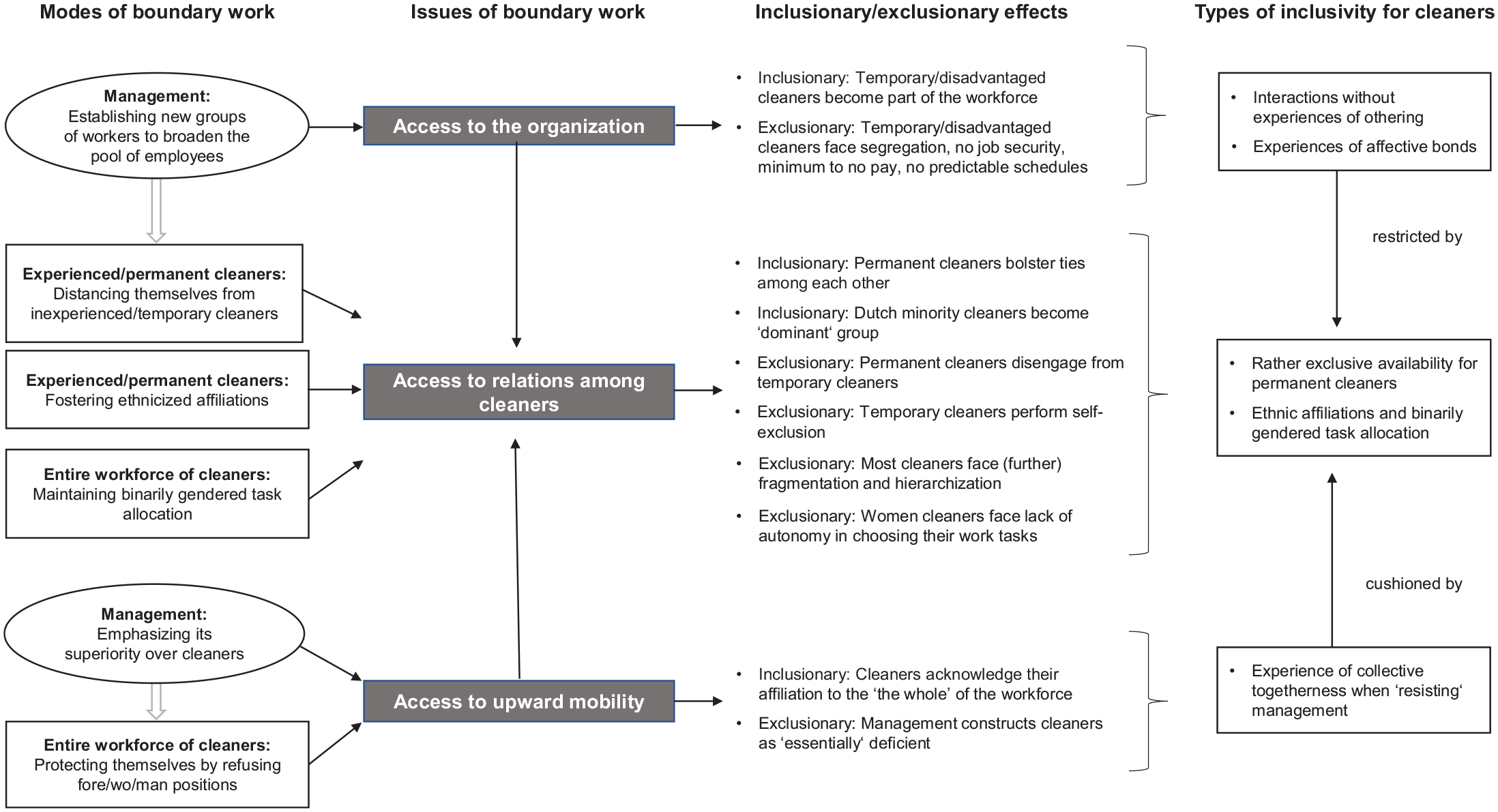
Overview of the modes of boundary work performed in CleanCo and its consequences for cleaners’ inclusivity.
Boundary work regarding access to the organization
Modes of boundary work revolving around the issue of who can enter an organization under what conditions, and who is denied access, are particularly crucial for the creation of inclusivity. In this regard, CleanCo’s management works on broadening the boundaries of who can become part of its cleaning workforce. It does so by (further) establishing new categories of workers: (1) the group of temporary workers with flexible – unpredictable – work schedules and (2) the group of disabled and/or particularly disadvantaged students who have to work for one year without payment in separate cleaning crews.
Management works on establishing new groups of workers to broaden the pool of potential employees
CleanCo has subcontracted recruitment agencies that actively search for (migrant) workers outside the Netherlands who are (still) willing to take on jobs in the cleaning industry. Thereby, it attempts to redraw – broaden – the boundaries of who is included in the workforce of cleaners. This is because ‘most local people do not choose this kind of work’ as one of the Duty Managers explains. Dutch recruitment agencies rely on Eastern European agencies to send people willing to work on a temporary basis alongside the Dutch minority cleaners with long-term contracts: Especially in the summer, we have a lot of Eastern European temporary agency workers. This is because recruitment agencies look for collaborations with Eastern European agencies. We have many people from countries such as Romania, the Czech Republic, Slovakia, Hungary, and Poland. (Chris, Duty Manager, Dutch majority background)
But aside from seasonal labor bottlenecks, the recruitment agencies also look increasingly for migrant workers outside the Netherlands who would take on jobs in the cleaning industry with its low pay, low prestige and short-term contracts.
A second way in which management tries to redraw the boundaries of who is included in the workforce of cleaners is to proactively approach groups facing a high risk of exclusion from the mainstream labor market (Hall and Wilton, 2011; Wilton and Schuer, 2006). Therefore, CleanCo has initiated a program targeting (drop-out) students who have been officially diagnosed with cognitive impairments, and/or experience difficulties with studying and therefore have poor employment prospects. This program requires that the students must work without pay for at least one year under the guidance of two experienced cleaners. The students are provided with more time to clean the airplanes compared with the regular cleaning crews, but with the consequence of working in separate groups. Thereby, they learn all aspects of the cleaning work and can adjust to the appropriate (fast) pace of collaboratively cleaning an airplane. After a year of working unpaid, the students who meet the required speed for cleaning are hired: We have now hired four or five ex-students from secondary vocational education. [. . .] They are good and loyal workers who are almost never ill. We have one young man who arrives an hour early for every shift, just because he wants to get everything ready before he starts work. Super-motivated employees! Great to see. (Carl, Branch Manager, Dutch minority background)
Inclusionary and exclusionary effects of boundary work
CleanCo’s management works on broadening the access to its workforce of cleaners by adding two particular groups of workers to its already existing staff: the group of temporary, mostly migrant workers and the group of disabled/disadvantaged students. The result is a workforce structure that is sociodemographically heterogeneous but at the same time homogeneous with respect to its lack of labor market power (see also Mackenzie and Forde, 2009). This becomes particularly manifest in the way that disabled and/or disadvantaged students are included in the company. They must work without pay for a year in order to have the opportunity – not the guarantee – to get a long-term contract at CleanCo. In contrast to organizational inclusion strategies targeting ‘diverse employees’ with professional backgrounds, who are supposed to bring in additional value based on diversity-associated skills and competences (Boogaard and Roggeband, 2010; Cox and Blake, 1991), the workforce of cleaners is hired because of the assumed absence of ‘uniqueness’: the driving incentive behind this recruitment approach is to keep the costs low through the ‘massification’ of the workers by standardizing and routinizing the cleaning work itself. However, the groups of temporary workers and disabled/disadvantaged students take on a special, segregated position within this ‘mass of workers’. They are denied the minimum standard of job security such as long-term contracts and predictable working schedules that is available for permanent staff (see also Kalleberg and Vallas, 2017).
Boundary work regarding access to relations among cleaners
Modes of boundary work do not take place in an isolated manner but are intertwined with or even stimulate other forms of boundary drawing, and thereby unfold reciprocal relationships. Owing to their interrelatedness, ‘changes on one boundary [can] reverberate elsewhere’ (Langley et al., 2019: 729). This is shown at CleanCo, where management’s boundary work to create and attract new groups of workers has stimulated boundary work among its experienced/permanent staff of cleaners, which in turn triggers specific forms of boundary work by the inexperienced/temporary workers as well.
Experienced/permanent cleaners work on distancing themselves from inexperienced/temporary cleaners
Experienced/permanent staff members tend to get frustrated when forced to clean together with too many new and only temporarily recruited cleaners. This is because they often need to work harder themselves to cover for the delay caused by the inexperienced workers: Recently, the time limit to clean an airplane with a cleaning crew of 10 cleaners has been shortened from 60 minutes to 50 minutes. ‘For me, it is possible to finish within those time limits’, cleaner Miguel, a Dutch minority cleaner, explains while cleaning another row of airplane chairs. He seems relaxed, somewhat bored even. He has been working for CleanCo for over five years. ‘After a while, you have taught yourself this fixed rhythm.’ This rhythm means, for instance: cleaning in straight lines, not in circles, and opening all the seats’ tables and cleaning them in one swipe, instead of one by one. ‘But I do understand that for new people, it is really hard [to manage the new time limits], and then you notice that when there are too many new people, the time limit becomes unfeasible. Then the people with experience need to step in. So, we have to do twice as much to meet the deadline. Some of the experienced people just refuse to do that. Like: ‘Yeah, I am not going to put money in other people’s pockets, while I have to work this hard.’ He stands up from the airplane chair and moves to the next row, continuing with his fixed rhythm.
Covering for the temporary cleaners’ slow(er) pace reduces the motivation of permanent crew members to interact or let alone bond with them. This is further reinforced by the frequent rotation of temporary cleaners, as they are the first ones to fill up vacant positions in different cleaning crews and thus hardly get the opportunity to become well known and appreciated members of a steady crew. This is shown in the experience of novice cleaner Alex, who is Romanian and is working at CleanCo for the summer period: Today, Alex is assigned a shift that involves cleaning only short flights, here the planes are smaller and assigned to a cleaning crew of a maximum of four cleaners. Rather than the usual 40 minutes that they have for bigger airplanes, they now have only eight minutes to clean the smaller airplanes. This requires extreme quickness in performing the cleaning tasks in the airplane. For Alex, it is the first time performing this type of shift, for which he has not been trained. The mandatory training day before starting in the cleaning crews only prepares the cleaners for the regular shifts. The other crew members are clearly annoyed and choose to ignore Alex. He himself remains mostly quiet. Even up to the point that the crew members jokingly ask each other: ‘Is he still alive?’ For the entire working day, they talk to each other in Dutch, which Alex does not speak, and give him few instructions, leading him to take too much time during the cleaning assignments in the airplanes and make several mistakes. At the end of their work shift, having cleaned more than 20 airplanes, they say to each other: ‘Luckily, tomorrow we will only be working with experienced cleaners.’
Mariam, a new Dutch-Surinamese cleaner hired via a temporary recruitment agency also notices the frustration of the well-experienced staff members: ‘I don’t like the way the other cleaners communicate with us . . . It is always very direct and loud.’ To avoid being shouted at, Mariam prefers to do the task of cleaning toilets: ‘Then it feels a bit like I can be my own boss when I am cleaning toilets. While in cabin cleaning, you are constantly being told: “Hurry, hurry!!!”’ The task of cleaning toilets is completed individually, while the task of cabin cleaning has to be conducted ‘in sync’ with other cleaners, whereby each cleaner is responsible for a line of airplane seats. Through opting for individual tasks – whenever possible – Mariam tries to avoid direct collaboration with the experienced cleaners, where her (slower) working pace creates constant tension with them.
However, this does not mean that the cleaning crews are only characterized by a hostile working environment. In fact, despite their low pay and permanent time pressure, the cleaners find time to discuss how to support their colleague who has recently lost his mother. But even in this moment of taking care of each other, the boundary between the permanent and temporary cleaners is – albeit benevolently – reinforced, as the following vignette shows: This crew of 10 cleaners consists of mostly long-term cleaners, working together daily between 8.30 a.m. and 4.30 p.m. This particular cleaning crew rarely has trouble with finishing the cleaning assignments within the time limit of 40 minutes. After one assignment, they even have some time left to gather at the front of the airplane and talk about the recent passing of Carl’s mother. Carl is one of their usual crew members. As they stand together, they discuss what they can do for their colleague, and come up with the idea to send him flowers. ‘Let’s not wait for [the management of] CleanCo to do something but give him something from us.’ ‘I agree, he is a really sweet boy.’ They all agree on giving three or five euros each: ‘Maybe three, it is also the middle of the month for us’ one of them mentions while they exit the airplane. During their following break in the canteen, one of the cleaners collects the money by going to all the regular crew members, one by one. He deliberately skips the two temporary workers who were assigned to this cleaning crew on that day by saying: ‘You don’t have to participate; you’ve only worked here once.’
Inclusionary and exclusionary effects of boundary work
The boundary work revolves around the distinction between experienced/permanent and inexperienced/temporary workers. Interestingly, in this type of boundary work, group membership related to gender, race or ethnic relations is not of relevance. Rather, it is the specific way that CleanCo organizes work itself – by allocating it to two different categories of workers – that influences first and foremost which forms of boundary work emerge (see also Håkansson and Isidorsson, 2012). This is shown, for instance, in the fact that the temporary cleaners receive their work schedule in the evening before their shift starts, while permanent staff know their schedule at least one week ahead. In this way, CleanCo maximizes its flexibility to react to labor bottlenecks at the expense of temporary workers’ predictability of work schedule. Furthermore, during the period of fieldwork CleanCo shortened the amount of time that is available for cleaning an individual plane without providing any (additional) training to its permanent or temporary staff.
Management’s boundary work on establishing two different categories of workers in combination with the increasing work pressure strongly impacts the boundary work taking place between these two groups: for the experienced cleaners with a long-term contract, there seems to be little incentive to engage and bond with the often-inexperienced temporary migrant workers. Not only because they work together on a temporary basis, but also because there is too much time pressure to allow them to guide the new workers in a calm and friendly manner during their work shifts. Therefore, the experienced/permanent cleaners mostly work on bolstering their ties among themselves and address the group of temporary workers only by ignoring them, or getting angry/frustrated with them. Thereby, they also protect themselves from having to take on extra workloads within increasingly shortened time limits. In return, the temporary cleaners also engage in boundary work, for instance, by self-exclusion from collaborative work and opting for individual tasks in order to avoid negatively charged interactions. As a consequence, the opportunities for bonding within the cleaning crews are primarily available for those who take part and succeed in collectively meeting the extreme time limits of aircraft cleaning; as a result, they are hardly available for temporary workers.
Experienced/permanent cleaners work on fostering ethnicized affiliations
In addition to boundary work revolving around differences in work experience and contract status/job security, the permanent staff also engages in boundary work connected to ethnicized affiliations. This type of boundary work becomes particularly manifest in the question that cleaners ask co-workers who have recently entered the workforce: ‘Where are you from?’ Although this question has been problematized as a way of othering in contexts where ethnicized and migrant workers are a minority (e.g. Boussebaa et al., 2014; Daskalaki et al., 2016; Holvino, 2003), it seems to lose this effect at CleanCo, where instead it is Dutch majority members who represent an exception. At the same time, this does not mean that ethnicized affiliations become insignificant with regard to boundary work and its respective inclusionary/exclusionary effects.
For instance, cleaner Najma, who moved from Tanzania to the Netherlands for her previous job, explains that cleaners at CleanCo connect with each other on the basis of similarities regarding their ethnicized background. This made it hard for her to establish social contacts, as she was the only one with a Tanzanian background: Every culture has their way of approaching someone. [For instance,] if they know they are both from Surinam, they know how to connect. When they know you are not Surinamese, they will not approach you the way they approach other Surinamese people. So, I just look for who will at least approach me, who I can communicate with, you know?
This bonding based on ethnicized affiliations – informally described by the cleaners as ‘playing politics’ – is not only socially relevant. Through preferential treatment related to their in-group membership (Tajfel and Turner, 1986), cleaners can also get access to ‘better jobs’ (see also Ituma and Simpson, 2009). For instance, two Eastern European cleaners complain that ‘if you have a Moroccan boyfriend in planning, then your cleaning crew will be assigned all the “good planes”.’ The Dutch-Moroccans are seen as the most powerful and probably the largest ethnic group within the workforce of cleaners, also taking up some of the managerial positions within the company, which are still dominated by Dutch majority group members. The aircraft cleaners direct the term ‘playing politics’ to the group of Dutch-Moroccans in particular (referred to as ‘mocro-politics’): ‘There are some Duty Managers of Moroccan origin who favor other Moroccans on certain tasks, shifts, that sort of stuff. That can be really annoying for others, who also just want to have work’ (Small talk with a Dutch-Surinamese aircraft cleaner).
Inclusionary and exclusionary effects of boundary work
Cleaners’ boundary work based on ethnicized affiliations manifests in talking to each other in the same shared languages, being socially more approachable and helping each other regarding work task allocation. Thereby, multiple informal in-groups emerge. However, as belongingness is connected to a distinct ethnic affiliation, some in-groups are more ‘powerful’ than others and there are also cleaners who do not get access to any in-group. Thus, this type of boundary work leads to a mixed picture of inclusionary and exclusionary effects: on the one hand, because of the omnipresence of ethnicized and migrant workers, the ideal of a White, male standard body (Simpson and Lewis, 2005; Zanoni et al., 2010) loses its function in terms of a normatively desirable and organizationally functional point of reference. Consequently, Dutch minority workers come to embody the dominant group themselves and are not forced into the position of ‘the Other’ anymore. However, their leeway for influencing their working conditions is still extremely limited. On the other hand, the workforce as a whole becomes fragmented by multiple, differently sized ethnic allegiances, leading to an informal, group-based hierarchy among the cleaners.
Cleaners work on maintaining binarily gendered task allocation
While the homogeneous ‘ethnicized Other’ becomes porous, the binary and unequal constitution of gender relations is not questioned at CleanCo. In contrast, binary gender relations are actively held in place through boundary work and result in disadvantaging women cleaners with respect to task autonomy and allocation. In the course of the training day for new cleaners, CleanCo already teaches only the women applicants the task of cleaning airplane toilets. Consequently, the fore/wo/men also assign this task only to the women in their cleaning crews, who then take turns in cleaning the eight to 10 toilets in each plane. When the participant researcher was wondering why only women engage in toilet cleaning, the forewoman explained that women cleaners take up this responsibility because men carry out the – more physically demanding – vacuum cleaning.
This is similar to what Soni-Sinha and Yates (2013) have found in their study on industrial cleaning, namely that the cleaning work assigned to women is construed as ‘light duty’ in contrast to men’s work, which is assessed as ‘heavy duty’. Building on Glenn (1992), they argue that women’s work is less valued in feminized occupations than work done by their male colleagues. Interestingly, in Soni-Sinha and Yates’ study, vacuum cleaning is considered women’s work against the background of sweeping, buffing and waxing that is perceived as men’s work. This illustrates that it is not the nature of tasks per se that determines whether and how they become gendered or not. Rather, it is the result of a complex and open-ended interplay between occupational identities, the nature of work (and its organizing) and prevalent ideals of workers’ bodies (Ashcraft, 2013).
This is also shown in the participant researcher’s encounter with the only woman she met doing vacuum cleaning during her seven months’ fieldwork. The cleaner worked at CleanCo for a year to save money to continue her studies. She preferred vacuuming to toilet cleaning and was able to convince her foreman to let her do it. Yet, another time the participant researcher saw her cleaning the toilets. She explained that she was the only woman in her cleaning crew and therefore she could not get out of this task. In contrast, men cleaners can voluntarily choose the task of toilet cleaning, which rarely happens. For instance, some opt for toilet cleaning when collaborative cabin cleaning would imply taking up additional work from slower cleaners to finish in time. Consequently, it is not the vacuum/toilet cleaning in itself that suggests a binarily gendered task allocation. Rather, it can be assumed that hierarchical gender relations are used as ‘a ready frame of meaning’ (Ridgeway and Correll, 2000: 112) to ‘tidy’ this sociodemographically heterogeneous work context with high employee turnover.
Inclusionary and exclusionary effects of boundary work
The cleaners pick up management’s categorization of cleaning toilets as a ‘women’s task’ and work on maintaining this group-based task division, although there is obviously some leeway for allocating tasks differently when on site. The occasional take-over of toilet cleaning by men cleaners is not to be read as a blurring of binarily gendered boundaries in this context. Because it is up to their individual choice whether and when they carry out the toilet cleaning, it actually emphasizes and further reproduces unequal gender relations. The result is that all women cleaners – despite their perhaps even powerful ethnicized allegiances – experience a lack of autonomy and an ‘association qua sex’ with the particularly dirty ‘dirty work’ of toilet cleaning. Thus, it seems as if the ‘patriarchal dividend’ (Connell, 2010: 162, emphasis in original) – the disproportionate benefitting of men from jointly conducted labor – is sustained even in such a women-dominated industry as cleaning (see Zulfiqar and Prasad (2022) for similar observations on the gendered task allocation of toilet cleaning in Pakistan). At the same time, as it is mostly migrant and Dutch minority men that are included in traditionally women-dominated, low-wage service sector work, this also emphasizes and further reproduces racialized and ethnicized inequalities (see also Orupabo and Nadim, 2020).
Boundary work regarding access to upward mobility
So far, we have traced how management’s boundary work of establishing new groups of workers to broaden the pool of potential employees is taken up by the cleaners themselves, and how their reaction is interrelated with other forms of group-based boundary work among them. But boundary work does not only take place with respect to access to the organization and among the cleaners themselves, but also regarding access to upward mobility. By upward mobility, we refer to the possibility of employees moving into higher paid, higher valued positions with more scope. Surprisingly, both managers and cleaners engage in boundary work that constructs these two groups as inherently different: managers emphasize their superiority as obvious and unquestionable, relying on ‘old patterns’ of ethnification of ‘the Other’ and a naturalizing of class relations. As a response, cleaners work on distancing themselves by declining the ‘in-between position’ of fore/wo/man.
Management works on emphasizing its superiority over cleaners
The status difference between managers and cleaners is manifest in unequally physical, spatial, temporal and financially compensated (conditions of) work. Managers do ‘inside work’, which they conduct in the office building during regular working hours. They have access to free coffee and nearby parking spaces. The cleaners, on the other hand, do ‘outside work’ by moving between different airplanes on the airport premises and cleaning them between 7 a.m. in the morning and 1 a.m. at night: work that ‘requires the strength of your whole body’ as a cleaner explains. Also, cleaners have to pay for their coffee, have no access to parking spaces and thus need to be able to reach the airport by public transport before 7 a.m. Managers rely on portable electronic devices in order to give the cleaners instructions on site without the need to be there in person. With the help of these devices, they unilaterally inform the fore/wo/men about the pending cleaning assignments and potentially direct them in real time, for instance, indicating when to take a break or in which order to fulfill the tasks. Basically, in this way, management keeps track of every minute of the cleaners’ work. In return, the cleaners feel permanently surveilled and controlled. Furthermore, steep differences exist in terms of payment: whereas cleaners earn minimum wage, ‘our director,’ as cleaner Asha explains in a loud voice, ‘is in the Quote 500’ (a list of the 500 wealthiest Dutch people, published yearly by the Dutch magazine Quote). The wage difference strongly impacts Asha’s feelings towards management and the unequal (classed) position of cleaners: We know that they [management] receive bonuses all the time, but who has earned that bonus? They didn’t earn it, I earned it. And what do I get? Not even an Easter egg at Easter? [. . .] Not even a coke or something at Christmas? Do we only have to give and give? (Cleaner Asha, Dutch minority background)
Although – or maybe precisely because – the differences between managers and cleaners are so obvious and ubiquitous, managers work on emphasizing their superiority over the cleaners. For instance, Duty Manager Ben with a Dutch majority background explains that for most cleaners, it is not possible to grow into a managerial position. He justifies this by pointing out the lack of proper educational training among the cleaners and that they would be unable to communicate professionally with customers: ‘In their ignorance, they could say things to people from the airlines who criticize their work like: “Who do you think you are?!”’ According to Ben, such potentially inappropriate behavior might even be provoked by flight crew members’ racist attitudes towards the cleaners with their mostly Dutch minority or migrant background. However, he is of the opinion that it is the cleaners who need to contain themselves: There are some airlines in which people really look down on cleaners because of their ethnic background. If you have a cleaner who is ready to punch [these people] on the nose . . . Well, it is still a customer, so there has to be someone who is able to say, ‘Hey guys, let’s stop this. Let’s take a deep breath, and you [the cleaner] will do your work, and you [the customer] can talk to me.’
For Duty Manager Ben, a strict boundary between managers and cleaners appears self-evident. He attributes rough manners to the cleaners, which he perceives as incompatible with professional customer service. Scully and Blake-Beard (2006) describe such a biased evaluation/construction of manners as a crucial element for upholding class differences. In addition to their ‘lack of manners’, the cleaners’ ethnicized minority and migrant backgrounds are also judged as unfitted to situations of contact with customers. The cleaners are expected to perform the ‘dirty work’ of cleaning as discreetly as possible and stay invisible to the customers whenever possible (Adib and Guerrier, 2003).
Interestingly, the task division between managers doing ‘inside work’ and cleaners undertaking ‘outside work’ has not always been this strict at CleanCo. ‘You know, it wasn’t always like this’, Duty Manager Sara with a Dutch majority background explains with a sense of nostalgia, while checking the work of a cleaning crew inside an airplane: [B]ack in the day, at times when it was really busy, we all went outside [to clean airplanes]: the planner, the branch manager, the supervisors, we just all went outside and redirected all our phones. Then you really got the feeling that we were all part of the same team. Nowadays, it is like: ‘They’ do the cleaning, and way, way, way over there is the office.’
Inclusionary and exclusionary effects of boundary work
Managers work on emphasizing and simultaneously legitimizing their superiority over the workforce of cleaners. They do so by constructing the cleaners as essentially different (Litvin, 1997; Lorbiecki and Jack, 2000; Zanoni and Janssens, 2003), based on the combination of their class status and their ethnicized/migrant background. However, the creation of two different classes of organizational members is not only rooted in historically developed power relations based on ethnification and unequal migration regimes (Van Laer and Zanoni, 2020); it is also, as the quote from Duty Manager Sara indicates, co-constituted by how the work itself is divided and allocated. While working together on the same task – the cleaning of airplanes – enabled a boundary work that emphasized the collaboration on more equal terms (‘we were all part of the same team’), the current highly separated ways of working ‘inside’ and ‘outside’ with all their connected privileges and disadvantages seem to stimulate boundary work that emphasizes the differences between managers and cleaners.
Cleaners work on protecting themselves by refusing fore/wo/man positions
In turn, the cleaners also engage in a form of boundary work that furthers the separation between those two groups. They do so by refusing to take on the position of forewoman or foreman – the only possibility for cleaners to get access to ‘upward mobility’. The position of fore/wo/man implies the responsibility of coordinating the cleaning crews during the cleaning of the airplanes, while also participating in the cleaning tasks themselves. They carry the portable device that displays the specific location they have to go to, which type of cleaning is requested, and how many minutes they have for performing the cleaning tasks. At first sight, the position of the fore/wo/man seems to blur the stark distinction between managers who coordinate and oversee the cleaning tasks and workers who exclusively execute them, since the fore/wo/men have to engage in both tasks.
However, for many cleaners, becoming the forewoman or foreman is not desirable, as first and foremost, it means being held responsible for the quality of the cleaning and whether the cleaning tasks are finished within the increasingly shorter and stricter time limits. Furthermore, the main issue is that the financial compensation for the additional responsibilities is perceived as inadequate. Cleaner Iwona, a migrant worker who occasionally takes up the position of forewoman during the high peak in summer, explains: ‘I think they should pay more for it, because they only pay €1 more. [. . .] If they [management] have a problem, or something is wrong, they complain to you. [. . .] Everything is your fault.’ Most cleaners engage in boundary work by refusing the ‘in-between position’ of a fore/wo/man and confining themselves to their cleaning job, where they do not have to take on the extra stress of coordinating responsibilities.
Inclusionary and exclusionary effects of boundary work
By actively declining the fore/wo/man position, cleaners protect themselves against increasing demands from management and at the same time engage in boundary work that explicitly demarcates them from the group of managers. However, they do so not from choice but more from a reaction to management’s striving for further exploitation. This is because management locates the position of the fore/wo/man, despite its additional responsibilities, in the low-wage and low-status context of basic cleaning work. Thus, it is not desirable for the cleaners to take on this role; instead, they prefer to clearly remain within their status group.
Interrelatedness of boundary work, resulting inclusion–exclusion configurations and their consequences for creating inclusivity
In the last stage of presenting our analysis, we want to deepen our understanding of the interrelatedness of modes of boundary work and extrapolate the specific inclusion–exclusion configurations that result from it. Reconstructing an organization’s inclusion–exclusion configurations also allows us – even if only temporarily – to evaluate which types of inclusivity are stimulated or hindered by these configurations.
With respect to the interrelatedness of the boundary work revolving around access to the organization and access to relations among cleaners, we find a strong link: it is the boundary work of CleanCo’s management on broadening access to its workforce of cleaners that heavily influences the boundary work present among the cleaners. This is because CleanCo’s management engages in configurational boundary work to ‘reshape the boundary landscape’ (Langley et al., 2019: 720) as such, by establishing new categories of workers – the temporary (migrant) cleaners as well as the disabled/disadvantaged cleaners. However, management’s explicit boundary work ends when the applicants who have molded themselves into these categories have crossed the ‘external border’ of the organization. It does not engage in further boundary work that might cushion the steep differences in working conditions between experienced/permanent staff and inexperienced/temporary workers as well as disabled/disadvantaged students.
Consequently, the cleaners respond to the ripple effects of management’s boundary work with modes of boundary work themselves. Responding to the working conditions of extreme and still increasing time pressure, little to no training for new workers and a lack of stability in the cleaning crews (constant rotation of temporary workers), the experienced/permanent cleaners work on distancing themselves from inexperienced/temporary staff in order to avoid having to take on extra work. The inexperienced/temporary workers react to this hostile working environment with self-exclusion from collaborative work contexts and thereby implicitly contribute to creating the experienced/permanent staff as a (more) cohesive group.
The resulting inclusion–exclusion configuration among the cleaners enables as well as limits the emergence of certain types of inclusivity. Through management’s attempts to broaden access to the organization, the workforce is characterized by heterogeneity related to differences in dis-/ability, gender, ethnicity and migration background. This enables the ‘practice of mixing’ (Janssens and Steyaert, 2020: 1145), where usually unfamiliar individuals come into contact with each other. With regard to the creation of organizational inclusivity, this means that the workers can interact with each other without conventional ‘othering experiences’ as the White, male standard body is de-centered. Furthermore, even affective bonds of care (Tyler, 2019) can develop among them, as shown in the example of floral greetings sent to the cleaner who is mourning his mother’s death. However, owing to the lack of time resources and time autonomy, the experienced/permanent cleaners try to limit the experience of mixing and affective bonds to their in-group. For the inexperienced/temporary cleaners, this implies not only a lack of bonding opportunities, but also of psychological safety as well as appreciation of their work performance (Shore et al., 2018).
The experience of inclusivity is further limited owing to experienced/permanent cleaners’ engagement in boundary work based on ethnicized affiliations. Cleaners with a long-term contract mostly have a Dutch minority background, which is crucial for getting access to ethnicized in-groups. In contrast, workers recruited via Eastern European employment agencies only have temporary contracts, get stuck with their migrant – provisional – status and thus are excluded from these ethnicized forms of bonding. Consequently, the affective bonds resulting from ethnicized affiliations do not represent an alternative gateway for the inexperienced/temporary workers to experience inclusivity, but further cement their disadvantaged situation.
Similarly, the boundary work on maintaining binarily gendered task allocation does not open up additional ways to experience inclusivity, but instead potentially worsens its availability for women cleaners. Here, management and (men) cleaners act in concert: management by insisting on categorizing cleaning toilets as ‘women’s work’ and thus trying to hire both women and men in equal numbers; and cleaners by fitting in with this task division, although there is some leeway for allocating tasks differently when on site. The consequence of this form of boundary work for the experience of inclusivity is, on the one hand, a form of mixing, as (migrant) women and men work together side-by-side. On the other hand, this numerical equality is not reflected in lived gender equality, nor does it trigger the inversion of existing power asymmetries (Janssens and Steyaert, 2020).
The interrelatedness of boundary work revolving around access to relations among cleaners and access to upward mobility only slightly changes the already identified inclusion–exclusion configurations and their connected experiences of inclusivity. The boundary work revolving around access to upward mobility is characterized by both managers and cleaners constructing themselves as opposing groups. The managers aim to justify their privileged positions at CleanCo by describing the cleaners as ‘essentially’ unsuitable for taking on managerial tasks qua their class and ethnicized/migrant background (Holvino, 2010; Ruiz Castro and Holvino, 2016). The consequence of this form of boundary work for the creation of inclusivity is that it mostly corroborates ‘existing power asymmetries as reflected in norms, identity fixations or privileges’ (Janssens and Steyaert, 2020: 1156). In addition, management’s usage of mobile devices for interacting with the cleaning crews on site further consolidates these power asymmetries, as it only allows a unilateral form of communication (Aneesh, 2009; Lee et al., 2015; Schildt, 2017). Thereby, cleaners are stripped of any influence on decision making – a core element of creating inclusivity (Mor Barak and Cherin, 1998; Nishii, 2013; Pelled et al., 1999) – regarding how to fulfill the respective cleaning tasks.
In turn, cleaners engage with boundary work by declining the position of fore/wo/man to protect themselves from increasing demands from management. This happens in reaction to management’s strict boundary drawing, which manifests in steep differences in the spatial, temporal, physically demanding and financially compensated conditions of work. While managers engage in boundary work to justify their privileges, cleaners do so to prevent further exploitation. However, this form of cleaners’ boundary work happens individually and does not contribute to the emergence of affective bonds – the experience of a certain type of inclusivity – among the cleaners.
At the same time, it is important to acknowledge that cleaners do experience a collective togetherness when they act ‘in resistance’ by making use of loopholes in the meticulously detailed work schedule. This happens, for instance, when the members of a cleaning crew hurry in a ‘joint initiative’ to dispose of the garbage earlier than scheduled by management in order to get a longer break, and their shared nervousness, excitement and pleasure radiates from their bodies (see also Tyler (2019) on the relevance of bodily presence for the emergence of mutual recognition). However, this togetherness is ephemeral in form and thus not capable of sustainably counteracting the fragmentation (experienced/permanent vs. inexperienced/temporary; ethnicized affiliations; gendered task allocation) and hierarchization (management vs. cleaners) induced by the dominant forms of boundary work revolving around the issues of access to the organization, the relations among the cleaners, and access to upward mobility.
With respect to the interrelatedness of boundary work revolving around access to upward mobility and access to the organization, we could not identify a direct link, as it is only those employees who have already successfully entered the organization that can be addressed by boundary work connected to upward mobility. Nevertheless, we would argue that it is management’s boundary work denying the cleaners any form of substantial upward mobility and constructing them as ‘essentially’ unsuitable for managerial tasks that makes the creation of two new, even more disadvantaged groups of cleaners in order to broaden the access to the organization a compatible and intelligible strategy.
Discussion
In this study, we examined a more or less typical case of hourglass-structured service sector organization (Craypo and Cormier, 2000). By reconstructing the modes of boundary work and their interrelatedness in our case organization, we were able to identify specific inclusion–exclusion configurations. These inclusion–exclusion configurations revealed that organizations cannot be judged as ‘either inclusive or not’. Rather, the creation of certain types of inclusivity is an ongoing, multipolar process, whereby different modes of boundary work can reinforce or weaken each other. This also means that the creation of inclusivity cannot be confined to the area of official ‘diversity and inclusion management’ (see also Ortlieb et al., 2021), but is to a large extent constituted by the present working and employment conditions, resulting from the ways in which (everyday) work is divided, allocated and rewarded.
Working and employment conditions as the ‘silent foundation’ of inclusivity
We contribute to organizational inclusion research by introducing the service sector work context with its particularly heterogeneous and vulnerable workforce as a central point of reference for assessing the ‘inclusivity of inclusion approaches’. Identifying the various types of inclusivity that were promoted or hindered through the specific inclusion–exclusion configurations present at CleanCo, we found that the inclusion conceptualizations of both mainstream and critical inclusion studies were only applicable to some extent. For instance, mixing among sociodemographically diverse group members without othering experiences (Janssens and Steyaert, 2020) and the emergence of affective bonds of care (Tyler, 2019) are types of inclusivity that were present among the cleaners. However, taking a closer look, we saw that it was first and foremost experienced/permanent cleaning staff who were able to take part in the creation of these types of inclusivity. In contrast, inexperienced/temporary cleaners were confronted with a lack of workgroup belonging, psychological safety and appreciation of their work performance – all of these issues are reflected in the inclusion themes identified by Shore et al. (2018).
We want to emphasize the fact that both critical and mainstream inclusion research is partially able to capture the experience of inclusivity in service sector work contexts. This is important in order to not only acknowledge already existing research, but also to avoid constructing service sector work and the workers who conduct it as ‘essentially’ different from other work contexts (Ghorashi and Sabelis, 2013). At the same time, critical as well as mainstream inclusion scholars seem to underestimate the role of working conditions for the creation and experience of inclusivity. This is shown, for instance, in the steadily increasing time pressure for accomplishing certain cleaning tasks and the simultaneously decreasing time autonomy owing to the usage of portable electronic devices by management. As a consequence, cleaners react by limiting their social bonding activities: experienced/permanent staff by focusing exclusively on their in-group, inexperienced/temporary staff by self-exclusion from collaborative working contexts.
However, it is not only the deterioration of the everyday working conditions under which the cleaners have to clean airplanes that negatively impacts the creation of inclusivity, but also the employment conditions more generally. This is shown, for instance, by the precarious employment status of temporary cleaners (e.g. unpredictable working schedules, constant rotation in different cleaning crews), further hindering the development of affective bonds between temporary and permanent staff. Moreover, the steep differences in employment conditions between management and cleaners also negatively affect the emergence of inclusivity. Those differences manifest in ‘small things’ such as free coffee and parking spaces for managers, while cleaners have to pay for coffee and cannot even access the parking lot; but also emerge in ‘big things’ such as the growing wage/salary gap between cleaners earning minimum wage and the management class, topped by the CEO being among the wealthiest people in the Netherlands (see also Amis et al., 2018). It is this expanding gulf, this lack of equality of employment conditions that stimulates competitive boundary work (Langley et al., 2019) in the sense that both groups engage in defensive struggles and hinder the creation of inclusivity: managers by emphasizing their ‘superiority’, cleaners by protecting themselves from additional exploitation.
These examples highlight the fact that current conceptualizations of inclusion do not adequately capture the significance of working and employment conditions as key factors for creating inclusivity in organizations. At the same time, the question arises whether they only become this significant in a context such as the service sector, where work is highly standardized, routinized, controlled, physically draining and generally precarious (Forde and Mackenzie, 2009; Jacobs and Padavic, 2015; Ravenswood and Harris, 2016). We would argue the opposite, however, and say that decent working and employment conditions represent the ‘silent foundation’ to experiences of inclusivity in high(er)-wage, high(er)-status and knowledge-based work contexts, where the majority of organizational inclusion studies has been conducted (Van Eck et al., 2021). It is silent because members of these work contexts commonly take a certain level of job security, time autonomy or physical integrity for granted and thus the relevance of working and employment conditions can easily slip through attempts to measure inclusivity. And those workers of an organization who do not take these conditions for granted, such as cleaners, couriers or warehouse workers, are either very hard to reach via conventional survey or interview methods (Berrey, 2014), or they are even outsourced (Smith and McBride, 2019) and thus ‘don’t count’ in measurements of an organization’s inclusivity.
Consequently, we want to urge organizational inclusion scholars to take the matter of class relations, which manifest in unequal working and employment conditions, into account when conceptualizing and measuring inclusivity (see also Romani et al., 2021). Moreover, we stress that it is not only the quality of working and employment conditions per se that influences the possibilities of creating and experiencing inclusivity, but also the extent of their in-/equality between occupational groups and hierarchy levels within an organization. In other words: do inclusion approaches reach their ‘natural limits’ by tiptoeing around the topic of equality? Thoroughly engaging with this question could introduce a focus on power struggles (e.g. which groups (do not) benefit from reducing intraorganizational wage differentials?) into organizational inclusion studies, thereby stepping away from their latent complicity with corporate elites.
Organizations as inclusion–exclusion configurations: Letting go of a linear inclusion narrative
The insight that the creation and experience of inclusivity can be related to the (perceived) in-/equality of working conditions between certain groups already points towards our second contribution: empirically reconstructing the constitutive relationality of inclusion and exclusion and the resulting conclusion that processes of inclusion (and exclusion) are anything but ‘all-embracing’. By inductively identifying several modes of boundary work enacted at CleanCo, we were able to reconstruct inclusion–exclusion configurations and their consequences for the creation of inclusivity.
This is because at their core, processes of inclusion are an attempt to redraw boundaries by blurring, broadening or shifting them and so on. We saw this, for instance, in CleanCo’s attempt to include disabled/disadvantaged students who were facing poor employment prospects in the primary labor market. Management worked on re-configuring its entry boundaries by establishing a new category of workers, who were allowed to work at a slower pace. However, at the same time, this was tied to the exclusionary effects of no payment for a year and taking part in special, separate cleaning crews. Similarly, the striking gender balance of the aircraft cleaning workforce – approximately half of the cleaners were categorized as men – compared with the usual feminization of the cleaning sector in the Global North (Duffy, 2007) does not seem at odds with the boundary work of allocating cleaning toilets exclusively to women workers. This is because the gender balance is the result of broadening the boundaries to include migrant and ethnic minority men, who become, given the overall precarious working and employment conditions in the service industries, the ‘somewhat less disadvantaged among the disadvantaged’ (Orupabo and Nadim, 2020: 359).
This illustrates very well that when approaching inclusion attempts as a ‘genuinely good thing’ we lose sight of the fact that ‘inclusion as a practice only makes sense against the background of something [. . .] simultaneously being “excluded”’ (Goodin, 1996: 349; see also Adamson et al., 2021; Dobusch, 2021; Tyler and Vachhani, 2021). Framing inclusion as boundary work enabled us to see not only this constitutive relationship between inclusion and exclusion, but also the processual, relational nature of boundary drawing. In turn, this makes foreseeing the inclusionary and exclusionary effects of inclusion attempts a complex endeavor, since ‘boundaries of inclusion are in a sense paradoxical because inclusion cannot be defined without its opposite (the “other”), with the result that others may well push back, potentially leading to boundary struggles or contests’ (Langley et al., 2019: 708). We saw this at CleanCo, where management’s boundary work on establishing new groups of workers to expand its pool of potential employees stimulated boundary work between experienced/permanent and inexperienced/temporary cleaners.
Three important points follow from this conceptualization of inclusion and exclusion as constitutive, processual and relational: first, in order to thoroughly assess the effectiveness of a specific inclusion measure, it is necessary to trace its immediate co-constitutive exclusionary effects, but also the more dispersed feedback it attracts.
Second, through analyzing the interrelatedness of several modes of boundary work within and at organizational borders it becomes possible to identify – although only temporarily – inclusion–exclusion configurations characteristic of an organization. This map of inclusion–exclusion relationships and how they interact can be evaluated subsequently via the types of inclusivity it promotes or hinders for certain groups. Thereby, we can do justice to both the onto-epistemological challenges of inclusion and exclusion being inextricably intertwined and the increasing search for ways to make organizational settings more inclusive (e.g. Ferdman and Deane, 2014; Mor Barak, 2016; Nishii, 2013; Shore et al., 2011, 2018).
Third, by approaching organizations as specific inclusion–exclusion configurations, we say goodbye to a linear narrative of organizations eventually getting rid of exclusion and becoming ‘inclusive as such’. Rather, we argue that certain configurations of boundary drawing – relying on forms of inclusion and exclusion – can have more or less ‘inclusive’ consequences for historically disadvantaged group members and more or less exclusionary repercussions for particularly privileged and/or majority group members.
Why do we insist on this analytical separation between forms of inclusion and exclusion on the one hand and the creation of inclusivity resulting from them on the other? We are convinced that only by acknowledging, and to some extent anticipating, the simultaneously occurring exclusionary effects of acts of inclusion, does it become possible to strip away the ‘happy inclusion story’ and reveal what inclusion attempts grounded in social justice ideals actually imply: a loss of power to those in privileged positions and the redistribution of resources.
Limitations and future research
Our study is not without limitations. While we think that our case organization is typical with respect to its hourglass structure and sociodemographically heterogeneous workforce, it is exceptional because of its official inclusion and diversity management, as well as its location at a Dutch airport. For instance, the (re)integration of unemployed and disabled people and the promotion of flexibilization of work has been a key focus point in Dutch social welfare policies (Knijn and Van Wel, 2014; Van Oorschot, 2004) and has thus influenced management’s boundary work in our case study organization. Also, the extreme time pressure shown in our data should be read against the background of increasing demands for efficient ‘throughput’ of passengers and airplanes in the context of the airport sector (Salter, 2008). Finally, the – albeit limited – agentic resources that the aircraft cleaners had in order to engage in modes of boundary work need to be explicitly situated in the context of the Global North.
For instance, in their study of low-caste cleaners in Pakistan, Zulfiqar and Prasad (2022) found that these cleaners did not have agency with regard to distancing themselves from their ‘dirty work’ and creating a positive self-image owing to an omnipresent caste system that fully collapses the self with one’s occupation. Therefore, future research could (comparatively) explore service sector work organizations in various industries and countries to find out whether and how these different (cultural) contexts induce different modes of boundary work and connected inclusion–exclusion configurations, and thus also identify the limitations to and opportunities for different types of inclusivity to emerge.
However, this does not address the second limitation that needs to be acknowledged in view of our study: our own boundary work in terms of focusing on the aircraft cleaning company as the core unit of analysis. Although we are aware of and try to be explicit about the relational entanglement of this company in capitalist economies of the Global North and their reliance on exploitable, globalized migration regimes, we remain focused on analyzing its consequences for the creation of inclusivity within the boundaries of the organization (see also Bendl et al., 2022). However, while the aircraft cleaning company is definitely a profiteer and accomplice of labor market regulations and international trade policies orchestrated by the Global North that use ethnicized Others, migrant workers and globally outsourced workers for capital accumulation (David, 2015; Romani et al., 2021), it is not to be understood as a causal force behind these institutional assemblages. Consequently, when investigating the limits and opportunities for creating inclusivity within organizations, future research could try to identify connections with those modes of (institutionalized) boundary work outside the organization that allow for ‘the unequal positioning of lives in the service of capital’ (Romani et al., 2021: 18) inside the organization.
Footnotes
Acknowledgements
We thank three anonymous reviewers and Alessia Contu and Ajnesh Prasad, the two handling Associate Editors of Human Relations, for their constructive guidance in developing this article. Earlier versions of this article have been presented at the 79th Annual Meeting of the Academy of Management, the 37th virtual EGOS Colloquium 2021 and the 13th International Process Symposium. We are grateful for the feedback we received in these contexts.
Funding
The authors received no financial support for the research, authorship and/or publication of this article.
