




Abstract
It has been nearly 10 years since the accident at Fukushima Daiichi nuclear power plant. With the cooperation of those involved, the site, which was once in a crisis situation, has improved to the point where it is possible to look ahead and proceed with work on schedule. In the off-site area, conditions for returning home have been progressed, and evacuation orders for some areas have been lifted by the Japanese Government. This article describes, in respect of the various efforts being made on site at the moment, the current status of fuel removal from the spent fuel pools, preparations for fuel debris retrieval, improvement of the working environment, and future plans. Removal of fuel from the spent fuel pool for Unit 4 was completed in December 2014, and work is continuing with Unit 3 in order to complete by March 2021. The decision was made to install a large cover in advance for Unit 1 in consideration of the risk of dust scattering, and to conduct fuel removal for Unit 2 from the south side without dismantling the existing upper section of the building. The target is for fuel removal from the pools, including Units 5 and 6, to be complete by 2031. Regarding fuel debris retrieval, progress in various investigations has made it possible to grasp the distribution of debris in the reactor containment vessels of Units 1–3 to a certain extent, and it was decided that the first retrieval will start with the most-investigated unit (Unit 2). A robot arm will be used for retrieval; initially, a trial retrieval will be started, and once the retrieval method has been verified and confirmed, the scale of retrieval will be expanded in stages using a device with the same mechanism. The working environment of Fukushima Daiichi nuclear power plant has also improved. By reducing the stirring up of radioactive materials due to facing (paving), etc., it became possible to reduce the degree of protective clothing needed, and the area in which people can work with simple clothing such as general work clothes now represents 96% of the entire site. Due to various reduction measures, the effective dose of workers is currently approximately 0.2–0.4 mSv month−1 on average per person. The work environment will continue to be improved steadily in the future. Finally, I would like to briefly mention the direction of future decommissioning efforts. The decommissioning of Fukushima Daiichi nuclear power plant and contaminated water management are being implemented based on the national Mid-and-Long-Term Roadmap. The latest edition (5th revision) sets out the milestones until 2031, and we are on target to achieve the goals set forth here and the goals set forth in the Nuclear Regulatory Commission's risk map. To that end, the Mid-and-Long-Term Decommissioning Action Plan 2020, which shows the main work processes of the decommissioning, was announced. This will enable us to proceed with decommissioning work more systematically in the future while looking ahead. Local people who sometime are concerned about risk arising from Fukushima Daiichi may grasp the future work plan concretely in relief, and can consider taking part in the decommissioning work. The key lies in how we can contribute to the reconstruction of Fukushima through the decommissioning of Fukushima Daiichi nuclear power plant, and we will continue to take responsibility for decommissioning of the power plant and contaminated water management under the principle of ‘striking a balance of reconstruction and decommissioning’.
Keywords
1. BACKGROUND TO THE ACCIDENT AND PURPOSE OF THE DECOMMISSIONING WORK
It has been nearly 10 years since the Great East Japan Earthquake on 11 March 2011. At the time, Units 1–3 were in operation in the six reactor/turbine buildings at Fukushima Daiichi nuclear power plant, and operation was safely discontinued immediately after the earthquake. However, the tsunami that struck approximately 50 min later caused the power plant to lose all power. The reactor lost its cooling function and the fuel melted. The hydrogen generated in the process caused an explosion at Units 1, 3, and 4, where the exhaust pipe was connected to Unit 3. In addition, radioactive materials diffused from the containment vessel, which was no longer airtight due to the increase in internal temperature and pressure, to the surrounding area, resulting in the evacuation of many people.
The Japanese Government declared a ‘cold shut-down status’ in December 2011, and each unit has since maintained a stable cooling state due to the decrease in decay heat of fuel debris and spent fuel. The evacuation area has been reduced gradually due to decontamination and the restoration of infrastructure by the national and local governments. In April 2019, residents began to return to the town where Fukushima Daiichi nuclear power plant is located.
The purpose of the decommissioning of Fukushima Daiichi nuclear power plant is based on the principle of ‘striking a balance between reconstruction and decommissioning’ so that the return of residents can proceed smoothly, and those who have already returned can live with peace of mind and rebuild the area. To that end, efforts are being made to reduce the risk of radioactive substances continuously in order to protect people and the environment.
2. FUEL REMOVAL FROM THE SPENT FUEL POOL
As with general nuclear power plants, fuel will be taken out first during the decommissioning of Fukushima Daiichi nuclear power plant. However, unlike ordinary reactors, the impact of the hydrogen explosion and meltdown represent a major obstacle in the preparations for removal.
Fuel will be removed from the spent fuel pool on each refuelling floor in the following order: (i) removal of rubble (excluding Unit 2 where there was no hydrogen explosion); (ii) decontamination/shielding; (iii) installation of fuel handling machine; (iv) fuel removal; and (v) storage in a shared pool, etc. on the premises.
With the exception of Unit 4 where fuel removal was completed in December 2014, the doses on all of the refuelling floors at Units 1–3 (where core meltdown happened) are high. As it is necessary to pay particular attention to the exposure of workers, most of the work is done remotely.
At Unit 1, the removal of rubble on the north side of the refuelling floor commenced in January 2018 and has already been completed. On the south side, where the spent fuel pool is located, rubble is piling up and covering the spent fuel pool, such as the fuel handling machine, overhead crane, steel frames, and slabs of collapsed roofs. Installation of a cover over the gate of the spent fuel pool, curing of the spent fuel pool, and props that support the fuel handling machine and overhead crane from below were conducted recently in order to reduce the risk as much as possible of steel frames, slabs, etc. falling into the spent fuel pool and scattering dust. In the future, a large cover will be installed, the rubble on the refuelling floor will be removed, and fuel removal will begin in approximately 2027–2028.
In Unit 2, in June 2020, the condition of fuel, etc. in the spent fuel pool was confirmed using a remotely operated underwater vehicle, and it was confirmed that there were no new issues that would hinder fuel removal. A preparation work for a platform to be installed on the south side of the reactor building is going on. And in the future, there will be an opening on the south side of the building to access the refuelling floor from this platform. Removal will start in approximately 2024–2026 (Fig. 1).
Fuel removal for Unit 3 commenced in April 2019. As of 30 January 2021, 524 of 566 fuel assemblies have been taken out, and the remaining 42 are scheduled to be taken out by March 2021.
Status of each unit.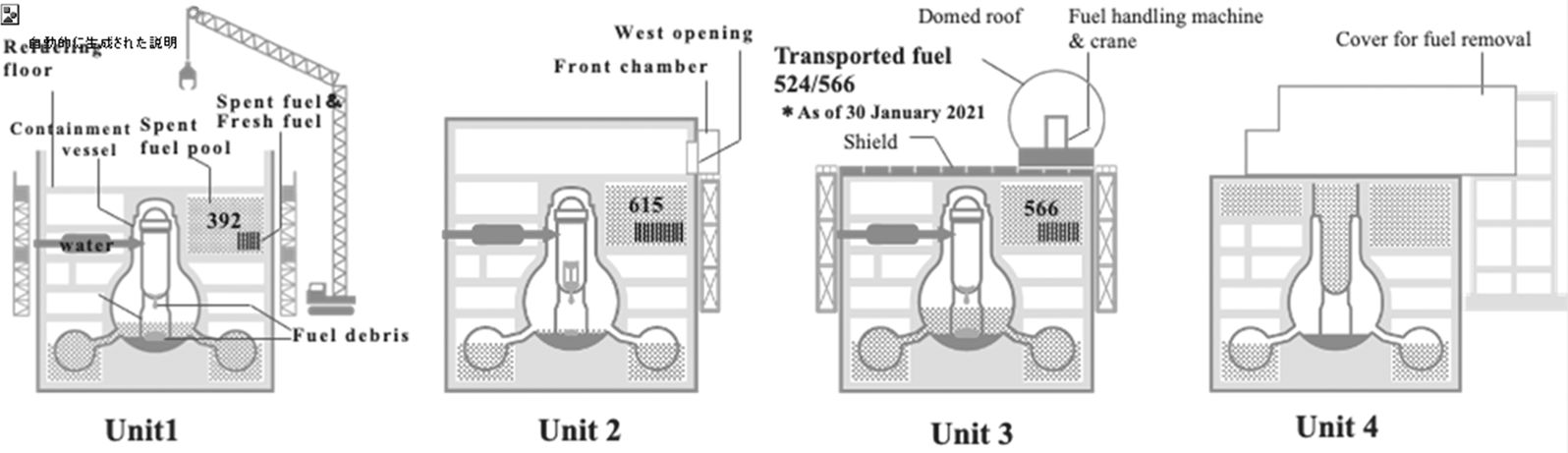
3. AIMING FOR FUEL DEBRIS RETRIEVAL
The retrieval of fuel debris at Units 1–3 will be an initiative that has never been experienced before. The retrieval work will proceed in the following order: (i) internal investigation of the reactor containment vessel; (ii) fuel debris retrieval; and (iii) storage. However, as this work needs to be undertaken in an extremely high-dose environment, most work will be carried out remotely.
In order to determine the extraction method and proceed with the development of specific extraction equipment, it is first necessary to grasp the position and properties of the fuel debris.
The distribution of fuel debris is estimated as follows from the above survey results and accident transient analysis results:
Unit 1: Most fuel debris is at the bottom of the containment vessel. Unit 2: A large amount of fuel debris remains at the bottom of the pressure vessel, and a certain amount is present at the bottom of the containment vessel. Unit 3: Somewhere in between Unit 1 and Unit 2.
As such, it was decided that retrieval will start in Unit 2. The main reasons for this decision are that the dose in Unit 2 is lower compared with the other units, more information has been obtained from internal investigations in Unit 2, and there is no interference with fuel removal work.
The equipment to be used in the upcoming trial retrieval is being developed in the UK and will be put into actual operation after testing and training at a mock-up facility. The plan is to use a robot arm with a maximum length of approximately 22 m to access the inside of the containment vessel. This robot arm is made of high-strength stainless steel so it will not bend even when stretched. Moreover, the plan is that a gold brush or a vacuum container type recovery device will be attached to the tip of the robot arm to recover grained fuel debris.
After the trial, once the retrieval method has been verified and confirmed, the scale of retrieval will be expanded in stages using devices with the same mechanism.
Tokyo Electric Power Company Holdings (TEPCO) was aiming to start fuel debris retrieval in 2021, but the development of these devices has been delayed due to the spread of coronavirus disease 2019 in the UK. We would like to continue to give top priority to safety while making efforts to keep the delay to approximately 1 year.
4. IMPROVEMENT OF WORK ENVIRONMENT
Immediately after the accident, reducing the effective dose of workers was an important issue at Fukushima Daiichi nuclear power plant. As such, in addition to dose reduction measures such as removal of high-dose rubble scattered by the explosion, removal of topsoil contaminated by fallout, logging of contaminated trees, and purification of contaminated water stored in the on-site tank, ground surface facing (mortar spraying and asphalt pavement) has been conducted.
As these efforts to improve the working environment reduced the stirring up of radioactive materials, the premises surrounding Units 1–4 were categorised as ‘highly contaminated areas’ (red zone and yellow zone) and ‘other areas’ (green zone) in March 2016 in order to optimise protective equipment. Currently, the green zone, where an individual can work wearing general work clothes and a disposable dust respirator, has been expanded to cover approximately 96% of the entire site.
In March 2011, the effective dose reached 21.55 mSv month−1 (average) as a result of the response immediately after the accident; this subsequently reduced significantly, and the latest measurement was in the range of 0.2–0.4 mSv month−1. Meanwhile, the average effective dose for the last year was 2.54 mSv month−1 (April 2019 to March 2020).
In recent years, management and measures regarding the equivalent dose to the lens of the eye have been strengthened. TEPCO has addressed the issues based on the Ionising Radiation Hazard Prevention Regulations, and also introduced a management value of ≤ 50 mSv year−1 in April 2018 without waiting for the revision of the law in 2021 in order to further improve the safety of workers (current 150 mSv year−1 will be revised to 50 mSv year−1 and 100 mSv for 5 years). Furthermore, regarding the 5-year dose management of the equivalent dose to the lens of the eye, an arrangement such as the aggregation method (system) was conducted, and an operation with an annual average of 20 mSv for 5 years was introduced in April 2019.
As a specific reduction measure on site, it has been essential to wear a full-face respirator when working in a place where beta rays are dominant and the crystalline lens is exposed. In addition to this, since April 2018, additional measurements near the eyes have been conducted if the equivalent dose to the lens of the eye exceeds 15 mSv. Not only that, when workers are working in a place where beta rays dominate, regardless of 15 mSv, a dosimeter is worn inside the full-face respirator to measure the dose near the eyes to evaluate the equivalent dose to the lens of the eye more accurately. In order to carry out these works, a jig for attaching a dosimeter near the eyes in the full-face respirator has been developed.
Regarding the equivalent dose to the lens of the eye, 64 people exceeded 20 mSv in fiscal year (FY) 2019. However, due to thorough implementation of these efforts, no workers exceeded 20 mSv in the first half of FY2020. It is expected that a similar result will be seen by the end of the year.
From April 2021, if the annual dose exceeds 12 mSv, a dosimeter will be worn near the eyes, and operations to finely control the dose to which workers are exposed will be commenced to ensure their safety.
5. THE BLUEPRINT OF AN IMPROVED WORK ENVIRONMENT
In the future, work will be pursued based on ‘further improvement of the work environment’ and ‘strengthening of radiation management targeting fuel debris retrieval’.
As a further improvement of the work environment, exchange places for personal protective equipment will be established at each area boundary to prevent the spread of contamination, while in less-contaminated areas, areas where respirators (including the DS-2 respirator) are not required will be established. Furthermore, areas will be set that do not require radiation control, such as dose control and contamination control, in a bid to enable work to be carried out more comfortably in a way that is easily understandable to the workers (Fig. 2).
On the other hand, there is concern that alpha nuclides could spread as fuel debris retrieval gathers momentum. In response to this, in addition to stricter on-site management, such as on-site monitoring and measures to control the spread of contamination at the boundary of the alpha-controlled area, lung monitors and bioassay facilities will be installed so that exposure evaluation can be possible, even if an internal intake should happen.
Improvements to the working environment. PPE, personal protective equipment.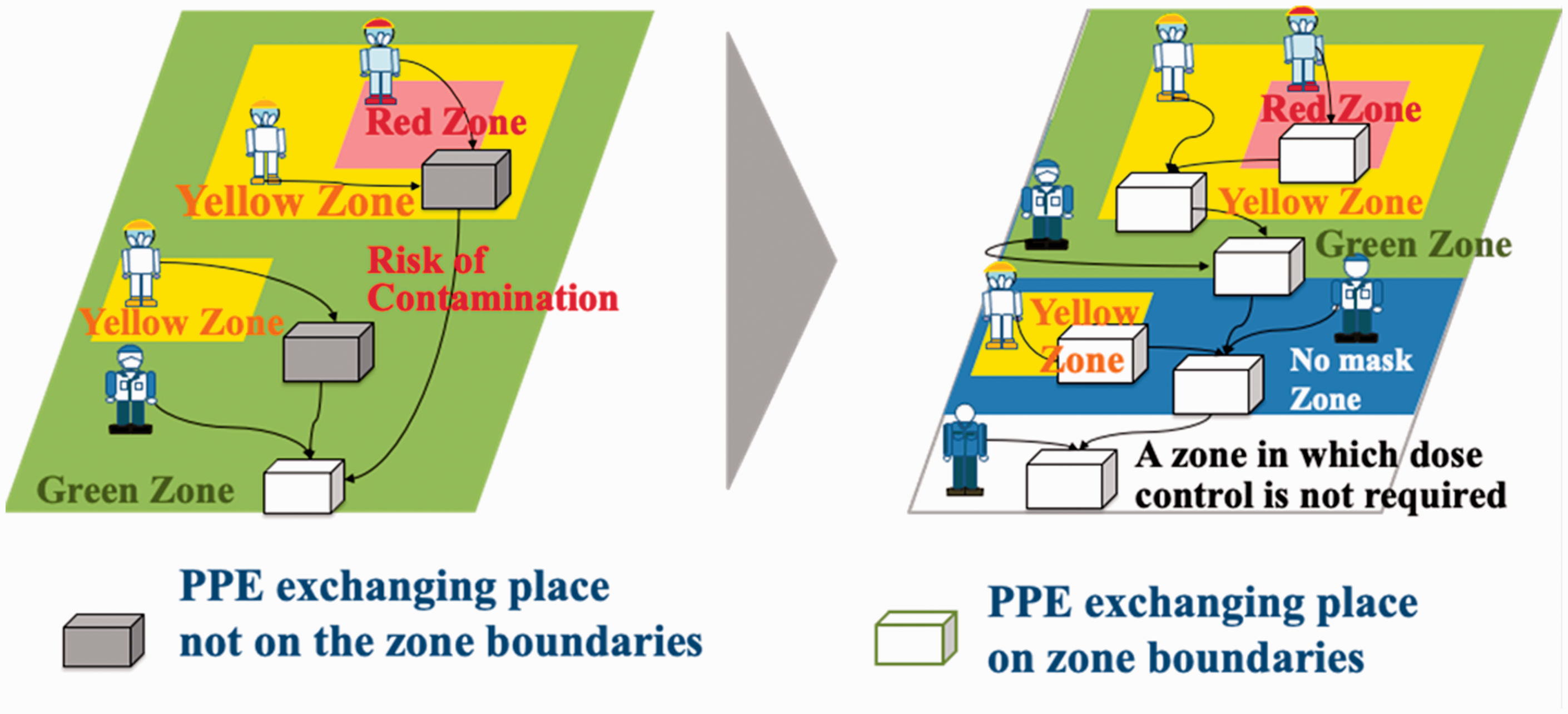
6. CONCLUSION – AIMING TO BALANCE RECONSTRUCTION AND DECOMMISSIONING
TEPCO is proceeding with the decommissioning work based on the Mid-and-Long-Term Roadmap towards the Decommissioning of TEPCO's Fukushima Daiichi Nuclear Power Station Units 1–4 compiled by the Japanese Government in December 2011 (hereinafter ‘Mid-and-Long-Term Roadmap’). The first phase in this roadmap is defined as the period before the start of spent fuel removal, and the second phase is defined as the period until the start of retrieval of melted fuel debris. The final (third) phase will be a long period lasting until the decommissioning is complete, and the Mid-and-Long-Term Roadmap revised in December 2019 repositioned the first 10 years of the third phase as a new period (3-1). This period is defined as the time when TEPCO will proceed systematically with multiple processes, such as fuel removal and contaminated water management, in order to carry out more full-scale decommissioning work (i.e. fuel debris retrieval). The main milestones have also been defined for the various fields.
With this in mind, in March 2020, the key process to achieve these milestones and the goals set out in the Nuclear Regulatory Authority’s Risk Map was developed and announced. It is referred to as the ‘Mid-and-Long-Term Decommissioning Action Plan 2020’. From now on, the plan is that it will be revised every year, and the Mid-and-Long-Term Decommissioning Action Plan 2021 will be published in March 2021. The Mid-and-Long-Term Decommissioning Action Plan enables TEPCO to undertake the decommissioning work more systematically while looking to the future. Local people will be able to understand the future decommissioning work in detail, and may consider joining the decommissioning work. The Mid-and-Long-Term Roadmap revised in December 2019 clearly states ‘balancing reconstruction and decommissioning’ as another pillar. Bearing this in mind, TEPCO will continue to take responsibility for decommissioning Fukushima Daiichi nuclear power plant and contaminated water management, so that the decommissioning work will enable reconstruction of the region.