




Abstract
Since the International Research Institute for Nuclear Decommissioning (IRID) was established as a technology research association in August 2013, it has been engaged in research and development (R&D) for decommissioning the Fukushima Daiichi nuclear power plant, which is currently an urgent issue, to strengthen the platform for decommissioning technology for the future. The work of IRID R&D is classified into three main pillars: removal of spent nuclear fuel from the pool; retrieval of fuel debris; and technological development for treatment and disposal of solid radioactive waste. This article describes an overview of R&D as of the first half of the fiscal year 2020, mainly focusing on investigation inside primary containment vessels and retrieval of fuel debris.
1. Overview of IRID
1.1. Organisation of IRID
The International Research Institute for Nuclear Decommissioning (IRID) is an organisation currently composed of the following Japanese organisations, the so-called ‘all-Japanese structure’:
Two national research and development agencies: Japan Atomic Energy Agency and National Institute of Advanced Industrial Science and Technology. Four plant manufacturers: Toshiba Energy Systems & Solutions Corporation; Hitachi-GE Nuclear Energy, Ltd; Mitsubishi Heavy Industries, Ltd; and ATOX Co., Ltd. Twelve electric utility companies: Hokkaido Electric Power Co., Inc.; Tohoku Electric Power Co., Inc.; Tokyo Electric Power Company (TEPCO) Holdings, Inc.; Chubu Electric Power Co., Inc.; Hokuriku Electric Power Company; Kansai Electric Power Company, Inc.; Chugoku Electric Power Co., Inc.; Shikoku Electric Power Company, Inc.; Kyushu Electric Power Company, Inc.; Japan Atomic Power Company; Electric Power Development Co., Ltd.; and Japan Nuclear Fuel Ltd.
1.2. Roles of IRID
Four organisations are working closely together as one team to decommission Fukushima Daiichi nuclear power plant. The Ministry of Economy, Trade, and Industry (METI) of the Japanese Government has determined the major policy and is undertaking overall progress management in accordance with the mid- and long-term roadmap. The Nuclear Damage Compensation and Decommissioning Facilitation Corporation is planning decommissioning strategies and developing research and development (R&D) to support the government activities. TEPCO Holdings and Fukushima Daiichi D&D Engineering Company are undertaking the work on-site, and IRID is in charge of implementing R&D.
1.3. R&D projects conducted by IRID
In general, R&D consists of four stages: fundamental research; basic research; applied research; and practical application. The scope of R&D conducted by IRID includes basic research, applied research, and practical application. Fig. 1 presents R&D projects conducted by IRID. These projects are being undertaken under subsidy projects of the Decommissioning and Contaminated Water Management granted by METI, and in collaboration with international organisations.
International Research Institute for Nuclear Decommissioning research and development projects.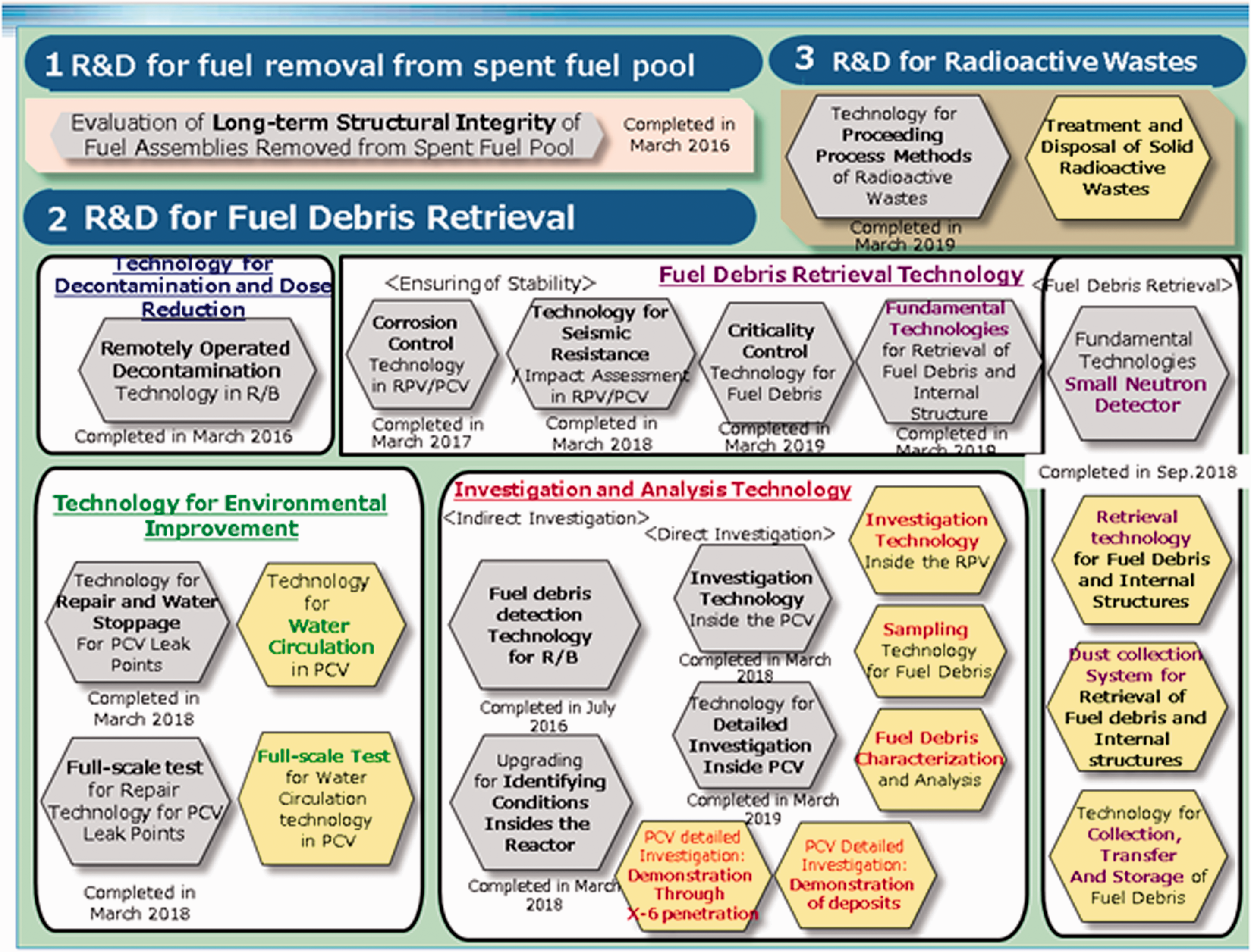
2. Progress and prospects of research
2.1. Investigative technology for PCV interior
Radiography using a cosmic ray muon was applied to Units 1–3 to investigate the conditions inside the primary containment vessel (PCV) for each unit. Fig. 2 depicts the overviews of muon measurement technology and investigative results of Unit 3. The results of estimation and investigation of the conditions of the reactor interior in each unit (evaluation results through the analysis code, analysis results obtained from actual measurement and experimental data, and results of the site investigation) were summarised as an integrated estimation figure of the PCV interior.
Results of measuring inside the reactor using muons.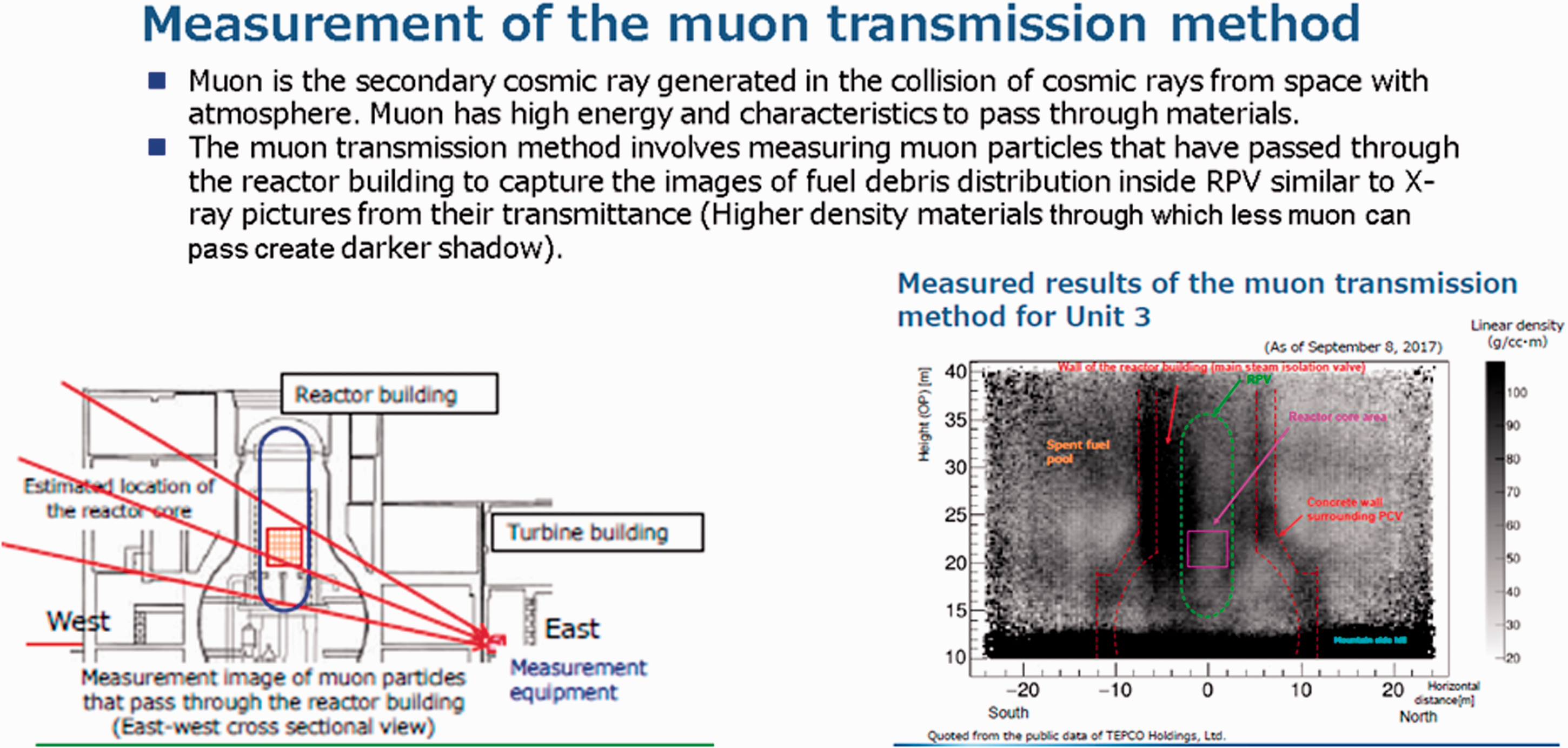
IRID have developed investigative robots to investigate the damaged conditions inside the PCVs and the spread of fuel debris depending on the investigation required for each unit. Fig. 3 shows robots developed for the investigation of PCV interiors.
Robot investigation of primary containment vessel interiors.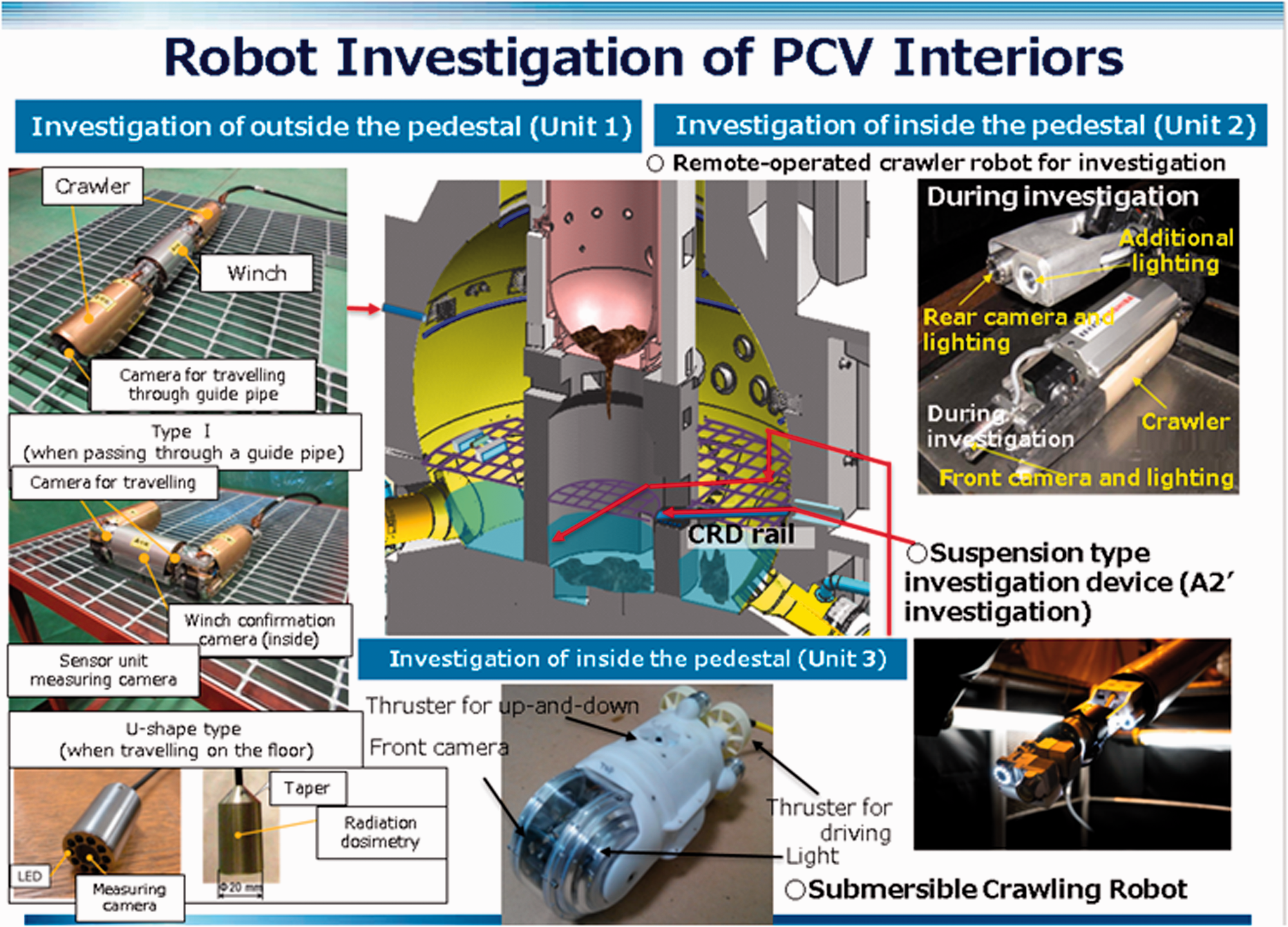
A site verification test was performed to investigate Unit 2 in January 2018, and the investigative robot successfully obtained an image of the basic structure of the reactor pressure vessel (RPV), i.e. the RPV pedestal (Fig. 4).
Inside the bottom of the primary containment vessel, adjacent to the inner wall of the pedestal, in Unit 2.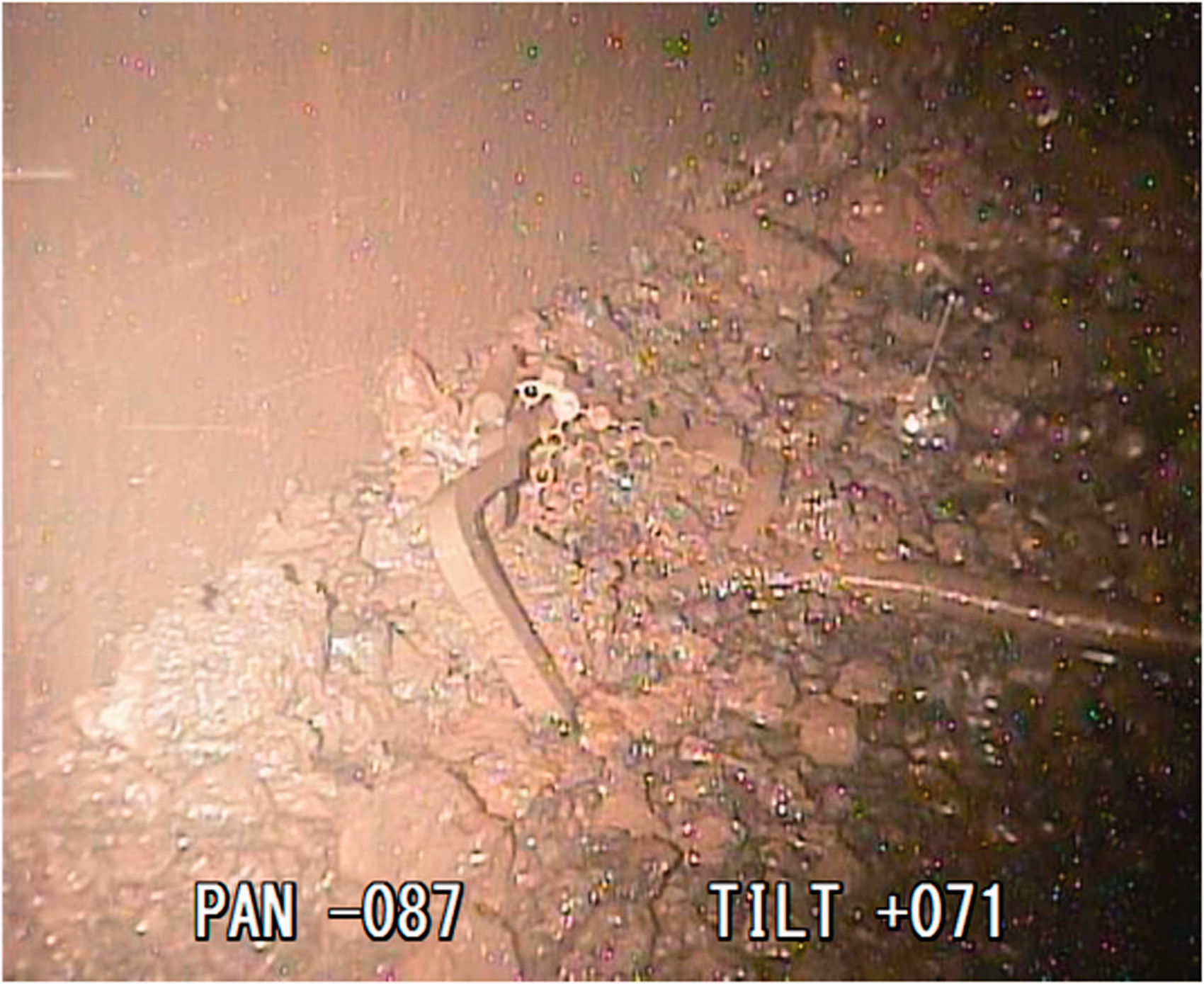
Fig. 4 depicts an image of sediment spreading at the bottom of the RPV pedestal, obtained by accessing the lower part of the RPV inside the pedestal. Currently, IRID is undertaking the development of new investigative apparatus able to acquire substantially more information. New boat-type access and investigative apparatus with submersible functions has been developed as a water level of approximately 2 -m length for the PCV of Unit 1 (Fig. 5). This apparatus is cylindrical in shape, with an approximate length of 1.1 m and diameter of 25 cm. It is equipped with various sensors to acquire information: a scanning-type ultrasonic distance metre to obtain shape data of the sediment accumulated at the bottom of the PCV; a high-power ultrasonic sensor to measure the thickness of the sediment; and a radiation detector to identify the distribution of fuel debris.
To investigate Unit 2, arm-type access apparatus (Fig. 6) has been developed for test retrieval of fuel debris, while accessing the inside of the PCV through the existing X-6 penetration (PCV penetration).
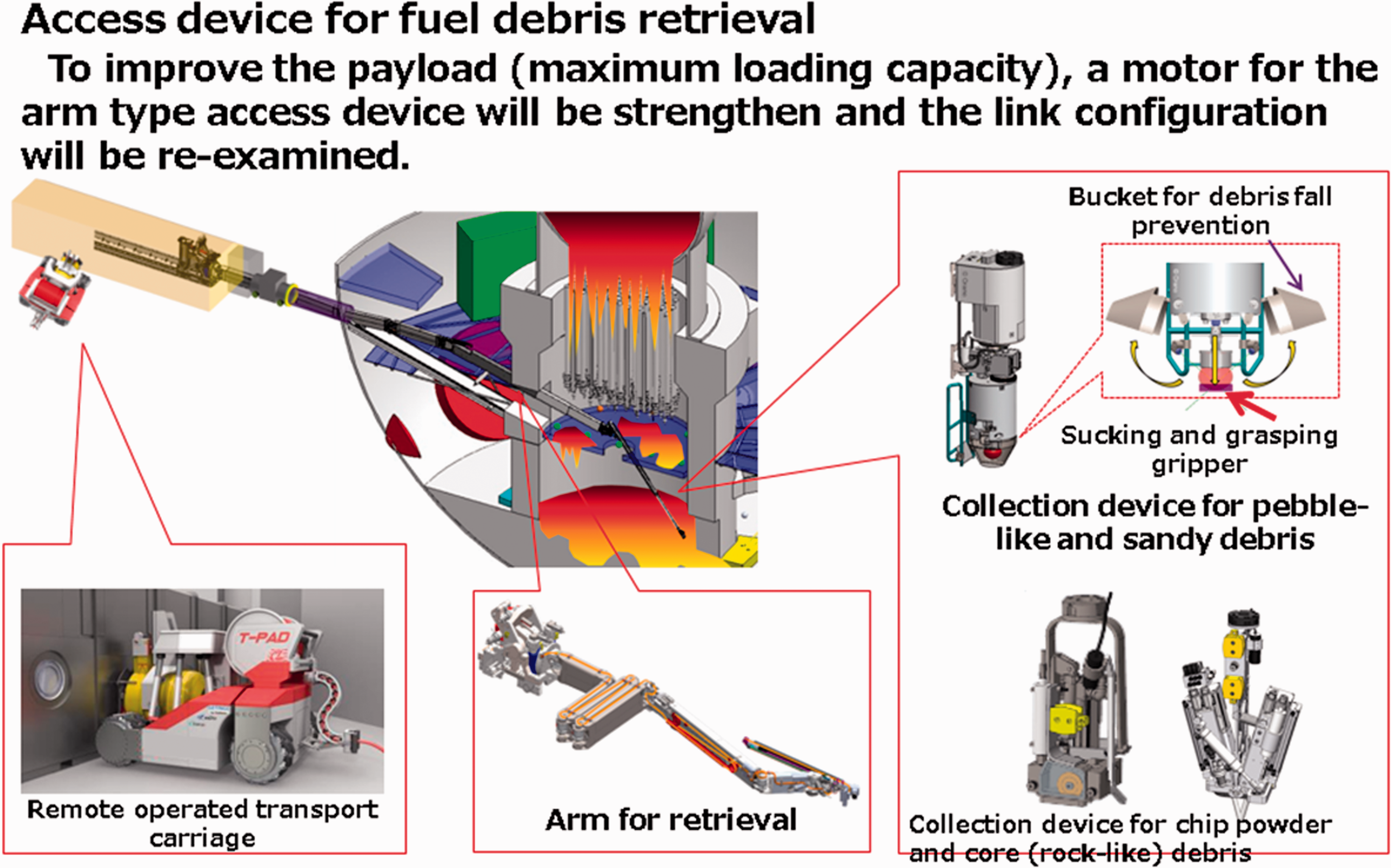
Apperance of the boat type access device. Arm-type access apparatus. Increasing the scale of retrieval of fuel debris.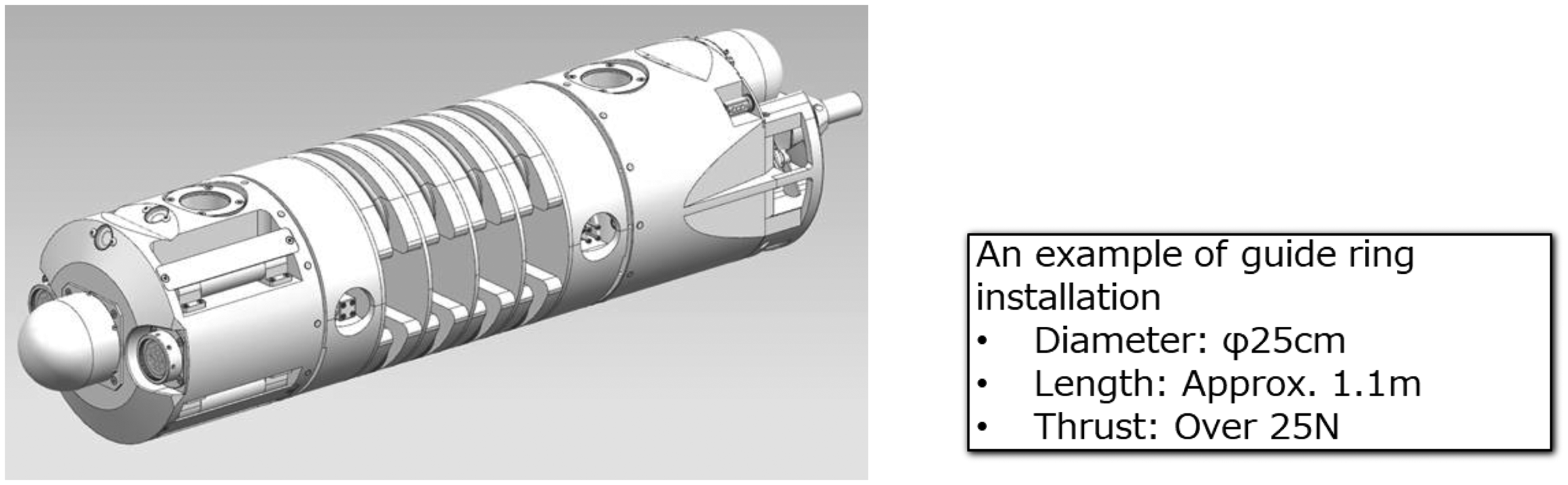
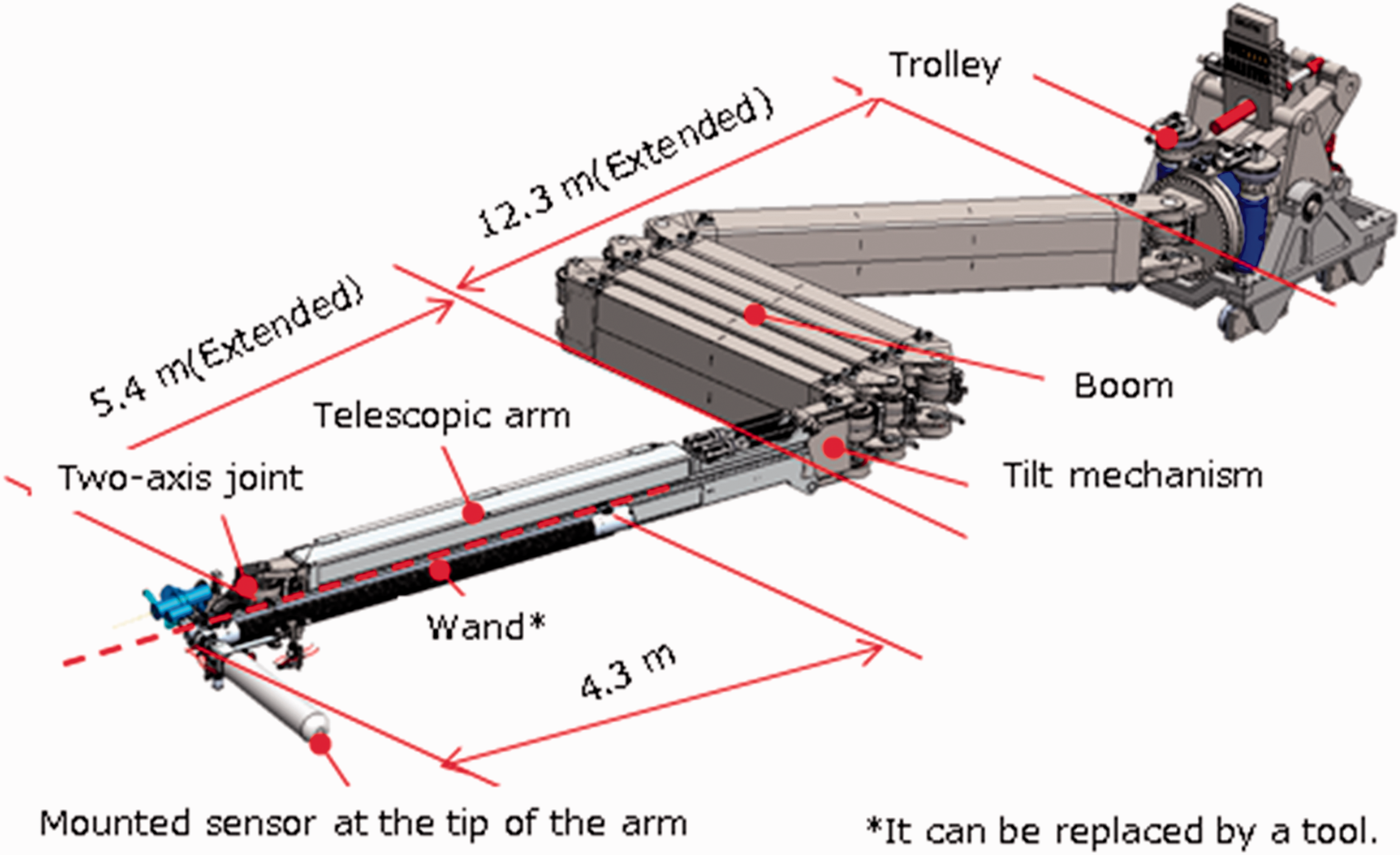
The arm-type access apparatus, with a total length of 22 m, can be folded and stored in the enclosure that is connected to the PCV, situated outside, before use. When using the arm, it can be unfolded and inserted into the PCV. Investigative equipment up to 10 kg can be loaded on the arm head. Fig. 7 shows an overview of the investigation inside the PCV using the arm-type access apparatus. The arm stored in the enclosure is designed to pass through X-6 penetration via the PCV connection structure, and enter the PCV accordingly.
2.2. Technological development of retrieval of fuel debris
Retrieval of fuel debris is planned to take a step-by-step approach in a flexible manner based on information obtained from test retrieval of fuel debris, increasing the scale of retrieval of fuel debris, and further increasing the scale of retrieval of fuel debris while proceeding with retrieval. Various technologies for apparatus have been developed for use in each stage. IRID has been developing methods applicable to the site in cooperation with relevant organisations while studying various methods.