




Abstract
This paper does not necessarily reflect the views of the International Commission on Radiological Protection.
Keywords
1. OVERVIEW OF JAPAN ATOMIC ENERGY AGENCY
Japan Atomic Energy Agency (JAEA), the only comprehensive nuclear research and development (R&D) institution in Japan, aims to contribute to the welfare and prosperity of human society through nuclear science and technology. The focus areas of JAEA are as follows, in accordance with the Medium/Long-Term Plan:
response to the accident at Fukushima Daiichi nuclear power station; research on improving the safety of atomic energy; R&D of the nuclear fuel cycle; and development of radioactive waste treatment/disposal technology.
In parallel with the various efforts of the Japanese Government in the fields of science and technology, JAEA has compiled a vision for the future – ‘JAEA 2050+’ – on what to aim for and what to do by 2050.
1.1. R&D bases for JAEA
JAEA has R&D bases all over Japan, from Hokkaido in the north to Okayama Prefecture in the south (Fig. 1). The largest bases are located in Tokai Village and Oarai Town in Ibaraki Prefecture, and include research reactors and accelerators, as well as hot laboratory facilities that can handle nuclear fuel materials. Originally, JAEA did not have R&D bases in Fukushima Prefecture, but following the accident at Fukushima Daiichi nuclear power station, efforts have been made to develop bases needed for R&D related to decommissioning.
Research and development (R&D) bases of Japan Atomic Energy Agency. FDNPS, Fukushima Daiichi nuclear power station.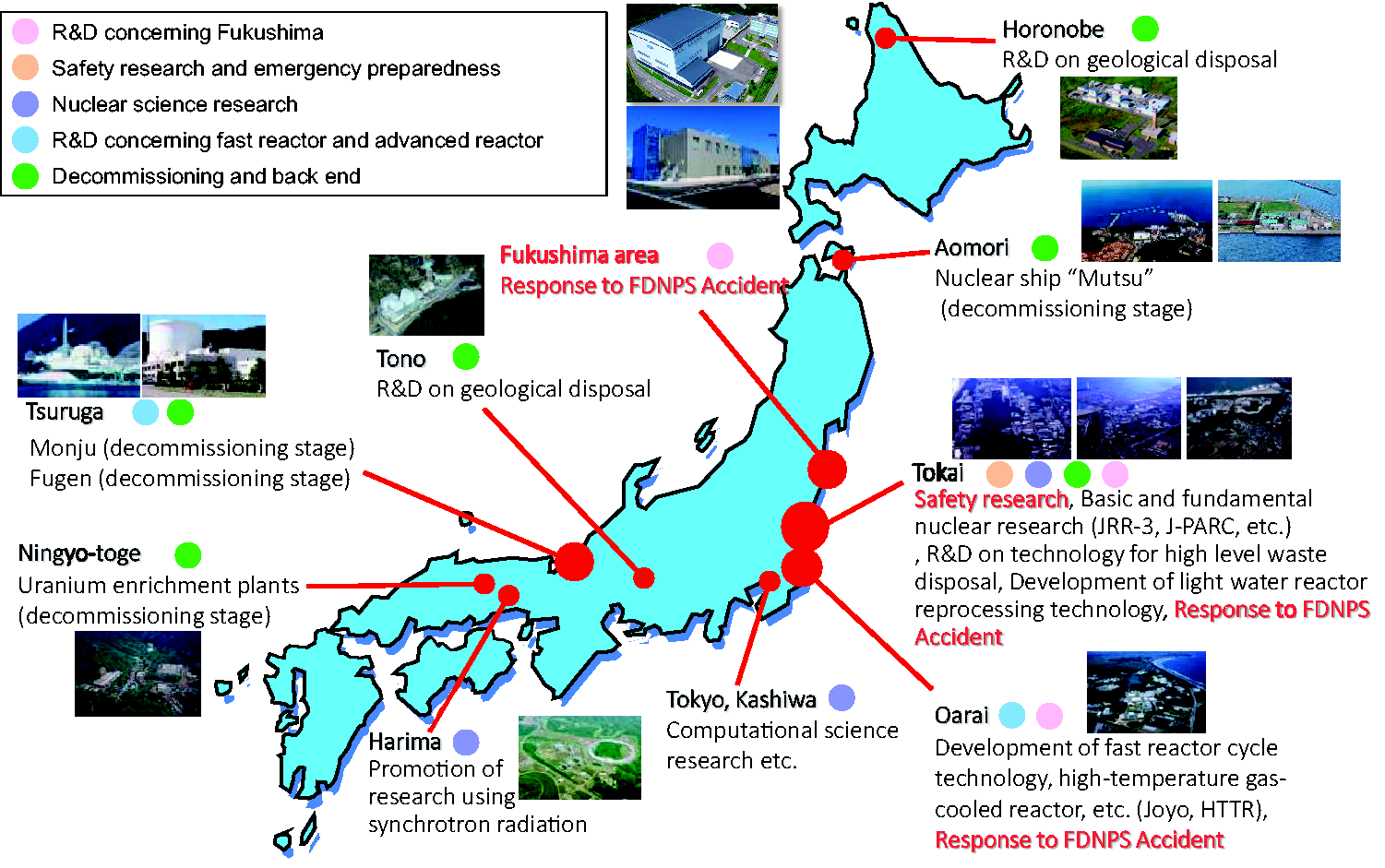
1.2. Structure of JAEA
Fig. 2 shows the structure of JAEA. JAEA adopted the R&D sector system, and the basic structure has six sectors. The Sector of Fukushima R&D is the main player for R&D for decommissioning Fukushima Daiichi nuclear power station, and other sectors (e.g. Sector of Nuclear Science Research, and Sector of Nuclear Fuel, Decommissioning, and Waste Management Technology Development) work together with the Sector of Fukushima R&D to fully activate the potential ability of JAEA R&D.
Structure of Japan Atomic Energy Agency (JAEA). R&D, research and development.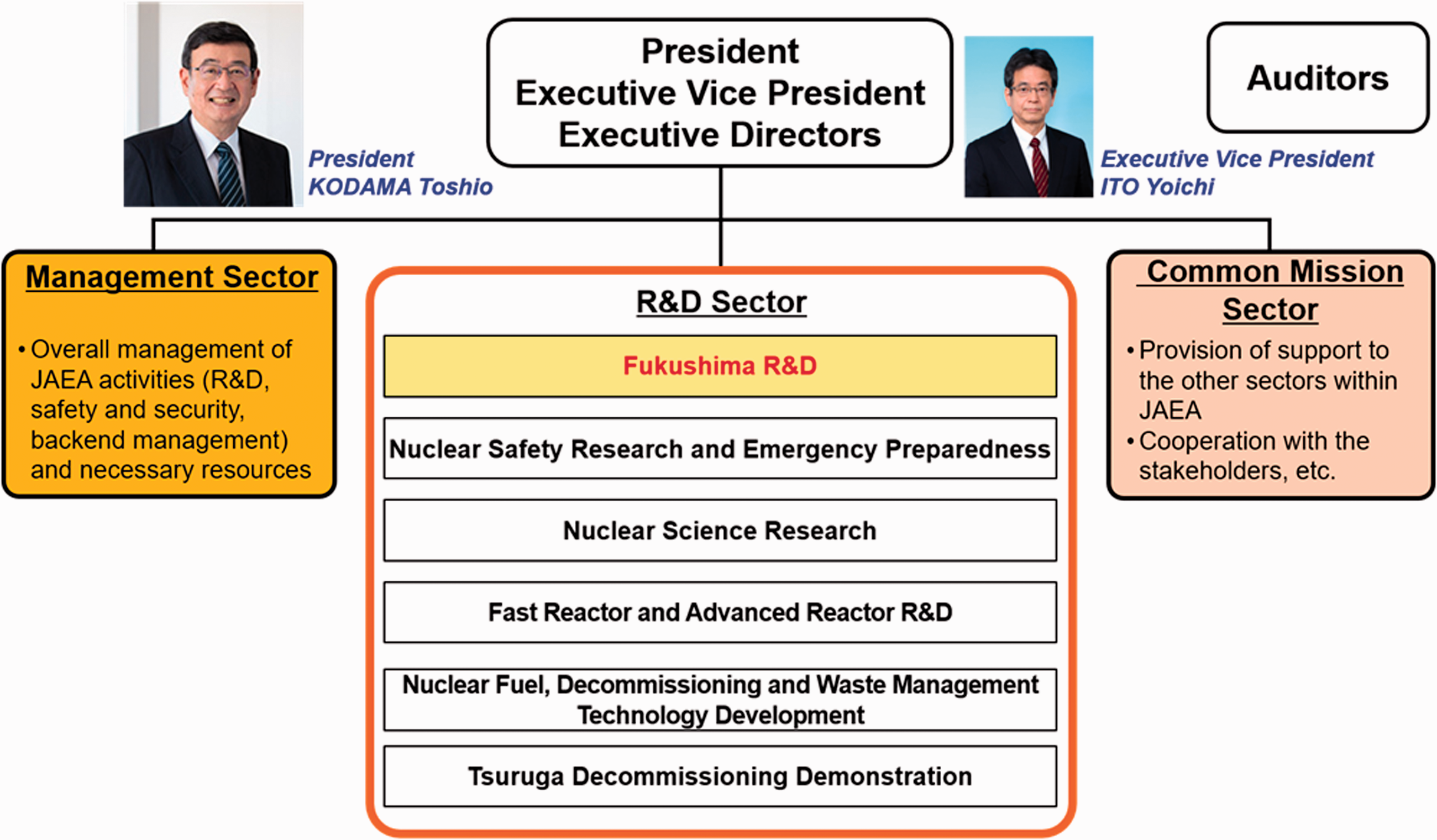
2. RESEARCH AND DEVELOPMENT ACTIVITIES THAT CONTRIBUTE TO THE DECOMMISSIONING OF FUKUSHIMA DAIICHI NUCLEAR POWER station
JAEA is conducting R&D on the decommissioning of Fukushima Daiichi nuclear power station and environmental recovery based on three pillars. The first is the infrastructure development of R&D in Fukushima Prefecture, the second is R&D for decommissioning Fukushima Daiichi nuclear power station, and the third is R&D for environmental restoration in Fukushima. The third pillar is not related directly to decommissioning Fukushima Daiichi nuclear power station, but radioactive materials were scattered around Fukushima Prefecture due to the accident at the power station. As such, environmental dynamics research, such as environmental monitoring and how radioactive substances (e.g. caesium) move, is being carried out with the aim of recovery of the environment in Fukushima, which is thought to be important for the reconstruction of Fukushima.
2.1. History of the Sector of Fukushima R&D
JAEA is designated as a supporting public institution under the Act on Special Measures Concerning Nuclear Emergency Preparedness. Therefore, immediately after the accident at Fukushima Daiichi nuclear power station caused by the Great East Japan Earthquake, JAEA’s experts were dispatched to Fukushima Prefecture for the implementation of environmental monitoring, decontamination demonstration projects, measurement of internal exposure of residents using whole-body counters in Fukushima Prefecture, and public meetings for those who were concerned about the health effects of radiation.
Subsequently, in response to the Japanese Government's formulation of a Mid-and-Long-Term Roadmap for decommissioning Fukushima Daiichi nuclear power station in December 2011, JAEA began full-scale R&D on decommissioning. In 2014, the Sector of Fukushima R&D was established as a formal organisation to tackle these issues. Since then, the infrastructure for R&D has improved. Naraha Centre for Remote Control Technology Development (NARREC) started operating in 2016, followed by the Collaborative Laboratories for Advanced Decommissioning Science (CLADS) in 2017, and the Administration Building of Okuma Analysis and Research Centre in 2018.
2.2. R&D bases in Fukushima and their infrastructure
Three centres and five bases have been established for R&D in Fukushima Prefecture. CLADS is conducting R&D for environmental recovery, such as monitoring and environmental dynamics at the bases established by Fukushima Prefecture in Miharu Town and Minamisoma City. R&D for decommissioning is being carried out by NARREC, CLADS, and the Okuma Analysis and Research Centre at bases in Hamadori district such as Naraha, Tomioka, and Okuma Town.
NARREC is a large facility where mock-ups (actual size models) can be installed, and it is possible to empirically verify the work planned on site in advance. For example, the pilot debris removal work scheduled for Unit 2 of Fukushima Daiichi nuclear power station will be pre-checked here. A virtual reality system to enable the working environment to be checked without going to site is also being developed (JAEA, 2018).
The Okuma Analysis and Research Centre is a facility that analyses radioactive waste and fuel debris from Fukushima Daiichi nuclear power station, and is currently under construction on the land next to the power station to facilitate transportation of analytical samples. In order to handle high-radiation samples, the plan is to install equipment such as concrete cells and iron cells that can block radiation, and equipment such as glove boxes that can contain radioactive substances (JAEA, 2017).
2.3. R&D structure of the decommissioning of Fukushima Daiichi nuclear power station
R&D for the decommissioning of Fukushima Daiichi nuclear power station is being carried out with funding from the Ministry of Education, Culture, Sports, Science, and Technology (MEXT) and the Ministry of Economy, Trade, and Industry (METI). The R&D under the jurisdiction of MEXT is medium- to long-term basic research, and is called the ‘World Intelligence Project’. This brings together domestic and foreign wisdom with operations mainly carried out by JAEA. The R&D under the jurisdiction of METI is technological development that is close to on-site application, and the strategy is established by the Nuclear Damage Compensation and Decommissioning Facilitation Corporation (NDF). JAEA is proceeding with lean R&D by exchanging information with NDF.
2.4. CLADS activities for decommissioning Fukushima Daiichi nuclear power station
CLADS conducts basic research, exchanges opinions with NDF and Tokyo Electric Power Company Holdings, and organises research issues that will be needed in the future as ‘basic foundational research’. CLADS functions as a hub to promote collaboration with domestic and international institutions and universities, but also carries out its own R&D. R&D into nuclear fuel analysis and its evaluation, reproduction/simulation technology of what happened in the accident reactor, analysis and its concept for the treatment and disposal of radioactive waste, and technology for measuring radiation remotely are underway, taking advantage of the strengths of JAEA. Furthermore, in advancing the decommissioning of Fukushima Daiichi nuclear power station, cooperation with foreign organisations, such as the Organisation for Economic Co-operation and Development/Nuclear Energy Agency (OECD/NEA) and the International Atomic Energy Agency, and cooperation with advanced nuclear power countries, such as the USA, the UK, and France, are extremely important. As well as benefitting from international cooperation, new knowledge is also being incorporated.
2.5. Human resource development
The decommissioning of Fukushima Daiichi nuclear power station will be a long-term effort taking 30–40 years. Therefore, it is very important to develop the next generation in order to continue the effort. The following have commenced:
Human resources development programme for students – in addition to implementing various human resource development programmes, research collaboration with universities and technical colleges is being promoted. Creative robot contest for decommissioning – this is held every year at NARREC. College students manufacture robots that reflect the problems and solutions that are expected in decommissioning work, and compete in terms of performance. Fukushima research conference – young researchers are invited from Japan and overseas to Fukushima to announce the current state of R&D on various topics, and also to discuss future directions for R&D.
3. FUTURE PROSPECTS
As shown in the Mid-and-Long-Term Roadmap, JAEA needs to utilise its technology and knowledge as follows:
Based on the analysis results of radioactive waste, a technical method for storage, treatment, and disposal of waste will be proposed. Based on the results of R&D and analysis of fuel debris, a technical method for storing, processing, and disposing of debris will be proposed. Utilising the analysis results of radioactive waste and fuel debris, the accident progress at Fukushima Daiichi nuclear power station will be analysed, and the results will be fed back in order to improve reactor safety.
Moreover, the framework of international cooperation, including joint projects sponsored by OECD/NEA, is important in terms of both the contribution to decommissioning of Fukushima Daiichi nuclear power station and research into safety. JAEA will continue to implement and further develop projects such as PreADES and ARC-F.
JAEA will continue to carry out activities such as R&D and human resource development, and will contribute to the support of local companies in Fukushima Prefecture and the reconstruction of Fukushima.