




Abstract
This paper does not necessarily reflect the views of the International Commission on Radiological Protection.
Keywords
1. JAPAN’S EFFORTS AFTER THE ACCIDENT
In the aftermath of the accident at Fukushima Daiichi nuclear power plant, government-wide efforts have been made for both social remediation and technical response to the consequences of the accident. For social remediation and support for the victims, such as compensation to the victims, reconstruction of society, and environmental remediation of the contaminated environment, large-scale measures have been made by the Government of Japan and local governments, and great progress has been made in the 10 years since the accident. However, from the mid- to long-term perspective, decommissioning of the damaged and contaminated facilities at Fukushima Daiichi nuclear power plant needs to be carried out to ensure the safety of the region, and various measures have been taken to accelerate the decommissioning project.
1.1. Response to the accident and current status
The actions taken at Fukushima Daiichi nuclear power plant after the accident can be broadly divided into emergency measures taken by the end of 2011, and subsequent measures for stabilisation and clean-up from the mid- and long-term perspectives. In the former, various emergency measures were taken to address the extreme situation caused by the accident, such as cooling the damaged cores and stopping leakage of highly contaminated water into the ocean. From December 2011 onwards, in line with the newly formulated government decommissioning policy (Government of Japan, 2011, 2013, 2015, 2017, 2019), a series of stabilisation measures and clean-up operations were implemented, including recovery of spent fuel, internal inspection of reactors, measures to control contaminated water, and management of radioactive solid waste. As a result, the four damaged reactors can now be controlled quite safely, and a certain level of stability for controlling risk at the site has been reached. As such, the site has entered the next stage (mid- and long-term clean-up). Japanese post-accident responses have undergone international peer review by the International Atomic Energy Agency five times to evaluate their appropriateness from a neutral and comprehensive standpoint (IAEA, 2013a,b, 2015, 2018, 2020).
1.2. Background of the organisational structure to underpin the decommissioning
Under Japanese law related to compensation for nuclear damage, while nuclear accident insurance covers just a portion of compensation for victims, compensation beyond the insurance coverage is the responsibility of the nuclear operator. In addition, under the law regulating nuclear reactors, decommissioning of nuclear facilities is also the responsibility of the operator. However, as the consequences of the accident at Fukushima Daiichi nuclear power plant were so enormous, the amount of compensation was expected to exceed the solvency of Tokyo Electric Power Company Holdings (TEPCO), so the Government of Japan hastily established a new legal system to secure compensation funds and to support the continuation of TEPCO's business. Furthermore, recognising that this decommissioning project was extremely difficult and required a response at national level, the Government of Japan decided to provide administrative guidance on the decommissioning in the frame of the Act on Special Measures Concerning Nuclear Emergency Preparedness.
To actualise this administrative initiative and facilitate compensation and decommissioning for which TEPCO takes responsibility as a nuclear operator, the Nuclear Damage Compensation and Decommissioning Facilitation Corporation (NDF) was founded by legislation.
1.3. Overall organisational structure
Fig. 1 shows the overall organisational structure that is currently in place. Regarding the decommissioning, with recognition that the site is still in a state of emergency, the Nuclear Emergency Response Headquarters of the Government of Japan takes a strong administrative lead in deciding on a policy for the 1F decommissioning in the frame of the Nuclear Disaster Act. The Ministry of Economy, Trade, and Industry (METI) is working as the secretariat to lead this interministerial mechanism. A policy named the ‘Mid- and Long-term Roadmap’ (Government of Japan, 2011, 2013, 2015, 2017, 2019) serves as the main pillar of the cooperative activities, and TEPCO and all other relevant organisations ought to follow this.
The organisational structure for decommissioning Fukushima Daiichi nuclear power plant.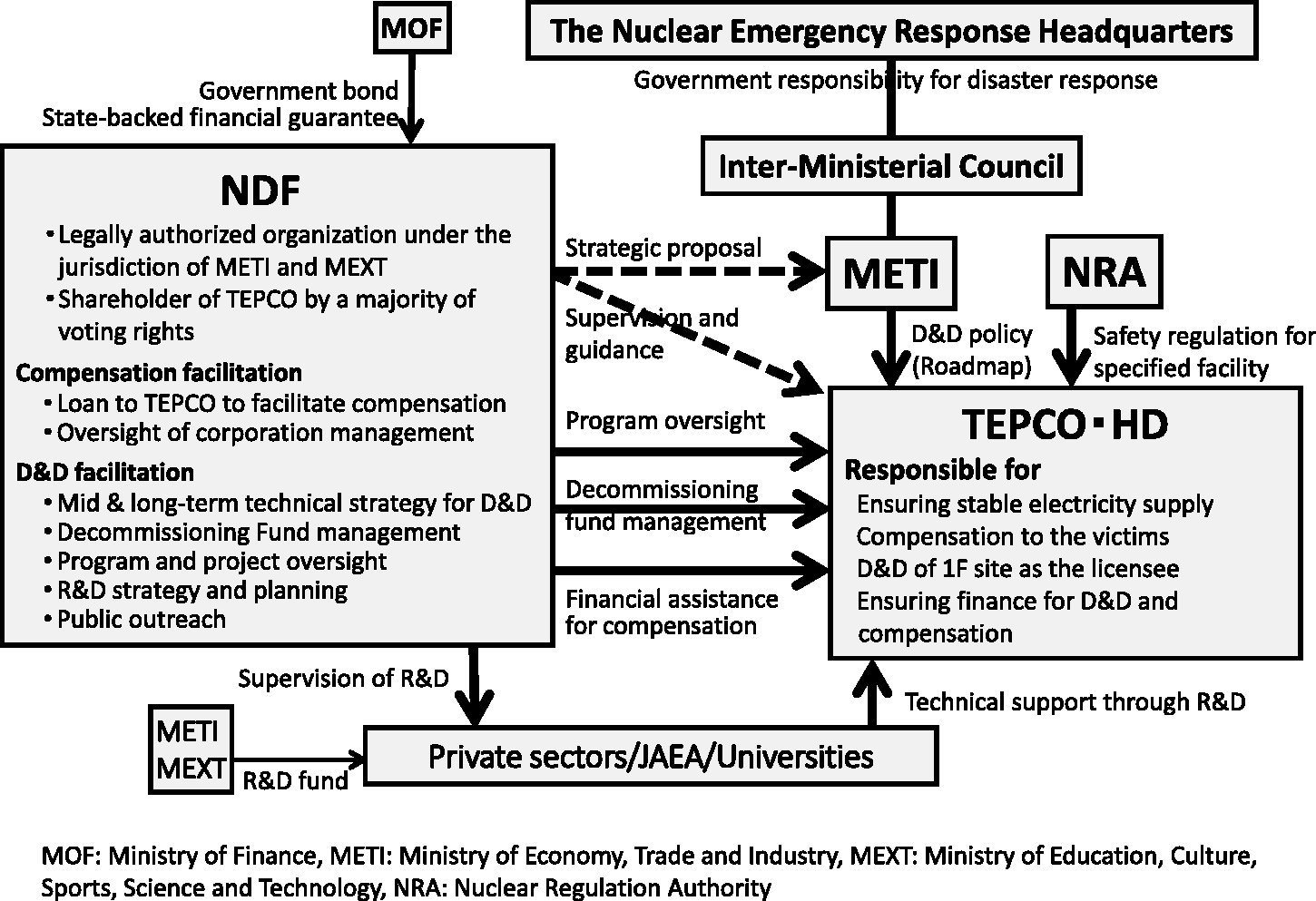
In the first place, TEPCO has a fundamental duty to move forward decommissioning safely and steadily as well as compensation, while doing its best to achieve reconstruction of the region. For the purpose of accelerating the decommissioning, the Fukushima Daiichi D&D Engineering Company (FDEC), an in-house company specialising in Fukushima Daiichi nuclear power plant, was established.
NDF plays a special role in facilitating this cooperative organisational structure. By accepting the government bonds, NDF supplies a huge amount of money to TEPCO to compensate the victims, and at the same time, NDF invests in TEPCO to obtain the majority voting rights, through which NDF oversees TEPCO’s business management.
For TEPCO's decommissioning project, NDF provides TEPCO with guidance and advice on its project management, and is also responsible for managing the funding of TEPCO's decommissioning project. In addition, NDF has voluntarily formulated and published a technical strategy (NDF, 2015, 2016, 2017, 2018, 2019, 2020) for the decommissioning of Fukushima Daiichi nuclear power plant from the mid- and long-term perspective so that decommissioning can proceed successfully in accordance with government guidance. This technological strategy has been referred to in the deliberations for the Government of Japan's roadmap and in TEPCO's decommissioning project plans. In addition, NDF supervises and coordinates the relevant research and development (R&D) subsidised by the Government of Japan.
In terms of ensuring safety, the Nuclear Regulation Authority regulates the safety of the decommissioning from an independent standpoint. Regarding the reinforcement of technical insufficiency, motivated private sectors, institutes, and universities have been contributing by accepting subsidies from the Government of Japan.
Timeline of organisational evolution over the past decade.
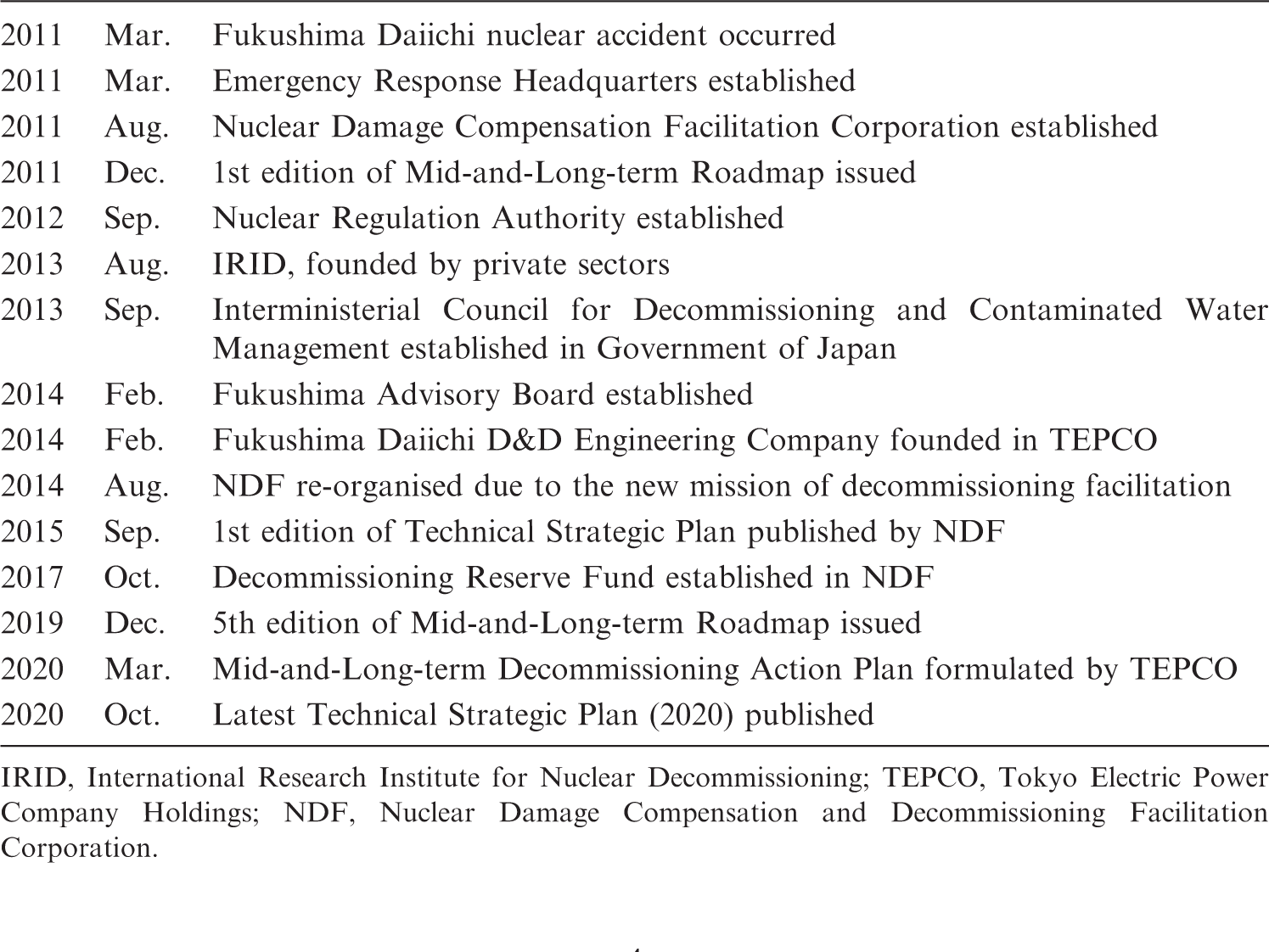
IRID, International Research Institute for Nuclear Decommissioning; TEPCO, Tokyo Electric Power Company Holdings; NDF, Nuclear Damage Compensation and Decommissioning Facilitation Corporation.
2. BASIC ELEMENTS SUPPORTING THE DECOMMISSIONING
In order to succeed in this difficult challenge, basic elements are needed to underpin this long-term project, such as decommissioning strategy and planning, organisational capabilities of project management and engineering, financing, technologies, and methods. However, as neither TEPCO nor the Government of Japan could prepare for such a large nuclear accident, these elements had to be developed from scratch. As a result of the cooperative efforts, these elements have been gradually created and strengthened over the 10 years since the accident.
2.1. Decommissioning plan and strategy
Internationally, the decommissioning steps following an accident at a facility (IAEA, 2014) are divided into four stages: emergency response; stabilisation; clean-up; and final stage with demolition and remediation. At Fukushima Daiichi nuclear power plant, it is considered that the emergency response and stabilisation stages have been completed, and we have reached the beginning of the clean-up stage. Fig. 2 shows a simplified timeline defined by the latest roadmap (Government of Japan, 2011, 2013, 2015, 2017, 2019). We are currently in Phase 2, and removal of spent fuel from Unit 3 and preparation for the start of fuel-debris retrieval have progressed successfully. Phase 2 is expected to end in 2021, and trial retrieval and gradual expansion of fuel-debris retrieval will start at the first implementing unit within Phase 3. In the first decade of Phase 3, removal of spent fuels from all reactor units will be completed, and small-scale fuel-debris retrieval will start at the first implementing unit. This will be scaled-up gradually, aiming to start full-scale operation in approximately 2031. In Phase 3-1, the milestones for certain important operations have been defined, such as reducing the volume of contaminated water generation, reducing stagnant contaminated water in the buildings, and enhancing storage of contaminated solid wastes.
Future view of the Mid-and-Long-term Roadmap (Government of Japan, 2019). R&D, research and development.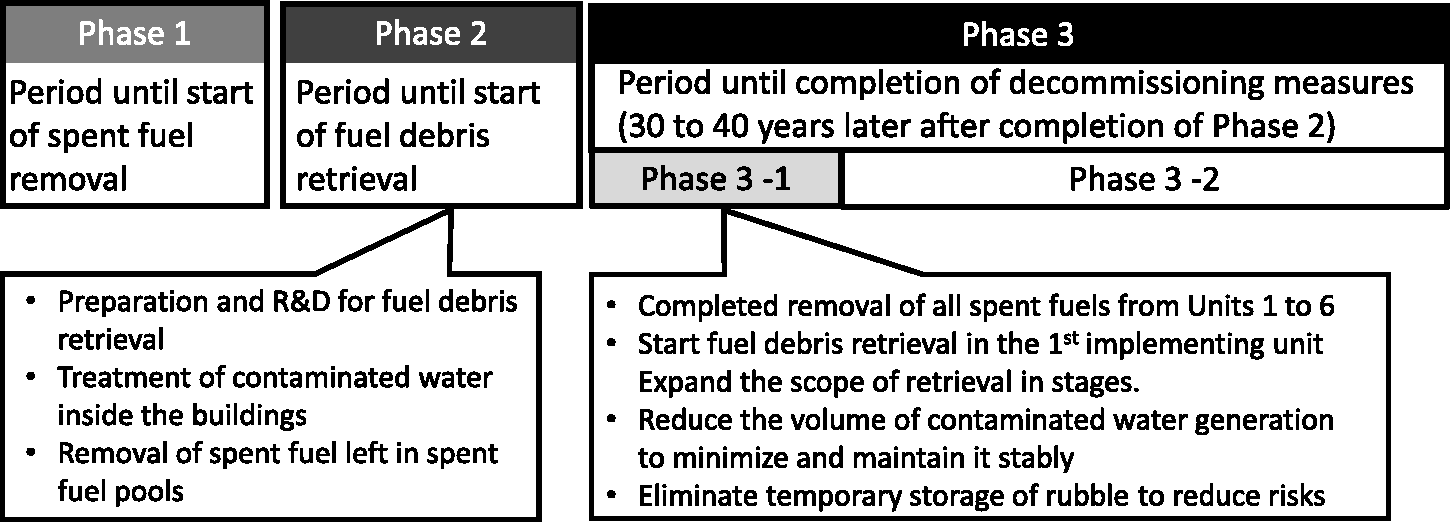
The first Mid-and-Long-term Roadmap was issued in late 2011 (Government of Japan, 2011, 2013, 2015, 2017, 2019), providing a holistic and basic approach to the mid- and long-term challenge. The first edition of the Technical Strategic Plan issued by NDF was issued in 2015 (NDF, 2015), and this presented the basic concept and directions based on risk-based strategy. This has resulted in updated strategic directions with specific technical measures.
Technical Strategic Plan 2017 (NDF, 2017) proposed a fuel-debris retrieval policy based on a step-by-step approach, requiring TEPCO to begin the preliminary engineering for fuel-debris retrieval. In 2019, NDF proposed that Unit 2 should be the first implementing unit for small-scale fuel-debris retrieval (NDF, 2019). The latest edition of the Technical Strategic Plan (NDF, 2020) focuses on the significance of enhancing TEPCO’s attitude towards responsible full-scale delivery in the future.
The roadmap of the Government of Japan has been revised five times since 2011, updating the key directions with the latest important milestones in major processes, such as the start of fuel-debris retrieval, completion of spent fuel removal, and reduction of stagnant contaminated water in the buildings. In response to these requests from NDF and the Government of Japan, TEPCO’s first Mid-and-Long-Term Decommissioning Action Plan 2020 was issued in March, 2020.
2.2. TEPCO’s capability to execute the decommissioning project
As TEPCO is a power generation company, it lacked experience in executing a long-term decommissioning project. Also, the domestic supply chain that supported TEPCO's nuclear power generation had no experience in designing and engineering such special decommissioning projects. For this reason, NDF has urged TEPCO to change its operations to a project management style, and to improve its own engineering capability to manage and utilise the technical capabilities of the supply chain. In response, FDEC reconfigured the Work Breakdown Structure (WBS) of the entire decommissioning process, and changed the organisation to a project-oriented one in 2019. Furthermore, FDEC is strengthening its internal engineering efforts. FDEC has also been strongly promoting Kaizen activities to eliminate waste in engineering and procurement.
2.3. Financial base
In order to secure a continuous and steady supply of funds for this long-term challenge, a new fund system was legally established in 2017, called the ‘reserve fund for decommissioning’. In this new system, TEPCO is obliged to deposit approximately 2 billion dollars every fiscal year from its business revenue into the special reserve account managed by NDF. The expense for the annual delivery is to be withdrawn based on the annual plan for decommissioning, which is formulated in collaboration with NDF. The excess of the annual deposit is to be accumulated in the reserve account to prepare for future large operations, such as fuel-debris retrieval from the damaged reactors. It is expected to accumulate several tens of billion dollars and will cover completion of fuel-debris retrieval over 30–40 years.
The unique feature of this funding system is that the plan for use of the decommissioning funds must be jointly prepared by both TEPCO and NDF, and the plan requires the approval of the Minister of Economy, Trade and Industry. This means that the plan for the delivery of decommissioning steps needs to be agreed upon by the Government of Japan supervised by NDF, ensuring alignment with the strategic direction.
2.4. Research and development
In view of the urgency and need for development to enable accelerated decommissioning, two ministries – METI and the Ministry of Education, Culture, Sports, Science, and Technology (MEXT) – have subsidised technical entities with motivation. The larger fund comes from METI, which provides approximately 130 million dollars per year to applicants for private companies and institutes, such as the International Research Institute for Nuclear Decommissioning, Japan Atomic Energy Agency (JAEA), and some other domestic and international companies. The major R&D subjects granted with this funding are small-scale fuel-debris retrieval and its scale-up, further scaled-up fuel-debris retrieval for the future, and waste management in terms of solid waste processing and disposal.
In parallel, MEXT subsidises JAEA to conduct an open call research fund for basic research and human resource development by universities. MEXT has tried to close the distance between the needs of TEPCO and the potential technology seeds from the universities. Recently, TEPCO has started preparation to enhance its management of R&D in the frame of its engineering work. NDF is responsible for planning and managing R&D with the METI fund, and coordinating the entire R&D system supported by the Government of Japan. This subsidised R&D system is expected to be improved to meet the first-hand needs from implementations at the site to increase the use of potential seeds for technical entities.
3. CONCLUSION
In Japan, although the accident was very sudden and no preparation was in place to respond to the aftermath, great efforts have been made to develop a solid organisational structure within the legal framework. As a result, under the strong initiative of the Government of Japan, a pragmatic and workable institutional system has been established to enable TEPCO and other related organisations to cooperate systematically. In this system, NDF is playing a special role in coordinating, facilitating, and supporting the entire system. At present, the elements that should support the long-term project, such as government policies, technical strategy, project plans, TEPCO's organisational capability, securing of finance, and R&D with government support, have been developed and strengthened. The decommissioning of Fukushima Daiichi nuclear power plant is making steady progress.