




Abstract
To promote radiation protection and health promotion among returning residents (returnees) in coastal areas of Fukushima, eHealth principles were used to develop a new application tool (app) that can record radiation exposure and health status while providing comprehensive support to returnees. Intended users are returnees and health and welfare workers. After assessing their needs, a flowchart and prototype for operational logic were created using commercially available software tools. Professional developers will focus on improving the user interface and ensuring data security. The finished app will be compatible with mobile telephones and tablets. Utility and ease of use are paramount to serve returnees of all ages effectively.
1. INTRODUCTION
Reconstruction after a nuclear accident is a complex process that involves not only radiation protection, but also social and environmental considerations for people returning to affected areas (ICRP, 2020). Indeed, in the case of the accident at Fukushima Daiichi nuclear power plant, residents returning to municipalities near the power plant (returnees) have been actively supported by health and welfare workers in reducing radiation exposure and promoting health (Takamura et al., 2016; Murakami et al., 2017). In addition, the returnees have increased their autonomous decision-making on radiation protection through the practice of citizen science and dialogue seminars with experts (Ando, 2016; Lochard et al., 2019). However, health and welfare workers faced difficulties in providing services due to limited time, human resources, and other logistical and administrative challenges.
Nowadays, digital application (app) tools are ubiquitous, with an emphasis on interactive online communication. The European Union’s Nuclear Emergency Situations – Improvement of Medical and Health Surveillance – Stakeholder INvolvement IN Generating Science (SHAMISEN–SINGS) project reported recommendations for app development to share radiation- and health-related information in a timely manner among local stakeholders and affected populations during early- and long-term recovery from a nuclear accident (ISGlobal, 2019). This type of usage of information technology (IT) is being branded as ‘eHealth’ in the field of health promotion by the World Health Organization (WHO, 2019). Thus, combining radiation protection and health promotion in an app may be a useful adjunct for health and welfare workers who support returnees by connecting information and people. This article reports on the development of a new app to record radiation and health measurements for use in areas affected by the Fukushima accident.
2. METHODS
Details of initial efforts have been reported previously (Ohba et al., 2020). Briefly, the intended users of this tool are returnees and health and welfare workers, among whom a needs assessment was conducted. Based on the results and thorough discussion among team members (which took approximately 2 months), a blueprint of the app content and its modalities was developed.
Next, the first author prepared a mock-up using FileMaker Pro 14.0.6 (Claris International Inc., Santa Clara, CA, USA), which enabled other team members to check the detailed operation logic of the app. Iterative revision and re-checking at this stage took approximately 1 month in total.
The authors collaborated with an IT company in Fukushima Prefecture, experienced in app development for health promotion. This development stage took approximately 3 months.
3. PRODUCTS AND CONCEPT
3.1. Blueprint of the app
The blueprint of the app included two major categories: radiation exposure and health promotion. The radiation exposure items were estimations of internal and external doses, based on geographic location (based on postal code) and records from personal dosimeters, whole-body counters, and food consumption as recorded by users’ manual input. As radiation protection depends on the awareness of one's own radiation exposure environment (Fujimura et al., 2017), a protocol was developed to automatically estimate doses and offer precautions in the app. Health promotion items include anthropometry, medical measures, medications, health behaviours, and mental health. Links to related information, automatic responses, and a separate interactive communication function with the research team were also prepared. The authors believe that automatic responses to the user in each of these items is important in order to increase user awareness of radiation protection and health promotion, and to further motivate users to continue using the tool. The link with the author team in this trial will eventually be replaced with links with local services.
Regarding data storage and data sharing: (i) users (returnees or health and welfare workers) record personal information in the app; (ii) the information is stored securely in a cloud system, which is a web server; and (iii) pre-registered health and welfare workers, who are the service providers of returnees joining the pilot, can access recorded information on their own secure computer or tablet in order to provide tailor-made support. This digital information tool provides a continuous flow from data collection, including solicitation of residents’ needs, to support and/or care planning among health and welfare workers.
3.2. Reconstruction of the blueprint using a mock-up
Fig. 1 shows an example of the workflow of the prototype app, which provided a platform for validation of functions. Experts in various fields (radiation, medicine, health promotion, risk communication, mental health, and health information) on the research team reviewed the prototype to improve the blueprint, which was subsequently presented to the IT company. This workflow is intended to eliminate discrepancies of understanding between the research team and the IT company. In addition, the mock-up becomes more efficient in terms of development resources because the focus can move to designing usability, including the interface.
Pre-development workflow shown by FileMaker.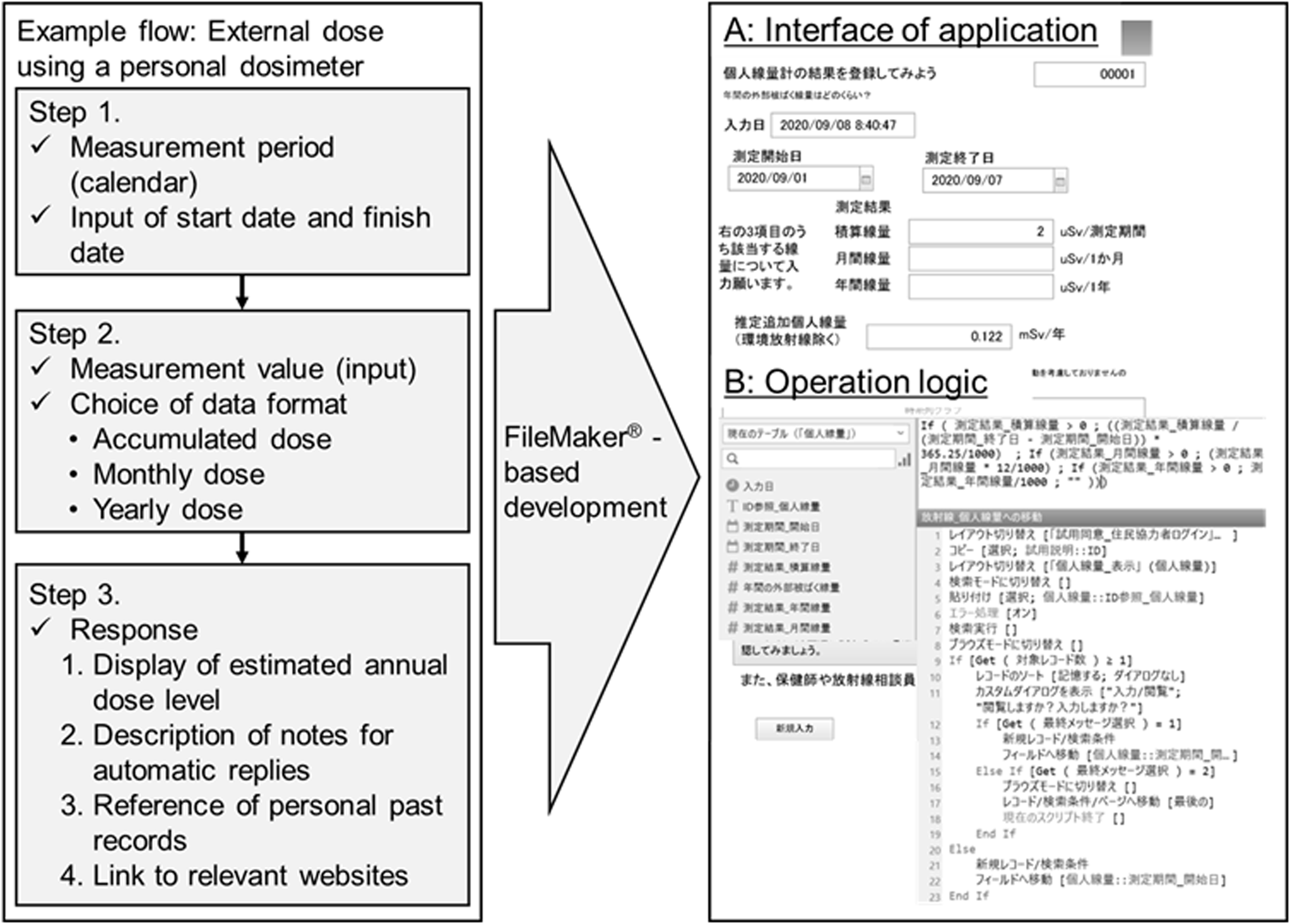
3.3. Points of the developing app
Fig. 2 is the app menu screen designed with pictogram icons and large text displays in order to increase usability among the intended users, many of whom are elderly. This arrangement followed the European Union’s SHAMISEN-SINGS recommendations (ISGlobal, 2019) for app development after a nuclear accident.
Tentative menu screens of the app. Items enclosed by a black solid line are radiation records. Those enclosed in grey dotted lines are health records.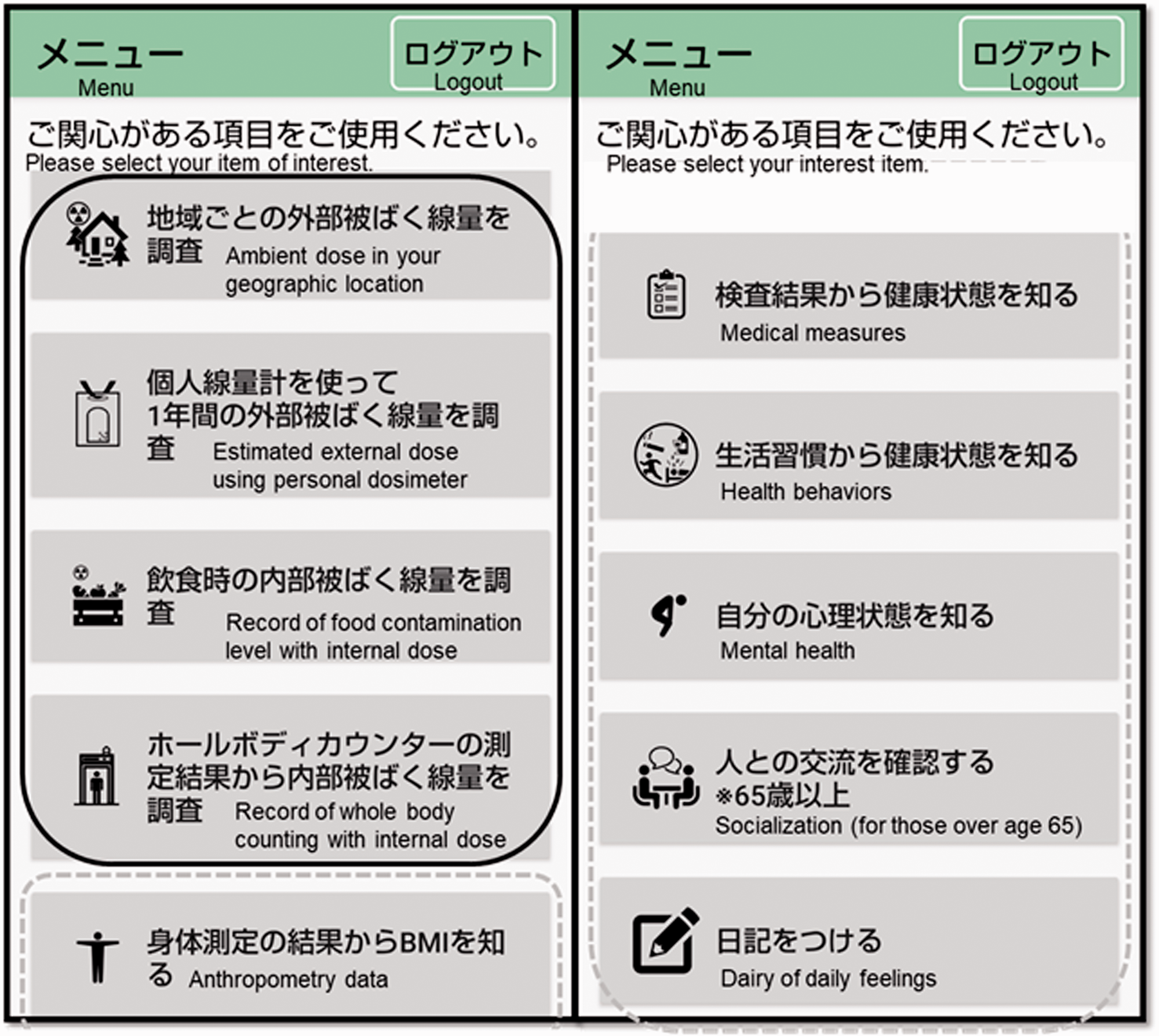
Fig. 3 shows subsequent screens after clicking ‘estimated external dose using personal dosimeter’ in Fig. 2. The left screen appears first, followed by the middle and right screens. A history record icon in the middle screen leads to the trend graph in the right screen. The link icon in the middle screen leads to external information from web pages from Japan’s Ministry of the Environment, its Information Booklet for Returnees, and Fukushima Health Management Survey reports (Fukushima Prefecture, 2019; Kuroda et al., 2020).
Tentative screens for recording external dose.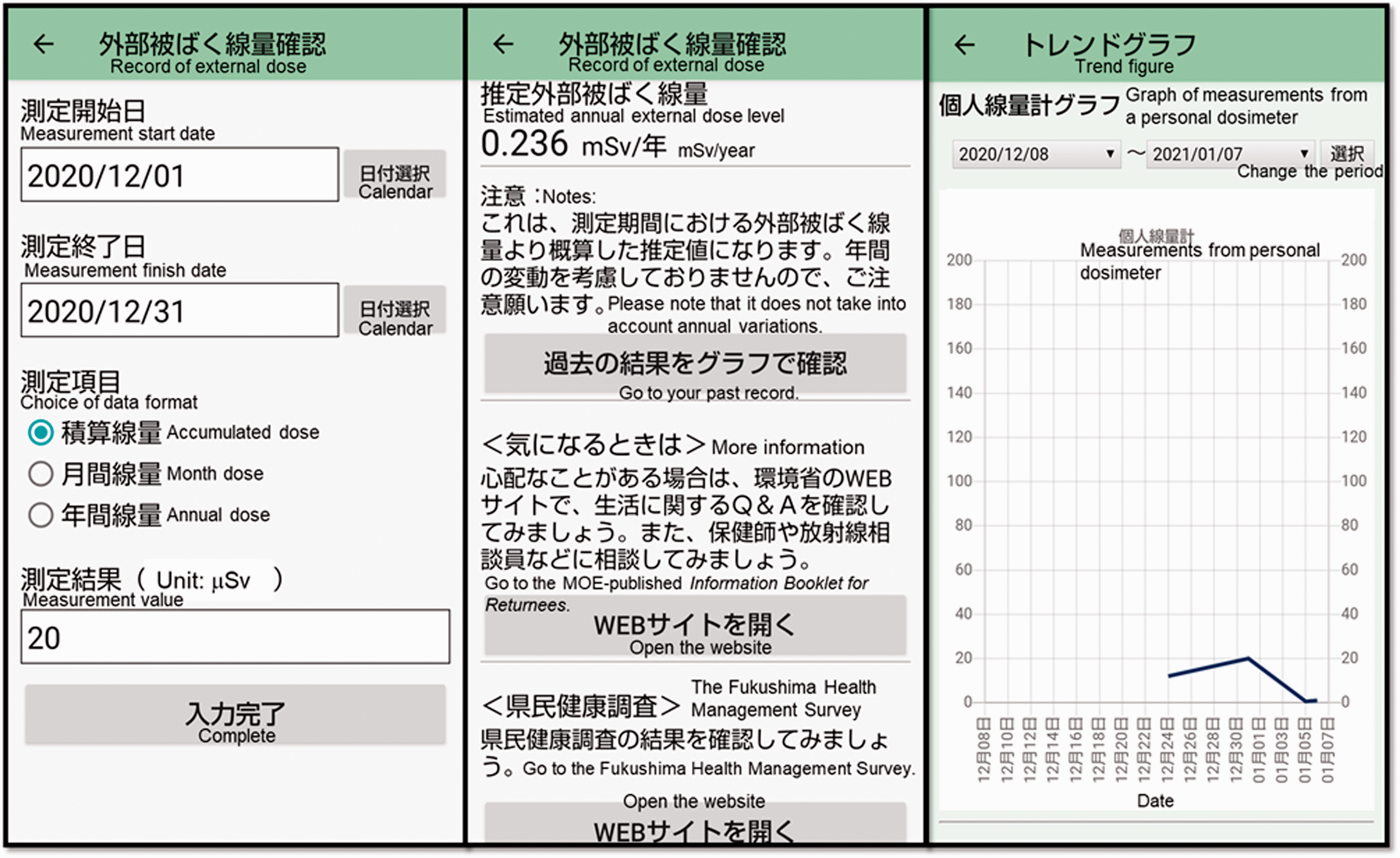
Fig. 4 shows the web screen provided by the cloud server for health and welfare workers to monitor clients’ data. Data can be downloaded in a comma separated value file from the webpage. This feature provides data security as personal data are not stored on an individual device. Only pre-registered providers can access the stored data with an ID and password.
Data output page on the website for pre-registered service providers (left). Data output of a comma separated value (CSV) file downloaded by the website (right).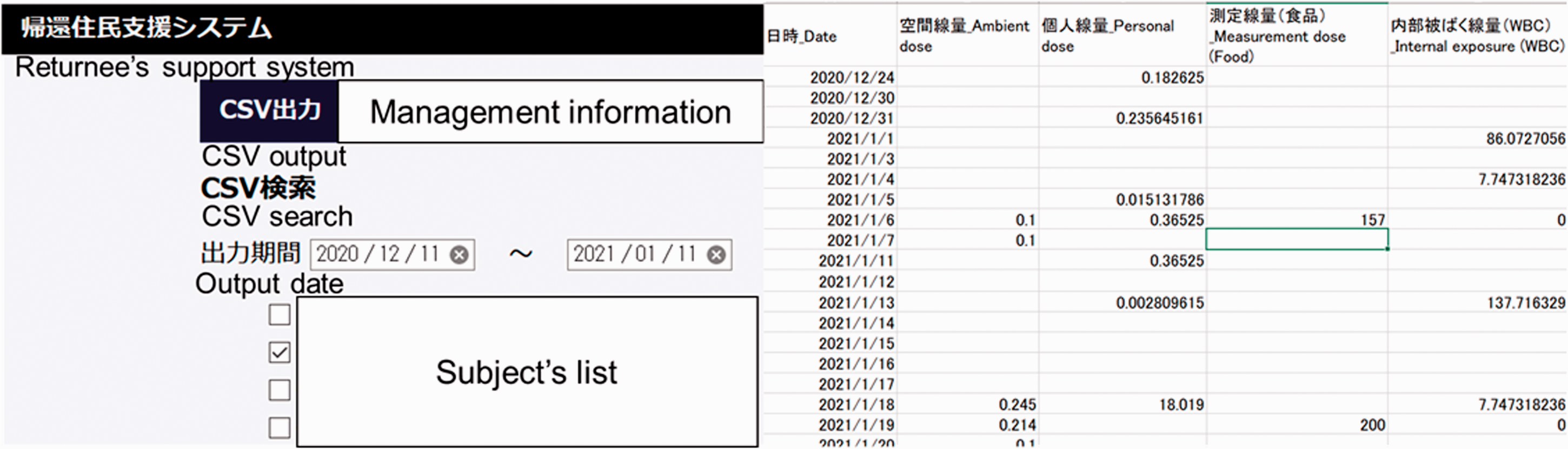
4. CONCLUSION
This app provides an awareness-raising opportunity for returnees to adjust their behaviour for radiation protection and health promotion. Health and welfare workers can provide support to returnees using the app’s data. This innovation uses technology to connect people: those returning to areas affected by the nuclear accident, and those in health and welfare professions. There are some limitations to acknowledge; for instance, in order to serve elderly and child-rearing returnees effectively, further consideration is warranted for practicality and ease of use. More efforts are needed to serve multiple age groups and ethnic groups in the affected areas. As such, the authors will continue to upgrade their tool by reviewing content and improving usability through pilot tests to be conducted in fiscal year 2021, in collaboration with returnees and local health and welfare workers (Ohba et al., 2020).
Footnotes
Acknowledgements
This work was supported by Research Project on the Health Effects of Radiation, organised by Ministry of the Environment, Japan (JFY 2019-2021). Screen captures of a mobile phone and a website in the app were provided by East Japan Accounting Centre Co., Ltd. The authors wish to thank East Japan Accounting Centre Co., Ltd for prompt cooperation with app development.