




Abstract
This paper does not necessarily reflect the views of the International Commission on Radiological Protection.
1. INTRODUCTION
Generally, reputational damage refers to ‘economic damage caused by people discontinuing consumption and tourism because people fear the food, goods, and land that had been considered as “safe” because of a certain incident, accident, environmental pollution, or disaster being widely reported’ (Sekiya, 2003, 2011).
At the initial stage of the accident, goods were officially considered safe if their radiation levels were below the standard set by the Government of Japan. The economic damage caused by people not buying goods with radiation levels below this standard was termed the ‘reputational damage’. At the point in time when reputational damage becomes an issue, the fact that goods are ‘safe’ is a premise that farmers, fishermen, and distributors understand to some extent. However, as this is difficult for all consumers and distributors who conduct business based on consumer trends to understand, economic damage will continue to be incurred. Agricultural products and marine products – the image of which has deteriorated despite having no issues regarding safety – are excluded from consumer options and their commercial value is reduced. If that continues, they will be removed from the distribution route.
Over time, air dose measurement, soil measurement, monitoring of radioactive substances (e.g. agricultural products), and inspection of all rice bags in Fukushima Prefecture have been performed, and the difference in absorption rates between varieties has been made apparent, thus enabling safety to be guaranteed as a result of the various absorption suppression measures. Ten years have passed since the accident at Fukushima Daiichi nuclear power plant, and radioactive contamination above the detection limit has almost disappeared from forest products such as mushrooms and edible wild plants, and agricultural products cultivated in fields, other than wild animals and plants. As for marine products, fish species have not been subject to shipping restrictions since February 2020.
An inspection system has been established, and information on the inspection results has started to be provided. The feeling of repulsion towards the agricultural products themselves has eased. However, distribution will not recover easily due to its long-term stagnation following the accident. As a result, the total shipment value of safe crops is not recovering. As the years passed since the accident, the issue of “reputational damage” became not just a matter of consumers refusing to buy, but also a problem of distribution that could not be recovered even if there were no food safety issues.
Currently, the main issues in the fight against reputational damage are the influence of changes and downsizing of the inspection system, the issue of contaminated water treated by ALPS and the treatment of removed soil. This paper will not discuss these issues because of limited space, but will summarize the issues related to reputational damage based on the surveys conducted by the author on (1) consumers' awareness of foods produced in Fukushima Prefecture, the significance of the inspection system and its results, and (2) distribution issues.
2. SURVEY ON CONSUMER AWARENESS OF FOODS PRODUCED IN FUKUSHIMA PREFECTURE
First, the results of the survey targeting consumers are presented. All participants were internet monitors of Rakuten Insight Inc. The research used quota sampling so that each prefecture had respondents both of an equal number of male and female and of an equal number by each age group (20s, 30s, 40s, 50s, and 60s). Fukushima Prefecture was assigned a quota of 300 responses, while the remaining 46 prefectures were assigned a quota of 200 responses each. A total of 9,500 responses were collected, implemented in March 2019. For reference, survey results from 2013 to 2017 in Fig. 1 are from surveys carried out in the past using the same method. Surveys were carried out in 2013 (all prefectures, n = 14,091), 2014 (Tohoku + Tokyo, Nagoya, and Osaka, n = 1779), 2015 (Tohoku + major cities, n = 3839), and 2017 (all prefectures, n = 9489).
Awareness of food produced in Fukushima Prefecture.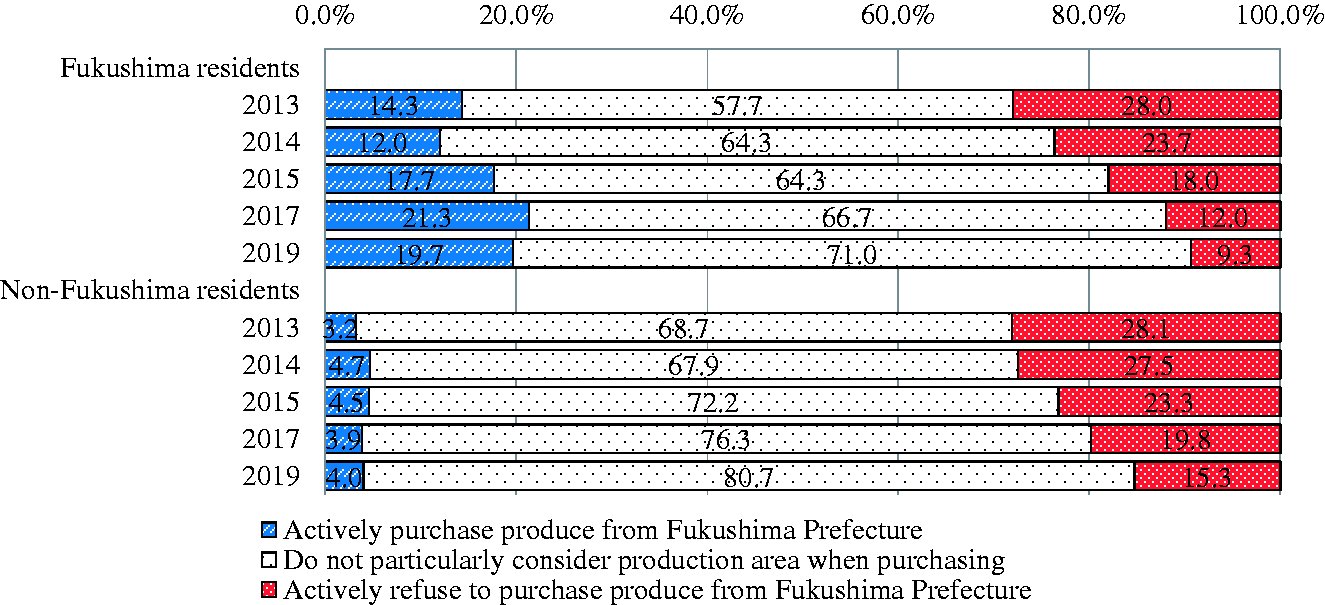
The number of people who refuse to eat food produced in Fukushima Prefecture has been decreasing year by year. This is especially true in Fukushima residents. Anxiety has eased because the inspection system has been implemented consistently, there have been no problems with the inspection results, and shipping restrictions are in place; this finding has been common to all surveys since 2014. The response rate for each reasons for decreased anxiety was greater for Fukushima residents. For Fukushima residents, there is evidence that the number of people rejecting Fukushima products has decreased, but for non-Fukushima residents, there is no clear reason why the number of people rejecting Fukushima products has decreased. With the passage of time, people's memories of the Fukushima nuclear accident have faded, and the number of people who reject it has somehow decreased. (Fig. 2). In Fukushima Prefecture, a large amount of information on the inspection system and inspection results is available, which may explain why the proportion of Fukushima residents who refuse to consume products from Fukushima Prefecture is decreasing.
Reasons why concerns have eased.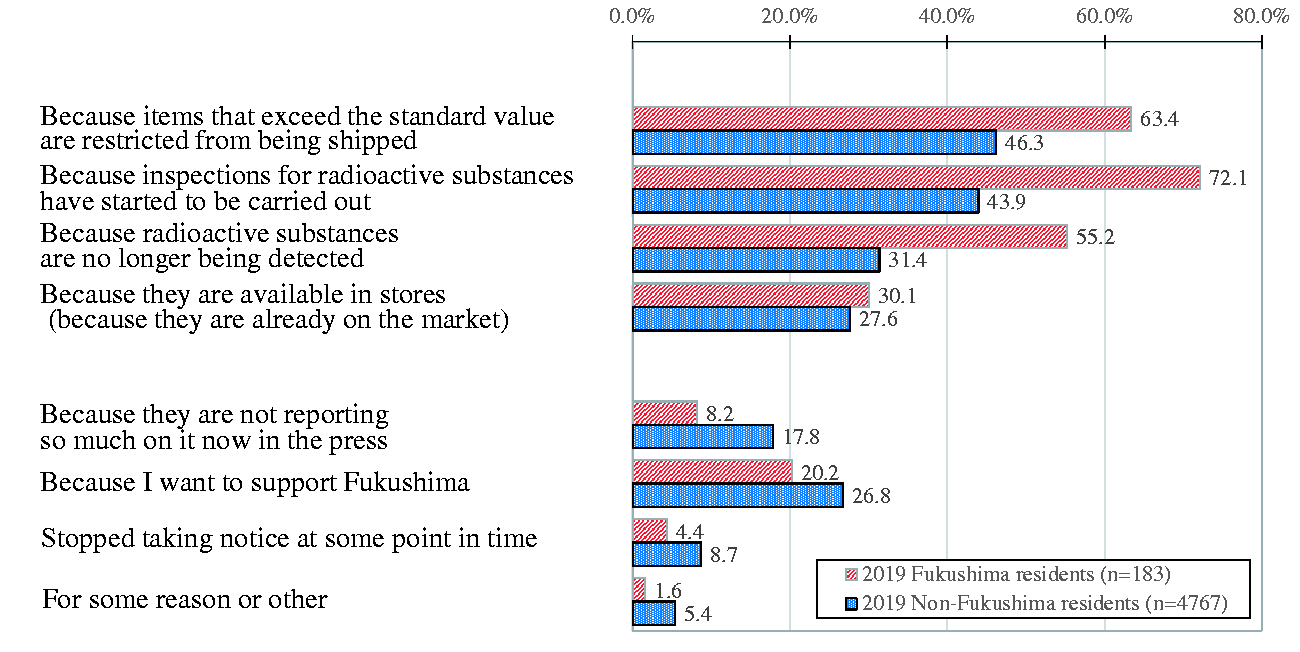
Furthermore, 95% of residents of Fukushima Prefecture reported that they were aware that all rice bags are tested, if one includes those who said that they had ‘heard about it’. Many residents of Fukushima Prefecture are aware of the transition to monitoring inspections, rice inspection results, continuation in the old evacuation order areas, screening inspections for marine products, etc., but these are also recognised by people who do not live in Fukushima Prefecture (Fig. 3). The inspection system and inspection results are less well known outside Fukushima Prefecture, and therefore have less effect on reducing the sense of concern outside Fukushima Prefecture.
Rate of awareness of the inspection system.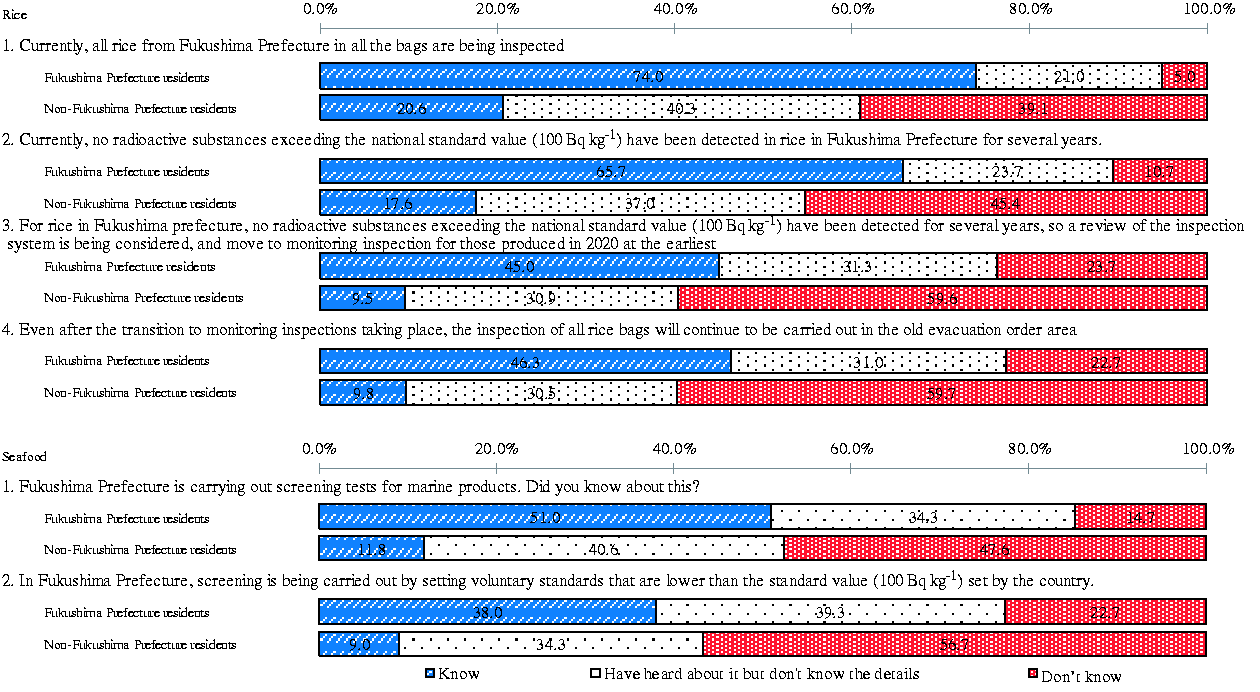
3. SURVEY ON DISTRIBUTOR AWARENESS OF FOODS PRODUCED IN FUKUSHIMA PREFECTURE
The results of the survey targeting distributors are presented below. From the corporate data of Tokyo Commerce and Industry 250 in the order of sales ranking from: (1) wholesale trade in Fukushima Prefecture; (2) retail trade in Fukushima Prefecture; (3) wholesale trade in Japan (excluding Fukushima Prefecture); and (4) retail trade in Japan (excluding Fukushima Prefecture), a total of 1000 cases were extracted. The survey period was from 18 March to 20 April 2015, with 241 valid responses (response rate 24.1%), and from 20 March to 20 April 2019 with 188 valid responses (response rate 18.8%).
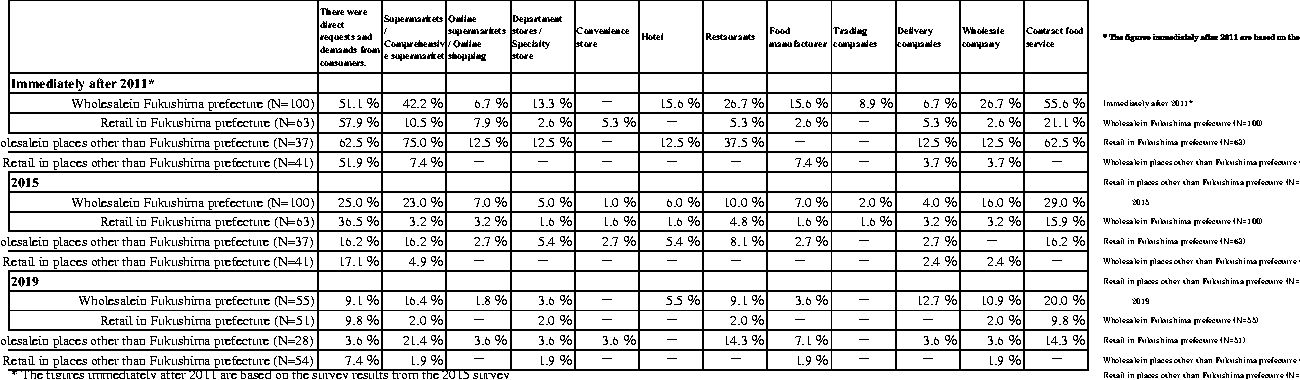
Although the percentage of direct requests from consumers has decreased, there are still some requests and demands from supermarkets, general merchandise stores, and school lunch providers that ask that products from Fukushima Prefecture not be handled (Table 1). Although the percentage of distributors who ‘experience direct requests, demands and claims’ that they do not handle products from Fukushima Prefecture is decreasing, a certain percentage of distributors still ‘feel the tendency for such requests and demands’ (Fig. 4). While the number of requests and complaints to avoid products from Fukushima Prefecture is decreasing, many distributors are convinced that consumers remain uneasy. There is a tendency for consumer trends to be forcefully ‘surmised'.
Business partner fields with requests not to handle products from the disaster area and Fukushima Prefecture. Are there currently any requests or demands not to handle products from the disaster area and Fukushima Prefecture? *The figures immediately after 2011 are based on the results from the 2015 survey.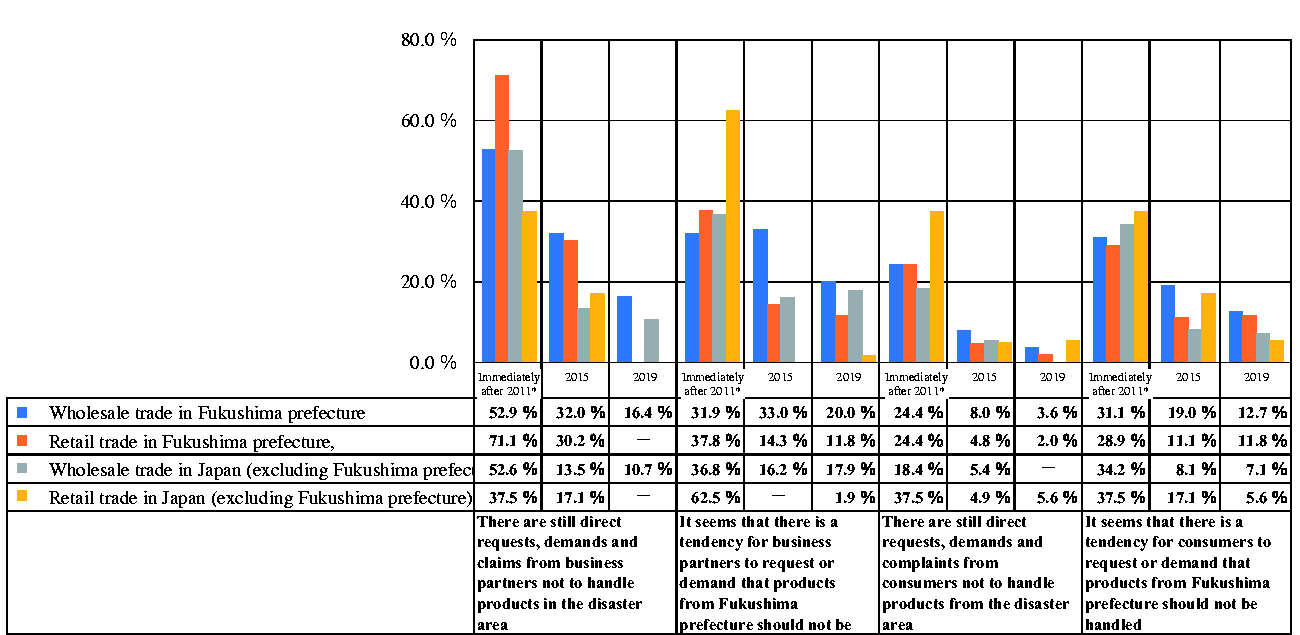
4. CONCLUSIONS
Ten years have passed since the accident at Fukushima Daiichi nuclear power plant, and radioactive substances contained in agricultural products and marine products are now below detectable levels. Amidst this, the testing stance is changing from one that guarantees safety to one that guarantees relief. In addition, testing is reducing due to financial reasons.
The proportion of Fukushima residents who refuse to consume products from Fukushima Prefecture has been decreasing because they have a high recognition rate of the inspection system and results. But the number of non-Fukushima residents who refuse has not been significantly decreasing because they have a low recognition rate of the inspection system and results.
Radiation inspection system has been ongoing since the accident, but it has either been changed or downsized in the past few years . Now that the current inspection results are no longer available, it is not sufficient to simply use the past approach where people have understood the safety of the products from the inspection data. It is necessary to reconsider how to promote safety, for example, by making sure that people have a new understanding of the past trends in the data on radiation levels contained in the past and radiation effects.
In addition, although the number of consumer requests and complaints related to food from Fukushima Prefecture have decreased since immediately after the accident, many distributors still think that consumers are anxious. There is a tendency for consumer trends to be forcefully “surmised”. Distributor awareness remains a reason why the market ranking of rice and beef has not recovered.
While consumers' resistance to food produced in Fukushima Prefecture has diminished, there is a decreasing demand for food for commercial use and in restaurants due to the coronavirus pandemic. Full-scale restoration of distribution routes is becoming indispensable. Based on this change, there is a need to consider measures such as direct delivery to consumers using online sales, development of related processed products, measures to expand further sales channels, etc., instead of simply repeating sales promotion events and commercials.
Over the last 10 years, it has become clear that the amount of radiation in food produced in Fukushima Prefecture has decreased, and that there have been various changes to agricultural products and marine products. With respect to radioactive contamination, inspection systems have moved on to the next stage. However, there is still no way to solve the problems caused by human minds, such as measures against rumours.
What is clear is that knowledge about the inspection system and dissemination of the test results is effective in reducing the proportion of people who refuse to consume food produced in Fukushima Prefecture. There is a need to disseminate information, both domestically and internationally, based on 10 years of inspection efforts and achievements, and to seek ways to provide information that do not rely on inspections.
Notes
(1) It is clear from the statistical analysis of the survey of residents of Fukushima Prefecture that the inspection system and inspection results have a strong influence on purchase intention of produce from Fukushima Prefecture. For details, see Sekiya (2016a). (2) See Sekiya (2019) for treated water issues and Isotope News No. 77 (under construction) for overseas reputational damage. (3) See Note (1). Sekiya (2016) showed that the awareness of test results and test systems is linked to a reduction in anxiety.