




Abstract
At the time of the accident at Fukushima Daiichi nuclear power plant in 2011, I was living in Iwaki City with my two children and my husband. With our home damaged by the tsunami and the deteriorating status following the situation at the nuclear power plant, we spent 2 years as evacuees before returning to Iwaki City. Subsequently, I decided to work as a radiation counsellor in the Suetsugi district of Iwaki City. I would like to describe my experience of taking measurements and helping to communicate with the residents while respecting the lives of local people.
1. FROM THE EARTHQUAKE UNTIL MY RETURN TO IWAKI CITY
The Great East Japan Earthquake on 11 March 2011 also caused a tsunami. We were at the mercy of damage caused by the earthquake, the tsunami, the nuclear accident, and the rapid succession of sudden changes.
1.1. Accident and evacuation
At the time of the earthquake on 11 March 2011, I was living with my husband, our 2-year-old son, and our 10-month-old daughter at our home in Yotsukura-machi, Iwaki City. Our home, which was a few hundred metres from the sea, was hit by the tsunami, so we evacuated to a nearby hillside shelter for 5 days. Subsequently, we learnt about the accident at Fukushima Daiichi nuclear power plant, and although no evacuation orders had been issued around our home, as the children were young, we decided to leave the city voluntarily. At first, we relied on an acquaintance and evacuated to Koriyama City, Fukushima Prefecture for approximately 2 months. We next evacuated to Sendai, Miyagi Prefecture where I was born and raised, and lived there for approximately 2 years with my children. During the evacuation, I had many discussions with my family. In order to establish a proper foundation to life in Iwaki City, we decided to return before the children started at elementary school.
1.2. Nowadays: life during evacuation, learning about radiation
My husband stayed in Iwaki City for his job. This meant that we had to live apart as a family. Life during the voluntary evacuation with my children alone was a similar life to that of a single mother, and in addition to being the most difficult time to raise children, I didn't know how to assess the danger of radiation, which led me to think of it as more dangerous. As a result, I became emotionally trapped and became harsh towards my children. Realising this, I started to study so that I would not have a negative influence on my children. I focused on looking at data that did not appeal to my emotions. As well as checking the daily data on radiation levels that were reported in newspapers and on the television, I measured the radiation levels in our own living space using a Geiger-Muller counter. After understanding the situation, I compared previous nuclear accidents with the accident in Fukushima, and gradually eased the restrictions on activities that I had previously self-imposed on myself and my family.
2. ACTIVITIES AS A COUNSELLOR IN SUETSUGI
2.1. How I became a radiation counsellor in Suetsugi district
Shortly after returning to Iwaki City, Ryoko Ando of Ethos in Fukushima, who was already engaged in radiation measurement activities in Suetsugi, invited me to join and I agreed (Ando, 2016a,b). I was involved in the Suetsugu project as a radiation a counsellor from January 2015 when the project received financial support from Iwaki City until March 2017. After that, from April 2017 to March 2020, the project was supported by Fukushima Medical University as part of its research project (Ando, 2018). When I was searching for answers myself during the evacuation, there were times when I felt very lonely. As such, I thought that the activities in Suetsugi might help to turn the place into somewhere that local residents could face their own concerns and feelings about radiation at their own pace and come to terms with them, and I felt that I might be able to help in that respect.
2.2. Work as a counsellor
2.2.1. External exposure measurement
Our activities included taking measurements of individual doses using an integrated personal D-shuttle dosimeter, which measured external exposure, and holding briefing sessions to explain the analysis of the results and graphs to the residents (Chiyoda Technol, 2020). Makoto Miyazaki of Fukushima Medical University was asked to analyse the data and explain it as an expert (Miyazaki, 2017). Dr. Miyazaki did not always come to Suetsugi, so I gave detailed explanations to the residents myself, and acted as a communication link whereby I would contact Dr. Miyazaki when queries were raised.
Results of external exposure measured using 15 individual cumulative D-shuttle dosimeters (Chiyoda Technol) in the Suetsugi district from April to May 2014 (created by Makoto Miyazaki, Fukushima Medical University).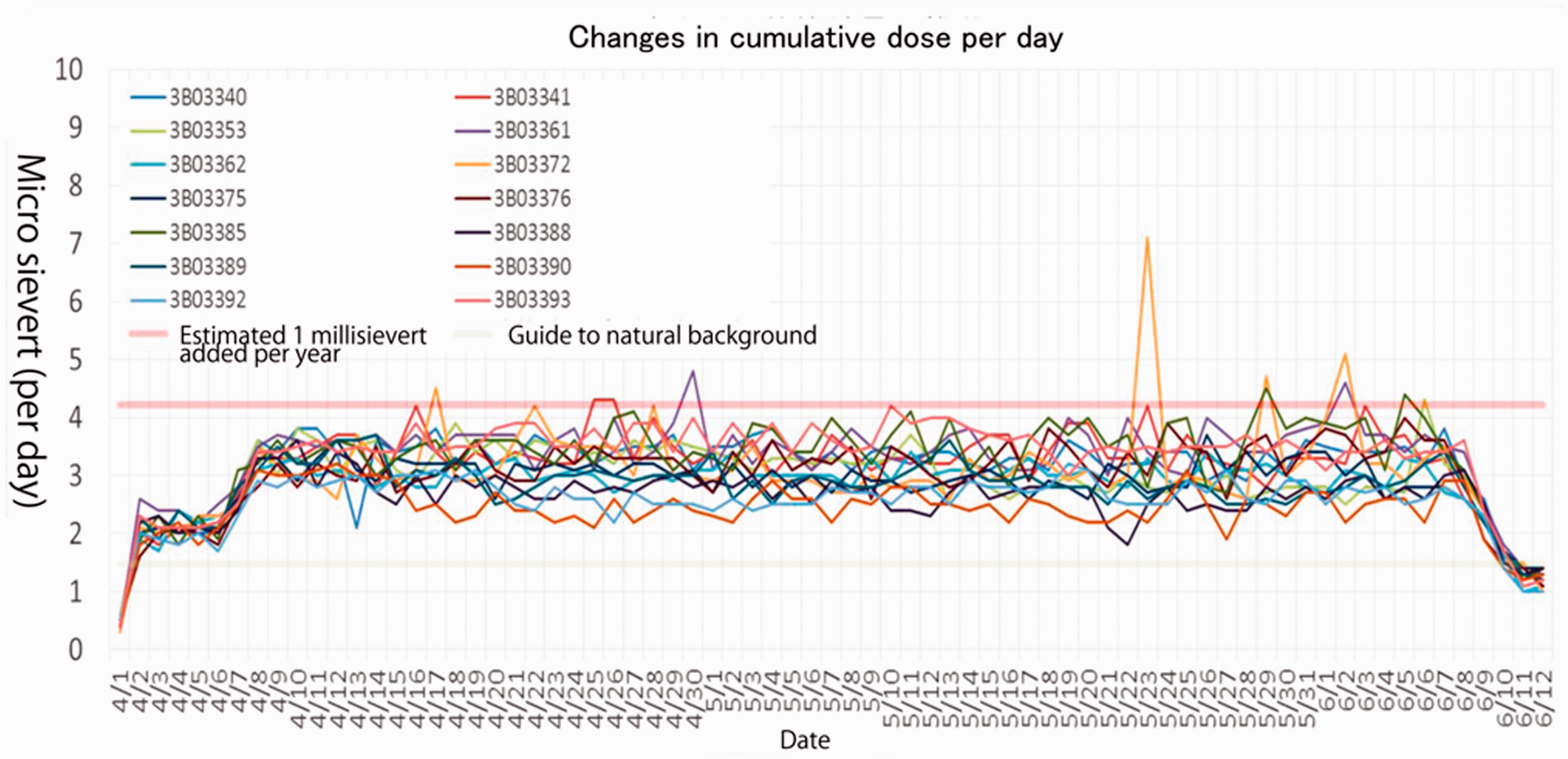
Dr. Miyazaki drew a line indicating the background level in the lower area of the graph of personal doses and a line indicating an additional 1 mSv of exposure over 1 year at the top, and explained to the residents in a visual way that their personal dose was virtually always in the gap in between (Fig.1). Explaining the link between individual lives and personal doses was easily understood by the residents when looking at a graph, without the need for difficult technical terms.
2.2.2. Food measurement
My main role was to manage radiation measurements of foodstuffs at a meeting place in Suetsugi district. I explained the results of the food measurements. I was careful to do two things: to let the residents know that the results were measured in radioactivity per kg, and to encourage them, through conversation, to have a concrete picture of the amount they would actually consume in their own diets.
Over the years, the number of people bringing in food consistently all through the year has decreased. On the other hand, the number of people bringing in seasonal fruits and vegetables did not decrease noticeably. (Fig.2, Fig.3) I personally felt that many people wanted to keep a record of the produce that they were familiar with or had an emotional attachment to, and this impressed me a lot. For example, mandarin oranges, astringent persimmons for drying, and other fruits that can only be picked at certain times of the year. I feel that the reason why they want to measure the food is because that food is very much connected to their sense of fulfillment in life. By checking the radiation levels of food, it seemed to me that they were not only learning about radiation levels and safety, but also reaffirming the value of their own lives. I am sure there were various reasons why the residents wanted to measure the radiation levels of various foodstuffs, and I felt that I could understand the various thoughts of these people. For example, in a household that was harvesting mandarin oranges, there were people who had been looking forward to sending them to other families living far away, as they did every year. They had decided to refrain from doing so after the nuclear accident, but were pleased that they ‘could confidently feed them to their little grandchildren’ when they discovered that there were no issues. Someone who had been worried about radiation at the beginning but who was chatting brightly after taking measurements left an impression on me.
Number of people visiting for measurement and number of food items measured in Suetsugi district in fiscal year 2016.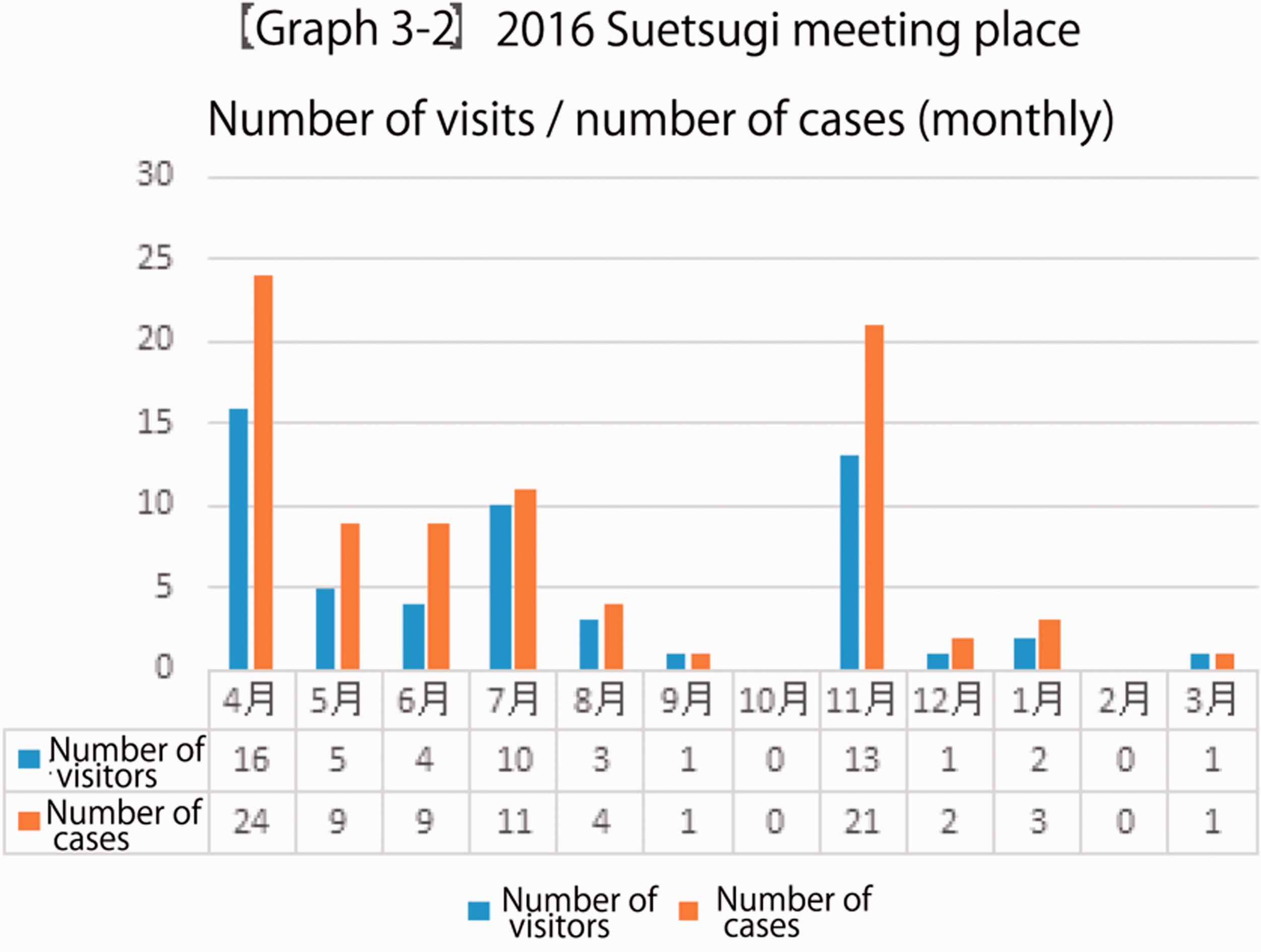
2.2.3. Publishing Suetsugi-dayori
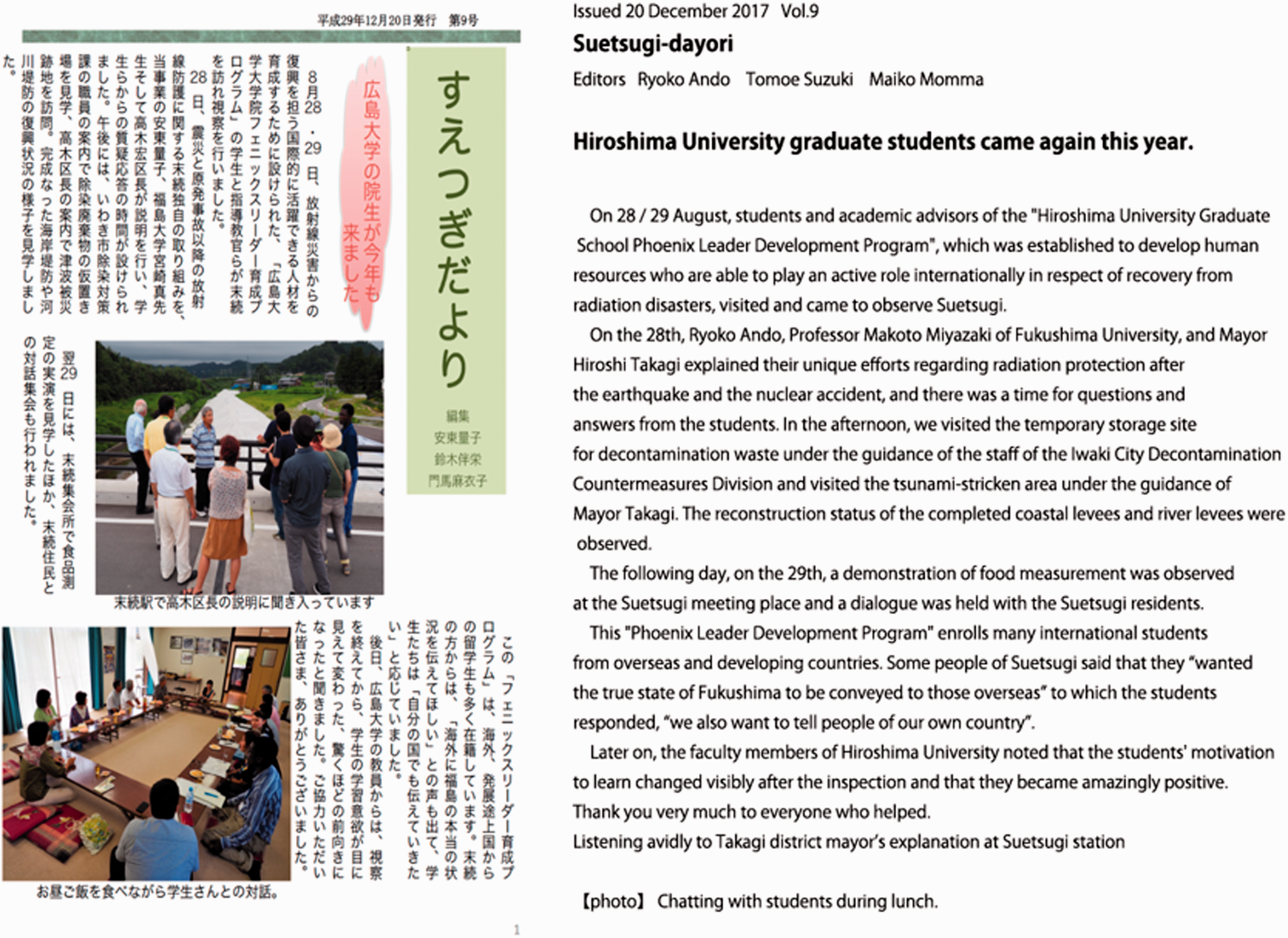
Also, a newsletter, Suetsugi-dayori, was produced once every 3 months. (Fig.4) Suetsugi-dayori included the measured radiation results, enabling the results to be shared between all residents of the district. By doing this, even people who could not come to hear Dr. Miyazaki explain were able to understand the situation, and even if they did not come to the foodstuff measurement themselves, they were able to understand the radiation situation of local foods.
Although there have been changes in activities such as individual dose measurements, with the use of D-shuttle dosimeters stopping as time passed, food measurements and publication of Suetsugi-dayori continued for approximately 5 years.
I wrote many interview articles for Suetsugi-dayori. I would talk to one person every month for approximately 2 h on average. I felt that everyone had a clear memory of what happened at the time of the accident, even after time had passed. When normal life returned, I was able to listen to stories of life based on Suetsugi community, experiences and a view of life.
Number of people visiting for measurement and number of food items measured in Suetsugi district in 2017. Suetsugi-dayori December 2017 edition. Left: Original Japanese version. Right: English translation.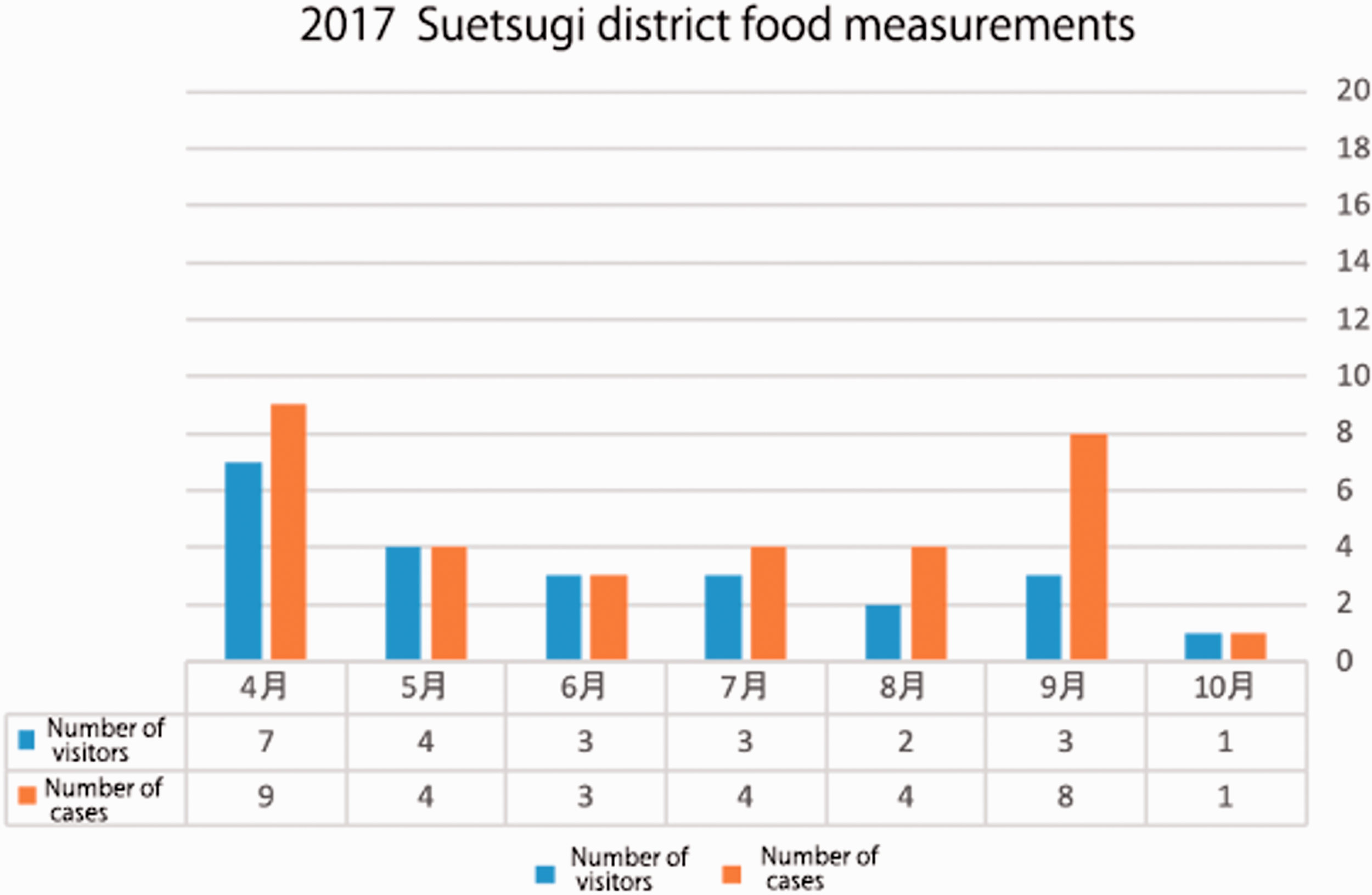
Residents also expressed the loneliness of large families living apart due to the evacuation and the fact that there were fewer children from Suetsugi. On the other hand, I heard that even in such a situation, they were encouraged to see the young generation in the area working hard to cope with the radiation. We heard from people of all ages about their experiences of how they have recovered in their own way from the nuclear accident they suddenly encountered in the middle of their lives.
3. WHAT I LEARNT AND WANT TO CONVEY REGARDING ACTIVITIES AS A COUNSELLOR
3.1. Meaning of measurement, attitude as a counsellor
What's important in measurement is not just giving the results. Through conversations, I became aware of why the measurements were wanted and what the foods meant to people. Eating habits are directly linked to an individual’s life and that of their family, and have a major influence on quality of life. To regain control of one's diet through measurement is equivalent to rebuilding one's life in the face of the reality of radioactive contamination. Their attachment to food means their attachment to life, and listening to their feelings through measurement was the most crucial aspect of the measurement.
I continued to be involved in measurements without being nervous. I thought that if I tried too hard to get people to understand radiation, it would put unnecessary pressure on the people who came, and they would not feel able to voice any small doubts. I personally thought I would spend 10 years taking measurements. I think this was probably the main reason why I was accepted by the district. I myself relaxed and asked the seniors in my own life to talk about child-rearing and housework, and I worked to create a relaxed atmosphere where people felt comfortable to chat. I believe this is why measurements were continued for years without resistance from local people.
Furthermore, in the latter years, the residents started to provide topics and essay articles for publication in the newsletter. It felt like people were looking forward to each issue of Suetsugi-dayori.
3.2. Characteristics of the activities in Suetsugi
I believe that what characterised our actions in Suetsugi was maintenance of the stance that the residents were the central focus. Residents’ wishes were valued, and external supporters such as ourselves did not push their opinions aside. Moreover, we were careful not to trample on the lives and relationships of local people. Experts acted as experts and counsellors acted as counsellors to assist if there were enquiries from the residents, and we tried to think ‘together’ about the measurements (Lochard et al., 2020).
There was no need for counsellors to explain radiation using technical terms when residents were unclear about something. I think that explaining that you do not understand something if you do not understand it, and following this up properly after consultation with an expert is the best way to gain the trust of residents.
Supporters are merely outsiders. I think the most important thing is for outsiders to earn the trust of residents in order to support the community (Ethos in Fukushima, 2020). Those of us involved as supporters in the community continued to work diligently, fulfilling our respective responsibilities. I think this helped to build trust and made it possible for us to work for a long time.
4. CONCLUSIONS
It is almost 10 years since the earthquake and accident at Fukushima Daiichi nuclear power plant. The progress in Suetsugi district over these 10 years has been summarised in videos and papers. These papers and videos give a clear picture of what radioactivity, experts and measurements look like from the residents' point of view. I would like all the experts to take a look too. Our activities have been carried out over a long period of time with major efforts from local people and many volunteer supporters, including Dr. Miyazaki, Mr. Jacques Lochard. Please see papers for details on how and what went on (Ando 2016a, Ando 2016b, Ando 2018, Lochard et al. 2020, Ethos in Fukushima 2020).