




Abstract
European Radiation Dosimetry Group (EURADOS) Working Group 7 is a network on internal dosimetry that brings together researchers from more than 60 institutions in 21 countries. The work of the group is organised into task groups that focus on different aspects, such as development and implementation of biokinetic models (e.g. for diethylenetriamine penta-acetic acid decorporation therapy), individual monitoring and the dose assessment process, Monte Carlo simulations for internal dosimetry, uncertainties in internal dosimetry, and internal microdosimetry. Several intercomparison exercises and training courses have been organised. The IDEAS guidelines, which describe – based on the International Commission on Radiological Protection’s (ICRP) biokinetic models and dose coefficients – a structured approach to the assessment of internal doses from monitoring data, are maintained and updated by the group. In addition, Technical Recommendations for Monitoring Individuals for Occupational Intakes of Radionuclides have been elaborated on behalf of the European Commission, DG-ENER (TECHREC Project, 2014–2016, coordinated by EURADOS). Quality assurance of the ICRP biokinetic models by calculation of retention and excretion functions for different scenarios has been performed and feedback was provided to ICRP. An uncertainty study of the recent caesium biokinetic model quantified the overall uncertainties, and identified the sensitive parameters of the model. A report with guidance on the application of ICRP biokinetic models and dose coefficients is being drafted at present. These and other examples of the group’s activities, which complement the work of ICRP, are presented.
1. EURADOS Working Group 7 – A network on internal Dosimetry
Task groups within EURADOS Working Group 7 (Internal Dosimetry).
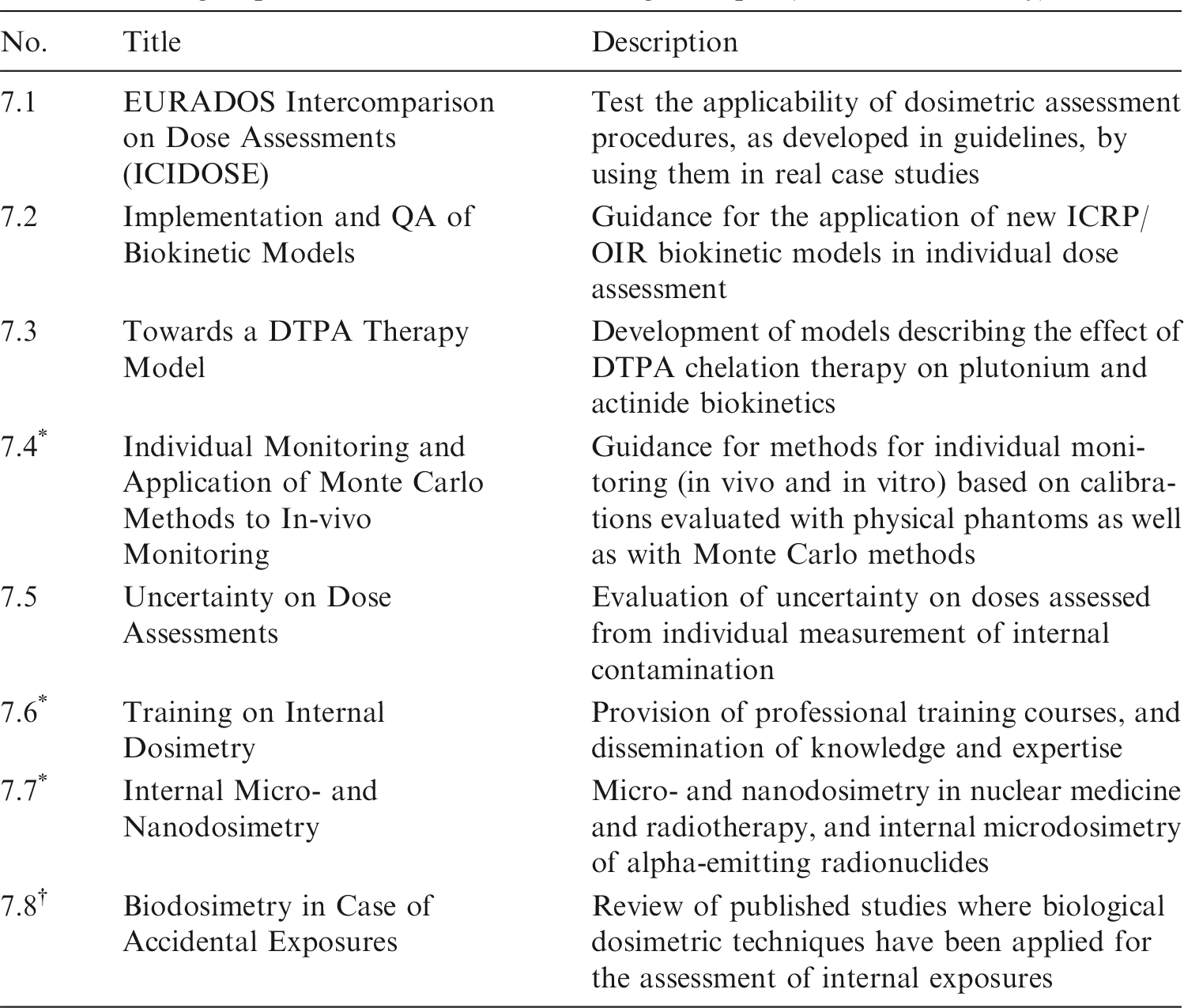
QA, quality assurance; ICRP, International Commission on Radiological Protection; OIR, occupational intakes of radionuclides; DTPA, diethylenetriamine penta-acetic acid.
These task groups are collaborating with EURADOS Working Group 6 (Computational Dosimetry).
This task group is a joint effort with EURADOS Working Group 10 (Retrospective Dosimetry).
2. Selected Activities
While ICRP develops methodology, reference models, and reference data for internal dosimetry, EURADOS focuses on supporting practitioners of internal dosimetry in application of the ICRP system and providing feedback to ICRP. Thus, the work of Working Group 7 is complementary to that of ICRP. Selected activities that demonstrate the work of Working Group 7 are summarised in the following sections.
2.1. Structured approach for internal dose assessment (IDEAS and TECHREC)
The IDEAS guidelines were developed in a European project as a follow-up action to the third European intercomparison exercise on internal dose assessment, which showed a need for harmonisation of procedures (Doerfel et al., 2000). The guidelines (Doerfel et al., 2006) present a step-by-step approach for the process of internal dose assessment based on the principles of harmonisation, accuracy, and proportionality. By following the procedure described, any two assessors should obtain the same dose estimates from the same bioassay data, which are intended to be best estimates. The guidelines also provide information on handling of monitoring data, data below detection limits, and biokinetic model fitting procedures. Improvements, revision, and update of the guidelines were performed in 2008–2012 by Working Group 7, resulting in Version 2 of the guidelines (Castellani et al., 2013).
In the TECHREC project (2014–2016), which was funded by the European Commission, members of Working Group 7 developed a document entitled ‘Technical Recommendations for Monitoring Individuals for Occupational Intakes of Radionuclides’, which will be published as a report in the European Commission radiation protection series (Etherington et al., 2016). The document brings together requirements and guidance from many sources, including European Directives, ICRP publications, reports of the International Commission on Radiation Units and Measurements, standards of the International Standardization Organization, and documents of the International Atomic Energy Agency (IAEA). It covers all topics of occupational internal dosimetry: monitoring programmes, monitoring techniques, dose assessment procedures, uncertainties, quality assurance, and reporting. The final TECHREC report, which will be published by the European Commission, intends – taking all recent developments into account – to give a complete account of the principles of monitoring for occupational intakes of radionuclides, and provide comprehensive detailed, authoritative, and internally consistent guidance on the practice of individual monitoring and internal dosimetry.
These two documents are examples of how Working Group 7 provides guidance for the application of the methodology and models provided by ICRP in their publications on internal dosimetry, and are useful tools, especially when assessing doses after ‘unusual’ or ‘non-standard’ cases of radionuclide incorporation. Working Group 7 is currently conducting an intercomparison exercise ICIDOSE 2017 on dose assessment after incorporation of radionuclides. This exercise will enable testing of the usefulness and impact of the proposed guidelines and recommendations.
2.2. Quality assurance and development of biokinetic models
The task group on biokinetic models observes the developments of ICRP biokinetic models. Draft models are implemented by the group and solved for defined scenarios. These calculations (e.g. for the updated caesium and iodine models) and intercomparison of results helped the group members with correct implementation of the models, but also showed some ambiguities in the descriptions of the ICRP models, which, with different interpretations, lead to small discrepancies in the results (Noßke et al., 2008). This feedback provided external quality assurance for ICRP during their work, and helped to improve the description of the models. Currently, a report is being drafted by the group to give guidance on the application of ICRP’s biokinetic models for individual dose assessment. The main parts of the document will be the element sections, which describe the models of the most common elements/radionuclides, provide guidance on their application to specific cases, and compare the new results with the former results. The report will also contain a chapter on implementation of the biokinetic models, which is covered only by a short paragraph in Occupational Intakes of Radionuclides (OIR) Part 1 (ICRP, 2015), and by two pages in Publication 133 (ICRP, 2016a). This quality assurance work and the future guidance report of Working Group 7 complement and support the work of ICRP.
When decorporation therapy is utilised, the reference methodology and dose coefficients of ICRP cannot be applied without modification of either data or models because biokinetic behaviour is intentionally modified. The development of models of plutonium and americium biokinetics able to describe the effect of decorporation therapy with chelating agents (such as diethylenetriamine penta-acetic acid) will enable dosimetrists to apply ICRP’s methodology to these cases. Such models will enable dose assessments to be performed without delay, and support the evaluation and planning of further therapies. The development of a method based on coupling a biokinetic model for the chelating agent to ICRP’s reference model for the biokinetics of actinides began during the CONRAD project (2005–2008) and is continuing in Working Group 7 (Breustedt et al., 2009; Kastl et al., 2014). A major issue in this task is the physiological interpretation of the compartments and transfers in the biokinetic models, and the interpretation of the available (animal and human) data.
2.3. Uncertainty in dose assessments
The study and treatment of uncertainties in internal dose assessments remain topics of scientific interest. The biokinetic models published by ICRP are reference models, the parameters of which are intended to represent a reference person. By definition, those parameter values are fixed numbers without uncertainties. Sensitivity analysis and the estimation of associated parameter uncertainties in biokinetic models need to be performed for better understanding of the models and to estimate influences of the single parameters on the predictions of the models and thus the dose coefficients (Leggett, 2001, 2003). The results of such studies provide information about the reliability of assessed doses and indications to select sensitive parameters for a better fit of the models to monitoring data, especially in non-routine cases. A study of the recent biokinetic model for caesium with different statistical techniques has been performed by Task Group 7.5 (Li et al., 2015).
The approach to uncertainty in dose reconstruction for epidemiology is another topic of the task group. An intercomparison exercise of lifetime dose reconstruction for three ‘representative’ uranium workers was organised in 2016–2017. Different hypotheses on key items (e.g. chronic vs acute intake regimes, type of absorption from lungs to blood, treatment of data below detection limit) lead to different results and thus variability in the assessed doses. A EURADOS report on the exercise and its implications, including guidance for assessors of similar cases, is in preparation.
2.4. Dissemination and training actions
The dissemination of knowledge and training in internal dosimetry is one of the main goals of Working Group 7. In collaboration with Working Group 6 (Computational Dosimetry), several intercomparison exercises on the application of Monte Carlo methods for the efficiency calibration of in-vivo counters have been undertaken (Gómez-Ros et al., 2008; Lopez et al., 2011b; Broggio et al., 2012; Vrba et al., 2014). In 2017, an intercomparison exercise with case studies for dose assessments has been organized. Several training actions have been carried out, including a winter school on internal dosimetry at the EURADOS annual meeting in 2017, a EURADOS/IAEA regional training course on advanced methods for internal dose assessments (Castellani et al., 2011), and a Working Group 7–Karlsruhe Institute of Technology training course on Monte Carlo methods for calibration of body counters (Breustedt et al., 2016).
In 2018, the latter course will be repeated as an advanced module of the EURADOS training course on the application of Monte Carlo methods for dosimetry of ionising radiation, being part of the E&T course for the application of Monte Carlo methods to dosimetry of ionising radiations, supported by CONCERT – the European Joint Programme for the Integration of Radiation Protection Research. Further planned training actions include a training course on the fundamentals of internal dosimetry, and a training course dedicated to the technical recommendations developed in the TECHREC project (Etherington et al., 2016).
3. The Future – OIR Series and Beyond
In 2015 and 2017, ICRP published the first two parts of its OIR series (ICRP, 2015, 2016b). The five planned publications of this series are intended to update the methodology of internal dose assessments and the reference (biokinetic and dosimetric) models and data. New dose coefficients based on the updated weighting factors of Publication 103 (ICRP, 2007) are provided. The computational framework for the calculation of dose coefficients has been described in an additional publication (ICRP, 2016a), which also provides data for the specific absorbed fractions required for the calculations. Models and data for assessment of doses (to members of the public) following intakes of radionuclides after environmental contamination (i.e. EIR) will be published by ICRP in future.
Working Group 7 will continue to observe the development and implementation of OIR and EIR models; the consequences of using the new models in the dose assessments will be studied, and further guidance in terms of application of ICRP’s system and models will be provided by the group. One of the updates that may, in future, raise a demand for supporting guidance is the change from using a shared kinetics approach to using independent (bio)kinetics for progeny nuclides. In the compartmental systems representing the different radionuclides within a decay chain, some organs and tissues are identified explicitly, while others are subsumed in a global pool of activity. When the identified regions vary along the decay chain, the biokinetic models of the progeny need to be modified for connecting with the compartmental structure of the parent, which is not always straightforward.
One has to keep in mind that the reference models as published by ICRP are always a compromise between physiological realism and simplicity (and thus applicability) (ICRP, 2015). A more detailed understanding of the processes and mechanisms behind the biokinetic behaviour of radionuclides, and detailed modelling, will facilitate a mechanistic modelling of decorporation therapy as well as adjusting the reference models to specific situations. More research work needs to be done by the internal dosimetry community to develop more detailed models which, in turn, could provide a basis for future ICRP reference models. Working Group 7 will continue its work in biokinetic modelling and promoting these research efforts.
For studying some biological effects of internal emitters, the dose quantities at the organ or regional tissue level might not be sufficiently accurate. Here, micro- and nanodosimetry can be employed to obtain detailed information about the distribution of energy deposition at the cellular or molecular level. Task Group 7.7 is studying the methods and techniques of micro- and nanodosimetry for internal emitters using Monte Carlo simulations of radiation transport at these scales. Applications cover the microdosimetry of inhaled alpha emitters and some Auger emitters (e.g. 125I), nanodosimetry of applying monoclonal antibody conjugated gold nanoparticles in radiotherapy, targeted molecular radiotherapy, and the biological effects at the molecular (e.g. DNA strand breaks) and cellular level (e.g. cell survival/killing). Work in this field will contribute to the understanding of the biological effects of internal emitters, and can contribute to further development of ICRP recommendations and models.
Besides the topics mentioned above, there are many more topics in internal dosimetry that demand further research (e.g. dosimetry of radon plus progeny, and personalised dosimetry for radiopharmaceuticals). Working Group 7 will continue to act as a network to promote research and collaboration in internal dosimetry, and will also continue dissemination and training actions as well as providing guidance on application of the ICRP methodology and data in dose assessment after intakes of radionuclides. The strong collaboration of Working Group 7 and ICRP Committee 2 will provide a good basis for future work, and will ensure that EURADOS actions are complementing ICRP work in internal dosimetry, and will contribute to advance internal dosimetry.