Abstract
This article examines postdisaster public health activities (focusing primarily on parenting support) through collaboration between universities and local government, and reports on the support provided to public health nurses, who are the gatekeepers of community health. For a year after the Fukushima disaster, discussions were held on the short- and long-term measures for responding to the concerns of parents, who face difficulty interpreting risks. Child health checkup data and mothers’ counselling sessions with public health nurses were analysed to gather evidence to reinforce the health system over the long term. As the results of the analysis showed a need for the development of a system for communicating health information in ways that are accessible to residents, a health literacy training programme was developed and implemented for public health nurses in Fukushima Prefecture.
1. Three perspectives
The postdisaster activities undertaken by the author, a specialist living in Fukushima Prefecture, can be summarised from three perspectives. The first perspective is that of a mother living in Fukushima with a child. In academic terms, this may be described as participatory observation of a qualitative study. The second perspective is that of an epidemiologist. The author has been involved in the analysis of data from the Fukushima Health Management Survey (a prefecture-wide cohort study) and the provision of parental support services based on the obtained results. The third perspective is that of a public health physician working with public health nurses in the region. In this area, in particular, the author is promoting health literacy for improving access to health information. This paper will focus primarily on the third perspective.
2. Start of activities
Fukushima city, which is home to Fukushima Medical University, lies within the 50-mile evacuation zone recommended by the US Government in the immediate aftermath of the accident at Fukushima Daiichi nuclear power plant. Mothers living in the city were naturally concerned about the health risks of radiation, and some decided to evacuate. Partly for this reason, the population of children aged <5 years in Fukushima city declined by nearly 15% during the 2 years following the disaster. A report by the Fukushima Nuclear Accident Independent Investigation Commission recommended disclosing information ‘for use by individual residents to make informed decisions’ (NAIIC, 2012) to assuage the concerns of residents. However, it was not at all clear, especially in the immediate aftermath of the accident, what specific actions were needed to address those concerns.
Approximately 1 month after the accident, the author received a telephone call from a public health nurse with whom she had worked on maternal and child health in Fukushima city. She wanted advice regarding how public health nurses could help mothers with concerns about radiation. Details about the author’s response have been published previously (Goto et al., 2014a). In short, the author asked the nurse to list the major concerns of mothers and the difficulties faced by nurses. She subsequently consulted with specialists in respective fields for their advice regarding the concerns and problems listed, and organised meetings with the nurses. The first meeting with the nurses, approximately 2 months after the accident, focused on responding to parents’ immediate anxiety. The second meeting, organised 6 months after the accident, addressed issues related to parents’ persistent anxiety, and the third meeting, held 8 months after the accident, examined ways to strengthen the long-term system for responding to parents’ concerns. Proposals were made on the topics discussed at each meeting: systematic information provision and setting up indoor play spaces at the first meeting; expansion of counselling services at the second meeting; and an early parenting support system and regular training sessions for public health nurses at the third meeting. The role of the author at these meetings was to listen to nurses report on the state of affairs as an adviser, collect information from specialists as needed, and assist nurses to make their own proposals regarding the steps needed. This experience, and discussion with Mr Jacques Lochard of the International Commission on Radiological Protection, suggested that it was important to take each of the following steps in turn when building trust through dialogue in health risk situations:
when responding to a person seeking advice, make it clear that you cannot tell the person what to do; ask the person to describe his/her concerns and situation; and think together with the person about what measures could be deployed.
3. Finding evidence
With regard to the proposal for strengthening the health system made at the third meeting with nurses, there was a need for detailed analysis of municipal data to draw evidence that could be used to plan measures. A database was created from health checkup files of 18-month-old children. This included written records of mothers’ counselling sessions with public health nurses. The detailed results of the analysis have been published previously (Goto et al., 2014b,c). In short, interpersonal problems at home were significantly associated with lower maternal confidence in parenting, and mothers who were concerned about differences in risk perception about radiation among family members tended to be depressed (Goto et al., 2014b). In addition, public health nurses reported difficulties in communicating information about health risks to residents (Goto et al., 2014c). This implied the need for public health nurses to improve their skills in mediating health information to mothers.
4. From data to action
This led to the launch of training workshops on health literacy for public health nurses in Fukushima Prefecture in 2013 (Goto et al., 2015). Health literacy is both knowledge and skills that residents need in order to gain access to, understand, and use information for promoting and maintaining good health, as well as knowledge and skills that healthcare professionals need for communicating health information. The training programme consists of two training sessions, followed by 1 month of application of the learned skills in practice. In the first session, the public health nurses are given an overview of health literacy skills, after which they learn the processes for assessing health information materials for ease of understanding. In the second session, they learn how to improve the understandability of the materials they assessed. They apply the learned skills to their work for the next month, at the end of which they are given a questionnaire sheet for reviewing the application of skills and additional materials.
As health information needs to be communicated in ways that are easily understandable by those receiving the information, the training programme places emphasis on two-way communication between those who disseminate information and those who receive information. Specifically, the author has introduced the ‘marker method’ to assess health information materials for ease of understanding. In this method, a person is given printed health information material and a marker, and is asked to ‘mark any words or sentences that might be difficult for another reader to understand’. It is often the case that the marked words are technical words that are familiar to the expert who created the material. The marker method not only creates opportunities to involve residents in the process of writing health information, but also helps public health nurses to take pride in the use of a new approach in improving communication with residents.
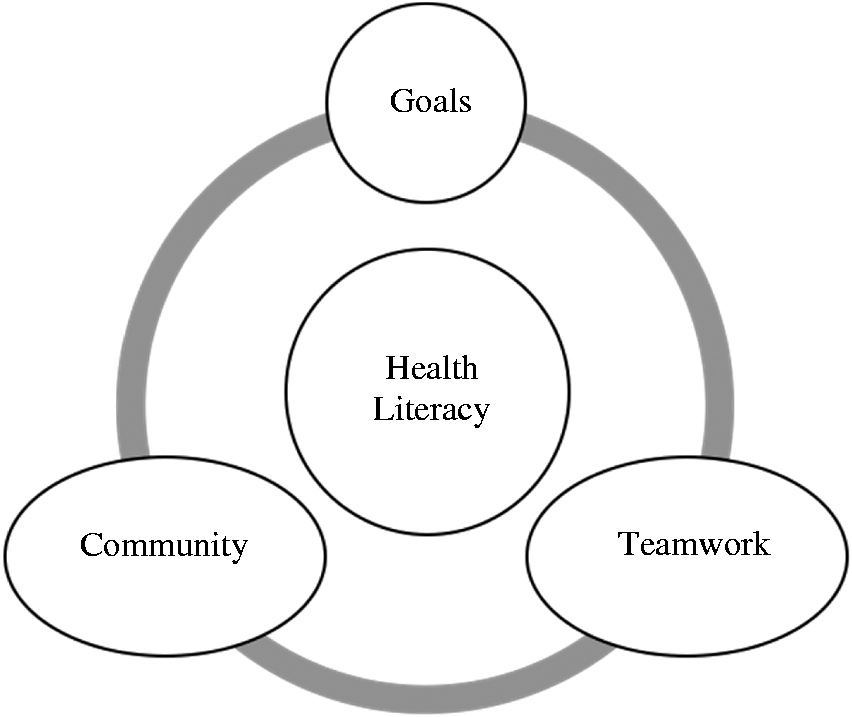
The long-term effects of the training programme that encourages healthcare professionals to embrace a health literacy perspective include improvement in accessibility to health information and improvement of the health system (Fig. 1) (Lai et al., 2015). This stems from the fact that, first of all, it promotes communication with residents as mentioned above. Second, it requires the communication to be relevant and to the point, which in turn requires the communicator to clarify the goals of the communication and hence the goals of the health promotion activities of which the communication is a part. Further, the training programme also stresses the importance of teamwork in creating the health information materials. As four eyes see more than two, working in a group means that the material can be revised from different angles to make the final product easy to understand.
Reinforcing the health system from a health literacy perspective.