




Abstract
Committee 4 of the International Commission on Radiological Protection (ICRP) is responsible for developing principles, recommendations, and guidance on the protection of people against radiation exposure, and to consider their practical application in all exposure situations. Currently, the Committee’s efforts are focused on the completion of a series of future ICRP publications on the implementation of its 2007 Recommendations to the various existing exposure situations. A report on protection against radon exposure was published recently (ICRP Publication 126), and two documents on protection against cosmic radiation in aviation, and naturally occurring radioactive material are under development. The programme of work for the forthcoming 2013–2017 period comprises the update of ICRP Publication 109 on protection of people in emergency exposure situations, and the update of ICRP Publication 111 on protection of people living in long-term contaminated areas after a nuclear accident, as well as the development of a future ICRP publication on the ethics of radiological protection. It also includes the preparation of task groups on the application of the Commission’s recommendations for contaminated sites from past activities and for surface and near-surface disposal of radioactive waste. Another important task for Committee 4 will be to develop a reflection on the tolerability of risk from radiation.
Keywords
1. Introduction
Committee 4 of the International Commission on Radiological Protection (ICRP) was created in 1962, with the name ‘Application of the Commission’s Recommendations’, when the Commission decided to re-organise its committee system in order to adapt to the changing context of radiological protection and to improve its mode of operation (ICRP, 2009a). In 1977, when the Commission reviewed and updated the names and missions of its committees, Committee 4 kept its name, which is still valid today, and its mission was stated as follows: ‘Committee 4 will continue its role of providing advice on the Commission’s system of dose limitation, and on protection of the worker and the public. The Committee will also serve as a major point of contact with international organisations concerned with radiation protection’. This basic mission has not changed since that time, but the wording was modified slightly when the first strategic plan of the Commission was prepared, and subsequently adopted in 2011 (ICRP, 2011), to be in coherence with the new approach of the system of radiological protection based on exposure situations. It now reads as: ‘Committee 4 develops principles and recommendations on radiological protection of people in all exposure situations’.
In 2013, with the beginning of a new term running until 2017, Committee 4 underwent a substantial renewal with 10 of the 17 members and the Chair being new. The membership reflects a good mixture of operational, academic, and regulatory expertise.
This paper presents an overview of the programme of work of Committee 4 for the 2013–2017 term. The emphasis is on the update of Publication 109 on protection of people in emergency exposure situations (ICRP, 2009a), and the update of Publication 111 on protection of people living in long-term contaminated areas after a nuclear accident (ICRP, 2009b) to take into account the lessons from the Fukushima Daiichi nuclear power plant accident, as well as the preparation of a future publication on the ethical foundations of the radiological protection system.
2. Programme of work of committee 4
In recent years, Committee 4, in parallel with the publication of three reports on protection in geological disposal of long-lived solid radioactive waste (ICRP, 2013), protection of the environment under different exposure situations (prepared jointly with Committee 5) (ICRP, 2014a), and security screening (ICRP, 2014b), has focused its efforts on the development of guidance for ‘existing exposure situations’. A first report on protection against radon exposure has also been published (ICRP, 2014c). Further work is underway, which concerns naturally occurring radioactive material (NORM) and cosmic radiation in aviation.
2.1. Work in progress
2.1.1. Naturally occurring radioactive material
Since the renewal of Committee 4, Task Group 76 on radiological protection against enhanced exposure from industrial processes using NORM has been placed under the chairmanship of Jean-François Lecomte (France) with a new membership and a more focused mandate. The objective is to develop a report presenting the general principles that apply to exposure situations resulting from activities involving NORM not deliberately used for their radioactive properties. Without entering into the details of the numerous industrial sectors involved, Task Group 76 will focus on the main steps of the activities that could give rise to significant exposure of workers or the public: extraction and handling of raw material; manufacture of products; generation of by-products; management of waste; and rehabilitation of contaminated sites.
The first discussions of Task Group 76 led to the conclusion that exposure situations resulting from activities involving NORM not deliberately used for their radioactive properties should be considered as existing exposure situations. As for any existing exposure situation, characterisation of the exposures is a prerequisite before any control can be envisaged. Exposures generally fall into the category of public exposure, but can be considered as occupational exposure in certain situations. Establishing a control on exposures resulting from NORM must be justified (i.e. do more good than harm), with all relevant factors being carefully considered, and, if justified, this control must be implemented through the principle of optimisation of protection. This involves identifying exposures that deserve to be reduced given their magnitudes using a restriction on individual doses to reduce inequity in the entire dose distribution. In accordance with the general recommendations of the Commission (ICRP, 2007a), the reference level to restrict exposures must be selected at or below the 1–20 mSv year−1 band as appropriate given the prevailing circumstances, and the basic requisites of information, assessment of exposures, and involvement of stakeholders must be applied in a graded approach. Beyond these general principles, Task Group 76 recognises that for reasons of convenience and/or equity, competent authorities may want to manage specific activities or parts of them like planned exposure situations.
2.1.2. Cosmic radiation in aviation
The development of a future ICRP publication on radiological protection against cosmic radiation in aviation is the responsibility of Task Group 83 under the chairmanship of Jacques Lochard (France). A draft report is now available and is being reviewed by Committee 4. Task Group 83 considers that exposure of aircraft crew and passengers to cosmic radiation, including solar eruptions, is an existing exposure situation. Doses received in aeroplanes can be well predicted by computer codes, and experience shows that the average annual dose of aircraft crew is higher than the average annual dose received by workers in the nuclear fuel cycle. Considering the constant increase of passengers in the future and the trend for aircrafts to fly for longer durations and at higher altitude, implementing a strategy for cosmic radiation in aviation is justified with the aim of keeping exposure of passengers and aircraft crew as low as reasonably achievable.
For the practical implementation of this strategy, Task Group 83 is proposing to use a graded approach proportionate to the level of exposure that may be received by passengers and aircraft crew. In view of the current options for the control of exposure during flights, Task Group 83 maintain the previous position of the Commission that the main action to control exposures in aviation is to adapt the flight schedules of the most exposed individuals by combining flight time and route selection.
For the vast majority of passengers who fly occasionally, the doses received can be considered as negligible compared with their total annual exposure due to natural background at ground level. However, Task Group 83 suggests that general information about cosmic radiation should be made available to all passengers. For frequent flyers, the recommendation is to use a graded approach to protection based on the levels of dose that they may receive according to the frequency of flight, and whether they fly on their own initiative or at the request of an employer. This can be achieved by providing individual information to frequent flyers, including access to free dose calculators and adjusting the frequency of flight when relevant. For the protection of aircraft crew, Task Group 83 proposes to maintain the previous advice of the Commission, but to introduce the use of a reference level to be selected by airlines or competent authorities to be consistent with Publication 103 (ICRP, 2007a) concerning implementation of the optimisation principle for existing exposure situations. Task Group 83 also considers that a reference level may also be useful to some frequent flyers for professional duties whose exposure circumstances are similar to aircraft crew.
Task Group 83 will pay special attention to the issue of protection for pregnant frequent flyers and pregnant aircraft crew to limit exposure to their embryo/fetus. It is proposed that female workers should be informed by their employers about the potential risk to the embryo/fetus from exposure to radiation in order to encourage timely declaration of pregnancy, so that provisions may be made to allow for the adjustment of duties during the remainder of the pregnancy.
Finally, Task Group 83 considers that disseminating accurate and adapted information on the existence of cosmic radiation and its impact in terms of exposure is the best way to raise awareness about protection issues, and to foster informed decisions among all stakeholders considering the benefits they receive from air travel.
2.2. Updates of Publications 109 and 111
Following the Fukushima Daiichi nuclear plant accident in March 2011, Committee 4, like the other ICRP committees, has been mobilised to help meet the many challenges that face experts, authorities, and affected populations in Japan (ICRP, 2014d). Several members of Committee 4 participated in the reflection of Task Group 84 created just after the accident to develop recommendations to inform the programme of work of ICRP based on the initial lessons learned from the accident (ICRP, 2012), as well as in the International Expert Symposium on Radiation and Health Risks and the International Academic Conference on Radiation Health Risk Management held in Fukushima in September 2011 (FMU, 2011) and February 2013 (FMU, 2013), respectively. The last event was the opportunity to discuss the Commission’s recommendations for the management of post-accident situations in the light of feedback from the affected territories from the first 2 years since the accident.
However, the main action of Committee 4 was to initiate, at the request of various Japanese members of the Commission, a series of dialogue seminars involving local stakeholders with the support of foreign organisations to find ways to respond to the challenges of long-term rehabilitation of living conditions in the areas affected by the Fukushima accident (Lochard, 2012). Building on the recommendations in Publication 111 (ICRP, 2009b), this exceptional commitment of the Commission to work practically with the affected communities was seen as an opportunity to share experience and promote radiological protection culture among all those engaged in the recovery process. By October 2013, six dialogue seminars had been organised in Fukushima Prefecture involving experts, authorities, professionals, non-government organisations, and representatives of affected communities in Japan as well as Belarus and Norway.
The dialogue seminars revealed that the human consequences among the affected people in Japan were similar to those observed after the Chernobyl accident in the Commonwealth of Independent States: loss of confidence in the authorities and experts; strong concern for health, especially of children; loss of control over everyday life; fear of being discriminated and abandoned; and apprehension about the future, with the permanent dilemma of ‘staying or not’ or ‘returning or not’ in the affected areas (Lochard, 2013). The preliminary lessons highlighted the importance of establishing places for dialogue in affected communities for experts and inhabitants to work together to characterise the radiological situation. This ‘co-expertise process’ allows individuals to find their own benchmarks progressively with regards to contamination, and to make informed decisions concerning their own protection (self-help protection), thus recovering their autonomy.
Building on the conclusions of Task Group 84 and the first lessons of the dialogue seminars in Fukushima, Committee 4 established a task group to update Publication 109 on the protection of people in emergency exposure situations (ICRP, 2009a), and Publication 111 on the protection of people living in long-term contaminated areas after a nuclear accident (ICRP, 2009b). Co-chaired by Michiaki Kai and Toshimitsu Homma (Japan), Task Group 84 is developing its content, taking into account the numerous international developments concerning the protection of workers and the public during the emergency and recovery phases of nuclear accidents. In order to consolidate its work and to get the most from the Fukushima experience, Task Group 84 also plans to hold a series of consultations in Japan in due course, with authorities, experts, professionals, and affected people.
Based on the initial discussions within Committee 4, Task Group 84 will focus its attention on the justification for, and optimisation of, emergency decisions, characterisation of the radiological situation, protection of emergency and recovery responders, decontamination and waste management strategies, management of contaminated foodstuffs and commodities, the shift from the emergency to the existing exposure situation, and the co-expertise process to develop radiation protection culture among the affected population.
An important aspect of the work will be clarification of the consequences on the protection of workers and the public of the situation-based approach introduced in Publication 103 (ICRP, 2007a) in place of the previous approach based on the distinction between practices and interventions. While this change was taken into account in Publications 109 and 111 (ICRP, 2009a,b), the reactions of the authorities, as well as those of the experts, professionals, and affected people in Japan, have shown how difficult it is for these stakeholders to think about the situation in any way other than as a planned exposure situation.
2.3. Ethics of radiological protection
Recognising that the system of radiological protection is combining scientific knowledge from different disciplines, a set of values rooted in ethics and social behaviour, and the experience accumulated from the day-to-day practice of radiation protection professionals, Committee 4 decided at the general meeting of the Commission in Porto in November 2009 to initiate a discussion in order to clarify the ethical basis supporting the system. As a first step, Committee 4 reviewed the various theories of ethics, and finally concluded that the system of radiological protection is rooted in the three major ethical theories: virtue, deontological, and utilitarian ethics. It also showed that although explicit considerations about the ethical basis of the system of radiological protection are almost absent from ICRP publications, a constant reflection on the ethical foundations of the system can be found in past writings of several prominent members of the Commission (e.g. Taylor, 1957; Silini, 1992; Lindell, 2001).
Based on these findings, Committee 4 established a working party at its Bethesda meeting in Autumn 2011. Given the importance of adopting a ‘cross-cultural’ approach, as the ICRP recommendations are intended to be universal, it was also proposed to develop the work in close cooperation with ethicists, philosophers, social scientists, and radiation protection professionals from the different regions of the world. As such, a proposal for cooperation was made to the International Radiation Protection Association (IRPA) in late 2012 to organise, together with ICRP, a series of regional workshops with the support of IRPA Associate Societies on the ethical dimensions of the ICRP radiological protection system. An agreement was established between ICRP and IRPA in early 2013. The first Asian workshop was held in Daejeon, Korea, in August 2013 (ICRP, 2015).
Finally, in October 2013 in Abu Dhabi, the Main Commission approved the creation of Task Group 94 on the ethics of radiological protection under the chairmanship of Deborah Oughton from the University of Life Sciences in Norway, with the purpose of consolidating the recommendations, improving understanding of the system, and providing a basis for communication on radiation risk and its perception. It also endorsed the continuation of regional workshops to collect relevant material for the advancement of the work of Task Group 94, discuss the ideas proposed by the latter, and review the successive versions of the report in preparation, as the work progresses.
The Daejeon workshop was a good opportunity to review the progress of the reflection of Committee 4, and also to confront it with the Asian cultural context. The presentations and discussions confirmed that the system of radiological protection combines the duty to act wisely and reasonably (virtue ethics) while respecting both individual rights (deontological ethics) and the pursuit of collective interest (utilitarian ethics). Furthermore, they strengthened that prudence, beneficence/non-maleficence, justice, and dignity can be considered as the cardinal ethical values underlying the basic principles (justification, optimisation, and limitation) and the main requisites (information, training, monitoring, health surveillance, etc.) of the ICRP system of radiological protection.
Discussions during the workshop also highlighted the values of reasonableness and tolerability; although these are not – strictly speaking – ethical values, they are at the heart of the system and enable the linkage of scientific and ethical components. Incidentally, workshop participants also mentioned that the radiological protection system should not only care about the physical dimension of people’s health, but should place more emphasis on the wellbeing of individuals, which includes mental and social aspects. Such enlargement would allow consideration of people’s perceptions regarding the sense of security.
The value of dignity was discussed in relation to the principles of bioethics, which are very similar to the ethics of radiological protection. Dignity is an attribute of the human condition, meaning that every individual deserves unconditional respect regardless of age, sex, health, social condition, ethnic origin, and religion. However, dignity is also the corollary of autonomy, which implies freedom and the capacity to deliberately decide and act. In this respect, ‘the need to account for the views and concerns of stakeholders when optimising protection’, introduced by the Commission for the first time in Publication 103 (ICRP, 2007a), is likely to contribute to respect the dignity of those for whom the radiological protection system is implemented. The emphasis in the recent Commission publications on notions such as the right to know, informed consent (ICRP, 2007b), and self-help protection (ICRP, 2009b) clearly highlight the importance placed by the Commission on properly informing and, if relevant, training stakeholders to take informed decisions. They undoubtedly strengthen the autonomy and dignity of individuals.
Finally, it is interesting to note the presentation made by Committee 4 member Senlin Liu on the application of classic Confucianism to radiological protection. He showed that this ancient philosophy, based on the virtues of righteousness, ritual, wisdom, and faith, may be used to interpret the radiological protection principles in ethical terms. This presentation largely contributed to strengthen the conviction of the task group members that the ethical values underlying the radiological protection system are widely shared by the different cultures in the world. This is an aspect on which the regional workshops will surely be of great help to confirm or refute this conviction. Following the Korean workshop, a series of other regional workshops are planned in Europe and North America over the course of 2014 and 2015.
The next steps for Task Group 94 will be to analyse, in greater depth, the ethical values and procedures that structure the different components of the ICRP system of radiological protection, such as the types of exposure situations, the categories of exposure, the various dose criteria, and the key requisites. It will also elucidate the ethical dimensions involved in the practical implementation of the system in the different domains: occupational health; medicine; protection of the environment; radioactive waste management; emergencies; and post-accident situations.
Task Group 94 will work closely with the Main Commission, as well as the other committees, given their obvious interest in ethical issues that concern all aspects of radiological protection. The objective is to finalise a report in 2015 in order to have a public consultation by the beginning of 2016, with a final discussion at IRPA14 in Cape Town in May 2016, and adoption of the report for publication by the Main Commission in Autumn 2016.
2.4. Tolerability of radiation risk
The recent experience of Fukushima clearly showed the confusion concerning application of the dose criteria recommended by the Commission since 2007. Dose limits for the public and for occupationally exposed workers (1 and 20 mSv year−1, respectively) that apply to planned exposure situations, regarding exposures resulting from the deliberate introduction and operation of sources used for their radioactive properties, are now generally well accepted all over the world. However, the reference levels introduced in Publication 103 that apply to emergency and existing exposure situations (ICRP, 2007a), and particularly the framework for their selection (the three bands defined by the values of 1, 20, and 100 mSv), are still misunderstood by many people, including radiological protection professionals, and sometimes even disputed. This de-facto situation has led Committee 4 to reconsider the tolerability of radiological risk, which is a central element of the system of radiological protection. For this purpose, a working party under the chairmanship of Anne McGarry from Ireland was established at the annual meeting in Moscow in September 2012.
The reflections of the working party initially focused on a review of past Commission developments. In Publication 26 (ICRP, 1977), the acceptability of the risk for workers was judged by comparing the risk associated with radiation exposure with the risk associated with other types of activity recognised for their high level of security, and the acceptability of the risk for the public was judged by comparison with risks commonly accepted in everyday life (risk-based approach). In Publication 60 (ICRP, 1991), the Commission introduced the so-called ‘tolerability of risk model’, introducing a distinction between unacceptable, tolerable, and acceptable levels of risks, using the reference to the natural background exposure for the public and a multi-criteria approach for the workers, taking into account several parameters characterising their exposure, to justify the dose limits of 20 mSv and 1 mSv year−1, respectively (risk-informed approach). Although Publication 103 (ICRP, 2007a) introduced a major evolution of the ICRP system of radiological protection with the introduction of three types of exposure situations, and the generalisation of the optimisation principle in connection with individual dose restrictions to all controllable exposure situations, it is interesting to note that the model of the tolerability of risk is not mentioned explicitly.
This led the working party to explore how it might be possible to articulate the past approaches of the Commission on tolerability with the new framework recommended by Publication 103 (ICRP, 2007a), particularly to adjust the reference levels for emergency and existing exposure situations. Without going into detail, seen in terms of tolerability of risk, Publication 103 (ICRP, 2007a) provides a number of indications that allow for the development of a renewed approach to the issue. First, there is the statement that, ‘At doses higher than 100 mSv, there is an increased likelihood of deterministic effects and a significant risk of cancer. For this reason, the Commission considers that the maximum value for a reference value is 100 mSv incurred either acutely or in a year’ (ICRP, 2007a, Para. 236). Although this statement needs some clarification about how to interpret the ‘acutely or in a year’, particularly in the context of emergency exposure situations, it gives an indication of the level of exposure above which the Commission considers it undesirable to expose people, and thereby the dose range that can be considered as tolerable. Secondly, Publication 103 also indicates the criteria to be considered when selecting reference levels: ‘the relevant exposure situation in terms of the nature of the exposure, the benefits from the exposure situation to individuals and society, as well as other societal criteria, and the practicability of reducing or preventing the exposures’ (ICRP, 2007a, Para. 242).
This last quotation makes it clear that fixing the dose criteria for protection management fundamentally depends on the nature and conditions of exposures, but also the societal aspects. From this point of view, the attitude of exposed people with regard to the exposure situation is certainly a key factor in judging the tolerability of risk levels. The preliminary thoughts of Committee 4 on the subject leads to the distinction of three basic attitudes towards risk depending on the need, or not, for exposed people to act based on the level of risk:
Quietude: in everyday life, people forget the risk if they are confident in the arrangements put in place to control it, and they trust the institutions and people responsible for this control. This is typically the case for public exposures in planned exposure situations that are completely under control. Vigilance: if people are suspicious that something may go wrong, they pay attention to the situation, and in the proven presence of a risk, they do what is reasonably achievable to maintain or mitigate it to a tolerable level. This is typical of occupational exposures in planned exposure situations for which workers must exercise constant vigilance. This is also true, to a lesser extent, for public exposure in existing exposure situations for which exposures must be previously characterised to be controlled. Reaction: when facing an imminent danger or being involved in an emergency, people act urgently and in a timely manner to protect themselves and their loved ones, usually demonstrating solidarity with other affected people. This is typically the case in urgent exposure situations resulting from the loss of control of a source, such as a nuclear accident, or from any unexpected situation.
By building on the above distinction, it is possible to adapt the model of the tolerability of risk of Publication 60 (ICRP, 1991) to the framework of Publication 103 (ICRP, 2007a), taking into account the criteria regarding the nature of the exposure situations and their controllability, and the basic attitudes of people towards risk (Fig. 1). Thus, exposures below approximately 100 mSv (acute or per year) could be considered as tolerable and furthermore acceptable when optimised in the range corresponding to the relevant exposure situation.
Adaptation of the tolerability of risk model to the International Commission on Radiological Protection framework for the choice of source-related reference levels according to type of exposure situation.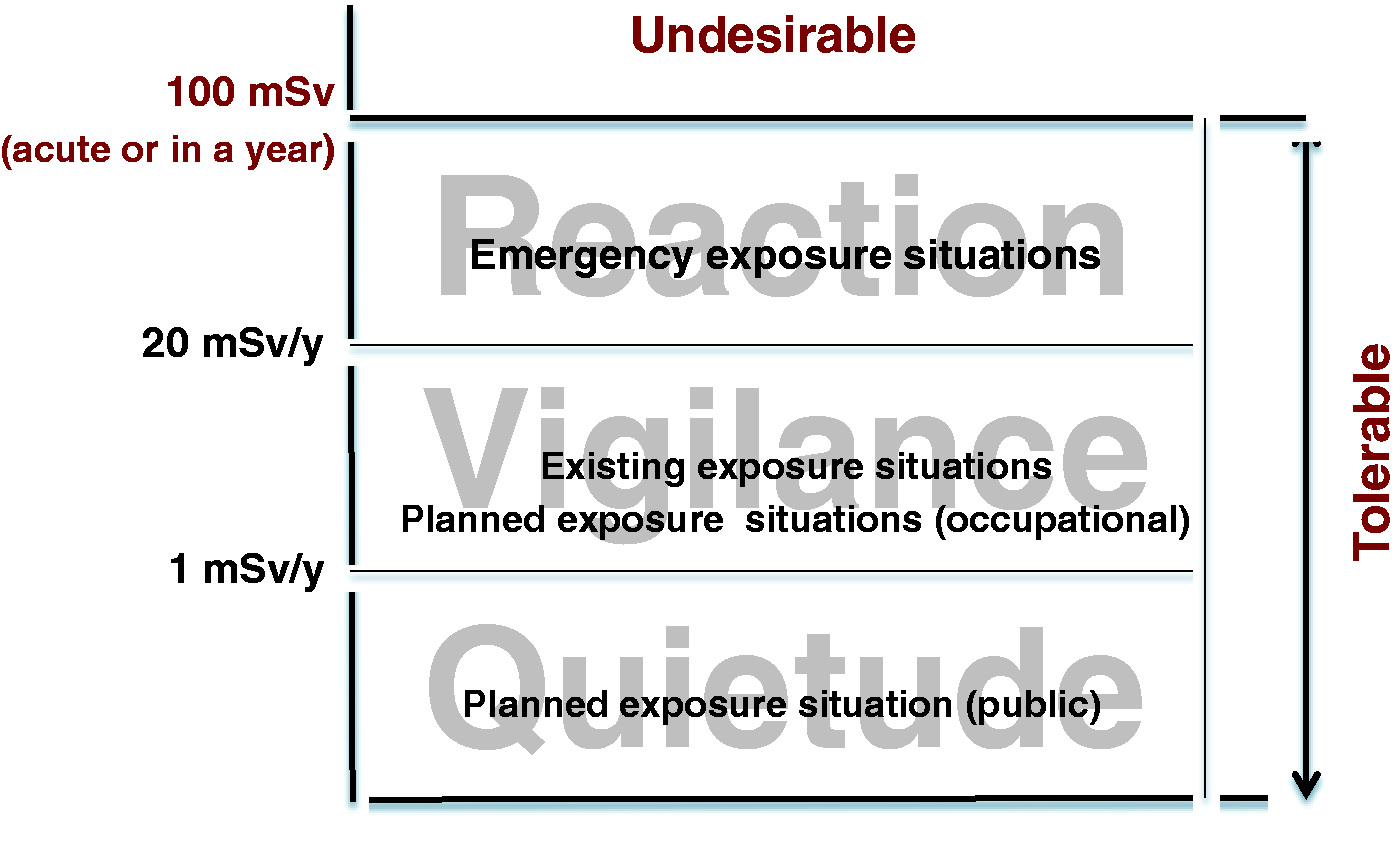
The approach of Publication 103 (ICRP, 2007a), as far as the tolerability of risk is concerned, could be called a ‘risk and exposure situation informed approach’. This is a preliminary reflection that needs to be further developed by the working party, together with the members of Committee 4 and, ultimately, the other ICRP committees.
2.5. Future work
Following the publication on radiological protection in geological disposal of long-lived solid radioactive waste (ICRP, 2013), Committee 4 received a letter from the Radioactive Waste Management Committee of the Nuclear Energy Agency of the Organisation for Economic Co-operation and Development (OECD) requesting follow-on collaboration to address other forms of land-based disposal of radioactive waste. Committee 4 decided to create a working party to develop the basis for a task group on this subject to be established at their next annual meeting in 2013. The future publication should provide a conceptual framework for the long-term control of exposure over the life cycle of such type of disposal, which could be used as a reference for the waste community when explaining its approach to the public and other stakeholders. Optimisation of protection should be the driving principle, and the publication should also cover the protection of the environment through cooperation with Committee 5. Finally, the work should be developed in close cooperation with the waste community.
Committee 4 has also established a working party to address the issue of contaminated sites resulting from past industrial, military, and nuclear activities. Although presenting some similarities with exposure situations resulting from long-term contaminated areas after a nuclear accident or a radiation emergency, contaminated sites from past activities have specific characteristics about the type of radionuclides, frequent presence of chemical contaminants, conjunction with planned exposure situations, and the fact that, in most cases, there is a historical relationship between the affected population and the sites. Past experience in countries that have addressed the legacy of former nuclear activities has shown that the complex and multi-form dimension of such exposure situations potentially affecting health, environment, economy, and the well-being of people calls for a protection strategy, which, to be successful, must involve local stakeholders. A delicate situation to be addressed by the working party is the one in which communities discover that they live on contaminated sites due to former activities of which they were not previously aware. It is expected that the terms of reference for creation of a new task group of Committee 4 will be ready in time for adoption at the next annual meeting.
Finally, Committee 4 recently discussed the opportunity to initiate a series of ‘end-user’ oriented publications. In the past, implementation documents have generally focused on broad areas covering multiple exposure situations [practices and interventions in the time prior to Publication 103 (ICRP, 2007a)]. Committee 4 has already moved towards documents that focus on one particular exposure situation with the series of publications covering key existing exposure situations. Further, comments received during the preparation of the report on security screening (ICRP, 2014b) showed that there is strong interest in a more focused discussion on how the ICRP framework and principles apply in a specific situation that is not covered routinely. Such documents would not attempt to present or endorse specific regulatory approaches, but would elaborate on the principles and framework of protection, which could then be used by organisations in the application of the recommendations. The publications would explain how the principles and recommendations apply in the field or area, and facilitate the connection faced by users between the regulations with which they must comply and the fundamental radiological protection framework and recommendations.
During the Main Commission’s meeting with the Special Liaison Organisations (ICRP, 2014e) in Abu Dhabi, the representative of the European ALARA Network expressed the wish for ICRP to develop specific advice on industrial radiography. This is an example of a topic for which Committee 4 might consider preparation of a document. In any case, the reflection on ‘end-users’ publications continues within Committee 4, and a decision will be taken in consultation with the Main Commission in the near future.
3. Concluding remarks
The ICRP system of radiological protection has gradually developed in the 20th Century by incorporating advances in knowledge about the effects of radiation, the evolution of ethical and social values, and feedback experiences from its practical implementation. Until World War II, the Commission only dealt with the protection of medical staff. After the War, the focus was on nuclear energy and radiological protection developed to protect workers inside nuclear installations and the public outside. This resulted in a coherent and effective regime of protection based on solid concepts, principles, and criteria widely shared internationally (ICRP, 1991).
The Chernobyl nuclear accident, followed by the raising concerns about exposure situations inherited from the 1990s, and the threat of ‘malevolent events’ following the September 11 attacks profoundly questioned the recommendations made in Publication 60 (ICRP, 1991). Although not explicit, this questioning played an important role in the development of the 2007 Recommendations (ICRP, 2007a). The introduction of three types of exposure situations embracing all controllable exposure situations, the generalisation of the optimisation principle in connection with individual dose restrictions to all these situations, the recommendation to involve stakeholders in the optimisation process, and the widening of the system to protect flora and fauna represent significant evolutions of the new ICRP radiological protection system.
The main task of Committee 4 over recent years has been to assimilate and integrate these evolutions in a series of publications devoted to different exposure situations by focusing, as a priority, on existing and emergency exposure situations for which the regime of protection applied to installations had shown its limits. The Fukushima accident unfortunately occurred before the professional community and all the stakeholders of radiological protection had time to assimilate the new approach to these situations. The confusion that prevailed regarding the use of reference levels to manage the emergency phase and post-accident phases is, from this point of view, emblematic. One of the challenges for the future is undoubtedly to explain the ICRP system of radiological protection by highlighting the potential co-existence of dose limits and dose constraints to manage planned exposure situations with reference levels to manage existing exposure situations (cosmic radiation, radon, contaminated sites, etc.), or even emergency exposure situations in the case of an accident.
This task will continue in the coming years in parallel with the aim of clarifying the ethical foundations of the system, and the social values that shape the tolerability of radiation risk. Despite all the efforts made in the past decades, it must be recognised that, apart from scientists, experts, and radiation protection professionals, citizens are rarely informed about radiation, and even less about the radiological protection system. ‘Risk communication’ has globally failed to reduce the gap between experienced professionals and uninformed people, and the relationship of our contemporaries with radioactivity remains largely dominated by the spectre of Hiroshima and Nagasaki, and uncertainty about the effects of low doses fed for decades by the ongoing scientific and social controversy on the effects of radiation. The experience of stakeholder engagement in the last two decades shows that, by developing a narrative about the ethical and social values incorporated in the system, it will be possible to improve understanding and gradually deploy a constructive dialogue on radiation risk and its perception with all concerned parties.