




Abstract
International Commission on Radiological Protection (ICRP) Publication 103 removed the distinction between practices and interventions, and introduced three types of exposure situation: existing, planned, and emergency. It also emphasised the optimisation principle in connection with individual dose restrictions for all controllable exposure situations. Existing exposure situations are those resulting from sources, natural or man-made, that already exist when a decision on control has to be taken. They have common features to be taken into account when implementing general recommendations, such as: the source may be difficult to control; all exposures cannot be anticipated; protective actions can only be implemented after characterisation of the exposure situation; time may be needed to reduce exposure below the reference level; levels of exposure are highly dependent on individual behaviour and present a wide spread of individual dose distribution; exposures at work may be adventitious and not considered as occupational exposure; there is generally no potential for accident; many stakeholders have to be involved; and many factors need to be considered. ICRP is currently developing a series of reports related to the practical implementation of Publication 103 to various existing exposure situations, including exposure from radon, exposure from cosmic radiation in aviation, exposure from processes using naturally occurring radioactive material, and exposure from contaminated sites due to past activities.
1. INTRODUCTION
1.1. From Publication 60 to Publication 103
The International Commission on Radiological Protection (ICRP) system of radiological protection was developed gradually over the 20th Century, integrating developments in knowledge about the effects of ionising radiation, the evolution of ethical and social values, and feedback experience from its practical implementation. Prior to the Second World War, the Commission focussed on the protection of medical staff. After the War, the main focus was on nuclear energy, and radiological protection was developed to protect workers inside nuclear installations and the public outside in normal situations. This resulted in a coherent and effective system of radiological protection applicable to what were called ‘practices’, where a source is introduced deliberately and the exposure can be fully anticipated. This system is based on solid concepts, principles, and standards (ICRP, 1977, 1991).
Over the last decades, the radiological protection system has been challenged profoundly by the occurrence of nuclear accidents, the threat of malevolent events, rising concerns about natural exposures, and exposure situations inherited from the past. These considerations were not entirely absent from the system recommended in Publication 60 (ICRP, 1991). However, this system appeared to be a two-speed protection system. In the case of practices, exposures should be reduced to a level as low as reasonably achievable (ALARA) below ceiling dose criteria (dose limits and dose constraints), which are not expected to be exceeded. In the case of interventions, it was recommended that action should only be taken when exposures exceed floor dose criteria (action levels and intervention levels), with high numerical values on occasion. This issue, among others, led the Commission to move towards Publication 103 (ICRP, 2007).
Two of the significant evolutions of the system of protection in Publication 103 (ICRP, 2007) were as follows.
Removal of the distinction between practices and interventions. Three types of exposure situations were introduced (existing, planned, and emergency), with generalisation of the optimisation principle in connection with individual dose restrictions (reference levels and dose constraints) to all controllable exposure situations. The need to account for the views and concerns of stakeholders when optimising protection in the general recommendations.
Both advancements were driven directly by the desire to better address exposure situations which are outside the box of practices (i.e. existing and emergency exposure situations).
1.2. A new set of reports
ICRP Committee 4 is in the process of developing a set of reports dedicated to various types of existing exposure situation. Publication 126 (ICRP, 2014b) is the first report to update the recommendations for radon exposure. The report on Radiological Protection from Cosmic Radiation in Aviation was approved for publication in March 2016 (ICRP, 2016). Task Groups are currently working on reports related to application of the Commission’s recommendations to naturally occurring radioactive material (NORM) and application of the Commission’s recommendations to exposures resulting from contaminated sites. In parallel, work is also underway to provide updates to Publications 109 and 111 (ICRP, 2009a,b) on emergency exposure situations and living in long-term contaminated areas following a radiological emergency, respectively.
Through the series of new reports, ICRP is developing a method to apply the 2007 Recommendations (ICRP, 2007) to existing exposure situations.
2. OUTLINES OF THE PUBLICATION 103 SYSTEM OF RADIOLOGICAL PROTECTION
The ICRP system of radiological protection is a fundamental framework for dealing with any controllable exposure situation in a systematic and coherent manner. The components of the system are illustrated in Fig. 1.
System of radiological protection illustrating the interrelationships of the principles of protection, the exposure situations, the categories of exposure, the dose criteria, and the requisites for implementation of the system.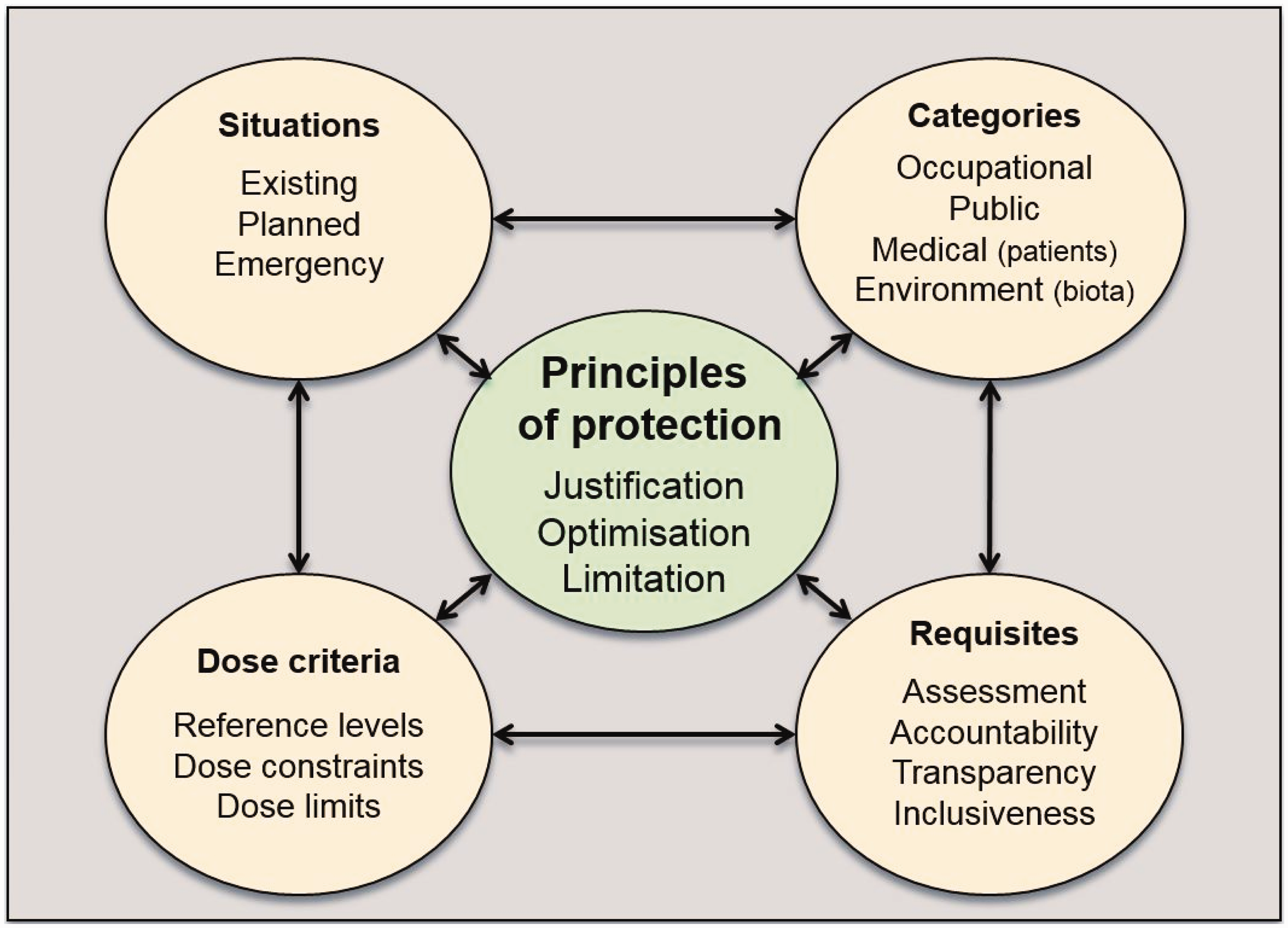
At the centre, the system of protection relies on the three principles of justification, optimisation, and limitation. These principles are applied in planned, existing, and emergency exposure situations. There are now four categories of exposure, namely occupational, public, medical (associated with medical diagnosis and treatment), and environmental (associated with protection of the environment). The dose criteria serve as boundaries within which the optimisation process takes place, and serve to reduce inequities of exposure. Finally, several requisites must be in place in order for the system to be implemented effectively. These include the need for assessment of exposures, provision of information in a clear and transparent manner, accountability for safety, and involvement of the relevant stakeholders.
This paper endeavours to demonstrate the application of the system of radiological protection to existing exposure situations, keeping in mind that the role of ICRP is to develop principles and recommendations, and not regulation.
3. NOTION OF EXISTING EXPOSURE SITUATIONS
Existing exposure situations are exposures from sources that already exist when decisions to control them are made. The corresponding source is generally natural, such as cosmic radiation in aviation and space flights, NORM, or radon. The source can also be artificial, such as contaminated sites from past activities and contaminated areas after a nuclear accident (ICRP, 2007).
An existing exposure situation may result from a planned exposure situation, as a legacy site, when the exposure results from operations that were not conducted within the relevant system of protection, or not to the standards considered acceptable today. It can also result from an emergency exposure situation after the first phases of the emergency, when the exposure situation is characterised and managed on a long-term basis. However, neither a planned exposure situation (except on a very long-term basis) nor an emergency exposure situation is expected to result from an existing exposure situation (ICRP, 2007).
Existing exposure situations have a number of common features. Exposures often affect places of living and day-to-day activities. They need to be measured in order to characterise the exposure situation. Levels of exposure are highly dependent on individual behaviours. Exposure situations are generally characterised by a wide spread of individual dose distribution. They do not present a potential for accident. In many cases, the exposure can be at least partially controlled by exposed individuals themselves (self-help protection). Many stakeholders are generally involved to control the situation. However, a lack of radiological protection culture is often present, which creates difficulties in working with those stakeholders. The situation may be controversial or sensitive; as such, radiological protection in this area is closely connected to social, economic, political, or ethical factors, among others.
Time is also a key factor for each type of exposure situation. While protective actions can be implemented at any time and are effective immediately in planned exposure situations, they must be implemented urgently and in a timely manner in emergency exposure situations to order to be efficient. In existing exposure situations, protective measures can only be implemented after characterisation of the exposure situation, and it generally takes time to progressively reduce or maintain exposures in accordance with the ALARA principle. However, regardless of the type of exposure situation, protective actions can be envisaged and prepared (i.e. planned) in advance.
4. CATEGORIES OF EXPOSURES
Existing exposure situations can lead to public or occupational exposure. One of the crucial points with existing exposure situations is to determine when workers can be considered as occupationally exposed. Due to the ubiquity of radiation and to avoid the need to subject all workers to a regime of radiological protection, the Commission limits its use of the term ‘occupational exposure’ to radiation exposures incurred at work as a result of situations that can reasonably be regarded as being the responsibility of the operating management (ICRP, 2007). In existing exposure situations, many workers are exposed adventitiously at work and can be managed using the Commission’s recommendations for members of the public. However, the employer has primary responsibility for the protection of workers (see ICRP, 2007, Para. 179) and the management of exposures. Once an exposure has been identified, careful management is needed.
Application of the definition of occupational exposure is a delicate issue for existing exposure situations because the definition of the Commission has been developed having in mind the planned exposure situations. The statement that situations ‘can reasonably be regarded as being the responsibility of the operating management’ may not be useful as the source is not deliberately introduced or operated, and not necessarily used for its radioactive properties. In many existing exposure situations, the operating management does not have real responsibility for the source, and has partial responsibility only for the pathways and exposure of the workers.
In existing exposure situations, there is little potential for high doses, and classification of areas is often difficult to determine. Thus, the key elements to deal with exposure at work are the general responsibility of the employer to protect the health of the workers, the management of the workplace rather than the workers individually (i.e. like for other risks when workers are not classified as exposed workers), the resulting level of exposure of the workers, and individual dose distribution.
Many existing exposure situations lead to environmental exposure and may challenge the protection of the environment. Although the set of dedicated reports developed by Committee 5 may be applicable, particularly Publication 124 (ICRP, 2014a), no specific recommendations have been set in the reports devoted to existing exposure situations.
5. PRINCIPLES OF PROTECTION
The ICRP system is based on three principles of radiological protection, and the first two principles are source-related. According to the principle of justification, any decision that alters the radiation exposure situation should do more good than harm. The principle of optimisation of protection means that all exposures should be kept ALARA, taking into account economic and societal factors, with restrictions on individual exposure to limit inequities in dose distribution. The third principle is individual-related. This is the application of dose limits, which means that the total dose to any individual from regulated sources in planned exposure situations, other than medical exposure of patients, should not exceed the appropriate dose limits recommended by the Commission. Only the justification and optimisation principles apply to existing exposure situations. However, source-related dose restrictions set for implementation of the optimisation principle serve to frame the exposures carefully in a given exposure situation.
In an existing exposure situation, as the source is not introduced deliberately, application of the justification principle is mainly focussed on control of the situation. The corresponding actions can be taken on the source (whenever possible), on the pathways (mainly), and on individuals (in a few cases). The characterisation of the situation is a prerequisite. Such characterisation is key in determining who is exposed; where, when, and how they were exposed; and the feature of the individual dose distribution.
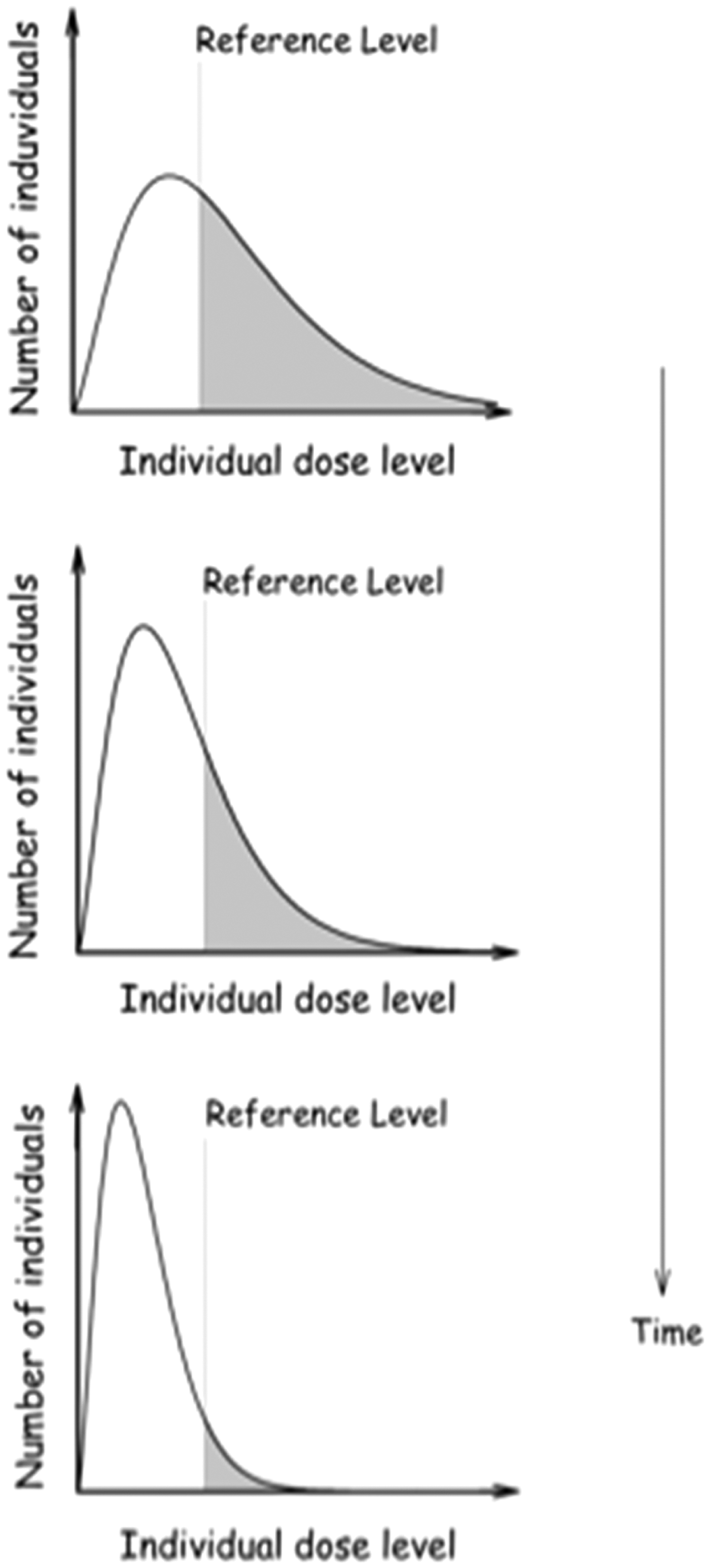
The principle of optimisation of protection, associated with dose restriction (or criteria), is the key principle. Experience shows that application of this principle is the most powerful way to reduce doses, regardless of the exposure situation. It should be implemented including both prevention (i.e. avoid any unnecessary exposure) and mitigation (i.e. reduce existing exposures ALARA). As illustrated in Fig. 2, the process of optimisation moves the dose distribution towards lower levels of dose, and reduces (ideally to zero) the number of individuals receiving an exposure greater than the selected dose restriction. This is a gradual process, as illustrated in Fig. 3. More information about dose restriction in an existing exposure situation is given in Chapter 6 below.
Optimisation of protection, showing the movement of dose distribution towards lower levels of exposure, with a focus on doses that may exceed a specified individual dose criterion. Evolution of the distribution of individual doses with time as a result of the optimisation process.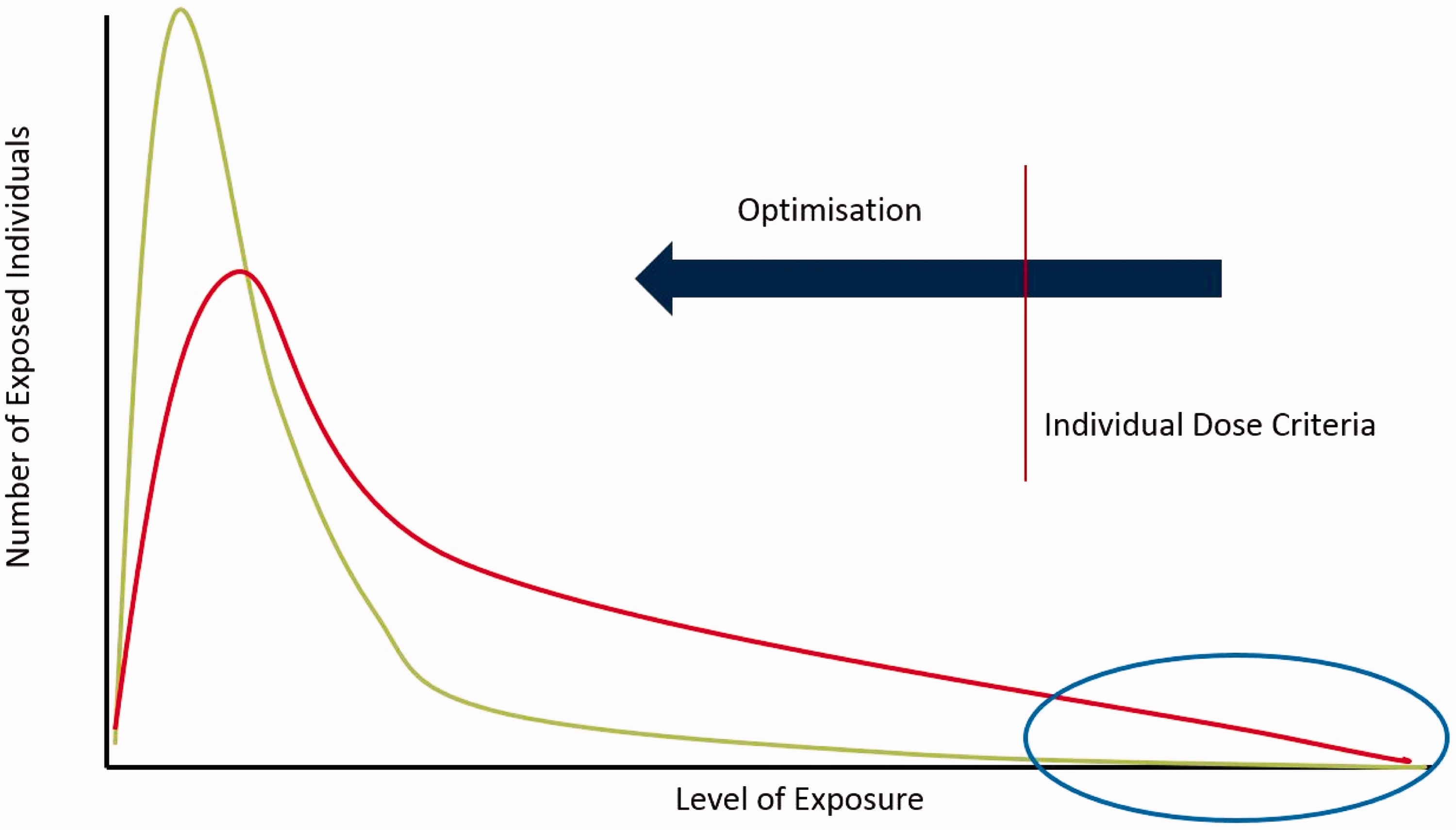
The optimisation process should be implemented with prevailing circumstances taken into account. Compared with planned exposure situations, existing exposure situations have some specificity. All parameters cannot be anticipated with the same precision. The status of the source, the classification of areas, the range of exposures, and the distinction between public and occupational exposures often have to be determined and framed on a case-by-case basis. The people concerned, including those with responsibilities to address the exposure situation, are not always fully trained and prepared. The optimisation process should be adapted to these specificities and based on a graded approach, focussing actions on exposures that are the most significant, and moving the dose distribution towards lower levels of exposure. This approach is generally more qualitative and less quantitative than in planned exposure situations. The way to fulfil with the values of prudence and reasonableness needs more pragmatism, which does not mean that the control of exposure is less efficient.
Relevant stakeholder involvement is important to consider the concerns and expectations of these people more effectively. The process of quantification and comparison of protective actions should be adapted (e.g. by proposing several options to stakeholders within an in-depth dialogue before selecting the best option). In a context where exposures may affect day-to-day activities, the involvement of stakeholders is a way to increase understanding, maintain vigilance, and promote autonomy and accountability of the people concerned.
In some existing exposure situations, protective actions implemented by exposed individuals themselves with the support of radiological protection professionals should be considered, as well as protective actions implemented by authorities. This is called the ‘co-expertise process’. The objective of the co-expertise process is to raise awareness among exposed individuals, and to develop their knowledge and skills step by step (i.e. practical radiological protection culture) in order to allow them to make informed decisions and behave wisely (self-help protection). It is a matter of dignity and autonomy.
6. DOSE CRITERIA
The dose criteria (or restriction) in an existing exposure situation is called the ‘reference level’; this is defined as the level of individual dose above which it is judged to be inappropriate to allow exposures to occur, and below which the goal is to reduce all doses ALARA (ICRP, 2007).
According to Publication 103 (ICRP, 2007), reference levels for existing exposure situations should be set typically in the 1–20-mSv range of projected dose. The first step is to characterise the relevant exposure situation in terms of the nature of the exposure, the benefits from the exposure situation to individuals and society, and the practicability of reducing or preventing exposures (ICRP, 2007). Past experience with the management of similar situations is another factor to take into account (ICRP, 2007). If the situation allows, a reference level below the recommended band could be selected, if such a selection provides the most appropriate boundary for identifying cases of individual exposure that warrant increased attention, and to best guide the optimisation process.
Although an existing exposure situation could lead to both public and occupational exposures, the Commission does not suggest the selection of a reference level for each category of exposure. In several situations, it is impossible or inappropriate to select different reference levels. However, Publication 103 (ICRP, 2007) states that in most existing exposure situations, there is a desire from the exposed individual, as well as from the authorities, to reduce exposures to levels that are close to or similar to situations considered as ‘normal’. This applies particularly in situations of exposure from material resulting from human actions (e.g. NORM residues and contamination from accidents).
Reference levels for existing exposure situations adopted or proposed to date.
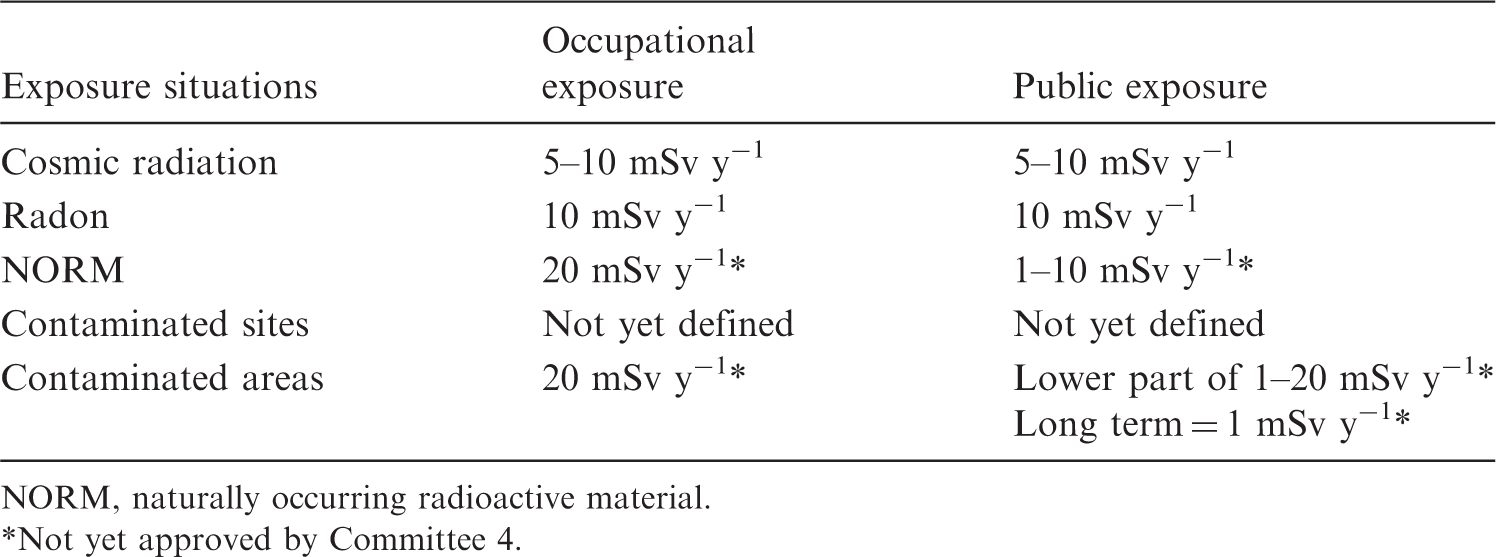
NORM, naturally occurring radioactive material.
Not yet approved by Committee 4.
7. REQUISITES
The basic requisites that apply to all exposure situations and categories of exposure are the provision of information on the exposure situation, and the assessment of corresponding exposures. These basic requisites are applied differently depending on the exposure situation and the category of exposure. In Publication 103 (ICRP, 2007), several requisites are mentioned, such as informed consent, education and training, collective and individual dose monitoring, recording of exposure, special health surveillance, and classification of areas.
Most of the requisites in the current system of protection were developed in order to protect workers inside classified areas, members of the public outside classified areas, and patients exposed to radiation (i.e. in planned exposure situations). They can be used in existing exposure situations, although in a specific way.
More thoughts have been carried out, however, on the issue of requistes in existing exposure situations. The reports dedicated to various types of existing exposure situation have reflected on this issue. Those emerging are the need to characterise the exposure situation, including assessment of the exposures prospectively (if possible) and retrospectively; provision of information in a clear and transparent manner; accountability for safety; and involvement of the relevant stakeholders. Accountability for protection of the environment should be added in many existing exposure situations. In situations such as living in a contaminated area, the provision of means to exposed individuals to assess themselves and reduce their dose, as well as the development of a radiological protection culture, are mentioned in Publication 103 (ICRP, 2007).
The issue of requisites should also be based on current reflections on the ethical values of the system of radiological protection. For example, information is closely linked to the question of the right to know, and stakeholder involvement in the dignity and autonomy of individuals.
For regulatory convenience, however, the national authority may decide to manage an existing exposure situation in a manner similar to that for a planned exposure situation when the situation has been well characterised, and it is possible to use the types of controls that are usually associated with planned exposure situations.
8. CONCLUSIONS
Through a new series of reports dedicated to existing exposure situations, ICRP is moving towards recommendations using a coherent, graded approach based on assessment of the exposure and prevailing circumstances, justification for action, and optimisation of protection using individual dose criteria to reduce inequities in exposure, focus actions on exposures that are the most significant, and move the dose distribution towards lower levels of exposure.
Some issues still need further reflection, such as a way to address the protection of the environment in the prevailing circumstances or the basis for radiological risk tolerability in a more appropriate way than the model developed in Publication 60 (ICRP, 1991).