




Abstract
This is the first in a series of articles exploring the development of modern otology in pre-and post-WWII Philadelphia as narrated by the 3 sons of 3 pioneering academic otolaryngologists.
David Myers was born in Philadelphia in 1906. His parents left the kingdom of Romania in 1902 to escape a regime which denied Jews property rights and citizenship and demanded indefinite conscription in the Romanian Army for young men. 1 Myers, his 2 brothers and 2 sisters lived above their parents’ tailor shop. They spoke only Yiddish until they began public school. Myers attended the Southern Manual Training High School (later South Philadelphia High School) created as a vocational school for new immigrants. Despite the school’s low expectations, Myers and his 2 brothers graduated, attending college – in David’s case at the University of Pennsylvania and Temple Medical School – and all became physicians.
Myers performed well in medical school and wanted to specialize in Obstetrics and Gynecology. Temple’s Dean, William Parkinson, told him that all the residency spots at Temple were filled. Instead, he suggested that David “shadow” Matthew Ersner, the Chairman of the Department of Otorhinology at Temple. Myers was married with 2 children by then and had to feed his family, so he saw general medical patients at his home nights and weekends while he continued his unpaid apprenticeship with Ersner. He helped with Ersner’s Pine Street private practice, drained abscesses and assisted with tonsillectomies. Myers’ passion, however, was for the treatment of hearing loss – his brother Abraham and his mother Sadie were hard-of-hearing from a young age.2,3 The mallet and gouge mastoidectomies Ersner performed were not satisfying, so Myers packed a sandwich and took the train to New York. There Dr. Julius Lempert was doing a new type of ear surgery – semicircular canal fenestration for hearing loss from otosclerosis with loupes, headlight and a dental drill. 4 During his excursions to New York, he met Dr. Samuel Rosen, Lempert’s junior partner. Their relationship proved important years later.
December 8, 1941, the day after the Pearl Harbor attack, David, his 2 brothers and his brother-in-law all enlisted in the Army Medical Corps. Myers was stationed at hospitals in Kentucky and North Carolina before he was transferred to the Pacific where he cared for war wounded for 2 years.
After the war Myers returned to Philadelphia and opened an ENT practice in the Oak Lane neighborhood. He was asked to help with ENT surgery at Temple as Dr. Ersner was disabled after losing a leg to diabetes. Eventually Myers succeeded Ersner as Chairman and soon hired Temple’s first ENT resident, Woodrow Schlosser. Myers was well-loved as an educator and respected by his fellow otolaryngologists who frequently referred their most difficult cases and their less than desirable results for his consideration.
While Myers was at Temple, Samuel Rosen visited from New York and introduced him to a much simpler treatment for otosclerosis than fenestration. After a series of cadaver dissections, Myers performed the first successful stapes mobilization in Philadelphia. The newly developed Carl Zeiss OPMI-1 operating microscope greatly facilitated the surgery 5 (Figure 1).
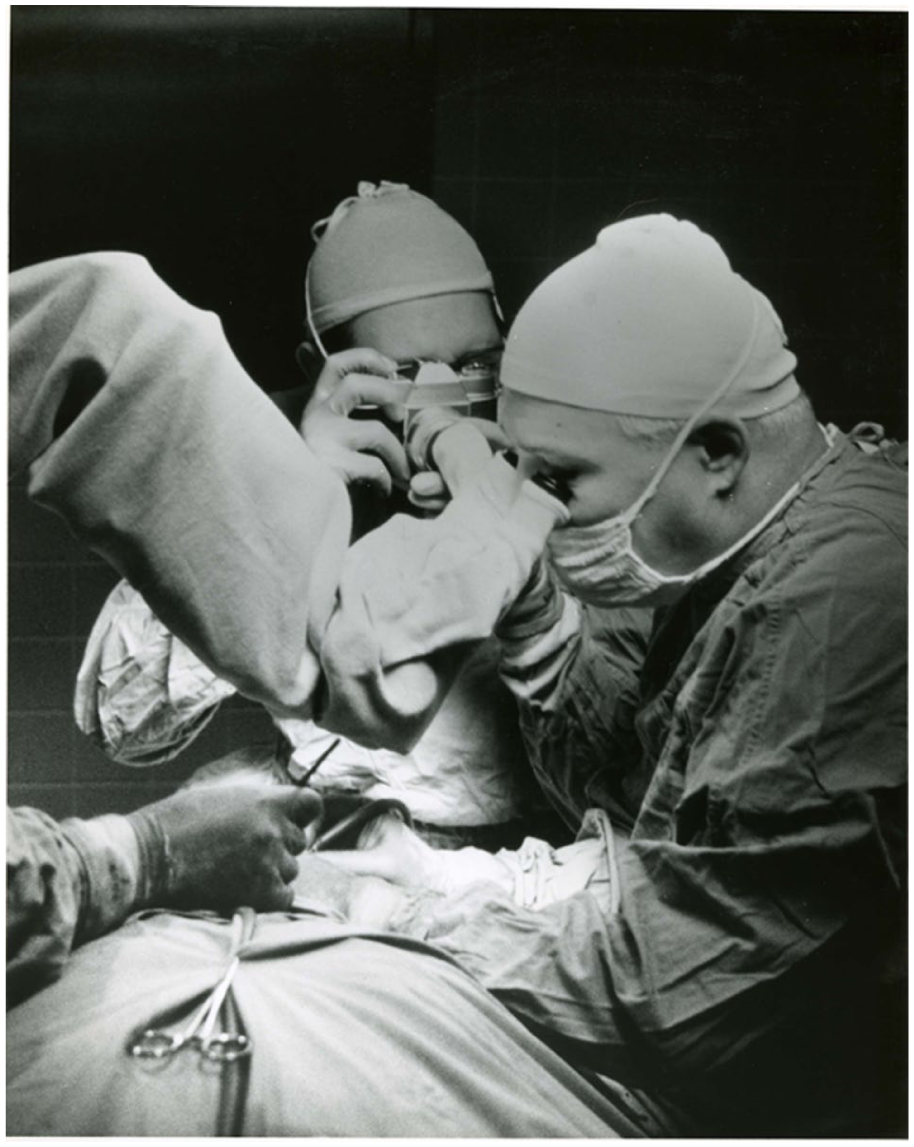
David Myers performing ear surgery under the operating microscope.
Stapes mobilization proved inadequate in part due to progression of otosclerosis and re-fixation. 6 In 1958, Myers traveled to Memphis, Tennessee, to learn the technique of stapedectomy with vein graft and polyethylene strut from Dr. John Shea. He embraced the procedure and by 1960 reported the excellent results of 250 stapedectomies.7,8 “Dr. Myers,” one of his scrub nurses commented, “if you keep doing so many of these operations, there won’t be any stapes left when your son finishes his training.” This proved to be true. His son, Eugene Myers, left otology behind and instead became a famous head and neck surgeon.
Footnotes

Ethical Considerations
This article does not contain any studies with human or animal participants.
Consent to Participate
There are no human participants in this article and informed consent is not required.
Funding
The authors received no financial support for the research, authorship, and/or publication of this article.
Declaration of Conflicting Interests
The authors declared no potential conflicts of interest with respect to the research, authorship, and/or publication of this article.
Data Availability Statement
This paper contains no new data. All data included are available through conventional library sources. The authors would be pleased to assist interested researchers via the corresponding author’s email.