




Abstract
Level of evidence: 5 – expert opinion.
This is the second in a series of articles exploring the development of modern otology in pre- and post-WWII Philadelphia as narrated by the three sons of three pioneering academic otolaryngologists.
Joseph Sataloff was born in Kiev on May 1, 1919, in the midst of the Russian Civil War. His family owned several department stores, but they left for America after the White Army occupied the city and began a series of violent pogroms. The Sataloffs arrived when Joseph (Joe to everyone) was eight months old and settled in West Philadelphia. Joe’s father soon found a job as a salesman at Silverman’s Bridel Shop at 6th and South Streets. As a boy, Joe sold fruit at the docks to help support the family.
Sataloff studied at West Philadelphia High School where he starred on the gymnastics team. Despite excellent undergraduate grades at the University of Pennsylvania (where he was also captain of the wrestling team at 118 pounds), when he applied to Penn Medical School, he was told that the Jewish quota was filled. Instead, he completed a Master’s degree and Doctor of Science at Penn’s Graduate School of Medicine and attended Hahnemann Medical School.
After receiving his medical degree, Sataloff was persuaded to join the Navy for advanced training in obstetrics and gynecology. He was stationed initially in Alaska, but after achieving the top score on the parasitology exam, he found himself transferred to the South Pacific-first in the regular Navy, then as a naval physician to the 3rd Marine Division. While stationed on Guam, he founded the island’s first Boy Scout troop and managed to find uniforms for them through the Philadelphia Counsel of the Boy Scouts in the midst of the Second World War. Joe was an Eagle Scout and received the Silver Beaver Award for his initiative on Guam.
With the end of the war, Sataloff completing his 7 ½ years of Naval service at the Philadelphia Navy Yard. There, he met Frank Lederer, a Professor of Otolaryngology at the University of Illinois, and a Marine Commander during the war. Lederer had built a rehabilitation program for the blind and hard-of-hearing at the Navy Yard, and there introduced Joe to otolaryngology. After discharge, Sataloff began a one-year apprenticeship with Fredrick Thayer Hill in Waterville, Maine. Hill had trained under Harold Mosher at Harvard. Despite his rural practice location, Hill became a national figure and served as President of the American Otological Society. He provided his apprentice with superb training. Waterville became a second home to Joe and his family.1,2
Returning to Philadelphia, Sataloff joined in private practice with George M Coates, then in his early 70’s, at his 1721 Pine Street office. Though in private practice, Coates was Chief of Service in Otolaryngology at the Graduate Medical School of the University of Pennsylvania and had a huge following. Sataloff began in general otolaryngology practice but quickly developed a passion for otology. Coates was a founding member of the Otosclerosis Study Group, an informal group devoted to understanding and treating this common cause of early hearing loss. Joe learned fenestration, stapes mobilization and stapedectomy from Study Group members including Julius Lempert, George Shambaugh, John Shea, Harold Schuknecht and Howard House. By the end of his surgical career, Sataloff had done more than 20,000 ear procedures including 10,000 stapes operations.
Joe’s medical curiosity extended beyond surgery. He became fascinated with the assessment of hearing loss3,4 and along the way observed a high rate of high-frequency loss among factory workers. 5 There was little knowledge of noise-induced hearing loss and even less was known of interventions to prevent it. 6 Sataloff’s clinical studies led to new industry and OSHA standards for noise exposure. His 1957 textbook remains the standard in the field. 7
Even as Sataloff’s Philadelphia practice grew, he maintained his ties to the State of Maine. Each summer, he traveled to Waterville with his family to appreciate nature, but more importantly to focus on his clinical studies, academic writing and teaching. Many of his 13 textbooks and more than 200 articles were written in the Maine woods. He taught courses in occupation hearing loss at Colby College and the University of Maine.
Joe Sataloff always had an artistic bent and an eye for a bargain. He became a world expert in Art Nouveau jewelry, which had fallen from popularity at the time. He read auction catalogs in five languages and gradually amassed an exquisite collection, much of which he lent to the Museum of Fine Arts in Boston for a fall exhibit that brought international attention to this magnificent art.
Sataloff eagerly shared his love of otology with his son Bob. They studied stereopticon images of the ear anatomy and drilled temporal bones together in the basement temporal bone lab. Bob crimped his first stapes prothesis at age 12. When Bob finished otology-neurotology training and joined his father’s Philadelphia practice, the elder Sataloff handed the all surgical cases to his son, telling his patients, “Go see my son. He’s the best in the world.”
Joseph Sataloff continued office practice until two weeks before his death at age 89. Throughout his career Joe served as Professor of Otolaryngology at Jefferson Medical College. His devotion to teaching inspired his son Bob to follow a career in academic medicine (Figure 1). Joe Sataloff with a large teaching model of the ear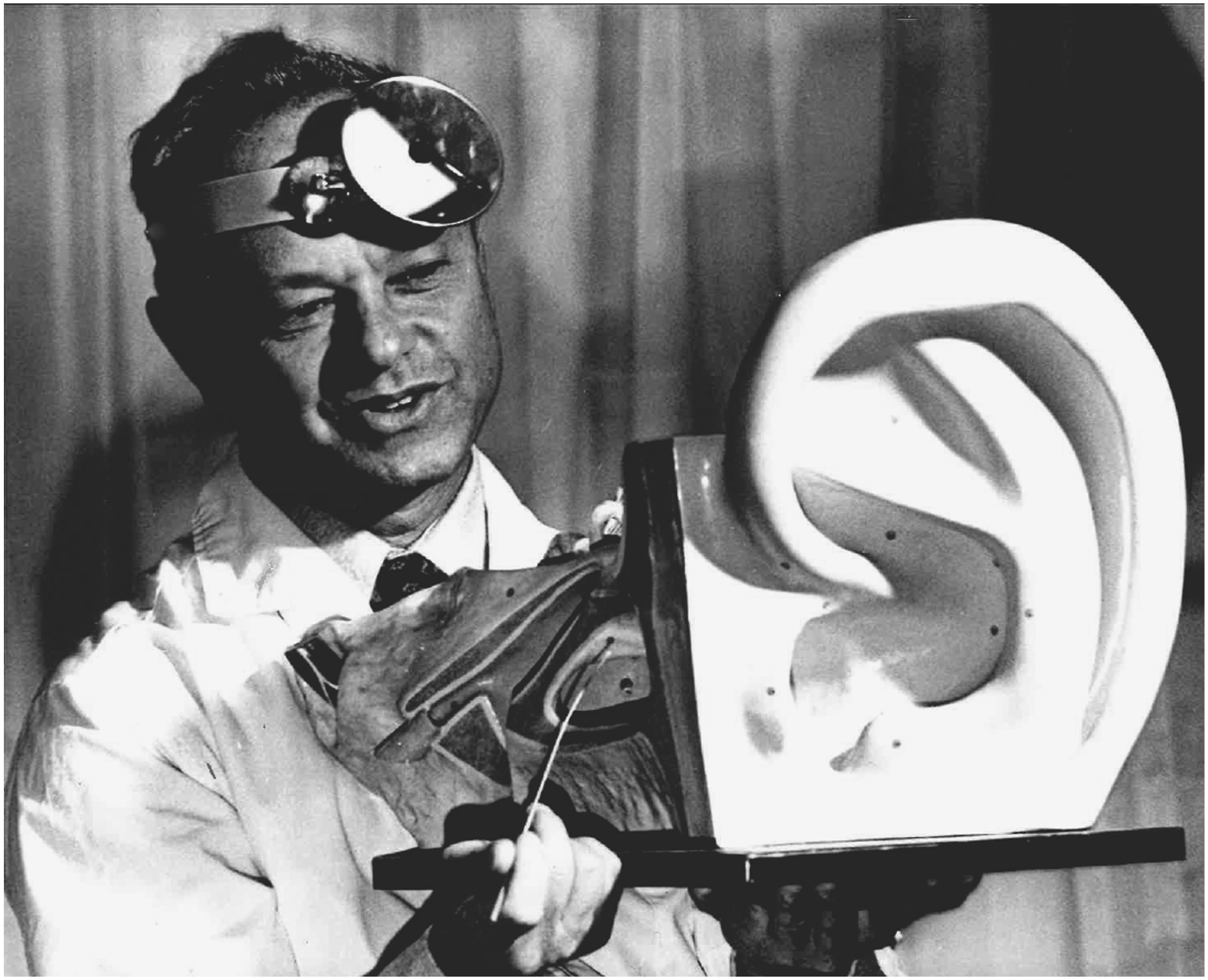
Footnotes

Ethical Considerations
This article does not contain any studies with human or animal participants. There are no human participants in this article and informed consent is not required.
Funding
The authors received no financial support for the research, authorship, and/or publication of this article.
Declaration of Conflicting Interests
The authors declared no potential conflicts of interest with respect to the research, authorship, and/or publication of this article.
Data Availability Statement
This paper contains no new data. All data included are available through conventional library sources. The authors would be pleased to assist interested researchers via the corresponding author’s email.