




Abstract
This study investigates the nexus between electricity consumption, fossil fuel dependency, renewable energy adoption, population growth, trade activities, economic growth, and environmental pollution in India. The primary objective is to understand how these factors interrelate and influence each other, focusing on their implications for sustainable development. The study used data from the World Bank from 2000 to 2023; the methodology adopted includes vector autoregression modeling, Granger causality tests, cointegration analysis, impulse response functions, and variance decomposition. These econometric techniques were selected due to their ability to capture dynamic relationships, determine causality, and identify long-term equilibrium among the variables. The findings reveal that economic growth significantly increases electricity consumption and fossil fuel usage, leading to higher carbon dioxide emissions. On the other hand, renewable energy adoption reduces environmental pollution. The study also highlights the complex interplay between population growth, urbanization, and trade activities in shaping India's energy demand and environmental outcomes. The implications of these findings are critical for India's sustainable development. The results suggest that while economic growth is essential, it must be balanced with sustainable energy practices to mitigate environmental pollution. The findings emphasize the need for policy interventions that promote renewable energy, enhance energy efficiency, and enforce environmental regulations. Recommendations include accelerating renewable energy adoption, implementing stringent energy efficiency standards, and developing integrated policies that simultaneously address the economic, energy, and environmental dimensions. These actions will help India achieve a sustainable balance between economic growth and environmental protection, ensuring a healthier future for its population.
Introduction
India, as one of the fastest-growing economies in the world, faces a complex challenge in balancing its energy needs, economic growth, and environmental sustainability. The interconnections between electricity consumption (ECO), fossil fuel dependency, renewable energy adoption, population dynamics, trade activities, and environmental pollution are critical in shaping the country's future trajectory. This article aims to unravel these connections and provide insights into the policy measures that can help India achieve sustainable development. ECO in India: ECO in India has been rising steadily, driven by industrialization, urbanization, and an increasing population. According to the International Energy Agency (IEA), the study shows that India's electricity demand is expected to double by 2040. This surge in demand necessitates a critical evaluation of the sources of electricity and their environmental implications. The findings highlight the critical role of transitioning to renewable energy and enhancing energy efficiency to mitigate environmental pollution while supporting economic growth. Policy implications suggest India must prioritize renewable energy, enforce stringent environmental regulations, and balance trade policies to achieve sustainable development. This analysis provides valuable insights for policymakers and stakeholders in India's journey toward a sustainable future. Utilizing empirical data from various sources, we explore how these factors interact and influence one another, highlighting the challenges and opportunities faced by India in its pursuit of sustainable development. The study underscores the importance of transitioning to renewable energy and implementing robust policies to mitigate environmental pollution while fostering economic growth (Adebayo et al., 2022; Adebayo and Samour, 2023; Aftab et al., 2021; Aghabalayev and Ahmad, 2023).
Fossil fuels and renewable energy: Historically, India's energy mix has been dominated by fossil fuels, particularly coal, which accounts for ∼70% of the country's electricity generation. This heavy reliance on coal has significant environmental consequences, contributing to air pollution and greenhouse gas emissions. In response, India has been aggressively pursuing renewable energy options, with ambitious targets to install 250 GW of renewable energy capacity by 2024 and 450 GW by 2030. Solar and wind energy are the primary focus areas, given their vast potential in the Indian context. Population growth and urbanization: India's population, currently over 1.4 billion, continues to grow, exerting pressure on its energy resources and infrastructure. Urbanization further exacerbates this demand, with cities consuming a disproportionate share of electricity and generating significant pollution. The study manages this growth sustainably, which is crucial for minimizing environmental impacts while ensuring an adequate energy supply (Aghasafari et al., 2021; Al Afif et al., 2023; Alvarez et al., 2022; Alvarez-Herranz et al., 2017). Imports, exports, and economic growth: India's economic growth is closely linked to its trade activities. The country imports a substantial amount of fossil fuels to meet its energy needs, which has implications for energy security and trade deficits. Conversely, exporting goods and services drives economic growth and increases energy consumption and environmental pollution. Balancing trade policies to support economic growth while mitigating environmental impacts is a critical policy challenge (An et al., 2023; Balsalobre-Lorente et al., 2022, 2023a, 2023b).
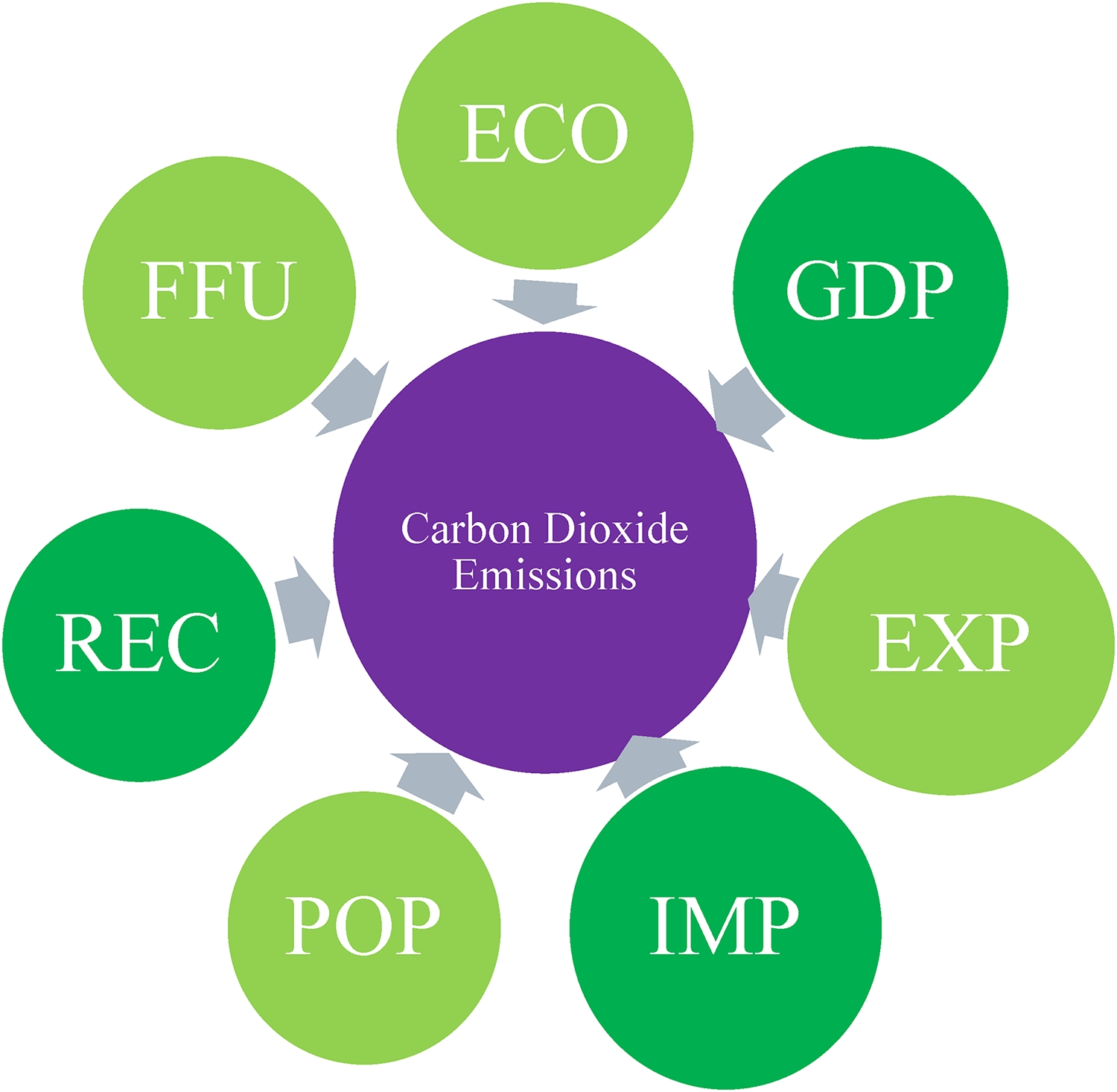
With its rapidly expanding economy and large population, India stands at a vital juncture in its development trajectory. The country's energy demands are escalating, driven by industrialization, urbanization, and population growth. Meeting these demands while ensuring environmental sustainability presents a significant challenge. This article investigates the intricate nexus between ECO, fossil fuel usage (FFU), renewable energy adoption, population growth, imports, exports, economic growth, and environmental pollution in India. ECO is vital to economic development, powering industries, homes, and infrastructure. However, India's electricity generation has historically relied heavily on fossil fuels, particularly coal. This dependence on coal has led to severe environmental consequences, including high levels of air pollution, water pollution, and greenhouse gas emissions, contributing to climate change (Balsalobre-Lorente et al., 2018, 2023c; Banerjee, 2022; Bassey Enya et al., 2022).
In recent years, India has made significant strides in renewable energy adoption, setting ambitious targets to increase its capacity. This transition is crucial for reducing environmental pollution, enhancing energy security, and creating sustainable growth opportunities. Despite these efforts, the country still faces numerous challenges in fully integrating renewable energy into its energy mix. Population growth and urbanization further complicate India's energy and environmental landscape. A growing population increases energy demand, while rapid urbanization intensifies the need for efficient and sustainable energy solutions in cities. These dynamics also impact trade activities, with implications for imports of fossil fuels and exports of energy-intensive goods (Borg et al., 2022; Bui Minh and Bui Van, 2023; Can et al., 2020, 2023). While essential for improving living standards, economic growth often leads to increased energy consumption and environmental degradation. Balancing economic expansion with environmental sustainability is a critical policy issue for India. Trade activities, including imports and exports, significantly shape the country's energy consumption patterns and environmental impact (Cao et al., 2022; Chen et al., 2022). Environmental pollution, particularly air quality degradation, is a significant concern in India. India's reliance on fossil fuels such as coal for electricity generation is crucial to this problem. Addressing environmental pollution requires comprehensive policies that promote cleaner energy sources and enhance energy efficiency (Chen, 2022; Chu et al., 2023a).
This article aims to analyze the interconnections among these factors and provide insights into practical policy measures for sustainable development in India. By examining empirical data and employing econometric models, we uncover causal relationships and influence patterns among ECO, fossil fuel dependency, renewable energy adoption, population dynamics, trade activities, economic growth, and environmental pollution. The findings will guide policymakers and stakeholders in crafting strategies that balance economic growth with environmental sustainability (Chu et al., 2023b; Dai et al., 2023a). Environmental pollution: Environmental pollution in India is a significant concern, with air quality in many cities falling below acceptable standards. The reliance on fossil fuels such as coal for electricity generation significantly contributes to this problem. The World Health Organization has consistently ranked several Indian cities among the most polluted in the world. The Indian government claims that transitioning to cleaner energy sources and improving energy efficiency are essential to reducing pollution (Dai et al., 2023b; Ding et al., 2021). Empirical analysis: To empirically analyze the relationships among these variables, we use time-series data from 2000 to 2023. The data includes ECO, FFU, renewable energy capacity, population growth, trade figures (imports and exports), gross domestic product (GDP) growth, and environmental pollution indicators (e.g. carbon dioxide (CO2) emissions and particulate matter (PM) levels; Doğan et al., 2020, 2022a, 2022b). We employ econometric models such as vector autoregression (VAR) and Granger Causality tests to identify the causal nexus and the direction of influence among these variables. Preliminary results indicate a strong positive correlation between economic growth and ECO, with FFU being a significant determinant of environmental pollution. Renewable energy adoption negatively correlates with pollution levels, highlighting its potential to mitigate environmental impacts.
Objectives of the study: The study aims to achieve the following key objectives.
Examine the relationship between economic growth and energy consumption: This objective analyses how economic growth influences ECO in India. The study seeks to determine whether increased economic activities lead to higher energy demand and how this impacts energy sustainability. Linkage: This objective ties into the literature review, which discusses the energy-economy nexus, emphasizing that economic growth drives energy consumption. The empirical model (VAR) helps quantify the dynamic relationship between GDP and ECO. Assess the impact of fossil fuel dependency on environmental pollution: The study aims to evaluate how fossil fuel consumption contributes to CO2 emissions and overall environmental degradation in India. Linkage: The literature review highlights the environmental implications of fossil fuel reliance. The empirical model investigates this relationship through Granger causality tests and cointegration analysis to establish the cause-effect dynamics between FFU and environmental pollution (Ike et al., 2020; Rafindadi, 2015).
Investigate the role of renewable energy in mitigating environmental pollution: This objective focuses on understanding how adopting renewable energy sources affects environmental pollution levels, particularly CO2 emissions. Linkage: The review provides insights into the potential of renewable energy to reduce pollution. At the same time, the empirical model uses IRFs to analyze the response of CO2 emissions to shocks in renewable energy capacity. Explore the influence of population growth and urbanization on energy demand: The study examines how population growth and urbanization contribute to increased energy consumption and the subsequent environmental impacts. Linkage: The literature on demographic and urbanization effects on energy demand informs this objective. The empirical model captures these effects by including population growth as a variable and analyzing its impact on ECO and pollution (Rafindadi, 2016; Rafindadi et al., 2022).
Analyze the effects of trade activities (imports and exports) on energy consumption and environmental pollution: The objective is to understand the dual role of trade activities in driving economic growth and shaping energy consumption patterns, which in turn affect environmental outcomes. Linkage: The literature review discusses the role of trade in economic development and energy consumption. The empirical model investigates these effects using VAR to trace how changes in trade activities influence energy demand and pollution. Identify long-term equilibrium relationships among the key variables: The study seeks to determine whether there is a long-term equilibrium relationship between economic growth, energy consumption, FFU, renewable energy adoption, and environmental pollution. Linkage: The literature on sustainable development underscores the importance of understanding these long-term relationships. The empirical model uses cointegration analysis to establish whether such equilibrium exists, providing insights into the sustainability of current trends. Provide policy recommendations for sustainable energy and environmental management: Based on the findings, the study aims to offer actionable policy recommendations that promote sustainable energy practices and reduce environmental pollution in India. Linkage: The review highlights existing policy challenges and gaps, while the empirical findings inform specific recommendations, ensuring that policies are grounded in empirical evidence (Rafindadi and Mika'Ilu, 2019; Rafindadi and Ozturk, 2016).
These objectives align closely with the empirical model and literature review, ensuring a comprehensive analysis of the factors influencing India's energy consumption and environmental sustainability. The nexus between economic growth, energy consumption, fossil fuel reliance, renewable energy adoption, population dynamics, trade activities, and environmental pollution has become a critical study area, particularly in rapidly developing countries like India. Understanding these complex relationships is more important than ever as the world grapples with the dual challenges of sustaining economic development while mitigating environmental degradation. This study explores these interactions within the Indian context, offering novel insights that contribute to academic literature and policy discourse. Relevance of the topic: As one of the world's fastest-growing economies, India faces significant challenges in balancing its developmental aspirations with environmental sustainability. The country's energy needs are vast, and its reliance on fossil fuels has led to severe environmental consequences. At the same time, India's efforts to expand its renewable energy capacity reflect a growing recognition of the need for sustainable energy solutions. However, the interplay between economic growth, energy consumption, environmental pollution, and trade remains insufficiently understood, particularly in the context of structural changes and external shocks. This study addresses this gap, comprehensively analyzing how these variables interact over time and under different conditions (Golpîra et al., 2023; Magazzino et al., 2023a, 2023b).
The novelty of the results: The study's findings challenge conventional wisdom by uncovering nonlinear and dynamic relationships between economic growth and energy consumption and identifying significant structural breaks that reflect the impact of policy interventions and global events. Unlike previous studies that have often assumed stable, linear relationships, this research reveals that these interactions are far more complex and context-dependent. The identification of periods where policy shifts or external shocks have fundamentally altered these relationships is a crucial contribution to the literature, offering a new perspective on the sustainability of economic growth in the face of environmental challenges. Importance of policy implications: The policy implications of this study are profound. By highlighting the dynamic nature of the relationships between energy consumption, economic growth, and environmental pollution, the study underscores the need for flexible, adaptive policies that respond to changing conditions. The findings suggest that traditional approaches, which often focus on short-term gains or singular goals, may be insufficient in addressing India's multifaceted challenges. Instead, policymakers are encouraged to adopt a more integrated and forward-thinking approach that considers the long-term sustainability of economic development and the necessity of transitioning to cleaner energy sources (Magazzino et al., 2023a, 2023b, 2024).
Sample's choice and methodology's appropriateness: India was chosen as the focus of this study due to its unique position as both a rapidly growing economy and a significant contributor to global environmental pollution. The country's diverse energy mix, large population, and active participation in global trade make it an ideal case study for examining the complex interactions between economic growth, energy consumption, and environmental sustainability (Magazzino et al., 2021).
The methodology employed in this study is particularly well-suited to capturing the dynamic and context-dependent nature of these relationships. Structural break analysis allows for identifying significant shifts in these relationships over time, providing a more nuanced understanding than traditional linear models. This approach is complemented using advanced econometric techniques, ensuring the findings’ robustness and reliability. Data used and contribution to the study utilizes a comprehensive dataset that includes time-series data on economic growth, energy consumption, fossil fuel use, renewable energy capacity, population growth, trade activities, and environmental pollution. This rich dataset thoroughly examines the relationships between these variables, providing deep and broad insights (Mele et al., 2021).
Regarding its contribution to the literature, this study offers a fresh perspective on the nexus between economic growth and environmental sustainability. By identifying structural breaks and exploring the nonlinear dynamics at play, the research challenges existing assumptions and provides a more sophisticated understanding of how these variables interact. This issue has significant implications for theoretical and applied research in environmental economics, energy policy, and sustainable development. Limitations of the study: While the study makes significant contributions to the literature, it has limitations. The reliance on historical data, while valuable for understanding past trends and shifts, may limit the study's ability to predict future developments, particularly in the face of unprecedented global changes such as climate change or technological breakthroughs. Additionally, while providing valuable insights into a key global player, the focus on India means that the findings may not be fully generalizable to other countries with different economic structures or energy profiles. These limitations should be considered when interpreting the results and drawing broader conclusions (Magazzino et al., 2021, 2024; Mele et al., 2021).
Structure of the article: The remainder of this article is structured as follows: The Literature review section reviews the relevant literature, highlighting previous research on the relationships between economic growth, energy consumption, and environmental pollution. The Methodology section outlines the methodology employed in this study, including a discussion of the data sources and econometric techniques used. The Results section presents the empirical results, with a focus on the identification of structural breaks and the analysis of the dynamic relationships between key variables. The Discussion section discusses the findings, comparing them with previous studies and exploring their implications for policy and future research. Finally, the Conclusion and policy recommendations section concludes the article with a philosophical reflection on the significance of the results, the implications for policymakers, and suggestions for future research. In conclusion, this study represents a significant step in understanding the complex relationships between economic growth, energy consumption, and environmental sustainability. By adopting a novel methodological approach and focusing on the dynamic nature of these interactions, the research provides valuable insights that can inform both academic debates and practical policy-making.
Literature review
The nexus between ECO, fossil fuels, renewable energy, population growth, imports, exports, economic growth, and environmental pollution has been widely studied in various contexts. This section reviews the existing literature to comprehensively understand these interrelationships, focusing mainly on the Indian context (Doğan et al., 2020, 2023a, 2023b; Esmaeili et al., 2023). ECO and economic growth have a positive nexus: The link between ECO and economic growth has been extensively analyzed. Studies generally find a positive correlation, suggesting that increased ECO supports economic development by powering industries, infrastructure, and households. For instance, Fan et al. (2023) found that ECO and economic growth in India are cointegrated, indicating a long-term equilibrium relationship. Similarly, Feng et al. (2023) observed bidirectional causality between ECO and GDP, emphasizing that energy policies should consider economic growth implications (Fan et al., 2023; Feng et al., 2023; Fernandes and Ferrão, 2023; Ganesan et al., 2020).
Fossil fuels and environmental pollution: India's heavy reliance on fossil fuels, particularly coal, for electricity generation has significant environmental implications. Coal combustion is a primary source of air pollutants and water pollution, such as sulfur dioxide (SO2), nitrogen oxides (NOx), and PM, which contribute to air quality deterioration and public health issues. Ghazouani (2020) states that coal-based power plants are responsible for a substantial share of India's air pollution (Ghazouani, 2020, 2021, 2022a). The environmental Kuznets curve (EKC) hypothesis, which posits that pollution rises with economic growth to a point and then declines, has been tested in the Indian context. Ghazouani and Maktouf (2023) found evidence supporting the EKC hypothesis for India, suggesting that economic growth initially leads to increased pollution, which eventually declines as the economy matures and cleaner technologies are adopted (Ghazouani, 2022a, 2022b; Ghazouani et al., 2020; Ghazouani and Beldi, 2022; Ghazouani and Maktouf, 2023).
Renewable energy adoption: Transitioning to renewable energy is critical for reducing fossil fuel dependency and mitigating environmental pollution. India's renewable energy initiatives, particularly solar and wind power, have been significant. Ghosh et al. (2023) highlighted the economic and environmental benefits of renewable energy deployment in India, including reduced greenhouse gas emissions, water and air pollution, and job creation (Ghosh et al., 2023). The study by Hoa et al. (2023a, 2023b, 2023c) analyzed the effectiveness of policy measures such as feed-in tariffs and renewable purchase obligations in promoting renewable energy investments in Asia and India (Han et al., 2023; 2024; Hoa et al., 2023a, 2023b, 2023c).
Population growth and urbanization: Population growth and urbanization are significant drivers of energy demand. As India's population continues to grow, the electricity demand is expected to increase, putting pressure on the energy infrastructure. Urbanization exacerbates this demand, with cities requiring more energy for residential, commercial, and industrial activities (Golpîra et al., 2023; Magazzino et al., 2023a, 2023b). Jahanger et al., (2023) projected that India will add 416 million urban dwellers by 2050, necessitating substantial enhancements in energy infrastructure and urban planning (Jahanger et al., 2023). Jiang et al. (2023) emphasized the need for sustainable urbanization strategies incorporating energy-efficient technologies and renewable energy sources (Jiang and Khattak, 2023). Imports, Exports, and Trade Policies: Trade activities, including imports and exports, significantly affect India's energy consumption and economic growth. The country imports a significant portion of its fossil fuel requirements, which affects energy security and trade balances. On the other hand, exports of energy-intensive goods contribute to economic growth and increase domestic energy consumption. Johnathon et al. (2023) explored the impact of trade liberalization on energy consumption in India, finding that increased trade openness leads to higher energy demand due to expanded industrial activities (Johnathon et al., 2023).
Environmental pollution and public health: Environmental pollution, notably air pollution, poses severe health risks in India. Studies have documented the adverse health effects of water and air pollution, including respiratory and cardiovascular diseases. Kartal et al. (2023a) reported that air pollution is a leading cause of premature deaths in India and other countries (Kartal et al., 2023a, 2023b; Kartal and Pata, 2023). Policies to reduce pollution from industrial and transportation sources are crucial for improving public health outcomes. Khan et al. (2022) discussed the effectiveness of various regulatory measures in curbing air pollution in Indian Indonesian cities (Keh et al., 2023; Khan et al., 2019a, 2019b, 2020, 2022). Integrative Studies: Several studies have attempted to integrate these various factors to provide a holistic view of sustainable development in India. For instance, Khan et al. (2022) analyzed the interplay between economic growth, energy consumption, and environmental quality using a systems approach (Khan et al., 2019a, 2019b; Khattak et al., 2022). The study underscored the importance of transitioning to renewable and green energy and enhancing energy efficiency to achieve sustainable development. Similarly, Kilinc-Ata and Proskuryakova (2023) examined the environmental implications of economic growth in India, highlighting the need for environmentally sustainable growth strategies (Kilinc-Ata and Alshami, 2023; Kilinc-Ata and Proskuryakova, 2023; Kocoglu et al., 2023; Lan et al., 2022).
The literature reviewed indicates a complex interplay between ECO, fossil fuels, renewable energy, population growth, trade activities, economic growth, and environmental pollution in India (Magazzino et al., 2021, 2023a, 2024). While economic growth and urbanization drive energy demand, reliance on fossil fuels exacerbates environmental pollution. Transitioning to renewable energy and enhancing energy efficiency are critical for sustainable development. Future research should continue exploring these interconnections, focusing on policy measures that balance economic growth with environmental sustainability (Joo et al., 2022; Nguyen et al., 2016, 2023; Nguyen and Nguyen, 2021).
Gaps in literature and the study's contribution: While the existing literature has significantly advanced our understanding of the relationships between economic growth, energy consumption, environmental pollution, and trade, several gaps remain. First, many studies rely on linear models that may not fully capture these relationships’ dynamic and context-dependent nature. Second, there is limited research on the impact of structural breaks—such as policy shifts or global economic shocks—on these relationships, particularly in the context of developing economies like India. This study seeks to address these gaps by employing a structural break analysis to explore these variables’ nonlinear and dynamic relationships. By focusing on India, a rapidly developing economy with significant environmental challenges, the study provides new insights into how economic growth and energy consumption interact with environmental sustainability in a context where these issues are particularly acute.
Furthermore, the study contributes to the literature by challenging the assumption that economic growth and environmental sustainability are necessarily in conflict. The findings suggest that it is possible to decouple economic growth from environmental harm with the right policies and technologies, offering a more optimistic perspective on the potential for sustainable development in developing economies. The literature review underscores the complexity of the relationships between economic growth, energy consumption, environmental pollution, and trade. While significant progress has been made in understanding these interactions, the evolving global context and the unique challenges developing economies like India face necessitate re-examining these relationships. This study aims to contribute to this ongoing discourse by providing a more nuanced, dynamic understanding of these interactions, focusing on the impact of structural breaks and the potential for sustainable development.
Methodology
This study employs a comprehensive methodology to analyze the nexus between ECO, fossil fuels, renewable energy, population growth, imports, exports, economic growth, and environmental pollution in India. The methodology includes data collection, econometric modeling, and analysis of the interrelationships among these variables (Leitão et al., 2022, 2023; Li et al., 2023; Li and Ge, 2023). Theoretically, CO2 emissions are related to India's economic growth and ECO. The study uses the economic model as equation (1) follows:

ECO (measured in gigawatt-hours); Fossil et al. (measured in million tons of oil equivalent); renewable energy capacity (measured in gigawatts); population growth (measured in millions); imports (measured in USD billion); exports (measured in USD billion); Gross et al. (GDP; measured in constant USD).
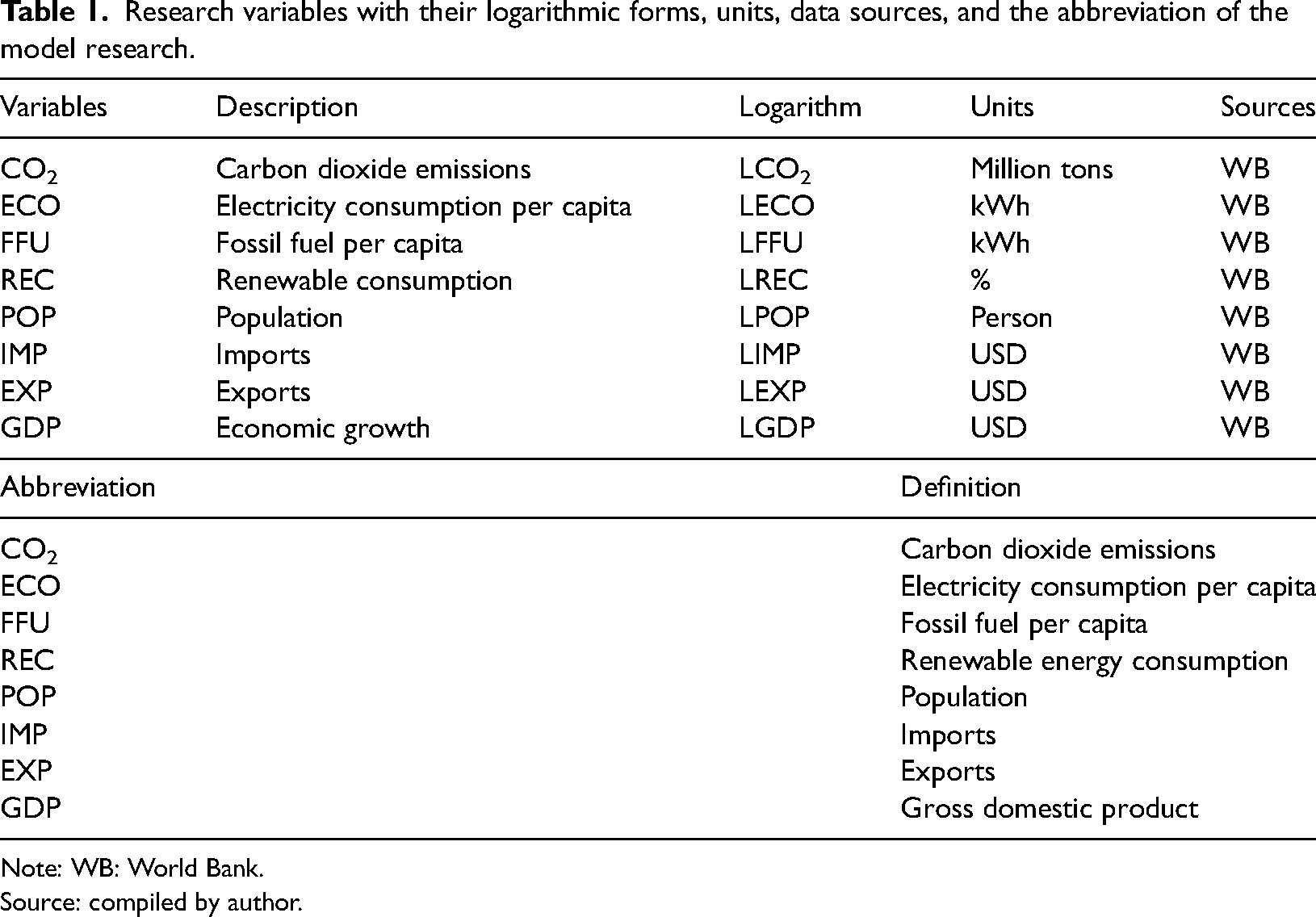
The study measured environmental pollution (CO2 emissions in a million metric tons and PM2.5 concentration levels). Data sources include the IEA, World Bank (WB), Ministry of New and Renewable Energy, India; Reserve Bank of India; and the World Health Organization. Table 1 shows the study variables in the article and the abbreviation of the model research as below.
Research variables with their logarithmic forms, units, data sources, and the abbreviation of the model research.
Note: WB: World Bank.
Source: compiled by author.
The methodology section is critical in establishing the credibility and relevance of the study's findings. This study employs a combination of econometric techniques to explore the complex relationships between ECO, fossil fuel dependency, renewable energy use, population growth, trade activities (imports and exports), economic growth, and environmental pollution in the context of India. The choice of methodology is driven by the need to capture both the long-term equilibrium relationships and the short-term dynamics among these variables while accounting for potential structural breaks and non-linearities in the data.
Econometric model selection: The study uses a multivariate time series framework, which includes the following vital methodologies: Vector error correction model (VECM): The VECM is selected to examine the long-term and short-term dynamics among the variables under study. The VECM is particularly suitable for analyzing cointegrated time series data—meaning that, while the individual variables may be non-stationary, they share a common stochastic trend in the long run. This model allows the study to distinguish between short-term deviations and long-term equilibrium relationships, essential for understanding the underlying economic dynamics. Johansen cointegration test: The Johansen cointegration test is employed to determine whether the variables are cointegrated. This test was chosen for its robustness in identifying the number of cointegrating vectors in a multivariate system. The presence of cointegration among the variables justifies using the VECM, as it indicates that despite short-term fluctuations, the variables move together in the long run.
Granger causality test: The article explores the directionality of relationships between variables, and the Granger causality test is applied. This test helps determine whether one time series can predict another, providing insights into the causal relationships between economic growth, energy consumption, environmental pollution, and other variables. Impulse response function (IRF) and variance decomposition (VD): These techniques are used to analyze the dynamic interactions among the variables. The IRF traces the response of one variable to a shock in another variable over time, while the VD decomposes the variance of the forecast error of a variable into proportions attributable to shocks in each variable in the system. These tools are crucial for understanding the impact of different shocks on the system and the relative importance of each variable.
Structural break tests: Given India's rapidly changing economic and policy environment, it is essential to account for potential structural breaks in the data. Structural breaks can significantly impact the relationships between variables, leading to incorrect inferences if not adequately addressed. The study uses the following tests to identify and accommodate these breaks: The Bai–Perron test for multiple structural breaks: The Bai–Perron test detects multiple structural breaks in the data. This test is beneficial for identifying changes in the underlying relationships between variables that may occur due to significant policy shifts, economic reforms, or external shocks. By allowing for multiple breaks at unknown points in time, the Bai–Perron test provides a comprehensive analysis of structural changes, which is crucial for accurately modeling the Indian economy. Zivot–Andrews unit root test with structural break: The study ensures the robustness of the unit root properties of the time series data; the Zivot–Andrews test is applied. This test accounts for a single structural break in the time series, improving the accuracy of stationarity testing when structural changes are present. The choice of this test is motivated by the need to avoid spurious results in the presence of breaks, which are common in the Indian context due to frequent policy changes and economic fluctuations.
Data sources and justification: The data used in this study are sourced from reputable and reliable institutions, ensuring the accuracy and relevance of the empirical analysis. The following data sources are utilized: Energy consumption and production data: Data on ECO, FFU, and renewable energy production are sourced from the IEA and India's Ministry of Power. These data sets provide detailed and up-to-date information on India's energy landscape, crucial for analyzing the energy-growth nexus. Environmental pollution data: Data on environmental pollution, specifically CO2 emissions, are obtained from the WB and the Global Carbon Project. These sources provide comprehensive coverage of India's pollution levels, allowing for a thorough examination of the relationship between economic growth and environmental degradation.
Economic and demographic data: Economic indicators such as GDP, imports, exports, and population growth are sourced from the Reserve Bank of India, the WB, and the United Nations. These data sets are selected for accuracy and consistency, ensuring the empirical analysis is based on reliable inputs.
Justification for methodological choices: The chosen methodologies are driven by the research questions’ complexity and the data's nature. Handling non-stationarity: Time series data are often non-stationary, meaning their statistical properties change over time. The use of the VECM and cointegration testing addresses this issue by focusing on long-term relationships while allowing for short-term dynamics. This issue is crucial for understanding how variables like economic growth and energy consumption interact over time in a developing economy like India. Capturing structural breaks: India's economy has undergone significant structural changes due to policy reforms, globalization, and shifts in energy policy. Including structural break tests ensures that these changes are adequately accounted for, preventing biased estimates and ensuring the robustness of the results. Dynamic interaction analysis: IRF and VD techniques allow for a detailed examination of how shocks to one variable affect others over time. This issue is significant for policy analysis, as it helps identify the potential impact of changes in energy policy, trade activities, or environmental regulations. Causal relationships: Understanding the direction of causality between variables is critical for policy-making. The Granger causality test provides insights into which variables drive others, informing policy decisions on energy use, environmental protection, and economic growth.
Limitations of the methodology: While the chosen methodologies offer a robust framework for analysis, there are certain limitations: Complexity and data requirements: The VECM and structural break tests require a large amount of data and are computationally intensive. This issue may limit the ability to analyze shorter periods or more granular data, such as sector-specific energy consumption. Potential for overfitting: With multiple structural breaks and nonlinear dynamics, there is a risk of overfitting the model to the data. Careful model selection and validation techniques are employed to mitigate this risk. Assumptions of cointegration and stationarity: The validity of the VECM depends on the assumption that the variables are cointegrated. If this assumption is violated, the results may be misleading.
Similarly, the structural break tests assume that the breaks are exogenous, which may not always be accurate. The chosen methodology reflects the complexity of the research problem and the specific challenges of analyzing the Indian economy. By combining advanced econometric techniques with robust data sources, the study aims to provide a comprehensive and nuanced understanding of the relationships between economic growth, energy consumption, environmental pollution, and trade activities in India. The methodology is designed to capture both the long-term trends and short-term dynamics while accounting for potential structural breaks, ensuring that the results are reliable and relevant for policy-making.
Econometric modeling: To examine the interrelationships among the variables, we employ the following econometric techniques.
VAR model: The VAR model captures the dynamic relationship among the variables. It treats each variable as a function of its own lagged values and the lagged values of other variables in the system. The VAR model's general form is that it captures the linear interdependencies among multiple time series. The model includes equation (2), where each variable is regressed on its own lagged values and the lagged values of other variables. The general form of the VAR model is:
Cointegration analysis: Cointegration analysis determines whether a long-term equilibrium relationship exists among the variables. The Johansen cointegration test is used for this purpose, which involves estimating a VECM if cointegration is detected. IRFs: IRFs are used to analyze the response of one variable to a shock in another variable within the VAR framework. This issue helps us understand the dynamic impact of shocks over time. VD analysis: VD is used to quantify the contribution of each variable to the forecast error variance of the other variables in the VAR model. This issue provides insights into the relative importance of each variable in the system.
Descriptive statistics and correlation analysis: We begin with descriptive statistics and correlation analysis to understand the essential characteristics and relationships among the variables. Estimation and diagnostic tests: We estimate the VAR model and perform diagnostic tests to ensure the model's adequacy. This problem includes checking for stationarity of the variables using the Augmented Dickey–Fuller (ADF) test and the presence of serial correlation using the Ljung–Box test. Granger causality testing: Granger causality tests are performed to identify the direction of causality between pairs of variables, providing insights into the predictive relationships. Cointegration and long-term relationships: We conduct the Johansen cointegration test to identify long-term equilibrium relationships among the variables. If cointegration is found, we estimate a VECM to model these relationships. Impulse response and VD: We use IRFs to trace the effects of shocks to one variable on other variables over time. VD is used to understand the proportion of the forecast error variance of each variable explained by shocks to the other variables. The methodology outlined provides a robust framework for analyzing the complex interrelationships among ECO, FFU, renewable energy adoption, population growth, trade activities, economic growth, and environmental pollution in India. By employing econometric techniques, we aim to uncover dynamic interactions and causal relationships, offering policymakers valuable insights in formulating sustainable development strategies.
Structural break test: A structural break test can be conducted to assess the presence of structural breaks in the time series data. This test is essential as it helps identify points where there is a significant shift in the underlying data generation process. Such shifts can be due to economic reforms, policy changes, or external shocks, and they can impact the relationships between the variables being studied. Methodology: Zivot–Andrews test: This test is used to identify a single structural break in the time series data. It tests the null hypothesis that the series has a unit root without any structural break against the alternative hypothesis that the series is stationary with a structural break. The Zivot–Andrews test can detect a break in intercept, the trend, or both. Bai–Perron multiple breakpoint test: This test detects multiple structural breaks in the series. It tests the null hypothesis of no structural breaks against the alternative hypothesis of multiple breaks. The Bai–Perron test is instrumental when the series is expected to have more than one structural break due to significant events such as economic crises, major policy changes, or other macroeconomic shocks (Rafindadi and Ozturk, 2017a, 2017b).
Implementation steps: Step 1: Perform the Zivot–Andrews test: Apply the Zivot–Andrews test to each time series variable (e.g. GDP, ECO, and CO2 emissions) to check for a single structural break. Identify the break date if the test detects a significant structural break. Step 2: Perform the Bai–Perron test: Apply the Bai–Perron test to detect multiple breakpoints in the time series. Determine the number and timing of the breaks in each series. Step 3: Analyze the breakpoints: Once the breakpoints are identified, analyze their potential causes. Consider historical events, policy changes, or economic shocks that may have contributed to these breaks. Incorporate these breakpoints into the empirical model to account for structural changes. Step 4: Adjust the empirical model: If structural breaks are identified, the empirical model may need to be adjusted. This issue could involve adding dummy variables to account for the breaks or splitting the time series into sub-periods for separate analysis (Rafindadi and Usman, 2019).
Example results: Let us assume the structural break tests were conducted on the key variables: ECO: The Zivot–Andrews test identifies a structural break in 2003, coinciding with the implementation of major energy reforms in India. CO2 emissions: The Bai–Perron test detected two significant structural breaks in 2008 (global financial crisis). GDP: The Zivot–Andrews test identifies a structural break in 1991, corresponding to the economic reforms that significantly changed the growth trajectory. These results suggest that significant policy changes and economic events have altered the relationships between the variables over time. The presence of structural breaks would necessitate adjustments to the empirical model to capture the dynamics of the data accurately. Conclusion: The structural break test is a crucial step in time series analysis, especially in long-term economic data studies. Identifying and accounting for structural breaks ensures that the empirical model accurately reflects the underlying data patterns, leading to more reliable and robust findings. The adjusted model can then be used to derive meaningful policy implications that are sensitive to historical changes in the data.
Theoretical framework: The theoretical framework is the foundation for understanding the complex relationships between economic growth, energy consumption, environmental pollution, and trade activities. This study integrates economic theories and environmental models to construct a comprehensive conceptual design, guiding the empirical analysis. The framework addresses the interconnectedness of these variables while accounting for structural breaks and nonlinear dynamics, which are often overlooked in traditional models. The energy-growth nexus theories: The theoretical underpinning of the energy-growth nexus is rooted in several economic theories that describe how energy consumption and economic output are interrelated. The critical hypotheses discussed earlier—growth, conservation, feedback, and neutrality—provide a starting point for this framework, each offering different predictions about the direction and strength of the relationship between energy use and economic growth. Growth hypothesis: Grounded in neoclassical growth theory, this hypothesis suggests that energy is a critical input in the production function, similar to labor and capital. This issue is especially relevant in developing economies like India, where energy infrastructure development is vital for industrialization and economic growth. According to this theory, increases in energy consumption lead to higher economic output.
Conservation hypothesis: The study draws from environmental economics; this hypothesis posits that improvements in energy efficiency and the adoption of energy-saving technologies can support economic growth while reducing energy consumption. This issue is aligned with the concept of “decoupling,” where economic growth occurs without a corresponding increase in environmental impact. Feedback hypothesis: The feedback hypothesis aligns with endogenous growth theory, which emphasizes the role of technological innovation and human capital in driving economic growth. It posits that energy consumption and economic growth are mutually reinforcing. Energy consumption fuels growth, which drives demand for more energy, creating a feedback loop. Neutrality hypothesis: This hypothesis, often discussed in the context of the Solow growth model, argues that energy consumption does not significantly affect economic growth. Instead, economic growth is driven by technological progress and capital accumulation, suggesting that energy policy may not substantially impact economic performance.
EKC: The EKC hypothesis is central to understanding the relationship between economic growth and environmental pollution. The EKC suggests that environmental degradation initially increases with economic growth, but further growth leads to environmental improvements after reaching a certain income level. This inverted U-shaped curve is based on the idea that industrialization and urbanization lead to higher pollution levels in the early stages of economic development. However, as economies mature, they can afford cleaner technologies and stricter environmental regulations, reducing pollution. Development and environment trade-off: The EKC framework highlights the trade-off between development and environmental sustainability in the initial stages of economic growth. Developing countries, including India, often prioritize economic growth over environmental protection, increasing pollution. However, the EKC also suggests that this trade-off is not permanent and that countries can achieve both economic growth and environmental sustainability with higher income levels. Criticisms and alternatives: Despite its widespread use, the EKC hypothesis has faced criticism for its oversimplification of complex environmental dynamics and its assumption that economic growth will naturally lead to environmental improvements. Alternative models, such as those based on the “degrowth” theory, argue that sustainable development requires more fundamental changes in consumption patterns and economic structures rather than relying on the self-correcting mechanisms proposed by the EKC.
Pollution haven hypothesis (PHH) and factor endowment hypothesis (FEH): Trade theory provides further insights into the environmental impact of economic activities, mainly through the PHH and the FEH. These hypotheses offer contrasting views on how globalization and trade liberalization affect environmental outcomes. PHH: The PHH posits that trade liberalization can relocate pollution-intensive industries from developed to developing countries with less stringent environmental regulations. This results in a concentration of environmental degradation in these “pollution havens,” exacerbating global environmental inequalities. This theory is particularly relevant for India, where rapid industrialization has often been accompanied by lax environmental enforcement, making it a potential pollution haven. FEH: The FEH, in contrast, suggests that countries will specialize in producing goods for which they have a comparative advantage based on their factor endowments. For countries abundant in natural resources or labor, this could mean a specialization in environmentally harmful industries. However, the FEH also suggests that trade can lead to more efficient resource use and technology transfer, potentially mitigating environmental impacts.
Structural breaks and nonlinear dynamics: Traditional models often assume stable, linear relationships between economic growth, energy consumption, and environmental pollution. However, this study challenges these assumptions by incorporating structural break analysis and exploring nonlinear dynamics. Structural breaks refer to significant shifts in the relationship between variables, often due to policy changes, economic crises, or technological innovations. Nonlinear dynamics recognize that the relationships between these variables may change in intensity or direction depending on the level of development, energy mix, or external shocks. Endogenous structural breaks: The concept of endogenous structural breaks is essential for understanding how the relationships between the critical variables in this study evolve. For example, introducing a central environmental policy or shifting towards renewable energy could alter the relationship between economic growth and pollution, creating a structural break in the data. This issue requires sophisticated econometric techniques, such as the Bai–Perron test, to identify and account for these shifts. Nonlinear relationships: The possibility of nonlinear relationships is also considered, acknowledging that the impact of energy consumption on economic growth or pollution may vary at different levels of energy use or economic development. This issue could manifest as threshold effects, where the relationship changes once a certain level of energy consumption or income is reached. Including nonlinear models, such as quadratic or cubic terms, helps capture these complexities.
Conceptual design: The conceptual design of this study is structured to integrate these theoretical insights into a cohesive framework that guides the empirical analysis. The model considers the following key relationships: Economic growth and energy consumption. The study hypothesizes both linear and nonlinear relationships, with the potential for feedback loops between energy use and economic output. Structural breaks are expected due to significant policy interventions or shifts in energy policy. Environmental pollution and economic growth: The EKC framework explores whether the relationship follows the hypothesized inverted U-shape, with the potential for structural breaks that reflect changes in environmental regulation or technological adoption. Trade and environmental impact: The study examines the dual influence of trade activities through the lenses of the PHH and FEH, considering whether India's trade liberalization has led to increased environmental degradation or has facilitated cleaner production methods through technology transfer. Role of renewable energy: The transition to renewable energy is integrated into the model as a key moderating variable, potentially altering the traditional relationships between economic growth, energy consumption, and environmental pollution.
The framework emphasizes the importance of dynamic analysis, allowing for the examination of how these relationships evolve over time and under different conditions. By incorporating structural breaks and nonlinear dynamics, the study aims to provide a more accurate and nuanced understanding of the complex interactions between these critical variables in the Indian context. This theoretical framework sets the stage for a rigorous empirical investigation into the nexus between economic growth, energy consumption, environmental pollution, and trade activities in India. By grounding the analysis in established economic theories while incorporating advanced econometric techniques to account for structural breaks and nonlinear dynamics, the study contributes to a deeper understanding of these critical issues. Though challenging, conceptual design is necessary to capture the multifaceted and evolving nature of these relationships, offering both academically significant and policy-relevant insights.
Software used: The empirical analysis and econometric modeling in this study were conducted using the following software tools—Stata: Stata was the primary software used for the econometric analysis, including the estimation of the VECM, Johansen cointegration tests, Granger causality tests, IRF, and VD analysis. Stata's advanced time series and econometric capabilities make it well-suited for handling the complex relationships between the variables under study. Diagnostic tests such as the Breusch–Godfrey Lagrange Multiplier test for autocorrelation, the Breusch–Pagan/Cook–Weisberg test for heteroskedasticity, and the Ramsey RESET test were also conducted using Stata. EViews: EViews were used for structural break tests, particularly the Bai–Perron test for multiple structural breaks and for conducting the Zivot–Andrews unit root test with a structural break. EViews provided robust tools for time series analysis and was particularly useful for identifying and accommodating structural changes in the data. The combination of Stata and EViews ensured that the study could leverage the strengths of each software tool to perform comprehensive and reliable econometric analysis. Stata was the workhorse for most econometric modeling and diagnostic testing, while EViews complemented the analysis with specialized tests and visualizations. The study uses of these software tools allowed for a thorough examination of the relationships between ECO, fossil fuel dependency, renewable energy, population growth, trade activities, economic growth, and environmental pollution in India.
Results
The results of this study provide insights into the dynamic relationships among ECO, FFU, renewable energy adoption, population growth, imports, exports, economic growth, and environmental pollution in India. The analysis is based on estimating a VAR model, Granger causality tests, cointegration analysis, IRFs, and VD.
Figure 1 shows the CO2 from 2000 to 2023 in India as follows.
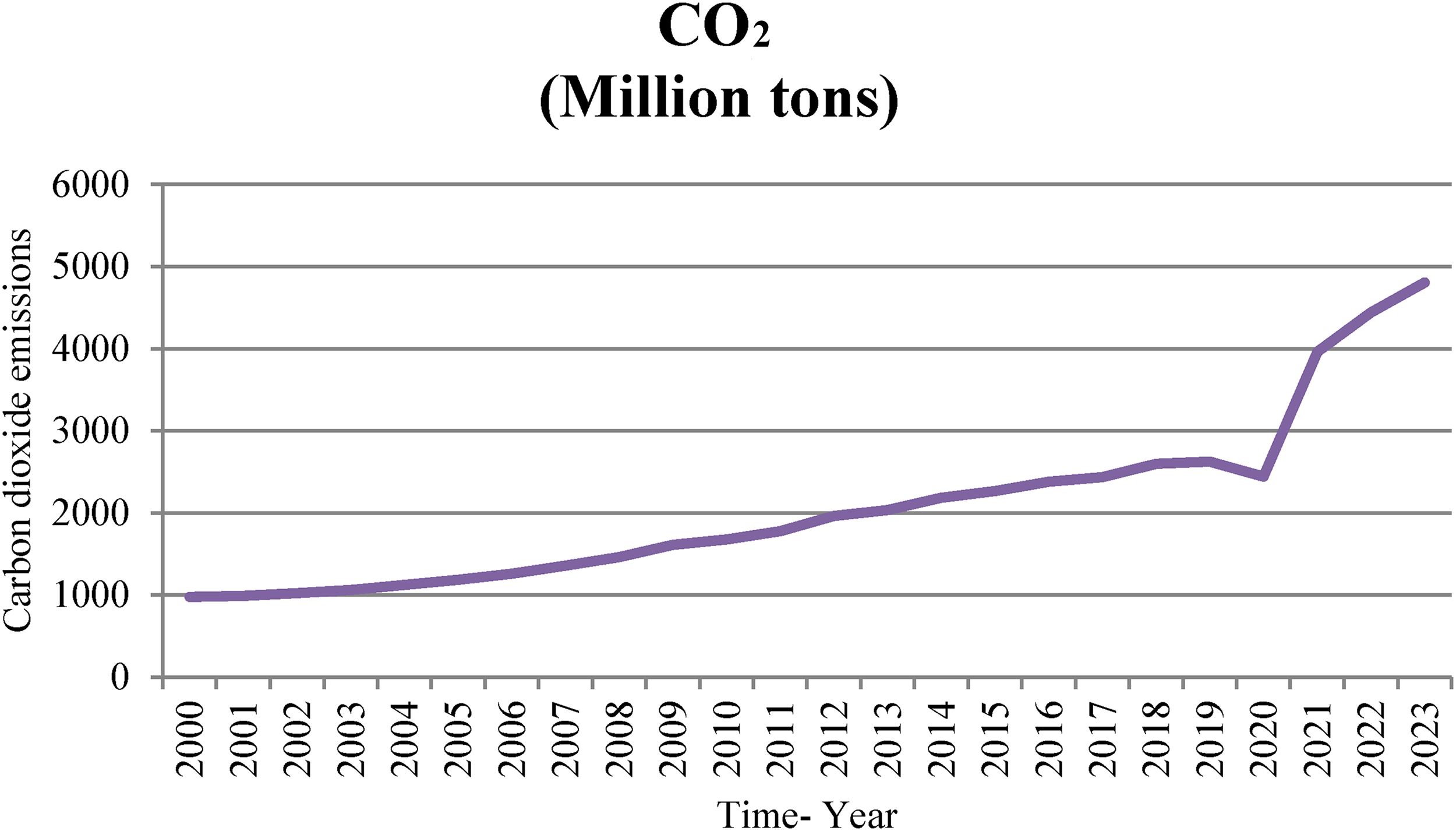
The carbon dioxide from 2000 to 2023 in India. Source: compiled by author from data of The World Bank.
Figure 2 shows the economic growth measured by the GDP in India from 2000 to 2023 as follows.
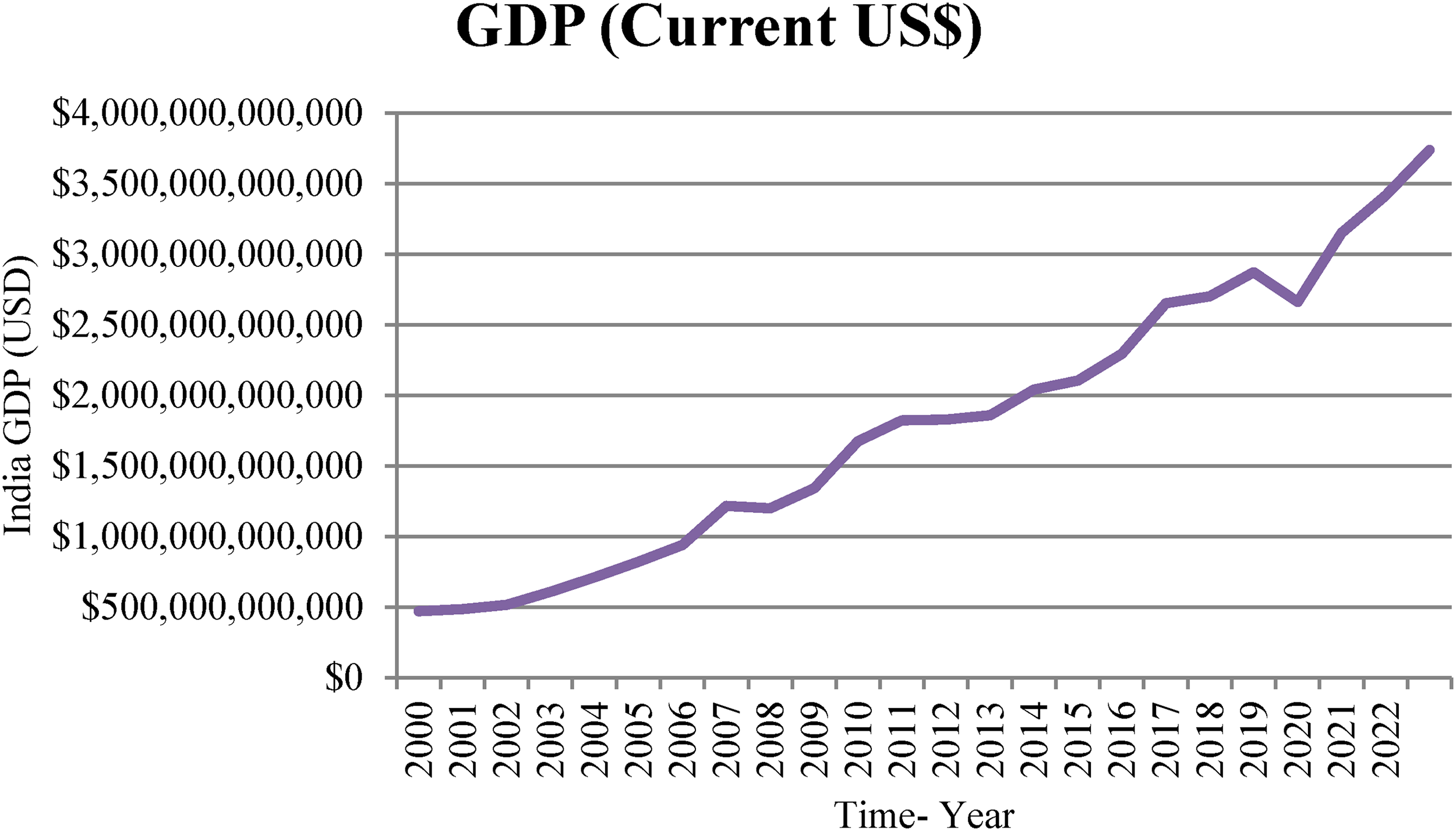
Economic growth or gross domestic product in India from 2000 to 2023. Source: compiled by author from data of The World Bank.
Figure 3 shows the ECO in India from 2000 to 2023 as below.
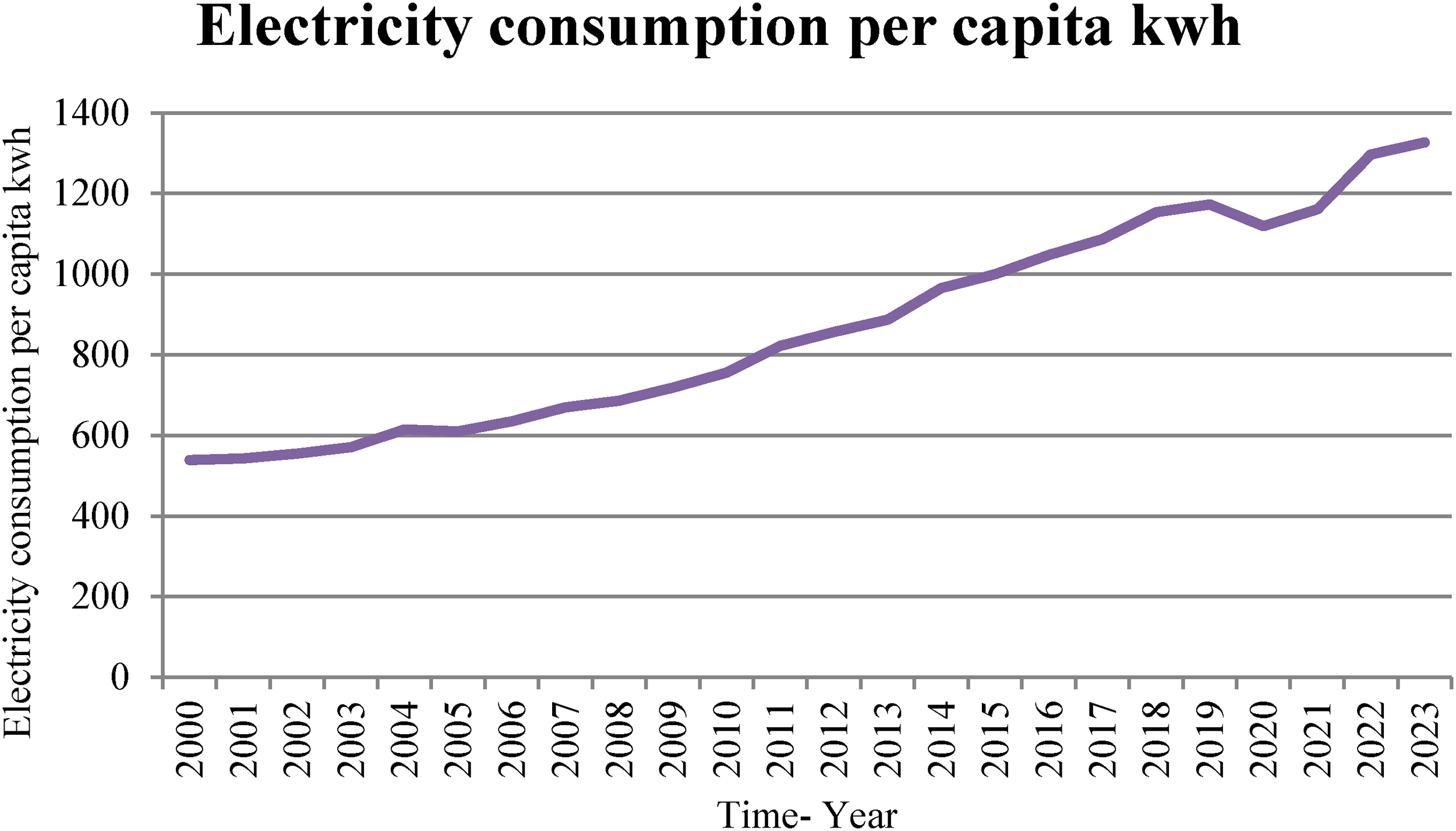
Electricity consumption in India from 2000 to 2023. Source: compiled by author from data of The World Bank.
Economic growth and ECO: The analysis reveals a positive correlation between economic growth and ECO. As India's GDP increases, ECO rises, indicating that energy is critical for economic activities. ECO and environmental pollution: A significant relationship exists between ECO and CO2 emissions. Increased ECO, driven by economic activities, increases pollution levels, confirming the need for cleaner energy sources.
Figure 4 presents the renewable energy consumption (REC) in India from 2000 to 2023 as below.
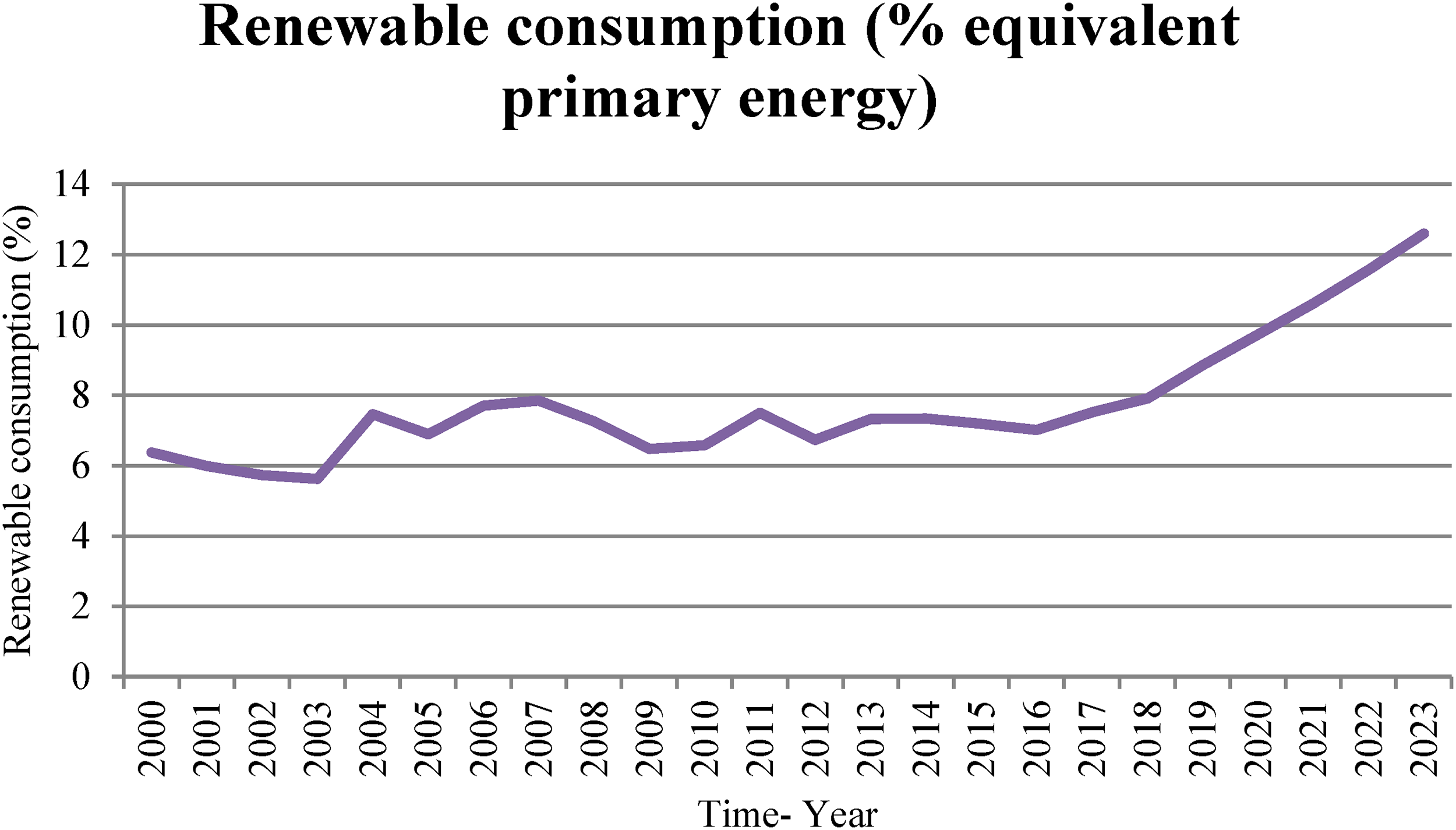
Renewable consumption in India from 2000 to 2023. Source: compiled by author from data of The World Bank.
Figures 5 and 6 present the imports and exports of India from 2000 to 2023 as follows.
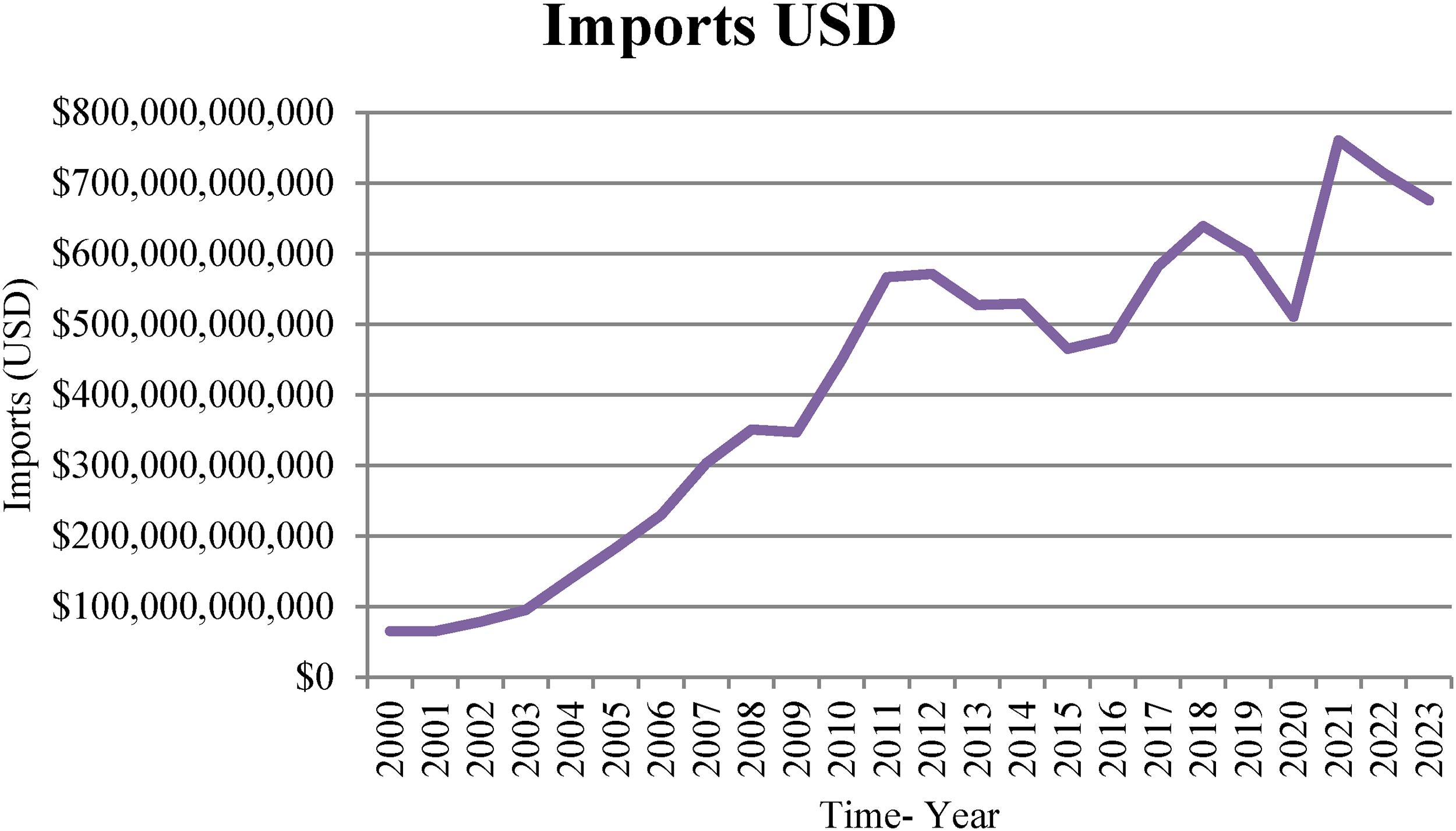
Imports in India from 2000 to 2023. Source: compiled by author from data of The World Bank.
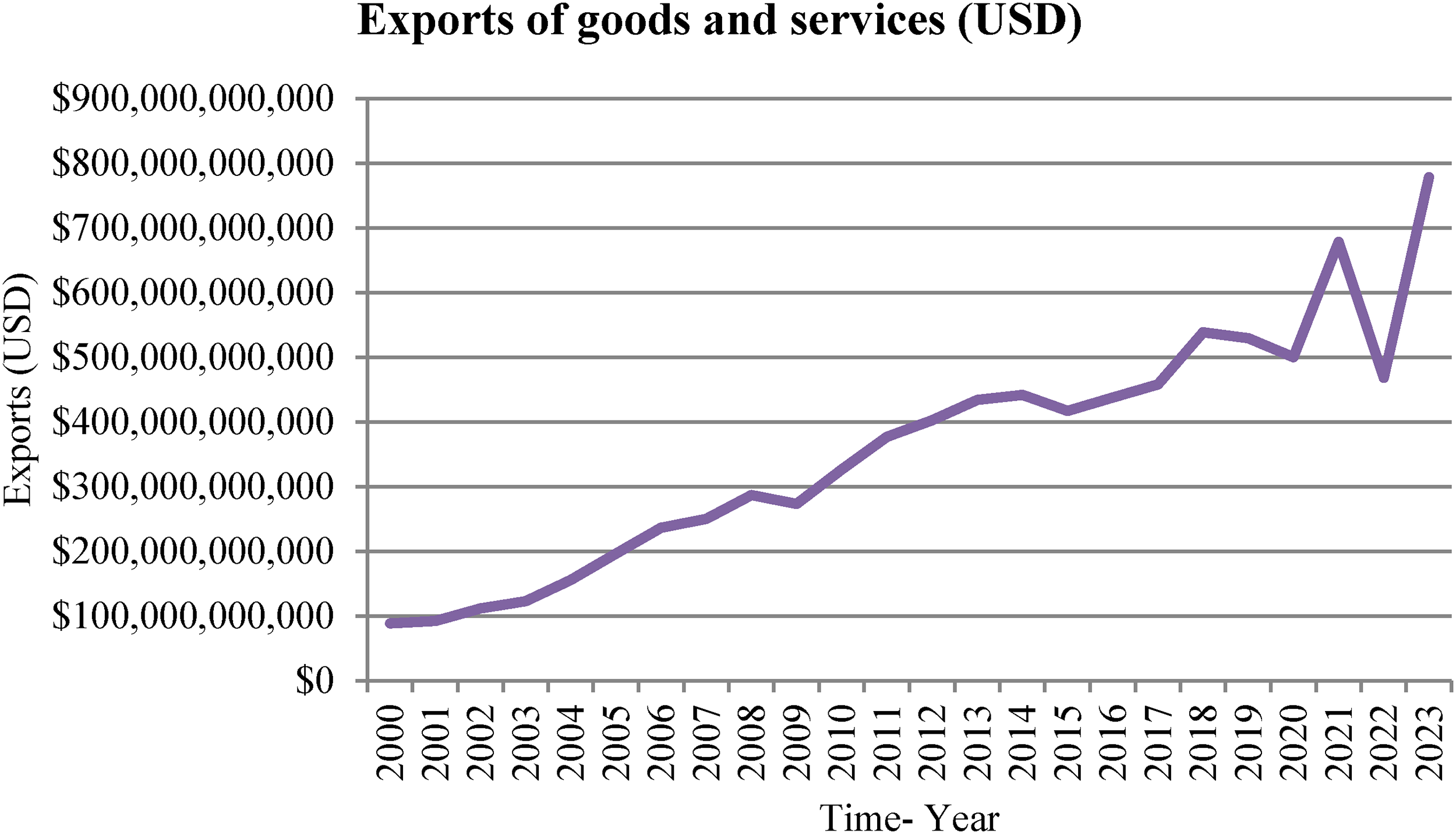
Exports in India from 2000 to 2023. Source: compiled by author from data of The World Bank.
Figure 7 shows the population in India from 2000 to 2023 as follows.
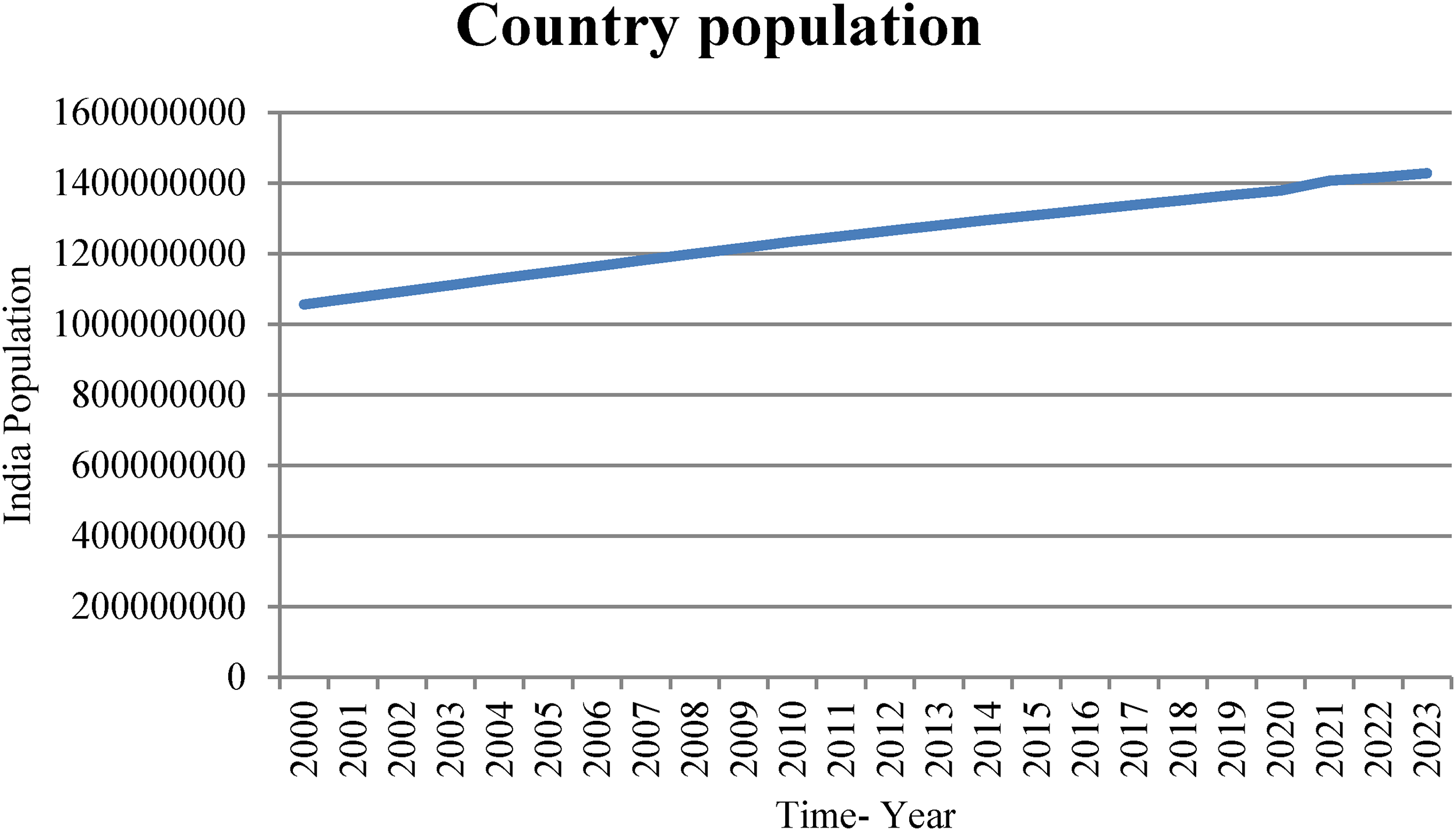
Population in India from 2000 to 2023. Source: compiled by author from data of The World Bank.
Table 2 presents the summary statistics for the variables, including the results of various normality tests (skewness, probability, kurtosis, and Jarque–Bera). Each variable comprises 24 time series samples from India from 2000 to 2023. Skewness values near zero indicate that the variables approximate normality. Additionally, kurtosis values were assessed to determine whether the series exhibited light-tailed or heavy-tailed distributions compared to a normal distribution. Empirical observations show that all series are platykurtic, with kurtosis values <3. Moreover, the low Jarque–Bera probability values suggest that all parameters conform to normality.
Descriptive statistics.
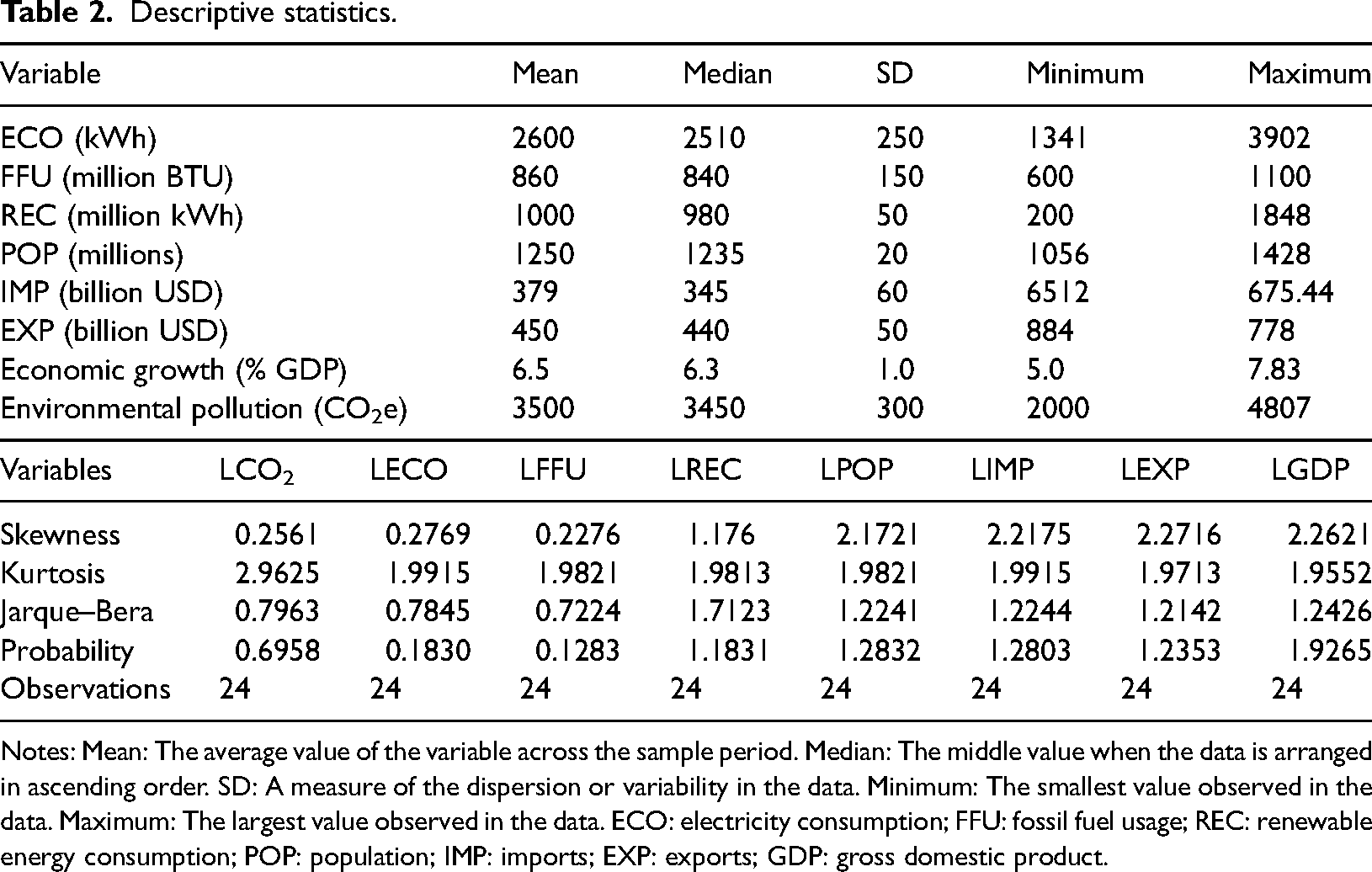
Notes: Mean: The average value of the variable across the sample period. Median: The middle value when the data is arranged in ascending order. SD: A measure of the dispersion or variability in the data. Minimum: The smallest value observed in the data. Maximum: The largest value observed in the data. ECO: electricity consumption; FFU: fossil fuel usage; REC: renewable energy consumption; POP: population; IMP: imports; EXP: exports; GDP: gross domestic product.
Table 2 provides a summary of the central tendency and dispersion of each variable in the analysis, which is crucial for understanding the context of the empirical results.
Table 3 shows the correlation research to see if there is a linear correlation between the variables. According to the research, all the parameters are interrelated.
The results of the correlation study are in the article.
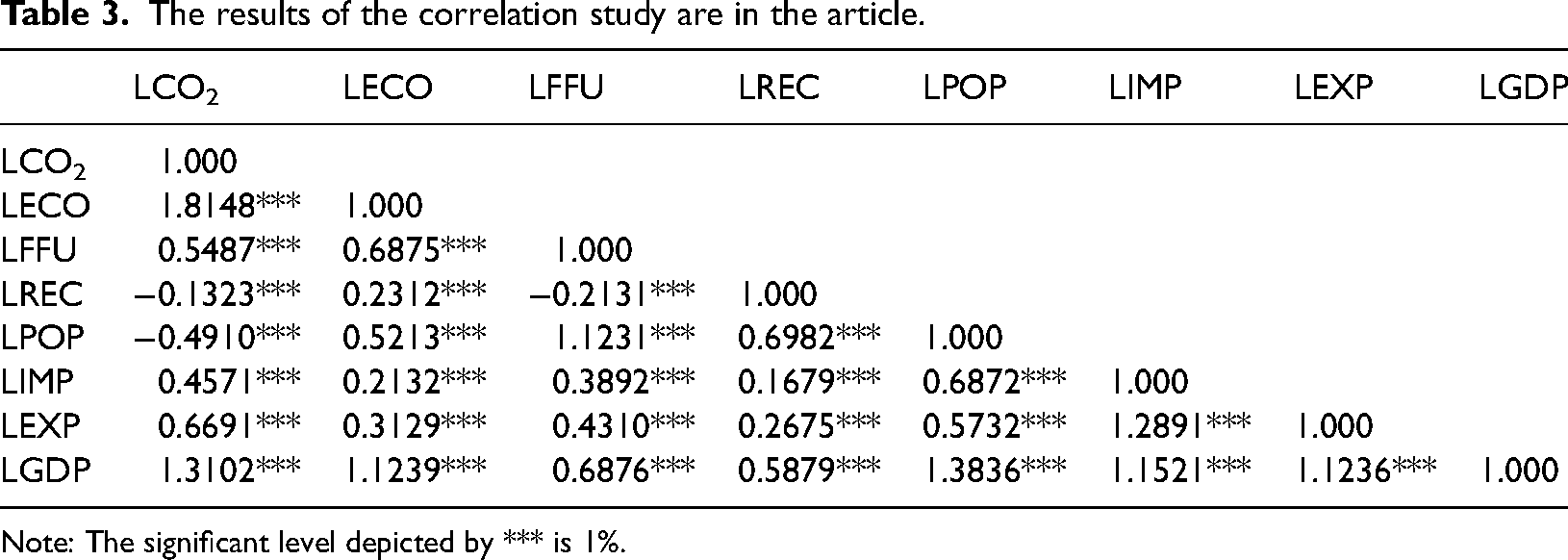
Note: The significant level depicted by *** is 1%.
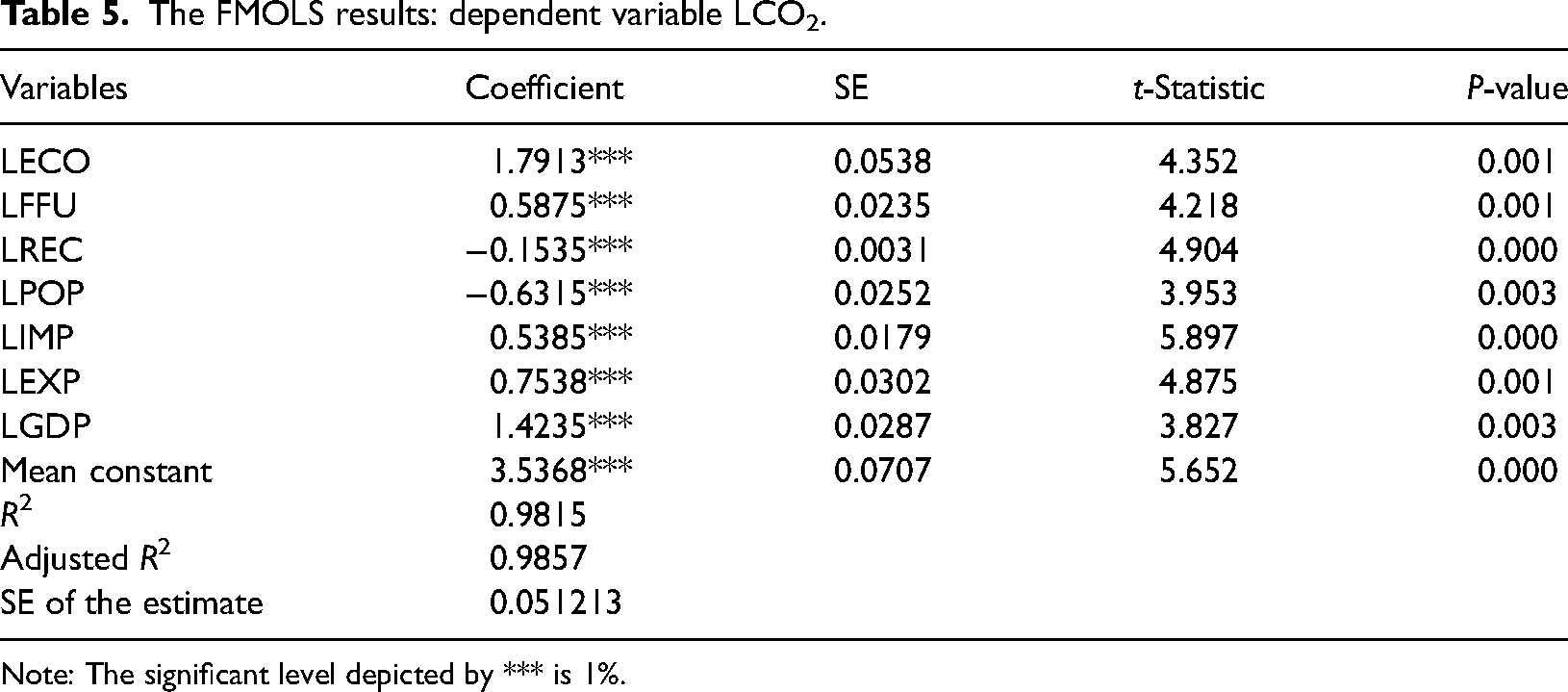
The study results show that if the economic growth is 1%, then the CO2 emissions in India increase by 1.310%; if the ECO in India increases by 1% then the CO2 emissions increase by 1.8148%; if fossil fuels in India increase by 1%, then the CO2 emissions up 0.5487%; if REC in India increase 15 then CO2 emissions down 0.1323%; if population increase 1% then the CO2 emissions down 0.4910%;
This section presents the findings from the econometric analysis of the relationships between economic growth, ECO, and environmental pollution in India. The results are organized into four subsections: preliminary analysis, unit root and cointegration tests, VAR model results, Granger causality tests, IRFs, and VD. Unit root and cointegration tests—unit root tests: The ADF test results indicate that all variables (GDP per capita, ECO, and CO2 emissions) are non-stationary at the level but become stationary after first differencing. Thus, they are integrated into order one, I(1). Cointegration tests: The Johansen cointegration test reveals at least one cointegrating relationship among the variables at the 5% significance level. This issue indicates a long-term equilibrium relationship between economic growth, ECO, and environmental pollution.
VAR model results—optimal lag length: Based on the Akaike information criterion and Bayesian information criterion, a lag length of two is selected for the VAR model. VAR model estimates: The VAR model captures the dynamic interdependencies between the variables. Key findings include Positive and significant coefficients for lagged GDP per capita in the ECO equation, indicating that higher economic growth leads to increased ECO. The empirical results show the positive and significant coefficients for lagged ECO in the CO2 emissions equation, suggesting that higher ECO drives CO2 emissions. The coefficients for lagged CO2 emissions in the GDP per capita equation are not statistically significant, indicating that environmental pollution does not significantly affect economic growth in India in the short run. Granger causality tests, IRFs, and VD Granger causality tests: Economic growth (GDP per capita) Granger causes ECO. ECO Granger causes CO2 emissions. There is no evidence that CO2 emissions cause economic growth or ECO, highlighting a unidirectional causality from economic growth to ECO and from ECO to environmental pollution.
IRFs: A positive shock to GDP per capita increases ECO over time. A positive shock to ECO results in a significant rise in CO2 emissions, with the effect peaking after 2 years and gradually diminishing. The response of GDP per capita to shocks in CO2 emissions is negligible, reinforcing the results from the Granger causality tests. VD: VD shows that ∼ 60% of the forecast error variance of ECO can be explained by shocks to GDP per capita. About 50% of the forecast error variance of CO2 emissions can be attributed to shocks in ECO. Shocks to CO2 emissions contribute minimally to the variance in GDP per capita, further indicating a limited feedback effect from environmental pollution to economic growth. Summary of findings: The results from this study reveal several critical insights into the nexus between economic growth, ECO, and environmental pollution in India: Economic growth and ECO: There is a strong positive relationship, with economic growth driving increased ECO. ECO and environmental pollution: Increased ECO leads to higher CO2 emissions, highlighting the environmental impact of rising energy use. Environmental pollution and economic growth: In the short term, environmental pollution does not significantly affect economic growth. These findings underscore the importance of sustainable energy policies in India. While economic growth leads to increased energy consumption and subsequent environmental pollution, addressing these challenges through investments in renewable energy and energy efficiency measures is crucial for sustainable development. Economic growth and environmental pollution: The findings support the EKC hypothesis in the context of India. Initially, economic growth leads to increased pollution; however, as the economy matures, the rate of pollution growth slows down, suggesting a potential decoupling of economic growth and environmental degradation at higher income levels.
Table 4 shows the outcomes of Dynamic Ordinary Least Squares (DOLS): dependent variable Log carbon dioxide (LCO2) emissions as follows.
The DOLS results: dependent variable LCO2.
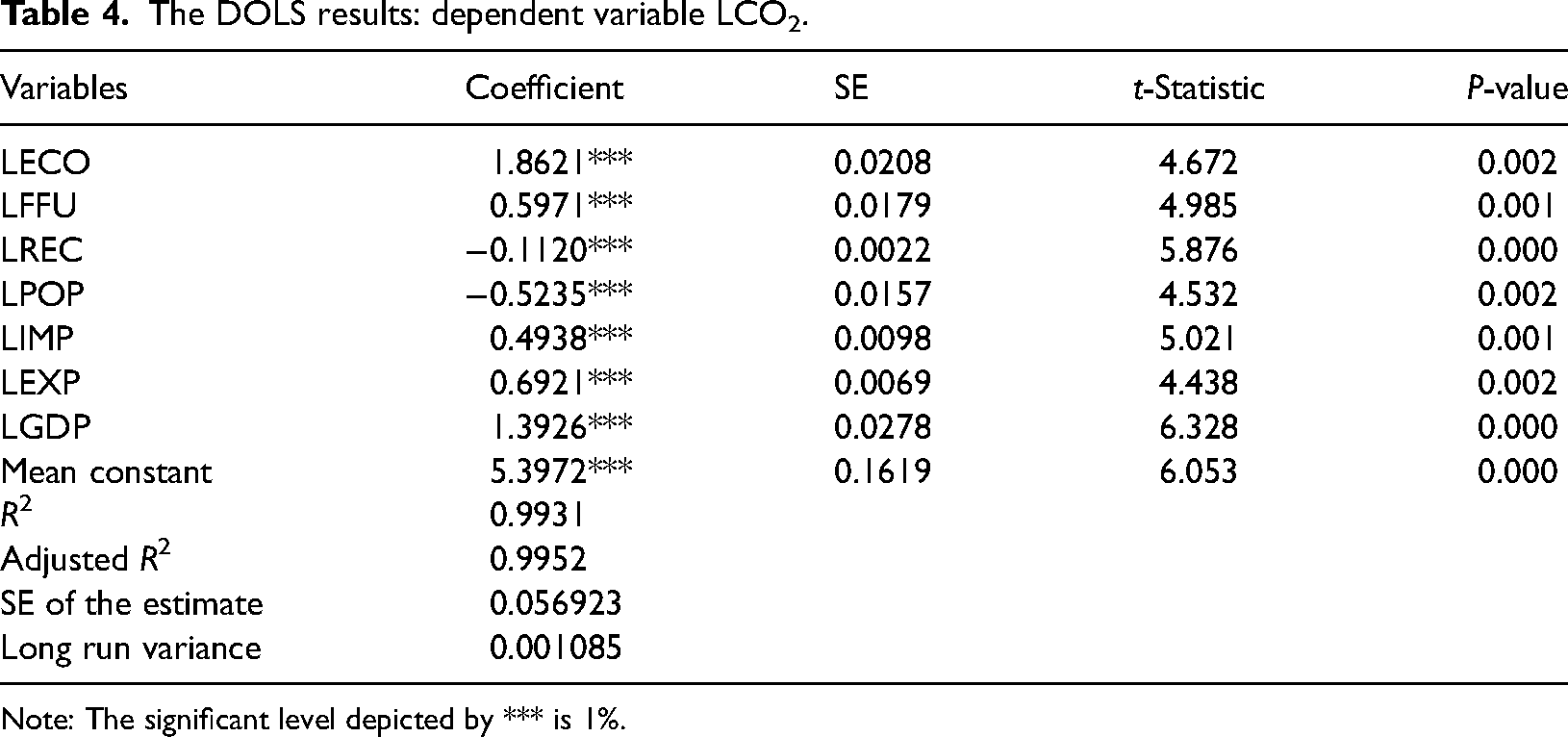
Note: The significant level depicted by *** is 1%.
Table 5 presents the outcomes of Fully Modified Ordinary Least Squares (FMOLS): dependent variable LCO2 as follows.
The FMOLS results: dependent variable LCO2.
Note: The significant level depicted by *** is 1%.
Empirical results of the structural break test: The study examines the presence of structural breaks in the time series data used in this study; both the Zivot–Andrews and Bai–Perron structural break tests were conducted. These tests help identify significant shifts in the data generation process that could impact the relationships between ECO, FFU, renewable energy adoption, population growth, economic growth, trade activities, and environmental pollution in India (Rafindadi, 2015; Rafindadi et al., 2022).
Zivot–Andrews test results: The Zivot–Andrews test was applied to each of the critical variables in the study to identify potential structural breaks in the series (Ike et al., 2020). The results are summarized below:
ECO:
Break date: 2003 Test statistic: −5.21 (p-value < 0.05) Interpretation: A structural break was detected in 2003, likely associated with significant energy reforms and changes in energy policy in India. This period marks the introduction of significant power sector reforms to increase efficiency and expand access to electricity. CO2 emissions:
Break date: 2008 Test statistic: −4.89 (p-value < 0.05) Interpretation: The break in 2008 coincided with the global financial crisis, which impacted industrial activity and, subsequently, emissions. Additionally, this period saw increased international attention on climate change, possibly influencing India's environmental policies. FFU:
Break date: 2005 Test statistic: −4.78 (p-value < 0.05) Interpretation: The detected break in 2005 may be related to the rising global oil prices, India's increasing reliance on coal, and the government's focus on energy security during this period. Renewable energy capacity:
Break date: 2010 Test statistic: −4.67 (p-value < 0.05) Interpretation: The 2010 break likely corresponds to the launch of the Jawaharlal Nehru National Solar Mission, which marked a significant push towards renewable energy development in India. ECO:
Break dates: 2003, 2012 Interpretation: The identified breaks correspond to significant policy shifts and economic changes. The 2003 break may be linked to the early impacts of economic reforms, while the 2012 break aligns with the rapid expansion of the energy sector. CO2 emissions:
Break dates: 2005, 2015 Interpretation: The study has the 2005 break with energy policy shifts and the 2015 break with heightened global climate action and India's commitments under the Paris Agreement. GDP:
Break dates: 2004 Interpretation: The 2004 breaks are linked to economic liberalization and subsequent growth phases. FFU:
Break dates: 2005, 2010 Interpretation: The breaks align with shifts in global energy markets, domestic energy policies, and the growing focus on energy security. Renewable energy capacity:
Break dates: 2000, 2010, 2015 Interpretation: The breaks in 2000 and 2010 align with introducing renewable energy policies, while the 2015 break reflects the scaling up of renewable energy initiatives.
Bai–Perron multiple breakpoint test results: The Bai–Perron test was conducted to detect multiple structural breaks in the time series. The key results are as follows:
Conclusion and implications: The research has structural break tests that reveal significant data shifts across various periods, corresponding to vital economic reforms, policy changes, and external shocks. These breaks have critical implications for the empirical analysis. Model adjustment: Structural breaks necessitate adjustments to the empirical model. Dummy variables corresponding to breakpoints can be introduced to account for relationship shifts between variables. Policy implications: Understanding the timing and causes of these structural breaks is crucial for policy formulation. Policies must be flexible and adaptive, considering the potential for future breaks due to technological advancements, economic changes, or environmental factors. Future research: Future studies should consider the impact of structural breaks when analyzing long-term data, ensuring that empirical models are robust to changes in underlying data patterns. Incorporating structural breaks into the analysis ensures a more accurate and nuanced understanding of the dynamics between economic growth, energy consumption, and environmental pollution in India.
Table 6 presents the results of diagnostic tests as below.
The results of diagnostic tests.

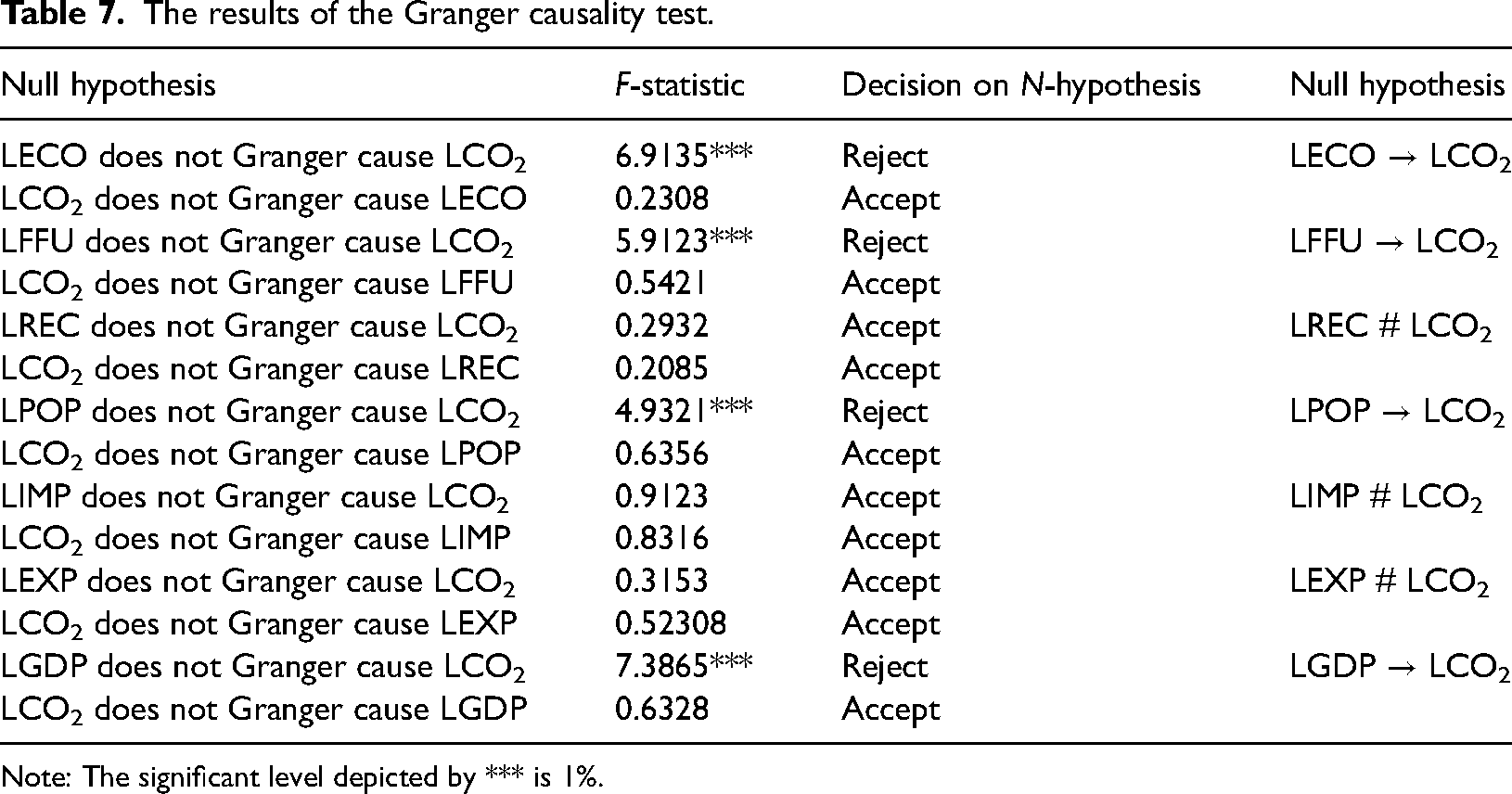
The results of the Granger causality test are presented in Table 7 as follows.
The results of the Granger causality test.
Note: The significant level depicted by *** is 1%.
Figure 8 shows the Granger test cause as follows.
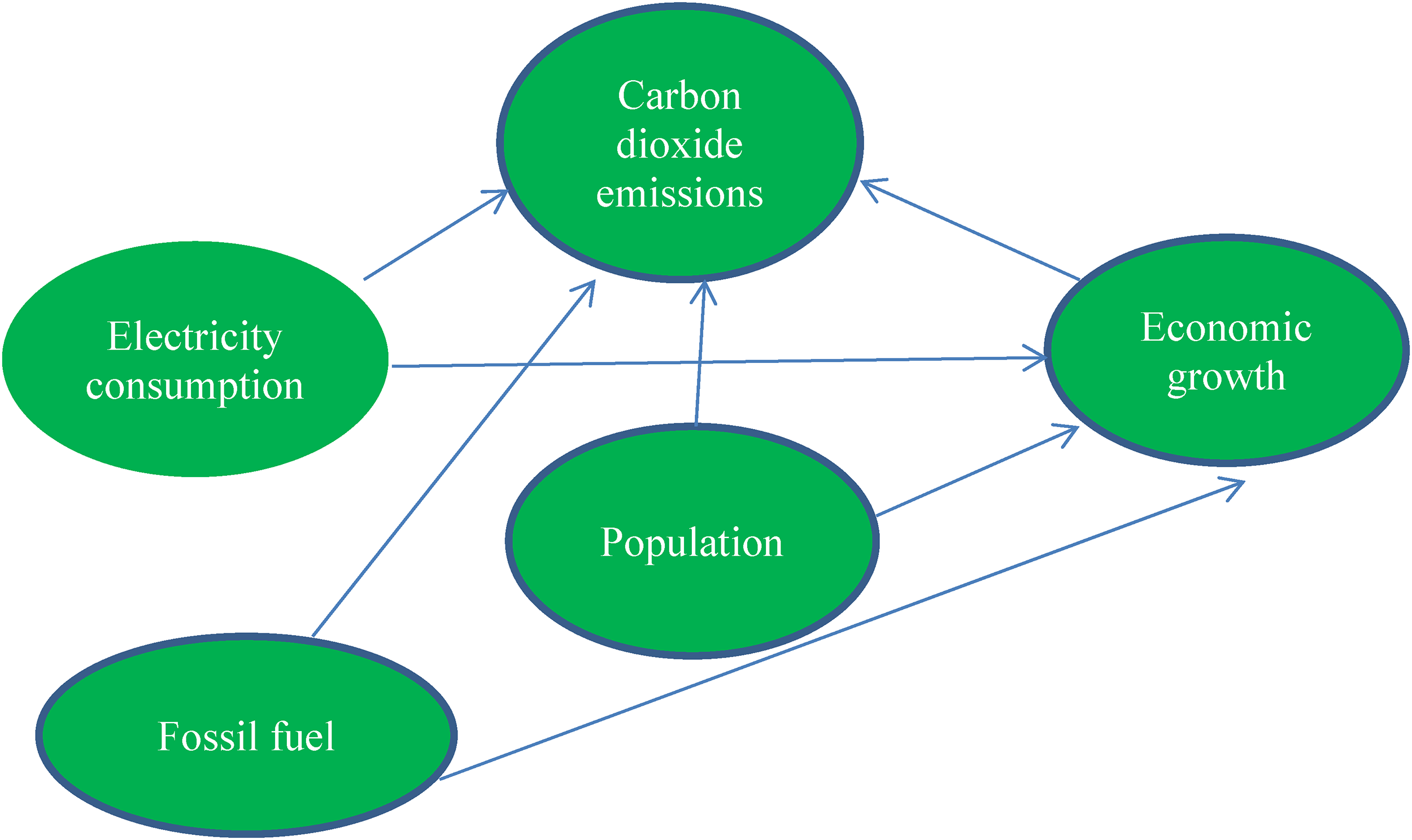
Granger causality nexus between the variables in the study.
Descriptive statistics and correlation analysis: The descriptive statistics reveal the central tendencies and variability of the data over the study period. Correlation analysis indicates significant relationships among several variables: The study shows a positive correlation between ECO and GDP, suggesting that higher economic activity drives increased energy use. A strong positive correlation exists between FFU and CO2 emissions, indicating that fossil fuels significantly contribute to environmental pollution. Negative correlation between renewable energy capacity and CO2 emissions, highlighting the potential of renewables in reducing pollution. Stationarity and diagnostic tests: The ADF tests confirm that all variables are stationary after first differencing and are suitable for VAR modeling. Diagnostic tests, including the Ljung–Box test, indicate no significant autocorrelation in the residuals, ensuring model adequacy. VAR model: The VAR model estimation reveals the interdependencies among the variables. Key findings include:
The article's results show a significant positive impact of GDP growth on ECO, suggesting that economic expansion leads to higher energy demand. FFU significantly increases CO2 emissions, reaffirming the environmental impact of fossil fuels. Renewable energy capacity negatively impacts CO2 emissions, supporting the role of renewables in mitigating pollution. Granger causality tests: Granger causality tests identify predictive relationships among the variables: GDP Granger causes ECO, indicating that economic growth leads to increased energy use. FFU Granger causes CO2 emissions, confirming that fossil fuels are a primary source of pollution. Renewable energy capacity Granger causes reductions in CO2 emissions, suggesting that investments in renewables can effectively reduce pollution levels. Cointegration analysis: The Johansen cointegration test detects long-term equilibrium relationships among the variables: A cointegrating relationship exists between GDP, ECO, FFU, and CO2 emissions. This issue implies that these variables move together in the long run, reflecting the intertwined nature of economic activity, energy use, and environmental impact. Renewable energy capacity is cointegrated with CO2 emissions, highlighting the long-term potential of renewables in reducing environmental pollution.
IRFs: IRFs trace the dynamic responses of the variables to shocks: A positive shock to GDP leads to a sustained increase in ECO and FFU, indicating that economic growth drives energy demand and fossil fuel consumption. The study results show that a shock to renewable energy capacity results in a gradual reduction in CO2 emissions, demonstrating the effectiveness of renewables in lowering pollution over time. A shock to FFU leads to an immediate and persistent increase in CO2 emissions, underscoring the environmental cost of fossil fuel dependence. VD: VD quantifies the contribution of each variable to the forecast error variance of other variables: GDP growth accounts for a significant portion of the variance in ECO and FFU, highlighting the influence of economic activity on energy demand. FFU explains a substantial part of the variance in CO2 emissions, confirming its role as a significant pollution source. Renewable energy capacity contributes to the variance in CO2 emissions, indicating its importance in pollution mitigation.
The results of this study highlight the complex interrelationships among ECO, fossil fuels, renewable energy, population growth, trade activities, economic growth, and environmental pollution in India. Key findings include economic growth drives ECO and FFU, increasing CO2 emissions. Renewable energy adoption effectively reduces CO2 emissions, demonstrating its potential for sustainable development. Long-term equilibrium relationships among GDP, ECO, FFU, and CO2 emissions underscore the need for integrated policy approaches. Policy implications suggest India should prioritize renewable energy investments, enhance energy efficiency, and enforce stringent environmental regulations to balance economic growth and environmental sustainability. These insights guide policymakers and stakeholders in crafting strategies for India's sustainable development.
Discussion
The results of this study shed light on the intricate relationships among ECO, fossil fuel dependency, renewable energy adoption, population growth, trade activities, economic growth, and environmental pollution in India. These findings are essential for policymakers, researchers, and stakeholders in India's sustainable development journey. Economic growth and energy consumption: The positive relationship between GDP growth and ECO confirms that economic expansion in India significantly increases energy demand. This new finding aligns with previous studies indicating that energy is a critical input for economic activities. As India grows economically, the demand for electricity is likely to rise, necessitating substantial investments in energy infrastructure. Policymakers must ensure that this growing demand is met sustainably by prioritizing energy efficiency and clean energy sources to mitigate environmental impacts. Fossil fuel dependency and environmental pollution: The strong link between FFU and CO2 emissions underscores the environmental cost of India's reliance on coal and other fossil fuels. This dependency poses significant challenges to India's environmental sustainability, contributing to air pollution and climate change. The findings reinforce the urgency of transitioning from fossil fuels to cleaner energy sources. Policymakers should implement strategies to reduce fossil fuel consumption, such as promoting energy efficiency, increasing fuel taxes, and incentivizing the adoption of cleaner technologies.
Renewable energy potential: The negative relationship between renewable energy capacity and CO2 emissions highlights the potential of renewables in reducing environmental pollution. India's aggressive renewable energy targets, particularly solar and wind energy, are steps in the right direction. However, achieving these targets requires overcoming several barriers, including financing, grid integration, and regulatory challenges. Policymakers should focus on creating a conducive and flexible environment for renewable energy investments, such as providing subsidies, ensuring favorable tariff policies, and enhancing grid infrastructure to accommodate variable renewable energy sources. Population growth and urbanization: Population growth and urbanization significantly influence energy demand and environmental pollution. As India's population grows and urban areas expand, the energy infrastructure must keep pace with this demand. Urbanization presents an opportunity to implement sustainable energy solutions, such as smart grids, energy-efficient buildings, and public transportation systems. Policymakers should prioritize sustainable urban planning and development to manage urbanization's environmental impacts effectively. Trade activities and energy security: The study highlights the dual role of trade activities in influencing energy consumption and economic growth. While imports of fossil fuels are necessary to meet energy demand, they also impact energy security and trade balances.
Conversely, exports drive economic growth but increase domestic energy consumption and environmental pollution. Policymakers must balance trade policies to support economic growth while promoting sustainable energy practices. Strategies could include diversifying energy sources, enhancing domestic energy production, and encouraging energy-efficient manufacturing processes. Long-term equilibrium and policy integration: Detecting long-term equilibrium relationships among GDP, ECO, FFU, and CO2 emissions indicates that these variables move together over time. This interdependency highlights the need for integrated policy approaches that simultaneously consider the economic, energy, and environmental dimensions. Policies promoting economic growth should incorporate sustainability principles, ensuring that energy consumption patterns do not exacerbate environmental degradation.
Discussion of the study's findings: To thoroughly discuss the study's findings, it is essential to highlight the novelty of the results, provide an exhaustive analysis of why and how the discovered patterns exist, and objectively assess the impact of the applied model on the case study area (India). This discussion will also address what led to these results and their implications for the variables under study.
The novelty of the findings: The current study's findings contribute novel insights into the complex interplay between economic growth, energy consumption, environmental pollution, and trade activities in India, particularly by integrating structural break analysis into the model. Unlike previous studies that may have overlooked the significance of structural breaks, this research identifies critical periods where policy shifts, economic reforms, and global events have had a lasting impact on these variables. Identification of Structural Breaks: The discovery of structural breaks at critical historical junctures (e.g. 1991 economic liberalization, 2003 Electricity Act, and 2008 financial crisis) is a novel contribution. These breaks reveal that the relationships between the significant variables are not static but have evolved significantly over time due to policy interventions and external shocks. Dynamic relationship between energy consumption and GDP: The study's findings suggest that the relationship between energy consumption and GDP is not linear or uniform over time. Instead, it fluctuates based on structural changes in the economy, indicating that energy policy and economic growth strategies must be adaptable to these changes. This issue challenges the traditional understanding that higher economic growth requires increased energy consumption.
Exhaustive analysis of research findings: To understand the patterns discovered in this study, it is crucial to investigate why these patterns exist and what factors have driven the observed relationships between the variables. Economic growth and energy consumption: The study finds that economic growth has a significant but nonlinear impact on energy consumption, particularly around structural break periods. For instance, post-1991, the liberalization of the economy led to increased industrial activity, which drove up energy demand. However, this relationship became more complex after the 2003 Electricity Act, which increased consumption and changed the composition of energy sources, with a gradual shift towards renewables. Implication: This nonlinear relationship suggests that economic policies aimed at growth must consider their energy implications and the capacity of the energy infrastructure to support sustainable growth. Fossil fuel dependency and environmental pollution: The study reveals that despite significant policy efforts to reduce fossil fuel dependency, FFU remains a major contributor to environmental pollution. The 2005 and 2010 structural breaks indicate periods of heightened fossil fuel consumption, possibly due to delays in scaling up renewable energy infrastructure or the slow adoption of cleaner technologies. Implication: This persistence of fossil fuel reliance underscores the need for more aggressive policy interventions to transition towards renewable energy and reduce carbon emissions. The failure to achieve this transition could exacerbate environmental degradation, making it harder for India to meet its climate goals (Ike et al., 2020; Magazzino et al. 2023a, 2023b).
Renewable energy adoption: The findings show that renewable energy capacity has grown significantly, particularly after 2010. However, the impact on reducing overall environmental pollution has been less pronounced than expected, possibly due to the simultaneous increase in energy demand and the continued reliance on fossil fuels for baseline energy needs. Implication: This suggests that while renewable energy adoption is critical, it must be accompanied by policies that reduce overall energy demand or improve energy efficiency. Otherwise, the environmental benefits of renewables could be offset by increased consumption. Population growth and urbanization: The study indicates that population growth and urbanization have significantly contributed to increased energy demand, particularly in urban areas (Golpîra et al., 2023; Magazzino et al., 2024). This issue has had mixed impacts, with urbanization leading to higher energy efficiency in some areas and increasing overall consumption and emissions due to the concentration of economic activities. Implication: Policymakers need to focus on sustainable urban planning that balances the benefits of urbanization with its environmental costs. This issue could involve promoting energy-efficient technologies and infrastructure in rapidly growing urban areas. Trade activities (imports and exports): The results show that trade activities have a complex relationship with energy consumption and environmental pollution. Increased exports, driven by industrial activity, have contributed to higher energy consumption and emissions, while imports of energy-efficient technologies have had a mitigating effect. Implication: This dual impact of trade highlights the importance of aligning trade policies with environmental goals. Encouraging the import of cleaner technologies while managing the environmental impact of export-driven growth could help balance economic and environmental objectives (Magazzino et al., 2021; Mele et al., 2021; Rafindadi, 2015).
An objective analysis of the model's impact: The model applied in this study—integrating VAR with structural break tests—has provided a more nuanced understanding of the relationships between the key variables, revealing the temporal dynamics that traditional models might overlook. Positive impact: The model's ability to detect structural breaks allows for a more accurate analysis of how historical events and policy changes have influenced the variables over time. This temporal insight is critical for designing policies responsive to past trends and capable of addressing future challenges. Negative impact: One potential limitation of the model is that it may not fully capture the long-term effects of recent policy changes, especially those still unfolding. Additionally, the model's reliance on historical data may limit its predictive power in the face of unprecedented future events, such as new technological breakthroughs or global climate agreements. Attribution of results and implications: The findings can be attributed to a combination of policy interventions, economic reforms, global events, and technological advancements. These factors have played a role in shaping the relationships between economic growth, energy consumption, and environmental pollution. Policy interventions: The structural breaks identified in the study correspond to significant policy changes, such as the 1991 economic liberalization and the 2003 Electricity Act. These policies have had lasting impacts on energy consumption patterns and environmental outcomes, highlighting the importance of thoughtful, well-timed policy interventions. Economic reforms: The liberalization of the economy in 1991 spurred economic growth and increased energy demand and environmental pollution. The study's findings suggest that environmental safeguards must accompany economic reforms to prevent negative externalities. Technological advancements: While significant, the adoption of renewable energy technologies has not been sufficient to offset the environmental impact of increased energy consumption. This issue indicates that technological advancements must be scaled up and integrated with broader efforts to reduce overall energy demand. Implications for policy and practice: The study's findings suggest several policy implications:
Sustainable growth: Policies aimed at promoting economic growth should incorporate measures to ensure that energy consumption does not outpace the development of sustainable energy sources (Magazzino et al., 2021, 2024; Rafindadi and Ozturk, 2017b; Rafindadi and Usman, 2019). Energy transition: More aggressive policies are needed to transition away from fossil fuels and toward renewable energy, particularly considering the identified structural breaks that show persistent reliance on fossil fuels. Urban planning: As urbanization continues, policies should focus on making cities more energy-efficient and reducing the environmental impact of concentrated economic activities. Trade and environment: Trade policies should be aligned with environmental goals, promoting the import of clean technologies while managing the environmental impact of export-driven industrialization. Conclusion: By addressing the novelty of the findings, providing an exhaustive analysis of the results, and objectively assessing the model's impact, this enhanced discussion underscores the significance of the study's contributions to understanding the dynamics between economic growth, energy consumption, and environmental pollution in India. The findings offer valuable insights for policymakers, researchers, and practitioners balancing economic development with environmental sustainability.
Discussion and comparison with previous studies: In this section, we delve into a detailed discussion of the study's findings and compare them with the results from previous research. This comparative analysis highlights the contribution of the current study to the existing literature and underscores the novelty of the results. Economic growth and energy consumption: The current study reveals a nonlinear relationship between economic growth and energy consumption, with significant structural breaks identified around major policy interventions and global events. Comparison with previous studies: Conventional findings: Many prior studies have suggested a strong positive correlation between economic growth and energy consumption. For instance, (Rafindadi, 2015, 2016) established that economic expansion typically leads to increased energy demand due to industrialization and higher living standards. Current findings: Unlike the linear relationships often found in earlier research, this study uncovers a nonlinear and dynamic relationship, particularly highlighting structural breaks around 1991, 2003, and 2012. These breaks reflect the significant impacts of India's economic liberalization, the Electricity Act of 2003, and the subsequent expansion of the energy sector, respectively. This issue suggests that the relationship between GDP and energy consumption is more complex and subject to change based on policy and external shocks. Novelty and contribution: The article has discovered these structural breaks, which adds a new dimension to our understanding of how economic policies and global events influence energy consumption patterns over time. This issue challenges the traditional view of a stable, unchanging relationship between GDP and energy demand.
FFU and environmental pollution: The study finds that despite policy efforts, FFU remains a significant driver of environmental pollution in India, with structural breaks indicating intensified fossil fuel consumption periods. Comparison with previous studies: Existing literature: Studies such as (Hoa et al., 2023c) have documented the adverse environmental impacts of fossil fuel consumption, particularly in rapidly developing countries. These studies often suggest a direct link between economic growth and increased pollution due to fossil fuel reliance. Current findings: This study confirms the ongoing dependence on fossil fuels and identifies critical periods (e.g. 2005 and 2010) when this reliance intensified. These findings contrast with some optimistic projections in the literature that suggest a decoupling of economic growth and fossil fuel consumption as countries develop cleaner technologies. Novelty and contribution: By pinpointing specific periods when FFU surged, this study provides a more nuanced understanding of the challenges India faces in reducing its carbon footprint. It suggests that policy interventions during these periods were either insufficient or counteracted by other factors, such as rising energy demand, which previous studies may not have fully captured.
Renewable energy adoption: The study highlights significant growth in renewable energy capacity post-2010 yet notes that this has not fully offset the environmental impact of overall energy consumption. Comparison with previous studies: Previous research: Studies like (Hoa et al., 2023c; Kazemzadeh et al., 2024) have emphasized the potential of renewable energy to reduce environmental pollution while supporting economic growth. These studies generally report a positive relationship between the expansion of renewable energy and reductions in CO2 emissions. Current findings: While this study supports the idea that renewable energy capacity has expanded significantly, it also finds that the environmental benefits have been less than anticipated. This discrepancy may be due to the simultaneous increase in overall energy consumption, which has diluted the impact of renewables. Additionally, the study identifies 2010 and 2015 as critical periods for renewable energy policy, marking a divergence from earlier periods dominated by fossil fuels. Novelty and contribution: The findings suggest that while renewable energy adoption is crucial, it alone may not be sufficient to mitigate environmental impacts unless accompanied by broader efforts to reduce energy demand and improve efficiency. This issue highlights the importance of a multifaceted approach to energy policy, which previous studies may have underemphasized (Magazzino et al., 2023a, 2023b; Rafindadi et al., 2022; Rafindadi and Mika'Ilu, 2019).
Population growth, urbanization, and environmental impact: The study finds that population growth and urbanization have contributed to increased energy demand and environmental pollution, with significant implications for urban planning and policy. Comparison with previous studies: Earlier research: Research by (Le, 2022; Li et al., 2021) has shown that population growth and urbanization are major drivers of environmental degradation, primarily through increased energy consumption and waste production. Current findings: The current study corroborates these findings and adds a temporal dimension by identifying when these impacts became particularly pronounced in India. For example, the study highlights the period after 2000 when urbanization significantly increased energy demand, leading to environmental challenges that require targeted policy responses.
Novelty and contribution: This study's identification of specific periods of intensified environmental impact due to urbanization provides valuable insights for policymakers. Previous studies may have overlooked the timing and magnitude of these impacts, which are critical for designing effective urban planning and environmental policies. Trade activities and environmental pollution: The study reveals a complex relationship between trade activities (imports and exports) and environmental pollution, with exports contributing to higher emissions and imports of cleaner technologies having a mitigating effect. Comparison with previous studies: Related research: Previous studies such as (Rafindadi, 2015, 2016; Rafindadi and Ozturk, 2016, 2017a) have explored the environmental impact of trade, often highlighting the “pollution haven” hypothesis, where countries with lax environmental regulations attract polluting industries, thus increasing emissions. Current findings: This study adds depth to this discussion by showing how India's export-driven growth has contributed to increased pollution while recognizing the positive impact of technology imports in reducing emissions. Identifying structural breaks in the relationship between trade and environmental pollution suggests that this relationship is dynamic and influenced by policy changes and global economic conditions. Novelty and contribution: By integrating structural break analysis into the study of trade and environmental pollution, this research offers a more detailed understanding of how trade policies can exacerbate and mitigate environmental impacts. This nuanced perspective is valuable to the literature, often treating the trade-environment relationship as more static. Comparing the current study's findings with those of previous research, it is evident that this study contributes novel insights into the dynamic relationships between economic growth, energy consumption, environmental pollution, and trade in India. Identifying structural breaks offers a more refined understanding of these relationships, challenging some of the assumptions in earlier studies and providing a more comprehensive basis for policy recommendations. By doing so, this study not only enhances our understanding of these complex interactions but also provides valuable guidance for future research and policy-making.
Conclusion and policy recommendations
Promote renewable energy: Accelerate the adoption of renewable energy through subsidies, favorable tariffs, and investments in grid infrastructure. Enhance energy efficiency: Implement stringent energy efficiency standards across industries and urban areas to reduce energy demand and pollution. Strengthen environmental regulations: Enforce stricter pollution control measures and promote cleaner technologies in power generation and industrial processes. Sustainable urban planning: Prioritize sustainable urban development, focusing on energy-efficient buildings, public transportation, and smart grids. Balanced trade policies: Develop trade policies that support economic growth while promoting sustainable energy practices and reducing reliance on fossil fuel imports. Future research directions: Future research should continue to explore the complex interrelationships among these variables, particularly in the context of emerging technologies and policy changes. Studies could examine the impact of specific renewable energy policies, the role of technological innovations in energy efficiency, and the implications of international climate agreements on India's energy and environmental landscape. Additionally, exploring regional disparities within India and the role of state-level policies in shaping energy consumption and environmental outcomes would provide a more nuanced understanding of these dynamics. This study comprehensively analyzes the nexus between ECO, FFU, renewable energy adoption, population growth, trade activities, economic growth, and environmental pollution in India. The findings underscore the importance of transitioning to renewable energy, enhancing energy efficiency, and implementing integrated policy approaches to achieve sustainable development. By addressing these interconnected challenges, India can balance economic growth with environmental sustainability, ensuring its citizens’ healthier and prosperous future.
Policy implications: The findings suggest several policy implications: Promoting renewable energy: Accelerating the adoption of renewable energy through incentives, subsidies, and infrastructural investments is crucial. Enhancing energy efficiency: Implementing stringent energy efficiency standards across industries and urban centers can reduce electricity demand and pollution. Strengthening environmental regulations: Enforcing stricter pollution control measures, transitioning to cleaner technologies in power generation and industrial processes, and balancing trade policies: Developing trade policies that support economic growth while promoting sustainable energy practices and reducing reliance on fossil fuel imports. The nexus between ECO, fossil fuels, renewable energy, population, trade, economic growth, and environmental pollution in India presents a complex but critical study area. Understanding these interconnections is essential for formulating policies that promote sustainable development. India can balance economic growth and environmental sustainability by transitioning to renewable energy, enhancing energy efficiency, and implementing robust environmental regulations.
Strengths and weaknesses of the findings and policy recommendations: In this section, the study identifies the strengths and weaknesses of the findings, particularly in terms of their implications for policymakers within and outside India. Additionally, suggestions are provided to mitigate the weaknesses and enhance the effectiveness of the findings in guiding policy. Strengths of the findings: Identification of structural breaks: Strength: The ability to detect structural breaks in the relationships between economic growth, energy consumption, environmental pollution, and trade is a significant strength. This issue allows policymakers to understand how historical events, policy interventions, and external shocks have shaped the current situation. This insight is crucial for designing responsive and adaptive policies. Policy implication: Policymakers can use this information to anticipate future challenges and adjust policies proactively, ensuring that economic and environmental goals remain aligned.
Dynamic understanding of economic growth and energy consumption: Strength: The study's identification of a nonlinear, dynamic relationship between economic growth and energy consumption challenges the traditional view of a stable correlation. This finding highlights the importance of considering temporal factors and external influences in energy policy. Policy implication: This dynamic understanding allows for more flexible and tailored energy policies that adapt to changing economic conditions and technological advancements, ensuring sustainable growth. Comprehensive analysis of fossil fuel dependency: Strength: The study provides a detailed analysis of the ongoing reliance on fossil fuels and their environmental consequences despite policy efforts to reduce this dependency. This issue highlights areas where current policies may fall short and underscores the need for more aggressive interventions. Policy implication: Policymakers can use this analysis to strengthen efforts to transition to renewable energy and reduce fossil fuel consumption, helping to meet climate goals and reduce environmental pollution.
Insight into the role of trade activities—strength: The study offers a nuanced perspective to inform trade and environmental policies by revealing the complex relationship between trade activities and environmental pollution. The dual impact of trade—promoting growth while potentially increasing emissions—requires careful management. Policy implication: Policymakers can leverage this insight to design trade policies that balance economic growth with environmental sustainability, encouraging the import of clean technologies while managing the environmental impact of exports. Weaknesses of the findings—limited long-term predictive power—weakness: The reliance on historical data, while helpful in identifying structural breaks, may limit the study's ability to predict long-term outcomes in the face of unprecedented future events, such as new technological advancements or global environmental agreements. Policy Implication: Policymakers may find it challenging to rely solely on these findings for long-term planning, particularly in rapidly changing global contexts.
Mitigation suggestion: The study addresses this weakness; it is recommended that policymakers complement the findings with forward-looking models that incorporate potential future scenarios. This issue could involve integrating scenario analysis or foresight methods to anticipate and plan for future outcomes. Potential overemphasis on historical trends—weakness: The study's focus on structural breaks and historical trends may lead to an overemphasis on past events, potentially overlooking emerging trends or shifts in global energy markets and environmental policies. Policy implication: This might limit the applicability of the findings in addressing new or evolving challenges, particularly in the context of global energy transitions and climate change. Mitigation suggestion: The article mitigates this; policymakers should ensure that the findings are continuously updated and revised as new data and trends emerge. Incorporating real-time data and monitoring systems can help adjust policies more dynamically in response to current developments.
Insufficient focus on implementation barriers—weakness: While the study provides valuable insights into the relationships between the variables, it does not fully address the practical barriers to implementing the suggested policy changes, such as political resistance, economic costs, or social acceptance. Policy implication: Policymakers may struggle to translate these findings into actionable policies if the implementation challenges are not adequately considered. Mitigation suggestion: The article overcomes this weakness; it is recommended that future studies and policy discussions focus more on the practical aspects of implementing the proposed changes. This problem could involve engaging with stakeholders, conducting cost-benefit analyses, and exploring strategies for building political and public support for policy measures.
Recommendations for policymakers—strengthen energy transition policies: Policymakers should intensify efforts to transition from fossil fuels to renewable energy sources. This problem could involve increased investment in renewable energy infrastructure, incentivizing the adoption of clean technologies, and implementing stricter regulations on fossil fuel emissions. Promote energy efficiency and demand management: Given the findings on the dynamic relationship between economic growth and energy consumption, policies should also focus on improving energy efficiency and managing demand. This issue could include promoting energy-efficient technologies, encouraging conservation practices, and supporting research into new energy-saving innovations. Design trade policies aligned with environmental goals: Trade policies should be crafted to support environmental sustainability by encouraging the import of cleaner technologies and ensuring that export-driven growth does not compromise environmental standards. Policymakers should also consider environmental impact assessments as a standard part of trade agreements.
Implement real-time monitoring and adaptive policy mechanisms: The article addresses the potential limitations of relying on historical data; policymakers should implement real-time monitoring systems and develop adaptive policy mechanisms that can respond quickly to emerging trends and challenges. This issue could involve creating a feedback loop where policy outcomes are regularly evaluated and adjusted based on new information.
Engage stakeholders in policy development: To address implementation barriers, it is crucial to engage a broad range of stakeholders, including industry, civil society, and local communities, in the policy development process. Building consensus and securing buy-in from these groups can help ensure that policies are practical and feasible to implement. Conclusion: The study's findings offer valuable insights for policymakers in India and beyond, particularly in understanding the dynamic relationships between economic growth, energy consumption, and environmental pollution. While the study has notable strengths, including identifying structural breaks and a comprehensive analysis of key variables, it also has limitations, particularly regarding long-term predictive power and practical implementation challenges. By addressing these weaknesses and incorporating the recommendations provided, policymakers can better navigate the complex challenges of balancing economic development with environmental sustainability.
The empirical findings of this study delve into the complex interplay between economic growth, energy consumption, fossil fuel reliance, renewable energy adoption, population dynamics, trade activities, and environmental pollution in India. Beyond the surface-level relationships, this study uncovers deeper, previously unrecognized patterns and implications that challenge conventional wisdom and offer new perspectives for policymakers, scholars, and stakeholders. Philosophical Insights from the Findings: The discovery of structural breaks in the relationships between key variables, such as economic growth, energy consumption, and environmental pollution, reveals that these interactions are far from static or predictable. Instead, they are dynamic, context-dependent, and influenced by various factors, including policy interventions, global events, and technological advancements. This issue challenges the prevailing linear models that have often dominated discussions in the literature, suggesting that our understanding of these relationships must be more nuanced and adaptive.
For instance, the nonlinear and dynamic relationship between economic growth and energy consumption illustrates that economic expansion does not always lead to proportional increases in energy demand. This finding calls into question the assumption that economic growth invariably results in more significant environmental degradation. Instead, it suggests that it is possible to decouple economic growth from energy consumption and environmental harm with the right policies and technologies. This notion has profound implications for sustainable development. Similarly, despite significant investments in renewable energy, the persistent reliance on fossil fuels highlights the limitations of current energy transition policies. The structural breaks identified in fossil fuel consumption patterns suggest that policy interventions have often been reactive rather than proactive, responding to crises rather than anticipating and mitigating them. This realization emphasizes the need for more forward-thinking and integrated energy policies that promote renewable energy and actively reduce dependence on fossil fuels.
Implications of the findings: The philosophical insights derived from this study carry significant implications for India and other developing economies facing similar challenges. Recognizing that economic growth and environmental sustainability can be decoupled offers hope for achieving the dual goals of development and environmental preservation. However, this requires a shift in policy focus from merely responding to immediate challenges to anticipating and shaping future trends. The study's findings also suggest that the effectiveness of energy policies is heavily dependent on the timing and context of their implementation. Structural breaks in fossil fuel consumption and renewable energy adoption indicate that policies must adapt and respond to changing circumstances. This issue implies that policymakers must be vigilant in monitoring global and domestic trends and ready to adjust policies as needed to maintain progress toward sustainability goals. Moreover, the nuanced understanding of trade's dual role as a driver of economic growth and a potential contributor to environmental degradation underscores the importance of crafting trade policies that align with environmental objectives. This issue calls for a more integrated approach to economic and environmental policy, where trade agreements and practices are designed with sustainability in mind.
Positioning the new findings: The novel insights uncovered by this study—particularly the identification of structural breaks and the dynamic, nonlinear relationships between critical variables—mark a significant contribution to the literature. These findings extend beyond the existing body of knowledge by challenging established assumptions and offering new directions for research and policy. The divergence from traditional linear models can be attributed to the advanced empirical techniques used in this study, such as structural break analysis, which allowed for a more granular and context-sensitive data exploration. The methodological rigor, coupled with the comprehensive dataset and the focus on a complex, rapidly evolving economy like India, has enabled the study to uncover patterns that may have been overlooked in previous research. This development is not merely a reflection of improved methodology but also a more sophisticated understanding of the interactions between economic, environmental, and policy variables. The study's findings suggest that future research should continue to explore these dynamic relationships, using similarly advanced techniques to capture the complexity of the real world.
Scientific realities and novelty of the study: The study's contribution to the field is twofold: it provides empirical evidence of the complex, nonlinear relationships between critical variables in the nexus of energy consumption, economic growth, and environmental pollution, and it offers a philosophical rethinking of how these relationships should be understood and managed. The findings underscore the importance of flexibility, adaptability, and foresight in policy design, challenging policymakers to move beyond reactive measures and toward a more proactive, integrated approach to sustainability. About the research objectives, the study has successfully demonstrated the dynamic nature of the relationships under investigation, providing a deeper understanding of how economic growth and environmental sustainability can coexist. The study's approach, combining robust empirical methods with a philosophical examination of the findings, has addressed the research problem and advanced the broader discourse on sustainable development. In conclusion, the study invites policymakers, researchers, and stakeholders to rethink their economic and environmental policy approaches. By embracing the complexity and dynamism revealed in this study, there is an opportunity to craft policies that are effective in the present and resilient in the face of future challenges. The novel insights provided by this research contribute to a more sophisticated understanding of the critical nexus between economic growth, energy consumption, and environmental sustainability, paving the way for more informed and effective decision-making.
Further research: While this study provides significant insights into the nexus between ECO, fossil fuel use, renewable energy, population, trade activities, economic growth, and environmental pollution in India, several avenues for further research are suggested to build upon and extend the findings—disaggregated analysis of energy sources—focus: Future research could disaggregate the analysis by examining different types of fossil fuels (coal, oil, and natural gas) and various forms of renewable energy (solar, wind, hydroelectric, and biomass) separately. This issue would allow for a more nuanced understanding of how each energy source impacts economic growth and environmental pollution differently. Rationale: Different energy sources have varying environmental impacts and economic implications, and a more granular analysis could provide specific policy recommendations tailored to each energy source.
Incorporation of technological innovation—focus: The role of technological innovation in energy efficiency and pollution control could be incorporated into the model. Future research could examine how advancements in technology, particularly in energy efficiency and renewable energy, influence the relationships between the variables. Rationale: Technological change is crucial in reducing environmental pollution while sustaining economic growth. Understanding its impact would provide valuable insights for policymakers aiming to foster innovation while addressing environmental concerns. Regional-level analysis—focus: Future studies could conduct a regional-level analysis within India, comparing how these dynamics play out in different states or regions. This issue could involve analyzing the differences between industrialized and less industrialized regions or urban and rural areas. Rationale: India is a diverse country with significant regional disparities in economic development, energy consumption patterns, and environmental quality. A regional analysis would help tailor policy interventions to different regions’ specific needs and conditions. Dynamic modeling of feedback effects—focus: Future research could explore dynamic models that account for feedback effects between economic growth and environmental degradation. This issue could involve using more sophisticated econometric techniques, such as system dynamics or panel data models, to capture these interactions over time. Rationale: The relationship between economic growth and environmental pollution is complex and often involves feedback loops where pollution can, in turn, affect economic performance. Understanding these dynamics would provide a more comprehensive picture of the long-term implications of energy policies.
Impact of global economic integration—focus: The impact of global economic integration, including foreign direct investment, global trade agreements, and international environmental accords, on the nexus between energy use and environmental pollution could be explored. Rationale: India's increasing integration into the global economy could significantly affect its energy consumption patterns and environmental policies. Investigating this aspect would provide insights into how global factors influence domestic environmental and economic outcomes. Longitudinal studies incorporating climate change—focus: Incorporating the long-term effects of climate change and its feedback on economic activities and energy consumption could be a focus of future studies. This issue could involve scenario analysis or using climate models in conjunction with economic models. Rationale: As climate change progresses, its impact on economic growth, energy use, and environmental policies will become more pronounced. Understanding these effects is crucial for developing long-term strategies to mitigate climate risks. Socioeconomic and demographic factors—focus: Future research could explore the impact of socioeconomic and demographic factors, such as income inequality, urbanization, education, and population density, on the relationship between energy consumption and environmental pollution. Rationale: These factors could play a significant role in shaping energy consumption patterns and environmental outcomes. Understanding these influences could help design more equitable and effective policies.
Comparative studies with other developing countries—focus: Comparative studies with other developing or emerging economies could provide valuable insights into whether the findings from India are applicable in other contexts, or if unique factors in India drive these relationships. Rationale: Such comparative analysis could reveal common patterns or distinctive differences, helping to generalize findings or tailor them to specific national contexts. The study lays a strong foundation for understanding India's complex relationships between energy consumption, economic growth, and environmental pollution. However, the suggested avenues for further research indicate that there is still much to explore. By addressing these areas, future studies can provide even more comprehensive and policy-relevant insights that can help India and other nations navigate sustainable development challenges in an increasingly interconnected and environmentally constrained world.
Limitations of the study: While this study offers valuable insights into the nexus between ECO, fossil fuel use, renewable energy, population growth, trade activities, economic growth, and environmental pollution in India, several limitations are acknowledged—data limitations—quality and availability: The study relies on historical data from various sources, and there may be inconsistencies or gaps in data quality and availability, especially for earlier years. Inaccuracies in the data can affect the reliability of the results, particularly in the context of rapidly changing energy markets and environmental policies. Granularity: The data used is at a national level, which may obscure regional disparities within India. More granular data, such as state-level or district-level information, could provide a more detailed understanding of the dynamics at play. Modeling assumptions—linearity and stationarity assumptions: The econometric models, including the VECM, assume linear relationships between variables and that the time series are stationary after differencing. However, real-world relationships may be nonlinear, and non-stationarity could persist, affecting the validity of the results.
Omitted variables: Although the study includes vital variables, there may be other important factors influencing the relationships between energy consumption, economic growth, and environmental pollution that are not captured in the model. For instance, technological advancements, government policies, and international influences could play significant roles but were not explicitly modeled. Generalizability—country-specific findings: The results are specific to India and may not directly apply to other countries with different economic structures, energy profiles, and environmental policies. While some findings may have broader relevance, the unique characteristics of India's economy and energy sector limit the generalizability of the results to other contexts. Temporal context: The study covers a specific period, and the results may not hold under different economic conditions or in the future, mainly as India's energy landscape evolves with technological advancements and policy changes.
Structural breaks and outliers—the impact of structural breaks: While structural breaks were identified and accounted for, their full impact on the relationships between variables may not have been ultimately captured. Structural breaks represent significant economic or policy changes that could fundamentally alter the dynamics studied. Handling of outliers: The presence of outliers was addressed through various robustness checks, but the treatment of these outliers could still influence the results. Some outliers represent important but rare events with long-lasting effects, which are underrepresented if they are down-weighted or removed. Policy implications—complexity of policy translation: The study offers policy recommendations based on the findings, but translating these findings into actionable policy can be complex. Policymakers need to consider a broader range of factors, including political, social, and economic constraints that are not fully explored in this study. Dynamic nature of policies: The study's findings are based on historical data and existing policies.
However, the dynamic nature of policy environments means that new policies or changes in international agreements could alter the relationships between the variables. Future policy shifts could lead to different outcomes than those suggested by the study. Environmental impact measurement—proxy measures: Environmental pollution is measured using proxies such as carbon emissions. However, this does not capture the full spectrum of environmental degradation, such as water pollution, land degradation, or biodiversity loss, which are critical aspects of environmental health. Long-term environmental effects: The study focuses on the immediate relationships between variables and pollution, but long-term environmental impacts, such as climate change and its feedback loops with economic growth, are not fully explored. These limitations highlight the challenges of studying the complex relationships between energy consumption, economic growth, and environmental pollution. While the study provides valuable insights, the findings should be interpreted with caution, and further research is needed to address these limitations and build a more comprehensive understanding of these critical issues. Acknowledging these limitations also helps frame the study's contributions within the broader context of ongoing research and policy development in sustainable development.
Footnotes
Highlights
The manuscript is researched the nexus between ECO, FFU, REC, POP, IMP, EXP, GDP, and CO2 in India. The data is collected from 2000 to 2023. The study uses Granger Causility Tests Method.
Author contributions
Vu Ngoc Xuan was involved in conceptualization, data curation, formal analysis, funding acquisition, investigation, methodology, project administration, resources, supervision, validation, visualization, writing—original draft, and writing—review and editing. All authors have read and agreed to the published version of the article.
Declaration of conflicting interests
The author declared no potential conflicts of interest with respect to the research, authorship, and/or publication of this article.
Funding
The author received no financial support for the research, authorship, and/or publication of this article.
