




Abstract
Taking the steeply dipping and large mining height working face of a mine as the engineering background, through the combination of physical simulation experiment, numerical calculation, theoretical analysis and field monitoring, based on a comprehensive analysis of the deformation and failure characteristics of the macrostructure of surrounding rock, the roof breaking mechanism and support instability characteristics of large mining height working face under the angle effect are studied. The research shows that due to the influence of the dip angle of the coal seam, the roof stress is asymmetrically deflected along the tendency, and the load of the overlying strata is transmitted to the upper and lower coal bodies with the stress-deflection boundary as the boundary, resulting in the deformation and failure of the roof and the filling showing obvious asymmetric characteristics. With the increase of dip angle, the asymmetric characteristics of roof stress transfer are enhanced, the stress release arch is reduced, the height of caving zone is reduced, the deformation and failure area is gradually moved up, and the regional characteristics of roof loading and deformation and failure are more obvious, which leads to the significant increase of unbalanced loading degree and instability probability of supports in different areas. Combined with the actual production, the prevention and control measures of hard roof caving and support crushing in fully mechanized mining face with steeply dipping seam and large mining height are put forward.
Keywords
Introduction
The steeply dipping coal seam refers to the coal seam with a coal seam dip angle of 35 ° ∼ 55 °, which is widely distributed in major mining areas in China. Its reserves are about 180 ∼ 360 billion tons, and its production is about 150 ∼ 300 million tons. More than 50% of the steeply dipping coal seams are high-quality coking coal and anthracite (Wu et al., 2023, 2020b), and most of them are thick and extra-thick coal seams. Large mining height (thickness 3.5 ∼ 5.0 m) mining. The key to safe and efficient mining of steeply dipping and large mining height working face is effectively controlling the “support-surrounding rock” system. As the constituent element and carrier of the “support-surrounding rock” system of the working face, the roof is the basis for ensuring the system's stability (Xie et al., 2016, 2015; Wu et al., 2014).
The coal-forming environment of steeply dipping coal seams is complex, and safe and efficient mining is tough. In recent years, many experts, scholars, and engineers have carried out research and exploration on the problems of mine pressure behavior law (Wang et al., 2022; Yang et al., 2021; Tu et al., 2017), distribution characteristics and spatial distribution of surrounding rock stress (Dai et al., 2006; Wei et al., 2021; Wang et al., 2020; Wu et al., 2020a), asymmetric deformation and failure movement law of roof and floor strata and rock mass structure (Wu et al., 2021; Li et al., 2022; Luo et al., 2021, 2023; Chi et al., 2021; Shi et al., 1993; Li et al., 2022), surface subsidence caused by coal seam mining (Yin et al., 2001; Xie et al., 2020), coupling mechanism, and stability control of “support-surrounding rock” system (Hao et al., 2021; Wang et al., 2017; Xie et al., 2020; Zhang et al., 2023; Zhao et al., 2022; Yang et al., 2020; Wang et al., 2018), sliding and toppling mechanism of support and equipment (Chi et al., 2020; Zhang et al., 2008; Yang et al., 2018) and possible surrounding rock disasters. It has promoted the continuous progress of the theory and technology of longwall mining in steeply dipping coal seams, and greatly improved the poor safety of mining in steeply dipping coal seams. However, the safety problems such as difficult roof stability control and easy sliding and dumping of supports and equipment still restrict the wide application and promotion of this technology.
In the mining of steeply dipping coal seams, due to the influence of the dip angle of the coal seam, the transfer and evolution characteristics of the surrounding rock stress are far more complex than those of the general dip angle coal seam mining. As a result, significant differences exist in the stress environment and load history of the surrounding rock in different areas of the stope space. This difference leads to substantial differences in mechanical properties and behaviors such as damage deformation and failure motion of surrounding rock in different areas of stope space, resulting in extremely complex control of surrounding rock stability in steeply dipping coal seam mining.
Therefore, based on the current research work, this article takes the steeply dipping and large mining height working face of a mine in Xinjiang as the engineering background and adopts the research method of similar material simulation experiment, numerical calculation, theoretical analysis, and field measurement. Based on a comprehensive analysis of the general law and genesis of the mine pressure behavior of the working face, the asymmetric evolution characteristics of the stress transfer path of the surrounding rock of the large mining height working face in the steeply dipping coal seam and its dip angle effect are systematically studied. The research results have particular theoretical reference value for the research of the mining pressure and strata control theory, the mechanism of surrounding rock instability and disaster prevention and control technology in steeply dipping coal seam mining.
Deformation and failure characteristics of surrounding rock
Three-dimensional numerical calculation model
The 25221 strike longwall fully mechanized mining face of a mine in Xinjiang is used to mine 5 # coal seam. The inclined length of the working face is 100 m, and the average dip angle of the coal seam is 45°, the depth of the coal seam below the surface is 80 m, and the average thickness of the coal seam is 5 m, the comprehensive histogram of the coal seam is shown in Figure 1. The 25221 working face adopts the large mining height mining technology, the mining height is 4.5 m and the roof is managed by all caving methods. According to the special geological conditions of the working face, the rated working resistance of the working face support was finally determined to be 6500 kN. The coal mine selected 60 ZZ6500 / 22 / 48 four-column hydraulic support shield supports and 3 ZZG6500 / 22 / 48 transition supports.
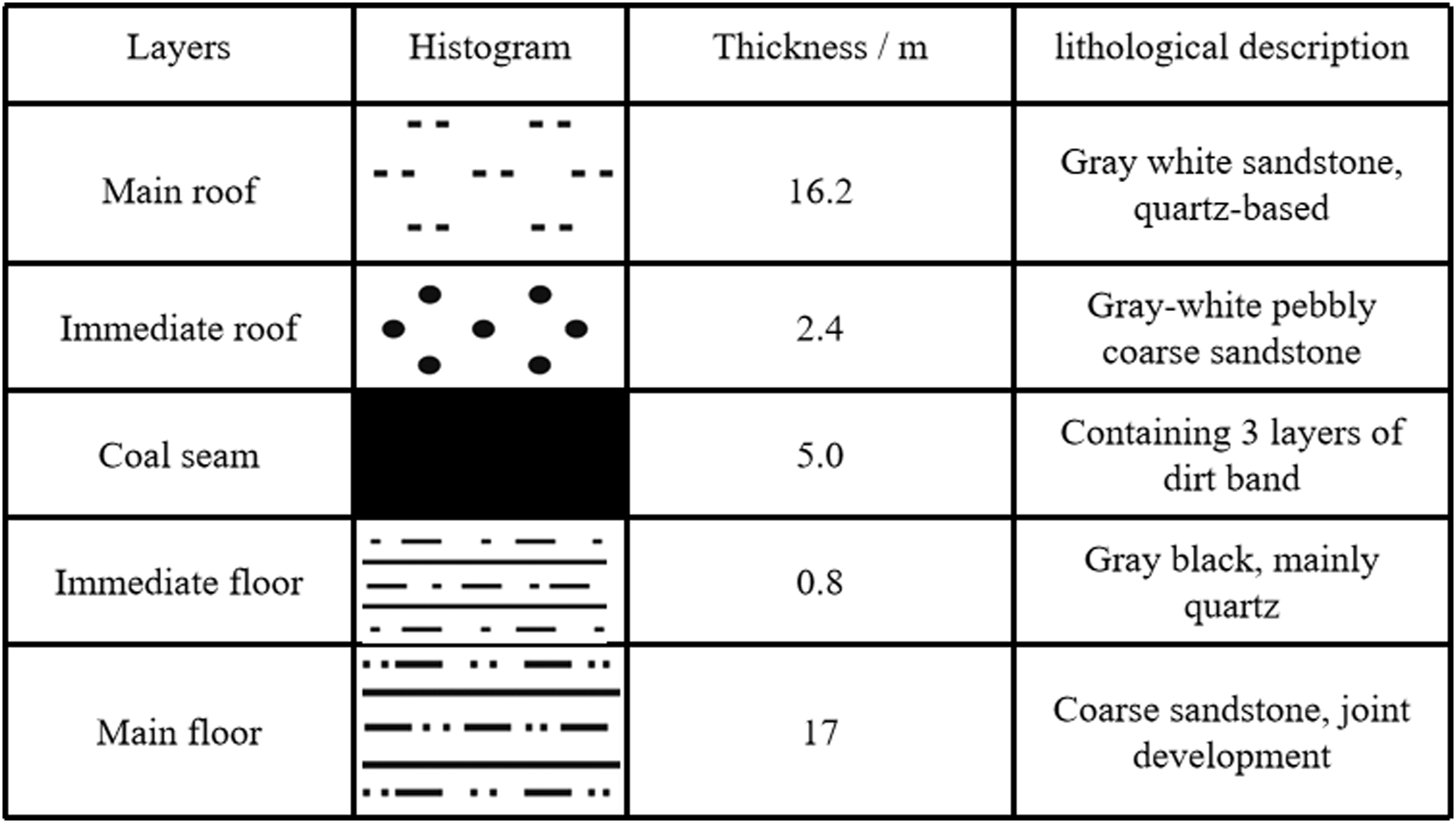
Coal strata histogram.
Roof failure characteristics
In order to study the mechanism of roof deformation and failure and support-surrounding rock instability in steeply dipping and large mining height stope, we selected a combined model frame of 1500 × 400 × 1500 mm. According to the experimental needs, the geometric similarity constant was determined to be 20, the bulk density similarity constant was 1.6, and the stress and strength similarity constant was 32, according to the similarity theory. According to the geological conditions of the working face and the physical and mechanical parameters of coal rock, we select river sand as aggregate, pulverized coal, gypsum and calcium carbonate as cementing materials, and use mica to simulate stratification, paving experimental model, see Figure 2(a). The customized hydraulic support model is used to monitor the load condition of the support, as shown in Figure 2(b). The high-precision sensors are installed on the columns, top beams, shield beams, and bases of the model support to monitor the columns and lateral loads.
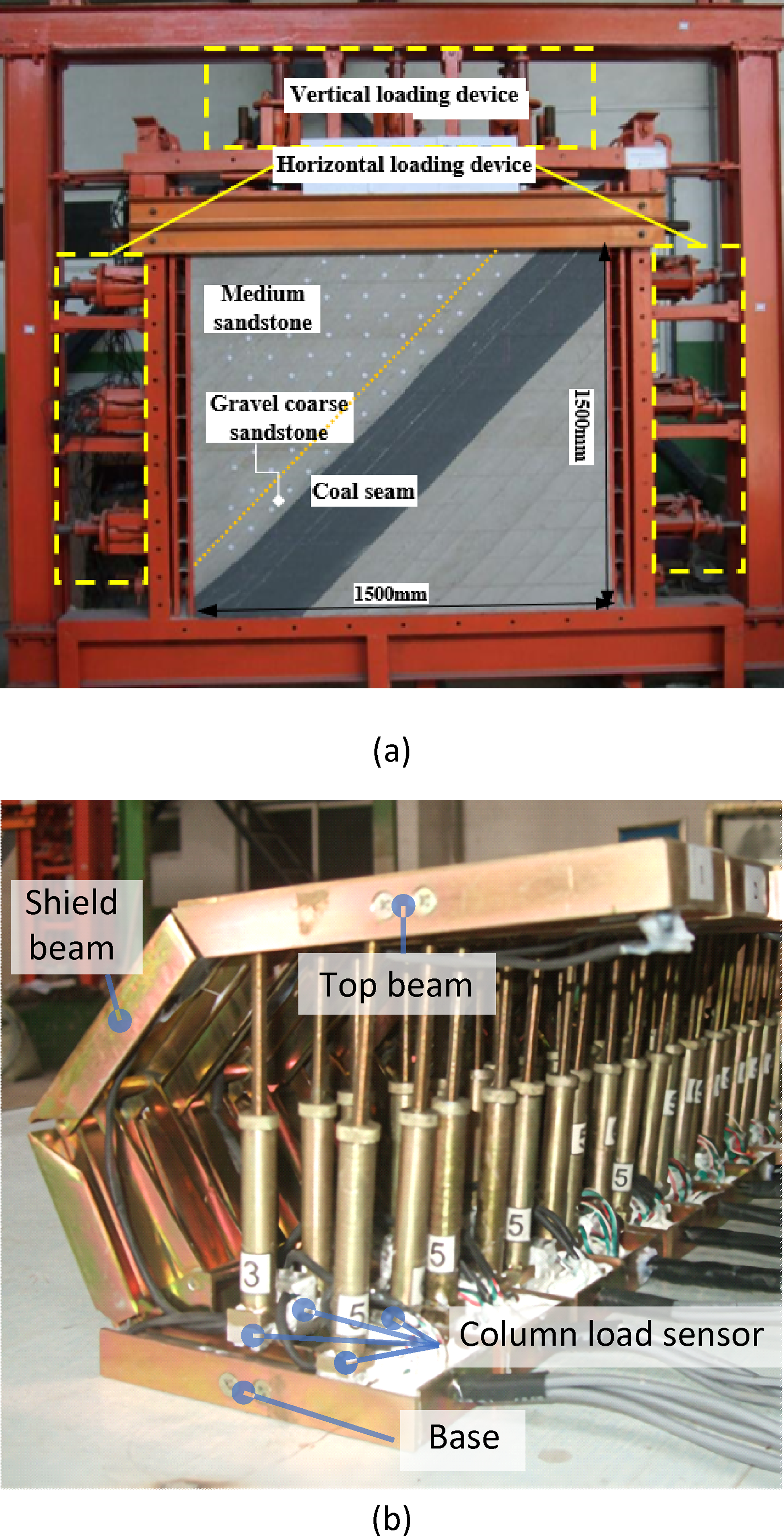
Physical similarity simulation experiment.
After excavating the coal seam, the immediate roof in the middle and upper part of the dip first breaks and slides along the floor to fill the lower part of the dip. The dip section shape of the collapsed immediate roof filling body is “rectangle + triangle.” The nonuniform filling of gangue limits the movement space of the roof in the lower area. In contrast, the movement space of the roof in the middle and upper area increases, resulting in insufficient roof caving in the lower area and sufficient roof caving in the middle and upper area. The roof forms a multistage stepped rock mass structure with a low lower layer and a high middle and upper layer. There is a large-scale space in the middle and upper parts of the working face. After the main roof is broken, the rotary movement occurs to form an antidip direction pile structure. The structure is unstable, prone to slip and deformation instability, forming a large impact pressure on the area, causing surrounding rock disaster, resulting in the support toppling and sliding (Figure 3).
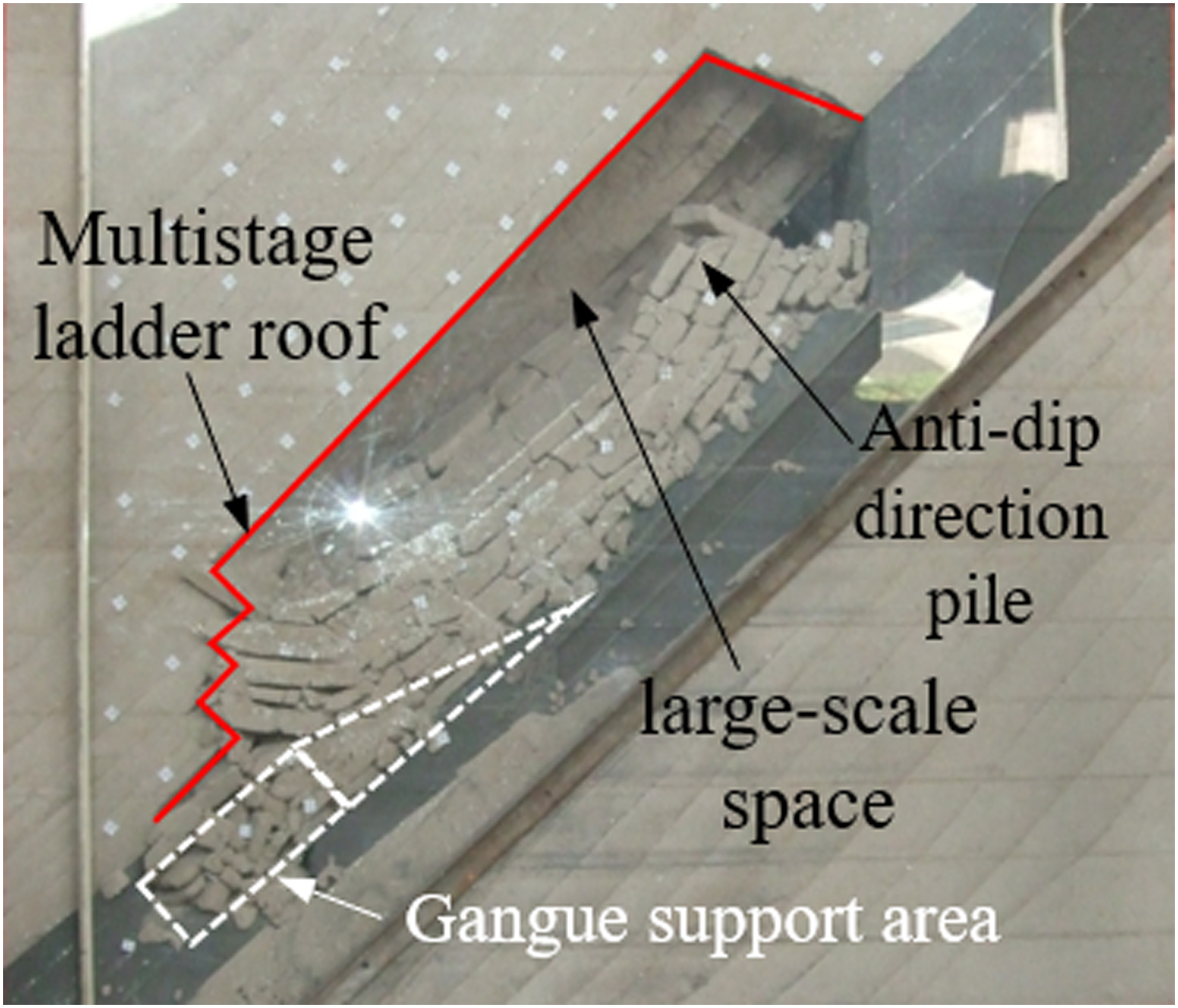
Roof caving filling characteristics.
Analysis of roof breaking mechanism
Three-dimensional numerical calculation model
The mechanical parameters of coal and rock mass can be determined by field geological survey and rock mechanics experiment results (Table 1), FLAC3D finite element and 3DEC discrete element numerical calculation software is used to construct calculation models of different coal seam dip angles, taking 45° as an example, see Figure 4. We use Fish language to redevelop the numerical calculation model, arrange survey lines and survey surfaces in the model, extract the calculation results under different coal seam dip angles, and combine the elastic-plastic theory to postprocess the calculation results, and comprehensively analyze the evolution law of mining stress transfer path and deformation and failure characteristics of the roof in steeply dipping and large mining height working face.
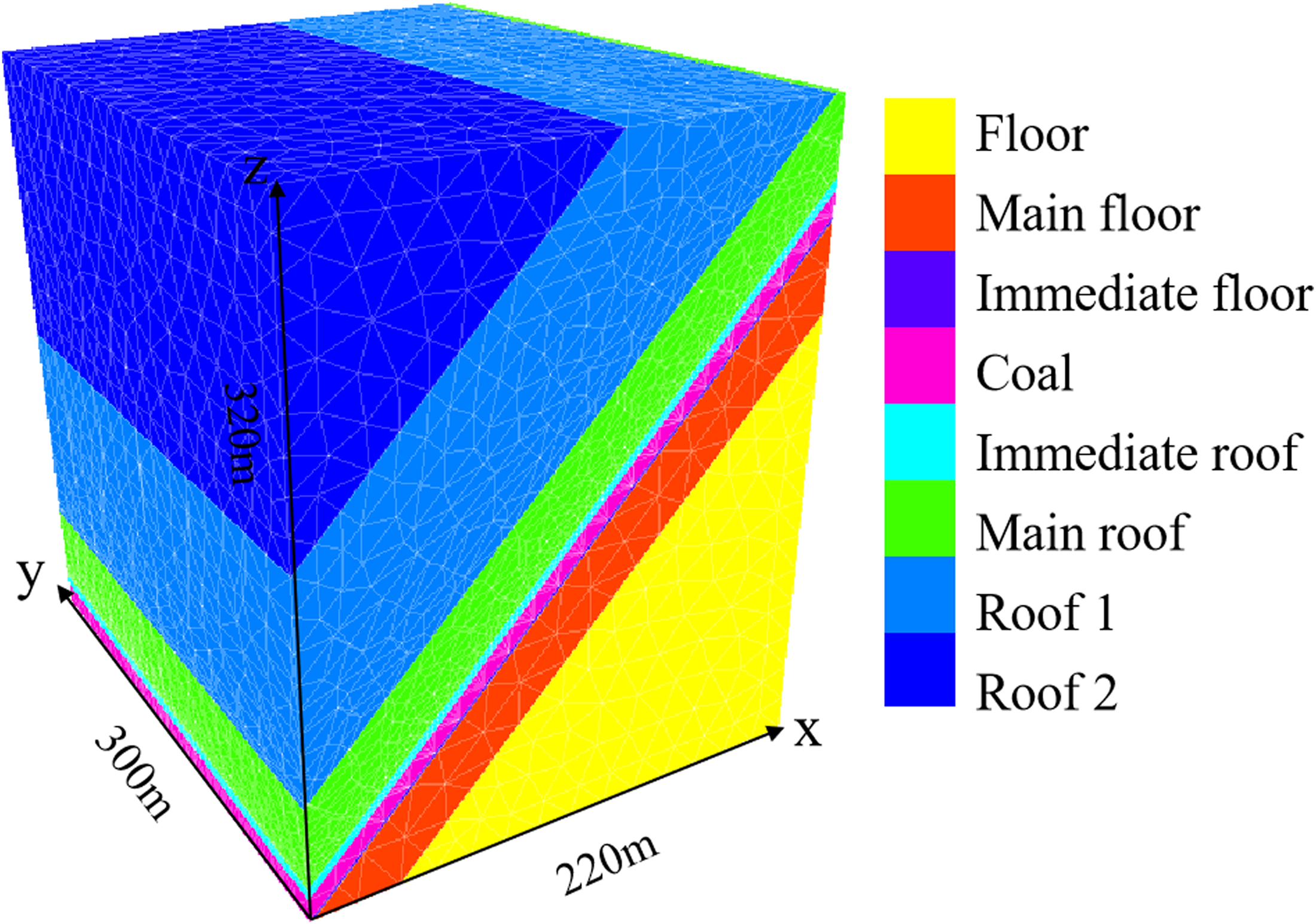
Numerical analysis model.
Mechanical parameters of coal rocks.
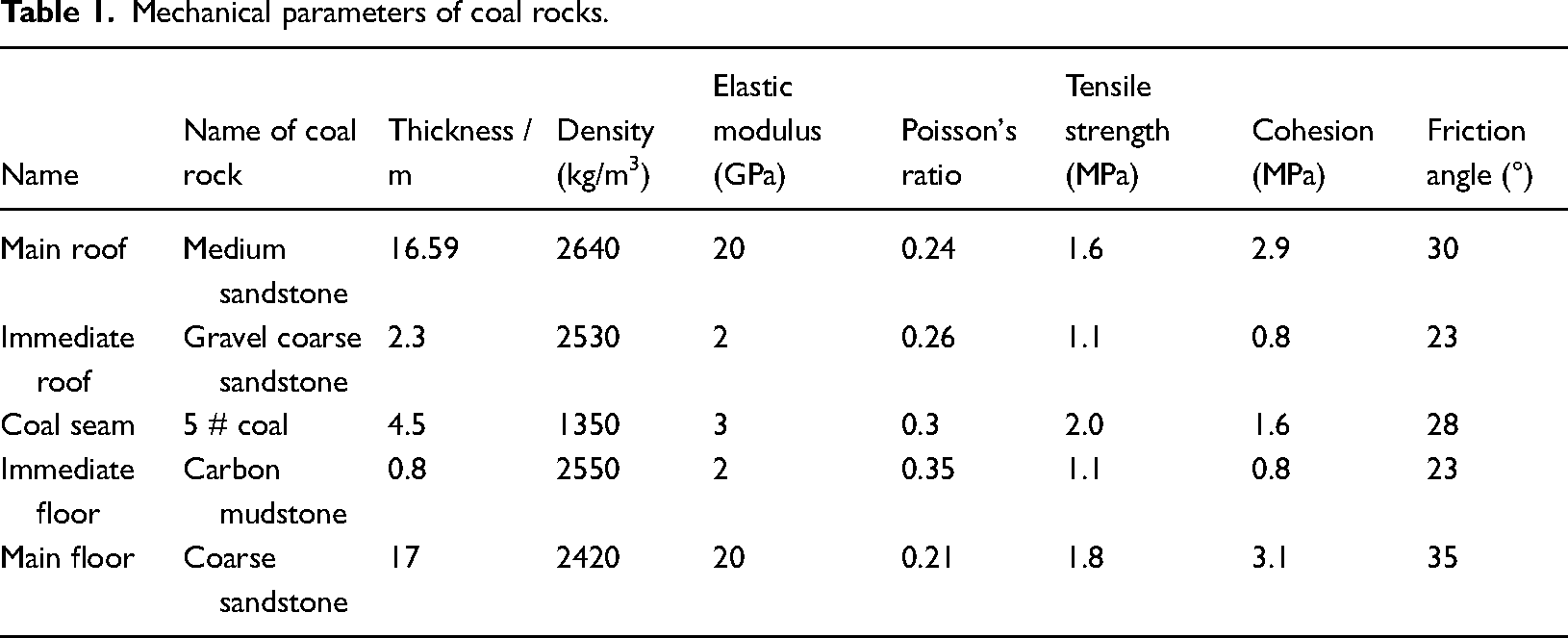
The model is 260 m wide (x-direction), 300 m long (y-direction), and 320 m high (z-direction). The working face length is 100 m, the mining height is 4.5 m, and the advancing distance is 200 m. Vertical displacement constraints are applied at the bottom of the model, and horizontal displacement constraints are applied on the model's front, back, left, and right sides. A vertical load of 2 MPa was applied to the model's top to simulate the formation depth of 80 m. Mohr-Coulomb constitutive model and large strain deformation mode are adopted.
Roof stress evolution characteristics
Affected by the dip angle of coal seam, asymmetric arch / inverted arch stress release zones are formed in the roof and floor strata after coal mining, and stress concentration zones are formed in the upper and lower end areas. The range of roof stress release zone in the upper part of the tendency is larger than that in the lower part, and the range of floor stress release zone in the lower part of the tendency is larger than that in the upper part. The range of stress concentration area and the peak value of concentrated stress on the side of the haulage roadway are larger than those on the side of the return airway. With the increase of dip angle, the axis of the roof stress arch shifts to the upper region, and the axis of the floor stress arch shifts to the lower region. The range of stress concentration area and the peak value of concentrated stress on the side of haulage roadway increase, the range of stress concentration area on the side of return airway decreases, and the asymmetric characteristics of stress release area of roof and floor become more obvious, as shown in Figure 5.
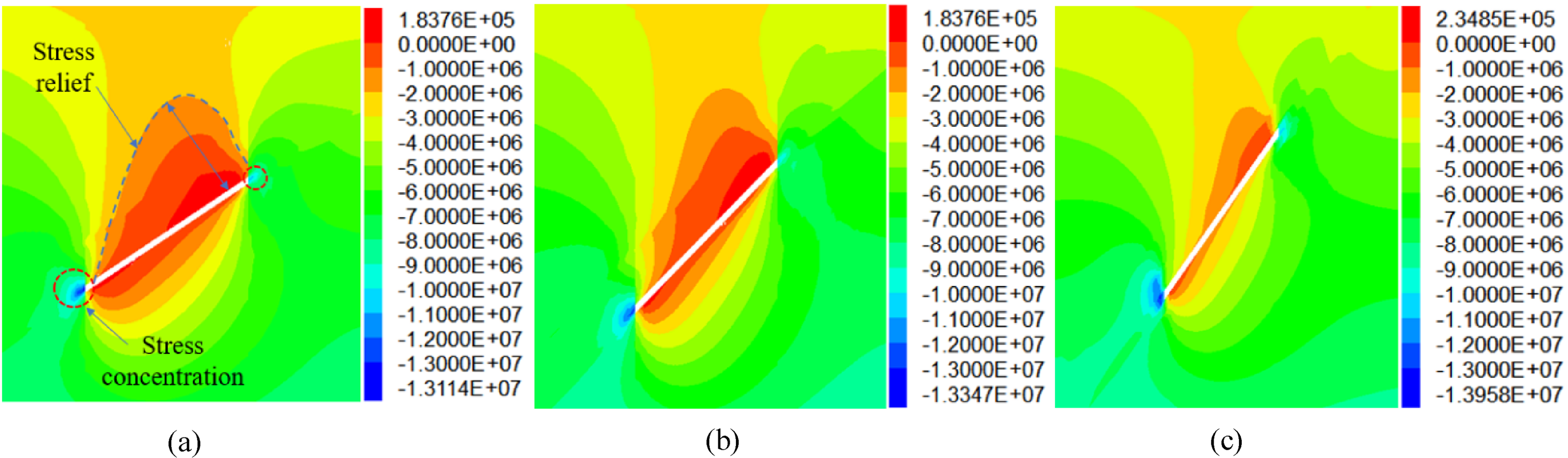
Distribution of vertical stress along inclination under different dipping angles (unit: MPa).
Roof caving migration filling characteristics
In the large mining height mining of steeply dipping coal seam, the deformation, failure and filling characteristics of surrounding rock show obvious asymmetric characteristics. The roof strata caving presents the roof structure of a “multistep key stratum.” The filling form of the inclined section of the accumulated gangue is “rectangle + triangle.” When the dip angle of the working face is 35°, 45°, and 55°, the length of the gangue support area is 7.4, 22.2, and 36.8 m, respectively. The height of roof caving zone is 29.6, 23.2, and 17.4 m, respectively. With the increase of dip angle, the length of gangue support area increases, the height of the caving zone decreases gradually, the range of roof movement and failure moves up, and the amplitude and intensity of roof strata movement in the middle and upper part of the tendency increase, forming an unstable antidip direction pile structure, which is prone to sliding instability, as shown in Figure 6.
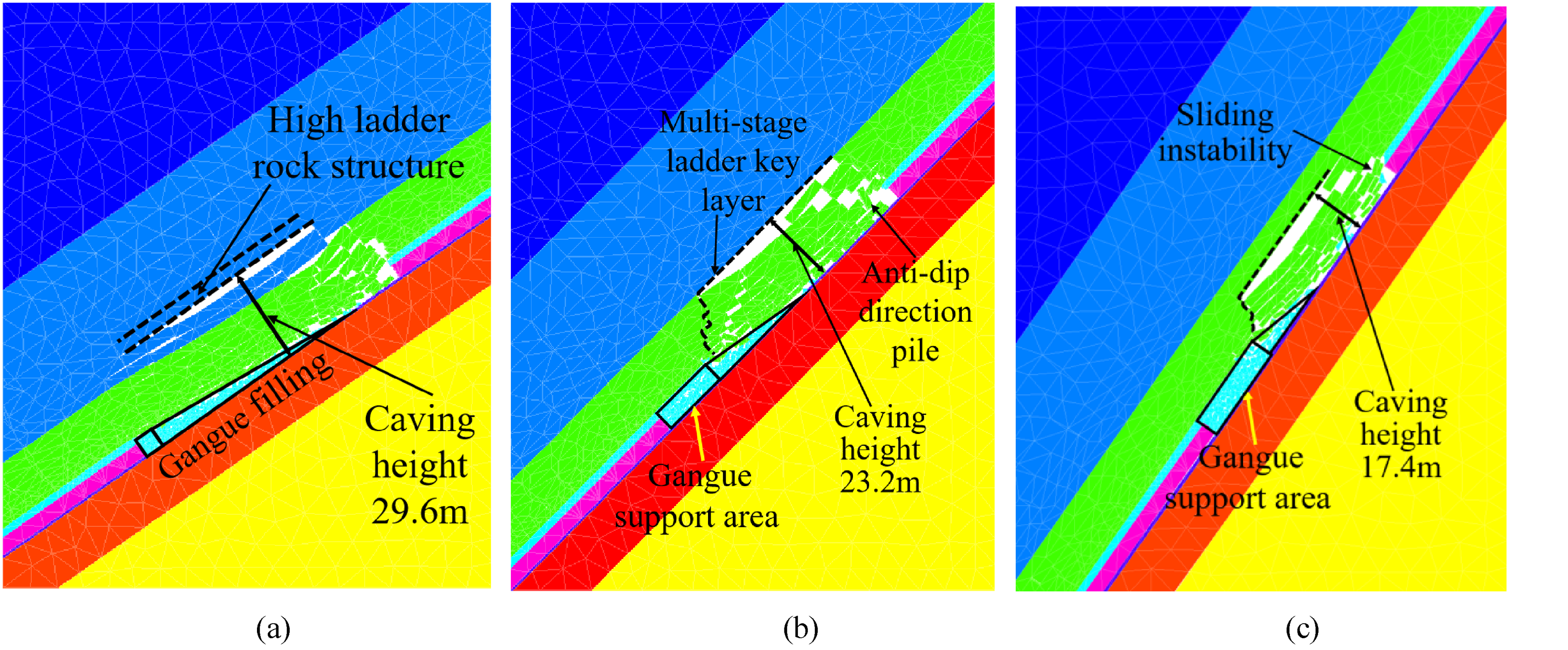
Caving migration and filling characteristics of roof along inclination under different dipping angles.
Evolution law of abutment pressure
Abutment pressure refers to the pressure acting vertically on coal seam, rock stratum, and gangue in the range of stress redistribution of surrounding rock after coal seam mining. It is a quantitative characterization of the evolution results of surrounding rock stress transfer. Therefore, we arrange the survey line along the working face tendency in the middle of the goaf strike, extract the calculation results under different coal seam dip angles, and obtain the evolution characteristics of the abutment pressure on the upper and lower coal bodies of the working face under different dip angles, as shown in Figure 7.
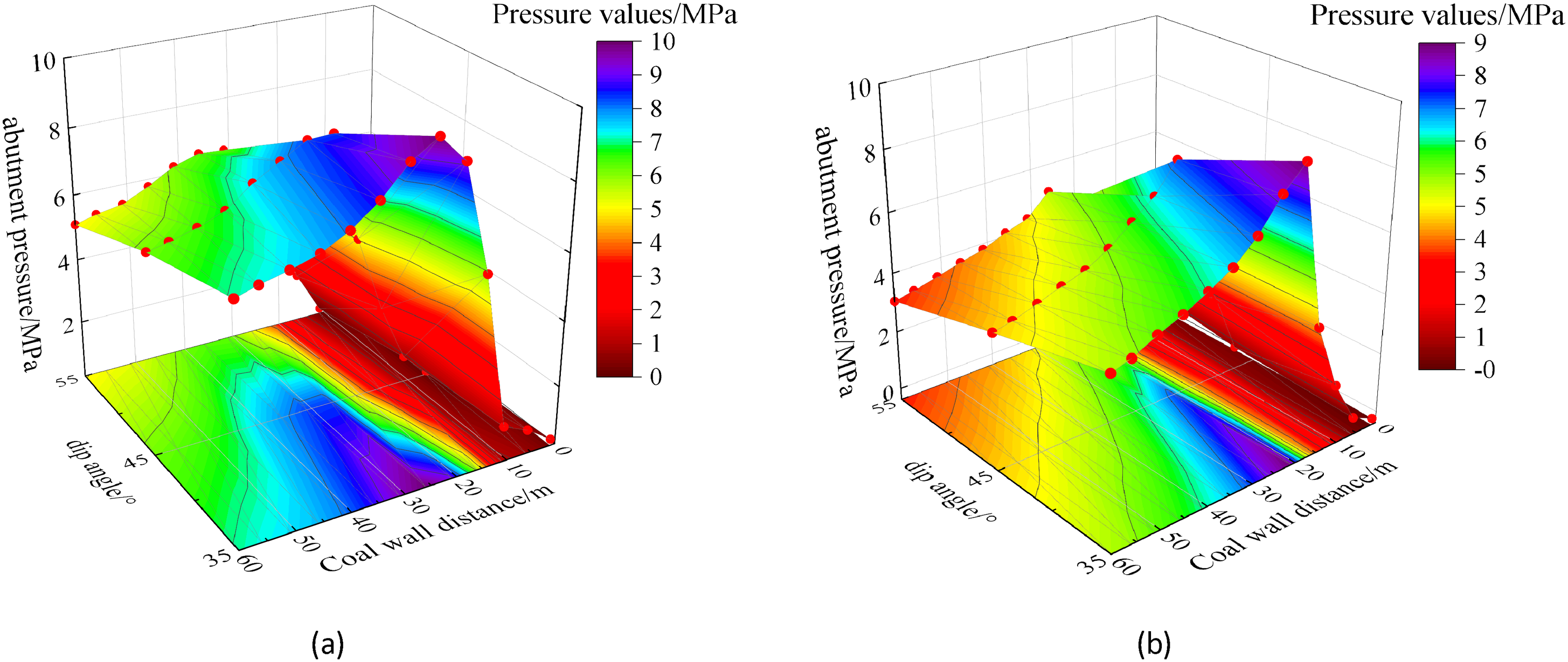
Evolution characteristics of abutment pressure along inclined in different angles.
Influenced by the coal seam's dip angle, the roof's mining stress evolves asymmetrically along the dip direction, which determines the asymmetric loading characteristics of upper and lower coal bodies. The buried depth of the lower coal body is greater than that of the upper side, which leads to the lower coal body's abutment pressure being greater than that of the upper side. With the increase of the dip angle, the tendency component of the surrounding rock weight increases, the vertical component decreases, and the abutment pressure of the upper and lower sides of the working face decreases, which leads to the decrease of abutment pressure of the upper and lower sides of working face. When the coal seam dip angles are 35°, 45°, and 55°, the peak values of the abutment pressure on the inclined upper coal body are 8.79, 7.27, and 5.49 MPa. The peak values of the abutment pressure on the inclined lower coal body are 10.07, 8.85, and 6.53 MPa.
Roof mining stress transfer path
Based on the numerical calculation results under different dip angles, combined with the elastic-plastic theory, the evolution characteristics of the surrounding rock mining stress transfer path are analyzed with the principal stress as the characteristic quantity.
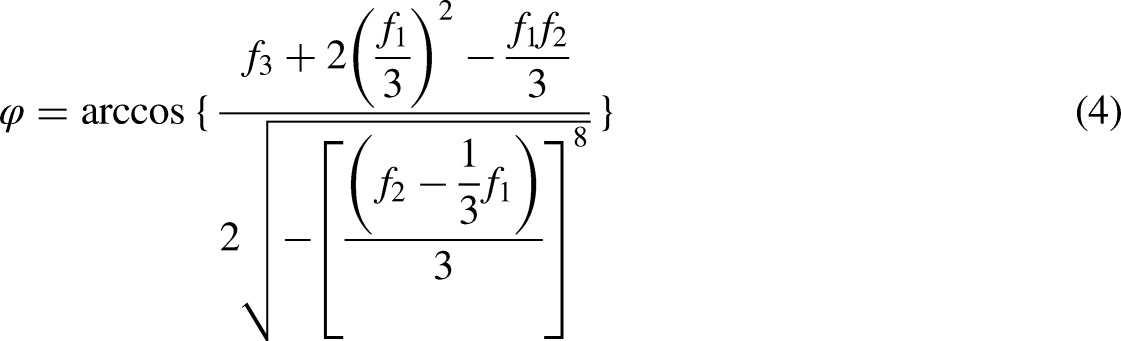
According to the elastic theory (Xian, 1989), the characteristic equation of the stress state at any point in a coal rock mass can be expressed as During steeply dipping coal seam mining, there is a stress deflection boundary in the roof strata (the stress deflection boundary refers to the critical curve where the principal stress direction does not deflect). The deflection boundary in the roof strata is the main reason for the asymmetric deflection of the roof stress transfer path. The load of the overlying strata on the left side is transferred to the lower coal body, and the load of the overlying strata on the right side is transferred to the upper coal body. Along the roof from top to bottom, the stress deflection boundary gradually migrates from the left side of the central axis (x = 134.5 m) of the working face to its right side. Affected by the dip angle of the coal seam, an obvious asymmetric stress transfer arch is formed in the roof strata. The arch foot of the stress arch is in the upper and lower coal bodies of the working face, and the position of the vault can be determined by the intersection of the stress deflection boundary and the tendency axis. Outside the stress arch, the overlying strata load on the left side of the stress deflection boundary is transferred to the inclined lower coal body, and the overlying strata load on the right side is transferred to the inclined upper coal body. The stress concentration phenomenon occurs at the upper and lower arch feet, the stress value increases and the direction is deflected, as shown in regions B and C in Figure 8 (a) to (c). In the stress arch, a more obvious stress release zone is formed, the principal stress value is obviously reduced, and the direction is also obviously deflected. Especially in the upper part of the tendency, the stress state of the roof evolves from bidirectional compression to unidirectional tension, and some areas even evolve into bidirectional tension, as shown in Area A in Figure 8 (a) to (c). With the increase of coal seam dip angle, the asymmetric characteristics of stress transfer in surrounding rock are enhanced, and the asymmetric characteristics of stress arch are more obvious. The asymmetric arch stress release area range is obviously reduced, the vault position migrates to the upper side of the working face, and the arch height gradually decreases. When the coal seam dip angles are 35°, 45°, and 55°, respectively, the distance between the projection position of the vault in the vertical direction of the coal seam and the coal body on the inclined upper side of the working face is 12.7, 4, and 4.8 m, respectively (negative value indicates that the projection position of the vault is located on the coal body on the inclined upper side of the working face), and the arch heights are 53.2, 45.9, and 38.4 m, respectively, as shown in Figure 8 (a) to (c).


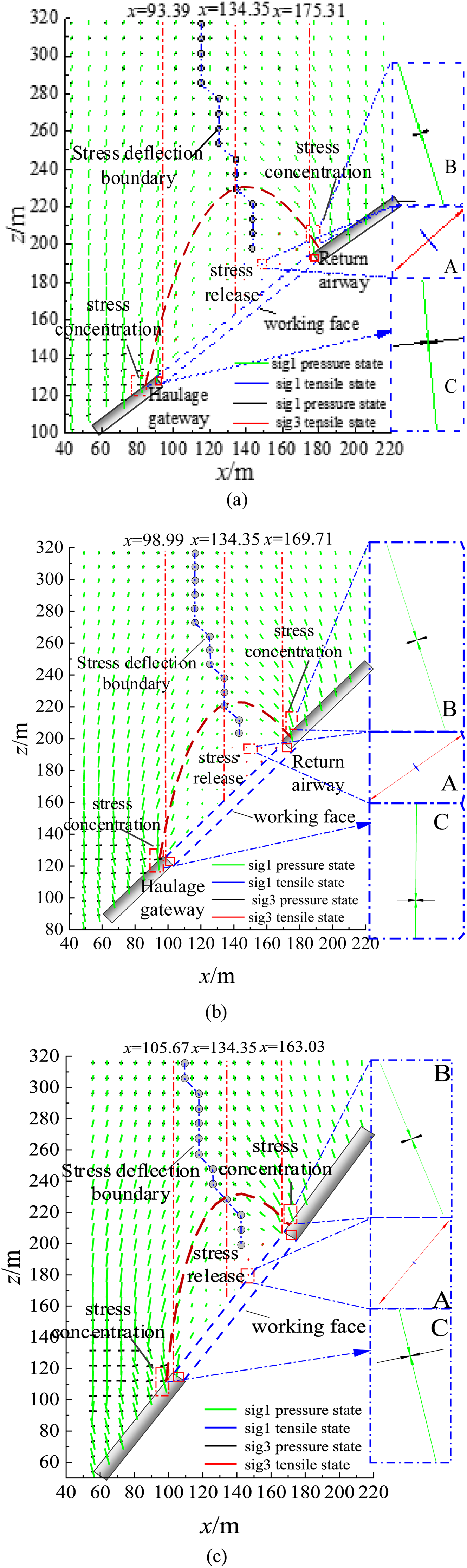
Evolution characteristics of stress state in inclined section of different angles.
Stability analysis of supports
In the mining of steeply dipping coal seam, the dip angle of coal seam, the migration law of roof and floor, and the pushing between supports will affect the stability of the support. The working face's roof, support, and floor are always in the dynamic system of interaction and mutual restriction. When the migration state of the roof changes, the interaction between the roof and support and between support and floor changes accordingly. In the “roof-support-floor” system of the working face, the movement of the roof causes the support to slide and rotate, as shown in Figure 9.
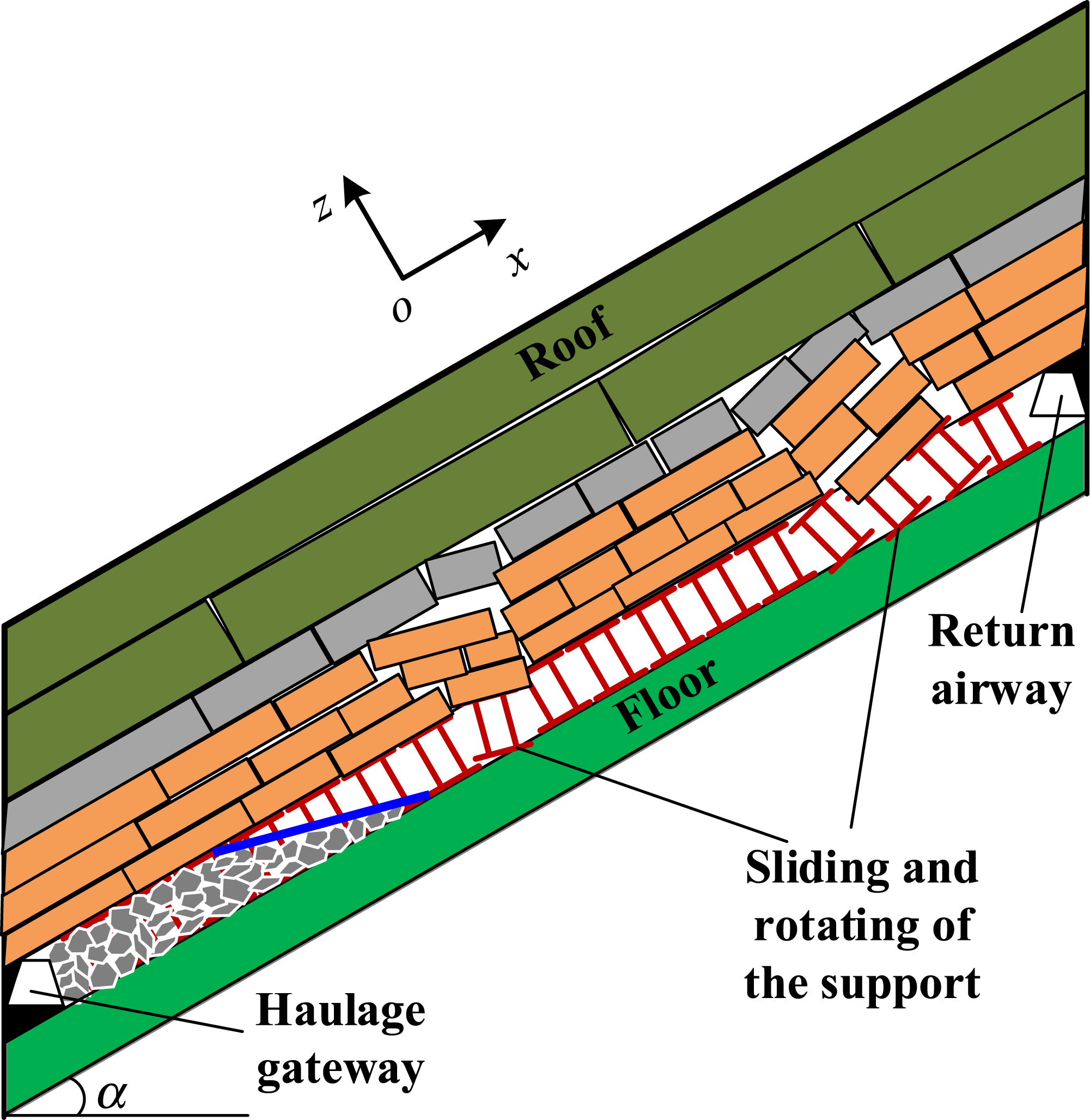
The relationship diagram of “support-surrounding rock” along the tendency of coal seam.
The mechanical model of the support along the inclination under general loading is shown in Figure 10. In Figure 10, α is the dip angle of coal seam,°; a the width of the support, m; b the height of the support, m; LG the height of the center of gravity of the support, m; G the weight of the suppot, kN; Si−1 and Si + 1 the interaction forces between adjacent supports, kN; P the working resistance of the support, kN; y0 the position of load P, m; y1 the normal load position of FN, m; FR the friction between the roof and the support, kN; FF the friction between the floor and the support, kN; and k0 the foundation coefficient of the floor, kN/m3.
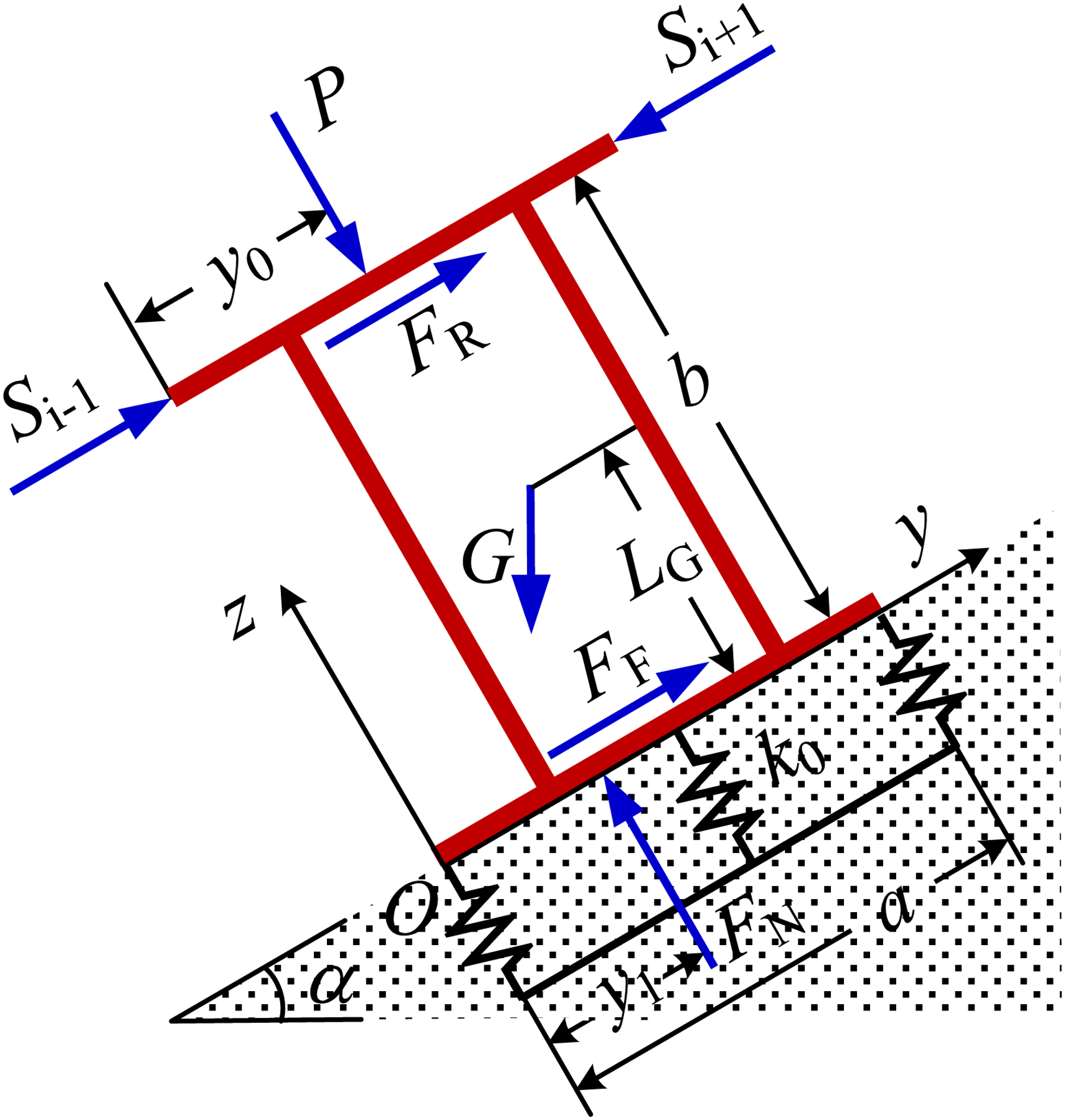
Mechanical model of support at inclined direction.
Critical instability working resistance of support when roof is stable
When the roof and floor strata are stable, the support tends to slide and rotate along the working face under the influence of its self-weight tendency component. The direction of the friction FR between the support and the roof is positive along the y-axis, and the value range is between 0 and Pμ1 kN. According to the tendency mechanical model of the support shown in Figure 11, the condition that the support does not slide is that its antisliding force is greater than the sliding force, that is,
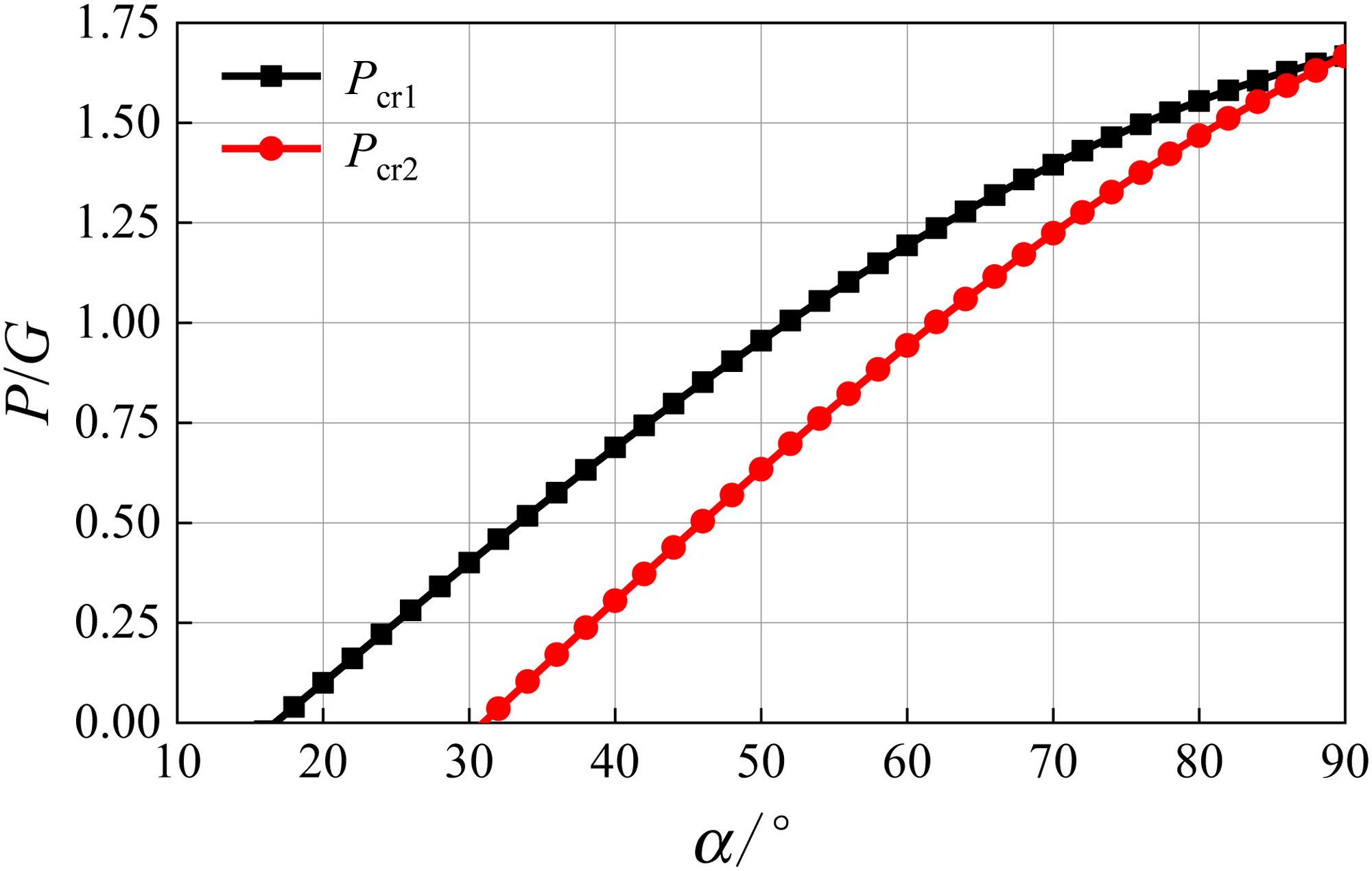
Influence of coal seam angle on critical working resistance of support.
In the equation, ΔSi = Si−1−Si + 1 is the resultant force of the force between adjacent supports, kN. Under the critical sliding instability state of the support, the friction force between the support and the roof and floor strata can be expressed as





The interaction characteristics between supports when the support is empty
When the support is empty, the roof load on the support disappears. Under the action of its gravity tendency component, the support slides and rotates along the tendency of the working face, and the effect between the supports is obvious. The friction force FF between the support and the floor under this load condition is


According to the equations (8) and (11), and let ΔSi = 0, the relationship between the critical working resistance and the dip angle is shown in Figure 10. It can be seen from the figure that the sliding critical angle of the support in the free state (P = 0 kN) is 17°, and the rotation critical angle is 31°. The critical working resistance increases with the increase of dip angle, and under the same coal seam dip angle, the critical sliding working resistance of the support is greater than its critical rotational working resistance; the critical working resistance to ensure the stability of the support does not exceed 2 times the weight of the support.
From the equations (13) and (14), the relationship between the critical interframe force and the dip angle is shown in Figure 11, which can ensure that single roof support does not slide and rotate. It can be seen from the diagram that the critical interframe force also increases with the increase of the dip angle, and under the same dip angle, the interframe force of the critical sliding of the support is greater than the interframe force of its critical rotation; the critical interframe force to ensure the stability of the support does not exceed 1 times the weight of the support.
At the same time, it can be seen from Figures 11 and 12 that when the roof and floor strata are stable, the critical working resistance to ensure that single support does not slide and rotate is much smaller than that of the normal working state of the support; when the support is empty, the critical interframe force to ensure that single support does not slide and rotate is also much smaller than the friction between the support and the roof and floor when the support is in normal working condition. It can be seen that the sliding and rotation of the support under normal working conditions are mainly caused by the migration of the working face roof; therefore, we should focus on the stability of the roof in the middle and upper regions, adjust the position of the support in time, realize the coupling contact and load state between the roof and floor of the working face and the support, ensure the stability of the “support-surrounding rock” system, and avoid the continuous and large-scale sliding and dumping of the support.
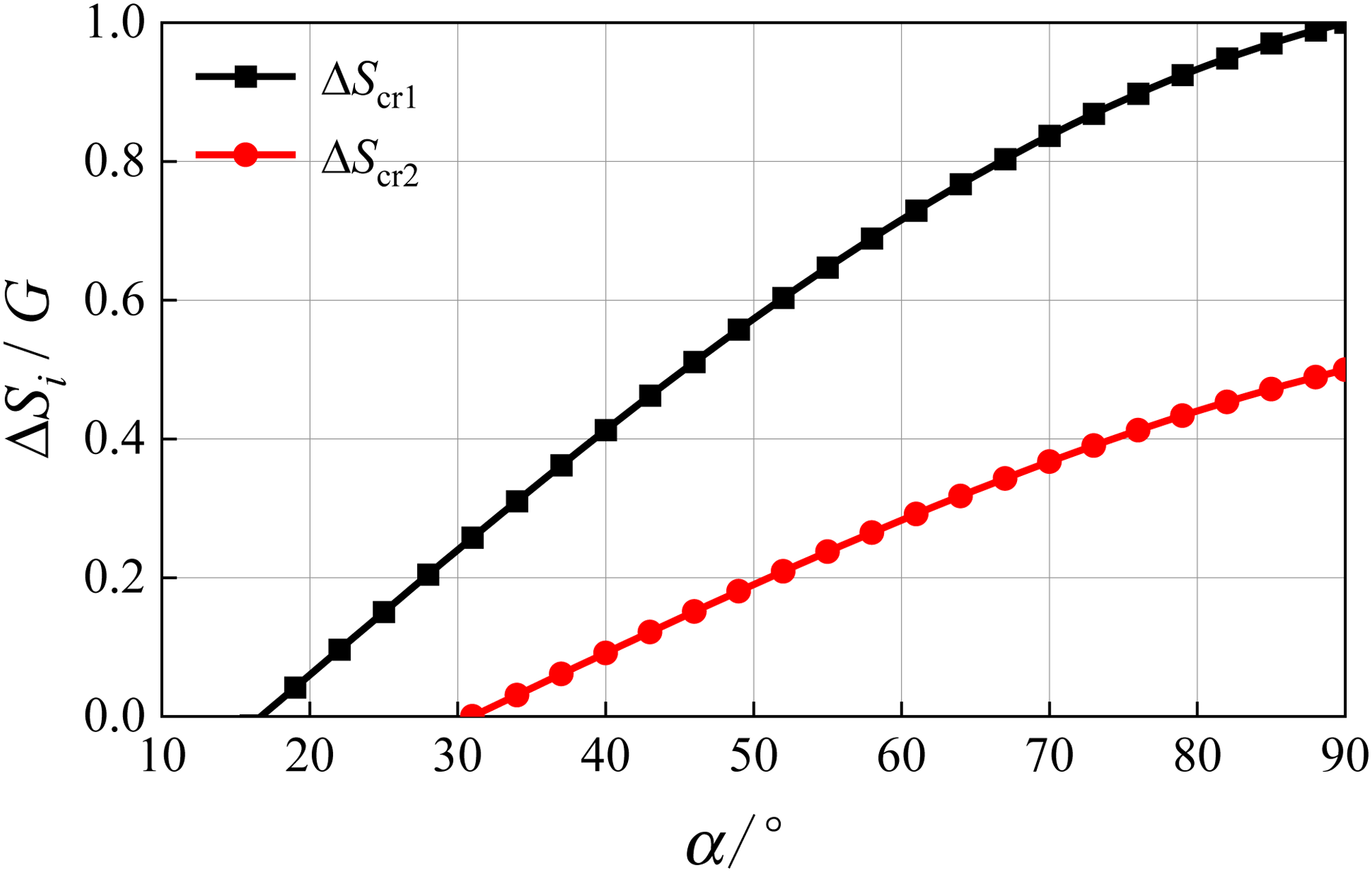
Influence of coal seam angle on critical interframe force.
Field monitoring
In order to grasp the general law of mine pressure behavior in the mining process of the working face, the measurement areas are arranged in the upper, middle, and lower regions along the inclined direction. The working resistance of the support in the measuring area of the working face was continuously recorded for 4 months by using the KJ377 mine pressure dynamic monitor. Then the mine pressure behavior law of the working face and the stress characteristics and stability characteristics of the support in different regions are analyzed.
The field monitoring results show that along the inclined direction, the mine pressure law shows the characteristics of nonequilibrium subregional appearance. The average working resistance of the support in the upper, middle, and lower regions of the working face is about 4985, 6422, and 3505 kN. The working resistance (support load) in the middle area of the working face is the largest, the upper area is the second, and the lower area is the smallest. The working resistance of the lower region is about 54.5% of the middle region, and the working resistance of the upper region is about 77.6% of the middle region. The standard deviation of the working resistance of the support in the upper, middle, and lower measuring areas of the working face is 1088.07, 1358.17, and 767.12 kN, respectively. The distribution of the working resistance of the support in the middle and upper areas is relatively discrete, and the distribution in the lower area is relatively concentrated, as shown in Figure 13.
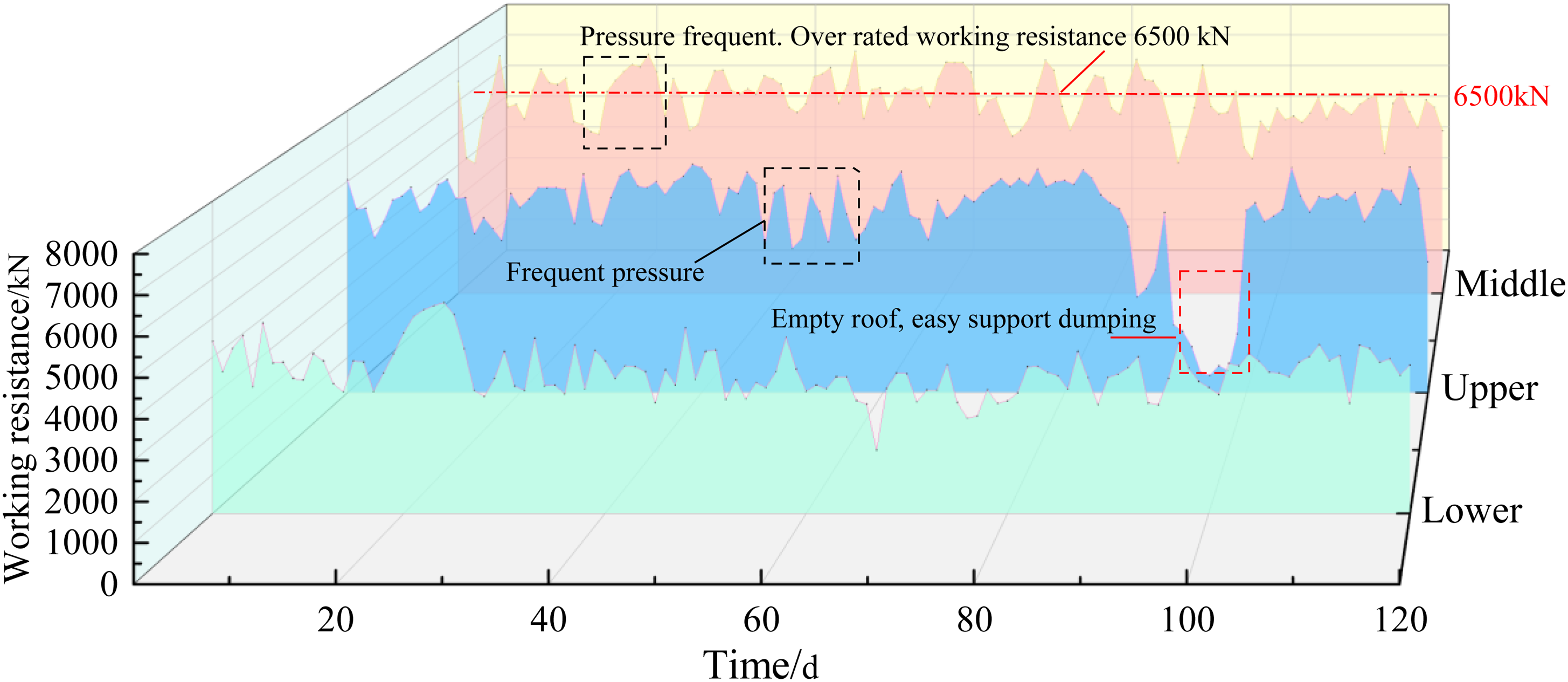
Characteristic of working resistance in different areas of working face.
In the lower part of the tendency, the gangue filling is dense, the roof movement is limited, and the support-surrounding rock system is stable. There is a large-scale space in the middle and upper areas, the roof migration space is large, the support change range is large, and the working resistance of some supports is very small or even zero, resulting in the lack of elements in the “roof-support-floor (R-S-F)” system, which is prone to roof caving. The load of individual supports in the middle and upper areas exceeds the rated working resistance, and the supports push and squeeze each other. The supports are prone to toppling and sliding. The “roof-support-floor (R-S-F)” system is more complex, and its instability tendency is much higher than that of gently inclined coal seam mining. It is easy to form a large pressure, and dynamic instability occurs to cause surrounding rock disaster, as shown in Figure 14.
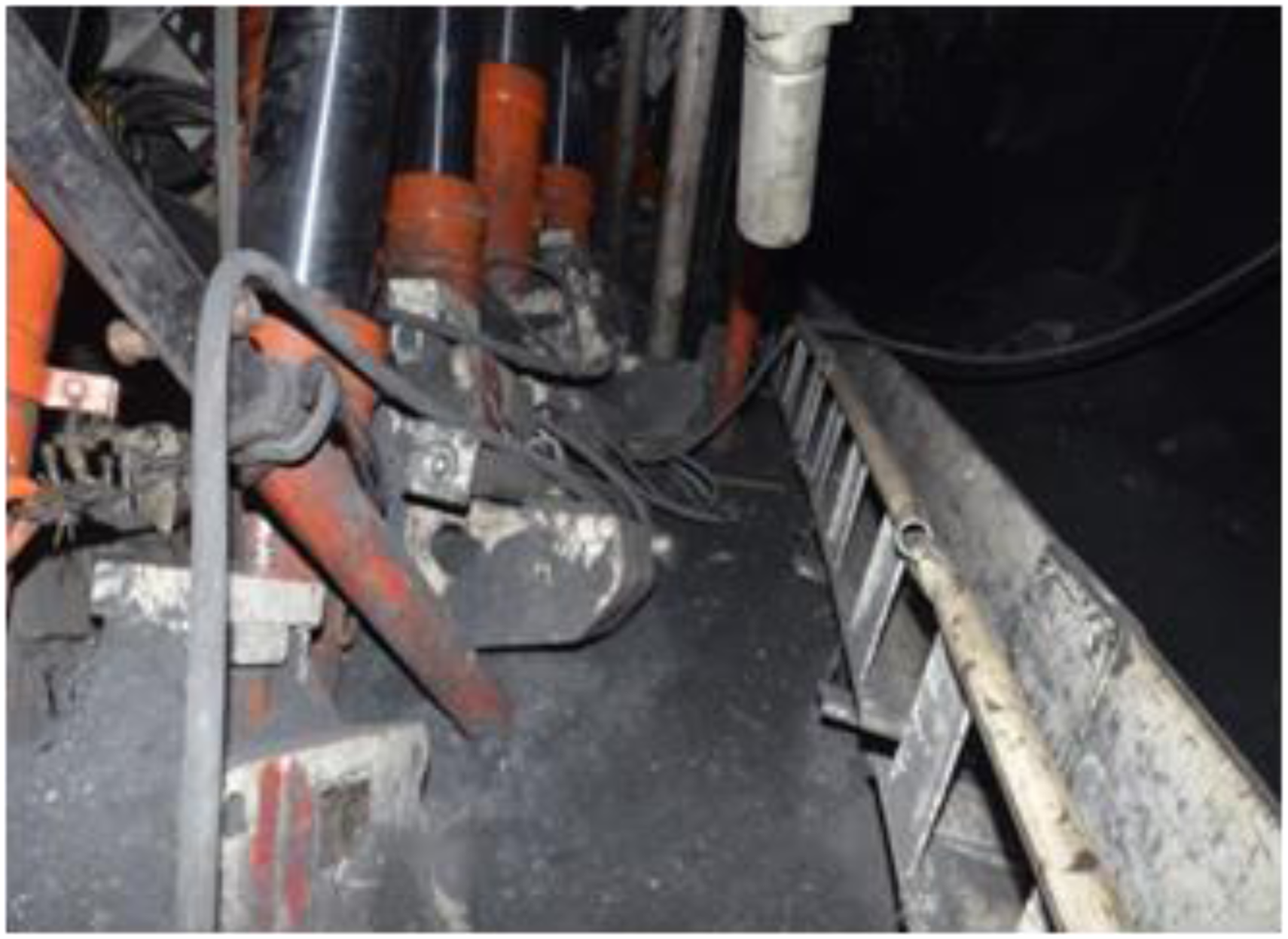
Support dumping.
Therefore, in the mining of large mining height working face in steeply dipping coal seam.
The working resistance and initial support force of hydraulic support should be set up in different areas. In general, the working resistance of the lower region is 30% ∼ 40% lower than that of the middle region, while the upper region is 10% ∼ 20% lower than that of the middle region. Using pitching oblique working face mining, the return airway is arranged in advance haulage roadway, and the advance amount is 25% ∼ 30% of the true inclined length of the working face. It can reduce the dip angle of the working face, reduce the sliding of the caving gangue and the nonuniform filling degree of the goaf, weaken the dip angle effect of the surrounding rock and the instability of the coal wall spalling, and improve the overall stability of the working face support, see Figure 15. Using nonuniform charge structure and group blasting method, the hard roof of the steeply dipping coal seam is weakened by advanced periodic blasting, which can reduce the roof caving step, reduce the roof caving block, reduce the block rate, eliminate the large area hanging roof and impact dynamic load pressure, and improve the stability of “support-surrounding rock” system, and the method has been implemented in the mine, and achieved good results, as shown in Figure 16. The hydraulic support's top beam and guard plate are designed as a parallelogram structure to ensure that the front end of the support is parallel to the coal wall and plays a role in sealing the roof. As a result, the coupling contact and load state of the roof and floor, coal wall and support of the working face are realized, ensuring the stability of the “support-surrounding rock” system and reducing the roof's stress. In addition, the base is a nonequal-length base, which significantly improves the antifalling and antiskid reliability of the hydraulic support, and is not prone to accidents such as support dumping and extrusion between supports (see Figure 17). Along the inclination dimension of the working face, a base adjustment frame and a side push (two-way action) device with mutual independence are added to the support base, bilateral adjustment frame beams and adjustment frame jacks (Figure 18), increase the width of the support base (1.75 m), and adjust the load and constraint state, thereby improving the anticollapse and antiskid reliability of the hydraulic support. Reasonable mining technology and strict scientific management of the working face are conducive to improving the production and efficiency of the working face, controlling the mining height of the working face, keeping the working face straight, stabilizing the lower support of the working face, moving the support from bottom to top, and pushing the scraper conveyor as a whole as possible.
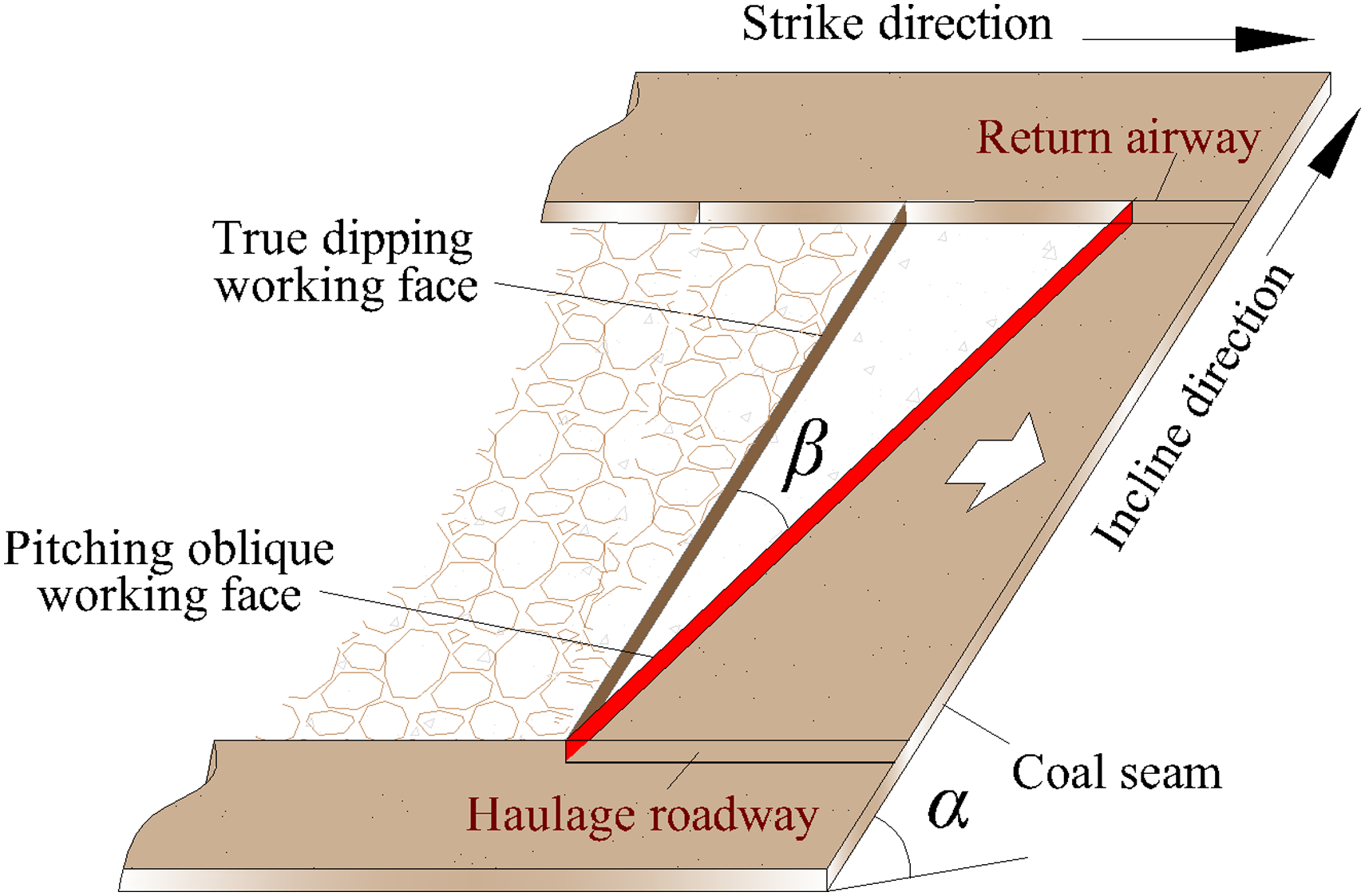
Pitching oblique working face.
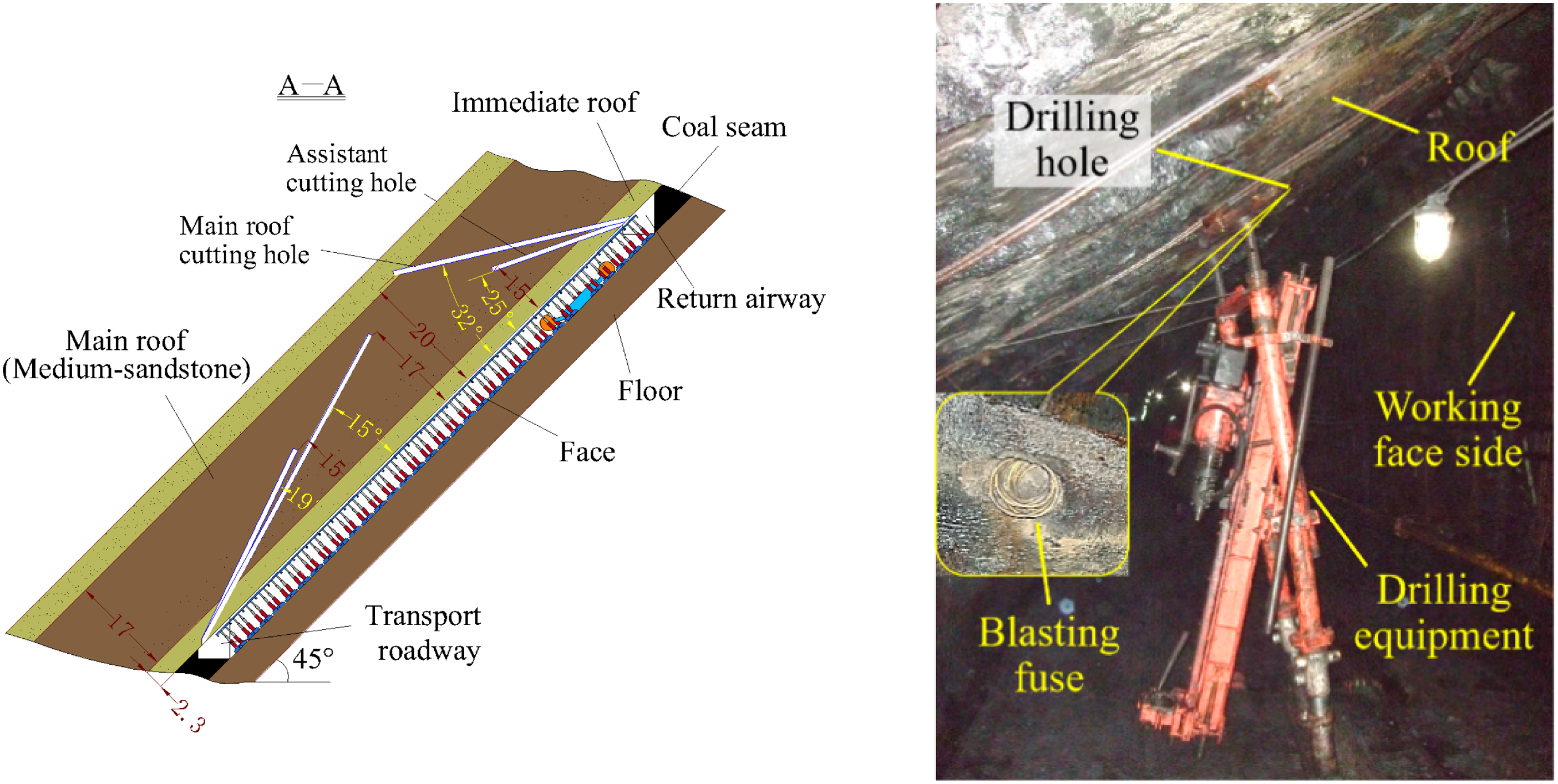
Hard roof preblasting weakening treatment.
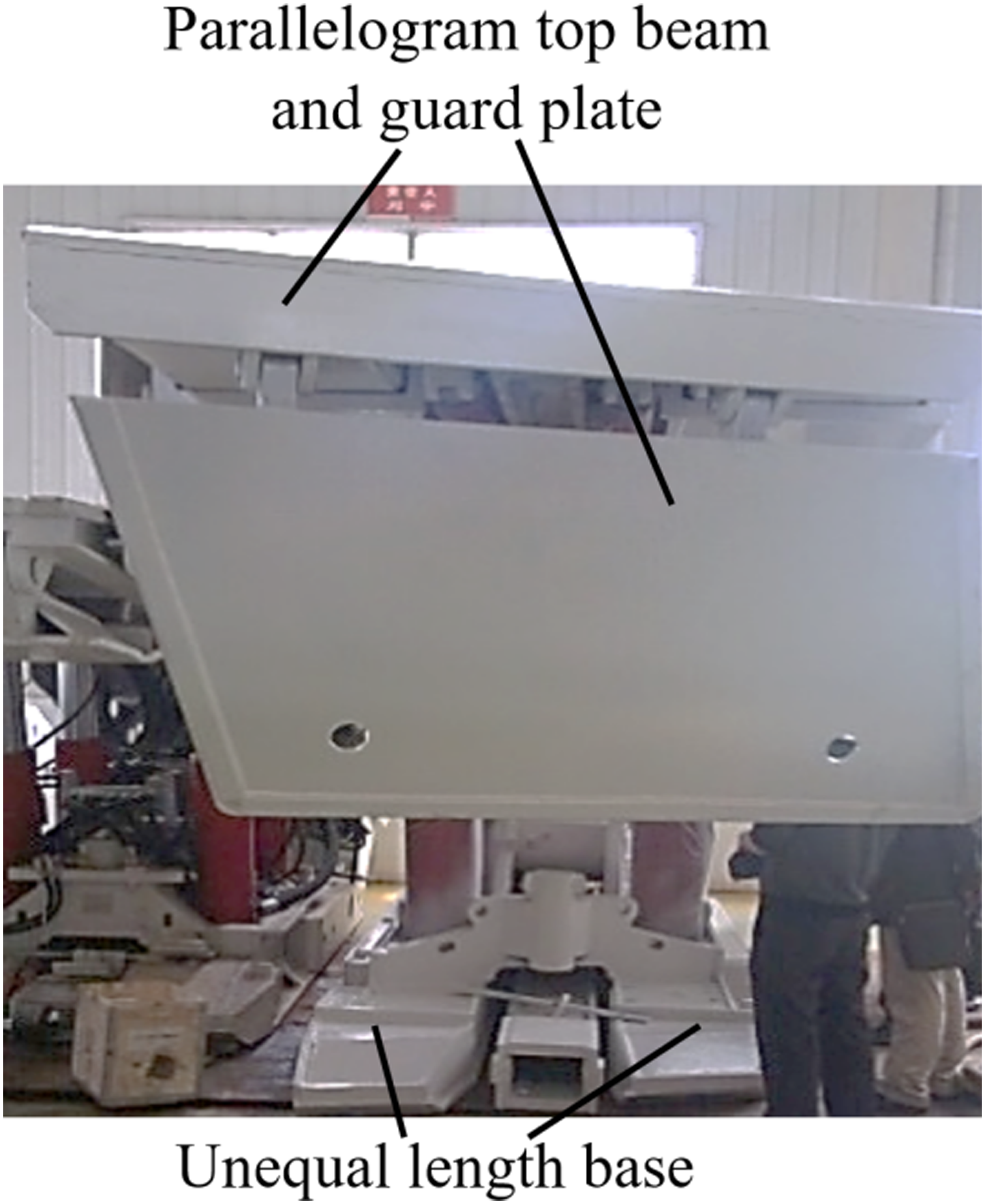
Parallelogram hydraulic support.
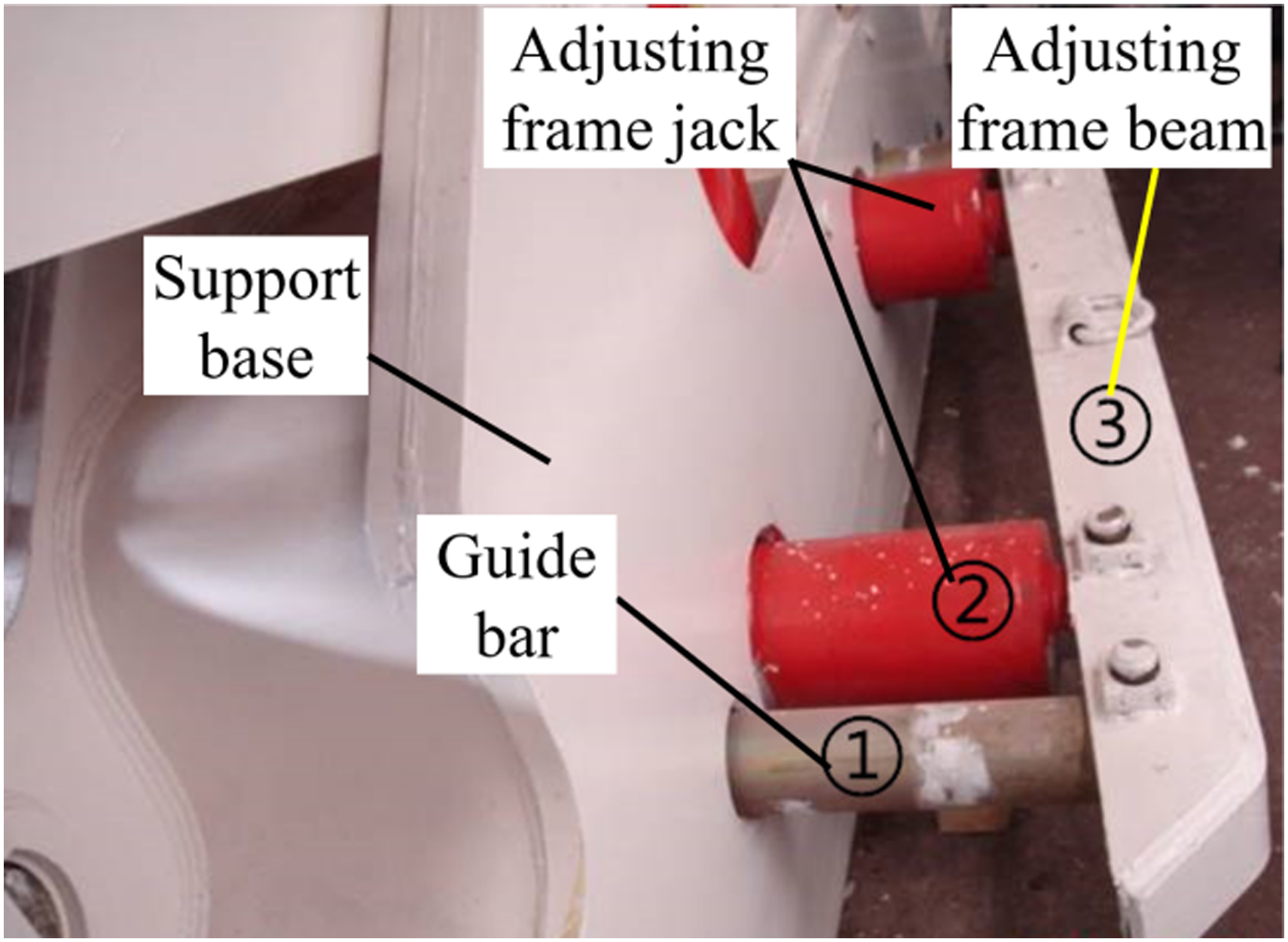
Large stroke bilateral bottom adjustment device.
Discussion
It can be seen from Figure 19 that the failure and stress distribution of the roof are asymmetrical. The failure and migration characteristics of the stope roof are more active than those of general mining height in the steeply dipping coal seam. The roof caving migration space increases with the increase of mining height. Affected by the dip angle of coal seam, the caved gangue will not stay in place but slide down along the floor, forming a nonuniform filling zone with filling and compaction in the lower part, partial filling in the middle part and hanging in the upper part.
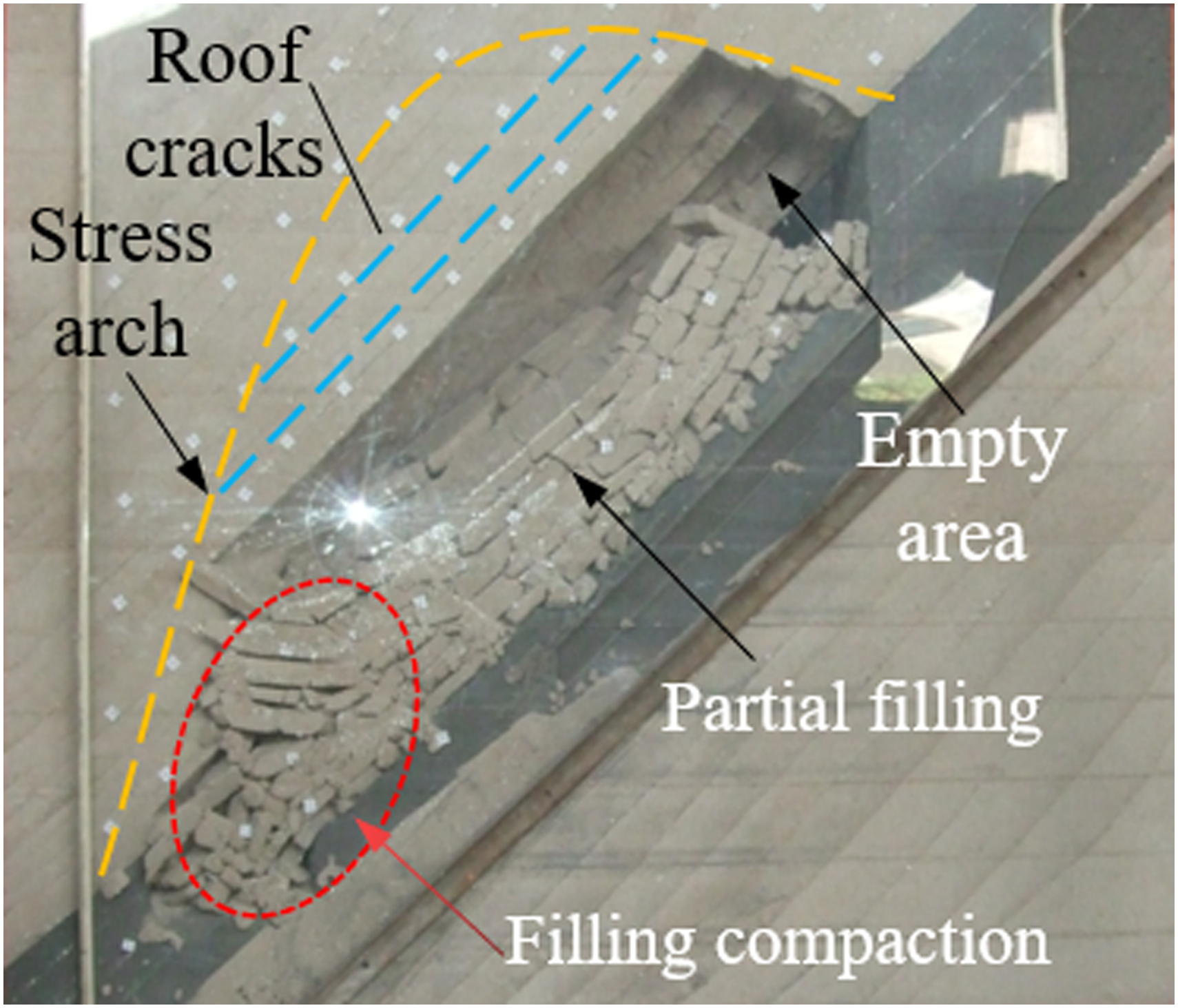
Stress arch of overlying strata.
The gangue filled in the lower area has a certain bearing capacity, and the main roof of the area is stable. In the main roof of the middle and upper part of the area, separation cracks are produced, and the cracks do not have the bearing capacity, so the stress arch is formed. The vault is inclined to the middle and upper part of the working face, the upper arch foot is on the side of the return airway, and the lower arch foot is on the side of the haulage roadway. Along the working face from bottom to top, the formation level of the block structure gradually increases, while its stability and supporting effect on the overlying undamaged rock strata gradually weaken, and the roof stress arch evolves to the high level and both sides of the upper and lower ends.
The nonuniform filling of gangue in goaf is the key factor in changing the loading state of surrounding rock and support in steeply dipping and large mining height stope. It can be seen from Figure 20 that the support load has obvious regional characteristics, and the distribution in the inclined direction of the working face is asymmetric. The average working resistance of the support in the middle area (No.4 ∼ No.6 support) of the working face is the largest. The working resistance of the upper (No.7 ∼ No.10 support) and the lower area (No.0 ∼ No.3 support) is smaller than that in the middle area, and the average values are 5363, 4676, and 3873 kN, respectively. This is due to the characteristics of the steeply dipping coal seam. The lower area has a certain supporting effect on the overlying strata due to the filling and accumulation of gangue, so the working resistance of the lower area is the smallest.
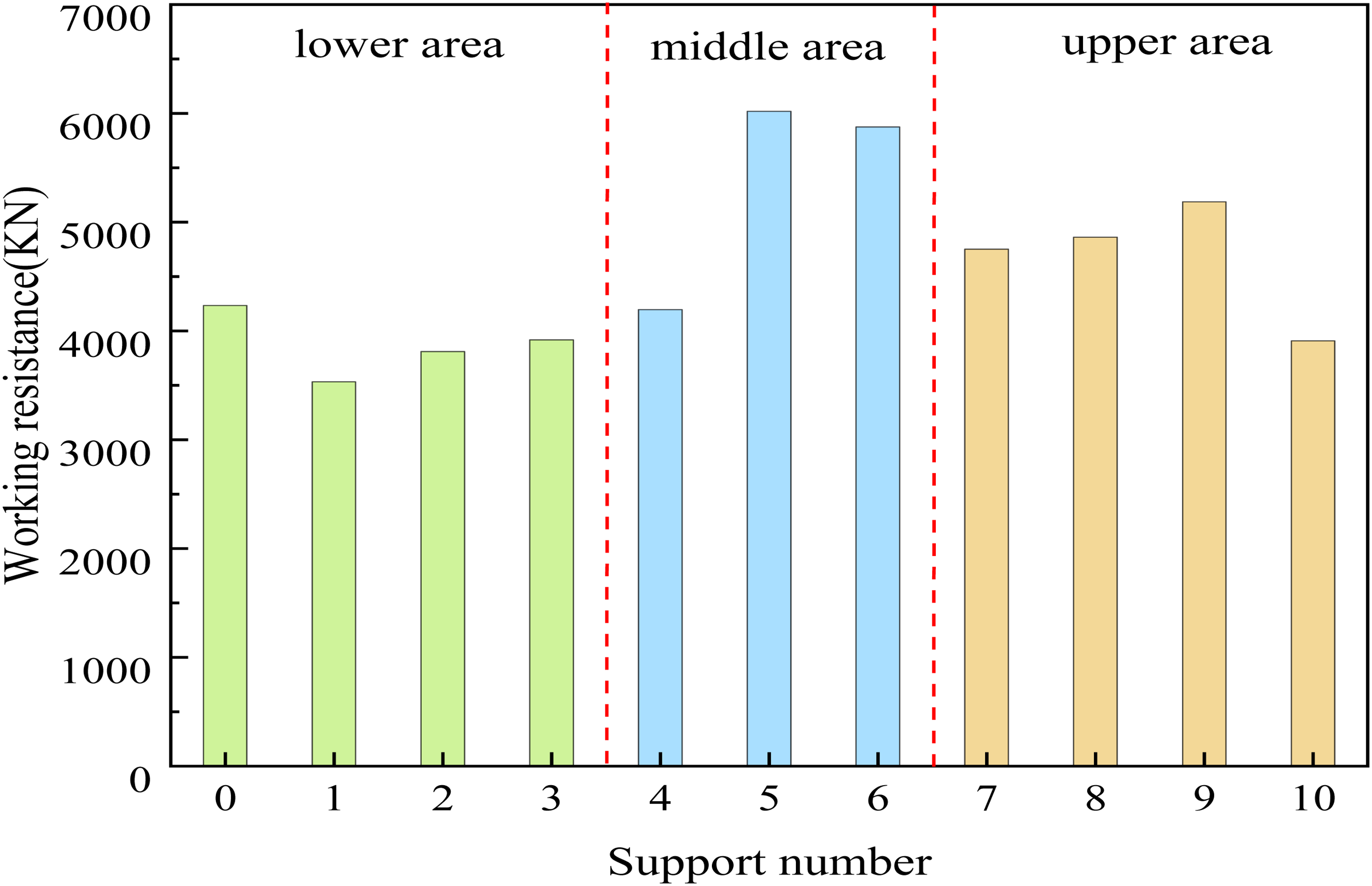
Working resistance of supports.
During the experiment, it was found that the lateral load of the lower support of the working face was relatively stable, and the load of the middle and upper support changed greatly. Compared with the general mining height of steeply dipping coal seam mining, the lateral load of the support is obviously increased. Due to the large mining height, the filling in the middle and upper areas is not dense, the space, amplitude, and intensity of the movement of the roof strata are increased, the contact state of the “support-surrounding rock” system is poor, the contact mode between the roof and the support and its loading characteristics on the support are complex, the phenomenon of partial load, no-load and intersupport extrusion of the support is obvious, the stability control of the support is difficult, and it is easy to appear dynamic instability to induce surrounding rock disaster, and it is easy to accumulate gas in the empty roof area of the upper corner, which seriously affects the safe mining of the working face, as shown in Figures 21 and 22.
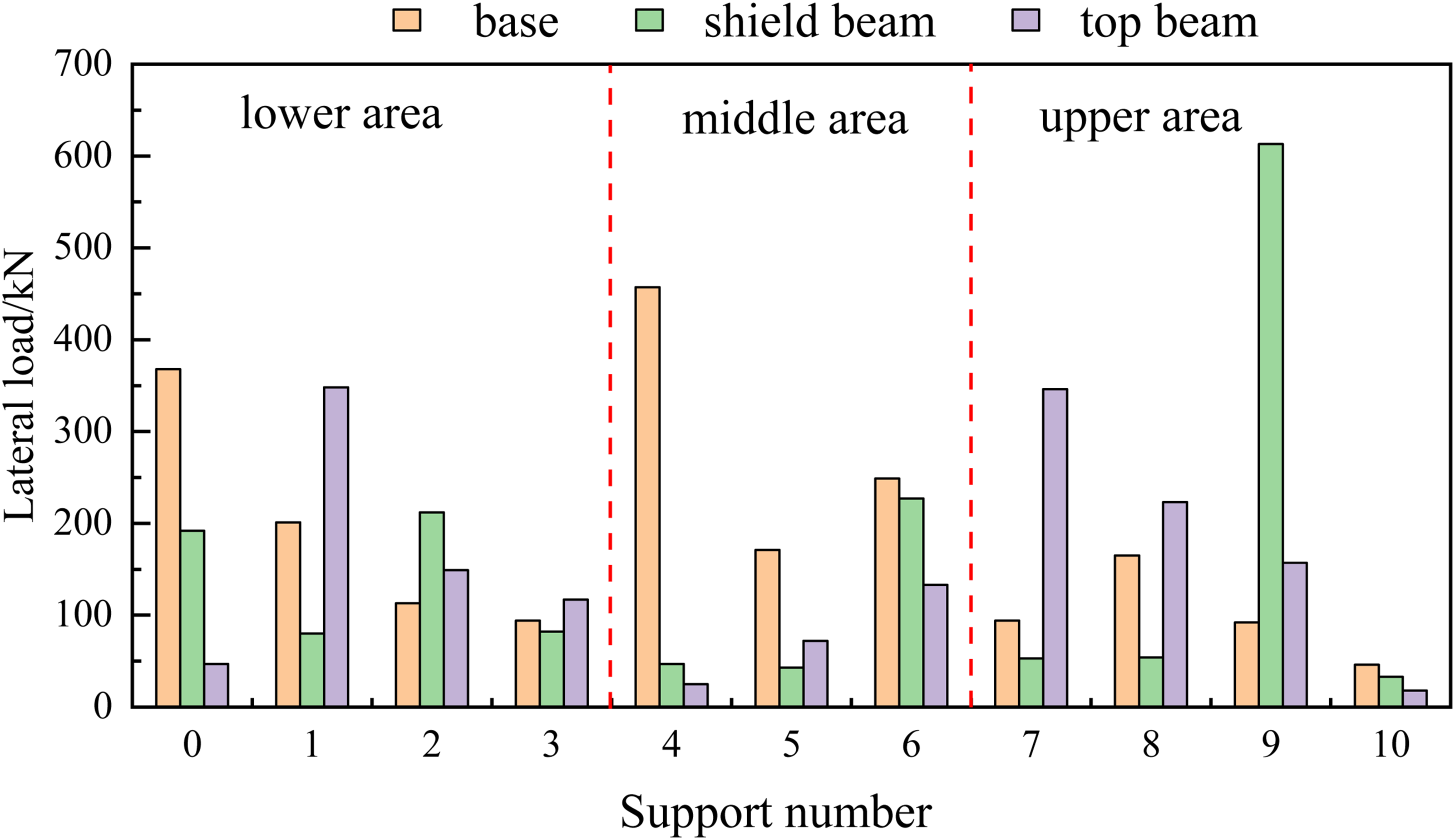
Lateral load distribution characteristics of supports.
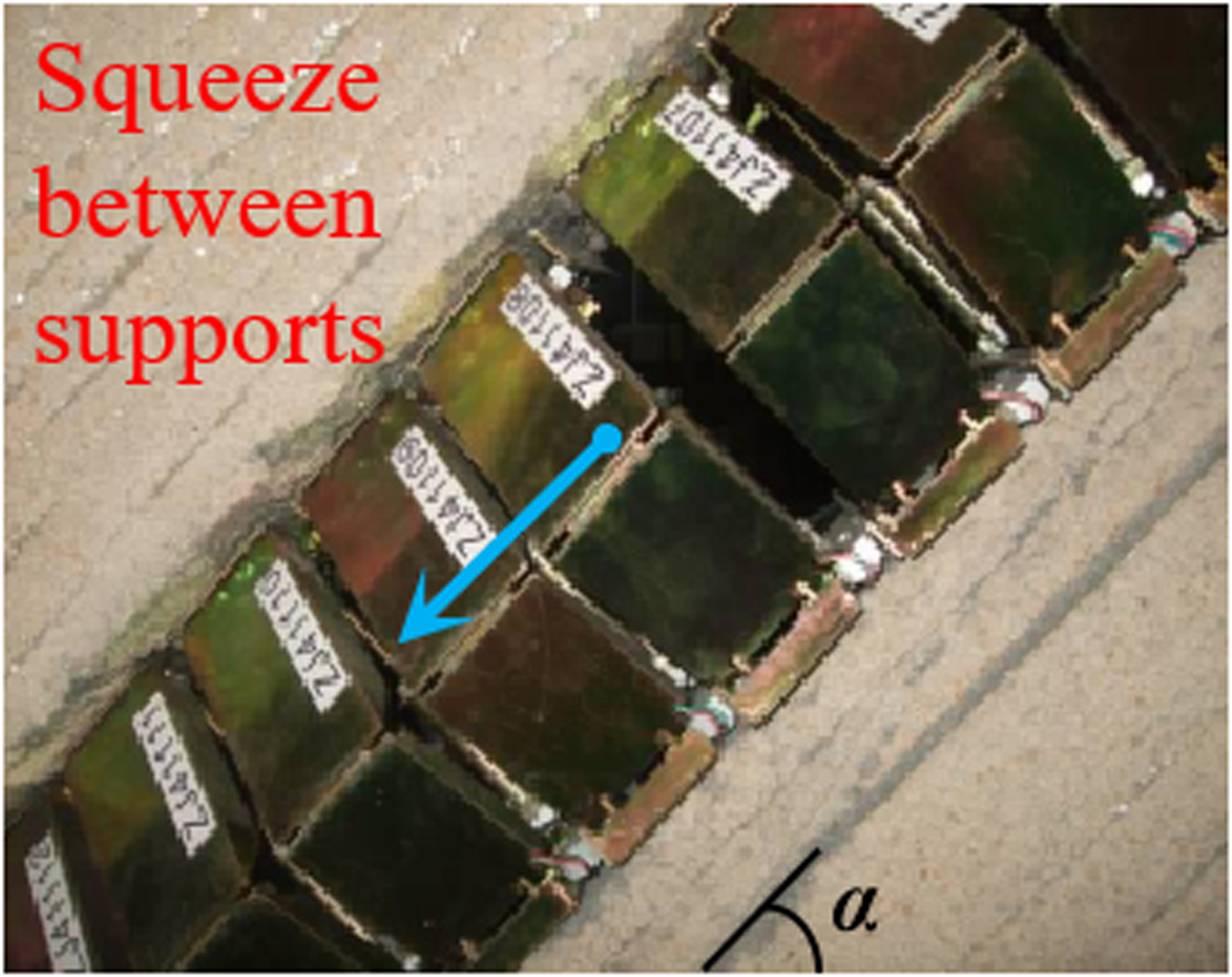
Interaction characteristics between supports.
At the same time, this study also has some limitations:
The 1500 × 400 × 1500 mm horizontal–vertical combined model frame is a two-dimensional experimental platform, which can only simulate the short-distance strike advance. It cannot obtain the roof fracture characteristics in three-dimensional space. At present, only 45°, experiments have been carried out. The next step is to carry out three-dimensional large-scale physical simulation experiments with multiple dip angles to facilitate a comprehensive understanding of the deformation and failure characteristics of the roof under different advancing distances. Due to the limitation of monitoring methods, only the working resistance of the support and the roof breaking characteristics are monitored in stages. The next research goal will be to fully grasp the three-dimensional roof breaking characteristics of the goaf in the whole space of the working face, the posture evolution of the support at different stages and the full-cycle mining stress monitoring data.
Conclusions
In the mining of steeply dipping coal seam with large mining height, the deformation, failure, and filling characteristics of surrounding rock show obvious asymmetric characteristics. The migration characteristics of stope roof are more active than those of general mining height and steeply dipping coal seam mining. A rectangular + triangular gangue support area is formed behind the support, and the roof strata collapse presents a “multilevel ladder key layer” roof structure with a low lower layer and high middle and upper layer.
Influenced by the dip angle of coal seam, an obvious asymmetric stress transfer arch is formed in the roof strata. The existence of stress deflection boundary in roof strata is the main reason for the asymmetric deflection of roof stress transfer path. Along the roof from top to bottom, the stress deflection position gradually migrates from the left side of the central axis of the working face to its right side. The load of overlying strata is transmitted to the upper and lower coal bodies by the stress deflection boundary.
With the increase of dip angle, the asymmetric characteristics of roof stress transfer evolution are enhanced, the range of asymmetric arch stress release area is obviously reduced, the vault is shifted to the upper area, the length of gangue support area is increased, the height of caving zone is gradually reduced, and the range of roof movement damage is moved up.
When the roof and floor strata are stable, the critical working resistance of the support is not more than two times the support's weight. When the support is empty, the critical interframe force to ensure the stability of the support is not more than one times the weight of the support.
The asymmetric transfer of mining stress in surrounding rock leads to the obvious regional characteristics of roof breaking and support instability, resulting in poor stability of the “support-surrounding rock” system in the middle and upper areas, and this phenomenon will become more and more serious with the increase of coal seam dip angle.
Footnotes
Acknowledgement
The authors acknowledge and appreciate the technical support provided by Coal Mine No. 2130 of Xinjiang Coking Coal (Group) Co., Ltd
Declaration of conflicting interests
The authors declared no potential conflicts of interest with respect to the research, authorship, and/or publication of this article.
Funding
The author(s) disclosed receipt of the following financial support for the research, authorship, and/or publication of this article: This work was supported by the National Natural Science Foundation of the PRC (52174126, 52204151), China Postdoctoral Science Foundation (Grant No. 2022MD713796), Shaanxi Outstanding Youth Science Fund Project (2023-JC-JQ-42), and Shaanxi University Youth Innovation Team Project.
