




Abstract
The European geothermal heating market, at one time dominated by only a handful of countries, is set to experience a purple patch in the coming years as governments scramble to find an affordable alternative to expensive gas-fired heating. The primary focus of this study will be to investigate what effect will worldwide governance factors and economic growth on the geothermal energy output among the 27 European Countries from the time being 1996 to 2021. Using the autoregressive distributed lag, the findings shows that a significant increase in the geothermal energy industry sustainability can occur in European Union 14 (EU14) emerged economies using worldwide governance factors than in EU13 emerging economies. Among additional factors, instability in the political realm, regulatory issues in the area of quality, accountability, and voice-related issues, and the ability to curb corrupt practices contribute more positively to geothermal energy sustainability in EU14 emerged economies than in European Union 13 (EU13) emerging economies. On the other hand, government effectiveness contributes more positively to geothermal energy sustainability in EU13 emerging economies than in EU14 emerged economies. The finding implies that geothermal power sustainability in EU region countries can be significantly increased by mounting the level of worldwide governance determinants to achieve Energy Union aims by 2030. This will finally be spread to combat climate change and environmental pollution. All observations on projected calculations are valid. The confirmation was achieved with the aid of the three estimators used in the study which are the pooled mean group estimator, the mean group estimator, and the third one was dynamic fixed effect approach. This study recommended that these European countries need to put more effort in terms of being effective in worldwide governance indicators which will help in goal attainment at the societal and environmental levels. Those in charge of making laws in the European countries should get more engaged in worldwide governance scopes as this will assist in facilitating the security and sustainability of geothermal energy generation. Those in charge of making policies in the EU countries should as well lay more emphasis on the strategies that could be cointegrated and as well sustainable toward worldwide governance fractionation toward the achievement of the sustainability of geothermal power and this will drastically reduce the need or dependence on fossil fuel and emissions coming from carbon dioxide in the future time.
Introduction
The European Commission and European Climate, Infrastructure, and Environment Executive Agency have invited EAVOR-LOOP to prepare a grant agreement to finance the first commercial-scale implementation of an innovative closed-loop geothermal technology. With a revenue of over €38 billion from 2020 to 2030 from the EU Emissions Trading System, the Innovation Fund aims to create the right financial incentives for companies and public authorities to invest in the next generation of low-carbon technologies and give EU companies a first-mover advantage to become global technology leaders. In China, Xiao et al. (2021, 2022) searched the economic length of the horizontal section of a downhole coaxial heat exchanger geothermal system based on net present value, suggesting that the project can only be profitable when the horizontal section length of the GR1 Well is between 0 and 4009 m, and the optimal economic length is 1466 m.
Historically, geothermal systems were only able to exploit resources where there was sufficient fluid, heat, and permeability (Vido et al., 2021). However, in so-called enhanced geothermal systems, where fluid is injected into hot rock to create man-made reservoirs, means geothermal energy can now also be extracted from dry, impermeable rock (Vido et al., 2021). High upfront costs and exploratory uncertainty mean that in 2019 <0.9% of the energy mix came from geothermal energy (García-Gil et al., 2020a). The International Energy Agency showed that geothermal represented only 15 GW of electrical capacity in 2020, compared with 737 GW of solar PV capacity (García-Gil et al., 2020a). However, experts believe the time and conditions are ripe for change, particularly in the heating sector (García-Gil et al., 2020a). Only with the right policy support and investment, geothermal use in EU renewable heat consumption could rise by more than 40% by 2023 (García-Gil et al., 2020a).
In the EU, geothermal energy consumption is projected to increase by 270% from 2019 to 2024. In 2020, district heating supplies around 12% of the total European demand for heat (García-Gil et al., 2020a). The European Commission revised guides on renewable energy in the year 2021, the objective behind this is to make legislation to be in tandem with new climate objectives in Europe which is to bring down emissions up to 55% by the year 2030 (García-Gil et al., 2020b). The revised text seeks to roughly double the share of renewables in the EU's energy mix, from around 20% currently to 38–20% by 2030 (García-Gil et al., 2020b). Since it has been confirmed that 40% of Europe's consumption comes from buildings and is also responsible for up to 36% level of emissions, it is paramount to encourage that heating and cooling-related activities to be renewed for the European countries to attain their climate goals (García-Gil et al., 2020b).
Half of the energy consumption of citizens in these European is consumed on heating and cooling, and up to 75% of the energy source is powered by fossil fuels (García-Gil et al., 2020b). Half of all energy consumed in Europe is from heat and a quarter is from electricity. There has been a huge policy focus on only a quarter of the problem, while half of the problem has been pushed to the side (Soltani et al., 2021). The EU regulations have gone for the low-hanging fruit. Virtually every country is starting to look at heat decarbonization because that is where the problem lies (Soltani et al., 2021). Also, another vital issue of concern is the agreements relating to heat purchase—these are binding agreements that prompt that there is a buyer for the energy generated—there will be a need for the European countries to design binding agreements like this in the country level instead of maintaining a single standard in the European Union (Soltani et al., 2021). District heat in general, like most renewables, involves a shift from operating expenses to capital expenditure (Ramos-Escudero et al., 2021). The problem is the upfront cost of the network which can be solved only with the right policies (Ramos-Escudero et al., 2021). In other words, geothermal power has the potential to become a major EU energy source but is held back by its high upfront costs (Ramos-Escudero et al., 2021).
About Lazard's Levelized Cost of Energy breakdown, the initial capital to put in place geothermal energy production ranges from $4000 and $6000 for a kilowatt-hour (kWh). However, the relative cost depends on public policy such as: do we have a carbon tax and subsidies to encourage the uptake of green solutions. People aren’t attached to their gas boilers, they just want affordable, reliable, and ideally sustainable heat (Ramos-Escudero et al., 2021). The Nordic countries are a case in point where district heating is everywhere in the Nordics (Mikhaylov, 2020). Heat networks supply 98% of the heat in Scandinavian cities because no one can burn oil and gas for heat anymore as per the new policy (Mikhaylov, 2020). True economic comparisons can only be drawn when energy sources are treated the same (Cao et al., 2021). Geothermal heat solutions often face unfair competition from fossil fuels due to tax treatment, electricity grid charges, and investment priorities in certain states (Cao et al., 2021).
Geothermal fails to take off due to a failure on the part of politics (García-Gil et al., 2020a). Blaming poor regulation for the current state of affairs and calls on EU policymakers to launch a European Risk Mitigation Scheme and binding decarbonization targets for the heating and cooling sector (García-Gil et al., 2020a). In 2021, a leaked version of the EU's revised renewable energy directive is falling short of the geothermal industry's expectations when it comes to boosting renewables in heating and cooling (García-Gil et al., 2020b). It will be difficult to attain a climate free of pollution in the European Union as desired by scientists and scholars except when fossil fuel consumption is replaced with a renewable energy source. Hence, the 2030 focus of attaining a pollution-free climate by the year 2050, could take farther than this before such could be attained (García-Gil et al., 2020b).
In the revised directives, consideration is being put in place by the European Commission to attain targets on renewable energy through the binding of heating and cooling and also putting in place several ways to attain this (Ramos-Escudero et al., 2021). Even when such binding targets are put in place, those in charge of policymaking have not fully addressed the problems being faced by the geothermal industry (Ramos-Escudero et al., 2021). Geothermal energy could be leveraged to minimize carbon emissions coming from heating and cooling since geothermal uses heat from the earth which is natural to generate heat and electricity (Ramos-Escudero et al., 2021). However, the huge capital outlay which is involved in explorations and drilling exercises, the relatively low-energy price, and its viability financially could still not be sustained (Ramos-Escudero et al., 2021). Resource risk is not only considered a large barrier for private developers of the geothermal industry but also is a major obstacle to general investors (Ramos-Escudero et al., 2021).
Issues about climate change have gone beyond addressing them with ineffective approaches or measures. Another environmental problem with geothermal energy production is that it could only be installed at some specific location due to certain features. Geothermal installations need to be done or constructed in a place where there is good accessibility to energy and this makes some areas not to be viable for this project (Grace et al., 2020). Furthermore, it was established that geothermal energy does not emit carbon dioxide, which is a greenhouse gas, however, in the cause of earth digging, some gases escaped and get released into the air (Khasani and Ryuichi, 2021). Earthquakes could as well be induced due to the digging exercise involved in the course of generating geothermal energy (Pasimeni et al., 2019). Apart from this, geothermal energy production comes with a huge capital outlay which makes it costly and uncompetitive; its cost ranges between $2 and $7 million to get a 1-megawatt capacity plant installed (Sigurjonsson et al., 2021).
Also, to facilitate the sustainability of geothermal energy production, as the underground reservoirs are getting depleted of energy fluid, they must be pumped back at a faster rate. Despite all these, geothermal power plants can have impacts on both water quality and consumption (Tomaszewska et al., 2020). Hot water pumped from underground reservoirs often contains high levels of sulfur, salt, and other minerals (Tomaszewska et al., 2020). Looking at it from another angle, it is pertinent to look into the social problems relating to geothermal as well. Geothermal energy production could trigger social problems such as ownership crises over land, people could get displaced of their belongings, the right of the indigenous people could be infringed upon, the flow of traffic could be disrupted, damage to road networks, noise, and odor population, poor population density, etc., nonproper consultations and dialogue among stakeholders over employment and economic benefits could as well constitute a problem (Im et al., 2021; Greiner et al., 2021).
The main research questions were: (1) How do worldwide governance factors improve the sustainable growth of the geothermal power industry in the EU region during the period between 2021? (2) In which EU members are more vulnerable to the effects of geothermal energy industry sustainability caused by worldwide governance factors? (3) What is the contribution of worldwide governance indicators to the improved sustainability level of geothermal production among the EU27 nations? As a result of the need to put in place a renewed and sustained energy such as geothermal, and the need to as well put in control the continuous climatic changes, it becomes pertinent for the EU at the regional and subregional levels, to work out the relationship between geothermal energy production and worldwide governance measures. The Primary Objectives of this study are: (1) to expatiate on the impact of worldwide governance on geothermal power sustainability in the EU region during the period between 1996 and 2021. (2) To provide a comprehensive review of the geothermal energy industry impacts on worldwide governance determinants between emerging countries and emerged nations within the time frame of 2021.
This study is of significant contribution to the existing body of literature. It facilitates common worldwide governance measures that could be used to attain sustainable development among the EU countries and has a good explanation of the connection among the research key determinant variables. Findings that will emanate from this research could assist the government of the European countries in tackling environmental-related pollution and climate change by exploring what contribution worldwide governance measures will have on the sustainability of the geothermal industry. The analysis technique adopted to explain interactions among the key variables of this study is peculiar to the European Union region. Furthermore, industries in geothermal production are sources of green energy, this research decides to consider the geothermal power industry and worldwide governance measures in a bid to understand whether sustainability predesign standard guidelines are met, to prompt further engagement of geothermal into the energy world.
The measures of the EU worldwide governance factors in this study are clustered based on the following categorizations: voice and accountability, political stability and no violence, government effectiveness, regulatory quality, control of corruption, and Rule of Law. Based on the World Bank Data Catalog, this research captures the worldwide pointers which are fixated on six factors: social, economic factors, sustainable, corporate, good, and civil governance (Alsaleh et al., 2022a). When a huge chunk of socioenvironmental and economic problems is tackled, the EU14 and the EU13 countries are expected to experience positive geothermal energy production leveraging the key determinants of worldwide governance. Furthermore, the findings this study will carry out could establish likely relationships and pinpoint governance pointers in this study which could be used to explain the influence worldwide governance will have on sustainable development this will be beneficial toward facilitating the attainment of sustainable development and this will cut down cost implication of policies among the 27 EU countries.
This study offers comprehensive examinations of central aspects and region-specific challenges related to sustainable governance and the geothermal power industry. Moreover, this research investigated the state of play of the implementation of the Sustainable Development Goals on geothermal power sustainability in the EU region. This study looks into hindrances related to specific policymaking, putting a summary of recent interventions and ethical doings for policymakers, as the study considers the positive influence of geothermal energy in the EU regions. Extant studies have tried to establish the relationship between geothermal energy production and policies. However, these extant studies were individually established in different countries using different modeling approaches, methods, and findings. It is interesting to know that only a few studies have been carried out to investigate the relationship between geothermal energy production and governance in European countries.
In all these studies, there was no agreement. This current study will therefore add to the existing literature by adopting worldwide governance factors and establishing the influence on geothermal industry sustainability in the European Union classified into the emerged and emerging economies within the considered time frame of 2021. Based on the extensive search carried out by the author, it is no doubt that this will be among the front lines of studies that will concurrently examine the impact of worldwide governance determinants on geothermal energy sustainable growth using the Autor-Regressive Distributed Lag (ARDL) regression. Furthermore, this research examines the nexus between some social-economic determining factors and worldwide governance measures by emphasizing the growth hypothesis. In the current study, several additional adjustments have been carried out to our models, and this is to ensure a good level of representation of geothermal energy generation at both the regional and subregional levels.
As the research locale is based on the EU, all estimates relating to application-specific long-term economic geothermal energy benefits have been primarily updated, going on the subsurface data temperature, coined from the model developed by Alsaleh et al. (2022b, 2022c). This constitutes a vital improvement to the model used in this study since the potentialities of geothermal were portrayed in the preceding versions in an elementary way. Findings reported in this study will therefore constitute a grand contribution to the existing literature in three key ways: various ways to explore geothermal energy benefits, its application to the environment, and their geographical focus.
Literature review
Relevant discussions establishing the nexus between geothermal energy production and governance have been an area of scholarly contributions among researchers and economists in the last few decades. A blueprint for geothermal energy dependence was first enunciated in the study of Kraft and Kraft (1973). Researchers continue to make further findings on this, there continues to be further in-depth research in this field. Over the years, economists have propounded different theories relating to economic growth, however, these theories have failed to capture geothermal which is no doubt one of the drivers of economic growth. For example, Li et al. (2021) explored the relationship between renewable energy sources and economic growth in the South Asian Association for Regional Cooperation Countries, which indicates that geothermal power has a direct and significant effect on sustainable growth. In the same manner, Lebbihiat et al. (2021) investigated the current status compared to the worldwide, utilization opportunities and countermeasures of geothermal energy use in Algeria. Lebbihiat et al. (2021) stated that a leading country producer of geothermal in Africa is Algeria, it is estimated that the country has an installed thermal capacity of 54.64 MWt installed thermal power. Algeria is also among the first five countries in the world known for applications relating to air conditioning. Similarly, Amoatey et al. (2021) investigated the status and potential of geothermal energy in Middle-East countries and points out that the majority of the oil-rich countries in the Middle East have not fully harnessed geothermal energy resources in their regions and this is due to lack of qualitative research and exploration activities in the region.
Among the key challenges to the deployment of geothermal energy on a large scale include huge capital outlay, public policy, securing a favorable location that supports the installation of geothermal, the level of quality in the resources to be deployed, and resistance from the indigenous people at the local level. For example, Soltani et al. (2021) asserted that to attain sustained development pathways there is a need for the critical assessment of all constraints relating to technical and economic factors, within the confine of environmental governance, as well as legal and social problems that could arise in the course of executing geothermal energy installations. Likewise, Kashem et al. (2021) searched the feasibility of a geothermal energy system in Indonesia, referring that despite all the cons caused by geothermal energy, the government still looks forward to turning Indonesia into the world's largest geothermal electricity producer over the next 10 years. Similarly, Afshar et al. (2017) investigated the development of geothermal power in Iran and indicated that Curie point depth could induce the occurrence of earthquakes and the nature of the thermal spring is connected to geothermal resources depth at the top. In the same way, Al-Douri et al. (2019) explored geothermal energy reserve and potential in Saudi Arabia, points that geothermal power has the potential to contribute to fulfilling the country's demands for being a part of an effective plan for reducing carbon dioxide (CO2) emissions. Identically, Al-Samari and Ali (2018) and Aljubury and Ridha (2017) investigated how an evaporative cooling system in a greenhouse could be enhanced by leveraging geothermal energy generation in Iraq.
The process of geothermal construction involves drilling down the earth which has to be very deep to drive out hot steam or trapped water in a rock formation (Niu et al., 2021). This is a very earth disruption procedure that could predispose an area to an incident of earthquakes at the earth's surface due to the earth's structural alteration beneath the ground (Niu et al., 2021). Fluid injection into enhanced geothermal systems reservoirs can reactivate subsurface faults and trigger earthquakes (Niu et al., 2021). In the same way, Ree et al. (2021) and Im et al. (2021) explored the inhabitants of Pohang, Korea, perspective on geothermal power plant installations, in the aftermath of the 2017 Pohang earthquake. The study adopted social representation theory using the mixed method approach which covers both quantitative and qualitative research studies. Findings from the study showed that the residents of Pohang residents had a negative but significant perspective on geothermal power plants regardless of safety measures put in place, mitigating the effect of climate change with some other economic-related factors. In the same manner, Greiner et al. (2021) studied the potential of rural roads related to differences in livelihood patterns, attitudes toward social change, and land disputes in Baringo, Kenya, indicating that geothermal power sustainability can play a main contributor to conflicts around land ownership and government.
Likewise, McBain et al. (2021) investigated the development of geothermal energy policy for the national and subnational ecological footprint in Australia, referring that policy development will need to identify land uses that can operate synergistically with land required for geothermal energy to mitigate the ecological footprint expansion as renewable energy increases. In the same way, Kombe and Muguthu (2018) studied the geothermal energy development in East Africa and related political barriers and strategies, suggesting that the East African Rift is among the most crucial regions of the world endowed with a remarkable geothermal potential for more than 15,000 megawatts electric (MWe). Under the governance regulation, many studies such as; Garcia-Gil et al. (2020a) and Garcia-Gil et al. (2020b) developed integrated national energy and climate plans to cover the dimensions of the Energy Union related to decarbonization, energy security, energy efficiency, internal energy market, research, innovation, and competitiveness.
For example, Koon et al. (2021) searched the resource and policy-driven assessment of the geothermal energy potential across the islands of St Vincent and the Grenadines, indicating that several policy approaches (such as incentivization for public–private partnerships, information certainty, regulatory processes, and strengthened institutions) are identified as potential means of enhancing geothermal resource development and leveraging the resource for the islands’ sustainable energy demands. In the same manner, Carla (2021) explored the institutional configurations, discernible by looking at the influence that the sociomaterial forms of energy exert on energy infrastructure and its governance, referring to that normative and cultural contexts of the region's under-consideration have influenced and modulated the effects of national regulatory schemes on geothermal energy deployment in Italy.
In the same way, Britta et al. (2020) explored in what way and to whom government representatives in conjunction with inhabitants at the local levels, relate and at the planning and implementation stages of geothermal energy installations, the study asserted further that the construction of large-scale geothermal infrastructural facilities and the attached established relation between the investor and the community is moderated by different cross-sectional approaches. It was generally observed from the literature reviewed that there are studies that have briefly looked into the existing nexus between geothermal energy use, governance, and economic growth, the findings of these studies are still incomplete. The majority of the studies were criticized on account of how valid their estimated coefficients, as well as their elasticities, are an area of concern because the tests carried out are not validated on an appropriate quantitative framework.
The majority of the tests did not put into consideration two important tests that are necessary if unbiased and consistent regression is to be obtained; the tests are the diagnostic statistics and the specification tests. The gaps between this current study and the previous ones are in so many ways. First, it finds out what will be the long-run effect of worldwide governance factors on geothermal energy sustainability in EU emerging countries and EU emerged countries during the period between and 2021 concurrently. In addition, it examined the nexus between socioeconomic factors and geothermal energy consumption adopting the growth hypothesis. Between the time frame of 2021, there is no record of this analysis being carried out in the EU regions. Furthermore, this study put into consideration the results outputs of the diagnostic and specification tests, which were hardly seen being carried out in the previous studies reviewed. Finally, it considers the use of panel data, which is recent. This technique makes it possible to have an analysis of unobserved parameters which are heterogeneous and cross-sectional inter-dependence.
Methodology and data
Theoretical framework


Summary of variables.
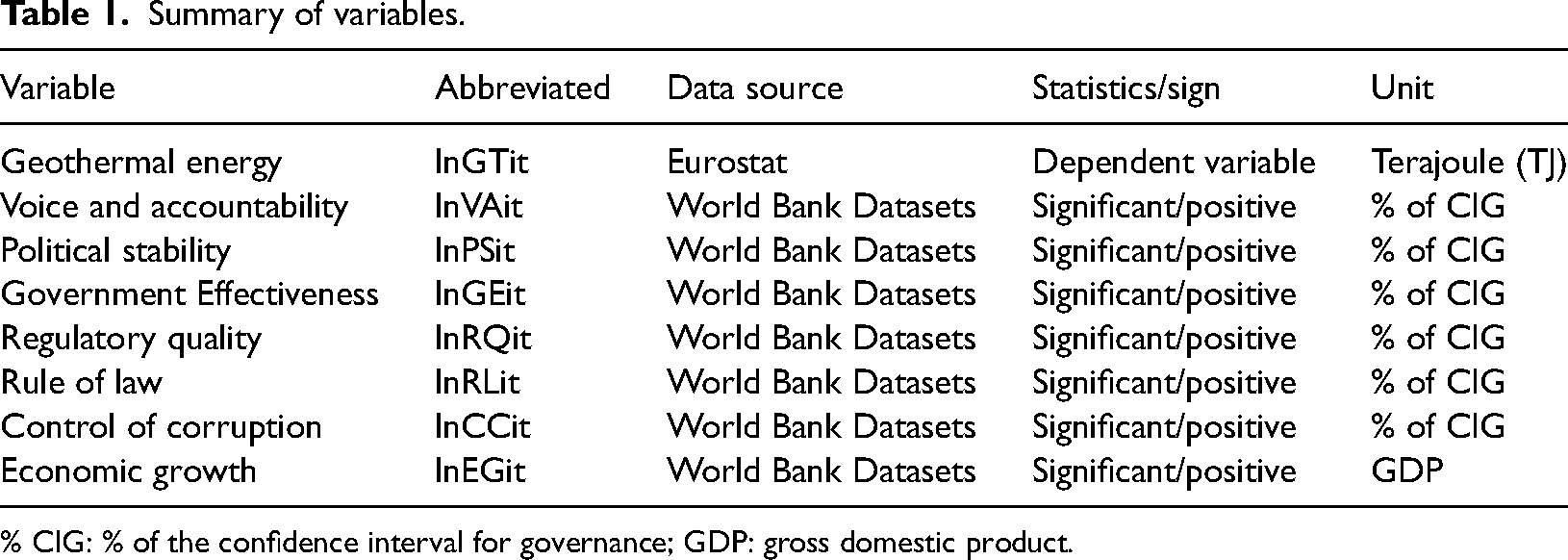
% CIG: % of the confidence interval for governance; GDP: gross domestic product.

Unit root testing of panel type
This test was conducted on all the variables selected for this study. The essence of the test is to mitigate cases of false regression when panel data is deployed. The primary reason why this test was carried out in this study is to address the issue of low power problem especially Augmented Dickey-Fuller is deployed. The works of Campbell and Perron (1991) and Ramirez (2006) asserted that how reliable estimation could be questioned when there is a low power in the unit test in such a way that total observations in a time series study are below 50 such as; Campbell and Perron (1991) and Ramirez (2006). This challenge could be addressed by deploying the panel unit root test since it has more power with a distribution that is standard and asymptotic. This, therefore, means that evidence from the test can be said to be reliable. Additionally, there is a high level of efficiency in the unit root test in comparison to the unit root test that is time series in nature (Im et al., 1997; Levin et al., 2002). This is a very common method adopted in many studies on energy consumption (Chen and Huang, 2013).
Estimation of panel
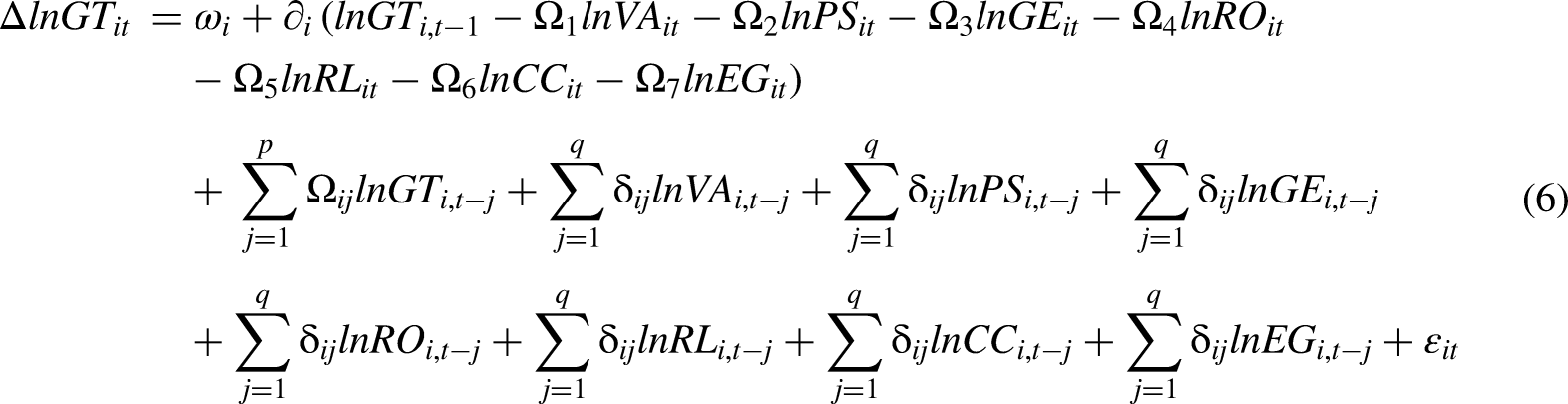
The pooled mean group estimator has features such as short-run estimation which also includes an intercept, adjustment speed, and heterogeneous error variance. The slope coefficient, in the long run, is limited to being homogenous. Using this method has the advantage of a high level of efficiency and consistency in capturing the presence of relationships in the long run. Despite all these, the error correction term still needs to be lower than 2 and negative. Apart from this, there is a vital assumption that is very paramount and this is consistency in estimations, and therefore residual error correction model can’t have serial correlations which could lead to inhomogeneity in the explanatory variables. These conditions could be adequately met once the lags (p,q) are adequately factored in for both the independent and the dependent variables of this study. Adopting this approach requires a large size of T and N, and it must be noted that the T must be greater in value than N. In the work of Pesaran et al. (1999), N is approximated to be around 20–30 countries. The Mean group is the second estimator adopted for this study and this estimator was introduced by Pesaran and Smith (1995). The benefit of this estimator is that it allows for separate regression for each country and as well maintains the coefficient. What makes it slightly different from the pooled mean group is that it is not restricted to the processes for estimators (James et al., 2017). In both the long and the short run, this estimator is known for its ability to produce different and heterogeneous coefficients. The dynamic fixed effect (DFE) is the third estimator used in this study. This estimator is similar in characteristics to the pooled mean group, in such a way that it restricts the coefficient of vector co-integration to be the same among all panels in the long run. Aside from this, the speed of adjustment is limited and this gives a short-run coefficient that is the same, it also allows a specific panel coefficient. The long-run relationship models of the mean group are expressed in equation (4) below:

Testing using Hausman specification tests
The testing method is vital to selecting among the three estimators, that is, the pooled mean group, the mean group, and the DFE (Hausman, 1978). Considering the selection between the pooled mean group and the mean group, when the null hypothesis formulated is accepted, the pooled mean group will be selected over the mean group as being efficient and when the null hypothesis formulated is rejected, the mean group will be selected as being efficient over the pooled mean group. Considering the pooled mean group and the dynamic fixed estimator, when the null hypothesis formulated is accepted, then the pooled mean group will be selected as being efficient over the dynamic fixed estimator and when the null hypothesis is rejected, this interpretation that the dynamic fixed estimator is better than the pooled mean group (Shaari et al., 2020).
Results and discussion
This research adopts three estimators (the pooled mean group, the mean group, and the DFEs) to investigate the influence of worldwide governance factors on geothermal energy sustainability in the considered EU countries using their economic development levels as yardsticks. The considered 27 European countries were grouped into two: EU14 emerged economies (Austria, Belgium, Denmark, Finland, France, Germany, Greece, Ireland, Italy, Luxembourg, the Netherlands, Portugal, Spain, and Sweden) and EU13 emerging economies (Slovakia, Slovenia, Croatia, Bulgaria, Czech, Cyprus, Estonia, Latvia, Hungary, Lithuania, Poland, Romania, Malta), as shown in Appendix F. There was a unit root testing which was done based on the guides of Levin, Lin, and Chu (LLC) and Im, Pesaran, and Shin (IPS), this was done to see the present stationarity of the data for all the variables considered in this study (GT, GOE, PSAV, REQ, ROL, VOA, COC, and EG). This, therefore, makes it pertinent to ascertain the order of integration in all the variables considered in this research. As revealed in Table 2, results outputs from the two tests were displayed and it can be interpreted that all the considered variables come out stationary at the level and for both LLC and IPS, it is the first difference. This reveals that the considered variables’ order of integration is mixed (I (I) and I (0)). In line with these results outputs, the panel autoregressive distributed lag can be deployed.
Panel unit root test results for the EU region in 1996 to 2021.
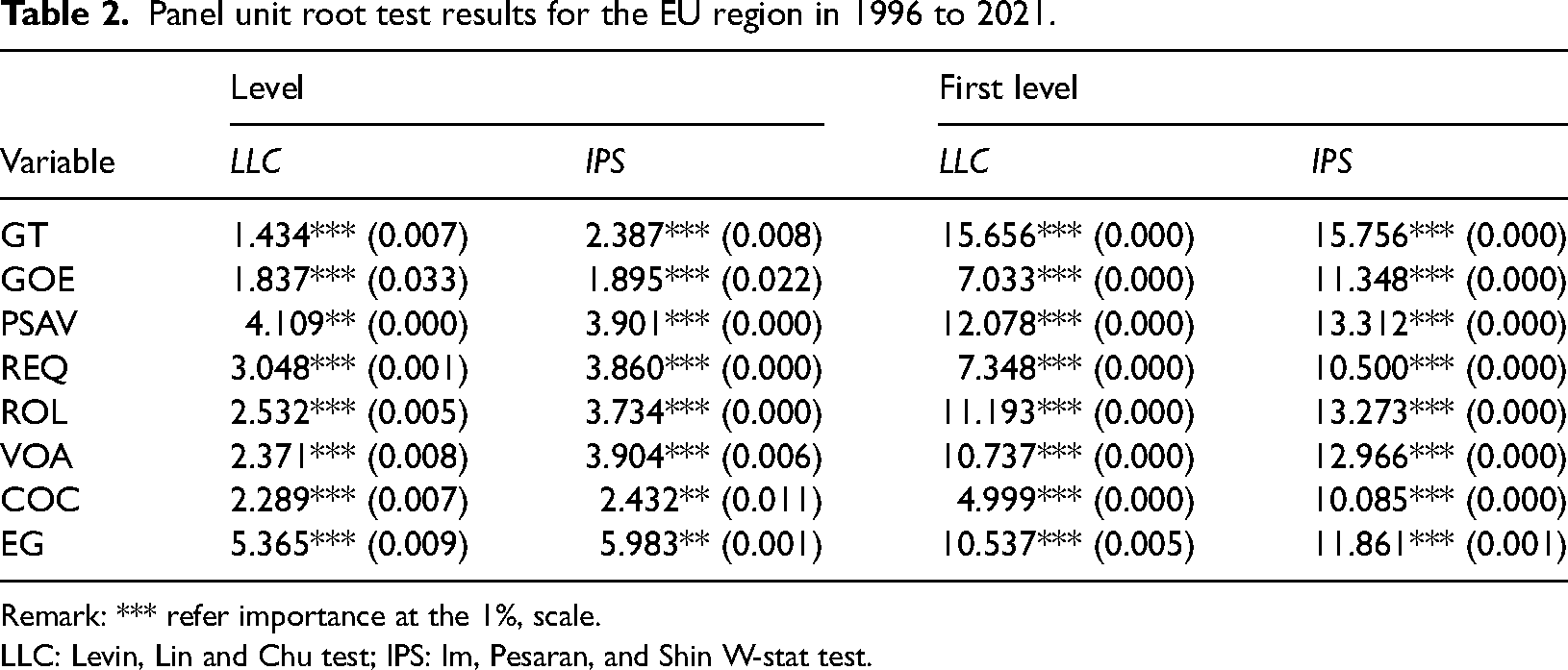
Remark: *** refer importance at the 1%, scale.
LLC: Levin, Lin and Chu test; IPS: Im, Pesaran, and Shin W-stat test.
Preliminary tests were used to start the estimation process. Summary statistics that reveal that variables have normal distribution are revealed in Appendix A and B. The results of the correlation analysis are shown in Appendix B. Also, the study considered the variance inflation factor, which constitutes a very important test to ascertain whether there is an existence of relationships among the independent variables or multicollinearity (Rawlings et al., 1998; Snee, 1981). This is done to avoid false regressions that could lead to conclusions or inferences that cannot be relied upon. Also, before carrying out the variance inflation factor test, this study carried out linear regression tests as shown in Table 3 in this study. Statistics in the table reveal that there are no relationships among the considered variables. The general rule is that when the variance inflation factor is <5 (James et al., 2017), it shows no relationship could be established, meaning that all variables could not be correlated.
Regression analysis.
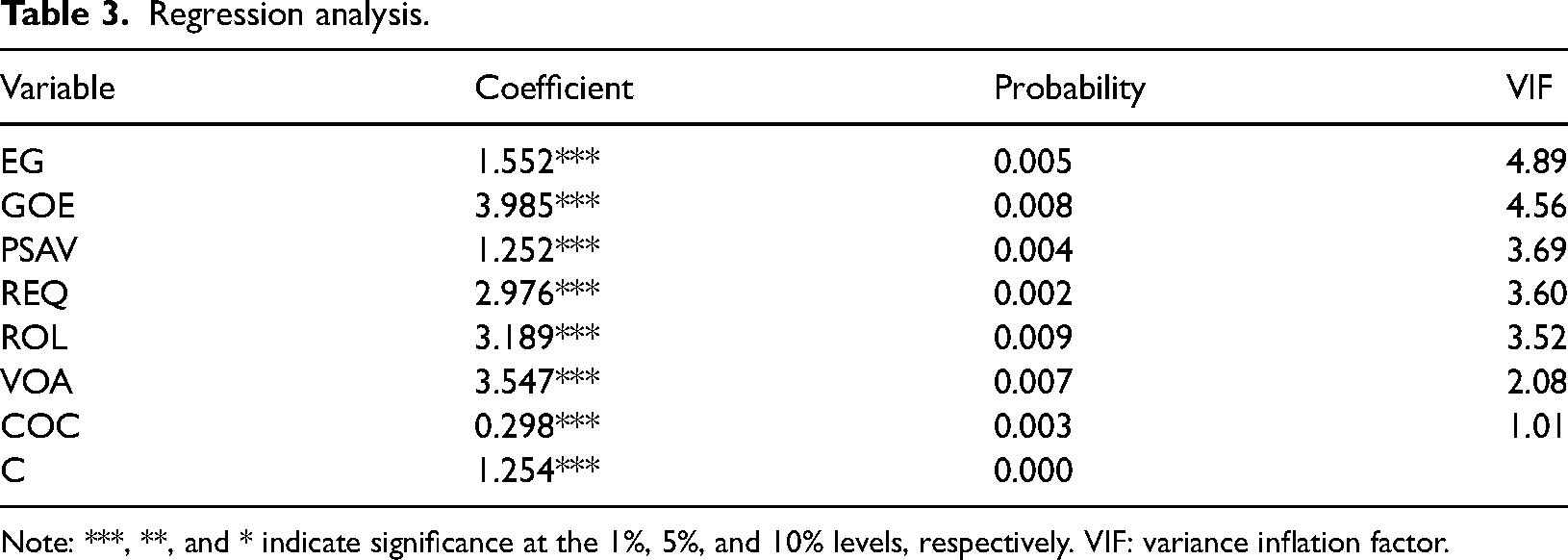
Note: ***, **, and * indicate significance at the 1%, 5%, and 10% levels, respectively. VIF: variance inflation factor.
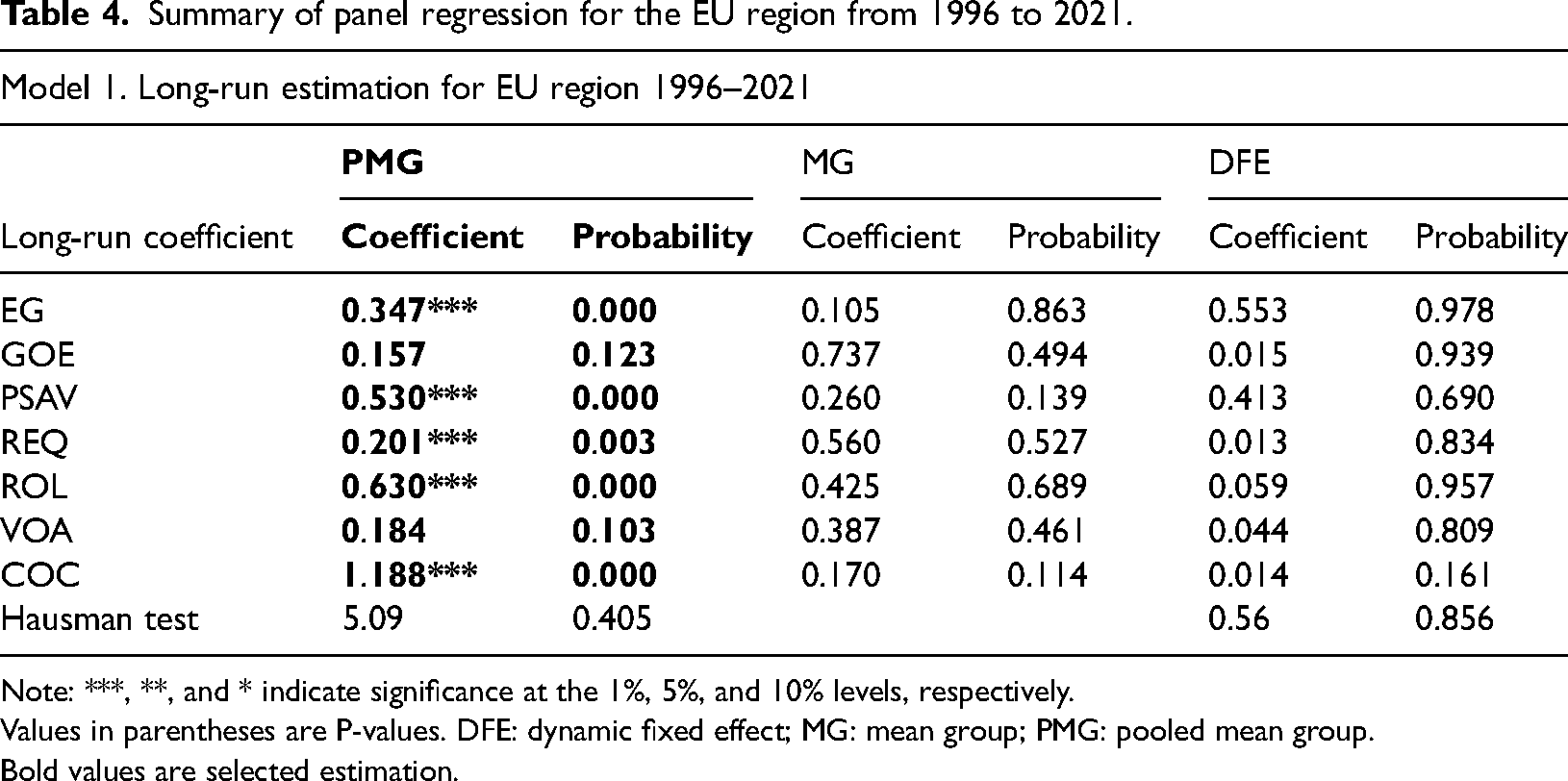
To estimate the effects of worldwide governance factors on geothermal energy sustainable growth, this research adopted three estimators. In Table 4, the Hausman test was considered to select between the pooled mean group and the mean group and between the pooled mean group/mean group and the DFE. Results from the analysis done using the Hausman test makes the null hypothesis formulated to be accepted and this makes the pooled mean group to be selected over the mean group. A similar analysis was also carried out on the pooled mean group and dynamic fixed estimator, the null hypothesis formulated was also accepted, and this suggests that pooled mean group estimator is also selected over the DFE. The results of the three estimators using the houseman test were shown in Table 4. Panel results of the three estimators, that is the pooled mean group, the mean group, and the DFE were revealed in Table 4.
Summary of panel regression for the EU region from 1996 to 2021.
Note: ***, **, and * indicate significance at the 1%, 5%, and 10% levels, respectively.
Values in parentheses are P-values. DFE: dynamic fixed effect; MG: mean group; PMG: pooled mean group. Bold values are selected estimation.
These results give a comprehensive check. In model 1 (see Table 4), the coefficient on economic growth output is found positive but statistically significant at a 1% statistical level, in the long run, suggesting a positive relationship between economic growth output and geothermal energy industry development in the EU region. This means that when the level of economic growth of outputs increases, there will be commensurate geothermal energy development in the considered EU regions. Specifically, when there is a 1% increase in the level of economic growth, this will bring about an estimated 0.347% increase in the level of geothermal development. This result is showing consistency with studies such as Li et al. (2021); Yikun et al. (2021); Anser et al. (2021); Soltani et al., (2021a); Piłatowska and Geise, (2021). It, therefore, means the considered European countries could leverage an increased level of economic production to increase the level of geothermal production. This is shown in Appendix G.
Furthermore, a 1% level of significant positive relationship was seen in political stability, this means that when the level of political stability is increased by 1%, there will be an incline of 0.530% in geothermal energy production. These results corroborate the findings of Destenie (2021), Yuxin et al. (2021), Muhammad et al. (2021), Al-Tal and Al-Tarawneh (2021), and Lyulyov et al. (2021). This means that an increased level of political stability and governance will boost geothermal development in the EU regions. That is, the aspired level of sustainability desired by the EU nations could be attained by widening the scope of political governance in two key areas these are the absence of violence and the absence of terrorism.
In addition, a 1% positive and significant level was also seen in regulatory quality in the long run. Precisely, when a 1% increase in regulatory quality is attained, this will bring about a 0.201% increase in the geothermal energy industry sustainability. This means that the desired level of geothermal industry sustainability could be achieved by improving corporate governance in the renewable energy industry. This result conforms with the findings of Abbas et al. (2021), Gungor et al. (2021), Ibrahim and Ajide (2021), Falchetta et al. (2021), Gyamfi et al. (2021), and Lyulyov et al. (2021). The implication of this is that sound and coherent policies and regulations should be formulated and implemented by the EU regions which encourage private sector engagement in the geothermal energy industry.
Rule of law as one of the variables captured in this study also has a 1% important and optimistic coefficient level. Specifically, when 1% growth is recorded in the rule of law, there will be a 0.630% increase in the level of geothermal power generation. It, therefore, means that when the rule of law is strictly adhered to, it could boost the level of development of the geothermal industry. This finding conforms with Mombeuil (2020), Muhammad et al. (2021), Saurer and Monast (2021), Bruce (2021), Mombeuil (2020), and Luyao et al. (2021). The studies concluded that geothermal has good prospects for forming civil governance. The implication of this is that when there is a high level of confidence in societal rules and people confidently abide by the societal laid down rules and regulations, and people also strictly abide by the quality of geothermal energy contract and its adequate enforcement, geothermal rights related to properties, the natural resource policing, as well as the judicial courts handling environmental matters, in addition to the possibility of criminal matters on natural resource and violation of environmental laws.
A 1% significant level of optimism and noticeable influence was also seen in control of corruption over the sustainable growth of the geothermal industry. It, therefore, means that when there is a 1% growth in corruption, a 1.188% level of development is found in geothermal development. This conforms to the works of Yao et al. (2021), Pei et al. (2021), Gani (2021), Lu et al. (2021), and Kumar et al. (2021) that suggest that control of corruption captures perceptions of the extent to which public power is exercised for private gain in the geothermal energy industry, including both petty and grand forms of corruption, as well as capture of the state by elites and private interests. The findings of this research showed that improvement in good governance will bring about additional growth in the geothermal energy industry. The level of geothermal development being craved by the EU countries could therefore be attained by improving the quality of good governance. The worldwide governance measures in the areas of social governance, and civil and economic governance should be improved upon as this will help in boosting indigenous content and services that are relevant to the need of the people.
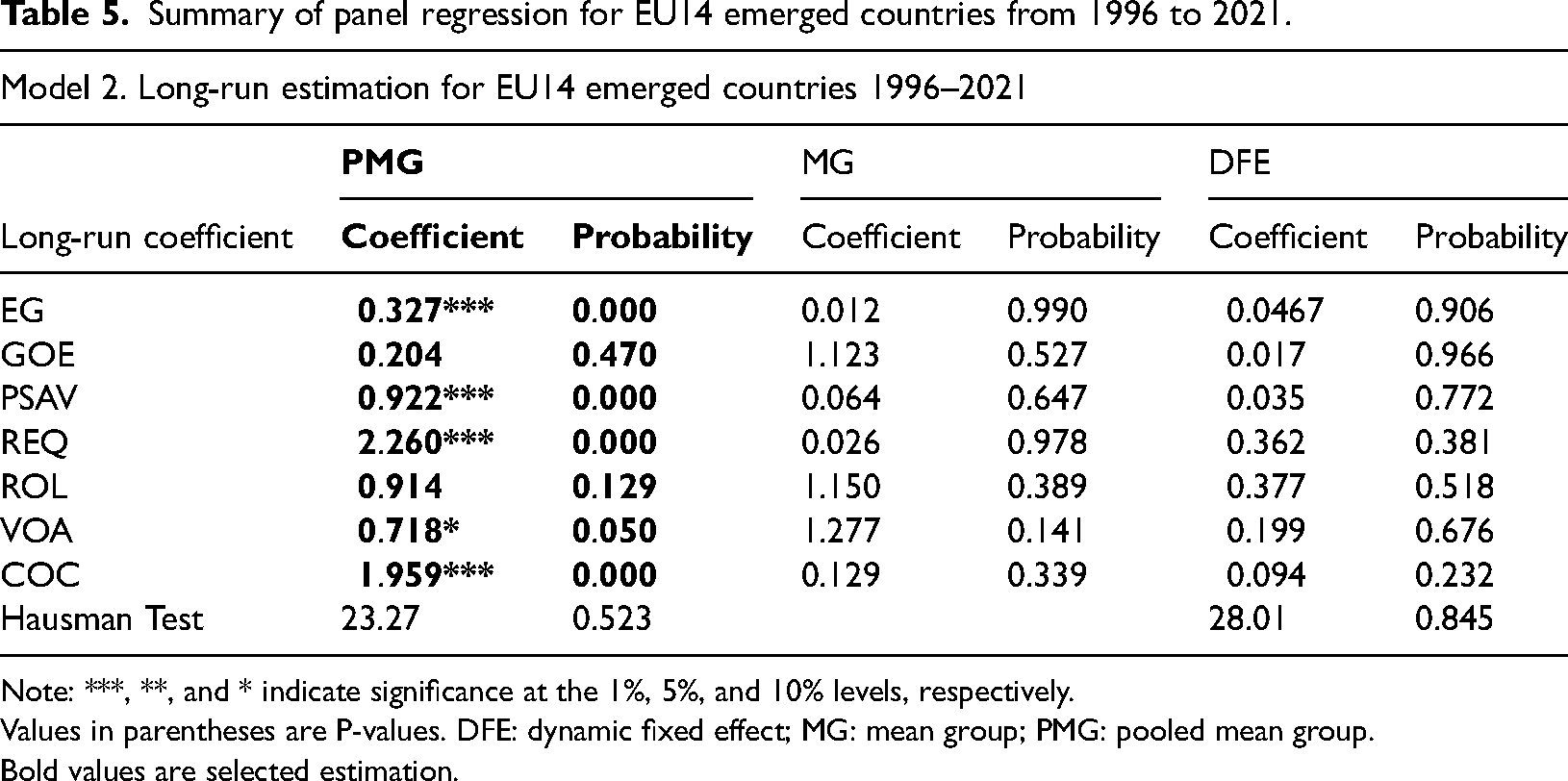
In estimating the effects of worldwide governance factors on the geothermal energy sustainable growth, this research adopted three estimators and they are the pooled mean group, the mean group, and the DFE. As shown in Table 5, a selection was made among these three estimators, that is, the pooled mean group, the mean group, and the DFE using the Hausman test. The Hausman test is very vital in making the selection between the pooled mean group and the mean group and between the pooled group/mean group and the DFE. In the analysis done between the pooled mean group and the mean group, the null hypothesis formulated is accepted and so the pooled mean group is favored over the mean group. In a similar test carried out between the pooled mean group and the DFE, the null hypothesis formulated was also accepted and so the pooled mean group is favored over the DFEs. Statistics in Table 5, therefore, reveal the results of analysis on the three estimators that is the pooled mean group, the mean group, and the DFE using the Hausman tests. The results of the panel model analysis of these three estimators are revealed in Table 5, which is the panel model analysis of the pooled mean group, the mean group, and the DFEs. This gives a comprehensive check.
Summary of panel regression for EU14 emerged countries from 1996 to 2021.
Note: ***, **, and * indicate significance at the 1%, 5%, and 10% levels, respectively.
Values in parentheses are P-values. DFE: dynamic fixed effect; MG: mean group; PMG: pooled mean group. Bold values are selected estimation.
In model 2 (see Table 5), the coefficient on economic growth output is found positive but statistically significant at a 1% statistical level, in the long run, suggesting a positive relationship between economic growth output and geothermal energy industry development in the EU14 emerged nations. This suggests that when there is an increase in economic growth, this will as well boost geothermal industry sustainability in the EU14 members. Specifically, when there is a 1% increase level in economic growth, it will breed a 0.327% boost in geothermal energy sustainability. These results corroborate the views of Anser et al. (2021), Soltani et al. (2021a), and Piłatowska and Geise (2021). This result reveals that the one European developed economy could attain its desired level of geothermal energy production by increasing its level of economic production (see Appendix G).
Also, political stability enters with a positive and significant coefficient at a 1% level in the long run, this suggests that when political stability increases by 1%, the level of supply in geothermal energy will increase by 0.922% among the 14 European countries. These results corroborate the views of Muhammad et al. (2021), Al-Tal and Al-Tarawneh (2021), and Lyulyov et al. (2021). It suggests that the geothermal energy industry sustainability in the EU14 emerged members rises with an increase in political governance and stability. The desired level of sustainability in the area of geothermal by the EU countries could therefore be reached by bringing about improvement in certain two key areas of political factors and these are the absence of violence and the absence of terrorism. Moreover, regulatory quality enters with a positive and significant coefficient at a 1% level, in the long run, EU14 emerged as members. When there is a 1% level increase in regulatory quality, this will bring about a 2.260% boost in the level of the geothermal energy industry. When corporate governance is therefore enhanced, the sustainability of the geothermal industry in the EU 14 countries could as well be sustained. This supports the views of Ibrahim and Ajide (2021), Falchetta et al. (2021), and Gyamfi et al. (2021). It, therefore, means that with the aid of sound policy formulation that facilitates the engagement of the private sector in the geothermal energy sector, growth could be achieved in the geothermal industry of the 14 European countries.
Voice and accountability also produce a 10% level of optimism and significant coefficiency. When there is a 1% growth in the rule of law, this will trigger a 0.718% boost in the level of geothermal production among the EU14 emerged nations. It, therefore, means that an increased level of additional voice and increased level of accountability will therefore serve as a boost to the geothermal power industry. These findings support the views of Nulambeh and Eryigit (2021), Asongu and Odhiambo (2021), and Agabo et al. (2021) the studies conclude that geothermal occupy an important space in the emerging social governance. The implication of this is that there will be an increased level of development in the geothermal energy industry when there is a higher level of confidence in selecting government renewable energy strategies by the citizens as well as facilitating the freedom of expression, a considerable level of freedom regarding belonging to the association, and a good level of free media report over environmental pollution and climatic changes.
Furthermore, there is a 1% level of optimism of control of corruption on the influence of the geothermal power generation industry. This means that when corruption is curbed by 1%, this will help the sustainable growth of the geothermal industry by 1.959% among the 14 developed European countries. These findings support the view of Gani (2021), Lu et al. (2021), and Kumar et al. (2021) that suggest that control of corruption captures perceptions of the extent to which public power is exercised for private gain in the geothermal energy industry, including both petty and grand forms of corruption, as well as capture of the state by elites and private interests. The findings of this paper show that an increased level of growth in good governance will boost the level of geothermal production among the 14 European developed countries.
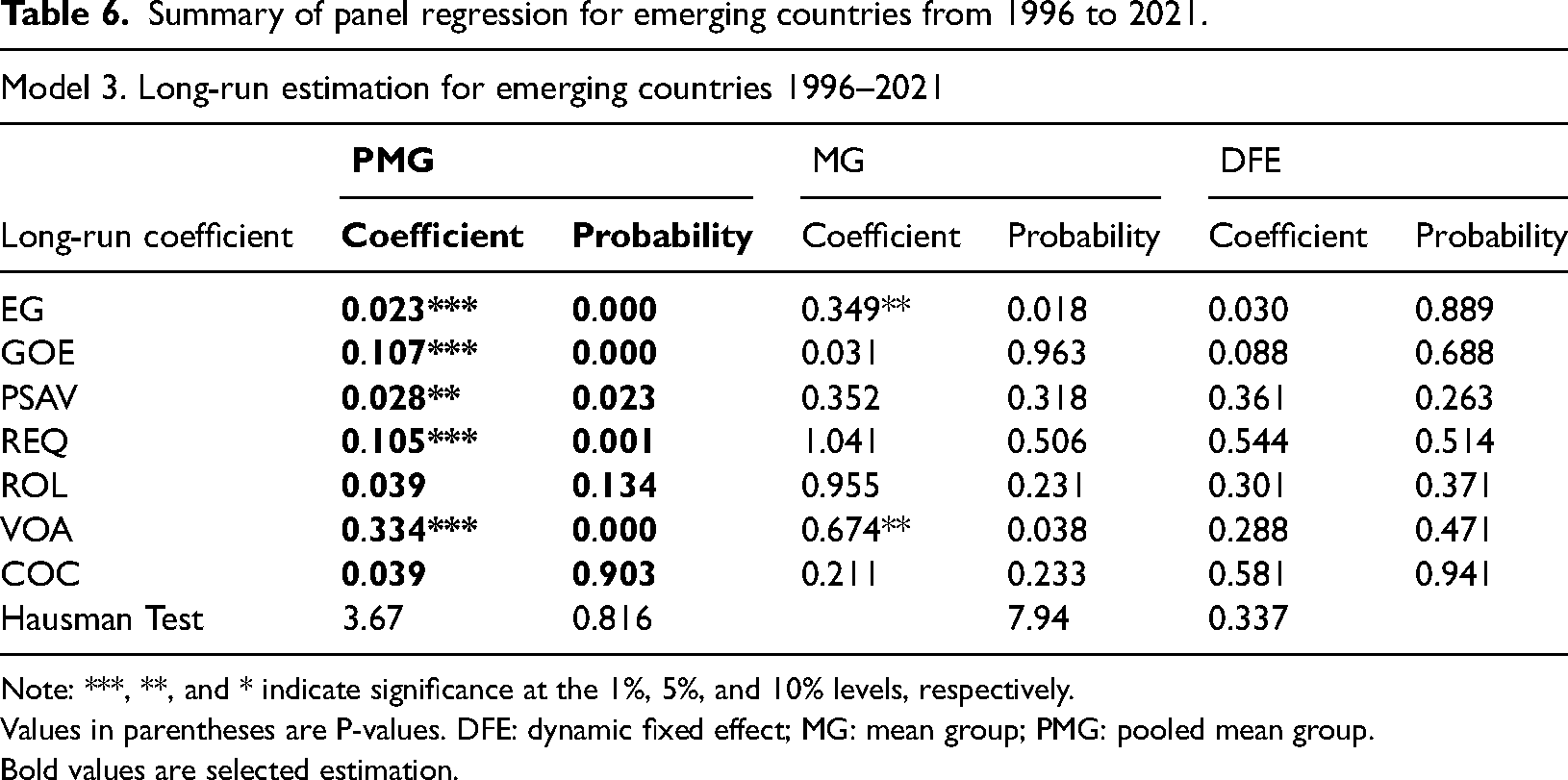
In a bid to ascertain the effect of governance at the worldwide level on the geothermal industry, the research adopts three estimators and these are the pooled mean group, the mean group, and the DFE. As revealed in Table 6, the study employs the use of the Hausman test which is very important to select between the pooled mean group and the mean group and between the pooled mean group/mean group and the DFE. In the aftermath of the analysis done, between the pooled mean group and the mean group, the null hypothesis formulated is accepted and so the pooled mean group is preferred over the mean group. In a similar test done between the pooled mean group and the DFE, the null hypothesis formulated is also accepted and so the pooled mean group is preferred over the DFE. The results of these three estimators are shown in Table 6. Results of panel models of the three estimators are also revealed in Table 6 and this gives a comprehensive check.
Summary of panel regression for emerging countries from 1996 to 2021.
Note: ***, **, and * indicate significance at the 1%, 5%, and 10% levels, respectively.
Values in parentheses are P-values. DFE: dynamic fixed effect; MG: mean group; PMG: pooled mean group. Bold values are selected estimation.
In model 3 (see Table 6), the coefficient on economic growth output is found positive but statistically significant at a 1% statistical level, in the long run, suggesting a positive relationship between economic growth output and geothermal energy industry development in the EU13 developing members. This suggests that when economic growth is boosted, there will be an increased level of development in geothermal among the EU13 countries. A 1% increase in the level of economic growth could bring about estimated 0.023% growth in geothermal energy production. It, therefore, means that when economic production is increased, the 13 developing European countries could attain their renewable and geothermal energy desired level (see Appendix G).
Furthermore, government effectiveness as one of the variables captured in this study shows optimism and produces an important coefficient level of 1%. Specifically, when a 1% growth level is sustained in government effectiveness, there will be a 0.107% boost in geothermal energy generation. The 13 European developing economies could therefore improve on the level of government effectiveness to boost the attainment of their targets on renewable energy and geothermal power production. This result is supported by the view of Al-Tal and Al-Tarawneh (2021), Evans et al. (2021), and Maji and Adamu (2021), who asserted in their studies that geothermal has a good prospect if the emerging good governance could be made sustainable. The implication of this is that when there is an increased level of efficiency and effectiveness in public and civil services, good policy formulation and due implementation, and commitment to the policies is made credible and free of any undue political pressures, the 13 European developing countries will attain growth in their geothermal energy sector (Muhammad and Long, 2021).
Also, political stability enters with a positive and significant coefficient at a 5% level in the long run, implying that an increase in political stability by 1% results in an incline in geothermal energy supply by 0.028%. This finding substantiates Destenie (2021), Yuxin et al. (2021), and Muhammad et al. (2021). It suggests that the geothermal energy industry sustainability in the EU13 developing members rises with an increase in political governance and stability. Moreover, the sustainability of the geothermal power industry needed by the EU13 developing members can somehow be reached by developing the two factors of political governance; the absence of violence and the absence of terrorism.
Moreover, regulatory quality enters with a 1% level of positive, which also turned out to be a significant coefficient in the long run. Precisely, if there is a 1% increase in regulatory quality, there will be a 0.105% boost in geothermal energy development. The desired level of geothermal energy production sustainability among the 13 EU developing countries could therefore be attained if corporate governance is adequately put into practice. This result conforms with the findings of Abbas et al. (2021), Gungor et al. (2021), and Ibrahim and Ajide (2021). The implication is that the 13 EU developing economies should put in place sound policies and be duly implemented to promote the involvement of the private sector in the geothermal energy industry.
In the analysis done on voice and accountability, a 10% level of optimism was seen with an important coefficient. Specifically, when 1% growth is recorded in the rule of law, it will trigger a 0.334% geothermal energy incline among the 13 European economies. It, therefore, means that an improvement in the area of extra voice and improving the level of accountability among the 13 EU economies could improve the increased level of growth in the geothermal energy industry. This result conforms to the view of Agabo et al. (2021), Asongu and Odhiambo (2021), and Nulambeh and Eryigit (2021), the studies asserted that there is a future for geothermal when appropriate social governance is put in place. The implication is that there will be growth in the geothermal industry if the citizens of the 13 EU economies could have an increased level of confidence in terms of their participation in selecting government strategies on renewable energy. Also, promoting of expression, freedom of association, and free media regarding environmental pollution and climate change issues.
This research proposes a framework on theoretical bases which is used for regional groupings of the European countries based on their level of economic development, rate of economic activities, and sustainability in development (Alsaleh and Abdul-Rahim, 2021a). This yardstick could further be used to classify these European countries in the line of the extent they are affected by the specific cluster of some economic and environmental attributes reactions coming from the producer which represents the supply side and the consumer on the demand side (Alsaleh et al., 2020). This grouping is important because it gives sufficient information regarding the relative interactions between the producers and the consumers over the commixture of certain indigenous attributes which are economic and environmental. This, therefore, shapes the structure of regional and environmental policies in the EUuropean Union (Alsaleh and Abdul-Rahim, 2020b). the grouping divided the countries into two clusters of similar characteristics and they are the developed and the developing countries, the grouping was also done based on careful consideration given to policies relating to the environment and economy of each of them (Alsaleh and Abdul-Rahim, 2021c). The current level of economic buoyancy of these European countries was used to have a binary categorization of these European countries into 14 developed economies and 13 developed economies. The categorization was to ascertain the influence of world governance dimensions on the level of output of geothermal energy. The 14 European developed nations are Germany, Italy, France, Spain, Denmark, Greece, Finland, Austria, Belgium, Ireland, Sweden, Luxembourg, the Netherlands, and Portugal. The captured 13 developing European countries are Slovenia, Slovakia, Romania, Poland, Latvia, Lithuania, Malta, Hungry, Estonia, Czech, Cyprus, Bulgaria, and Croatia as shown in Appendix E (Alsaleh, Abdul-Rahim, et al., 2021).
The three estimators used in this study (PMG, MG, and DFE) were used to measure short-run effects. Statistical results on these estimators were displayed in Appendices C, D, and E, respectively. Since the error correction term values are negative, and also significant at the 1% level for the three estimators, it means there is a long-run relationship. Model 1 (see Table 4) reports the estimated result for the impact of the worldwide governance factors on geothermal energy production among the EU region members for the period 1996 to 2021. While model 2 (see Table 5) shows statistics of the estimated influence of worldwide governance factors on geothermal energy industry sustainability in the EU14 emerged economies for the period 1996 to 2021. Likewise, model 3 (see Table 6) shows the result of the estimated impact of worldwide governance factors on geothermal energy industry sustainability in the EU13 emerging economies for the period 1996 to 2021.
Conclusion and policy implication
Conclusion
The results from Tables 5 and 6 both reveal that worldwide governance factors have a significant positive effect on geothermal energy sustainability. Results outcomes reveal that we have a more important level of optimism over the influence of economic growth and control of corruption on geothermal power sector growth, which is found to be more among the established 14 EU countries than the 13 EU establishing countries. The magnitudes of the impact are revealed to be 0.327 and 1.959 for the 14 developed countries and 0.023 and 0.039 for EU13 underdeveloped countries, respectively. This research submitted that significant growth in geothermal energy production could be attained more in the 14 established European countries than the 13 established European countries in EU13 establishing nations leveraging on economic outgrowth and control of corruption variables.
Furthermore, results outcomes also show that there is a significant level of optimism on voice and accountability, stability in the political realm, and quality of regulation on geothermal production is more among the 14 established countries than among the 13 establishing European countries. Notably, the magnitudes of the influence are 0.718, 0.922, and 2.260 for the 14 developed European countries and 0.334, 0.028, and 0.105 for the 13 underdeveloped European countries, respectively. This shows that a landmark development of the geothermal sector could be attained more among the 14 EU countries than we could have among the 13 EU-establishing countries, leveraging on voice and spate of accountability, stability in the political realm, and quality regulation variables. Conversely, the level of optimism about government effectiveness on geothermal power sector growth is more important among the 13 EU-established countries than among the 14 EU established countries. Notably, the magnitudes of the influence are 6.521 and 0.056 for the 13 EU developing countries and 0.043 and 0.051 for the 14 EU developed countries, respectively. This shows that landmark growth can be attained in geothermal energy production more among the 13 EU established countries, than among the 14 EU established countries leveraging on government effectiveness factors.
The research explores the relationships between economic growth, and worldwide governance factors (voice and accountability, political stability, effectiveness in governance, quality of regulation, putting corruption to checks, and law taking its due course) with geothermal energy sustainability in the locale of the European Union regions. This research employs the ARDL model for data spanning from 1996 to 2021 for the EU region. Geothermal energy is found to be a clean energy source that might help decarbonize the EU's economy. The study reveals a stronger positive effect of economic growth and control of corruption on geothermal energy sustainability in EU14 emerging economies than in EU13 emerging economies. In the same manner, the study shows a stronger positive effect of voice and accountability, political stability, and regulatory quality on the geothermal energy industry in EU14 emerged economies than in EU13 emerging economies (see Appendix F). On the other hand, the study shows a stronger positive effect of government effectiveness on the geothermal energy industry in EU13 emerging economies than in EU14 emerged economies (see Appendix F).
This study has revealed that the government of the 13 European underdeveloped countries should prioritize injecting quality into governance. This should include the likes of social, civil, and economic governance which will promote the development of geothermal in the 13 EU underdeveloped countries. Also, institutional factors could as well be enhanced by the government of the 13 EU countries. These institutional factors include corporate governance, sustainable governance, and good governance. This can boost the level of geothermal production among the 13 EU developing countries. This research also submits that increased financial appropriation to the rule of law and its implementation in the area of protection of fundamental rights and properties will as well boost the sustainable growth of geothermal among the 14 EU developed countries.
Policy implications
Conversely, this study recommends that an increased level of investment in worldwide governance factors will as well boost the level of geothermal energy sustainability among the 13 EU developing countries. When governance at the advanced level becomes sustainable, this will assist in attaining energy security and minimize the need for other sources of contaminated energy. Sustainable governance will help to boost the sustainable growth of geothermal at a rapid level and electricity generated from geothermal should replace the demand for the power generated from fossil fuels, relative to goods and services being produced and this will assist in attaining the targets of the Energy Union come the year 2030. The government of the 13 EU undeveloped countries should focus on enhancing the quality of regulation that promotes the involvement of the private sector. This will serve as a boost to the geothermal energy sector of the 13 EU countries. They should endeavor to raise the level of standards on quality regulations and all EU members should be beneficiaries of this development. Both the 14 EU developed countries and the 13 EU developing countries will have their strategies for sustainable development and environment elevated, leveraging the influence of worldwide governance on the geothermal energy sector. Also, a qualitative and well-built physical environment is germane to the management of the geothermal energy industry exploring different avenues. When geothermal and other renewable energy sources are put into good use, it will cut down costs and productivity will be boosted through efficient usage of inputs.
Furthermore, when there is a qualitative and conducive natural environment, the team of workers working in that environment will live a healthy life, and cases of illness will be minimized because a polluted environment could reduce the level of human productivity. Environmental degradation is no doubt hazardous to human health. Lastly, degradation in the environment could as well affect the sustainability of the geothermal energy supply, this will bring down the level of outputs, and the capacity of a country to meet its energy targets will become threatened, in that case, a country will not be able to meet the energy needs of its population. It is paramount to consider that when improving the quality of governance to boost the sustainability of geothermal energy, the ecosystem should not be neglected, and the conservation of the natural state of the environment should not be jeopardized. In the course of earth digging to fetch the underground water needed for geothermal, if such a process is mismanaged, it could lead to serious land degradation and the quality of water could as well get deteriorated thereby creating insecurity. This study enunciated the immeasurable value of worldwide governance in the EU boundary, this study sees the region as an area with no restrictions in which there is a free flow of goods and services as well as human capital. One of the European Union's greatest achievements is the worldwide governance among the 27 EU countries. In the current turmoil of social and economic problems, the EU should revive its efforts toward sustainability in governance, make necessary adjustments to modern governance approaches in the EU and keep pace with the dynamism of the society. The EU must facilitate governance at the international level and this must cut across products and services as well as outputs from the geothermal energy source. Just like any other empirical study, this research is also not without limitations. This study also comes with limitations. The level to which this study could be generalized is that there is an instance of small data size due to missing data which warranted the application of quite a several econometric analytical tools in analyzing the hypotheses. This research has served as a background for future research about open platforms for smart grids on how they can be harnessed into boosting geothermal energy production in other countries such as African countries. Also, the financial angle of it could as well be detailed, on how the platform will be funded and the returns on it. Also, the conditions put forward by this research as being necessary for the successful implementation of the platform could be further investigated to ascertain if the conditions are sufficient. This study considered business as the user of this platform, related studies in the nearest future could as well look into it from the angle of regulators and at just the household levels as this will widen the scope in the area of usage and usefulness of the open platforms in geothermal energy production. Research in future studies could leverage this study as background to come up with similar mechanisms to ensure sustainability in monitoring, some other top sectors apart from geothermal.
Footnotes
Data availability
Data is available upon request.
Declaration of conflicting interests
The author(s) declared no potential conflicts of interest with respect to the research, authorship, and/or publication of this article.
Funding
This research was funded by Shanghai Ocean University and University Putra Malaysia. Thus, we would like to thank them for the endless support and cooperation.
