




Abstract
Based on the identification of visual kerogen assessment, a subdivision method of organic matter types was proposed. Combined with GR curve, the distribution was further studied, the relationship between shale reservoir parameters and organic matter types was analyzed, and the significance was discussed. The results show that the kerogen types of organic rich shale in the lower part of Wufeng-Longmaxi Formation in the south of the Sichuan Basin are mainly of type I, II1a and II1b, while type II2 and type III are not developed. In Wufeng Formation, the shale organic matter is mainly of type II1a and II1b. From Long111 to Long114, the shale displays a trend of “Type I-II1b-II1a-II1b”. Type I was characterized by higher TOC, porosity and gas bearing capacity of shale reservoirs than the other organic matter. The reservoir parameter of type II1a was better than type II1b, indicating that the organic matter type control on the quality of shale reservoirs. Type difference is closely related to the bio-precursors component, among which type I and type II1a are related to the content of planktonic algae, while type II1b is related to the content of benthic algae. This study provides a good reference for the subdivision of marine shale organic matter types and the evaluation and prediction of gas bearing properties.
Keywords
Introduction
Wufeng-Longmaxi Formation from the upper Ordovician and lower Silurian of the Sichuan Basin is rich in organic shale with high organic matter abundance, high brittle mineral contents, moderate burial depth, and good gas-bearing property, and it is one of the main strata for shale gas exploration and development in China (Li et al., 2013; Zou et al., 2015; Ma and Xie, 2018; Wang et al., 2021; Ross and Bustin, 2008).It is known that the organic matter content is the most important shale enrichment factor and the one with commercial development value with organic matter generally greater than 2%. The organic matter is also a carrier of adsorbed gas, and organic pores provide the primary pore type in shale reservoir space (Slatt and Rodriguez, 2012; Loucks et al., 2012; Klaver et al., 2016). The shale gas generation capacity is controlled by the abundance and type of shale organic matter, which is generally divided into type I, type II and type III (Zhang et al., 2022). Type I and II are easier for pyrolysis and organic pores production (Cao et al., 2015).
The organic matter of black shale from the Wufeng-Longmaxi Formation in the Sichuan Basin mainly comes from lower aquatic organisms, and it is a typical sapropelic kerogen and has good gas generation conditions (Shen et al., 2016; Li et al., 2020).When evaluating the quality of source rocks, the type of organic matter is one of the important indexes. While a conventional classification method is not effective for Wufeng-Longmaxi Formation in Sichuan Basin, because of the high maturity of source rock. The geochemical parameters of the kerogen generally tend to be similar to each other, and it is difficult to effectively divide them. Luckily, direct microscopic observation of macerals can solve this problem, but the existing classification scheme of mixed type II cannot fully reflect the subtle differences of biological sources, and it is unfavorable for the quality evaluation of shale reservoirs. Therefore, by taking the lower part of Wufeng-Longmaxi Formation as the research object, which is rich in shale and located in Yibin-Changning area of southern Sichuan Basin, a new and more suitable subdivision scheme of shale organic matter types has been put forward. After making clear the differences and distribution rules of organic matter types in this area, the influence of different types on shale reservoirs and its gas bearing property has also been further studied. This study is not only of significance for the evaluation of shale reservoir quality and the prediction of favorable reservoirs in the south of Sichuan basin, but also the subdivision of marine shale organic matter types and the evaluation and prediction of gas bearing properties.
Regional geological overview
Due to the convergence of the Cathaysian ancient land and the Yangtze plate, the latter in the Middle Ordovician developed as a foreland basin (Liu et al., 2021; Tang et al., 2022). In the Early Silurian, due to the enhancement of compression, the Chuangzhong uplift, the Qianzhong paleouplift, and the Xuefeng uplift were formed successively, which changed the sedimentary environment of the Sichuan Basin and its surrounding areas into a limited deep-water environment surrounded by paleouplift. The black shale of Wufeng-Longmaxi Formation was formed in this environment (Figure 1) (Guo et al., 2004; Nie et al., 2017; Ge et al., 2019; Rong et al., 2019).
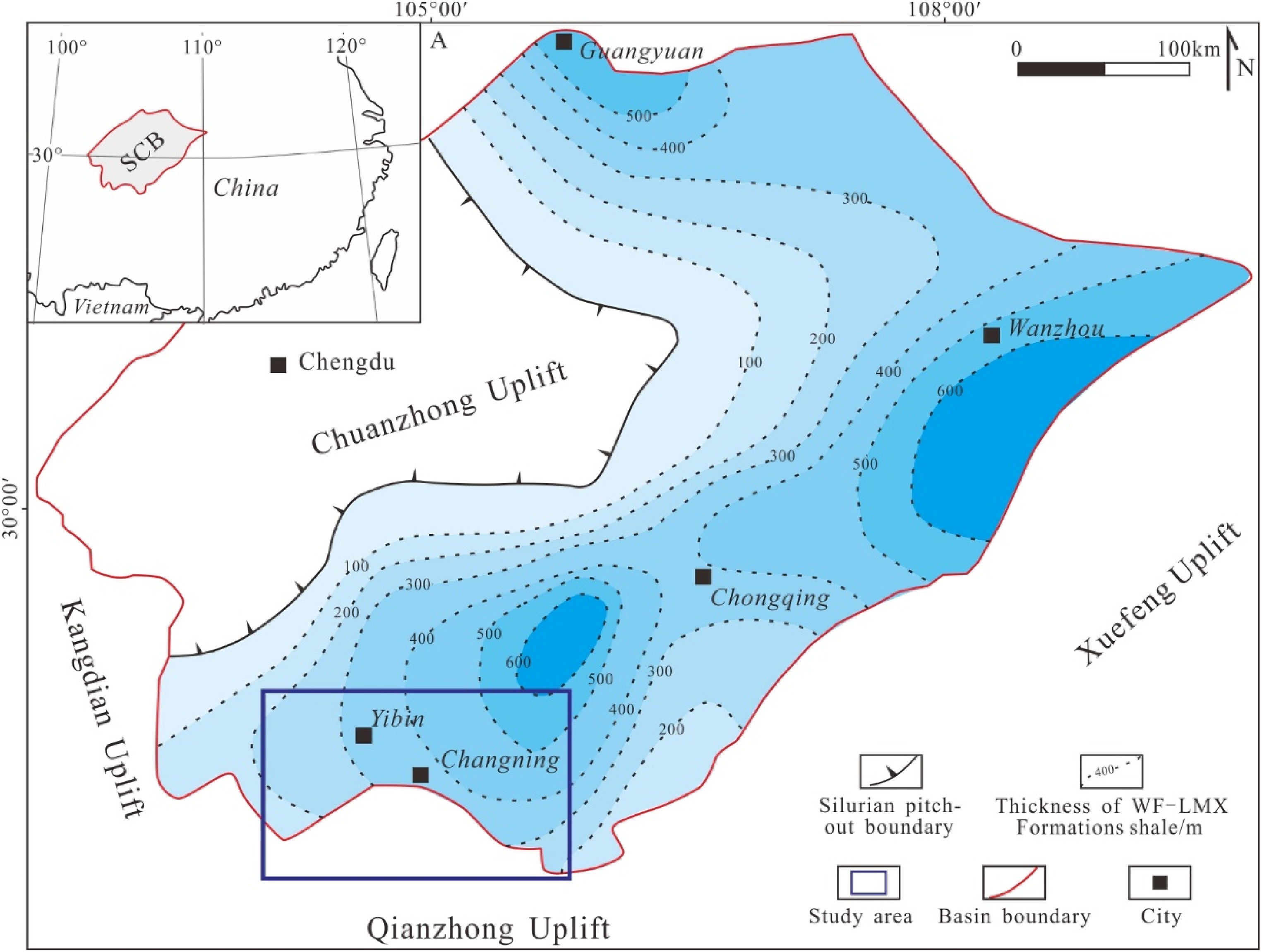
Contour map of shale thickness of Wufeng-Longmaxi Formation in the Sichuan Basin and location map of the study area (modified after Huang et al., 2012; Jia et al., 2021).
The marine strata at the turning period of Ordovician and Silurian in the upper Yangtze region are mainly represented by the Wufeng-Longmaxi Formation. The lower part of Wufeng Formation is rich in graptolites, mainly a black siliceous shale, with a thickness of several meters to more than ten meters. The fossils are mainly of graptolites and radiolarians. The upper part of Wufeng Formation is argillaceous mixed facies (i.e., Guanyinqiao section), which is mainly argillaceous limestone, with a thin thickness of more than ten centimeters (Yang et al., 2018) and Hirnantia fauna fossils can be seen (Harper and Hints, 2016).
In the vertical direction, the Longmaxi Formation can be divided into upper and lower parts. The lower part of Longmaxi Formation (i.e., Long1) is mainly of black carbonaceous shale and black calcareous shale, with abundant graptolite content and high organic matter content, and pyrite particles and porphyry strata can be seen (Su et al., 2009; Wu et al., 2018; Chen et al., 2019).The upper part of Longmaxi Formation (i.e., Long2) is mainly composed of grayish black argillaceous shale, dark gray argillaceous siltstone and gray siltstone, with developed laminae and less graptolite content which are mostly broken (Guo et al., 2004).In order to meet the actual needs of commercial development for the organic rich shale, according to the gamma ray (abbr. GR) curve characteristics, four sub-layers from bottom to top of lower part of Long1 are divided: a, Long111, Long112, Long113and Long114(Li et al., 2020).
Maceral identification of organic matter
The organic macerals of marine shale mainly include sapropelinite, liptinite, vitrinite and inertinite. Direct observation under the microscope avoids the failure to distinguish the types of organic matter because the geochemical parameters tend to be consistent due to high evolution.
Sapropelinite
Sapropelinite is the most important organic component in marine shale (Pickel et al., 2017), which is formed by biodegradation such as algae (Taylor et al., 1998). It belongs to amorphous body and has no fixed shape and structure (Wang et al., 1993; Khan et al., 2020).
Liptinite
Liptinite was introduced by Ammosov (1956) and it is similar to exinite (Stopes, 1935) in the marine shale. The original organic matter of liptinite is plant reproductive organs, epidermal tissues and secretions, which generally has specific biological forms, including plant spores, pollen, cuticle, resin and cork layer (Zhang et al., 2016; Pickel et al., 2017)
Vitrinite
The original organic matter of vitrinite is the wood fiber of plants, which can be divided into structural vitrinite and unstructured vitrinite, among which the structural vitrinite has relatively clear wood structure, while the unstructured vitrinite is generally uniform and dense without more subtle structure (Jia et al., 2021). The optical properties of marine vitrinite are similar to those of the traditional, but the genesis is different. Some scholars believe that it is graptolite fragment (Petersen et al., 2015), and some believe that it is the residue of marine lower plants and bacteria (Goodarzi et al., 1992). The marine vitrinite can be round or banded, which is common in marine shale (Liu et al., 2022). As the macerals of Wufeng-Longmaxi Formation lack traditional vitrinite, the vitrinite mentioned below is marine vitrinite.
Inertinite
The original organic matter of inertinite was woody fiber, which is formed by carbonization. Its micro sub component is filamentous (Gao et al., 2021), with various shapes, including intermittent, fragmented, banded and oval ones.
Differences of organic matter types and their distribution
Subdivision of organic matter types
The common kerogen type division method in China is the T index (abbr. TI) method and the calculation formula is: TI = (100a + 50b-75c-100d) / 100 (Cao, 1985). Where, a stands for the percentage of sapropelinite components, b for the percentage of Liptinite components, c for the percentage of vitrinite components and d for the percentage of inertinite components. However, the method is coarse and the index range is a bit large, which cannot be used for fine characterization of hydrocarbon generation capacity and reservoir quality of Wufeng-Longmaxi Formation shale.
In view of the differences in shale organic matter types, a subdivision of organic matter types is needed. Based on the division standard of kerogen macerals of conventional source rocks (Table 1), the index range is further subdivided. As marine vitrinite has similar hydrocarbon generation potential as traditional vitrinite, combined with previous research results, it is taken as part c in the formula for calculation. According to the characteristics of marine shale, the shale organic matter type II1 can be subdivided into II1a and II1b, which are evaluated as better, good, and poor (Table 2). It should be noted that the three types of organic matter are all from marine shale and have good hydrocarbon generation potential. The “bad” here is relative “bad” rather than absolute “bad.”
Classification standard for Kerogen microscopic identification (Cao, 1985)
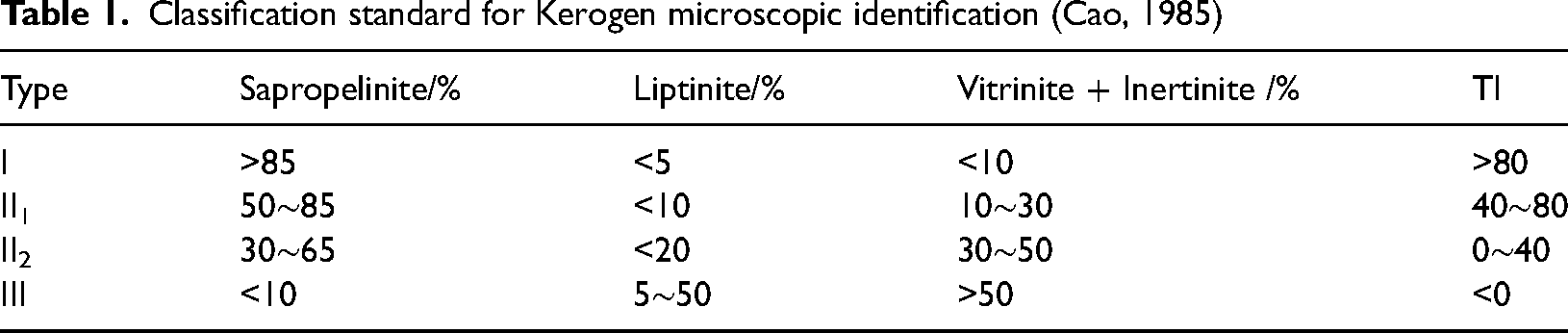
Subdivision standard of kerogen macerals in marine shale

Distribution characteristics of organic matter types
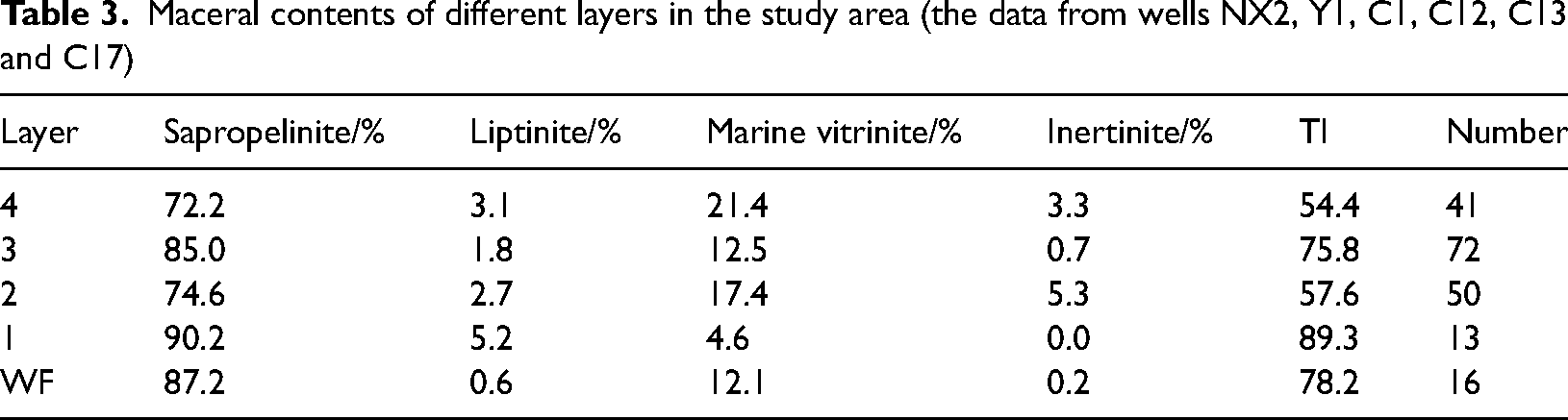
Organic matter components of organic rich shale in the lower part of Wufeng-Longmaxi Formation in the study area mainly include sapropelinite, liptinite, marine vitrinite and inertinite. Sapropelinite is the dominant matter type (Table 3).Through the detailed division of marine shale organic matter types, it is found that the kerogen types of organic rich shale from Wufeng-Longmaxi Formation in the study area are mainly of type I, type II1a and type II1b, while type II2 and type III are not developed. The distribution of organic matter types in Wufeng-Long11 has a good correspondence with the GR curve. In general, the organic matter of type I is enriched in the highest GR intervals, while the ones of type II1a is enriched in the intermediate section, the ones of type II1b with lower value range is enriched in box-shape section (Figure 3). The value of GR curve is also positively correlated with the TI (Figure 2). Therefore, for non-cored wells in the area, the organic matter types can be figured out based on measured data (Figure 4).
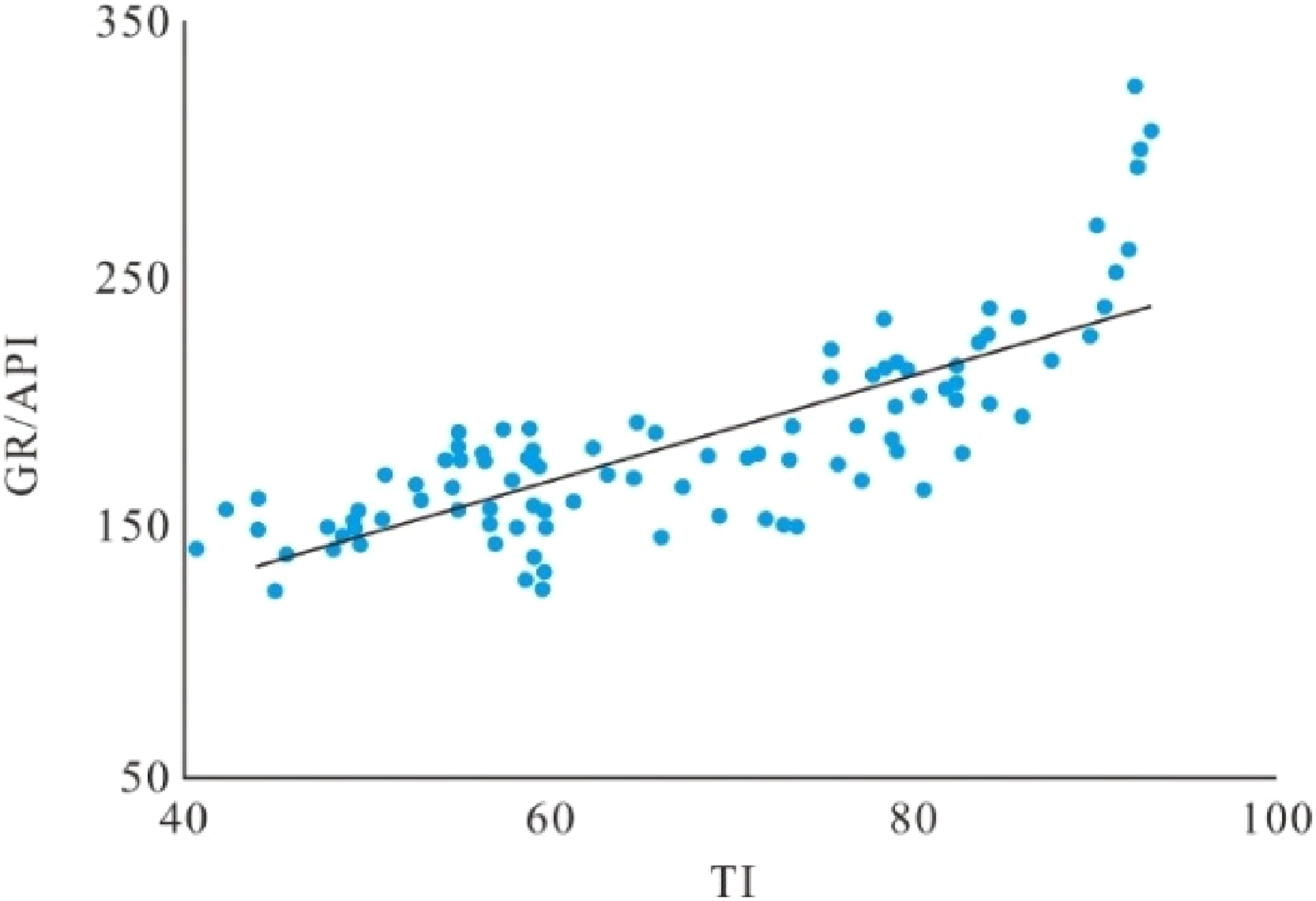
Scatter diagram of GR and TI.
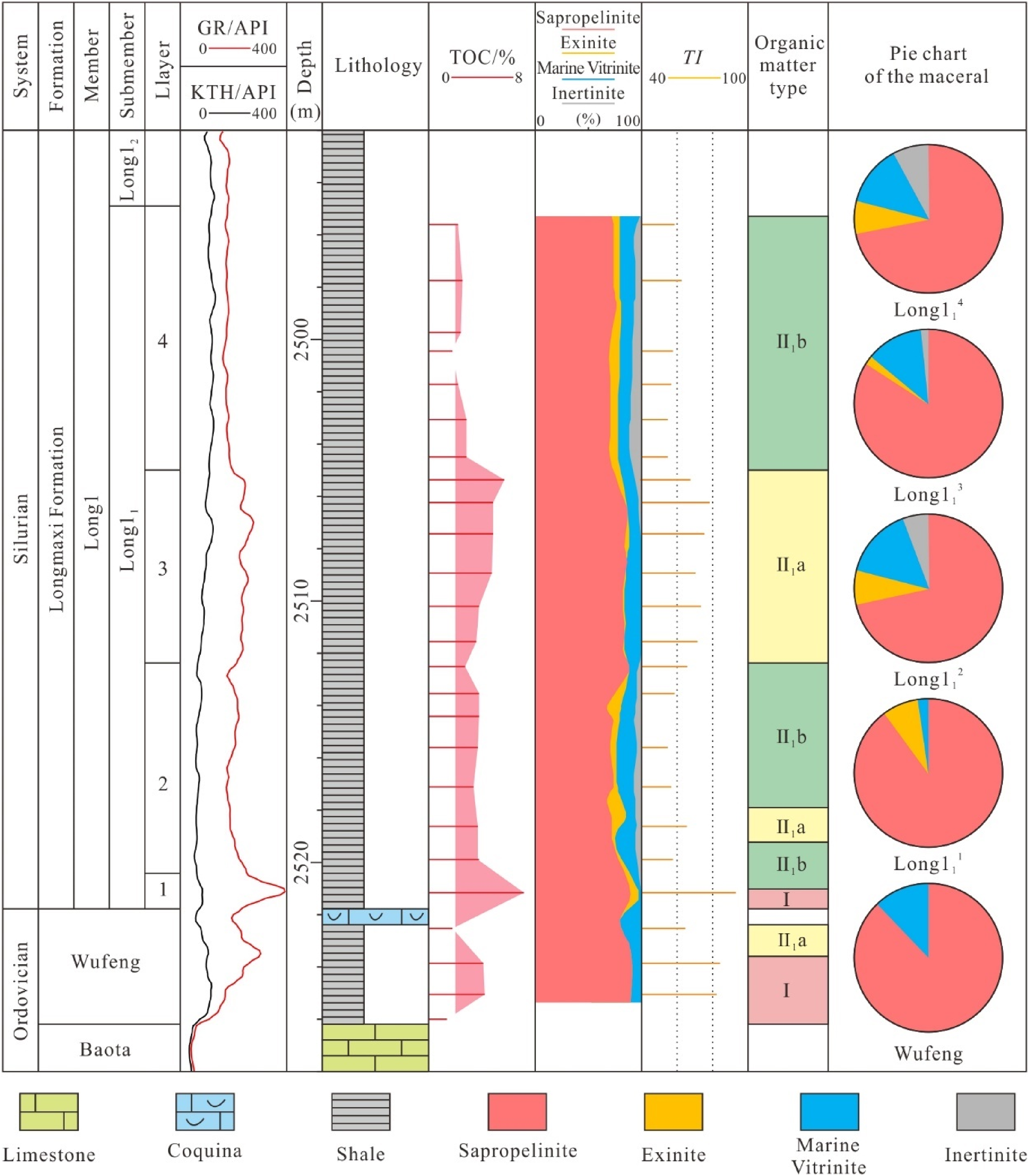
Comprehensive histogram of organic matter types in C1 well in the study area.
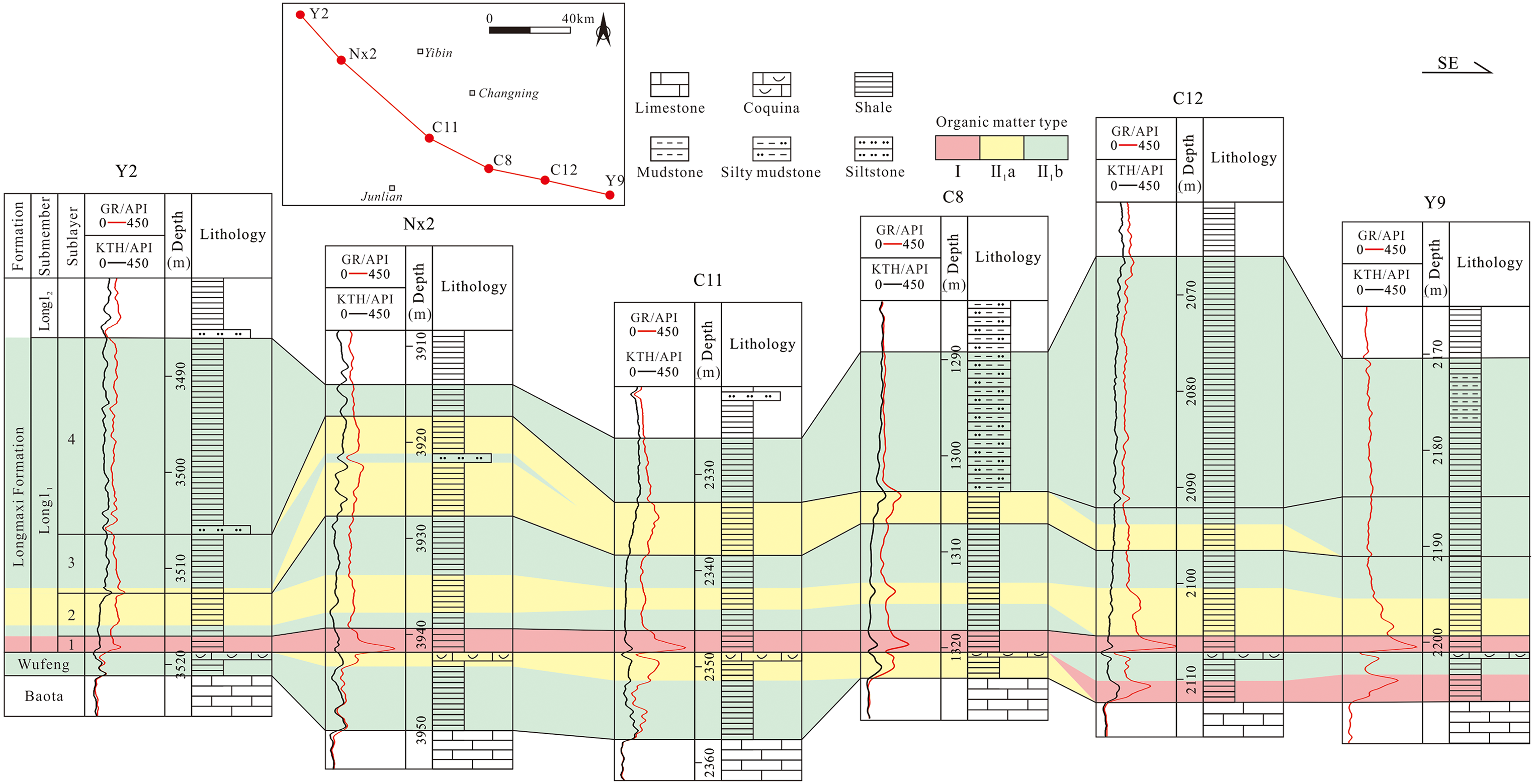
Vertical correlation of shale organic matter types of Wufeng-Longmaxi Formation in the study area.
Maceral contents of different layers in the study area (the data from wells NX2, Y1, C1, C12, C13 and C17)
Vertical distribution characteristics
In the lower part of Wufeng-Longmaxi Formation in the study area, the organic matter is mainly sapropelinite, followed by marine vitrinite, liptinite and inertinite are very less. In Wufeng Formation, the shale organic matter is composed of sapropelinite and marine vitrinite, almost to the exclusion of liptinite and inertinite, with an average sapropelinite content of 87.2% and average marine vitrinite content of 12.1%. In Long111, the sapropelinite shale content is the highest, with an average of 90.2%, while the inertinite is undeveloped. In Long112, the sapropelinite shale content decreases, with an average of less than 80%; the marine vitrinite content increases, with an average of 17.4%. In Long113, the sapropelinite content increases again, with an average of 85.0%, and an average content of marine vitrinite is 17.4%. In Long114, the sapropelinite content is the lowest, with an average of 72.2%, while the marine vitrinite content is the highest, with an average of 21.4% (Table 3).
Through the detailed division of organic matter types of shale in the lower part of Wufeng-Longmaxi Formation in the study area, it was found that the organic matter of shale in the study area is type I, II1a, and II1b, while type II2 and III are not developed (Figure 3 and Figure 4). In the Wufeng Formation, type I, II1a, and II1b are well developed (Figure 3), while type I and II1a are locally developed (Figure 3). From Long111 to Long114, the type has the change trend of “type II-II1b-II1a-II1b”, showing the vertical distribution characteristics of “good-poor” and “not bad-poor” cycles. On the whole, the second cycle is worse than the first cycle. In Long111, type I organic shale is stably developed, and the type of organic matter is the best. In Long112, it is mainly of type II1b occasionally of typeII1a, and it is poorer than that of in Long111.In Long113, it is mainly of type II1a and occasionally of type I and II1b, and it is better than that of in Long112.In Long114, type II1b is stably developed but it is worse than that of in Long113 (Figure 3 and Figure 4).
Lateral distribution characteristics
Through the correlation of NW-SE connected well sections (Figure 4), it is found that the lateral differentiation rule of organic matter types is obvious. In the Wufeng Formation, the shale thickness is characterized as thicker in the middle and thinner on both wings, among which the northwest is dominated by type II1b, the middle shows a trend of evolution to type II1a, and the southeast is dominated by type I.
In general, the type of organic matter in the middle-southeast is improving. In Long111, type I organic shale is stably developed from northwest to southeast and the shale thickness changes little, ranging from 1∼3 m, which is the best type of organic matter. In Long112, the shale thickness is thickest in the middle and thin on the wings, with the greatest thickness of about 12 m and the thinnest thickness only 4.5 m and it is mainly of type II1b and the thickness of organic shale in type II1a is smaller, and from northwest to southeast type II1a in the top of Long112 gradually migrates to the middle and lower part, but on the whole, it is significantly worse than that of Long111. In Long113, the shale thickness tends to thicken first and then decrease from northwest to southeast, with the greatest thickness of 10 m in the Nx2 well and the thinnest thickness of 4 m in the C8 well. The organic matter type is mainly of type II1a and type II1b is only developed in northwest and southeast, and it is generally better than that of in Long112. In Long114, the shale thickness tends to be thinned first and then thickened, with the biggest thickness of 20 m in the Y2 well in the northwest and the smallest thickness of 4 m in the Nx2 well. Type II1b is stably developed and the organic matter type is generally worse than that of in Long113.
Planar distribution characteristics
In the lower part of the Wufeng-Longmaxi Formation in the study area, type I, II1a, and II1b organic matter are developed, and the organic matter type displays some differences and regularity in planar distribution. In the Wufeng Formation in the study area, the three kerogen types are all developed. In the Yibin area in the northwest, type II1b organic shale is developed, with relatively poor organic matter type. In the Changning area in the middle part, the organic shale is mostly characterized by “type I dominated and type II1a supplemented”, with good organic matter type (Figure 5A). In Long111, the organic shale type is stable and single, with type I stably developed in the whole area and the organic matter type is the best (Figure 5B). In Long112, the organic shale is dominated by type II1b in the whole area and type II1a is locally developed, while type I organic shale is not developed in the whole area, and the organic matter type is generally poor (Figure 5C). In Long113, the organic matter is generally dominated by type II1a and type I is only visible in the C27 and C17 wells. In the northwest and southeast of the study area, the organic shale gradually changes from type II1a to II1b. In general, the organic matter type of this sub-layer is obviously better than that of Long112 (Figure 5D). In Long114, the organic shale type is stable and single, type II1b is developed in the whole area, type I and type II1a are not developed, and the organic matter type is poor (Figure 5E).
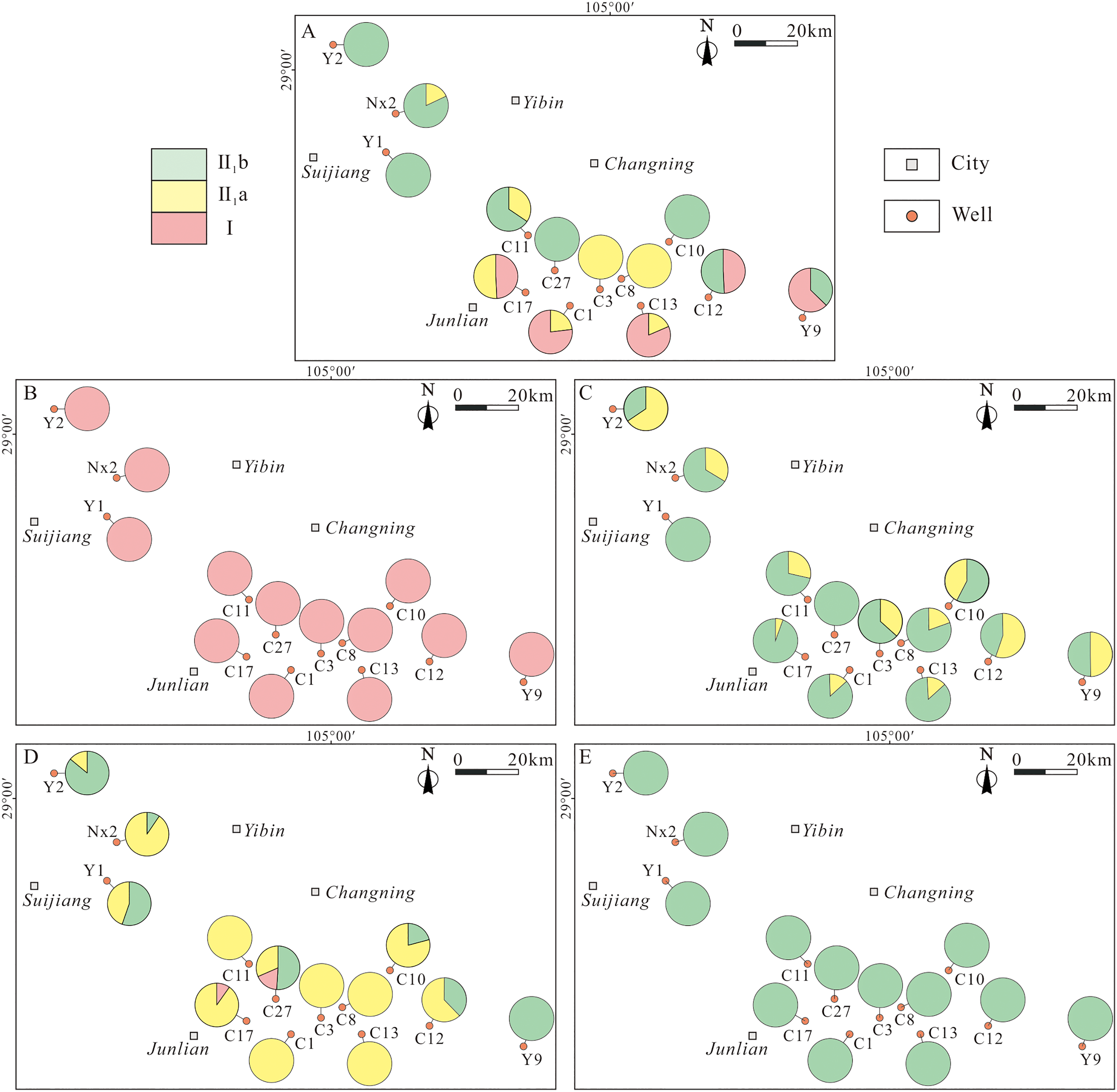
Plane distribution of shale organic matter types in the lower part of Wufeng-Longmaxi Formation. A. Wufeng Formation; B. Long111; C. Long111; D. Long111; E. Long111.
Discussion
Influence of organic matter type on shale reservoirs
Shale reservoirs are self-generating and self-preserving. The evaluation parameters of whether it has commercial value include organic matter abundance, porosity, gas bearing property, etc. The abundance of organic matter is generally evaluated by total organic carbon content (TOC). The higher the TOC, the better the quality of oil generating parent material and the greater the hydrocarbon generating potential of source rock (Liu et al., 2022; Chen et al., 2021; Wei et al., 2021). Porosity is the development degree of pore space in rock. As an important parameter to measure the physical properties of reservoir, it is an important factor to determine the gas bearing property of reservoir (Slatt and O’Brien, 2011; Borjigin et al., 2021; Wang et al., 2016b).
Taking shale reservoirs with different organic matter types as the object, the differences of total organic carbon content (TOC), gas content and porosity are compared. The results show that they are strong differences. For type I organic shale, the TOC content is higher, greater than 2%, up to 8.4%, most of which are between 3% and 5%. For type II1a organic shale, the TOC is high, between 1% and 7%, most of which are concentrated in 2%∼4%. For type II1b organic shale, the TOC is low, less than 4%, and most of which are 1% ∼ 3% (Figure 6A). Gas content differentiation is consistent with TOC, and shows the characteristics of “type I higher, type II1a high and type II1b low”. For type I organic shale, the gas content is the best, with a variation range of 2m3/t∼5 m3/t. For type II1a organic shale, the gas content is next, ranging from 1m3/t∼4m3/t, mostly concentrated in 2m3/t∼3m3/t. For type II1b organic shale, the gas content is the poorest, lower than 3m3/t, most of which are 1m3/t ∼ 2m3/t (Figure 6B).The variation rule on porosity is different. For organic shale of type I and II1a, the porosity is good, mostly concentrated at about 6%, while the porosity of type II1b organic shale is relatively low, mostly 2% ∼ 4% (Figure 6C).Combined with the vertical differential distribution characteristics of organic matter, the most favorable exploration horizons in the study area are Long11 and Long13, Wufeng Formation and Long12 are followed, and Long14 is the poorest. On the plane, the type of organic matter in the middle and east is relatively good, which is conducive to the enrichment and high production of shale gas.
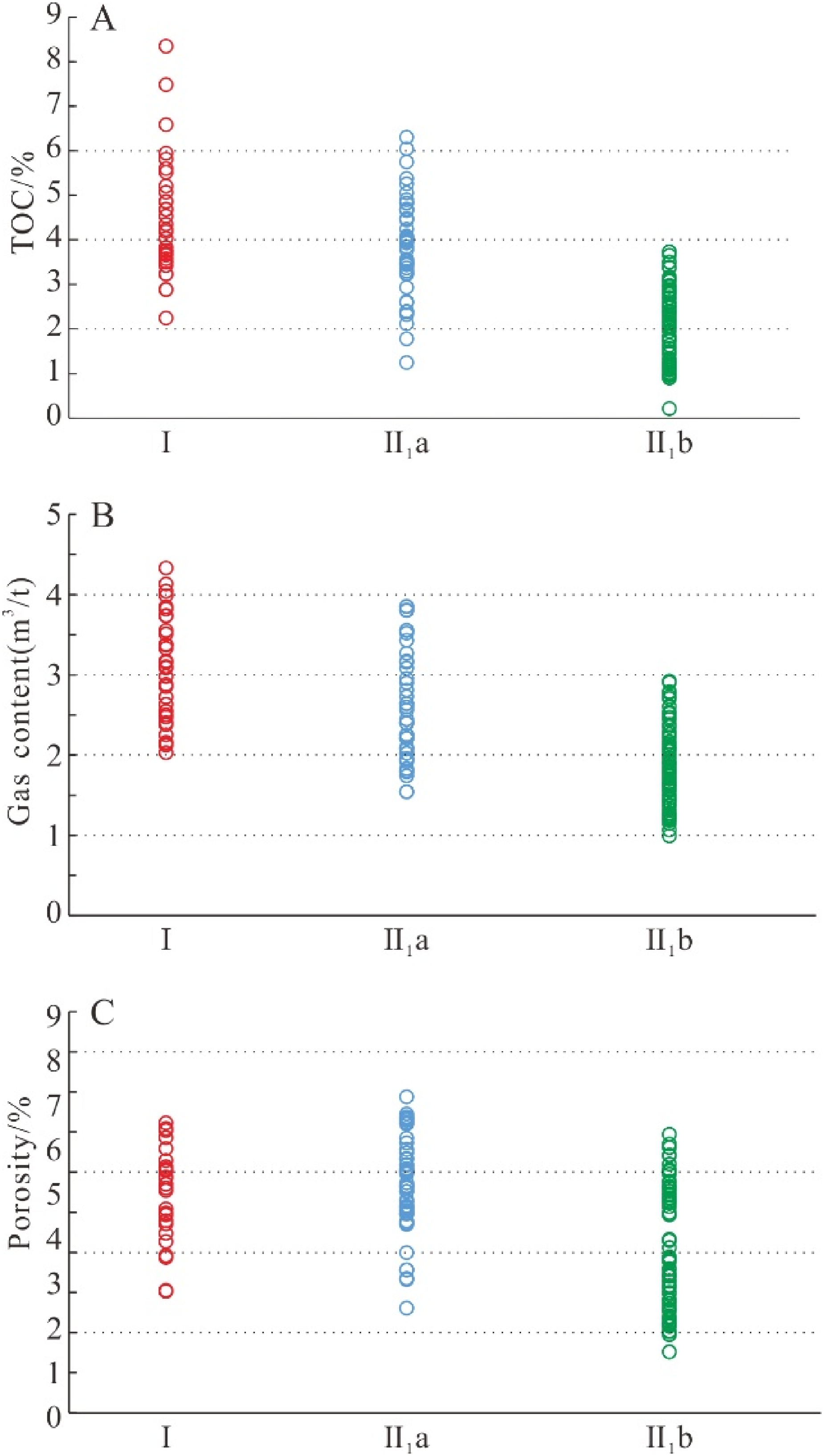
Scatter diagram of shale reservoir characteristics and different organic matter types of Wufeng Formation-Long11 in the study area. A. TOC scatter diagram; B. Porosity scatter diagram; C. Scatter diagram of gas content.
Relationship between organic matter types and bio-precursors component
At the transform period of the Ordovician and Silurian, frequent volcanic activity provided abundant nutrients into the sea basin (Chen et al., 2019; Li et al., 2014; Wu et al., 2018). Organisms such as algae flourished and produced a large amount of organic matter. Different organic matter has different chemical components. Therefore, its hydrocarbon generation process, hydrocarbon generation products and hydrocarbon generation potential were different. The bio-precursors component of organic matter in marine shale are complex and have the characteristics of multiple sources. The difference of bio-precursors is the main factor causing the difference of organic matter types (Li et al., 2012).
Bio-precursors of the marine shale of the Wufeng-Longmaxi Formation have various types, mainly including planktonic algae, benthic algae, graptolite, chitin, spongy spicule, etc. (Shen et al., 2016). Graptolites are the most common biological fossil type of the Wufeng-Longmaxi Formation. On the contrary, however, it is found that the abundance of graptolites has no relationship with the content of organic matter in shale (Qiu et al., 2019), which shows that graptolites have little effect on TOC content and its hydrocarbon generating capacity is limited. The main hydrocarbon generating parent material of the Longmaxi Formation is algae, which is divided into planktonic and benthic algae. Planktonic algae include lamellar and structural algae, amorphous, spherical and collective (Lewan, 1986; Hu et al., 2014), while planktonic algae in the Longmaxi Formation mainly appear in the form of monomer or aggregate (Figure 7A, B and C).Benthic algal fragments generally have three structures: filamentous, granular and reticular. Filamentous features of light and dark can be clearly seen in filamentous benthic algal fragments (Figure 7D). Granular algal fragments (Figure 7F) are generally thick, in the shape of small ball combination, and obvious reticular structure can be seen in reticular algal fragments.
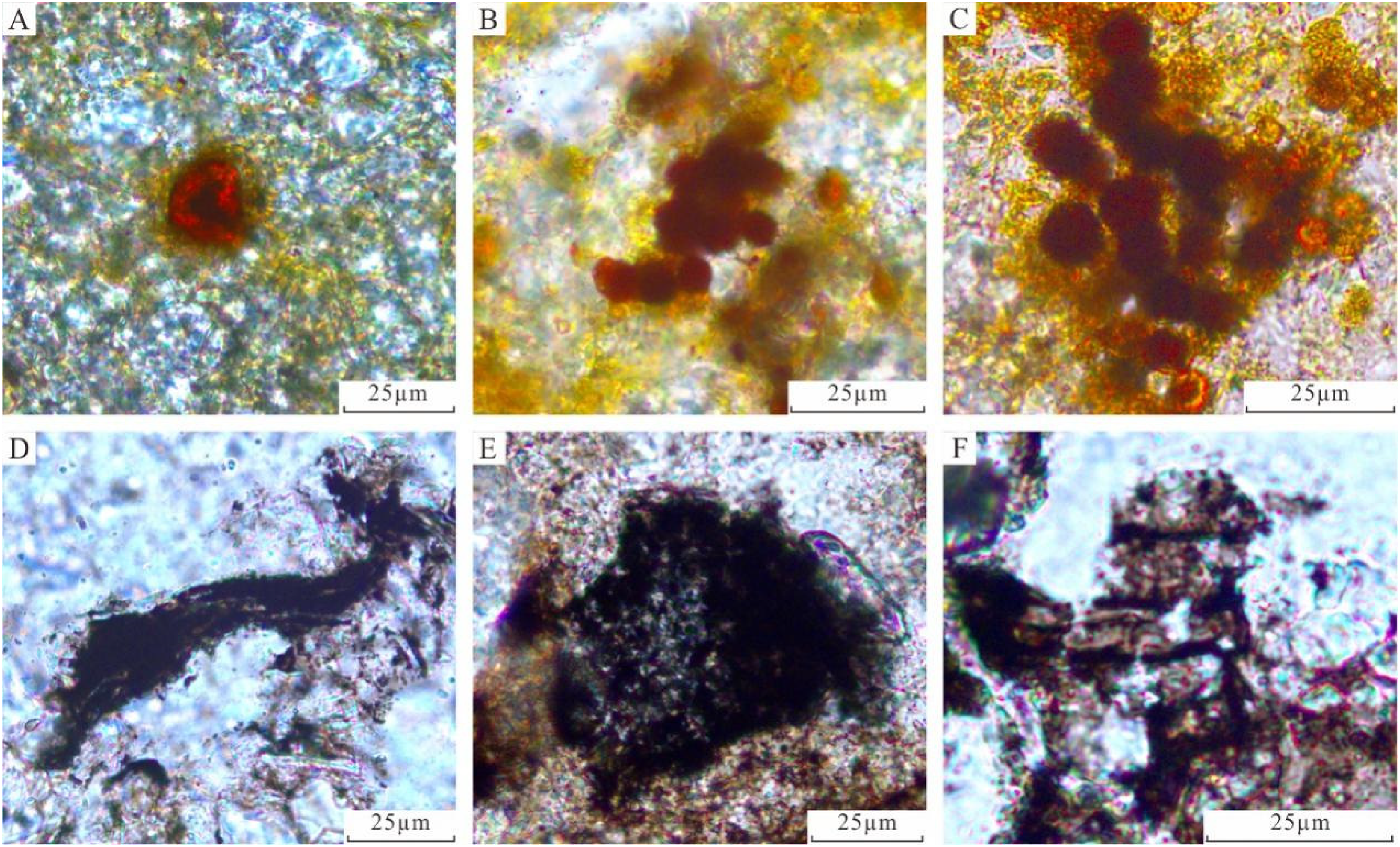
Structural characteristics of algae in Wufeng-Long11shale of Shuanghe profile in the study area (modified after Hu et al., 2020; Pang, 2019). A. Unicellular planktonic algae, Long111; B. Multicellular planktonic algae, Long111;C. Multicellular planktonic algae, Long113; D. Filamentous fragments of benthic algae, Long113;E. Granular fragments of benthic algae, Long112;F. Granular fragments of benthic algae, Wufeng Formation.
Previous studies (Pang, 2019) on the organic matter macerals and hydrocarbon generating parent material sources of 17 shale samples from Wufeng-Long11 of Shuanghe profile in the study area revealed that there existed obvious differences in the content changes of planktonic algae and benthic algae. During the sedimentary period of the Wufeng Formation, the planktonic algae content showed an increasing trend from bottom to top. From the late sedimentary stage of the Wufeng Formation to the early stage of the Longmaxi Formation, that is, the sedimentary stage of Long11, the proportion reached the peak, up to the highest of 45%. During the deposition stage of Long112, the proportion of planktonic algae decreased, only 10%-20%, generally showing a decreasing trend. During the deposition stage of Long113, the planktonic algae content increased again, and reached the peak in Long113, up to nearly 30%.The planktonic algae in Long114 showed a trend of decreasing first and then increasing gradually, and the content proportion gradually increased from 15% to 55% (Figure 8).
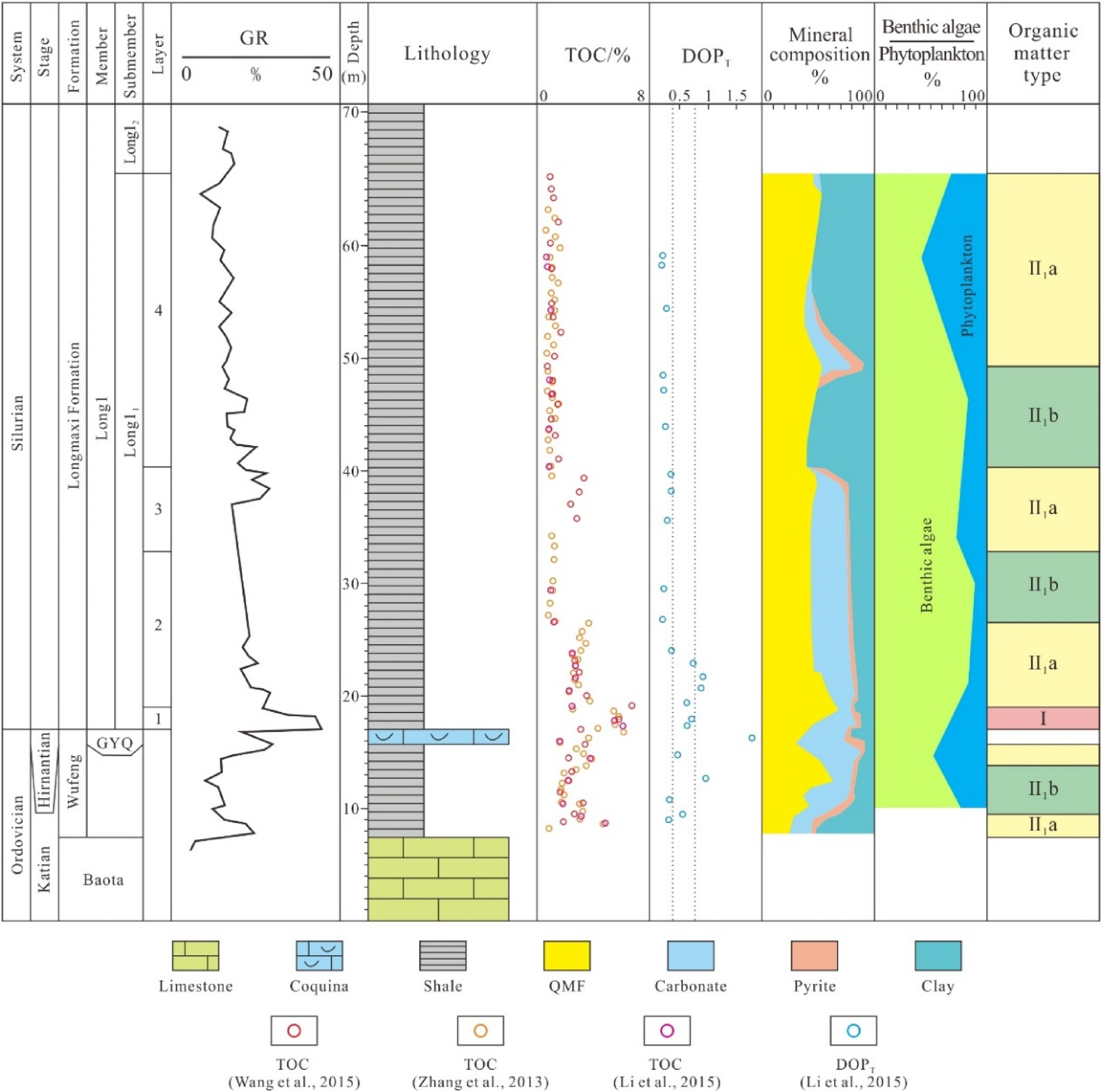
Vertical characteristics between bio-precursors component and organic matter types of Shuanghe profile in the study area (GR, TO, DOPT, mineral content and algal content as per Pang, 2019; Wang et al., 2016a; Zhang et al., 2013; Li et al., 2015).
The thermal pressure simulation experiment of planktonic algae and benthic algae shows that the total oil production of marine planktonic algae is 2∼3 times that of benthic algae (Qin et al., 2007; Xie et al., 2014). The organic matter with planktonic algae as hydrocarbon generating organisms has greater hydrocarbon generation potential, and it is mainly of type I organic matter, followed by benthic algae as hydrocarbon generating organisms, and type II organic matter is the dominant (Qin et al., 2010). Planktonic algae is considered to be the main contributor of shale organic matter in Wufeng-Longmaxi Formation (Zhang et al., 2020). In this paper, the organic shale type II1is subdivided into type II1a and type II1b. Obviously, the hydrocarbon generation capacity of type II1a dominated by planktonic algae is higher than that of type II1b with benthic algae. The GR of the Shuanghe outcrop section is similar to that of drilling in the Changning area. Combined with the identification results of downhole shale organic matter macerals, the vertical distribution characteristics of hydrocarbon generating parent materials in the Shuanghe outcrop can be roughly inferred (Figure 8). In the Wufeng Formation, the organic shale type is dominated by type II1a at the bottom and top, with greater contents of TOC, GR, and planktonic algae. In the middle part of the Wufeng Formation, it is dominated by type II1b, with low TOC content and low box-shape value on GR. In Long11, the organic shale is mainly of type I, with greater contents of TOC, GR and planktonic algae. In Long12, the organic shale of lower part is mainly of type II1a, with greater contents of TOC, GR and planktonic algae. In the upper part of Long12, it is mainly of type II1b, with less contents of TOC, GR and planktonic algae. In Long13, the organic shale is mainly of type II1a, with more contents of TOC, GR and planktonic algae. In Long14, the organic shale of lower part is mainly of type II1b, with less contents of TOC, GR and planktonic algae. In the upper part of Long14, it is mainly of type II1a, with less contents of TOC and GR and high proportion of planktonic algae.
In general, the proportion of planktonic and benthic algae has a good coupling relationship with the type of organic matter. The organic matter enrichment area of type I and type II1a corresponds to the intervals with more content of planktonic algae, which has strong hydrocarbon generation capacity and more TOC content. Therefore, it is a good target for shale gas exploitation. There only exists difference in Long114, which may be related to the increase of clay content and dilution of organic matter.
Thoughts of organic matter types on sedimentary environment analysis
At the turning period of Ordovician and Silurian, the study area is in a closed deep-water environment of “three uplifts and one depression.” Due to the influence of global glacial events (Yang et al., 2018), Wufeng Formation has experienced a “rise and fall” change of relative sea level, and it is a transgressive system tract in sedimentary period of Wufeng Formation, and reaches a high stand system tract in the sedimentary period of Guanyinqiao section (Chen et al., 2015).At the initial sedimentary period of Longmaxi Formation, that is, the deposition stage of Long11, due to global warming, the end of Hernante glaciation and the Oceanic Anoxic Event because of rapid rise of sea level, a set of widely stable black shale was formed (Chen et al., 2015). The redox parameters (such as DOPT) indicate that the Wufeng Formation was in an oxic-dysoxic environment in early stage of sedimentation, an anoxic environment in middle stage, and gradually returned to a dysoxic environment in late stage. However, the first layer of Longmaxi Formation was in a dysoxic environment during sedimentation, the second layer was in an anoxic environment at early stage, and gradually transformed into a dysoxic-oxic environment. The third layer was in a dysoxic environment as a whole, and the fourth layer was in an oxic environment (Figure 8). Based on element geochemical analysis, relevant scholars put forward the organic matter enrichment law, and considered that in the sedimentary period of Wufeng Formation the enrichment of organic matter was controlled by strong retention environment, while in the sedimentary period of Longmaxi Formation, it was the weak retention environment and high sea level jointly that controlled the enrichment (Zhang et al., 2013; Li et al., 2015; Lt et al., 2015; Huang et al., 2021).In the light of present situation, the deep-water sedimentary environment has become a necessary condition for the formation of organic rich black shale, but in recent years, some scholars have proposed that it is still possible to develop organic rich black shale in shallow water. The middle and upper Devonian black shale in the eastern United States is a set of organic rich black shale deposited under the shallow water background (Smith et al., 2019). The Yuertus Formation at the bottom of Cambrian in Tarim basin also has a similar sedimentary process, that is, on the exposed surface, during the gradual transgression, due to the uneven unconformity surface, a shallow water limited lagoon environment is formed, gradual overlap forms a set of penetrating organic rich black shale (Jin et al., 2020).
The bottom of Wufeng-Longmaxi Formation in the study area has a sedimentary background being like the black shale of eastern United States and the black shale of Yuertus Formation in Tarim. The boundary between the bottom of Wufeng Formation and Baota Formation is an obvious unconformity. The Guanyinqiao section at the top of Wufeng Formation is a set of shallow water sediments. The Hernante glacial event led to a decline of sea level of more than 70 m (Brenchley et al., 2003). Therefore, the local lack of Guanyinqiao section in Sichuan Basin may be related to exposure denudation (Xiong et al., 2019).
In recent years, it has been proposed that at the initial sedimentary period of Longmaxi Formation, the sea level did not rise rapidly but gradually, and it reached the most flooding surface near the top of Long113, and then transformed into a high stand system tract (Xiong et al., 2020).Combined with the latest isotopic dating results, there both exists a slow transgression process with a time limit of about 2.5 Ma in the black organic rich shale development intervals of Wufeng Formation and Longmaxi Formation (Gradstein et al., 2012).In addition, the sedimentary environment of Wufeng Formation and Long11 is characterized by weak hydrodynamic force and strong reducibility. Plus with the participation of multi-stage volcanic activities, volcanic ash enters the sea to form a nutrient Sea Basin and promote the algae proliferation (Li et al., 2014).As mentioned above, the organic matter of type I and type II1a is related to the increase of planktonic algae content, while type II1b organic matter is related to the increase of benthic algae content (Figure 8).In the study area, benthic algae in Wufeng Formation-Long1 is relatively developed, the survival of which requires certain light and oxygen. Although red algae and brown algae can live in the water depth of 30 ∼ 60 m in the subtidal zone in clear seawater (Richard et al., 1988), this is also greatly different from the sedimentary water depth of Wufeng-Longmaxi Formation in deep-water shelf facies. Meantime, the latest research shows that there are obvious oxidation events in the organic rich black shale of Longmaxi Formation (Wang et al., 2021).Therefore, it seems that the sedimentary environment of the black shale of Wufeng-Longmaxi Formation in Sichuan basin also has the possibility of shallow water, but whether it is an organic rich black shale formed under the shallow water overlap mode still needs to be deeply studied.
Conclusions
A more refined organic matter division method is proposed. Based on the division of type I, type II (type II1, type II2) and type III organic matter, type II1 is further subdivided into type II1a and type II1b. Different types of organic matter have a great impact on reservoir and its gas bearing property. Through the comparison of logging data, it is found that the subdivided organic matter type has a good correspondence with the GR curve, which makes this subdivision method operable and practical, and can be used for reservoir quality evaluation and prediction of marine high-quality shale.
The organic matter types of organic rich shale in the Wufeng-Longmaxi Formation are mainly of type I, II1a and II1b, while the organic matter of type II2 and type III are not developed. In the Wufeng Formation, the organic shale is mainly of type II1a and II1b. From Long11 to Long14, the organic shale has the change trend of “type I-II1b-II1a-II1b,” showing the vertical distribution characteristics of “better-poor” and “good-poor” cycles.
Comparing the TOC, porosity and gas bearing properties of shale reservoirs from different organic matter types, it is found that the three reservoir parameters have the characteristics of “type I-better, type II1a-good and type II1b-poor.” Combined with the vertical distribution characteristics of organic matter, it is considered that the most favorable exploration strata in the study area are Long11and Long13. On the plane, the type of organic matter in the middle and east is better.
The difference of organic matter types is closely related to the bio-precursors component. The organic matter of type I and type II1a are related to the increase of planktonic algae content, while type II1b is related to the increase of benthic algae content. Combined with the relationship between organic matter types and bio-precursors component, it is considered that there may be shallow water overburden deposition in the shale in the lower part of the Wufeng-Longmaxi Formation, which needs further research and discussion.
Footnotes
Acknowledgments
This study was supported by the Science and Technology Cooperation Project of the CNPC-SWPU Innovation Alliance (No. 2020CX010000, No. 2020CX020000).
Declaration of conflicting interests
The author(s) declared no potential conflicts of interest with respect to the research, authorship, and/or publication of this article.
Funding
The author(s) received no financial support for the research, authorship, and/or publication of this article
