




Abstract
The presence of gas content in medium- and high-rank coal poses a threat to safety production. Safe gas extraction is based on a correct understanding of the pore structure of coal. This work investigates the pore structure characteristics of medium- and high-rank coal and evaluates their fractal structure. The coal samples were collected from Huainan Coalfield and Qinshui Coalfield, and divided into four types, according to the difference in surface bright characteristics. Through adopting low-temperature liquid nitrogen adsorption and desorption, and applying Kelvin equation, we obtain the main pore structure types and main pore size distribution characteristics of various coal briquettes. Electron microscope scanning structure and scientific analysis were used for special adsorption and desorption curves and hysteresis to find the dynamic reason. According to the different adsorption mechanism and Frenkel–Halsey–Hill-based model, with P/P0 = 0.4 as the dividing point of fractal dimension analysis, the pore structure of coal samples is classified into five grades. The fractal evaluation results are consistent with the results of curve analysis and pore size analysis.
Keywords
Introduction
Medium-rank coal refers to the coal whose maximum vitrinite reflectance (denote by
The main classification methods of pore diameter are: International Union of Pure and Applied Chemistry (IUPAC) (see Thommes et al., 2015) classifies pores with internal pore widths <2 nm as micropores, and the micropores are divided by 0.7 nm, and the narrower micropores with pore width <0.7 nm are ultramicropores. The pore width is >0.7 nm, the wider micropore is very micropore. The pores with a pore width between 2 and 50 nm are mesopores, and the pores with a pore width >50 nm are macropores. Hodot (1966), according to the adsorption and desorption properties of medium holes with different pore widths, classified micropores with a pore diameter of <10 nm, nanopores with a pore diameter of 10–100 nm (Loucks et al., 2009), medium pores with a pore diameter of 100–1,000 nm, and large pores and fissures with a pore diameter of more than 1000 nm. The testing technologies for pore characteristic parameters mainly include: image testing technology, such as X-ray computed tomography imaging technology, scanning electron microscope (SEM), high-power projection electron microscope, and so on; fluid injection technology, such as He adsorption experiment, CO2 adsorption experiment (Du et al., 2020), N2 adsorption experiment, high pressure mercury intrusion experiment, and so on; non-fluid injection technology, such as infrared spectroscopy, Raman spectroscopy, nuclear magnetic resonance, small angle X-ray scattering (Okolo et al., 2015; Zhao et al., 2014), X-ray diffraction, coal chemical calculation methods, and so on.
Many methods have been used to analyze the coal composition, porosity, pore shape, pore connectivity, internal and external specific surface area, pore volume, and fractal dimension of low-, medium-, and high-rank coals. The calculation formulas and models obtained from the research include Langmiur model, Dubinin–Astakhov model, Brunauer–Emmett–Teller (BET) model, Frenkel–Halsey–Hill (FHH) model, Neimark model, thermodynamic fractal model, and so on. Among the existing research results, many of them relate the appearance characteristics of coal to the adsorption and desorption performance of coal. There are also many studies relating the pore structure characteristics of coal to the adsorption and desorption performance. However, the research on systematically associating the intuitive surface characteristics of coal with the microscopic pore structure characteristics of coal, quantitatively analyzing the internal relationship between them, and using the fractal model to test and verify the relationship is rare in the literature. The external characteristics and internal mechanisms are correlated and quantitatively evaluated. It is conducive to scientific research personnel and engineering personnel to use scientific guidance to make quick decisions in practice.
The present work is closely related to two streams of literature: coal pore structure characteristics and coal fractal characteristics. In the study of Guo et al. (2020), low quality blended coal is used as raw material to prepare gasified-coke under different residence time, and the changes of pore structure and fractal dimension are investigated. Their findings indicate that the pore structure characteristics, such as specific surface area, pore volume, and average pore diameter, at different residence times are continuous and complete. Mangi et al. (2020) also study the coal pore structure characteristics and fractal characteristics for untapped coalbed methane (CBM) exploration. Li et al. (2020) study the relationship between methane adsorption and the coal structure for high-rank coal. They find that, at low pressure, the excess adsorption capacity increases rapidly and reaches the maximum value when the test pressure is about 8 MPa. Gu et al. (2019), by applying the FHH method, study the characteristics of nano-scale pores and fractal features of organic-rich shale. Nie et al. (2015) investigate 11 coal samples to find their pore structure characteristics. They point out that pore structure characteristics with different metamorphism vary a lot, the number of mesopores in low-rank coal decreases with the increase of rank coal, and coalification mainly affects mesoporous structure. Laxminarayana and Crosdale (1999) study the effect of coal organic fraction of gas sorption for Australian coals. They find that adsorption isotherm results of dry coals indicated that Langmuir volume for bright and dull coal types followed discrete, second-order polynomial trends with increasing rank.
In our present work, we investigate the pore structure characteristics of medium- and high-rank coal and evaluates their fractal structure. The coal samples were collected from Huainan Coalfield and Qinshui Coalfield, and divided into four types, according to the difference in surface bright characteristics. Through adopting low-temperature liquid nitrogen adsorption and desorption, and applying Kelvin equation, we obtain the main pore structure types and main pore size distribution characteristics of various coal briquettes.
Sample collection and experimental testing
The experimental samples were collected from the working face of Qinshui Basin and Huainan Coalfield, which were lumpiness or flake coal samples newly collected on the coal wall. The observation of the coal samples shows that the common characteristics of the four coal samples (DJ, LZ, YW, CZ, respectively, see Figure 1) are stratified or lamellar, and the upper and lower layers are closely integrated and contacted. The edges and corners of the coal samples are obvious and there is no obvious displacement between the blocks. The differences between the four coal samples are in terms of gloss and hardness: DJ coal samples have poor gloss, black as a whole, and some areas are slightly grayish-brown, and can be broken with a little effort; LZ coal samples can see clear and bright coal layers in the block, there is more coal in the dark part, mixed with bright coal, which can be broken by hand, but the fragments are difficult to be smaller than the centimeter-level block; YW coal sample presents obvious stratification state, and the proportion of dark coal is significantly lower than that of LZ coal sample. The coal sample is hardly broken by hand and needs to be treated with a crushing hammer; CZ coal sample is bright on the whole, and the hierarchical partition is still obvious. The bright coal is the main body, and its hardness is large. It is difficult to break it to the block below the centimeter level with a hammer. According to the difference in surface bright characteristics, the coal can be divided into four types, i.e., I, II, III, and IV, respectively.
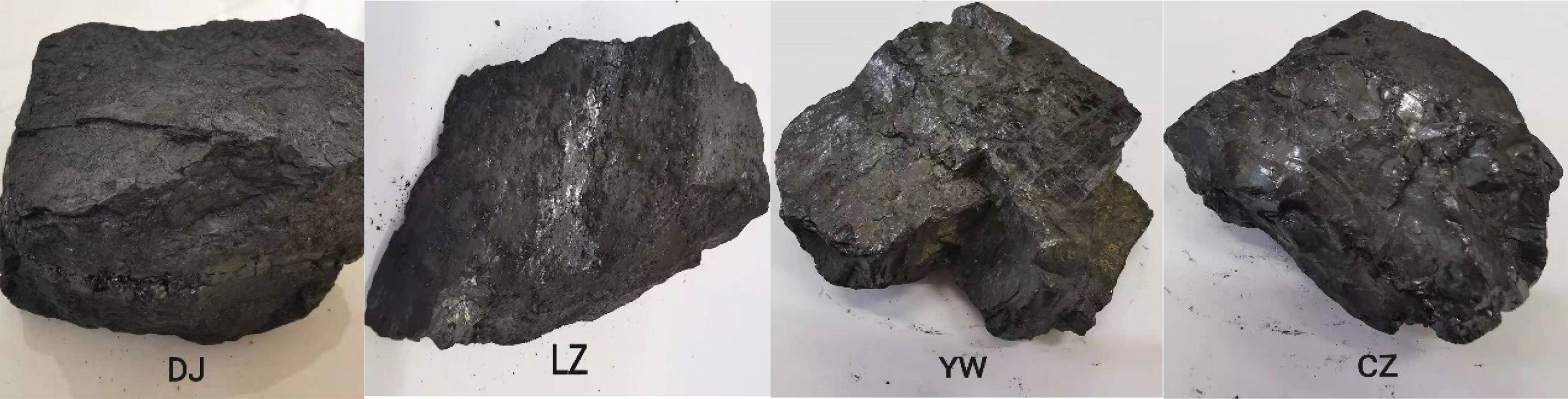
Samples of the original coal.
The coal sample is crushed with a crusher and selected particles with a particle size <0.2 mm. According to “Coal Vitrinite Reflectance Microscope Measurement Method” GB/T 6948-2008, the maximum vitrinite reflectance
Physical properties of coal.
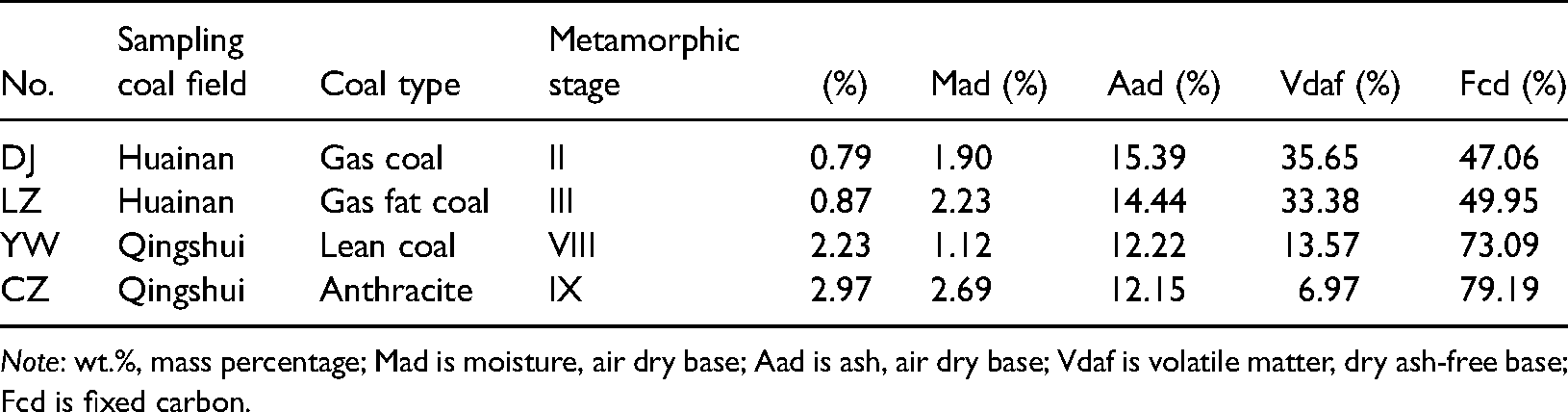
Note: wt.%, mass percentage; Mad is moisture, air dry base; Aad is ash, air dry base; Vdaf is volatile matter, dry ash-free base; Fcd is fixed carbon.
The particle size of each tested coal sample was 2 g from 60 to 80 mesh pulverized coal, which was heated to 100°C under vacuum and dried for 2 h, and degassing for 12 h at 150°C. The treated coal samples were placed in a vacuum tube and tested at a temperature of 77 K. During the experiment, the relative nitrogen pressure (P/P0) was gradually increased to 1, and the interval time at each equilibrium pressure was set to 10 s. Liquid nitrogen adsorption and desorption experiments were carried out. In this paper, the low-temperature liquid nitrogen adsorption experiment was completed in accordance with the Chinese national standard of “Gas adsorption BET method to determine the specific surface area of solid matter (GB/T19587-2004)” (Zhou et al., 2015), using Microactive for ASAP 2460 and TriStar II 3020 pore analyzer. The Hodot (1966) classification method is selected as the pore classification method in the analysis. Its outstanding advantage is that the adsorption and desorption mechanism of gas in different types of pores in his classification is different.
Experimental results and analysis
Experimental results of cryogenic liquid nitrogen adsorption
The test particle size of the coal sample is 0.18–0.25 mm. The liquid nitrogen adsorption and desorption diagram obtained by the test is shown in Table 2.
Pore structure characteristics of high-rank coals in low-temperature liquid nitrogen adsorption experiments.
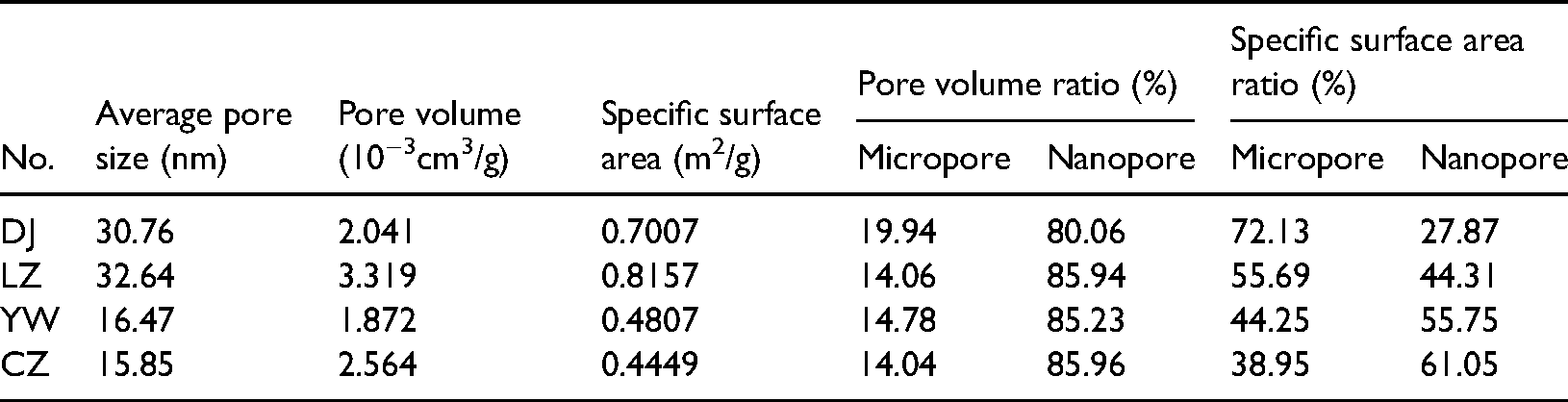
The specific surface area of high-rank coal is smaller than that of middle-rank coal. For example, the specific surface area of CZ coal sample per unit mass is only 54.54% (
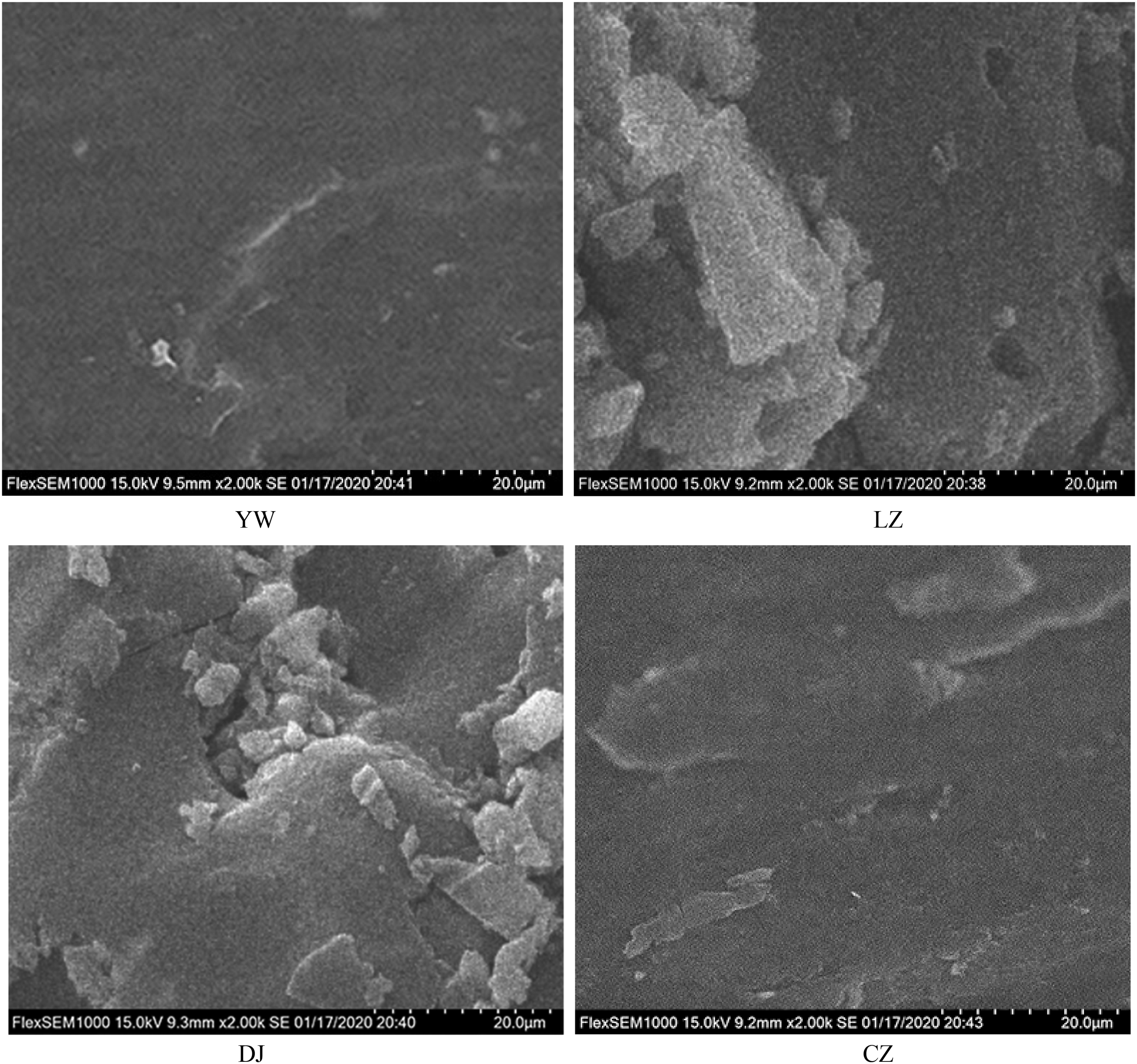
SEM images of YW, LZ, DJ, and CZ coal samples.
Pore structure morphology and connectivity of medium- and high-rank coals
The pore types of coal samples can be analyzed by the shape of adsorption isotherm and the size of hysteresis ring. According to the observation of adsorption isotherms, the isotherms of medium- and high-rank coal show common characteristics, which can be divided into five stages according to relative pressure increase rate (low pressure with P/P0 in 0–0.1, low and medium pressure with P/P0 in 0.1–0.4, medium pressure with P/P0 in 0.4–0.8, medium and high pressure with P/P0 in 0.8–0.9, high pressure with P/P0 in 0.9–1), see Figure 3.
Micropore filling area. The isotherm is at the initial stage, showing a significantly large and steep upward trend. At this stage, the micropores are filled sequentially and then gradually bend into a platform. Single-layer adsorption zone. The adsorption isotherm is bent like a knee. This is because more and more gas molecules enter the pores, the micropores are filled, and adsorbate molecules will form a thin layer on the pore surface. Multi-layer adsorption zone. After the knee-shaped corner, the adsorption curve enters the platform zone, and the entering surface adsorption of the platform zone enters the surface multi-layer adsorption stage. Capillary aggregation stage. When P/P0 is >0.4, a capillary aggregation reaction occurs. The capillary aggregation reaction is the phenomenon that the adsorbed gas in the pores changes into myopic liquid as the partial pressure ratio increases. The Kelvin equation quantitatively calculates the relationship between the capillary size and equilibrium pressure that can achieve condensed gas. As the equilibrium pressure of the adsorbate tends to balance, the pores of the coal sample will be completely filled.
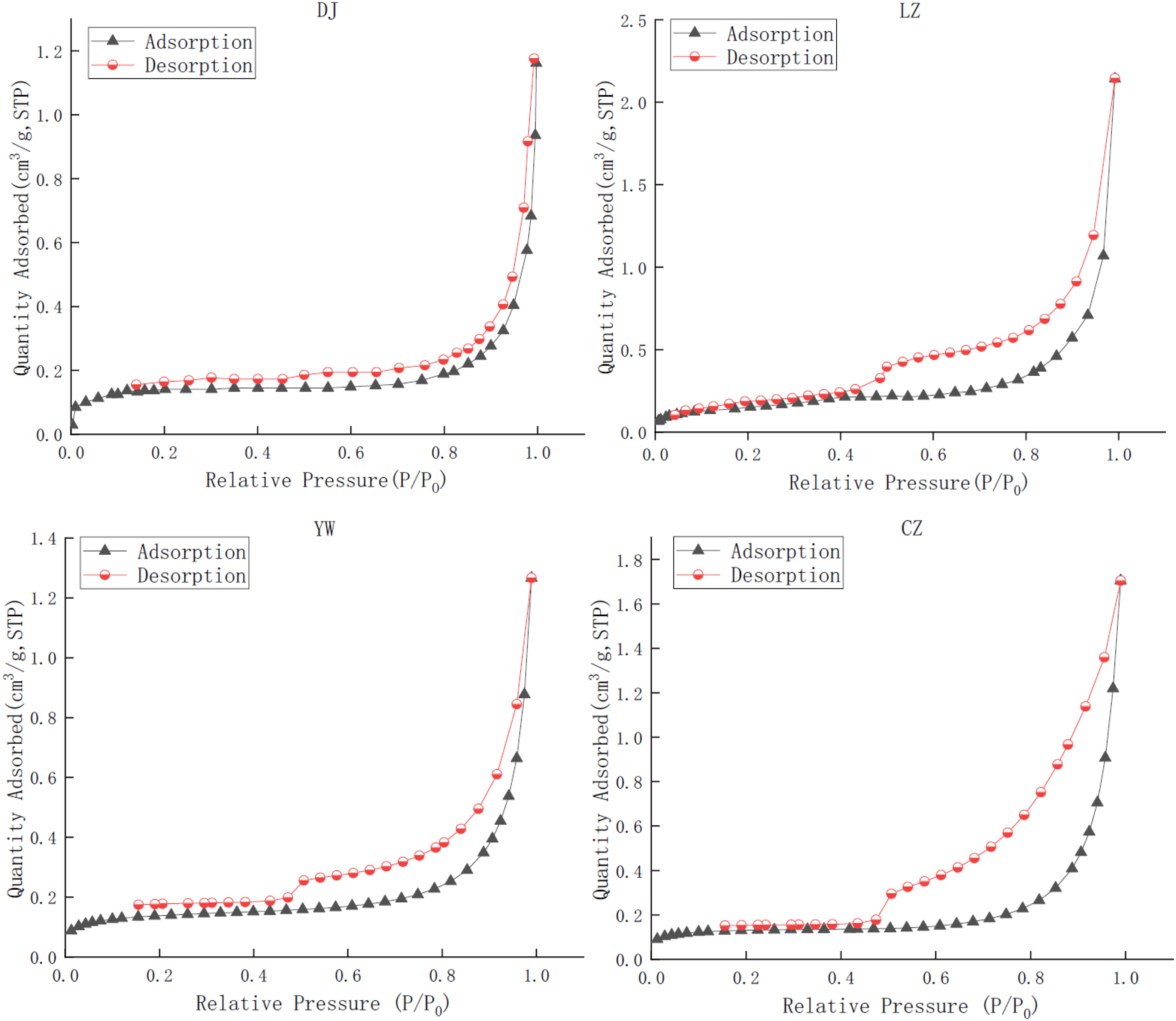
Low-temperature liquid nitrogen adsorption and desorption curve of medium- and high-rank coal.
IUPAC (2015) classified adsorption isotherms into five types in sequence through a series of reports. Observing the adsorption isotherms of medium- and high-rank coals, the maximum liquid nitrogen adsorption capacity reached under standard conditions is 1.18 cm3/g for DJ coal, 2.14 cm3/g for LZ coal, 1.27 cm3/g for YW coal, and 1.70 cm3/g for CZ coal. Although the maximum adsorption capacity and stage adsorption details are not exactly the same, the state of the curve completely conforms to the characteristics of the fifth type of adsorption isotherm, which is a typical porous material adsorption curve.
After the adsorption process is completed, the amount of gas is decreased in the experimental system to obtain the desorption isotherm. Due to the different mechanisms of desorption and adsorption, the desorption isotherms and adsorption isotherms of coal samples rarely overlap, forming a hysteresis loop. IUPAC classifies the hysteresis loop of the adsorption isotherm into five types: H1, H2, H3, H4, and H5. According to the IUPAC classification standard, LZ coal hysteresis ring conforms to H3 type characteristics, which is a large-porous hysteresis ring that is not filled with pore aggregates; CZ coal hysteresis ring conforms to H2 type characteristics, and is an ink with a narrow bottleneck bottle-shaped mesoporous material hysteresis ring; YW, CZ coal hysteresis ring is in line with H2 characteristics and is an ink bottle-shaped mesoporous hysteresis ring with a bottleneck. DJ coal hysteresis ring conforms to the characteristics of H5 category and is a relatively rare type of hysteresis ring. It is a mesoporous material hysteresis ring with some pores blocked. The pore characteristics of DJ coal scanned by SEM electron microscope are verified again. The advantage of IUPAC hysteresis classification method is that the pore size and morphology of porous materials are divided into five categories based on the shape characteristics of hysteresis loops. The disadvantage is that the object is all porous materials, and there is a lack of targeted research on coal materials. In addition, the adsorption desorption curves need to be carefully compared according to the degree of approach, so it is a little inconvenient to use the classification method.
Zhou et al. (2018) divided the liquid nitrogen adsorption and desorption lines into four types and corresponding to four pore-like structures according to the inflection point and the size of the hysteresis ring, as shown in Figure 4. The advantage of this classification method is that it does not need to compare the five classification graphs one by one to obtain the pore type and the connection status of the pores according to the two main characteristics. The disadvantage is that it fails to deeply explore the pore characteristics according to the closed interval characteristics of the hysteresis loop. In addition, the pore size corresponding to the relative pressure can be calculated according to the Kelvin equation. We use this method to explore the pore characteristics of the closed point and inflection point of the hysteresis loop,
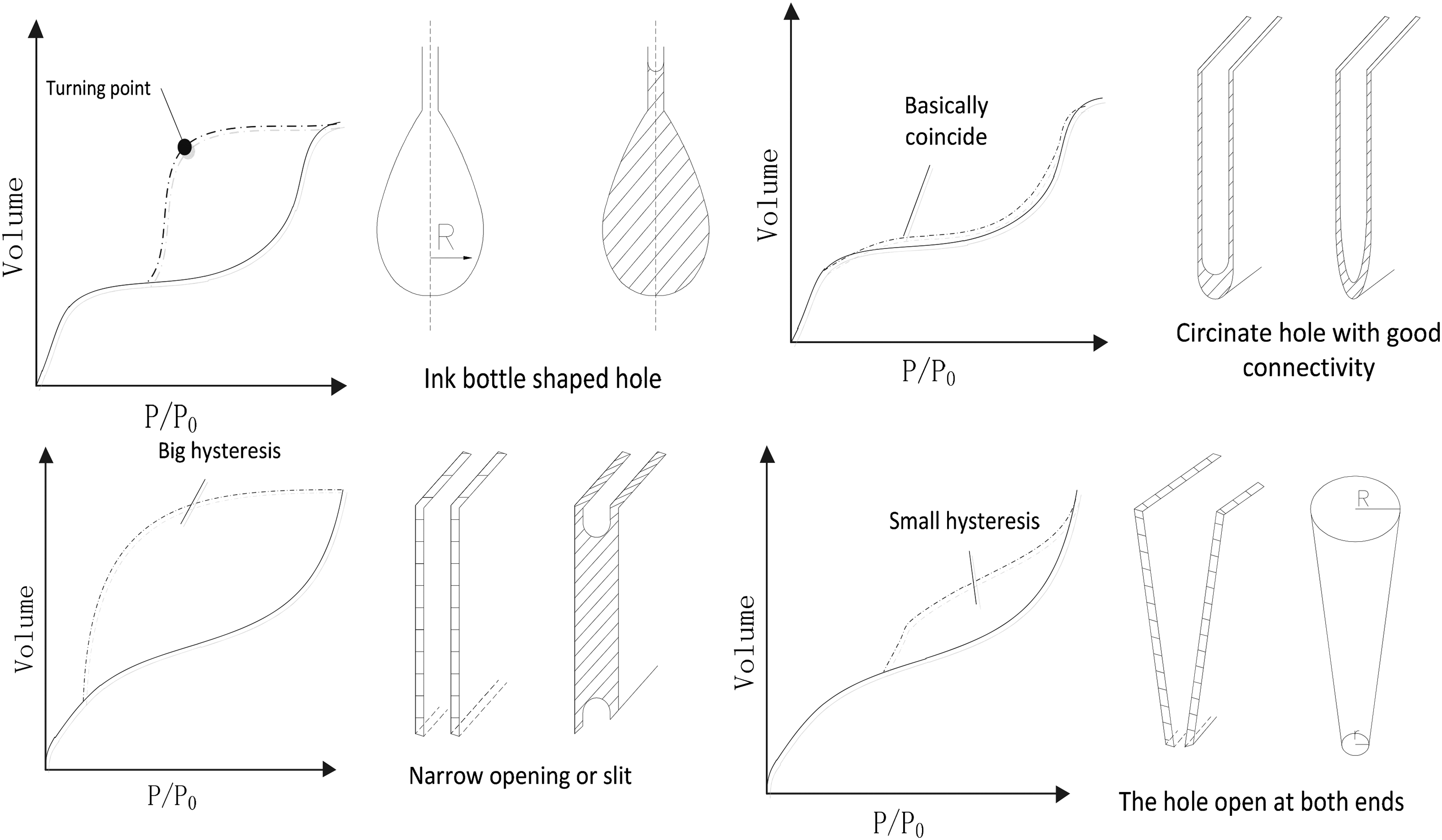
Hysteresis loop characteristics and pore types.
The type of pore structure of coal is complex, the shape type of the isotherm adsorption desorption line, the stage, whether the hysteresis loop is formed, whether the hysteresis loop is closed, whether the hysteresis loop is smooth, whether the hysteresis loop has an inflection point, the area where the hysteresis loop inflection point is located, and the size of the hysteresis loop, these eight factors work together to divide the low-temperature liquid nitrogen adsorption and desorption curves of medium- and high-rank coal samples into four types: C1, C2, C3, and C4.
Type C1 is a hysteresis loop for the adsorption and desorption of bright type I coal. DJ coal belongs to this type. The adsorption line increased rapidly in the stage of 0–0.1 at the relative pressure P/P0, indicating that the micropores with the pore size below 1.56 nm accounted for a large proportion in the micropore distribution. Similarly, the adsorption line increased the fastest in the stage of 0.95–1 at the relative pressure P/P0, indicating that the pores with the pore size above 40 nm were the main pores. The adsorption line and desorption line almost coincide, indicating that desorption is almost the inverse process of adsorption. The pore types are mainly open pores, such as double-headed open cylindrical pores and barrel pores, and open and closed cylindrical pores and split pores. Hysteresis line in the relative pressure P/P0 = 0.5 is not an obvious turning point, and type I mold with a small amount of the ink bottle shape holes exist in coal. When the relative pressure P/P0 is in the stage of 0.8–1.0, the degree of adsorption line and desorption line is the smallest among the four images. IUPAC hysteresis discrimination method and SEM scanning also prove that there are pore plugging materials in this type of coal.
Type C2 is a hysteresis loop for the adsorption and desorption of type II coal. LZ coal belongs to this type. This pore system is more complicated. The adsorption line shows a stable upward trend when the relative pressure P/P0 is between 0 and 0.4. When the relative pressure P/P0 is between 0.4 and 0.6, the upward trend becomes slower. The slope of the curve is close to 0, and when the relative pressure P/P0 is 0.6–0.8 interval, entering the stable rising stage again, indicating that in the pore size distribution below 10 nm, the micropores with pore diameters below 3 nm and the micropores with pore diameters in the range of 5–10 nm have a large contribution to adsorption. When the relative pressure P/P0 is 0.8–1.0, the adsorption curve enters a rapid rise stage, indicating that in this coal pore system, nanopores account for a larger proportion of micropores, and the rising rate is the fastest when the relative pressure P/P0 is >0.96. It shows that pores with a pore diameter of 50 nm or more account for the main body of the pores. The adsorption line and desorption line do not form hysteresis region in the region where the relative pressure P/P0 is <0.42, indicating that the microporous region is dominated by tubular and columnar pores with good connectivity. The hysteresis loop is formed in the region where the relative pressure P/P0 is 0.42–1, and the inflection point is formed at the relative pressure 0.5, indicating that the pores with a diameter of more than 4 nm are dominated by ink-bottle pores. The turning point in the curve shape is relatively flat, hysteresis loop area is relatively light IV type coal is small, which explain the bottleneck of the ink bottle shape hole is wide.
Type C3 is a hysteresis loop for the adsorption and desorption of type III coal, and YW coal belongs to this type. The biggest feature of this hysteresis loop is that a closed loop is not formed at relatively low pressure. After repeated experiments and troubleshooting of the instrument, the joint hysteresis line has an obvious inflection point to explain the non-closed problem: the main body of the pore system is an ink bottle-shaped hole with a narrow neck. From the perspective of the upward trend of the adsorption curve, there are two obvious upward trends in the relative pressure P/P0 below 0.2 and the relative pressure P/P0 above 0.8, indicating that the pore system has nanopores with a pore size of 10 nm or more and a pore size of 2 nm. The following micropores are the main ones. Because the relative pressure P/P0 increases in the interval >0.9, the rising trend is significantly greater than the relative pressure P/P0 in the 0.8–0.9 interval, so the pores are mainly composed of holes with a diameter of 20 nm or more. Because the pore adsorption and desorption are characterized by relatively easy adsorption, it is relatively difficult to desorb the pores of the fine-necked ink bottle below 2 nm, which ultimately causes the adsorption and desorption curve of this type to fail to close.
Type C4 is a hysteresis loop for the adsorption and desorption of bright type IV coal, and CZ coal belongs to this type. The three characteristics of this curve are obvious. The first feature is that the adsorption curve does not achieve a significant upward trend in the region where the relative pressure P/P0 belongs to 0–0.8, and the upward trend is obvious in the region where P/P0 belongs to 0.8–0.9, and it suddenly rises sharply in the region where P/P0 belongs to 0.9–1.0. It shows that in the pore system, nanopores are the main body, and the nanopores are mainly pored with a diameter of 20 nm or more. The second feature is that the adsorption and desorption line is closed in the area where the relative pressure P/P0 is 0.42–0.44, and the area where the relative pressure P/P0 is lower than 0.42 is overlapped, indicating that the pores with a diameter of <3.4 nm are cylindrical with good air permeability holes and wedge-shaped holes are dominant. The third feature is that it has an obvious inflection point and a large hysteresis ring, indicating that the ink bottle-shaped hole and the narrow gap with poor connectivity are the main body in this section.
The relationship between pore size distribution, specific surface area, and pore volume of medium- and high-rank coals
Bright type I coal (see Figure 5) has a medium pore volume of 0.002041 cm3/g and a specific surface area of 0.7007 m2/g in medium- and high-rank coals. The difference between it and other coals is that the image curves of other coals show single or double peaks. The pore volume change curve with the average pore diameter and the specific surface area changes with the average pore diameter curve shows a multi-peak state, indicating that the pore size section is more uniformly distributed in each region, and the nanopore stage has a greater contribution to the pore volume. This kind of coal has good pore connectivity, good adsorption and storage performance, low contribution to the specific surface area of the nanopore stage but high contribution to the pore volume, indicating that the complexity of the pore inner wall is average, but the presence of blockages in the pores will increase. The complexity of its pore structure is also a problem that needs further research in the bright type I coal gas extraction and CBM development.
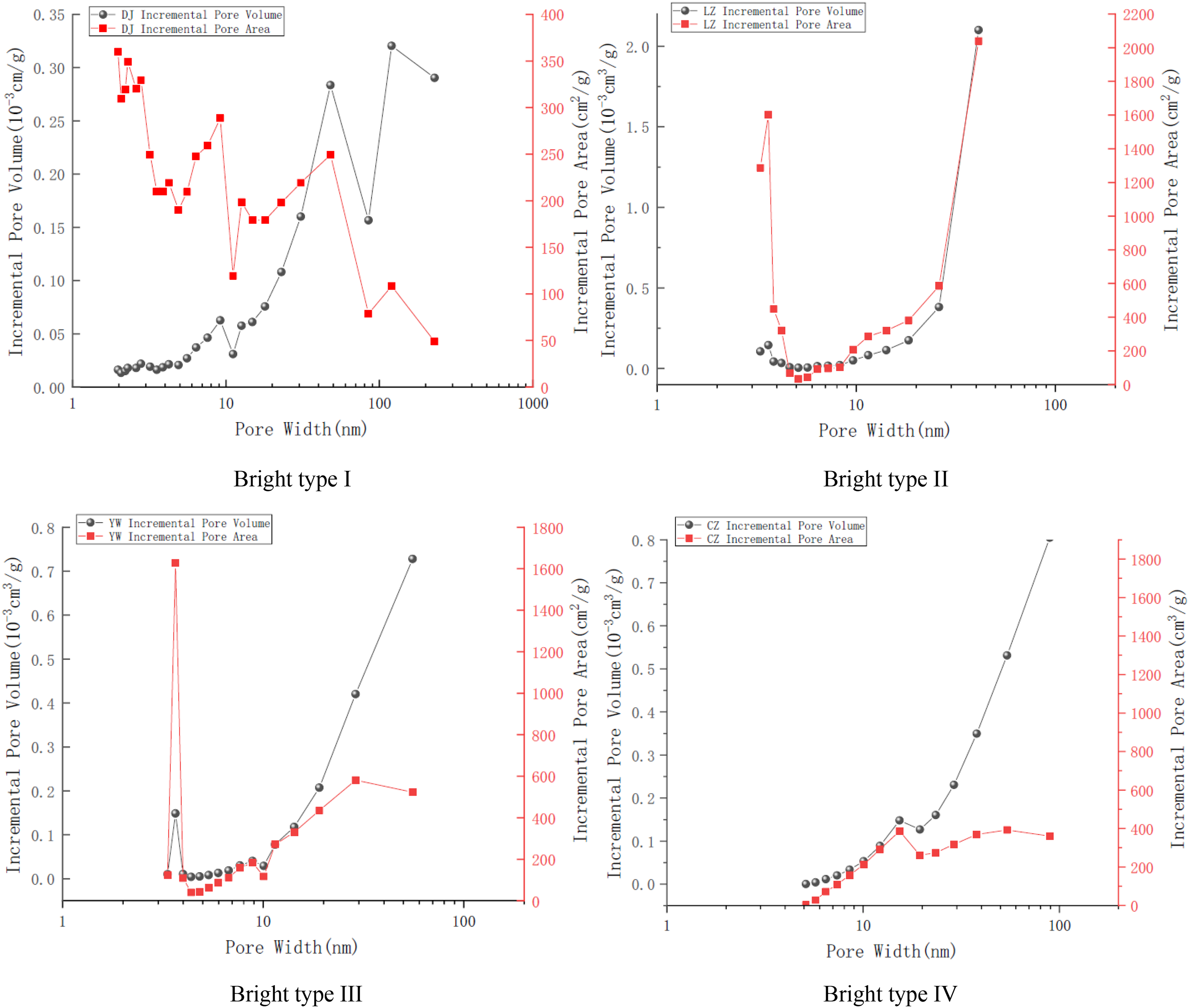
Curve of pore volume and specific surface area of medium- and high-rank coal in average pore diameter.
Bright type II coal (see Figure 5) has a high pore volume of 0.003319 cm3/g and a specific surface area of 0.8157 m2/g in the medium- and high-rank coals. The pore volume curve and the specific surface area curve are formed in the micropore area of about 3 nm and the area of 50 nm or more. The peaks indicate that the pores in these two intervals have the largest contribution rate to the change of pore volume and specific surface area. The pore volume and specific surface area of the pore diameter of the two stages are slightly distributed, and the pore volume change rate and specific surface area of the area above 50 nm diameter. This indicates that the complexity of pore structure above 50 nm is general. The existence of high microporosity in this type of coal is conducive to the adsorption and storage of CBM, and the simple transition pore structure is conducive to gas extraction, but the high microporosity ratio reduces the development value of CBM.
Bright type III (see Figure 5) coal in middle- and high-rank coal pore volume 0.001872 cm3/g and specific surface area of 0.4807 m2/g belong to the low category, the pore area and realize bimodal pore area, pore volume curve peak is located in the micropore area aperture and aperture surface curve peak is consistent, but the specific surface area rate of change in the area is greater than the pore volume change rate and explain about 2 nm porous occupies a more and more complex pore structure, joint adsorption stripping did not form a closed curve and hysteresis loop is also evidence that point. The briquette is suitable for the occurrence of CBM and can be used for gas extraction and displacement, but is not suitable for the development of CBM.
Bright type IV coal (see Figure 5) has a pore volume of 0.002564 cm3/g and a specific surface area of 0.4449 m2/g in the lower category of medium- and high-rank coals. The peak value is achieved in the nanopore area, and the volume curve and above phase hole rate are greater than the rate of change of specific surface area curve, and show that the type of coal pores and the pore structure of the complex degree above the hole is low, in combination with liquid nitrogen adsorption stripping curve and hysteresis loop feature. It is concluded that the type of coal pore system is mainly composed of the ink bottle hole, the type of coal is very suitable for CBM, diffusion, although the pore volume and specific surface area at the lower stage. Because the pore structure is given priority to with aperture above 10 nm hole structure is simple, so the extraction of gas can be performed, according to the occurrence of CBM total economic development.
Research on the fractal characteristics of pores in middle- and high-rank coals
The original meaning of fractal is the shape that part and whole are similar in some form. In recent years, in the field of materials research fractal geometry, the fractal dimension D is a “rough index.” The ideal smooth surface can be used as a collection of simple modeling, but the cause of the channel itself and distortion under stress, dislocation, and defects, the real channel surface is rough, the study of its roughness needs to be discussed by case. The overall channel surface is irregular, but look at different scales, they have similarities, the surface is known as a fractal, their size is directly proportional to the AD, here A is unknown feature sizes of adsorption material, the fractal dimension D become the important parameters, the characterization of channel characteristics D has two extreme value, D of 2 indicates that the channel is completely smooth, and D of 3 indicates that the channel is completely rough. Frenkel, Halsey, and Hill (FHH theory) proposed a computational model of FHH fractal dimension to deal with the computational model of adsorption of gas molecules on the surface of fractal media. The mathematical expression of the FHH model is as follows:

In curve fitting analysis (see Figure 6), different interval division methods have been applied based on different perspectives. Zhou et al. (2018) divided the analysis interval into P/P0<0.5 and P/P0>0.5, and conclude that there is no obvious difference in the types of coal and rock studied and the fractal dimension has no obvious correlation. We divide the interval according to different stages of adsorption mechanism. When the relative pressure P/P0>0.4, the continuous multilayer adsorption is accompanied by the capillary aggregation process. When capillary agglomerates, the nitrogen adsorbed in the pores is transformed into an approximate liquid with the increase of the partial pressure ratio. This is also the key point for the closure of the hysteresis loop during desorption. Therefore, this paper sets the relative pressure 0.4 as the calculation and analysis of the fractal dimension interval demarcation point. The fitting analysis is performed on the scattered data in the interval, and the fitting calculation results are shown in Table 3.
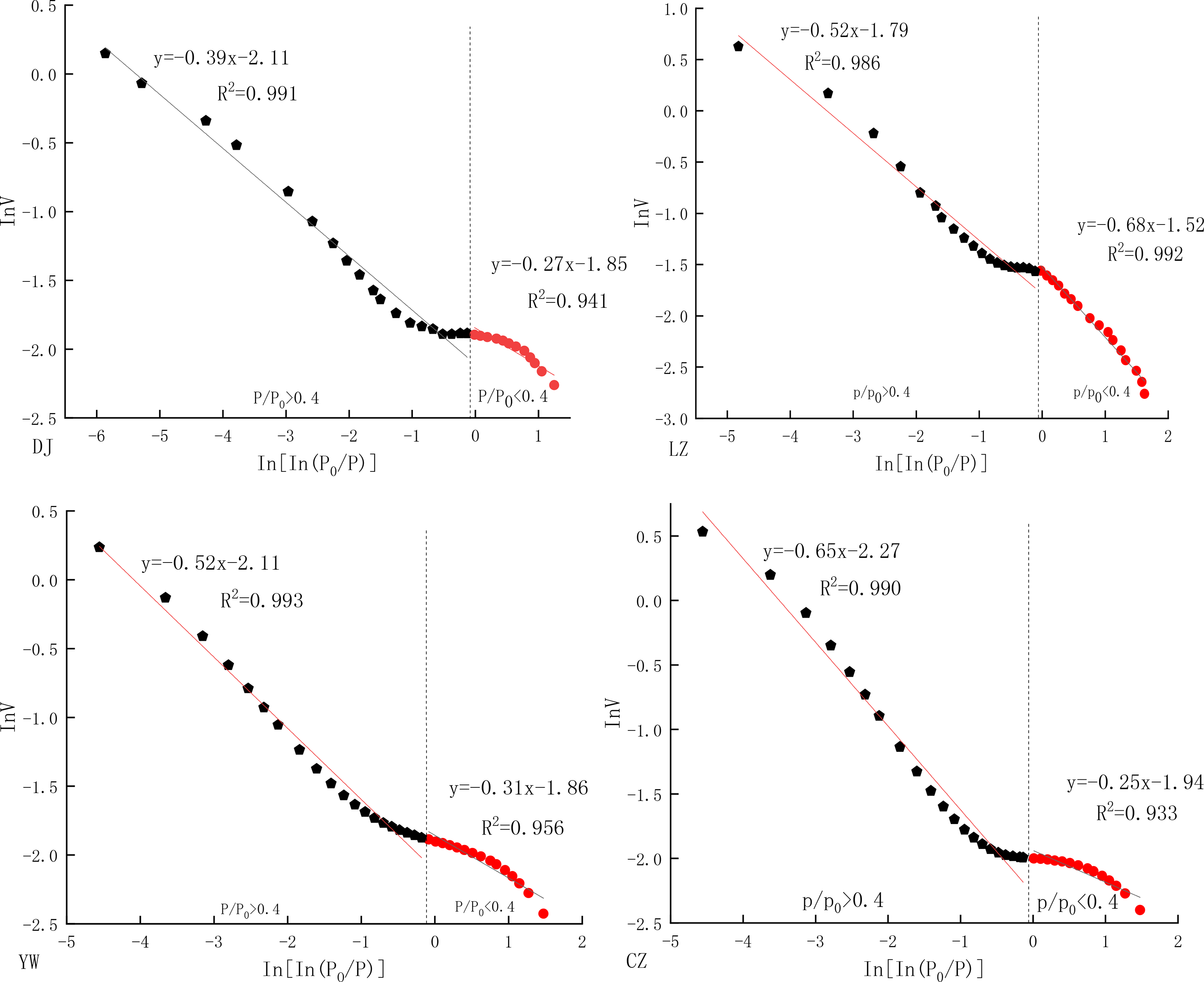
Curve fitting analysis.
Calculation of fractal dimension of middle- and high-rank coal based on Frenkel–Halsey–Hill-based model.
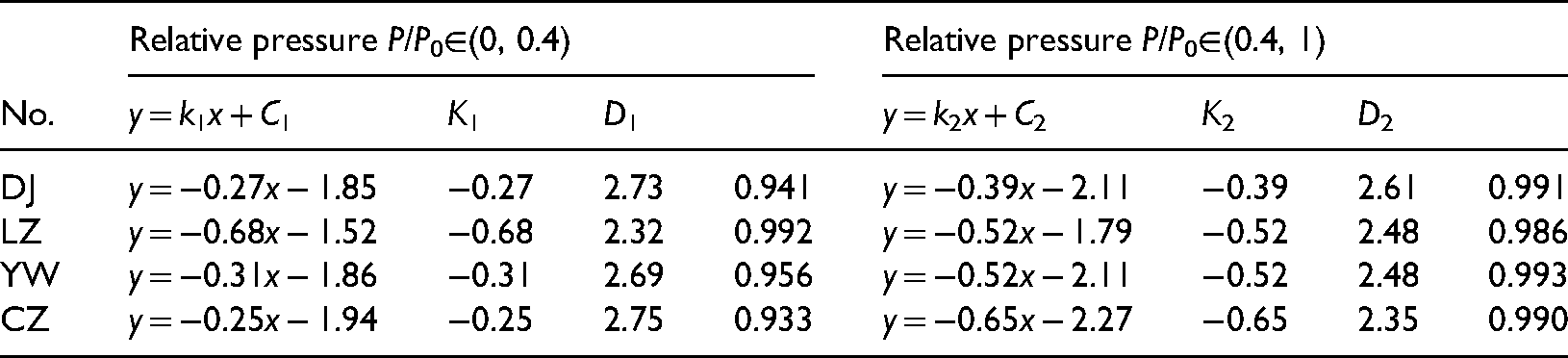
In each interval of the fitting, the correlation coefficient of the fitting curve is >0.90, half of which is above 0.990, indicating that the measured coal pore distribution conforms to the fractal characteristics and the fit is good. However, the regular conclusion that the fractal dimension of the low-pressure section is greater than the fractal dimension of the high-pressure section has not been obtained. For example, the fractal dimension D1 of the low-pressure interval of the relative pressure of LZ coal P/P0<0.4 is less than the fractal dimension D2 of the high-pressure interval of P/P0>0.4. But it is consistent with the fractal conclusion obtained by Zhou et al. (2018).
Based on the numerical meaning of the fractal dimension, the fractal dimension value is 2 representing “completely smooth” to the fractal dimension value is 3 representing “rough” and the intermediate value is divided into five intervals, D∈(2, 2.2) represents “smooth”; D∈(2.2, 2.4) means “less smooth”; D∈(2.4, 2.6) means “normal,” D∈(2.6, 2.8) means “less rough” D∈(2.8, 3.0) means “ rough.”
According to the above numerical divisions and meanings, the fractal dimension of DJ coal is D1 = 2.73, D2 = 2.61, it can be considered that the micropore and nanopore structure of bright type I coal is “less rough”; the fractal dimension of LZ coal is D1 = 2.32, D2 = 2.48, it can be considered that the micropore structure of bright type II coal is “smooth,” and the smoothness of the nanopore structure is “normal”; the fractal dimension of YW coal is D1 = 2.69, D2 = 2.48, which can be considered as bright type III. The microporous structure of the briquette is “rough,” and the degree of nanopore structure is “normal”; the fractal dimension of CZ coal is D1 = 2.75, D2 = 2.35, which can be considered as “less rough” and nanopore structure is “smooth.” The representative meaning of the calculated results is consistent with the research conclusions in sections “Experimental results of cryogenic liquid nitrogen adsorption”; “Pore structure morphology and connectivity of medium- and high-rank coals”; and “The relationship between pore size distribution, specific surface area, and pore volume of medium- and high-rank coals,” which also supports the previous research results.
The calculation of fractal dimension changes the analysis of pore structure characteristics from qualitative analysis to quantitative calculation, which is of great significance. The fractal structure characteristics of coal formed by different regions, different depths, and different compositions need to be further studied in large samples.
Conclusion
Four representative middle- and high-rank coal samples were collected for liquid nitrogen adsorption and desorption experiments, and the curve shape proved that the coal samples were typical mesoporous coal rocks. According to the coal and rock surface gloss, layered structure tightness, and intuitive hardness, coal samples can be divided into bright types I, II, III, and IV coal. The shape of the four types of adsorption and desorption curves and the degree of closure of the hysteresis rings were analyzed, and the aperture sizes corresponding to the abscissimal coordinates were calculated by Kelvin model. According to the different adsorption mechanisms and FHH model, with P/P0 = 0.4 as the dividing point of fractal dimension analysis, the pore structures of coal samples are classified into five grades, namely, smooth, less smooth, normal, less rough, and rough. Bright type I with nano and micropore is grade “less rough”; bright type II with nanopore is grade “normal,” while bright type II with micropore is grade “smooth”; bright type III with nanopore is grade “normal,” while bright type III with micropore is grade “less rough”; bright type IV with nanopore is grade “less smooth,” while bright type IV with micropore is grade “less rough.” The results of fractal characteristics analysis and the previous two parts of pore structure and adsorption and desorption capacity analysis are mutually corroborated.
The calculation of fractal dimension leads the analysis of pore structure from qualitative to quantitative, and the division of evaluation interval is clear and practical, which is convenient for researchers and engineers to make quick processing and judgment according to the characteristics. How to use nitrogen to displace gas based on the pore structure characteristics of coal will become the research and application direction in coal mine gas extraction and CBM development.
Footnotes
Acknowledgments
This paper is supported by the Key Project of University Humanities and Social Science in Anhui Province (No. SK2019A0102), Program for State Key Laboratory of Mining Response and Disaster Prevention and Control in Deep Coal Mines (No. SKLMRDPC20ZZ02), Program for Innovative Research Team of Huainan Normal University (No. XJTD202001), Program of Hefei Technology College (No. 2021KJB16).
Declaration of conflicting interests
The authors declared no potential conflicts of interest with respect to the research, authorship, and/or publication of this article.
Funding
This paper is supported by Key Project of University Humanities and Social Science in Anhui Province (No. SK2019A0102), Program for State Key Laboratory of Mining Response and Disaster Prevention and Control in Deep Coal Mines (No. SKLMRDPC20ZZ02), Program for Innovative Research Team of Huainan Normal University (No. XJTD202001), Program of Hefei Technology College (No. 2021KJB16), University Outstanding Young Talents Project of Anhui Province (No. gxyq2021270).
