




Abstract
The gas desorption index of drill cuttings is a basic index that measures the initial desorption capacities of coal seams and predicts coal seam gas outbursts. Following a long period of gas drainage in the No.7 coal seam of the No.86 mining area in the Haizi coal mine, the gas desorption index of drill cuttings was still found to be much higher than the threshold value for outburst risks. This abnormal phenomenon led to the present study of the rational selection of test methods and objects in this context. In this study, particle size distribution, pore structure and gas desorption characteristics of coal samples in anomalous areas were analyzed. We found that desorption characteristics are related to particle size and particle size varies in relation to tectonic stress and magmatic intrusions. It appears that the anomalous readings are related to particle size of the coal, resulting from tectonic/magmatic pulverization. Furthermore, measured particle size of drill cuttings is not actually reflective of coal particle size – larger particles may be comprised of multiple smaller particles. The results show that coal samples with particle size <1 mm accounts for 76.3% of total samples and coal samples with particle size >1 mm only accounts for 23.7% of total samples. The porosity and total pore volume increase as the particle size decreases. The specific surface area increases with decreasing pore diameter. Transitional pores and micropores increase the specific surface area of the coal sample considerably. The desorption capacity increases with decreasing particle size. The additional tectonic stress caused by magmatic intrusion has a crushing effect, and 1–3 mm particles used in test were composed of a large amount of smaller particles, eventually resulting in abnormal gas desorption index phenomena. Therefore, we proposed an improved method for measuring the gas desorption index of pulverized coal.
Keywords
Introduction
Coal and gas outburst is a very complicated gas dynamics phenomenon in coal mines. An outburst is the failure of coal and its ejection by stored potential energy being converted to kinetic form. This failure is associated with the release of seam gas (Fisne and Esen, 2014; Gray, 1983). The world’s major coal producing countries witness differing levels of coal and gas outbursts. Several hypotheses for the mechanism of coal and gas outbursts have been suggested by scholars around the world, and a hypothesis including multiple factors has received broad acceptance, creating a theoretical basis for outburst prediction, as well as selection and examination of outburst prevention measures. According to this hypothesis, the most important factors that influence the occurrence of coal and gas outbursts are geological structures (particularly steeply dipping seams, faults, and mylonite); gas-related properties of coal seams (composition, pressure, content sorption capacity, desorption rate); mining-induced stress state in the coal seam, and properties and structures of coal seams (strength, porosity, and permeability) (Beamish and Crosdale, 1998; Cao et al., 2001; He and Zhou, 1994; Lama and Bodziony, 1998; Wang et al., 2013, 2014). Several studies have shown that almost all coal and gas outburst coal seams contain tectonic coal, and the coal seam where outbursts occur shows low strength, high porosity, low permeability, and complex tectonic environments (Cheng et al., 2013; Jiang et al., 2010; Li et al., 2011, 2013; Shao et al., 2010).
Tectonic coal is coal deformed under the effects of one or more periods of tectonic stress (Hou et al., 2012; Jiang et al., 2010; Ju et al., 2006; Qu et al., 2010; Zhang et al., 2007). In 1958, the Geological Research Institute of the former Soviet Union divided tectonic coal into five categories based on coal luster, joint distribution and fissure spacing. Based on this classification, China classified destruction forms of coal into five stages that are still used as an index for the determination of coal and gas outbursts (Skoczylas and Wierzbicki, 2014). When category III, IV and V damage is involved, the coal strength is extremely low and the pulverization degree is high, resulting in high levels of outburst risk (Yu and Cheng, 2012). The geological structure involved plays a central role in controlling the development and distribution of tectonic coal. Researchers agree that tectonic coal development areas present risks for coal and gas outbursts.
A variety of forecasting methods have been proposed, such as the D (an index relate to the depth, the Protodyakonov coefficient f and the gas pressure of coal seam) and K (an index relate to the Protodyakonov coefficient f and the initial speed of gas diffusion) comprehensive index method, the R index method, and the drill cuttings comprehensive index method (Cheng et al., 2010; SACMS, 2009; Skoczylas et al., 2014). The gas desorption index of drill cuttings has been widely used in China and abroad. French derived V1 using the direct method to determine the releasable gas content of coal seams, where V1 represents the gas desorption levels of 10 g of coal cuttings 35–70 s after being exposed, and where the value of V1 is used to predict outburst hazard levels (Cheng et al., 1997). Winter and Janas (1971) proposed outburst prediction index Kt, which reflects the speed at which the gas desorption rate of drill cuttings decreases with time. He also proposed that the relationship between the gas desorption volume and desorption time of coal samples can be expressed as a power function:
The geologic environment of the Haizi coal mine is very complex, and multiple periods of tectonic movement have resulted in the extensive development of various forms of tectonic coal. Because of high porosity and low permeability characteristics, the tectonic coal has become one of the key factors controlling coal and gas outbursts. Magmatic rock is widespread in the Haizi coal field, and the maximum thickness of the sill is 170 m. Tectonic coal under the magmatic sill in the No. 7 coal seam of the No. 86 mining area has been subjected to extremely high degrees of pulverization, and abnormally high risks of coal and gas outbursts have been detected by in situ stress distribution and outburst indexes measurements (Wang et al., 2017). During mining of coal in this area, gas pressure and content decreased to 0.2 MPa and 3.35 m3/t, respectively. These values are far lower than the stated critical values of 0.74 MPa and 8 m3/t for China (SACMS, 2009; Yang et al., 2012a); however, the measured value of Δh2 is still much higher than the threshold value for coal and gas outbursts. To ensure the accuracy of outburst predictions of pulverized coal, the relationships among coal pulverization levels, gas desorption characteristics and outburst indexes must be systematically studied. Based on the abnormal phenomena of the gas desorption index of the Haizi Coal Mine, this study analyzes the structural and adsorption/desorption characteristics of pulverized coal in the No.7 coal seam, reveals the mechanism of the formation of this naturally pulverized coal, and proposes a new method to accurately determine the gas desorption index of drill cuttings.
Overview of the abnormal index workface
The Haizi coal mine lies in the middle of the Huaibei coal field and north of the Linhuan mining field. It is surrounded by the Damajia Fault (NE trending), Daliujia Fault (NNE trending) and Wufang Fault (NEE trending) (Wang, 2009; Yang et al., 2011). Thus the mine is structured in the shape of an irregular triangle as shown in Figure 1. Coal-bearing strata in the area are Permian. The Nos.3, 4, 7, 8, 9 and 10 coal seams are mineable coal seams, of which Nos.7, 8, 9, 10 coal seams are well developed and are the primary mineable seams.
Geological conditions and profile of the prospecting line of the Haizi coal field.
The No.86 mining area is located along the western boundary of the first level of the Haizi coal mine. The average length of its strike is 1.4 km and the average length of its trend is 1.2 km. The mining area covers roughly 1.68 km2. The No.7 coal seam of the No.86 mining area is one of the coal seams seriously affected by tectonic movement in the Huaibei coal field (Guo et al., 2016), and also presents the highest levels of outburst risk (Wang et al., 2017). The coal is mostly crushed and it is difficult to find large lumps of coal in the working face. Since 1986, five coal and gas outburst accidents occurred in the No.7 coal seam during construction and production. The upper part of the No.7 coal seam is covered with magmatic rock. The distribution and contours of the magmatic rock are shown in Figure 1(a). To better study the intrusion of igneous rock in the area, we draw a profile of the No.22 prospecting line of the No.86 mining area (Figure 1(b)) according to geological data collected from the Haizi coal mine. According to this profile, it is evident that magmatic rock in the mining area is oriented parallel to the coal seam and the thick rock sill lies above the Nos.7, 8, and 9 coal seams. The inclination angle of magmatic rock in the area is 10–25° and the rock reaches depths of −230 m to −390 m.
As the No.7 coal seam of the No.86 mining area has been identified as outburst danger zone on the basis of recorded outbursts, gas pressure, and gas content, measures (such as pre-drainage through penetration boreholes and boreholes along the coal seam) were taken to eliminate outburst risks before mining and tunneling at the 764 working face, as shown in Figure 2. After taking pre-drainage measures, the maximum remaining gas and releasable gas content derived from indirect measurements (Cheng et al., 2010; Wang et al., 2015) was 4.82 m3/t and 2.89 m3/t, respectively. The maximum remaining gas content, releasable gas content and remaining gas pressure levels derived from direct measurements (Wang et al., 2015) were 5.55 m3/t, 3.36 m3/t, and 0.3 MPa, respectively, which are less than the stated critical values of 8 m3/t and 0.74 MPa in China. Therefore, we concluded that coal and gas outburst risk was eliminated at the 764 working face. However, during mining and tunneling, the measured value of the desorption index (Δh2) was still greater than its critical value. The gas desorption index of drill cuttings (Δh2) exceeded the critical value (200 Pa) in many areas of conveyor roadways along the 764 working face during mining and tunneling, as shown in Figure 3, and values reached up to 350 Pa, far exceeding the critical value, at some sites.
Drilling holes along the coal seam of the 764 working face. (The red lines are boreholes.). Measurement results of the Δh2 of the 764 conveyor roadway.

Coal sampling and experimental methods
Coal sampling
For the abnormal gas desorption index of drilling cuttings (Δh2) at the 764 working face, we sampled from the 764 working face, and the sampling location is shown in Figure 1. We found that the coal was mostly crushed and it was difficult to find large lumps of coal in the working face. The coal was very soft and weak. Therefore, we screened the coal samples obtained from the field directly without crushing. In order to study the characteristics of the pulverized coal, we obtained the particle size distribution by screening the coal samples in the laboratory and measured the pore distribution and desorption characteristics.
Experimental methods
Particle size distribution test method
In the laboratory, coal samples collected from the field were screened using sifters with pore diameters of 0.074 mm, 0.2 mm, 0.5 mm, 1 mm and 3 mm. We obtained samples with particle sizes of 0–0.074 mm, 0.074–0.2 mm, 0.2–0.5 mm, 0.5–1 mm, and 1–3 mm and calculated the weight percentage for each.
Pore size distribution test method
Pore size distribution characteristics of the coal samples were measured by the mercury intrusion porosimetry (MIP) (Kaufmann, 2010; Schmitt et al., 2013) using an Auto Pore IV 9500 mercury porosimeter with a pressure range of 0–230 MPa. The measureable range of pore diameter was 0.003–360 µm and the volume accuracy of mercury intrusion/ejection was 0.1 µL. The following classification from Hodot (1966) was used for coal pore size: micropores (<10 nm), transitional pores (10–100 nm), mesopores (100–1000 nm), macropores (>1000 nm).
Desorption experiment
We prepared 50 g coal samples with the particle size range of 0–0.074 mm, 0.074–0.2 mm, 0.2–0.5 mm, 0.5–1 mm, and 1–3 mm as the experimental coal samples respectively. Then the prepared coal samples were put into coal sample tanks and the airtightness of the tanks was checked, and then the coal sample tanks were evacuated with a vacuum pump for about 8–10 h in water bath with constant temperature of 333 K; after vacuum pumping, the coal sample tanks were filled with a purity of 99.99% methane until the pressure reached 1.5 MPa. The coal sample tanks were placed in the 303 K water bath, close to the temperature in the workface underground, and the gas pressure was adjusted until the gauge value was stable at 0.5 MPa (usually 2 to 3 days). After the adsorption equilibrium was achieved, the free gas in the coal sample tank was rapidly released and the pressure drastically reduced to atmospheric pressure. Then the coal sample tank was connected to the desorption cylinder as soon as possible. The desorption pressure stayed constant when the desorption process was held. The desorption volume was measured by recording the liquid level. The experimental devices are shown in Figure 4.
Devices and method of gas desorption. 1 – Constant temperature Water bath; 2 – pressure gauge; 3 – coal sample tank; 4 – vacuum pump; 5 – valve; 6 – soft hose; 7 – desorption cylinder; 8 – reference tank; 9 – methane cylinder.
Laboratory testing of the gas desorption index of drill cuttings
The applied test method of Δh2 in laboratory is similar to that of the underground field. Δh2 was measured using the MD-2 type gas desorption instrument produced by the Coal Research Institute of Fushun. The instrument and a structural sketch are shown in Figure 5. The particle size of coal samples in this test was 1–3 mm. For the MD-2 type gas desorption instrument, the gas desorption volume of per gram coal sample (Q, cm3/g) from the fourth minute to the fifth minute has a relationship with Δh2, which is described by the equation Picture of real products (a) and structure schematic (b) of the MD-2 type gas desorption instrument.
The following steps were performed to measure Δh2 in the laboratory: (1) putting the coal samples into the airtight coal sample tanks, which were then filled with methane; (2) opening the coal sample tanks when the coal samples reached adsorption equilibrium at 0.5 MPa and timing at the same time; (3) immediately loading the coal samples into the sample bottle up to the scale mark, beginning the test when the exposure time of the coal sample is 180 s (3 minutes), and (4) recording the differential between the water pressure scales (unit in mm) on both sides after 2 min. Δh2 is equal to the product of the differential and 10 Pa each mm.
Experimental results and analysis
Particle size distribution characteristics of the coal samples
The mass distribution of the coal samples with different particle sizes.

Pore distribution characteristics of the coal samples
Coal is a naturally complex porous and fractured organic rock (Clarkson et al., 1999; Green et al., 2011; Meyers, 1986). Coal has a very well developed pore and fracture system with large pore surface area and open spaces, which constitute spaces for methane adsorption and transportation (Clarkson and Bustin, 1999; Guo et al., 2015; Liu et al., 2017). The mercury intrusion method is often used to examine the pore distribution characteristics of coal. The pore distribution test results are shown in Figure 6. The total volumes of intruded mercury in the samples with particle sizes of 0.2–0.5 mm, 0.5–1 mm and 1–3 mm show little difference. The accumulated amount of intruded mercury increases with decreasing particle size during the early stage of mercury intrusion. The total amount of intruded mercury in coal samples with particle sizes of 0.074–0.2 mm is slightly higher than that of coal samples with particle sizes exceeding 0.2 mm. The total amount of intruded mercury for coal samples with particle sizes less than 0.074 mm is much higher than that of the other particle sizes.
The mercury intrusion-ejection curve of coal samples with different particle size.
The pore volume distribution of the coal samples with different particle sizes.

The specific surface area distribution of the coal samples with different particle sizes.


Variations of the specific surface area with pore diameter.
Gas desorption characteristics of the coal samples
Research on the occurrence and development of gas disasters shows that methane desorbs rapidly during coal and gas outbursts, and a large amount of adsorbed gas is emitted from coal over a short period (Guo et al., 2016; Skoczylas et al., 2014; Wierzbicki and Skoczylas, 2014; Xue et al., 2014). As the gas desorption index is abnormal at roughly 0.3 MPa after the elimination of outbursts in underground field cases, we set our experimental equilibrium pressure levels to 0.5 MPa for testing purposes. By studying the gas desorption characteristics of coal samples with different particle sizes, we can provide a theoretical basis for the prediction of coal and gas outbursts.
Variations in accumulated gas desorption levels with desorption time under the same equilibrium pressure level (0.5 MPa) are shown in Figure 8. The desorption curves of coal samples with different particle sizes present the same variation characteristics under the same gas pressure, and the accumulated gas desorption amount and desorption time follow a power function relationship. At the same pressure, the accumulated gas desorption amount increases with decreasing particle size. The average gas desorption rate of each initial desorption stage is shown in Table 4. It indicates that the initial desorption rate is very fast for samples of the same particle size and the desorption rate decreases rapidly. The initial desorption rate of samples with different particle sizes increases with decreasing particle size. With smaller particle sizes, desorption rate declines faster, indicating that with the higher fragmentation degree, the desorption capacity becomes stronger.
Gas desorption curves of coal samples with different particle sizes. The desorption rate of the coal samples with different particle sizes in the first 20 min.

To quantitatively analyze differences in gas desorption properties between coal samples from the No.7 coal seams of the Haizi coal mine and other coal samples, Guo et al. (2016) compared pulverized coal samples from No.7 coal seams of the Haizi coal mine with two coal samples unaffected by magma intrusion. It was found that the accumulated desorption amount and initial desorption rate of pulverized coal sample are higher than those of the other two coal samples under the equilibrium pressure and particle size. The change in matrix scale and pore structure damage caused by crushing largely determines the gas desorption characteristics of pulverized coal, which exhibits high initial gas desorption levels and rapid initial gas desorption rates. These characteristics contribute to high coal and gas outbursts risks for the No.7 coal seam of the Haizi coal mine.
Analysis of the abnormal gas desorption index
The premise of the abnormal gas desorption index
The gas desorption index of the coal samples with different particle sizes.


Variations of the gas desorption index with particle size.
To verify this deduction, we conducted a scanning electron microscope test of the coal samples. Upon observing the coal samples with different particle sizes under varying levels of magnification, we found that the coal samples with smaller particle size had simpler structure. Large particles were easy to screen, but their structure is complex. Figure 10 shows scanning electron microscope images of 1–3 mm particles. It is evident that the 1–3 mm particles show a layered structure or agglomerates of smaller particles, affecting the accuracy of the index results.
Scanning electron microscope images of coal samples with particle size of 1–3 mm.
The accumulated desorption amount of the coal samples with different particle sizes in the first 20 min.

The fitting results of accumulated desorption amount and particle size.
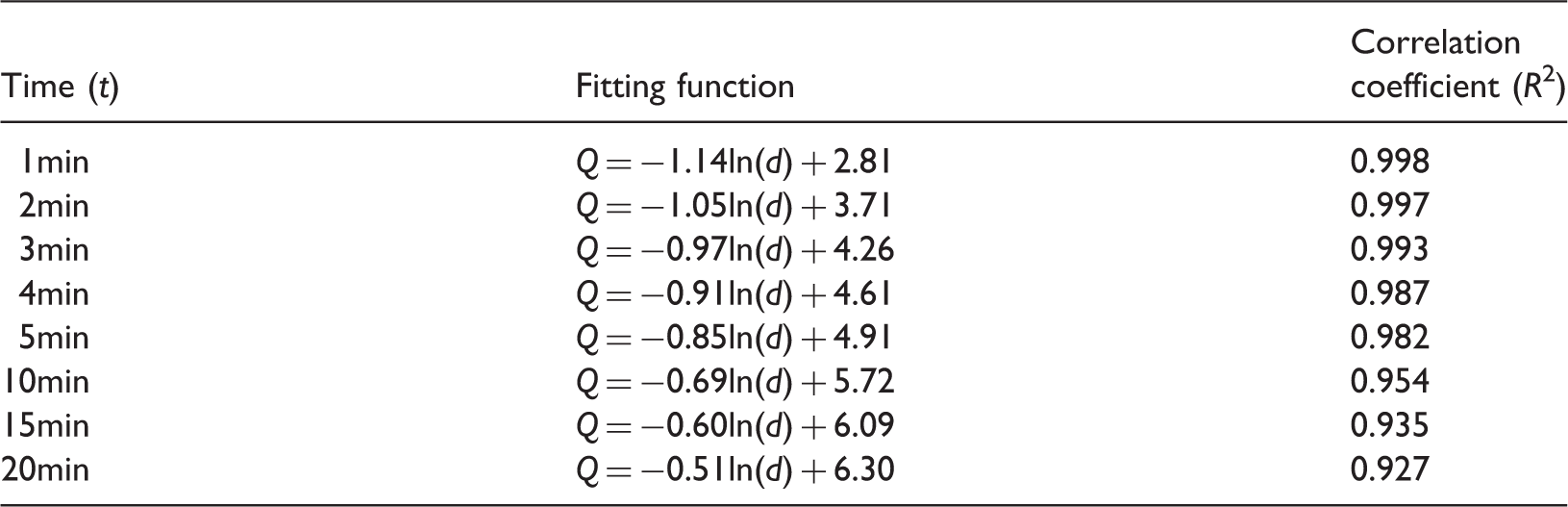
From the correlation coefficient, it is evident that the fit is very good. To verify the accuracy of the accumulated desorption amount equations obtained by fitting, we compared the calculated desorption curves derived from the equations with the experimental desorption curves. The corresponding comparison results are shown in Figure 11.
Comparison of the calculated desorption curves and the experimental desorption curves.
It is evident that the calculated desorption curves by using average particle sizes and experimental desorption curves are basically the same, verifying the accuracy of the accumulated desorption amount equations. So we expected that the experimental desorption curve of 1–3 mm particles would be coincident with the calculated desorption curve (d = 2 mm). However, we used the accumulated desorption amount equations to calculate the desorption curve (d = 2 mm) and compared it with the experimental desorption curve of samples with particle size of 1–3 mm, as shown in Figure 12. The calculated desorption curve falls below the experimental desorption curve, indicating that the accumulated desorption amount of samples with particle size of 1–3 mm is greater than our expectation.
Comparison of the calculated desorption curve and the experimental desorption curve.
According to the previous conclusion: the accumulated desorption amount increases with decreasing particle size. Using the accumulated desorption amount equations, we recalculated the equivalent average particle size of 1–3 mm screened particles based on the experimental desorption amount at 1 min, and the value is 1.677 mm (<2 mm). Then we obtained the calculated desorption amount at other time by substituting 1.677 into other equations in Table 7 and compared the calculated desorption curve (d = 1.677 mm) with the experimental desorption curve of coal samples with particle sizes of 1–3 mm. As shown in Figure 12. It is clear that the calculated desorption curve (d = 1.677 mm) is more coincident with the experimental desorption curve than the calculated desorption curve (d = 2 mm). Therefore, we concluded that the 1–3 mm coal particles used in test were composed by a large amount of smaller particles. As indicated previously, the gas desorption index of drilling cuttings reduces with increasing particle size when the particle size is >1 mm, and we can explain the abnormally high desorption index measured from the underground field and in the laboratory.
Coal in the No. 7 coal seam of the Haizi coal mine shows obvious layered structure, high pulverization degree, and is easily broken. From the study, we believe that the abnormal desorption index of drill cuttings was caused by the pulverization characteristics of coal samples. These issues are determined by the structural characteristics of the pulverized coal, and cannot be solved by improving screening equipment. Therefore, it is inappropriate to compare the drill cutting desorption index of the coal sample (sieving particle size of 1–3 mm) with the reference critical value of Δh2 (200 Pa) outlined under China’s Outburst Prevention and Control Regulation.
Causes of pulverized coal formation
Since the formation of the coal-bearing strata in the Haizi coal mine, the coal-accumulating basin has experienced complex tectonic evolution. The coal seam has undergone high levels of deformation under the influence of fracture, fold and layer slip structures, and the coal structure is now broken and pulverized (Guo et al., 2016). However, in addition to the pulverization resulting from tectonic movement to the coal, the magmatic intrusion further crushed coal by changing the geostress, which is another major cause of pulverization in the area. To study the effects of magmatic intrusion on geostress, we carried out geostress measurements and field verifications.
Measurement results of geostress.
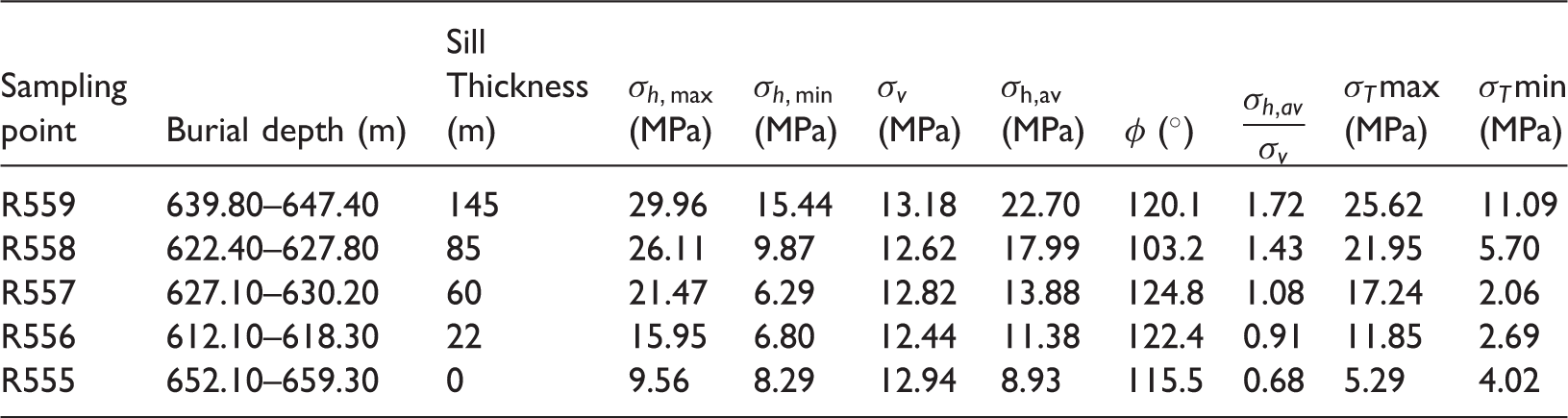

The relationship between
The drilling cutting quantity (S) is a predictive index for outburst hazards of working faces and reflects the geostress of coal seams and the pulverization degree of coal. It is measured by drilling a 42 mm diameter borehole along the coal seam, and the quantities of drilling cuttings per meter were defined as drilling cuttings quantity. Generally, with the increase of geostress, the value of drilling cuttings quantity will significantly increase, and the possibility of outburst will increase. The comparative analysis results on drilling cutting quantity for different sill thicknesses are shown in Figure 14. It is evident that that the drilling cuttings quantity increases with the increasing thickness of the overlying sills, consistent with measured results of geostress in the Haizi coal field. Therefore, the magma intrusion has changed the geostress and has aggravated the pulverization of the coal. With a greater thickness of the overlying sills, the transformation becomes more obvious.
Measurement data of drill cuttings quantity.
Discussion of the desorption index measurement method
As the pulverized coals have been crushed considerably, the physical and mechanical properties and related desorption characteristics of coal with different particle sizes are different. It is not possible to screen coal samples into accurate particle sizes ranges during the few minutes in the underground field. To accurately determine the critical value of the desorption index, we discussed the determination of the critical value of the desorption index under laboratory conditions. Furthermore, a new method for testing the desorption index of pulverized coal drilling cuttings was proposed.
(1) Determination of the desorption index critical value
Many scholars have found that the desorption index of drilling cuttings has a clear power function relationship with equilibrium pressure (An et al., 2013; Cheng et al., 2016). Therefore, the 
To determine the critical value of the desorption index of drilling cuttings, the critical outburst pressure of a coal seam must first be analyzed. Critical values of gas pressure and content used to predict outburst risks are 0.74 MPa and 8 m3/t according to China’s Outburst Prevention and Control Regulation, and we can calculate the corresponding gas content and pressure level of critical values via the indirect method (Yu and Cheng, 2012). Combining the relationship between the minimum outburst pressure level and the Protodyakonov coefficient f (
Using the particle size distribution of the coal samples, the weighted gas desorption index of drilling cuttings ( (2) Site desorption index measurement method
From the critical value of the coal seam gas desorption index of drilling cuttings derived from laboratory experiments and analyses, we can measure the gas desorption index of drilling cuttings of the coal samples directly using the MD-2 type gas desorption instrument in an underground field. The obtained coal samples are not sieved during the measurement process. Comparing test results with the threshold obtained from a laboratory, when test results are larger than the threshold, the measurement field has outburst risks and further measures should be taken to eliminate such risks. Otherwise, the measurement field does not have outburst risks, and mining activities can be carried out.
Fitting results of desorption index of drill cuttings and equilibrium gas pressure.

Conclusions
Coal shows a high degree of pulverization in the No.7 coal seam of the Haizi coal mine, where the gas desorption index of drill cuttings is abnormal. Coal samples with particle size <1 mm accounts for 76.3% of total samples and coal samples with particle size >1 mm only accounts for 23.7% of total samples. The porosity and total pore volume increase with a decrease in particle size. The specific surface area of coal samples with different particle sizes increases with decreasing pore diameters. The specific surface area of transitional pores and micropores accounts for more than 90% of the total specific surface area, which increases the specific surface area of coal samples considerably and contributes to gas storage and migration. The desorption curves of coal samples with different particle sizes have similar variation characteristics under the same gas pressure, and the accumulated gas desorption amount and desorption time show a power function relationship. Under the same pressure, the accumulated gas desorption amount increases with decreasing particle size. The initial desorption rate is very fast for coal samples of the same particle size, after which desorption rates rapidly decrease. The initial desorption rate increases with decreasing particle size, and for smaller particles, the desorption rate declines more quickly. When the particle size of the coal samples is less than 1 mm, the gas desorption index of drilling cuttings increases with increasing particle size. Compared with the desorption index of samples <1 mm, the gas desorption index of drilling cuttings reduces with increasing particle size when the particle size increases to 1–3 mm. We deduced that the abnormally high desorption index measured at the 764 working face was caused by the fact that the coal samples with the particle size 1–3 mm used in test were composed of a large amount of smaller particles. This deduction was verified through scanning electron microscope testing and desorption experiments. In addition to tectonic movements, magmatic intrusion in the Haizi coal field is another major cause of the high pulverization levels. The effects of the magmatic intrusion on the geostress increase with the thickness of overlying sills. The larger the thickness of overlying sills, the greater the change in geostress, which in turn leads to an increase in coal pulverization. A new method for determining the critical value of the gas desorption index of drilling cuttings and a new test approach to the gas desorption index are proposed in this study. The critical desorption index (355 MPa) of the No.7 coal seam in the Haizi coal mine was obtained using the new method and was used to guide safe mining activities in the Haizi coal mine.
Footnotes
Acknowledgement
We appreciate the helpful comments from the editors and reviewers.
Declaration of Conflicting Interests
The author(s) declared no potential conflicts of interest with respect to the research, authorship, and/or publication of this article.
Funding
The author(s) disclosed receipt of the following financial support for the research, authorship, and/or publication of this article: This work was supported by the Fundamental Research Funds for the Central Universities (2017CXNL02) and A Project Funded by the Priority Academic Program Development of Jiangsu Higher Education Institutions (PAPD).