




Abstract
Coalbed gas (CBG) has been widely used as an important energy source. However, its utilization and allocation system is imperfect in mining areas. During the utilization process, a large amount of CBG is discharged into the air, causing environmental pollution. In this study, we proposed a “full spectrum-domain-time” CBG utilization model. In this model, by combining high methane concentration gas power generation, low methane concentration gas purification, and ultra-low methane concentration gas thermal storage and oxidation utilization, we were able to utilize CBG with full-spectrum of methane concentrations. In addition, by establishing CBG transportation and storage system in mining area, we were able to realize CBG supply in the entire network domain. Furthermore, based on the time series prediction algorithm, the CBG demand of different mining areas is predicted and regulatorily met by real time allocation. Through these three steps, an efficient “full spectrum-domain-time” CBG utilization system was formed and practically applied in Yangquan mining area. The application results showed that under the comprehensive control of “full spectrum-domain-time” CBG utilization model, CBG with methane concentration ≥0.2% could be used in the mining area and its utilization rate increased year by year, reaching the highest of 77.15%. Overall, our study provided a reference for the efficient CBG utilization in the mining area.
Introduction
Coalbed gas (CBG) is the major source of gas disasters in coal mines, causing a major problem in coal production (Wang and Du, 2020; Yuan, 2016; Zhou et al., 2019). Extracting CBG from underground can not only reduce the occurrence of gas disasters (Wei et al., 2021a, 2021b), but also provide a source of clean energy (Tao et al., 2019; Zheng et al., 2019). However, exhaustion of a large amount of CBG will lead to air pollution and aggravated greenhouse effects. To properly utilize CBG, it is necessary and important to explore efficient CBG utilization models and apply them in the production field of coal mines.
China’s CBG reserve amounts to 36.8 trillion cubic meters, ranking the third in the world. According to the China’s “13th Five-Year Plan” from 2015 to 2020 (Wen et al., 2019), in the year of 2020, the proven geological reserve of newly-increased CBG reserve is 420 billion cubic meters, the extracted CBG volume will reach 24 billion cubic meters, of which 14 billion cubic meters will be extracted from coal mines, and the utilization rate of CBG will increase to 50%. Figure 1 shows the CBG extraction volume and utilization rate in China during 2012 and 2018. It is clear that although CBG utilization rate is gradually increasing, it is still very low, less than 42%. The main reason for such a low utilization rate is that the gas extracted from underground coal mines mostly has methane concentration <10% and is massively released to the air rather than directly used for combustion, resulting in environmental pollution. Therefore, the key to increase CBG utilization rate is increasing the utilization rate of low concentration gas (Li et al., 2020; Yuan et al., 2020). At present, China has initially formed a cascade utilization model for CBG extraction and utilization (Shen et al., 2015; Xiong, 2018; Yao, 2016). The technologies for extraction and utilization of high concentration gas have been matured (Singh, 2011), while the technologies for low-concentration gas utilization are still under development along with the low-concentration-gas-based power generation technology and methane condensation and purification technology. Moreover, lack of scientific management and regulation of CBG resources in its storage and allocation process as well as insufficient understanding of its temporo-spatial demands have led to the waste of some CBG resources.
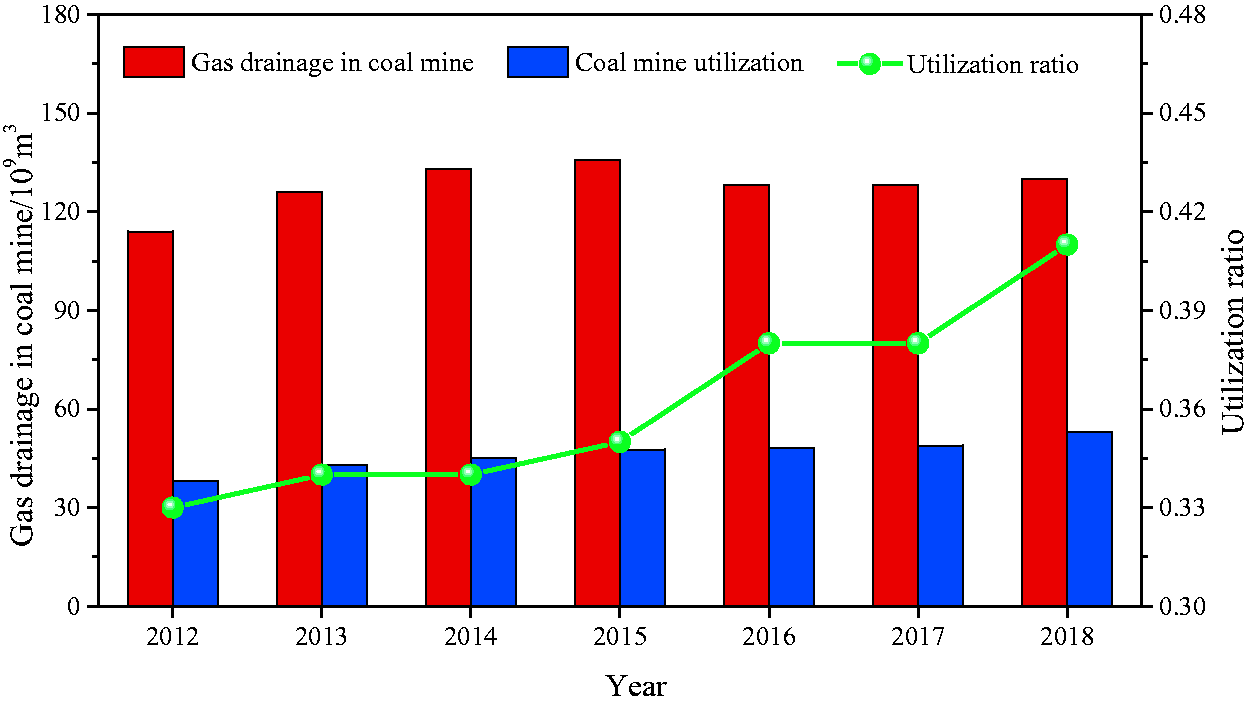
Coal mine gas extraction and utilization from 2012 to 2018 in China.
Coal mines as relatively independent units can consume the extracted CBG for industrial purposes such as power generation and heating. If used reasonably, CBG could be utilized more efficiently. Therefore, we proposed a “full spectrum-domain-time” model for comprehensive CBG utilization and applied it in Yangquan Coal Group, Shanxi Province, China. Here we summarized the model in details, and evaluated its effectiveness.
“Full spectrum-domain-time” model for CBG utilization
“Full spectrum” CBG utilization
The “full spectrum” CBG utilization refers to utilization of CBG with both high, low and ultra-low methane concentrations. CBG of different sources has different methane concentrations. The gas pre-extracted from ground wells of the original coal mines, the methane content is> 90%. The gas extracted from the ground wells in the mining and goaf areas, the methane content is 50%–90%. The gas captured from underground wells, the methane content is more than 30%. The above-mentioned CBG with methane concentration >30% is widely used as a fuel for heating and power generation. Due to technology maturation, their utilization would not result in resources extravagance and environmental pollution. However, due to imperfective utilization and generalization technologies, most of the low-concentration gases, which account for a majority of the CBG, including those captured from underground with methane concentration < 30% and ventilation-exhaust-air, are poorly utilized. Especially, CBG with volumetric methane concentration < 0.75% are directly discharged into the air from coal mines, resulting in massive extravagance of these valuable methane resources. Therefore, in order to achieve the “full spectrum” CBG utilization, it is necessary to enhance utilization of these wasted low concentration gases.
First, CBG extracted from coal mines with 80% methane concentration can be directly used as a fuel for power and heat generation, chemical industry and the like. This part of gas only accounts for 1% of the total amount of extracted gas from coal mines. Second, CBG with 30%–80% methane concentration can be used for power generation, gas boilers, as well as preparation and purification of liquefied natural gas
According to the above extraction and utilization methods, gas extracted from coal mines can be divided into three groups: high concentration gas with methane content > 30%, low concentration gas with methane content of 10%–30%, and ultra-low concentration gas with methane content < 10%. High-concentration gas is mainly used for combustion/power generation and can be reused for other industrial purposes while ensuring civil demand in the mining area. Low concentration gas is mainly used for power generation and purification to supplement the demand for high concentration gas in mining area. The utilization of ultra-low concentration gas is mainly through thermal storage oxidation technology. The low concentration gas can release a lot of heat in the high temperature oxidation device. Part of the heat released is used to maintain the temperature of the reaction vessel, and the remaining heat can be used for power generation and wellbore heating.
“Full domain” CBG utilization
The “full domain” CBG utilization refers to the realization of the entire network CBG supply in the entire coal mine to meet the electricity demand of the entire coal mine by generating power using the high/low-concentration gas power generation technology and the heating demand of the entire coal mine by generating heat using CBG as the fuel. In addition, the remaining CBG can also be used for shaft heating, coal slime drying, alumina roasting, and other engineering projects.
“Full time” CBG utilization
The rational use of CBG resources relies, on the one hand, on expanding its utilization concentration range so as to reduce unnecessary extravagance, while on the other hand, on scientific management means to reduce CBG extravagance in the resource allocation process.
The full time CBG utilization is proposed to realize the reasonable allocation of CBG resources. In detail, that is under the premise of ensuring the normal supply of CBG resources using data prediction method to real-time analyze the supply and demand relationship of CBG resources in the coal mining area and dynamically predict the variation trend for gas demand so as to take reasonable resource allocation measures. The current demand for CBG in the coal mining area is mainly for power and heat generation, which has an obvious time effect. For example, in winter, with the weather gradually turning cold, the demand for electricity and heating grows clearly, thus the demand for CBG also increases greatly. By contrast, in spring and fall, the demand for electricity and heating decreases, so for the CBG resources. Thus, one can use the data prediction method to find the gap between the supply and demand of CBG resources, thereby taking rational management measures to balance the demand and supply.
Based on this, a time series algorithm prediction model is used to predict the CBG demand in the mining area. The prediction could be realized based on the built-in exponential smoothing model of SPSS (including Winters addition model and Winters multiplication model) and ARIMA model. According to the expert modeler in the software, the appropriate prediction model can be automatically selected, and the periodicity of the time series can be considered to determine the parameters of the model.
The “full spectrum-domain-time” CBG utilization model is shown in Figure 2.
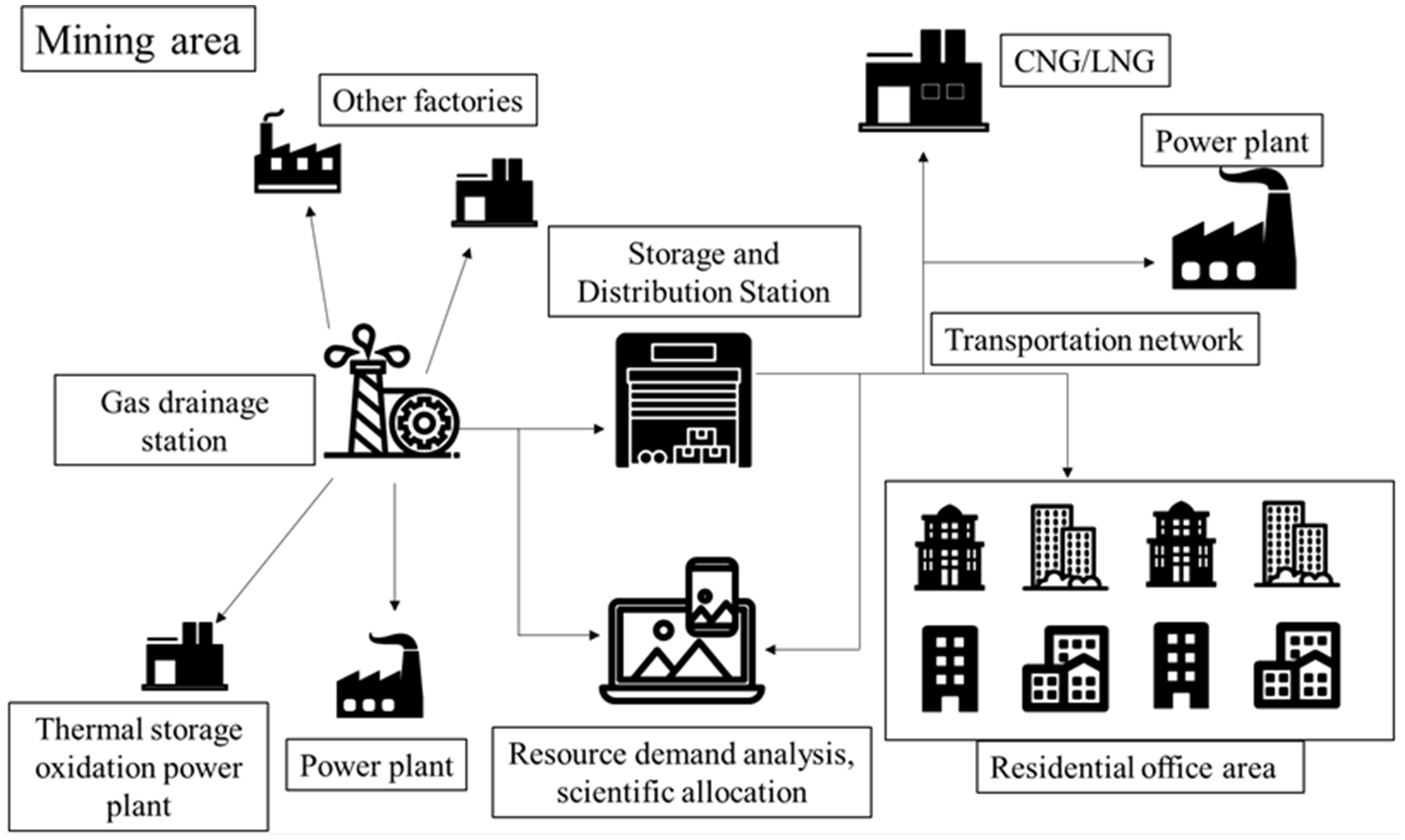
The “full spectrum-domain-time” CBG utilization model in mining area.
CBG utilization technology and its application in Yangquan Coal Group
Overview of Yangquan Coal Group
Shanxi Yangquan Coal Group currently has 40 production and infrastructure coal mines distributing in Taiyuan, Yangquan, Jinzhong, Linfen, Xinzhou and Shuozhou, Shanxi Province, China. Among them, there are 9 outburst mines, 16 high gas concentration mines, and 15 low gas concentration mines. A total of 54 sets of main ventilators are installed with a total installation power of 102 million kW and the actual ventilation volume of ∼6,40,400 m3/min. A total of 157 extraction and discharge pumps are installed in 34 ground pumping stations with installation power of 130,000 kW and installation capacity of 98,000 m3/min.
Yangquan Coal Group started to utilize CBG in 1958 and established a specialized CBG branch in 1984. Since 1986, it has safely supplied a total of 6.55 billion cubic meters of commercial gas. At present, it has built a complete CBG storage and utilization system and formed a new pattern of large-scale CBG utilization in civilian and industrial power generation, purification and liquefaction, and other similar fields.
Application of the “full spectrum-domain” CBG utilization model in Yangquan Coal Group
As shown in Figure 3, under the “full spectrum” utilization model, Yangquan Coal Group could process and utilize CBG with methane concentration ≥0.2% under the promise of ensuring normal apparatus operation. By doing so, it basically achieved joint recovery of coal and gas and reduced extravagance of resources and occurrence of disasters, thus ensuring the safety of coal mine production. The exhaust air with methane concentration < 1% in coal mine is used for power generation after mixed with CBG or for heating after mixed with air. Similarly, the exhaust air with methane concentration of 1–10% is also used for power generation after mixed with CBG with higher methane concentration or for heating after mixed with air. Gas with methane concentration of 10–20% is used for power generation using related technologies for low concentration gas and for production of pipeline network gas after purification. Gas with methane concentration of 20–30% is used to produce CNG and LNG using pressure swing adsorption (PSA) purification technology. Gas with methane concentration > 30% is used for power generation, supplying gas to urban pipeline network, as well as production of CNG and LNG using cryogenic liquefaction purification technology.
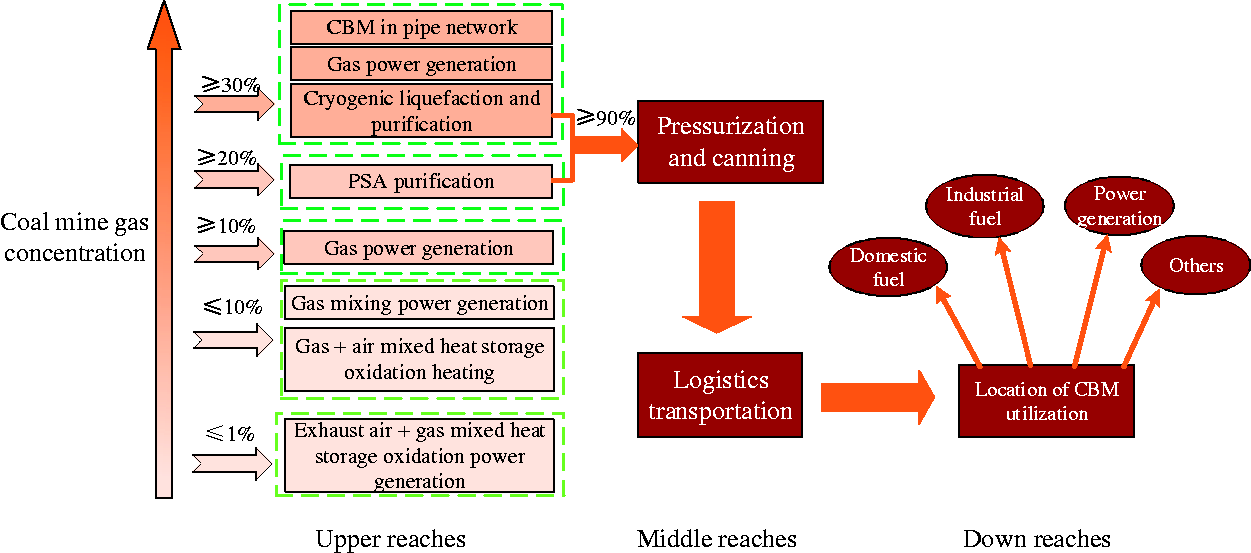
The “full-spectrum” CBG utilization model in Yangquan Coal Group.
Under the “full domain” utilization model, Yangquan Coal Group currently has established 14 gas storage and distribution stations, 3 gas relay pressurization stations, and 154 pressure regulation stations with a total storage/distribution capacity of 3,60,000 m3, a total installed capacity of 16762 kW, more than 590 kilometers of laid low- and medium-pressure pipeline networks, and up to 1,379 square kilometers of pipeline network coverage areas. Thus, the group has been able to fully supply CBG for the entire mining area. Figure 4 shows a schematic diagram of the supply pipeline network of high-concentration gas with the methane concentration > 30%.
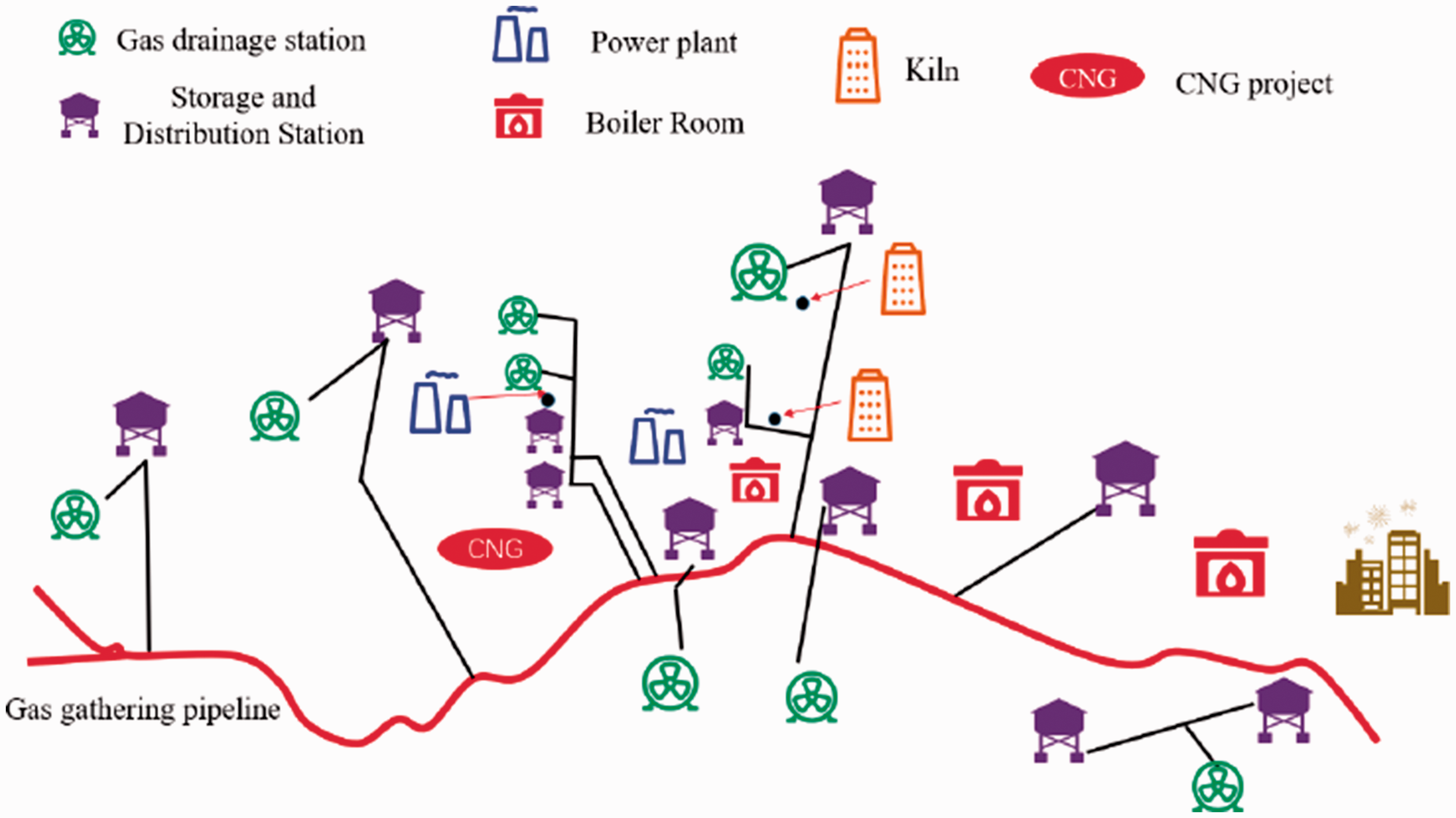
The “full-domain” CBG supply model in Yangquan Coal Group.
Application of the “full time” CBG utilization model
Based on the realization of both “full spectrum” utilization and “full domain” supply of CBG, the “full time” utilization model was proposed to complete a reasonable allocation of CBG resources, that is, to manage CBG demand from both temporal and spatial angles, predict the evolution trend of CBG demand using the time series algorithm and provide historical CBG production and usage data in the future. Overall, we were able to predict the short-term CBG demand in different regions from January 2017 to November 2019 using data from four gas supply centers in Laoqu, Wukuang, Xiyang and Shouyang. The usage data comes from the coalbed methane utilization branch of Yangmei Group. Figure 5 is a sequence diagram of the raw data for 35 months.
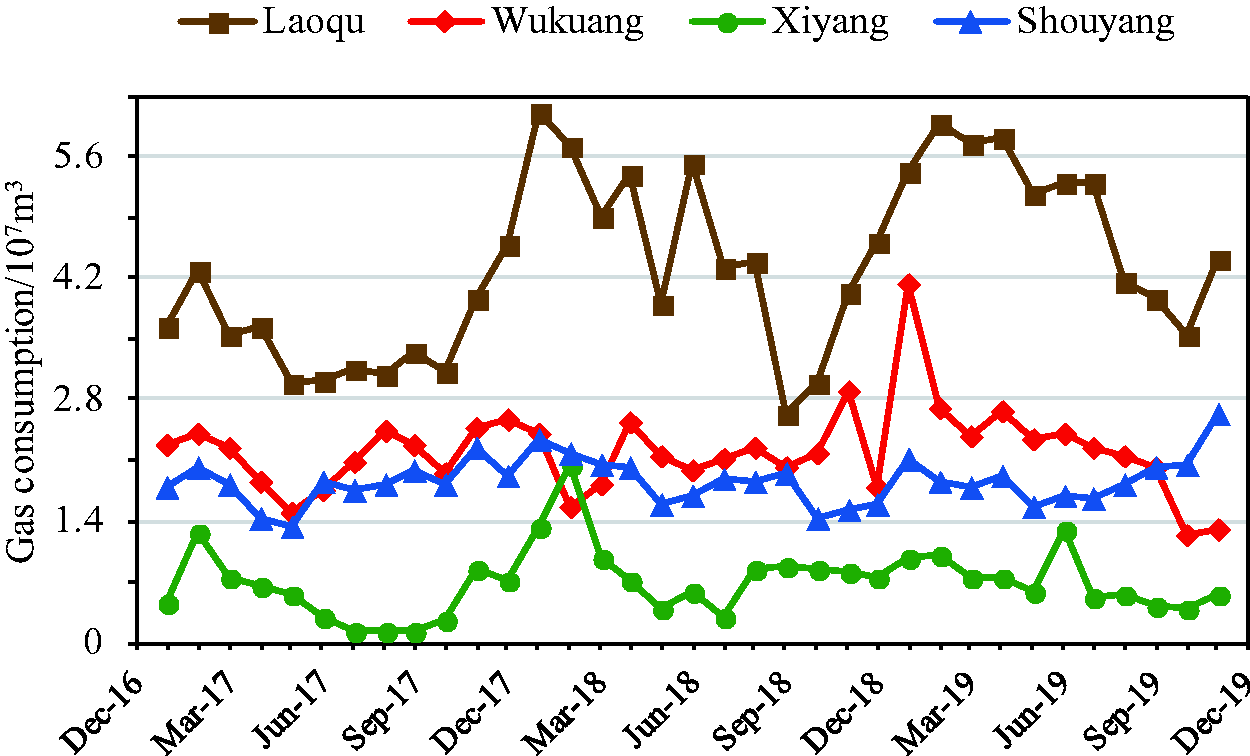
Gas consumption in four different regions within 35 months. (a) Gas demand in Laoqu as well as the fitting and prediction results. (b) Gas demand in Wukuang and the fitting and prediction results. (c) Gas demand in Xiyang as well as the fitting and prediction results. (d) Gas demand in Shouyang as well as the fitting and prediction results.
The above four sets of data were imported into SPSS, and the variable attributes and dates are defined. An expert modeler was used to automatically select an exponential smoothing model or ARIMA model to fit and predict the data based on the characteristics of the data with considering the seasonality and periodicity. The prediction data is set as the gas consumption data from December 2019 to June 2020. Figure 6 shows the predicted results of gas consumption in four different regions. The parameters of the prediction model are shown in Table 1. In the Figure 6 and Table 1, LCL is the lower limit of confidence interval, UCL is the upper limit of confidence interval, RMSE is the root mean square error, MAPE is the mean absolute percentage error, and MAE is the average absolute error.
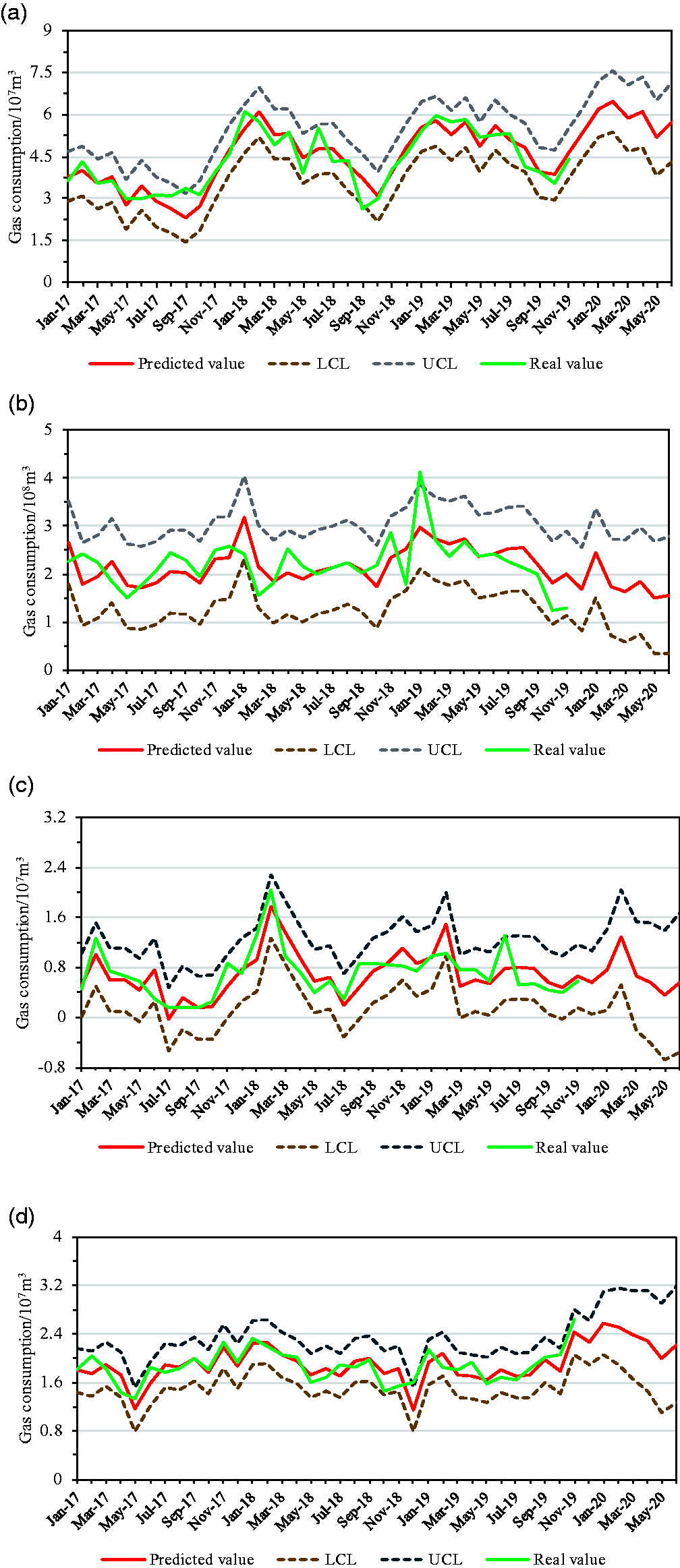
Time series prediction results.
Predictive model statistics.
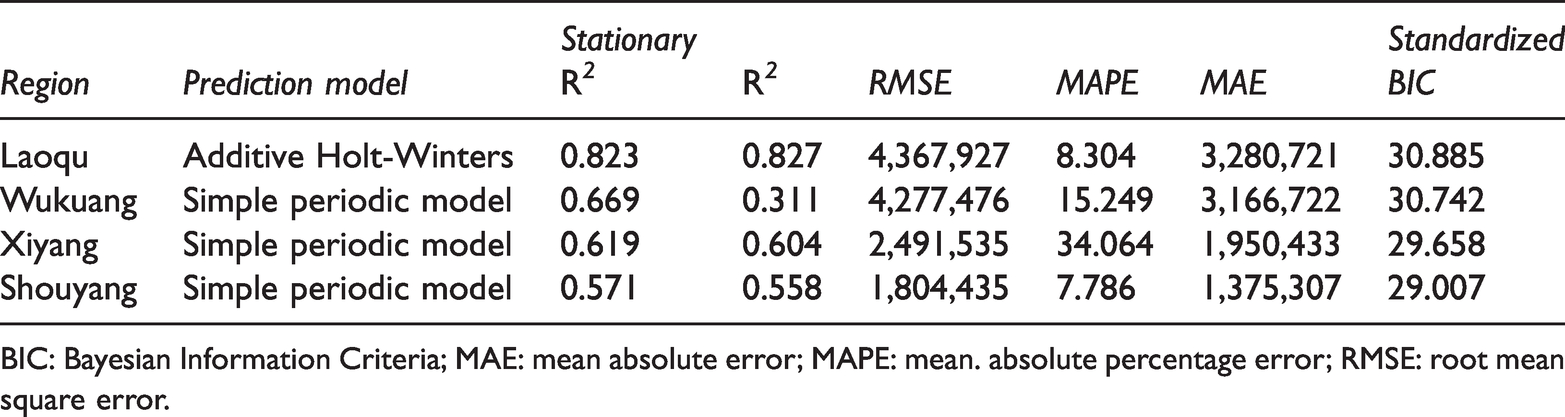
BIC: Bayesian Information Criteria; MAE: mean absolute error; MAPE: mean. absolute percentage error; RMSE: root mean square error.
It can be seen from the prediction results (Figure 6 and Table 1) that the model most suitable for predicting the demand in Laoqu is the additive Holt-winters model, which shows a high fitting degree with a R2 of 0.827 and a mean absolute percentage error of 8.304. The model most suitable for predicting the demand in Wuchuang is the simple periodic model, which has a mean absolute percentage error of 15.249 and an average absolute error of 3.2E6. The prediction effect of time series for Xiyang is not ideal because it has a mean absolute percentage error of only 34.064, which is mainly due to the fact that Xiyang is a suburb area where new equipment is just put into operation and the old one is just shut down, so that the gas consumption law there is poorly understood, leading to poor prediction. The reasonable prediction model for CBG demand in Shouyang area is also the simple periodic model, which has a mean absolute percentage error of 7.786 and a mean absolute error of 1.4E6. Therefore, the exponential smoothing model is more accurate for predicting CBG demand in the mining area.
The result of demand prediction shows that the demand of CBG in Laoqu will increase first and then decrease in the next half year. The demand for CBG in Wuchuang shows a downward trend. The demand for CBG within the scope of Xiyang is relatively stable, but the demand will increase sharply in February 2020 and need to be well controlled. The demand in the Shouyang area is relatively stable.
Application results and accomplishment
According to the industrial plan, by the end of the 13th Five-Year Plan, the total pure CBG production of Yangquan Coal Group will reach 2.2 billion m3. Among them, 1,677.4 million m3 will be utilized, with utilization rate of 77.15%, which is far over the goal of 50% in the Five-Year Plan. Besides, Figure 7 shows the situation of CBG utilization of Yangquan Coal Group from 2014 to 2019. It can be seen that the amount of CBG utilization shows a year-by-year increasing trend. Of them, power generation from low-concentration CBG also shows an increasing trend. Therefore, application of the “full spectrum-domain-time” CBG utilization model has achieved good results in Yangquan Coal Group as the consumption of low-concentration CBG increases annually and the utilization rate is far above the average in China.
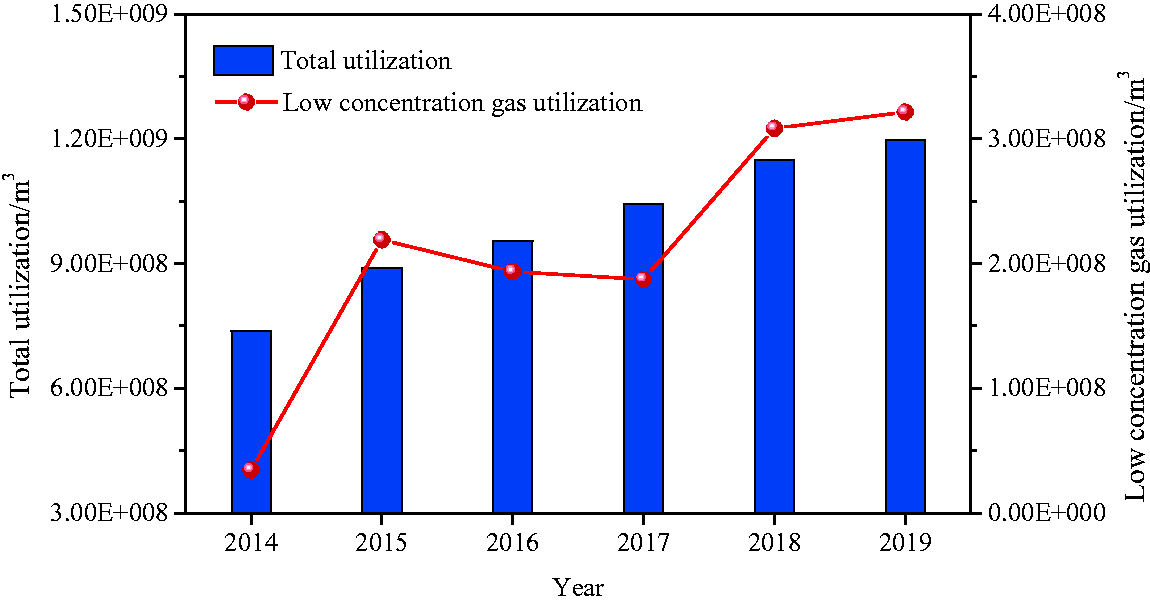
CBG utilization in Yangquan Coal Group from 2014 to 2019.
Conclusion
Although CBG extraction in China is increasing annually, its utilization rate has been very low. Therefore, developing CBG utilization and allocation system is of great significance. In this study, we put forward a “full spectrum-domain-time” CBG utilization model and applied the model in Yangquan mining area. Driven by this model, the utilization of low concentration gas in the mining area has increased significantly, and the utilization rate of CBG far exceeds the average level in China.
In the future, the research and development of low concentration gas utilization should be increased by establishing 1) more CBG utilization demonstration project construction models, 2) full-scale technological innovation models and management systems under different conditions, 3) a collaborative information sharing mechanism for scientific research, technological innovation and engineering construction and 4) a safe, efficient and scientific CBG utilization model.
Footnotes
Declaration of conflicting interests
The author(s) declared no potential conflicts of interest with respect to the research, authorship, and/or publication of this article.
Funding
The author(s) disclosed receipt of the following financial support for the research, authorship, and/or publication of this article: This study was supported by the “Thirteen-Five” National Science and Technology Major Issues of Special Tasks of China (2016ZX05045-006-002), the key projects of Science and Technology Innovation and Entrepreneurship Fund of Tiandi Technology Co., Ltd (2019-TD-ZD004), the key projects of China Coal Science and Industry Group Chongqing Research Institute Co., Ltd (2018ZDXM06).
Authors’ contributions
Jianshe Linghu wrote the article; Jinhua Chen designed and performed the experiment; Jianbin Zhou performed the experiment; Wangang Jiang collected the data.
Availability of data and materials
Raw data will be made available by the authors, without undue reservation, to any qualified researcher on request.
Consent for publication
All participants consented the confidential publication of their contributions in this study.
