




Abstract
To optimize the arrangement of a network of surface boreholes for abandoned gob methane extraction, a method for regional division of abandoned gobs based on their connectivity is proposed. Based on vertical and horizontal connectivity criteria, the abandoned gobs in Yangquan Coal Mine No. 3 are divided into 28 regions. Based on the abandoned gob methane sources, a calculation model for abandoned gob methane reserves is established. The abandoned gob methane reserves of connected regions in Yangquan Coal Mine No. 3 are predicted by using the developed estimation model. An abandoned gob methane extraction field test was conducted, and the results showed that the methane flow rate of vertical borehole #1 reached 3.6 m3/min. Based on the test results of vertical borehole #1 and the abandoned gob methane reserve calculation in the connected region, surface boreholes in a connected region were arranged in Yangquan Coal Mine No. 3.
Introduction
Abandoned gob methane (AGM) is a source of clean energy, and its calorific capacity per cubic meter can reach 33.5–36.8 MJ, which is equivalent to that of 1.22 kg of standard coal or 1.13 l of standard oil (Jackson and Kershaw, 1996; Qian, 2016). AGM extraction technology is used to extract the methane desorbed from the residual coal, coal pillars, and adjacent coal seams in abandoned gobs (Qian et al., 2003). The exploitation and utilization of AGM can not only greatly reduce the greenhouse effect caused by the AGM escaping to the atmosphere but also achieve considerable economic benefits.
In countries other than China, research efforts on AGM extraction and utilization are under rapid development. In the late 1970s, four long horizontal boreholes were drilled into the Pittsburgh coal in Pennsylvania from a section of a mine that had been abandoned for 2.5 years, and the cumulative methane production was 7.2 × 10⁶ m3 (Karacan et al., 2011). In 2001, an important coal-bed methane (CBM) development was the exploitation of methane from abandoned mines. Six AGM exploitation schemes producing an equivalent of 42.5 MWe are operational in the UK (Creedy et al., 2001). In Germany, the first power generation utilization plants from mine gas in the abandoned area of the Ruhr district were put into operation in 1997 in Herne, and Hangard, Kohlwald, and Sinnerthal produce 51 × 106 m3 of AGM annually, of which 92% is used by industry (Burrell and Kershaw, 2000; Kunz, 2004).
At present in China, there is less information on AGM extraction, and the relevant research efforts are rare. In the end of 2000, China and Britain jointly pursued an abandoned mine methane extraction and utilization project in China, and corresponding theoretical research on aspects such as resource prediction, monitoring technologies, and resource exploitation and utilization was conducted. Guo and Zhang (2003) gave a brief description of the gas resource amount in abandoned mines. Han et al. (2004) studied methods to determine the calculation limits of the CBM resource of abandoned coal mines based on the “three-zone” theory, and several methods to determine the limits of the resource calculation were provided. Zhang (2007) analyzed gas compositions in abandoned coal mines and introduced a method for calculating the volume of the AGM resource. However, investigation of the existing references reveals that the research efforts on AGM extraction in China are mainly limited to reservoir description and resource prediction, none of which relate to the arrangement of a network of surface boreholes for AGM extraction.
For a specific mine, the arrangement of a network of surface boreholes for abandoned gob gas extraction includes the following four steps: (1) The abandoned gobs of the mine are divided into different regions. (2) Calculation of AGM reserves is performed in different regions. (3) A field test of the first vertical borehole in a region is conducted. (4) The number and specific locations of surface boreholes are determined based on methane flow rate of the first vertical borehole and the AGM reserves calculation result in a region. According to the above steps, in this paper, a method for regional division of abandoned gobs based on their connectivity is proposed.
Yangquan Coal Mine No. 3 is an abandoned coal mine, and its main production layers are coal seams #3, #12, and #15. Based on the criterion of abandoned gob connectivity, a regional division was performed in Yangquan Coal Mine No. 3 in China. A calculation model for the AGM reserve using the different-source method was established. AGM reserves in the connected region of Yangquan Coal Mine No. 3 were predicted by using a reserve calculation model. A field test of AGM extraction through a vertical borehole was conducted. Based on the test results and the AGM reserve calculation in the connected region, surface boreholes in a connected region were arranged in Yangquan Coal Mine No. 3.
Regional division of abandoned gobs based on their connectivity
Regional division of abandoned gobs is a prerequisite for the arrangement of a network of surface boreholes, and the criterion for connectivity between abandoned gobs is the basis for regional division. The connectivity between abandoned gobs refers to the boundary intersection of the gas flowing fracture zones (GFFZs) above adjacent abandoned gobs, and it has two meanings:
horizontal connectivity, that is the boundary intersection of the GFFZs above adjacent abandoned gobs in the same coal seam; vertical connectivity, that is the boundary intersection of the GFFZs above abandoned gobs in different coal seams in the vertical direction.
Horizontal connectivity between abandoned gobs
Criterion for horizontal connectivity
The width of the coal pillar between abandoned gobs determines the horizontal connectivity between those abandoned gobs. As shown in Figure 1, if the width (D) of the coal pillar is greater than the sum (d1 + d2) of the lateral boundaries of the GFFZs on any same height above two adjacent abandoned gobs, then these two abandoned gobs are separated by the coal pillar. If the width of the coal pillar is less than the sum of the lateral boundaries of the GFFZs on a same height above two adjacent abandoned gobs, then the GFFZs above two adjacent abandoned gobs intersect each other, and the two abandoned gobs are connected. Because the geological and mining conditions are similar between adjacent working faces, one can consider the lateral boundaries of the GFFZs on the same height above the abandoned gobs of these two working faces to be equal, that is d1 = d2; therefore, as long as the width of the coal pillar is less than twice the maximum distance between the lateral boundary of the GFFZ and the mining boundary, these two abandoned gobs are connected.
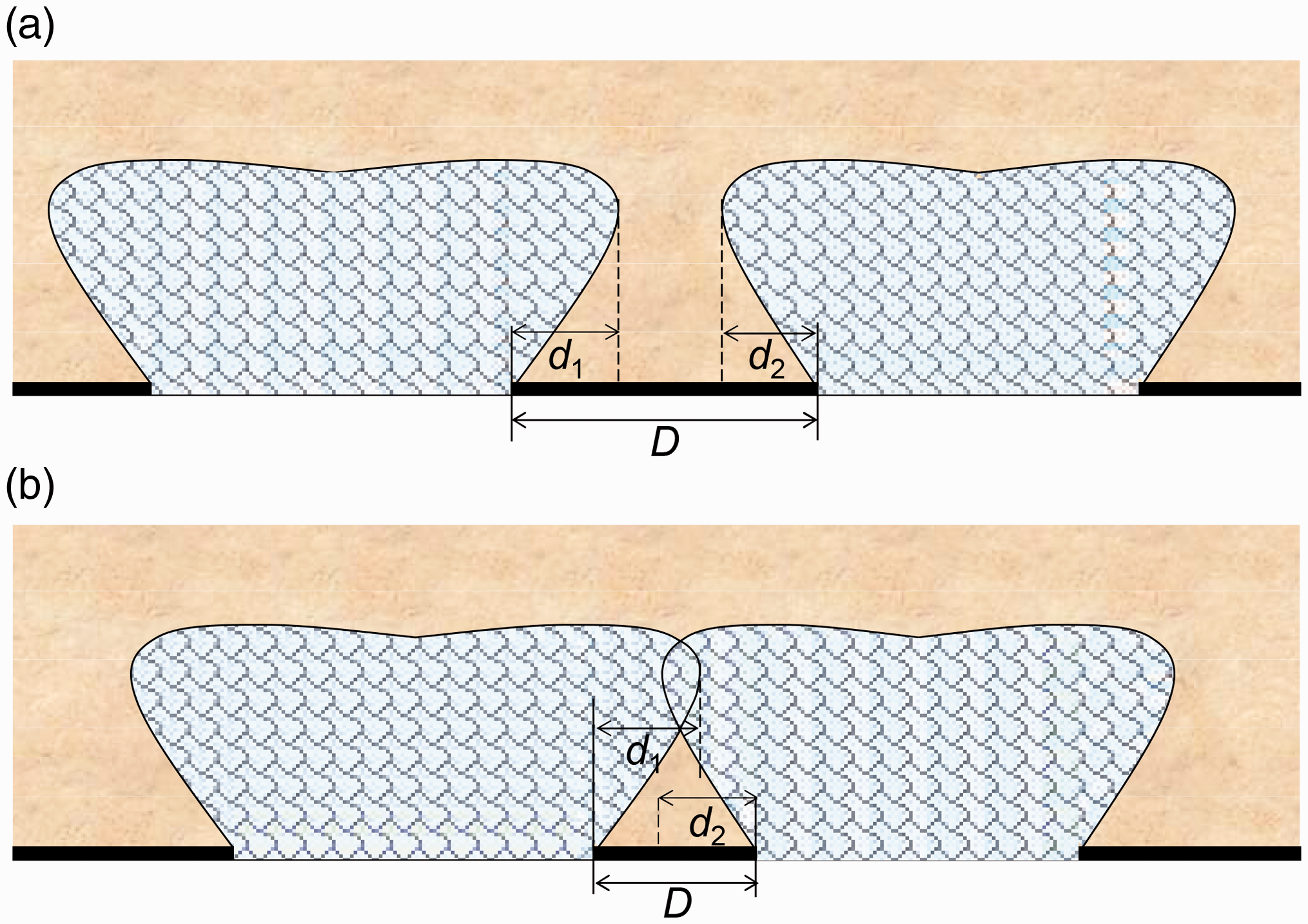
Schematic diagram of horizontal connectivity between abandoned gobs: (a) Disconnected horizontally, two unconnected abandoned gobs and (b) connected horizontally, two interconnected abandoned gobs.
During mining of a coal seam, the variation of stress in a coal rock mass significantly influences the deformation and failure characteristics of the coal rock mass. After the overlying coal rock above the gob is broken, the horizontal stress in the coal rock masses beyond the breaking line decreases significantly; meanwhile, under the effect of lateral abutment pressure, plastic failure occurs in the coal rock masses, and the fractures in the coal rock masses develop and run through (Figure 2). Therefore, the position of the peak of the lateral abutment pressure can be used as the identification criterion for the lateral boundary of the GFFZ.
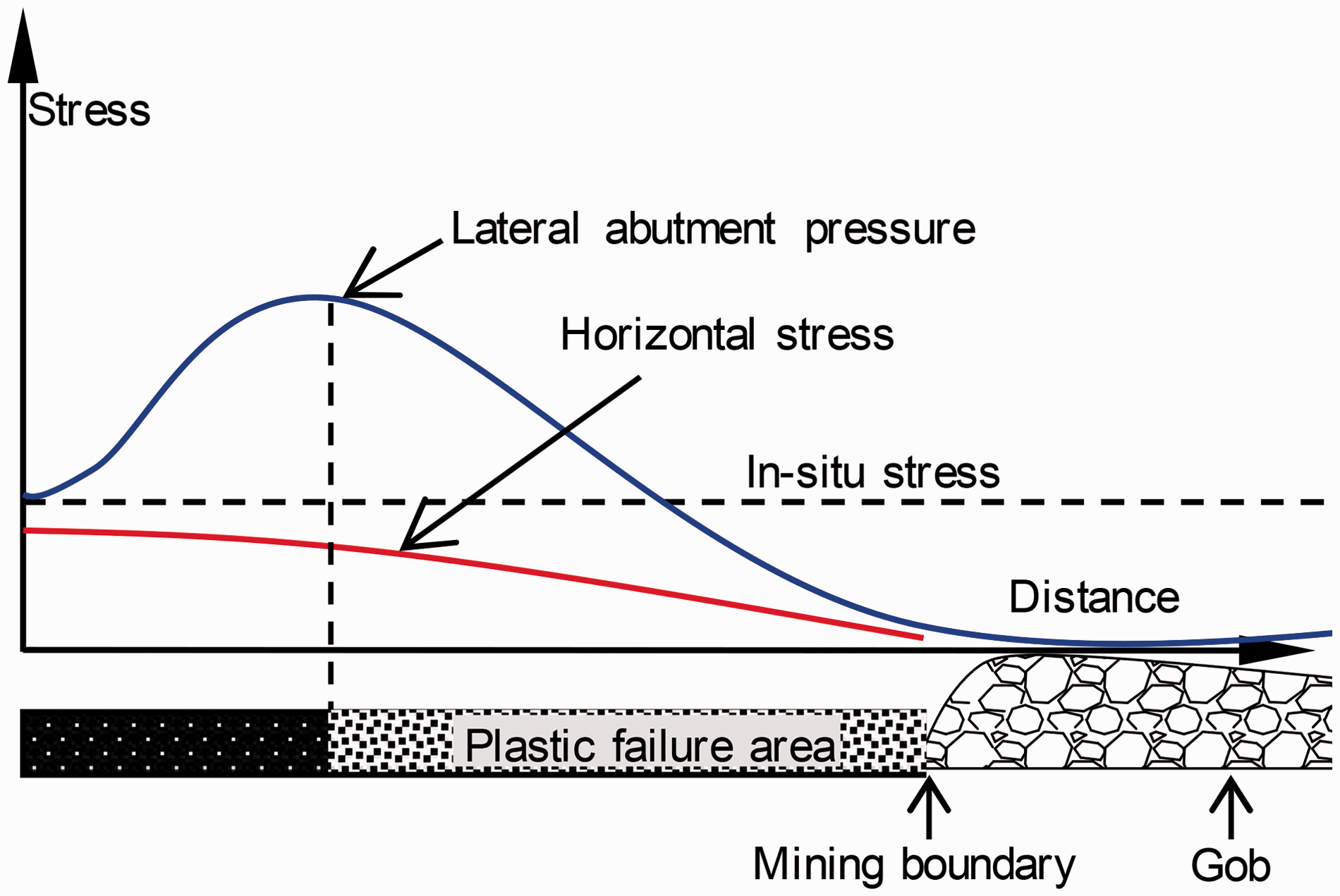
Influence of the variation of stress in coal rock masses on the development of mining-induced fractures.
Numerical simulation
Based on the geological conditions of Yangquan Coal Mine No. 3, a numerical model for dip direction was established. The model had a length of 500 m and a height of 186 m; the working face length was 250 m, with a 125 m coal pillar left on each side. The top boundary load on the model was applied based on the weight of the rock with a thickness of 314 m, the left and right boundaries of the model were fixed in the horizontal direction, and the bottom boundary was fixed in the vertical direction. The material constitutive model used was an ideal elastoplastic constitutive model with a Mohr–Coulomb yield criterion. This model could simulate the variation laws of the lateral boundary of the GFFZ under different conditions conveniently by allowing parameters such as mining height and mining depth to be changed. The structural schematic diagram of the model is shown in Figure 3.
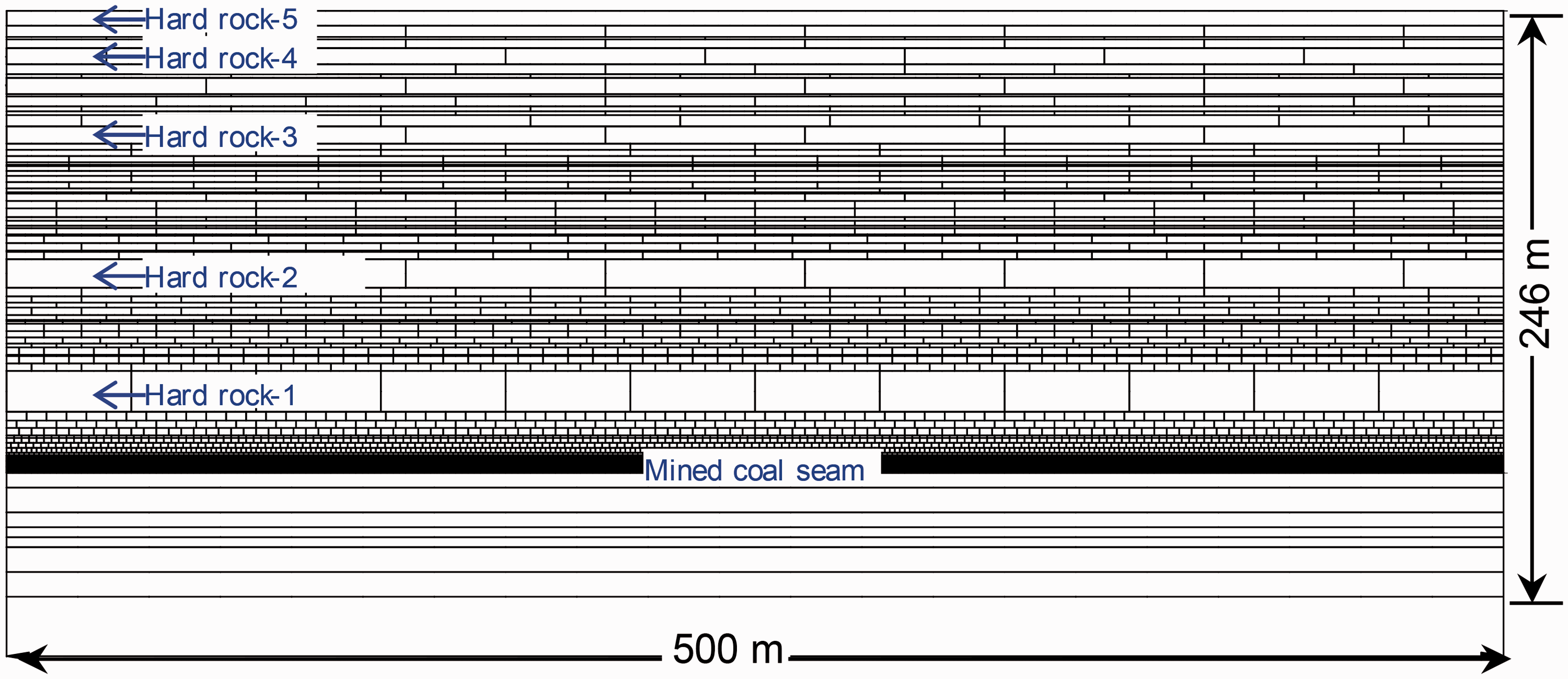
Structural schematic diagram of the model.
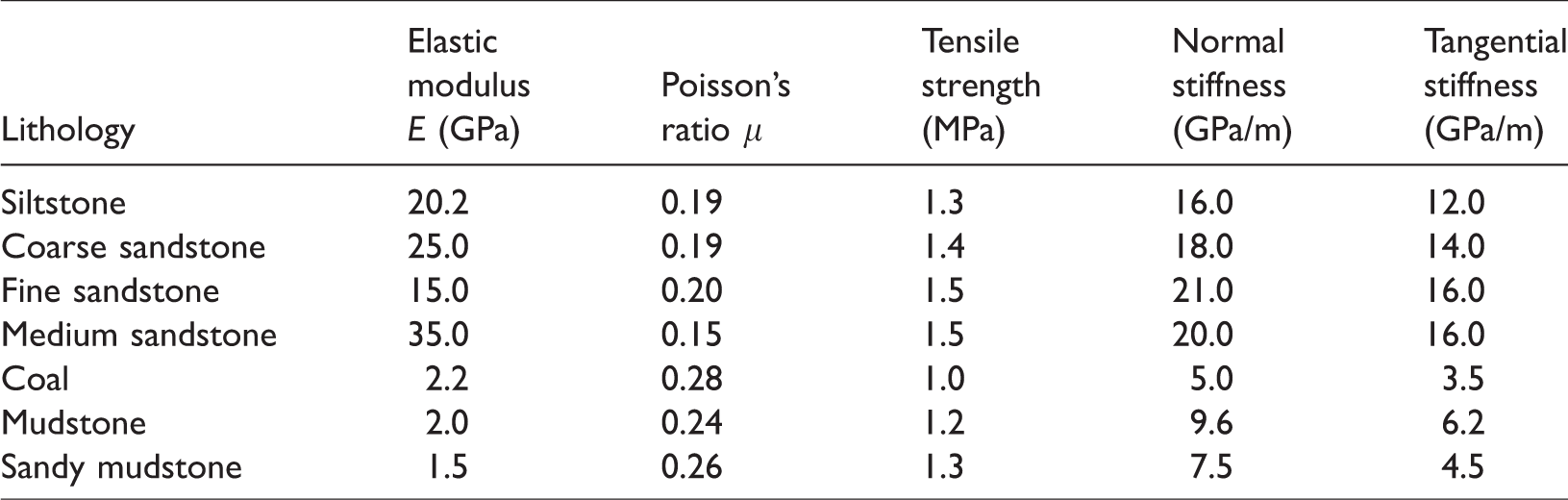
Table 1 lists the mechanical parameters of the overlying rock strata above the gob based on the lithological measurement results of the roof in Yangquan Coal Mine No. 3.
Physical and mechanical properties of rock strata.
Simulation results
To study the influence of the mining height on the development of the lateral boundary of the GFFZ, numerical calculation models were established for simulation with mining heights of 1, 2, 3, 4, 5, 6, and 7 m, respectively. To study the influence of the mining depth on the morphological development of the lateral boundary of the GFFZ, mining depths were set as 300, 400, 500, and 700 m by changing the boundary load based on the geological conditions in Yangquan Coal Mine No. 3.
Figure 4 shows the variation of the lateral boundary of the GFFZ under different mining heights and mining depths.
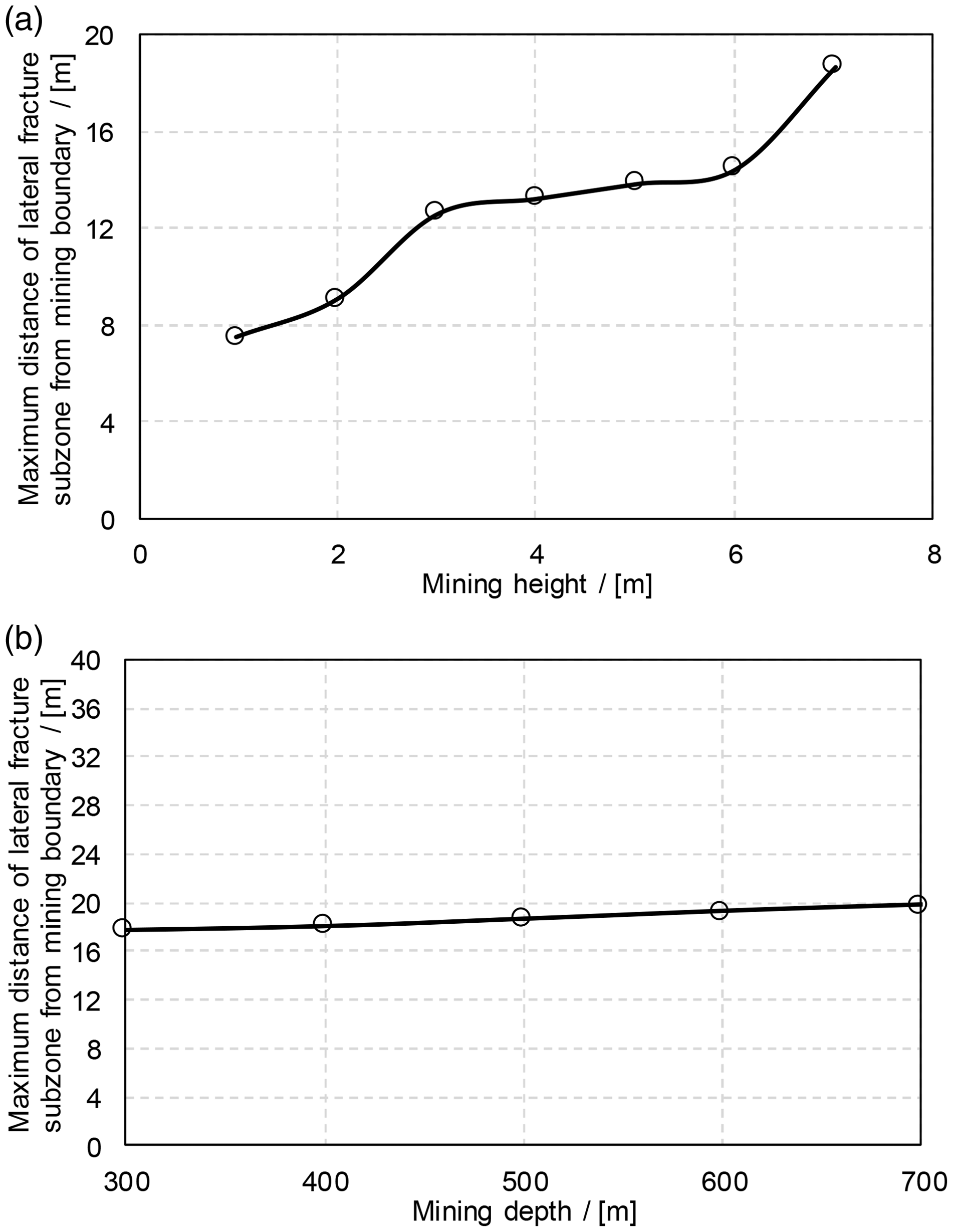
Variation of the lateral boundary of the GFFZ under different (a) mining heights and (b) mining depths.
As can be discerned from Figure 4(a), the maximum distance between the lateral boundary of the GFFZ and the mining boundary increased with the increase of mining height. It can be seen from Figure 4(b) that, with the increase of mining depth, the outer boundary line of the GFFZ tended to move away from the mining boundary, which, however, was not very conspicuous. When the mining depth increased from 300 to 700 m, the maximum distance between the lateral boundary of the GFFZ and the mining boundary increased by 2 m.
In conclusion, the mining height is the main factor influencing the maximum distance between the lateral boundary of the GFFZ and the mining boundary.
Vertical connectivity between abandoned gobs
Criterion for vertical connectivity
Under the mining conditions of the coal seam group, the development height of the GFFZ above the lower coal seam determines the vertical connectivity between abandoned gobs. As shown in Figure 5, if the distance between coal seams is greater than the height of the GFFZ above the lower coal seam, that is h > H, the abandoned gobs of these two coal seams are not connected; if the upper coal seam is in the range of the height of the GFFZ above the lower coal seam, that is h < H, the abandoned gobs of these two coal seams are interconnected.
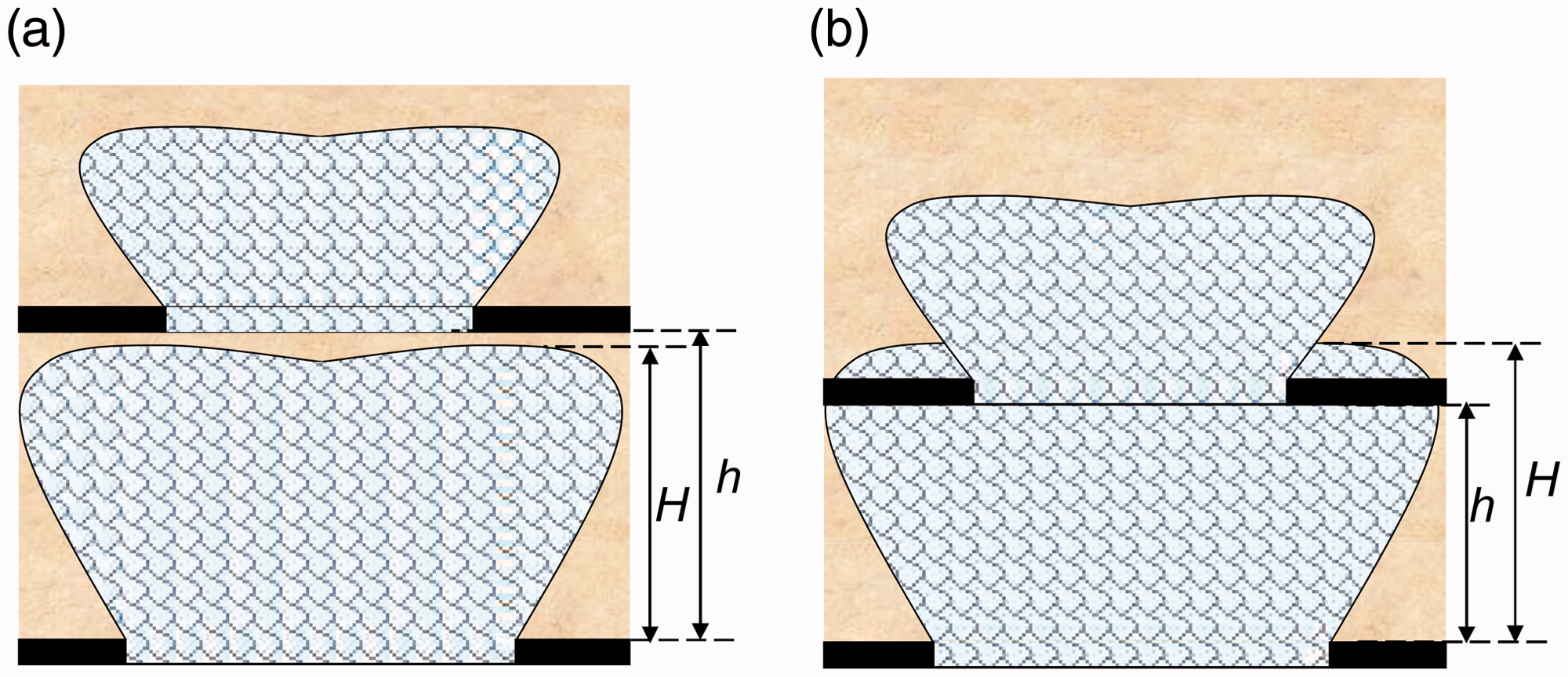
Schematic diagram of vertical connectivity between abandoned gobs: (a) Disconnected vertically, two unconnected abandoned gobs and (b) connected vertically, two interconnected abandoned gobs.
GFFZ height determination
The hard rock strata, which have controlling effects on the movement of overlying rock strata, are called key strata. A hard rock stratum that has a controlling effect on a group of rock strata is called a subkey stratum, and a hard rock stratum that has a controlling effect on its upper layer through surface strata is called a primary key stratum (Qian et al., 1996; Xu and Qian, 2000). Based on the geological borehole column in Yangquan Coal Mine No. 3, the positions of the key strata were identified using the key stratum identification software KSPB; the identification results are shown in Figure 6. As can be discerned from Figure 6, there are five subkey strata and one primary key stratum existing in the overlying rock strata of Yangquan Coal Mine No. 3.
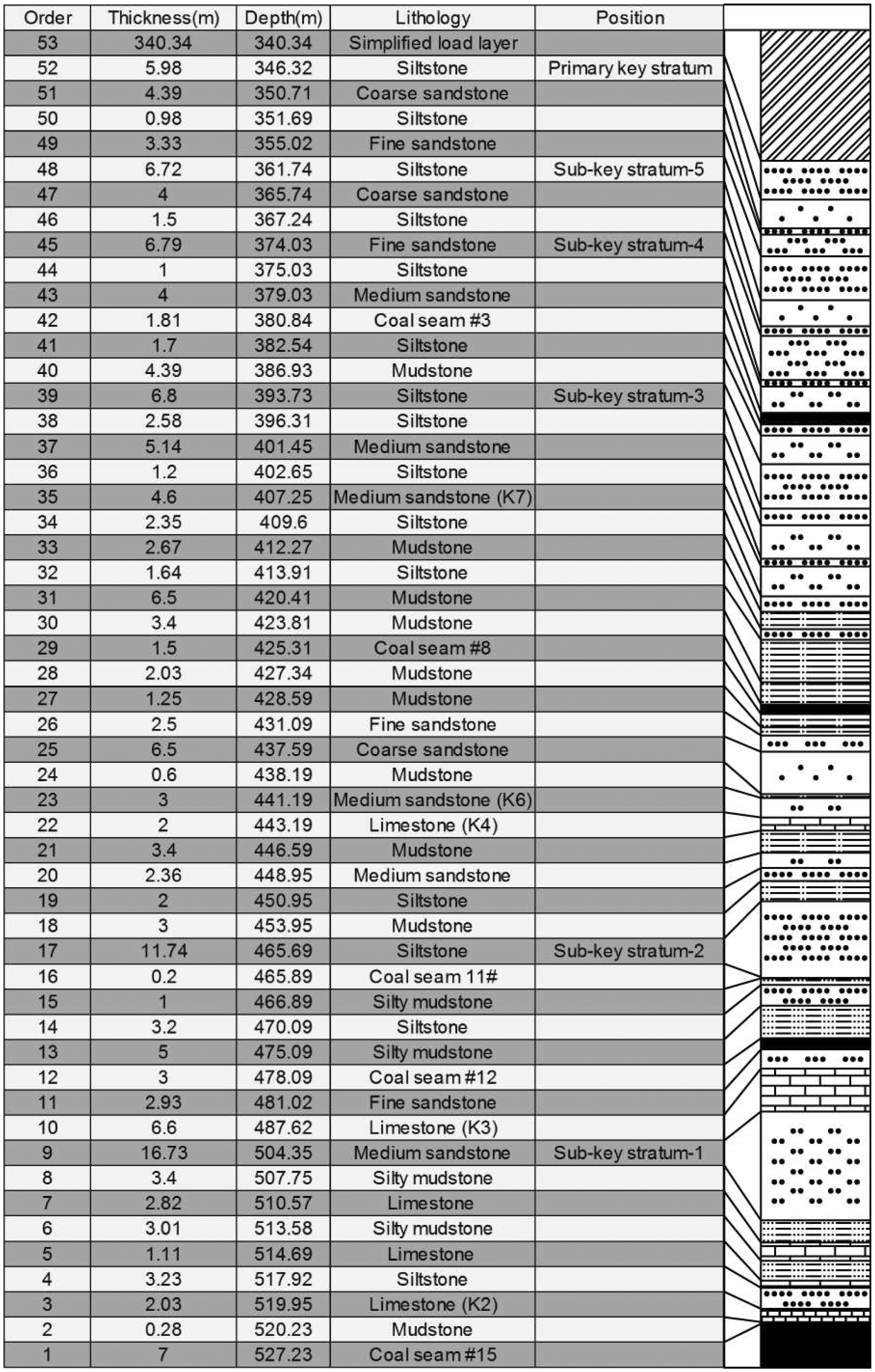
Key strata identification in Yangquan Coal Mine No. 3.
Research results in the literature (Xu et al., 2012) show that the position of a primary key stratum has a significant influence on the height of the water flowing fracture zone. For simplicity, we consider the height of the water flowing fracture zone to be the height of the GFFZ. Based on previous studies, a method for determining the height of the GFFZ based on the location of the key stratum was given. The steps are as follows (Figure 7).
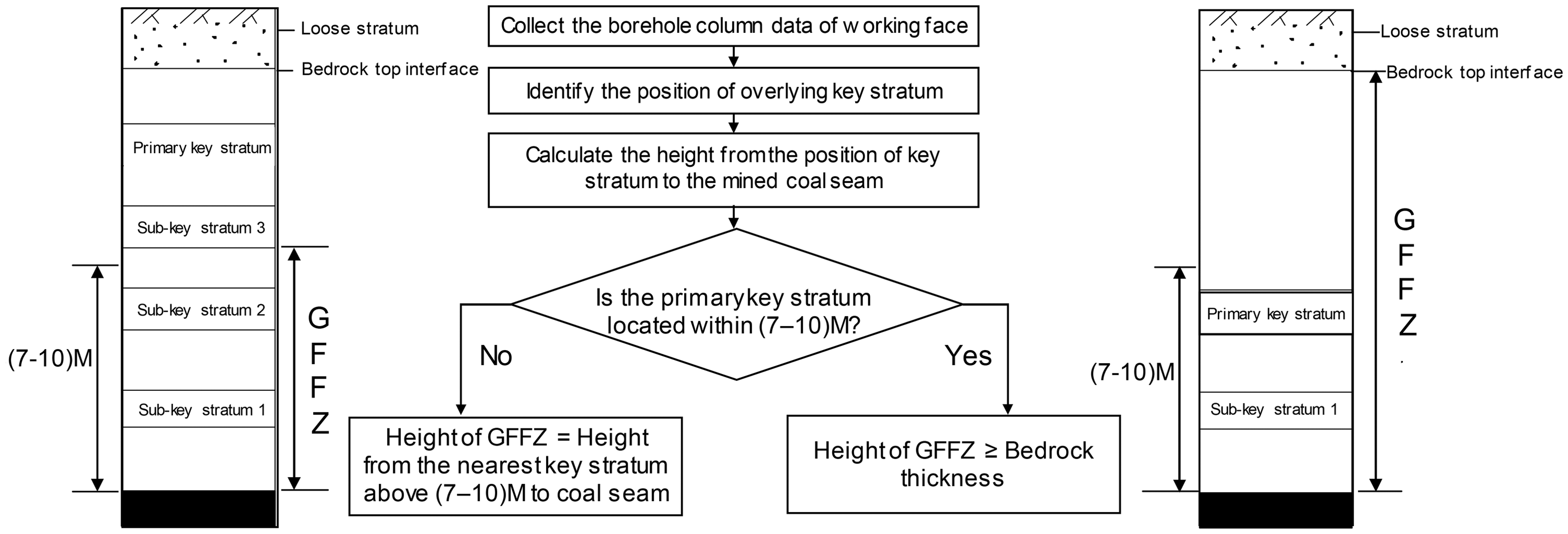
Prediction method flowchart for determining the height of the GFFZ based on the position of the key stratum. GFFZ: gas flowing fracture zone.
The distance from the primary key stratum to coal seam #15 is 172.6 m. According to the prediction method in Figure 7, the height of the primary key stratum is a factor of >7–10 greater than the mining height of coal seam #15, so the GFFZ above coal seam #15 would be developed to the nearest key stratum by a factor of >7–10 greater than the mining height, that is to subkey stratum 3, which is 126.5 m from coal seam #15. Because coal seam #12 is in the range of the height of the GFFZ above the abandoned gob in coal seam #15, the abandoned gobs of these two coal seams are interconnected in the vertical direction. The position of coal seam #3 is higher than that of subkey stratum 3; therefore, the abandoned gobs in coal seam #3 are isolated with the abandoned gobs in coal seams #15 and #12 (Figure 8).
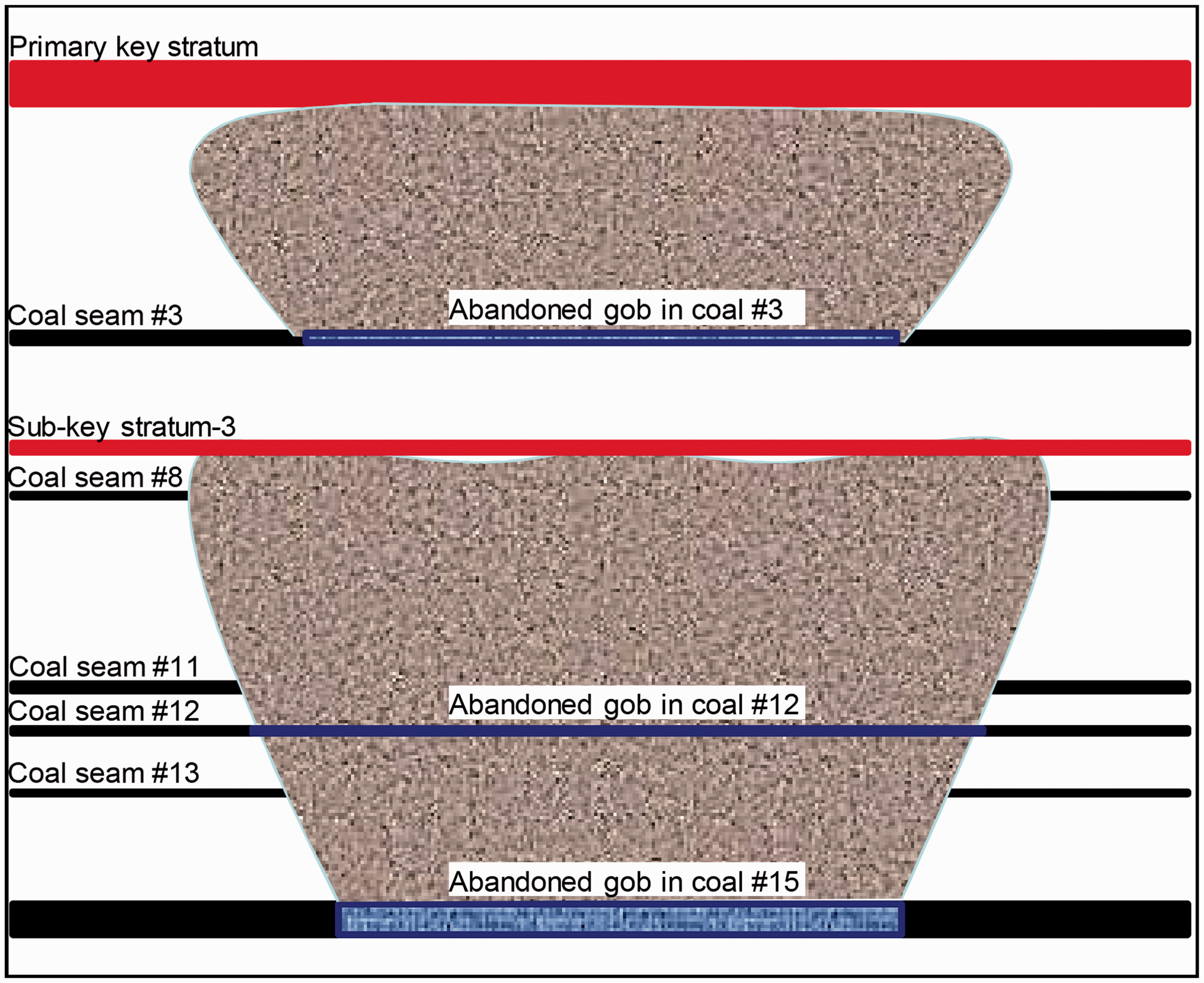
Vertical partition of abandoned gobs in Yangquan Coal Mine No. 3.
Regional division in Yangquan Coal Mine No. 3
If the boundary of the GFFZs above adjacent abandoned gobs intersects each other, the adjacent abandoned gobs can be regarded as one connected region. Our simulation results showed that mining height was the main factor influencing the maximum distance between the lateral boundary of the GFFZ and the mining boundary. The mining heights of coal seams #3, #12, and #15 are 2, 3, and 7 m, respectively; therefore, the critical widths of the coal pillar between adjacent abandoned gobs are 18, 25, 38 m, respectively, based on simulation results in Figure 4(a). If the width of the coal pillar in coal seams #3, #12, and #15 are less than 18, 25, and 38 m, respectively, the adjacent abandoned gobs in the same coal seam can be regarded as one connected region. Based on the above criteria, the regional division of Yangquan Coal Mine No. 3 is shown in Figure 9.
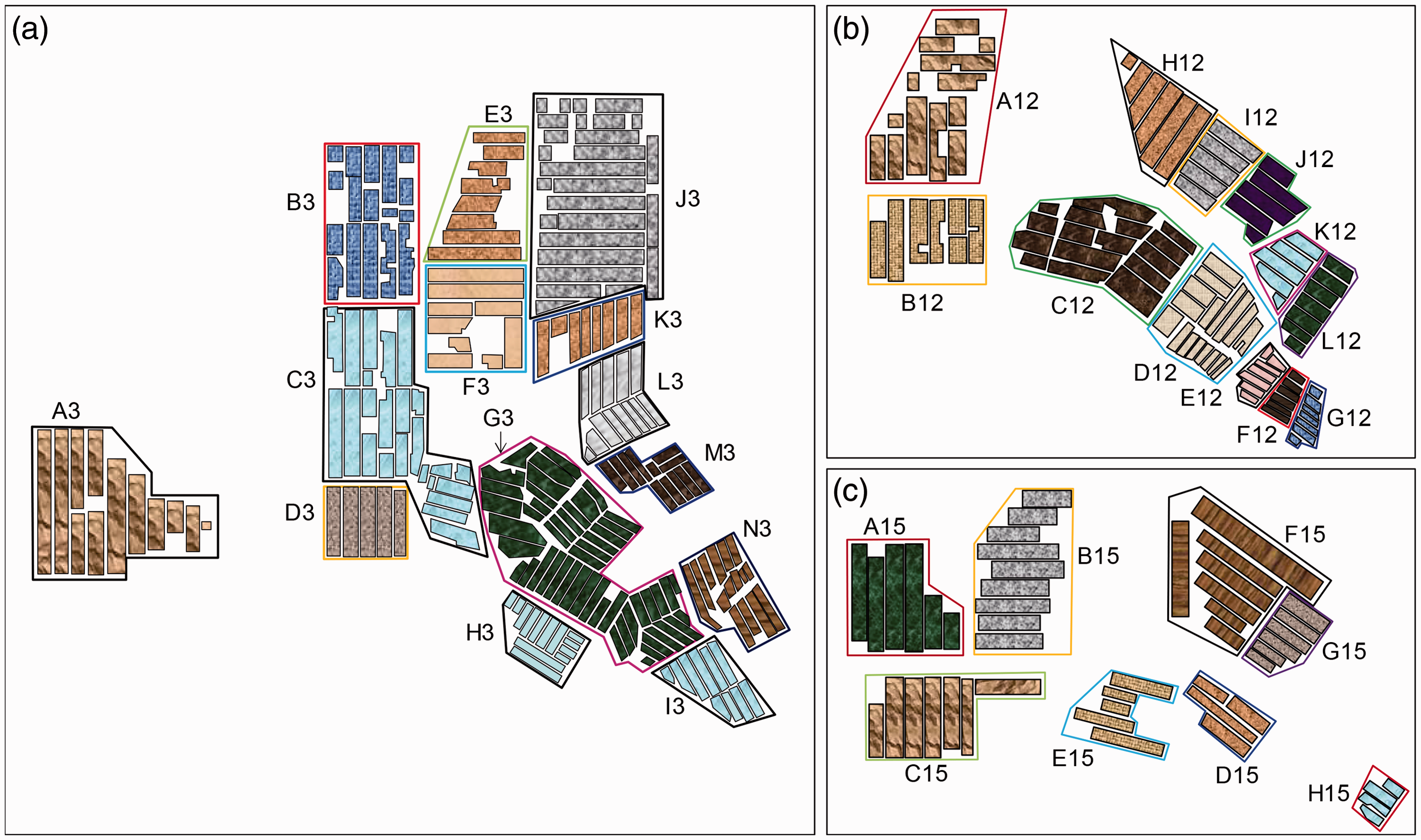
Regional division results in coal seams (a) #3, (b) #12, and (c) #15.
Based on the criteria for vertical and horizontal connectivity, the abandoned gobs in Yangquan Coal Mine No. 3 can be divided into 28 regions as follows: A3, B3, C3, D3, E3, F3, G3, H3, I3, J3, K3, L3, M3, N3, O3, P3, A12–A15–B15, B12–C15, C12–D15–E15, H12–F15, I12–G15, L12–H15, D12, E12, F12, G12, J12, and K12.
Calculation model for AGM reserves in the connected region
To maximize the AGM extraction benefits, multiple surface boreholes may be arranged in a connected region, but the optimal number of surface boreholes within a connected region should be determined by the AGM reserve in the region and the methane flow rate from the first surface borehole. In this paper, a prediction model for the AGM reserve is established using the different-source method according to the occurrence range of AGM.
AGM refers to methane that can be depressurized and desorbed within the mining-influenced range after a work surface is closed. Methane that is beyond the mining-influenced range or cannot be depressurized and desorbed within the mining-influenced range is not considered as AGM, because its occurrence state is not changed by coal mining. Using the traditional overlying “three-zone” theory one cannot completely identify the methane pressure relief and desorption boundaries of adjacent coal (rock) seams, so the overlying coal rock seams above abandoned gobs were divided into a GFFZ, a pressure relief and desorption zone (PRDZ), and an uneasy desorption zone (UDZ) by Hu et al. (2010) and Qu et al. (2015), as shown in Figure 10. Vertical penetrative fractures develop in the range of the GFFZ, where the methane flow mode was free flow in large fractures and seepage in small fractures. Within the range of the PRDZ, the coal seam methane is fully depressurized and desorbed, horizontal separation fractures develop, and there is a large amount of high-concentration methane accumulated in the separation space. There are no mining-induced fractures generated within the range of the UDZ, so the coal seam methane basically remains in its original occurrence state. Therefore, according to the definition of AGM in this paper, the methane existing in the GFFZ and in the PRDZ is AGM, the occurrence range of which is bounded by the height of the GFFZ and that of the PRDZ in the vertical direction and the mining-influenced range in the horizontal direction.
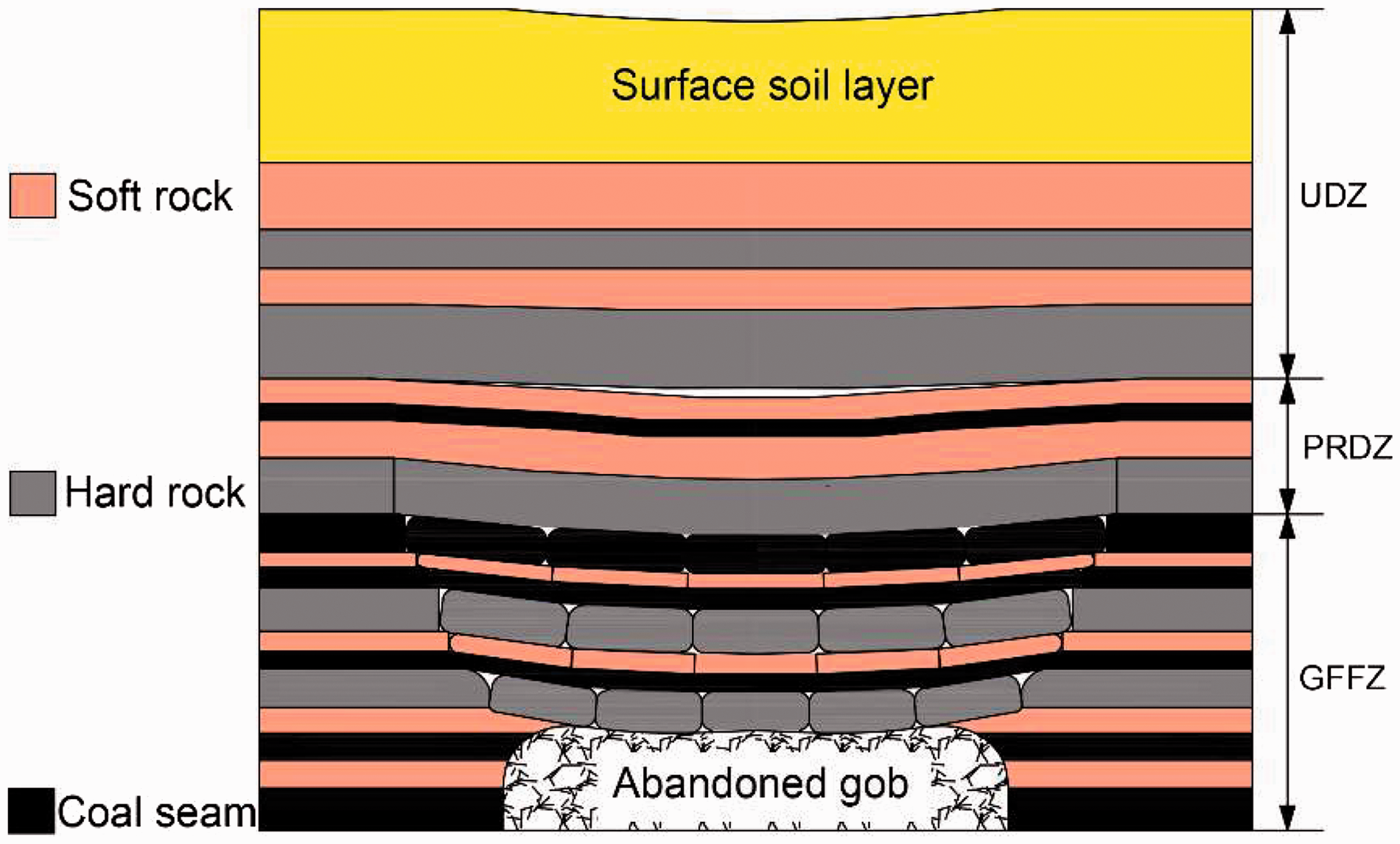
“Three zones” divided by relieved gas delivery. GFFZ: gas flowing fracture zone; PRDZ: pressure relief and desorption zone; UDZ: uneasy desorption zone.
As can be discerned from the occurrence range of AGM, there are three sources for AGM, i.e. the coal pillar in the abandoned gob, the residual coal, and the fully depressurized adjacent unmined coal rock seams.
AGM reserves within the range of the GFFZ
AGM reserves in residual coal
The amount of AGM reserves occurring in the residual coal is the difference between the primitive methane reserves of the residual coal and the emission quantity of the residual coal, which can be expressed as

AGM reserves in the coal pillar
There is a pressure release zone near the coal wall. The relationship between methane emission intensity and exposure time of the coal wall follows a negative power-law function (Wang et al., 2007). The amount of AGM reserves occurring in the coal pillar is the difference between the total methane emission quantity from the coal pillar and the methane emission quantity before the working face closed, which can be expressed as

AGM reserves in adjacent coal rock seams
A large quantity of pressure relief gas in the adjacent stratum within the range of the GFFZ rushes into the mining space during the mining process, and this continues after the working face is closed. The amount of AGM reserves occurring in adjacent coal rock seams within the range of the GFFZ can be calculated using

There is a negative relationship between the methane emission quantity of adjacent coal rock seams and the distance to the mining coal seam in inclined or slightly inclined seam mining, so the methane emission rate of the ith adjacent coal rock seams within the range of the GFFZ can be calculated using

AGM reserves within the range of the PRDZ
Because the gas emission quantity of adjacent coal and strata seams within the range of the PRDZ is very little while the working face is advancing, the amount of AGM reserves occurring in adjacent coal rock seams within the range of the PRDZ is as follows

According to the calculations shown above, the model for estimating AGM reserves can be expressed as

As can be discerned from equation (6) the mining velocity and mining rate at the working face are important factors influencing the AGM reserves in residual coal. The higher the mining velocity at the working face, the less the total amount of methane emission from this coal seam and adjacent coal rock seams, and the more the methane reserve remaining in the abandoned gob. The smaller the coal mining rate at the working face, the more the coal that remains in the abandoned gob, and the larger the methane reserves in the abandoned gob.
Model validation
To validate the correctness of the model, the AGM reserves were calculated for the K8206 working face in Yangquan Coal Mine No. 3 as an example.
General situation of the K8206 working face
Coal seam #15 at the K8206 working face in Yangquan Coal Mine No. 3 was mined, but none of coal seams #3, #8, #11, and #12 overlying the working face were mined. The methane contents in coal seams #3, #8, #11, and #12 were 18.2, 15.6, 16.1, and 17.8 m3/t, respectively. The elevation of the K8206 working face was 503.6–596.3 m and the elevation of the ground was 1025–1168 m. The working face had a strike length of 1300 m, a dip length of 252.2 m, and an average advance speed of 3 m/day. The coal seams at the working face had a total thickness of 7.0 m and dip angles ranging from 1° to 7°. The original methane content of the coal seams was 7.13 m3/t.
AGM reserves of the K8206 working face
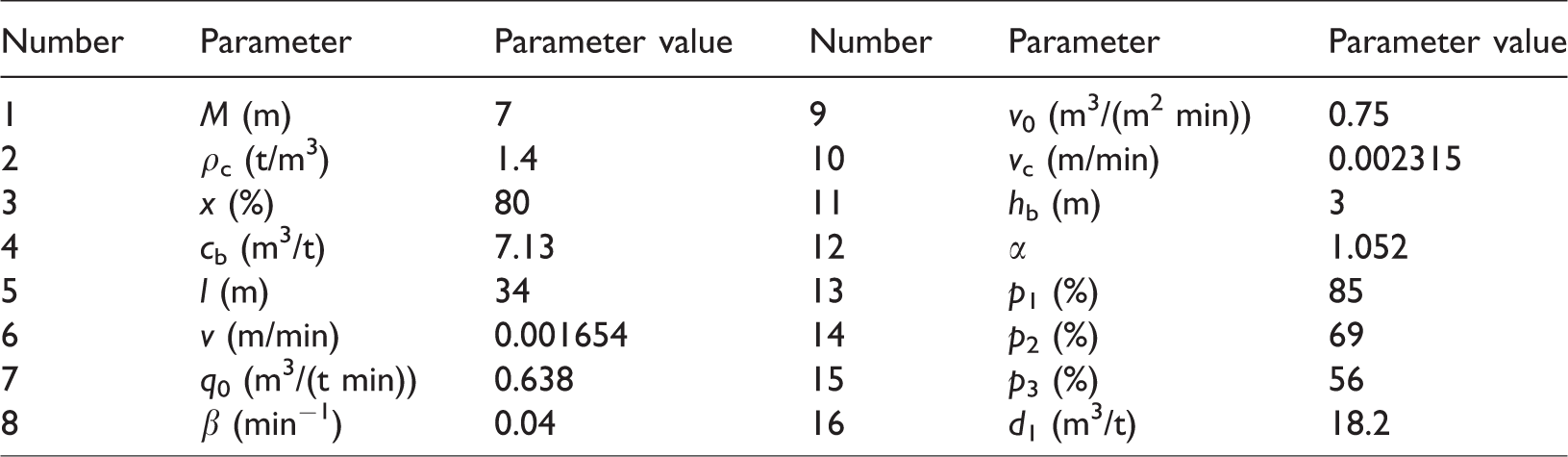
As can be discerned from Figure 6, the coal seams occurring in the GFFZ of the overlying rocks on the K8206 working face were coal seams #8, #11, and #12, and the coal seam occurring in the PRDZ was coal seam #3. The AGM reserve at the K8206 working face was predicted using the AGM reserve prediction model established in this paper, and the values taken for model parameters are listed in Table 1. The AGM reserve at the K8206 working face was calculated to be 25.0233 million m3 by substituting all parameter values in Table 1 into equation (6).
To validate the accuracy of the AGM reserve prediction model established in this paper, the AGM reserve at the K8206 working face was calculated using the material balance method. Within the occurrence range of the abandoned gob, the AGM reserve can be regarded as the residual methane amount after methane emission and can be expressed as follows

Methane extraction data during mining at the K8206 working face were collated, and the daily methane emission amounts during mining at the working face are shown in Figure 11. The methane emission amount during mining at the K8206 working face was calculated based on the daily methane emission amount data and it reached 50 million m3.
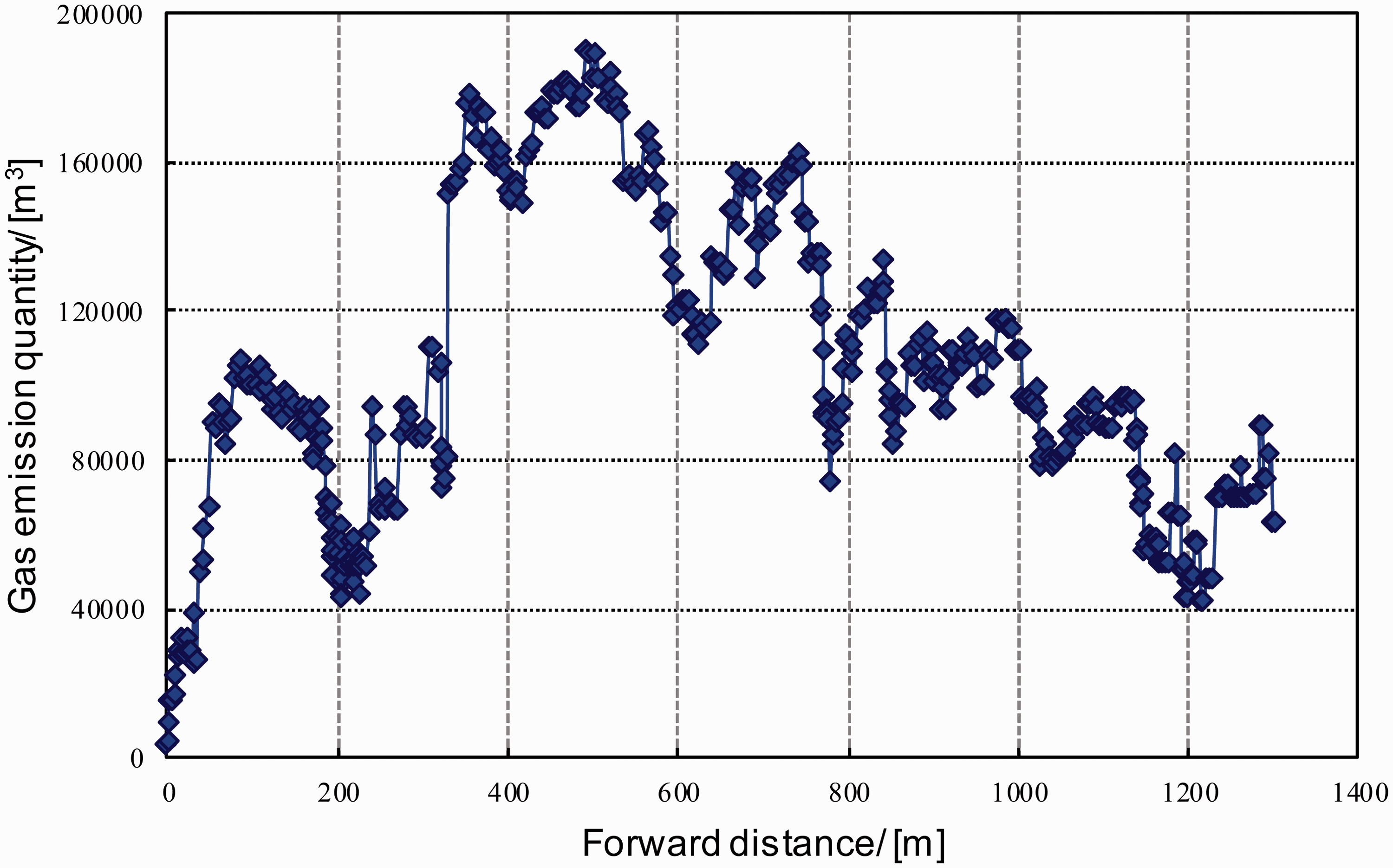
Gas emission quantity for the K8206 working face.
The original methane reserve in the GFFZ and PRDZ within the mining range at the K8206 working face calculated based on the parameter values in Table 1 is 74.616 million m3. The AGM reserve at the K8206 working face can be calculated with equation (7) and it is 24.616 million m3, which differs little from the result (25.0233 million m3) calculated using the prediction model based on the “three-zone” theory of methane pressure relief and transport in this paper, thus further validating that the prediction model established in this paper is accurate and reliable.
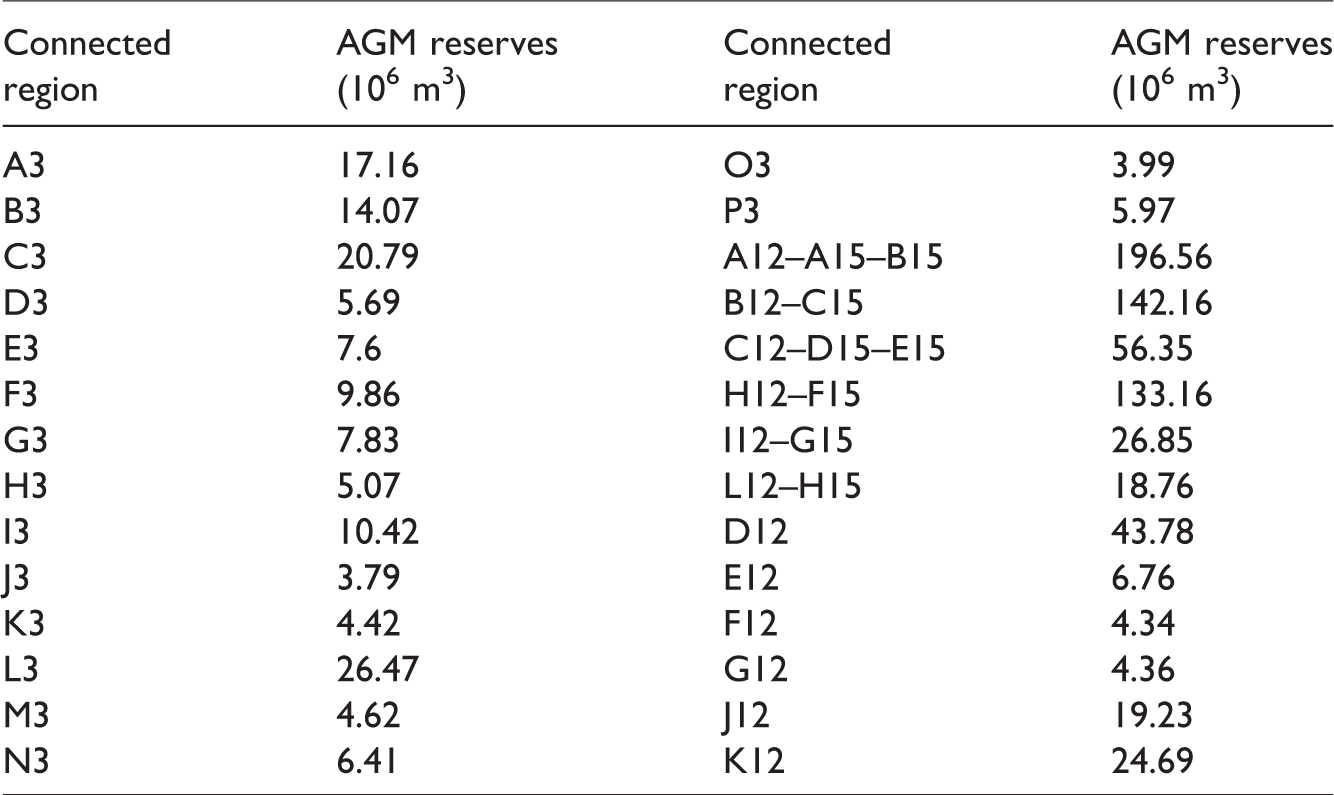
The AGM reserves of connected regions in Yangquan Coal Mine No. 3 are predicted using the developed estimation model (equation (6)). The parameters used in the model are listed in Table 2, and the predicted methane reserves are listed in Table 3.
Model parameters.
Predicted reserves for each connected region.
Arrangement of surface boreholes in the connected region
After comprehensive consideration of topography, transportation, and AGM reserves, an AGM extraction engineering experiment was conducted in region C12–D15–E15 in Yangquan Coal Mine No. 3. The former research results indicated that fissures were developed with high permeability in the O-ring fissure zone near the mining boundary. However, given that the AGM reserve of coal seam #3 is small, vertical borehole #1 in region C12–D15–E15 should run through the O-ring fissure zones in the abandoned gobs of coal seams #12 and #15 (Figure 12).
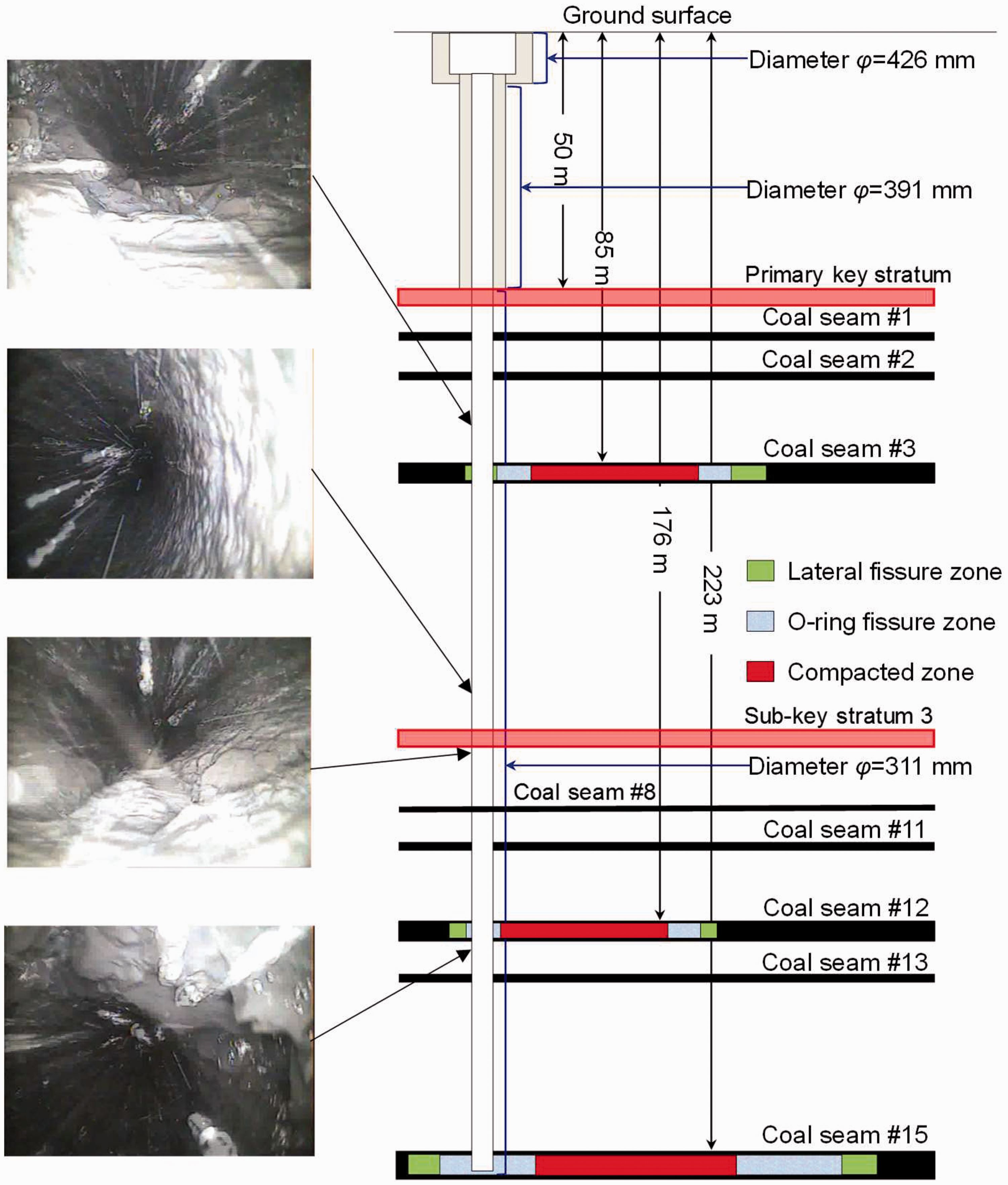
Borehole structure of vertical borehole #1 in region C12–D15–E15 in Yangquan Coal Mine No. 3.
The cracking characteristics in region C12–D15–E15 were investigated by borehole television (Figure 12). As can be seen from Figure 12, mining-induced fractures are generated within the range of the lateral fissure zone of coal seam #3. There are massive mining-induced fractures below the subkey stratum 3 also. However, there are no mining-induced fractures between coal seam #3 and subkey stratum 3. Therefore, the abandoned gobs in coal seam #3 are isolated from the abandoned gobs in coal seams #15 and #12. Fracture observation results show that the method for regional division of abandoned gobs based on their connectivity in this paper is correct.
Vertical borehole #1 was the first borehole used for AGM extraction in Yangquan Coal Mine No. 3. The field test results show that the AGM flow rate of vertical borehole #1 reached 3.6 m3/min (Figure 13(a)). To obtain a stable methane flow rate, discontinuous experiments on AGM extraction were conducted on 1, 3, 6, 10, 15, and 21 November 2014. The experimental results show that the methane flow rate was stable during the extraction time of 8 h when the break time was three days (Figure 13(b)).
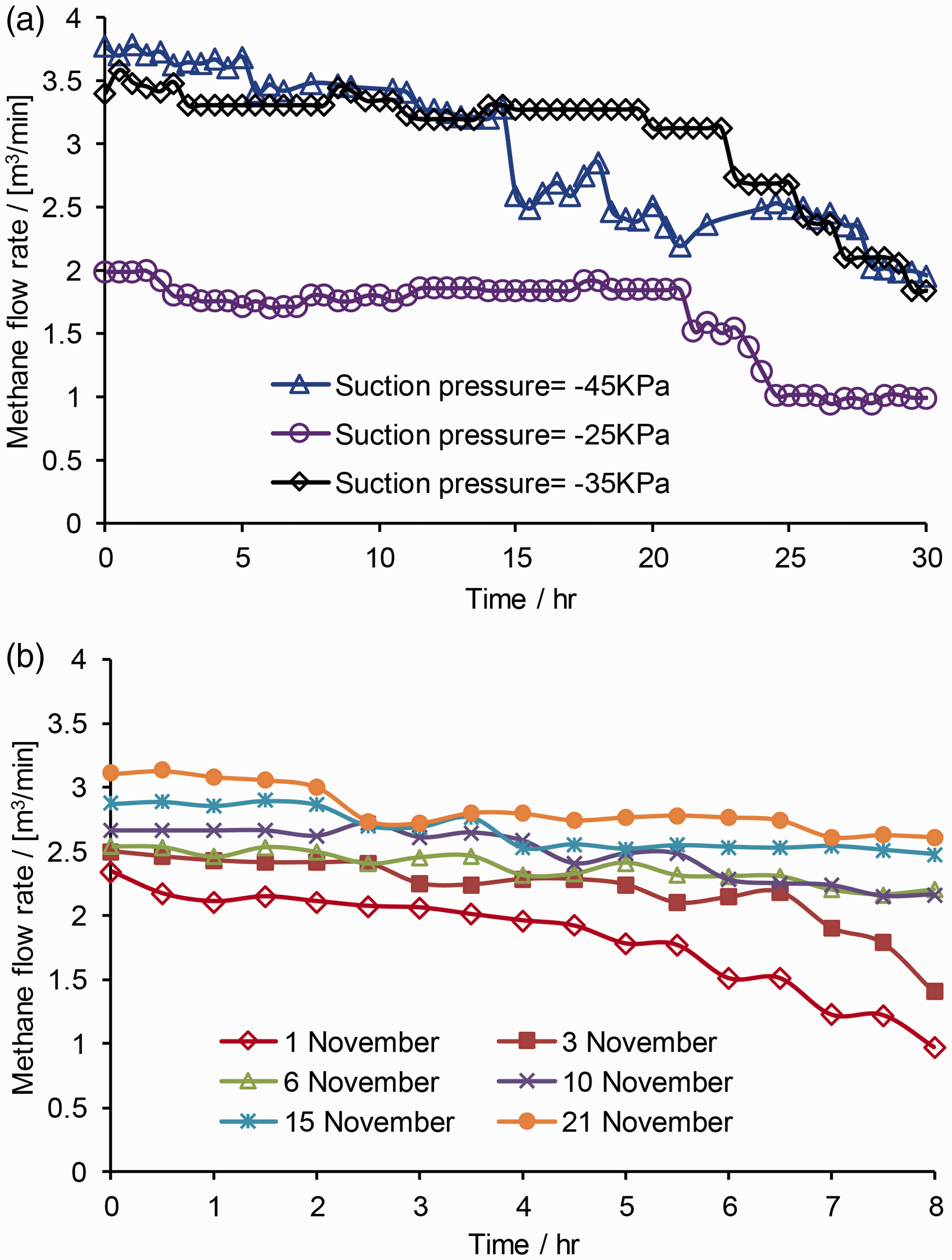
Field test results from vertical borehole #1 in Yangquan Coal Mine No. 3. (a) Change law of methane flow rate along with time and (b) change law of methane flow rate under different break time.
As can be seen from Table 3, the AGM reserves in region C12–D15–E15 are 56.35 million m3. Based on the engineering experimental results of vertical borehole #1, vertical borehole #1 would produce 9.3 million m3 in the next 10 years. Therefore, another five vertical boreholes would be needed in region C12–D15–E15. In Figure 14, boreholes #2, #4, and #6 ran simultaneously through the O-ring fissure zone of coal seams #12 and #15, and boreholes #3 and #5 ran through the O-ring fissure zone of coal seam #12.
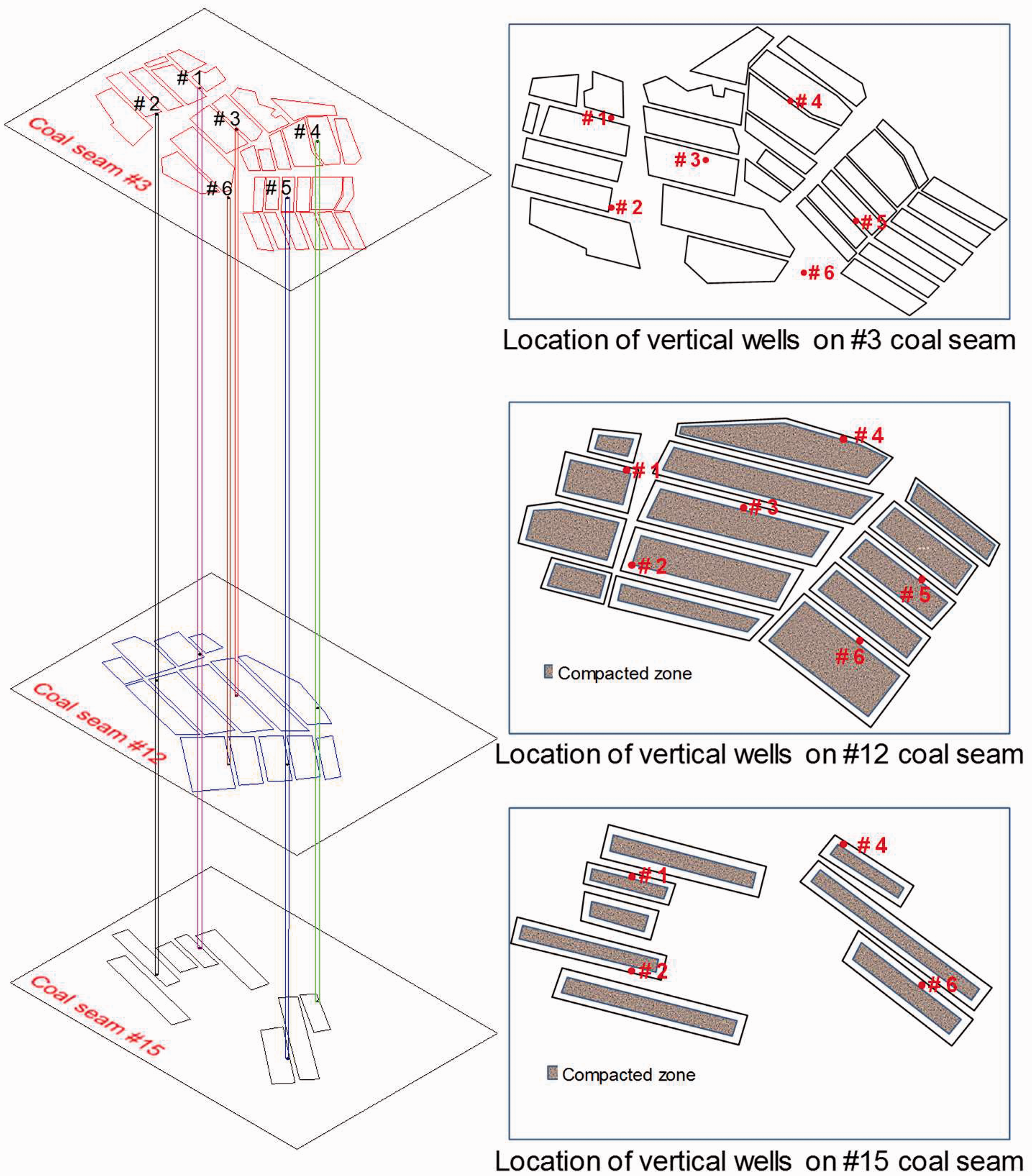
Arrangement of surface boreholes in connected region C12–D15–E15.
Conclusions
In this paper, the position of the peak of the lateral abutment pressure was used as the identification criterion for the lateral boundary of the GFFZ. Based on the geological conditions of Yangquan Coal Mine No. 3, numerical models under different mining heights and mining depths were established, and the results showed that the maximum distance between the lateral boundary of the GFFZ and the mining boundary increased with the increase of mining height and mining depth. However, the mining height is the main factor influencing the maximum distance between the lateral boundary of the GFFZ and the mining boundary. Discrimination methods for the vertical and horizontal connectivity between adjacent abandoned gobs were given. Based on the criterion for vertical and horizontal connectivity, the abandoned gobs in Yangquan Coal Mine No. 3 were divided into 28 regions. Based on the occurrence range of AGM, there are three sources for AGM, i.e. the coal pillar in the abandoned gob, the residual coal, and the fully depressurized adjacent unmined coal rock seams. According to the sources of AGM, a calculation model for AGM reserves is established by using the different-source method. The AGM reserves of connected regions in Yangquan Coal Mine No. 3 are predicted using the developed estimation model. The engineering experimental results from vertical borehole #1 show that vertical borehole #1 would produce 9.3 million m3 in the next 10 years. The predicted methane reserves in region C12–D15–E15 are 56.35 million m3. Therefore, another five vertical boreholes would be needed in region C12–D15–E15. Based on O-ring fissure zone theory, surface boreholes in connected region C12–D15–E15 were arranged in Yangquan Coal Mine No. 3.
Footnotes
Declaration of conflicting interests
The author(s) declared no potential conflicts of interest with respect to the research, authorship, and/or publication of this article.
Funding
The author(s) disclosed receipt of the following financial support for the research, authorship and/or publication of this article: Financial support for this work was provided by the Natural Science Foundation of China (No. 51404257), Fundamental Research Funds for the Central Universities (No. 2014QNB39), and the Priority Academic Program Development of Jiangsu Higher Education Institutions (No. SZBF2011-6-B35).