




Abstract
As a knowledge-based industry, the structure of the solar photovoltaic industry is influenced continuously by transformations which originate from technosciences. This paper adopts the notion of the ‘science’ community to include universities and research institutes to examine government funding impact on science–industry collaboration in the Chinese solar photovoltaic industry. The triple helix model of university–industry–government relations for explaining structural developments in knowledge-based economies is often used to depict integration among functions of knowledge creation, business production and governance control at the interfaces in these knowledge-based organizations. Through comparisons between subsidized and nonsubsidised R&D activities, based on 10,366 scientific publications derived from the databases of Web of Science during the period from 2003 to 2013, the impact of government funding on their research collaboration is examined in the solar photovoltaic industry take-off phase and acceleration phase. The findings show that the three helices interact to foster collaboration between the knowledge-based organizations where the government–science link and the government–industry link are fairly strong, but the science–industry link is relatively weak. In consequence, policy-makers should develop more effective mechanisms to foster knowledge diffusion between science and industry.
Introduction
Innovation through the creation, diffusion and use of knowledge has been recognized as the key driver of economic growth and competitive advantage in knowledge-based economies (The Organisation for Economic Co-operation and Development (OECD), 2002). This phenomenon of industry, university and government interaction is captured within the notion of the triple helix (TH) model (Etzkowitz and Leydesdorff, 2000). The premise of the TH model is that the potential for innovation to influence economic development in a knowledge-based society lies in the interaction of components from university, industry and government which generates new institutional and social outputs for the production, transfer and application of knowledge.
The TH components may interact in a range of forms through government funding to foster collaboration between knowledge-based organizations, which usually involve universities, public research institutes (PRIs) and enterprises. The role of government funding in the TH model is increasingly an inherent part of national innovation strategies of OECD countries and emerging economies (Protogerou et al., 2013), particularly in the emerging energy-saving sectors (Teirlinck and Spithoven, 2012). Drawing on previous empirical studies (e.g. Fier et al., 2006; Ubfal and Maffioli, 2011) and theoretical argument of the potential benefits of research collaboration (Grant and Baden-Fuller, 2004), government funding is alleged to promote collaboration among knowledge-based organizations. For a long time, policy-makers have called for robust empirical evidence that the commitment of public money has resulted in significant and tangible outcomes (Clarysse et al., 2009). Thus, sound conceptual frameworks and empirical studies are needed to assess the contribution of public research funding policy to innovation performance (OECD, 2002).
Traditional studies of the impact of government funding on recipient organizations have often failed to define which effects to measure, and which attributes are due to a specific government intervention (Georghiou and Clarysse, 2006). Buisseret et al. (1995) introduce the concept of behavioral additionality (BA), which is defined as the change in an organization’s way of undertaking research that can be attributed to policy actions. Thereafter, several theoretical and empirical studies of government funding evaluation have adopted this concept (e.g. Busom and Fernández-Ribas, 2008; Fier et al., 2006; Teirlinck and Spithoven, 2012). Although most empirical studies on government funding in research collaboration are conducted in developed countries in the West (e.g. Czarnitzki and Fier, 2003), evaluation studies have also been conducted at organizational level in non-Western countries such as Japan and Korea (Lechevalier et al., 2010; Kang and Park, 2012).
A key issue is to what extent policies made for promoting innovation are underpinned by the knowledge and innovation capacities embedded within knowledge-based organizations (Lu and Etzkowitz, 2008). This suggests the need to enhance our understanding on the relationship between TH interactions and innovation. Against this background, this study confines attention to the solar photovoltaic (PV) sector where government funding for collaboration between knowledge-based organizations is a key driver to promoting innovation in China.
China was behind the iron curtain from 1949 till its open-door policy in the 70’s. Its solar PV research, albeit at a very embryonic stage, could date back to the early 70s when it was termed the pre-development phase. The rapid rise of China in its solar PV research since 2003 (take-off phase), means that China is expected to overtake Europe as the largest producer of PV electricity soon after 2020 (IEA, 2014a). The question is, does the government have a central role to play, and if so, what has the government done, in pushing the solar PV industry on its fast track development since 2003? How do the others (regional governments, research community, industry, international partners, etc.) respond during the different industry development phases?
The interactions between the components of TH system may take different forms (Ranga and Etzkowitz, 2013), which are reflected in the varying institutional arrangements of academia–industry–government relations in the ‘statist model’, ‘laissez-faire model’ and the balanced ‘triple helix model’ (Etzkowitz and Leydesdorff, 2000). The power of the Chinese government is much stronger than that of academia and industry. It is neither a balanced TH model (equal and interdependent partners) nor a ‘statist model’ (government takes dominant leading role) at present. As universities, PRIs and enterprises have obtained increasing autonomy in the process of China’s science and technology (S&T) system reform, the science–industry–government relations is in the transition from a statist model to the more balanced TH model (Xue and Zhou, 2011). To contribute further evidence to the TH interactions, it is beneficial to review the changes in collaboration among the knowledge-based organizations against the background of government policy changes.
The aim is to identify (a) the changes in government polices during the solar PV industry phases of pre-development, take-off and acceleration, and (b) how government funding increases the BA of knowledge-based organizations in funded solar PV research in China.
Research rationale
Previous research identified that China is moving from a statist model to the TH model (Xue and Zhou, 2011), but how do the collaborative relations change among the knowledge-based organizations? The approach in this study is to take the solar PV industry development phases (set against the background of policy changes) as the basis for analyzing the changes in collaboration (measured in terms of research co-publications) among the TH partners.
Solar PV is one of the most promising emerging energy technologies. In many respects, the solar PV industry is not an industry per se, but a set of technologies with the potential to transform various fields. Moreover, knowledge is distributed among various organizations including enterprises, universities and PRIs, characterized by inter-organizational collaboration networks that result in and contribute to the high level of innovation in the industry (Wu and Mathews, 2012). There is, largely, consensus in the international community that government investments are key to fostering technological improvements in solar PV technologies (IEA, 2014a) since the initial investments required are so much higher than those for fossil fuels at the early stages of development. For instance, the active support by the Japanese government for solar power technologies through significant R&D investment and the support provided under the Advanced PV Generation program are widely credited for having made Japan a leader in this field (Gallagher et al., 2006). In fact, government involvements in research and development in countries leading in solar PV technologies have been quite strong, e.g. the United States (U.S.), Japan and Europe. Thus, this study focuses on the impact of government funding on the interactions of knowledge-based organizations in the solar PV industry.
The TH model proposed by Etzkowitz and Leydesdorff (2000) engages three types of actors – university, industry and government at national/regional system levels to depict the transformations in the knowledge creation processes.
In the Chinese context, PRIs including research institutes of Chinese Academy of Sciences (CAS), state-level research institutes and provincial institutes used to be the major actors in China’s R&D activities (Xue and Zhou, 2011). Today, PRIs are no longer the only actors in the nation’s research system as both universities and enterprises have become significant actors (Chen and Kenney, 2007). Thus, following previous researchers (e.g. Teirlinck and Spithoven, 2012; Tether and Tajar, 2008), universities and PRIs are grouped together as the ‘science community’. The concept of the TH model in this research encapsulating science–industry–government interaction, includes universities plus PRIs (‘science’), enterprises (‘industry’), and government. Science–industry collaboration refers to the collaboration between universities/PRIs and industry actors.
Two broad concepts, synergy and BA, help elaborate the TH interaction within the context of this research and are discussed in detail below.
Synergies
Acceleration of innovation and economic development comes from synergies arising between the three institutional spheres. This synergy unfolds in three broad ways. First, enterprises (i.e. industry) have first-hand access to new technologies and rely on partnerships with the other spheres and hybridization within the model to develop new knowledge and innovation. Second, universities and PRIs (i.e. science) become central in initiating, creating, and dispersing useful knowledge and receive feedback from entrepreneurs about the commercial viability of their research. Thirdly, governments exert a strong influence on the innovation process through the financing and steering of public organizations (i.e. universities, PRIs) that are directly involved in knowledge generation and diffusion, and through the provision of financial and regulatory incentives to all relevant actors of the innovation system (Etzkowitz, 2008; Leydesdorff and Meyer, 2006; OECD, 2002). Moreover, individuals and organizational actors in the TH not only perform their own role, but also ‘take the role of the other’ when the other is weak or under-performing (Etzkowitz, 2008; Etzkowitz and Leydesdorff, 2000). Rather than a static mapping of the linkages, the TH model recognizes that the respective roles of different actors change over time, and that correspondingly this dynamic provokes changes in the internal configuration of each actor (Martin, 2011). In short, the relations of science–industry–government are continuously reshaped in an endless transition to enhance innovation, bringing forth new technologies, new firms and new types of relationships in a sustained systemic effort (see Etzkowitz and Leydesdorff, 2000; Ranga and Etzkowitz, 2013).
The first objective of this study is therefore to identify the government policies which affect development of the knowledge-based organizations through the phases of pre-development, take-off and acceleration of the solar PV industry from 2003 to 2013.
Behavioral additionality
As a complement to the traditional measure of input and output additionalities, the concept of BA (Buisseret et al., 1995) is introduced to refer to changes in an organization’s way of undertaking research which can be attributed to policy actions. These changes could materialize in the form of acceleration additionality, scope additionality and cognitive capacity additionality (Falk, 2007; Salmi, 2012). Since tracking intangible behavioral changes resulting from government funding is much more difficult than monitoring physical resource inputs and outcomes of innovation activities (Salmi, 2012), the evaluation of BA is limited by the difficulty in measurement and the availability of data (Falk, 2007). Most existing empirical studies have relied on surveys and interviews to assess the changes in innovation behavior and strategy through comparisons between subsidized and nonsubsidised R&D activities (e.g. Clarysse et al., 2009; Fier et al., 2006), or have been based on case studies or on the account of a few highly publicized co-operative R&D projects which are not representative (e.g. Czarnitzki and Fier, 2003; Hsu et al., 2009). To this end, this study focuses on the behavior additionality as the act of research collaboration manifested in the number of co-authored scientific publications to explore the additionality effect of government funding on the research collaboration between and within universities, PRIs and enterprises.
The second objective of the study is to examine whether government funding increases the BA in funded solar PV related research in China.
Method
Technology management literature does not converge on a unified theory of technological evolution (Sood and Tellis, 2005). Studies of technological evolution have conceptualized technology transitions or technological trajectories as proceeding in a sequential and progressive performance improvement, prescribing an S-shaped curve, over time (e.g. Sood and Tellis, 2005). The S-curve logic states that, in a technology’s early stages, the rate of progress in performance is relatively slow. As the rate of technological improvement increases, the new technology reaches a period of maturity, i.e. the technological performance of a specific technology (modeled by the S-curve) follows a behavior pattern which is similar to the diffusion models of innovations (Rogers, 2003). Various phases in the transition process constitute a complex set of societal cogwheels that engage each other but take place in several different areas, which are different at various transitions stages (Rotmans et al., 2001) and involve interactions between technological, industrial, policy and social changes (Del Rio et al., 2010). In particular, the pre-development phase is characterized by basic R&D activities and a high uncertainty and discontinuity in terms of technologies, markets and regulations (Bergek et al., 2008). In the take-off phase, the new technology has entered the market and dominant design(s) emerge. The technology has to compete with both established technologies as well as with other new technologies (Tushman and Rosenkopf, 1992; Utterback, 1994), and it may need protective spaces to keep developing and bridge a so-called ‘Valley of Death’ (Kalil, 2005) where incentives are provided for new entrants into various parts of the value chain thus bringing new resources and advocacy coalitions (Jacobsson and Bergek, 2011). The acceleration phase is the phase in which the new technology goes beyond the nursing markets, and starts experiencing a higher growth when formation of common language and a common body of knowledge increases the need and foundation for incremental innovations (exploitation). At technological transitions, there are a lot of changes occurring in industrial settings, government policy and social settings, which reinforce each other. The acceleration phase, for example, is mainly the result of positive feedback mechanisms in several areas, such as favorable policy, effective network structures that interact with each other (Rotmans et al., 2001). The final phase is the stabilization phase, in which the new technology has become dominant in current routines, infrastructure and legal frameworks, however, the stabilization phase is beyond the scope of this study.
Based on the theoretical S-curve trajectory framework (e.g. Bakman and Oliver, 2013) of technological transition, the industry phases of pre-development, take-off and acceleration of solar PV technology mentioned in objective 1 are examined against the government policies in place at the time. These phases are then analyzed in terms of scientific publications (as research output) to examine the impact of government funding on research collaboration.
Co-authorship is one of the most tangible and well-documented forms of scientific collaboration (Glänzel and Schubert, 2005). There is a growing consensus that scientific co-publications, which refer to co-authored publications with two or more affiliation addresses, provide a proxy measure of research collaboration between the knowledge-based organizations of universities, enterprises and PRIs (e.g. Levy et al., 2009; Niedergassel and Leker, 2011). In the Chinese context, scientific publications have additional advantages to enable the examination of government sponsored research collaborations mentioned in objective 2. Scientific publication is one of the most important output evaluation indicators of government-sponsored projects, and it is usually required to acknowledge the specific funding projects in government-sponsored publications. Based on this understanding, this study assumes that publications with acknowledgement of government funding are the output of government sponsored R&D activities, otherwise, the output of R&D activities occurs without government support. This offers an opportunity to distinguish research activities with government support from those without.
A database containing scientific publications data on solar PV in China is created by searching the database of Web of Science (WoS), specifically in (a) WoS TM Core Collection (the Science Citation Index Expanded part, SCI), specializing in science and medicine and, (b) China Science Citation Database SM, specializing in Chinese scientific papers (CSCD). The method adopts keyword search strategy; a huge search terms with boolean operator is thus created (see Appendix 1). As a result, an initial sample of 13,686 publications in total is obtained, from 2003 to 2013. This study has filtered the sample and included only those records referred to S&T in the research domains and journal articles and reviews (containing funding information if any) in document types. Publications in conference proceedings are excluded because government funding information is not available in conference papers. As a result, a new sample of 10, 366 publications are downloaded with full information record (e.g. authors, title, abstract, funding, address, research area).
Definitions and operationalization of variables.
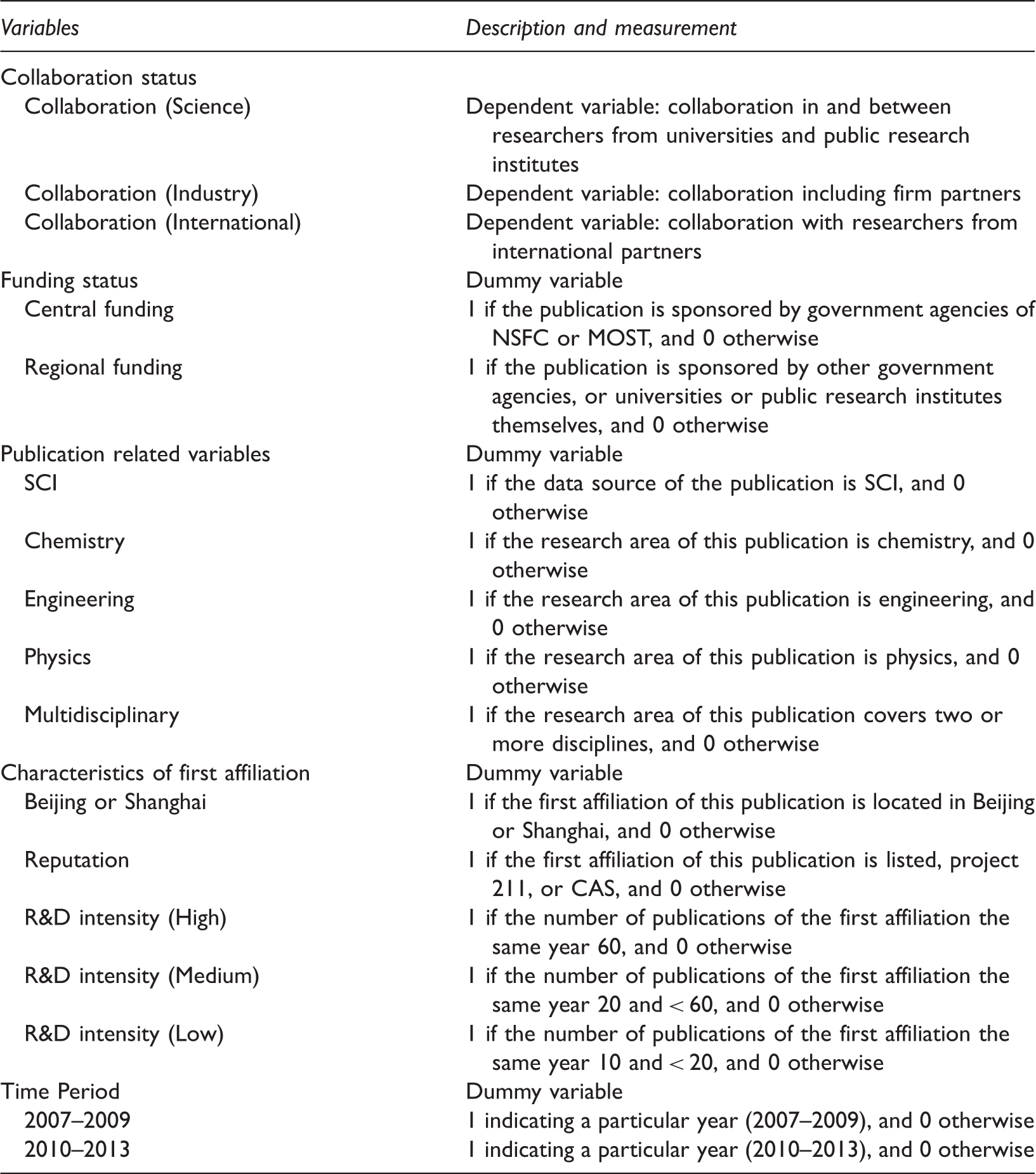
NSFC: National Natural Science Foundation of China; MOST: Ministry of Science and Technology; CAS: Chinese Academy of Science.
In the logistic regression models, dummy variables are used (see Table 1). For instance, three dummy variables for research intensity are created, namely, high (the number of publications>60), medium (20–60) and low (10–19) intensity, publications below 10 is the reference category. To control the influence of reputation, this study discriminates CAS, 1 top universities (listed in project 211 2 ), and listed government owned enterprises from other PRIs, universities and enterprises respectively (coded 1 if belong to the former type and 0 for the other). In order to compare the effect of government funding in the take-off phase and the acceleration phase, the beginning of the take-off phase from 2003 to 2006 is the reference category and two time dummy variables (2007 to 2009 and 2010 to 2013) are created.
The development of the solar PV industry phases in China is discussed next, followed by the results of the multinomial logistic regression analysis of research collaboration in the take-off and acceleration phases.
Review of the development of the solar PV industry
China is expected to overtake Europe as the largest producer of PV electricity soon after 2020, with its share regularly increasing from 18% of global generation by 2015 to 40% by 2030 then slowly declining to 35% by 2050 (IEA, 2014a). Drawing on the work of previous researchers (e.g. Sun et al., 2014; Zhang et al., 2014), the development of solar PV industry in China along the S-curve technological trajectories are divided into three phases of 1958 to 2002, 2003 to 2008, and 2009 to 2013, namely, pre-development, take-off, and acceleration respectively.
Pre-development phase: 1958–2002
Although R&D of solar PV dates back to 1958, the investment in R&D was very limited prior to 2000 (Marigo, 2006). While the first generation manufacturing base of solar PV was established in the late 1970s, China had a relatively small solar PV manufacturing industry before 2003 (Yang et al., 2003), and the PV products had not been used for civil applications (Sun et al., 2014). The majority of manufacturing companies established during this period were state owned enterprises, which were dependent upon the central government’s decisions and had neither the mandate nor the incentive to experiment with technology and innovation (Marigo, 2006). During this period, solar PV technologies enjoyed very limited research funding (Gallagher, 2014) compared with developed countries. Moreover, the limited national solar PV programs placed heavy emphasis on cells research, which was mainly carried out by PRIs and top universities (Yang et al., 2003). As a result, the quality of Chinese solar PV products such as mono-crystalline solar cell and solar modules fell short of their counterparts in developed countries (Dunford et al., 2012). In short, the solar PV sector in China suffered from issues such as high production costs, capital shortages, insufficient R&D funding, and lack of market-formation support from the government during this period (Gallagher, 2014).
Take-off phase: 2003–2009
During the period 2003–2007, the development of the Chinese solar PV sector shifted to an export-oriented stage. On the one hand, the introduction of ‘feed-in-tariffs’ and ‘renewable portfolio standards’ in developed countries, such as Germany, Italy, Spain and the U.S. in the 1990s and 2000s, spurred a global demand for solar PV modules and panels (Grau et al., 2012). On the other hand, the Chinese government, at both central and regional levels, provided strong support for the solar PV manufacturing industry. In 2006, the Chinese central government identified the solar PV industry as one of a number of key industries in the Catalog of Chinese High-Technology Products for Export (Zhang et al., 2014). As a result, PV manufacturers were eligible for additional financial support for R&D and received export credits at preferential rates from the Import-Export Bank of China, as well as export guarantees and insurance through the China Export and Credit Insurance Corporation. Access to such flexible capital enabled Chinese PV companies to raise funds through overseas (initial public offerings) IPOs. Specifically, a number of Chinese solar PV manufacturers, such as Suntech, Trina Solar, Yingli, Solarfun, JA Solar, and China Sunergy, were listed on the New York Stock Exchange or the NASDAQ stock market, from 2005 to 2007 (Zhang et al., 2014). The Chinese regional governments also provided the solar PV firms with incentives such as low interest loans to purchase equipment, land transfer price refunds, electricity price refunds and multiple-year corporate tax reductions (Gallagher, 2014). As a result, China’s solar PV manufacturing capacity increased exponentially during this period, pushing the country to the number one position among solar PV producing countries in the world and accounting for at least 23% of the global PV cells production in 2008 with estimated production over 2000 MW (IEA, 2009). Moreover, at least three Mainland Chinese companies registered on the top 10 of the global PV cell manufacturers in the same year (IEA, 2009).
While China has been successful in solar PV manufacturing, it should be noted that this success was achieved through the purchase of manufacturing equipment in a competitive international market (De La Tour et al., 2011), i.e. the core technologies, materials and equipment mainly depended on import (Sun et al., 2014). In other words, the success of Chinese solar PV manufacturers in the global market was not dependent on domestic R&D and innovation. In contrast, R&D and innovation were comparatively weak in China (Huo and Zhang, 2012), when compared with other countries, such as Germany, Japan and the U.S. (De La Tour et al., 2011; Grau et al., 2012).
Acceleration phase: 2010–2013
The global financial crisis occurred in 2008, together with the ensuing ‘antidumping’ and ‘anti-subsidy’ investigations by the U.S. and Europe, had an adverse impact on China’s solar PV industry (Zhang et al., 2014). The Chinese government was evidently coming to appreciate that without a strong domestic market, Chinese producers would be heavily exposed if demand from overseas fell (IEA, 2009). Therefore, the Chinese government had provided strong support via incentive policies and financial measures to expand the domestic market, in an attempt to focus more on R&D (IEA, 2012). In short, the Chinese government had started to shift its export-oriented solar PV policy towards a more balanced policy, including continued export support, strong application support and R&D funding investment.
With respect to the continued export support, the China Development Bank, a policy bank, gave 250 billion CNY of extension credits to the PV industry and opened a line of credit of about US$30 billion for Chinese solar cell and module manufacturers during 2009 to 2010 (Grau et al., 2012). During the same period, certain Chinese regional governments issued various refund policies that were supported by their tax revenues to promote investment in new PV manufacturing plant (Zhang et al., 2014). Since 2009, the production of PV cells in China increased about 10 times and reached estimated production of over 22,000 MW (IEA, 2014b) by 2013. Recognizing that it was important to address the mismatch between production capacity and domestic use, the Chinese government started to shift its solar PV policy towards the domestic market (Zhang et al., 2014). China’s policies and strategies in support of solar PV operated at both the central government and regional/provincial levels. The central government agencies issued national targets and encouraged the regional/provincial government agencies to propose strategies to meet those targets. Consequently, keen bidding within the industry and other key market actors took place.
The following key schemes were in place after 2009:
The so-called ‘Golden Sun Program’
3
fund that aims to develop PV on buildings and off-grid applications (IEA, 2012; Sun et al., 2014); A capital subsidy for PV on buildings,
4
financed through a special fund for renewable energy (Zhang et al., 2014); Two rounds of concession programs for the development of large utility-scale PV power stations (LSPV) especially in parts of northwest China (Zhang et al., 2014); and A feed-in tariff scheme for utility-scale PV that is financed by a renewable energy surcharge for electricity consumers (IEA, 2012; Zhang et al., 2014).
Apart from the above schemes, the Chinese government had taken additional measures aimed at promoting or framing the development of distributed PV (DPV) generation in China’s 12th Five-Year Plan in 2012 for Renewable Energy Development issued by the State Council (Zhang et al., 2014). To support this plan, the Chinese government had promulgated a series of policies to provide stronger support for DPV power, adjusted the capacity-based subsidies, and introduced a resource-based feed-in tariff scheme subsidy from 2012 to 2013 (Zhang et al., 2014). By 2013, China installed 12,920 MW, setting an absolute record that placed the country in first place with regard to all time PV installations for the first time (IEA, 2014b).
Recognizing the importance of R&D and innovation, the Chinese government started to focus more on PV-related technologies such as silicon production to catch up with the major producing countries (De La Tour et al., 2011; IEA, 2014b). Subsequently, a set of government funding programs, such as the National High-tech R&D Program (Program 863) that supports innovation in strategic high-tech fields, the National Basic Research Program (Program 973) that supports basic scientific research for long-term development and the Key Technologies R&D Program that supports R&D for the current development of the national economy, had been put in place (IEA, 2014b). Since 2010, the average annual investment from the Ministry of Science & Technology (MOST) of China is about 500 million CNY, which is similar to that of the traditional solar PV leading countries. At the same time, a number of national key laboratories had been set up to promote enterprises’ PV technology R&D, such as, Yingli State Key Laboratory and Trina Solar's State Key Laboratory. Additionally, government research funding from High-tech Program (863) and Basic Research Program (973) is increasingly available for enterprises. In short, the Chinese government policy, in the period 2010–2013, was more balanced in the emphasis placed on export, domestic application and domestic R&D.
Results
Scientific publications in government funded research
Government R&D funding (at both central and regional levels) has played an important role in the Chinese solar PV industry (see Figure 1 based on the publication data from 2003 to 2013). Figure 1 shows the collaboration in the solar PV sector during 2003–2013, as measured by inter-organizational co-authorship in publications. Before 2006, the collaboration in the solar PV industry grew very slowly but the collaboration increased during the latter stage in the take-off period 2007–2009 and grew very rapidly after 2009 in the acceleration phase. Subsequent multinomial logistic regression analysis thus compares the periods of 2003–2006 and 2007–2009 in the take-off phase with the 2010–2013 acceleration phase. Publications have increased remarkably from 139 in 2003 to 2658 in 2013. Government funding, particularly from the central government, plays a substantial role in supporting R&D activities. The ratio of publications with government funding support to the total publications increased noticeably from around 75% in the take-off phase (2003–2009) to over 90% in the acceleration phase (2010–2013) (Figure 1). These results reveal a major trend in accordance with government policy transitions discussed in the last section.
Publications 2003–2013.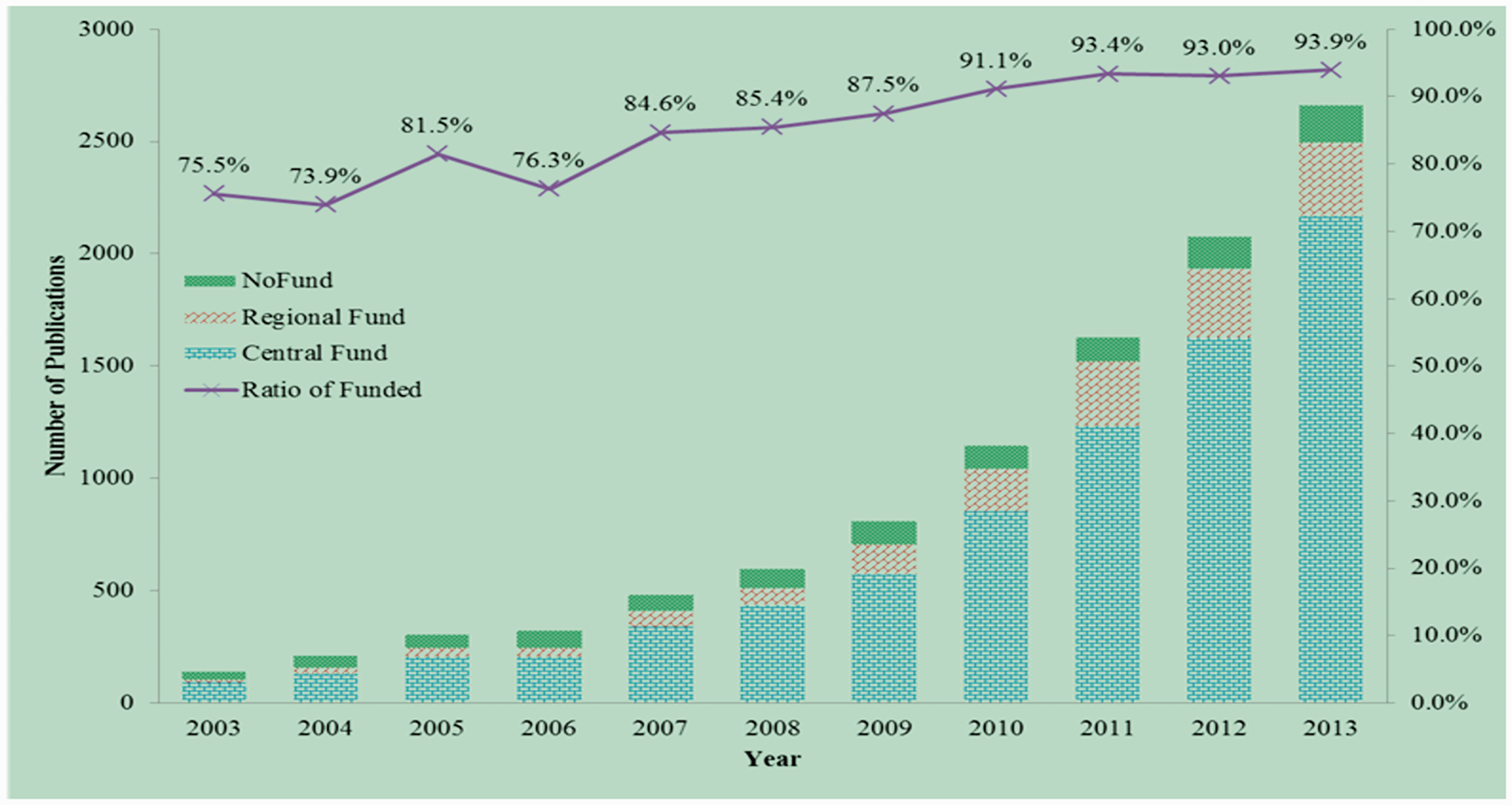
Figure 2 shows a growing trend of all three types of collaboration. The growth of collaboration with industrial partners is relatively slow. The Chinese government, whether central or regional, used to support enterprises through investment incentives (e.g. low interest loans; exemption of land fee) and deployment incentives (e.g. Golden Sun Project; Solar Roofs Plan), rather than providing R&D funding to enterprises (De La Tour et al., 2011; Huo and Zhang, 2012). Since 2009, the Chinese government has realized the importance of R&D for PV technologies in enterprises, thus, central government funding and various regional R&D funding have been provided for enterprises’ R&D activities. This trend is also reflected in the growing pattern of science–industry collaboration with government funding support (see Figure 2), though the amount is still relatively small.
Government funded co-publications.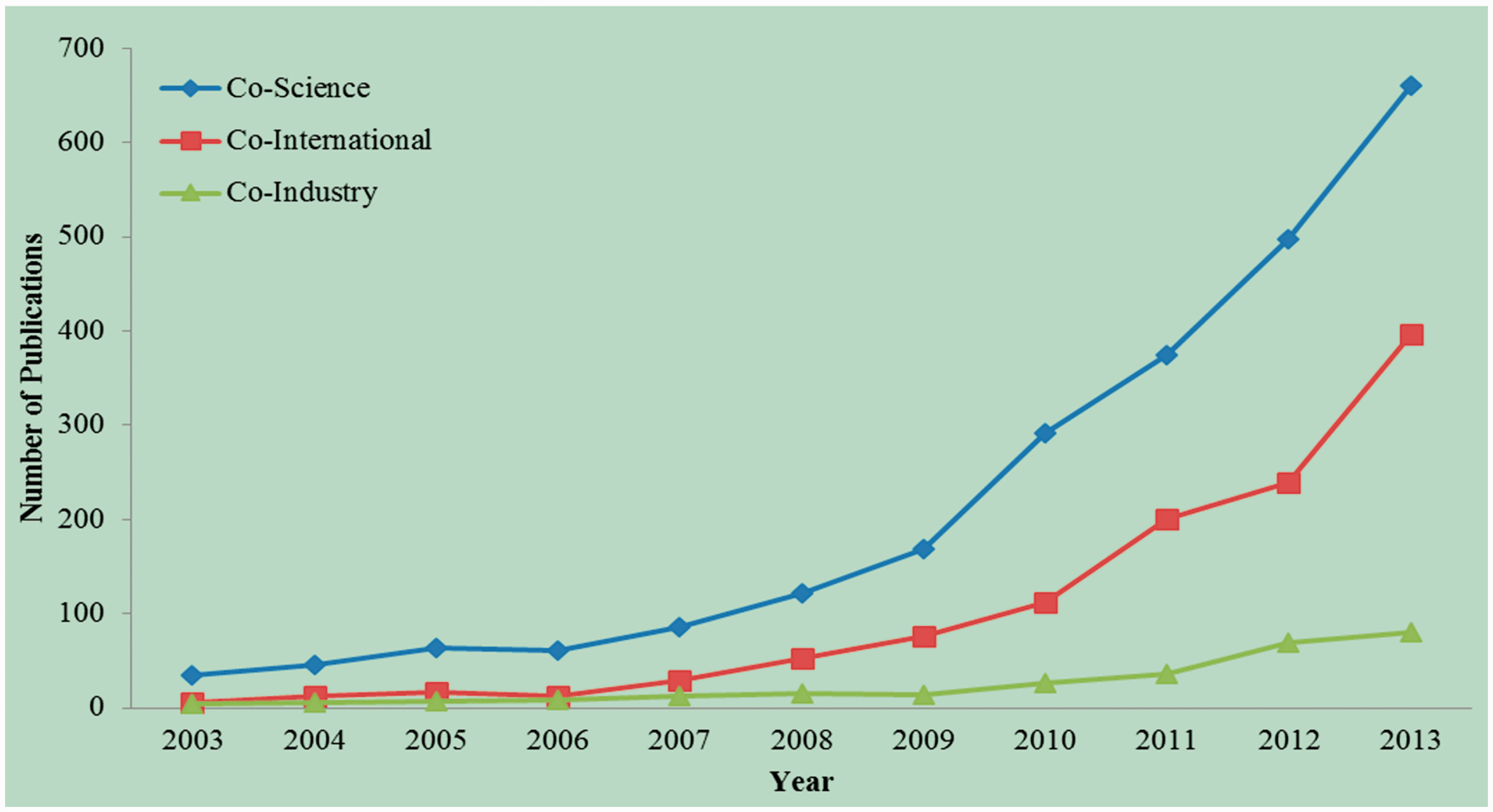
Despite the overwhelmingly large proportion of publications due to government-funded research, it does not mean that there is a causal relationship between government funding and research collaboration. Kleinknecht and Reijnen (1992) warn that a purely quantitative relationship is not necessarily identical with causal links. The primary concern is whether government funding results in additional collaboration activities, rather than substituting for private support that would have occurred in the absence of the government intervention. Next, the multinomial logistic regression analysis is conducted to address this concern.
Multinomial logistic regression analysis
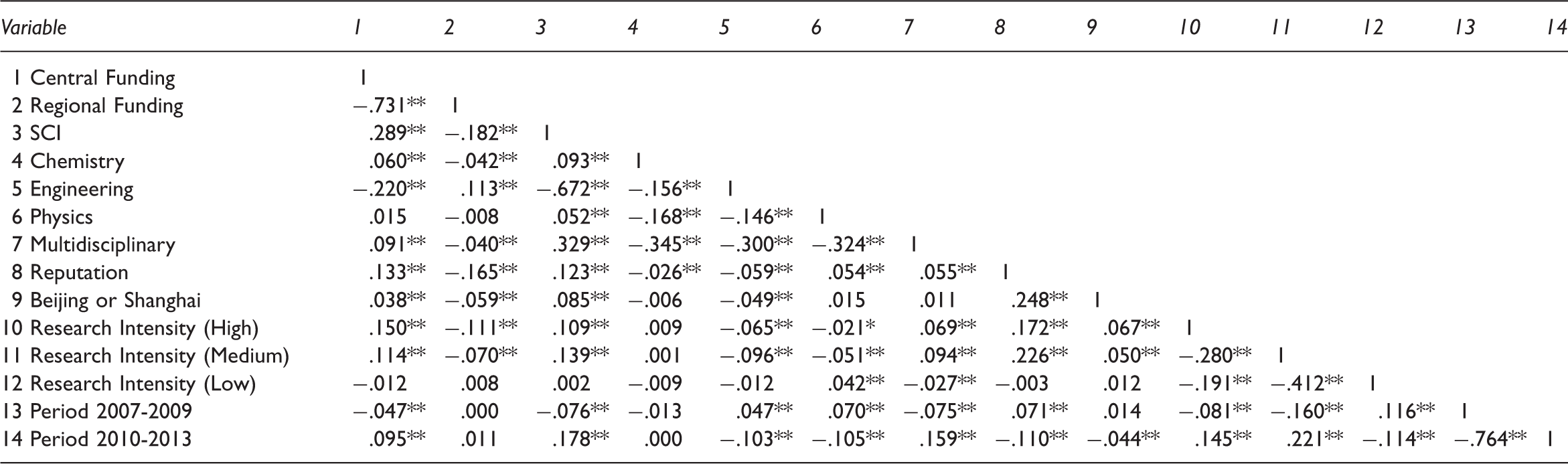
Descriptive statistics and Pearson correlations (N=10,366).
Correlation is significant at the 0.05 level (2-tailed).
Correlation is significant at the 0.01 level (2-tailed).
From Table 2, there are a few noticeable negative correlation coefficients in the field of engineering. Solar PV publications in the field of engineering correlate negatively with SCI journals (−0.672), the reputation of the affiliation (−0.059), the location (Beijing/Shanghai) of the affiliation (−0.049), research intensity (−0.065, and −0.096), and the period of 2010–2013 (−0.103).
In the acceleration phase (2010–2013), it is seen that this period is associated significantly with government central funding, SCI journal publications, and multidisciplinary research. Also, affiliations with high (and medium) research intensity are very active (significant +ve correlation) in this period, while leaving behind (−ve correlation) the low research intensity researchers.
Multinomial logistic regression parameter estimates (N=10,366).
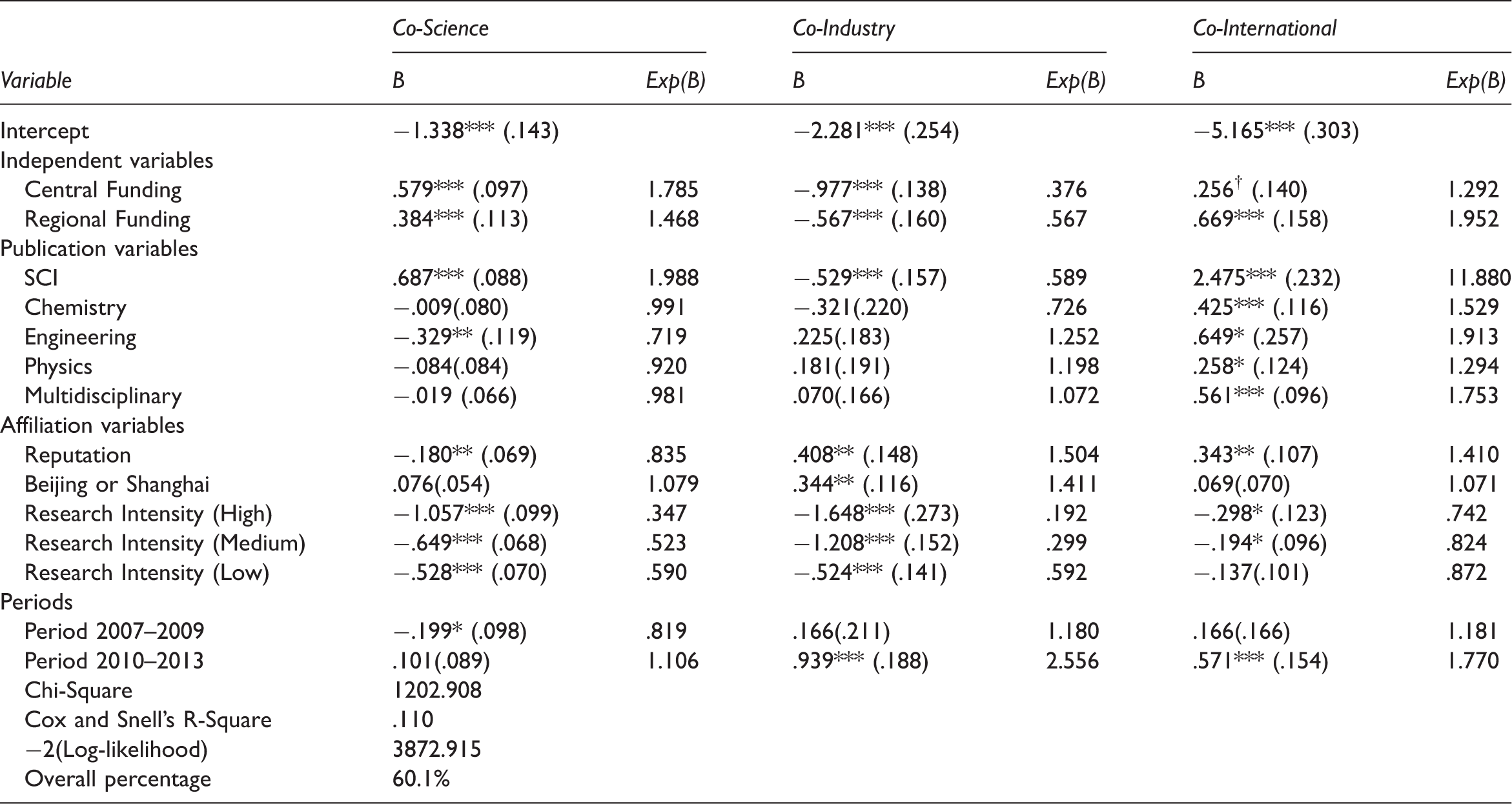
The reference category is: No-Collaboration.
Standard errors in brackets.
p<.10.
p<.05.
p<.01.
p<.001.
Accordingly, the following equation gives the proportional by chance accuracy rate: (0.2472 + 0.0382 + 0.1182 + 0.5982=0.434). Based on the requirement that model accuracy should be 25% better than the chance criteria (Bayaga, 2010; Petrucci, 2009), the standard to use for comparing the model's accuracy is therefore 1.25 * 0.434= 0.543, which is lower than the classification accuracy rate 0.601 in this study, suggesting that the model has adequate accuracy.
The regression results indicate that both central and regional government funding affect the likelihood of research collaboration significantly in knowledge-based organizations, although the direction of these effects varies across the different collaboration types (co-science, co-industry, co-international). From Tables 2 and 3, the major findings are:
(1) In the science community, researchers with either central funding (0.579 and 0.256 in Table 3) or regional funding (0.384 and 0.669 in Table 3) are more likely to engage in research collaboration (co-science and co-international) than researchers without funding. (2) Government funding, at both central and regional levels, has not encouraged (in fact has a negative effect on) the likelihood of science–industry collaboration (−0.977 and −0.567 in Table 3). (3) There is more likelihood of research collaboration with international partners supported by regional (0.699 in Table 3) than central government funding. (4) Co-publications with international partners and with fellow researchers in the (local) science community tend to be in SCI journals; those publications with industrial partners do not tend to be in SCI journals (−0.529 in Table 3). From Table 2, it is also seen that SCI journal publications correlate positively with central funding and negatively with regional funding.
It is suggested, therefore, that central funding has supported research collaboration in the science community (p<0.001) which results in significant increase in SCI journal publications but has not significantly encouraged international collaboration (p<0.1) and discouraged science–industry collaboration (−ve coefficient p<0.001). On the other hand, regional funding significantly contributes to the collaboration within the science community (p<0.001) and international collaboration (p<0.001), especially in international collaboration in the engineering field.
(5) In the field of engineering, research collaboration with international partners are significant (0.649 in Table 3). From Table 2, it is shown that engineering is associated with regional funding. Together with Table 3, it is suggested that regional funding has encouraged international collaboration but not collaboration within the (local) scientific community in the field of engineering (−0.329 in Table 3). (6) Reputation (of the affiliation) is a significant factor in enhancing science–industry research collaboration as well as collaboration with international partners. However, reputation affects research collaboration within the (local) science community negatively and significantly, suggesting that top reputed universities/research institutes do not collaborate with each other. Table 2 also shows that reputation is associated positively with central funding and negatively with regional funding. (7) Research intensity levels (high, medium, or low) bear a significant and negative relationship with all types of collaborations (co-science, co-industry, and co-international). This indicates that non-active researchers are more likely to seek collaboration. Table 2 also indicates that the higher the research intensity, the higher the association with central rather than regional funding. (8) Researchers from the science community in Beijing and Shanghai (areas with higher research intensity in solar PV) engage significantly in collaboration with industry (0.344 in Table 3), but not collaboration with international partners or among the (local) science community. Table 2 also shows that researchers in Beijing and Shanghai are associated positively with central funding but negatively with regional funding. Together with Table 3, it is suggested that researchers in Beijing and Shanghai engage significantly in science–industry collaboration (0.344 in Table 3) with reputable affiliations (0.248 in Table 2) backed by central funding (0.038 in Table 2) resulting in significant SCI publications (0.248 in Table 2); however, this trend is decreasing in the acceleration phase (−0.44 in Table 2). (9) While collaboration with the (local) science community is less likely to happen in the latter period of the take-off phase (−0.199 in Table 3), science–industry collaboration and international collaboration both increase significantly in the acceleration phase (0.939 and 0.571 in Table 3).
The acceleration phase is significantly associated with central funding but not regional funding. Central funding is significant in the acceleration phase (0.095 in Table 2), when more SCI publications (0.178 in Table 2) and multi-disciplinary research (0.159 in Table 2) were found. However, central funding has not significantly encouraged science–industry collaboration and the increase in international collaboration is mostly associated with regional funding.
Discussion
The two major aspects in (1) science–industry collaboration, and (2) the main changes that occurred in the acceleration phase, are discussed; followed by research implications and limitations of this study.
Based on the concept of BA, the collaboration of researchers sponsored by government funding is compared with researchers without funding support through a multinomial logistic regression model. The regression results support positive relationship between government funding and research collaboration among academic scientists (both domestic and international), but not science–industry collaboration, i.e. the science community are less likely to collaborate with industrial partners when supported by government funding. There may be two main reasons. First, Schartinger et al. (2001) argue that different sources of research funding (i.e. from business or government authorities) to the science community may have a distinct impact on their interactions with industry researchers. The higher the level of government research funding obtained by researchers of the science community, the less will be their dependence on other sources of research funding (e.g. industry). Thus, a negative relationship might be expected between government funding and science–industry interaction (D’Este and Patel, 2007). In China, universities and PRIs are heavily dependent on government funding, and the majority of government funding is granted to the science community in the solar PV sector.
Second, collaboration is expected, in principle, to induce researchers to conduct research more effectively. Technology collaboration is one of the primary and early ways that organizations respond to uncertainties and environmental changes (Schilling and Steensma, 2001). However, collaboration also imposes costs on collaborating researchers. Several scholars have noted potential drawbacks or costs of collaboration, including loss of managerial autonomy, coordination of actors and goals, financial instability, difficulty in evaluating organizational results, and the opportunity costs of the time and resources devoted to collaborative activities (e.g. Duque et al., 2005; He et al., 2009; Oliver, 2009). A plausible explanation is that academic scientists are not likely to collaborate with industry due to differences in research orientations (Oliver, 2009) and, possibly, collaboration costs. University researchers are more preoccupied with basic research aimed at publication, with teaching, and with administration, leaving relatively less time to engage in cooperation with industry (Egeln et al., 2004).
In general, the science–industry relation measured in terms of co-publications is relatively weak, compared with collaboration within the science community and with international partners. However, this finding is in line with previous researchers (e.g. Kroll and Liefner, 2008; Lu and Etzkowitz, 2008; Motohashi and Yun, 2007) who argue that science–industry collaboration remains weak in China. Since, the weak science–industry relation might have negative effects on the performance of the TH system, the Chinese government has realized that effective mechanisms should be put in place to facilitate various forms of collaboration between research institutes, enterprises, and universities. 5
In the acceleration phase, for the purpose of promoting knowledge flows, personnel mobility, S&T resource sharing, and eventually technology innovation capacity building, the Chinese government has given increasing support to industry R&D through multiple national key laboratories set up in enterprises to promote enterprises’ R&D. Additionally, government funding projects such as High-tech Program (863) and Basic Research Program (973), are increasingly available to enterprises. However, if the science–industry collaboration remains weak, the enterprises cannot effectively absorb the research achievement of the science community (Kroll and Liefner, 2008; Lu and Etzkowitz, 2008). Due to the lack of trust and motivation, most of the Chinese enterprises undertake only short-term cooperation with universities to solve certain practical problems in production (Wang and Zhou, 2009). Further research in detail evaluation of the influence of the changing government innovation policy on the science–industry collaboration is beneficial.
To promote economic development, the Chinese government has encouraged researchers in the science community to create effective links with enterprises since the 1980s (OECD, 2008). Leading up to the acceleration phase, the science–industry relations take myriad forms including technology contracts, joint research, technology transfer & licensing, university-affiliated enterprises, and science parks (high-tech zones) (Motohashi and Yun, 2007). Although high-tech zones have expanded rapidly in terms of size and scope, much of this growth has been in product assembly and thus does not represent Western notions of high technology (Cao, 2004). Therefore, both central and local governments are expected to provide more incentives and supportive policies to encourage science–industry collaboration.
The combination of low R&D capability in enterprises and relatively strong R&D capability in PRIs and universities has created a situation in which Chinese enterprises typically contract out their R&D or conduct joint research with science community for innovation purposes. Learning from the US Silicon Valley model, an increasing number of science parks have been built in close proximity to universities and PRIs with the goal of promoting linkages between researchers of science community and enterprises (Chen and Kenney, 2007). For example, the famous Zhongguancun area of Beijing, which is in close proximity to CAS institutes, Peking University and Tsinghua University, is recognized as the largest concentration of Chinese and foreign high-tech companies in China (Cao, 2004).
Even though China commenced research to develop solar PV in the late 1950s, the government efforts in R&D of solar PV were negligible before 2009. It mainly aimed at increasing the production of cells and modules with focus on easy-to-follow technologies rather than serious R&D (De La Tour et al., 2011). The situation represents a ‘statist model’ where government takes the leading role in developing projects and providing the resources, and limits the capacity of academia and industry to initiate innovative transformations (Ranga and Etzkowitz, 2013). During this period, the interaction between science and industry was very weak. This situation has gradually changed in the acceleration period (2009–2013), as China recently started to focus more on R&D to advance PV-related technologies, such as silicon production, to catch up with the major producing countries (De La Tour et al., 2011; IEA, 2014b). Since 2009, the average annual investment for R&D from the MOST is about 500 million CNY and the supported fields cover all manufacture chain of solar PV: poly-Si, wafer, solar cells, PV modules, thin-film technology, concentrating photovoltaics (CPV), energy storage, balance of system (BOS) components and system engineering. At the same time, the Chinese government has realized the importance of R&D in industrial actors, and a number of national key laboratories have thus been set up to promote enterprises’ technology R&D, thus moving towards a more balanced TH model – where the science–industry–government relationship is relatively equal, yet interdependent, in taking joint initiatives (see Etzkowitz, 2002). Additionally, government funded initiatives including High-tech Program (863) and Basic Research Program (973), are increasingly providing for enterprises’ R&D. With the support of the Chinese government, the science–industry relationship is undergoing changes towards a more strengthened one.
There is a large consensus in the international community that government investments are the key to foster technological improvements in solar PV technologies (IEA, 2014a). Although the acceleration phase has boosted China into the forefront of the world stage in solar PV energy, the Chinese central government support amounted to only 25 million Euro from 2006 to 2010 – for comparison of China and Germany, see Grau et al. (2012). China’s solar sector has developed with less targeted help from the central government than the wind sector, but instead, relied on subnational governments, most often in the form of tax breaks and discounted land rates (Nahm and Steinfeld, 2014). This study also supports the evidence that regional government funding has played a substantial role. Qualitative study during 2010–2013 conducted by Nahm and Steinfeld (2014) on 42 firms in China based on 107 interviews, conclude that there are three modalities of China’s innovative manufacturing in the wind and solar sectors. These are (1) knowledge-intensive scale-up – capabilities to reengineer existing products based on deployment of manufacturing and upscale R&D knowledge, (2) design new products for commercialization, and (3) technology systems integration, which have supported the solar PV industry to achieve impressive results in manufacturing innovation and technology commercialization (Nahm and Steinfeld, 2014). However, further qualitative study involving users shed more light on the commercialization aspects. For instance, users of the solar home system have their concerns in equipment reliability and the PV certification program (D’Agostino et al., 2011), thus, there is room to improve after-sales service networks, especially in the more remote regions in China such as Qinghai province. The successful enterprises are those who have established manufacturing standards and practices, and have facilitated product certification to support them in entering export markets.
In Germany, R&D funding and the introduction of feed-in-tariffs (FIT) policy have played very significant roles in the development of its solar PV industry. In contrast to Germany, China encourages the solar PV industry in production first, before expanding the domestic installations; the installations that followed will propel China to be one of the largest installers in the world in the next decade (Yu et al., 2016). Germany, on the other hand, has adopted the traditional innovation pathway that focuses on early R&D investment followed by commercialization. Although the commercialization of solar PV in Germany grew rapidly with the implementation of FIT in 2004, major adjustments to FIT had to be made in 2009, and finally the FIT system has become a financial burden to policy efficiency. Germany has also higher production costs than its international competitors, and led to a downfall in global competitiveness in solar PV in 2012 and 2013 (see Yu et al., 2016, for a full analysis). Unlike Germany, China first focused on easy-to-follow technologies instead of serious R&D. Coupled with low labor costs and government incentives for industry development, China now focuses on upstream capital-intensive technology development, and has so far avoided similar FIT pitfall by taking a more balanced pathway.
The core idea of the balanced TH model, in theory, is that the three institutional spheres of academia, industry and government should overlap and collaborate with each other, with each taking the role of another (Etzkowitz and Leydesdorff, 2000). In practice, academia, industry and government interact in different ways in various parts of the world. In some countries, as exemplified in the US, the interaction occurs bottom up through the interactions of individuals and organizations from academia and industry institutional spheres. In contrast, governments in Europe play an active role in encouraging the cross-institutional interaction (Etzkowitz, 2002). Recently, a comparative study similarly demonstrates that the TH interactions in China, South Korea and Poland are very different (Martin, 2011). In China, the government has retained extensive planning control and an influential role in most matters related to science, technology and innovation. The South Korea government is the most successful one in enhancing public–private linkages through government incentives, which have become a crucial element in its economic development strategy. In Poland, firms are not easily directed by central government, the major share of R&D is performed by public research organizations, and universities concentrate their efforts on fundamental research. Moreover, the interrelations among the academia, industry and government are not static, but keep changing over time (Leydesdorff and Zawdie, 2010). In short, the TH relations are dynamic (keeps evolving even in the same country) and vary across the world.
In this study, universities and PRIs are grouped into one category, however, Teirlinck and Spithoven (2012) have suggested several arguments to set PRIs apart from universities: (1) from a business perspective, cooperation with universities is aimed, mainly, at enabling firms to do strategic long term research; (2) PRIs often have scientific missions necessitating large-scale and complex research facilities using economies of scale; (3) project management of complex, cooperative research is less developed in universities as their management models differ from those of PRIs where researchers tend to work under more predetermined schedules and project plans, and larger number of researchers per project (with a broader set of skills) are assigned to match possible competences in research cooperation agreements. In China, PRIs are specialized research centres that perform R&D and related activities that are governed and financed by government (Xue and Zhou, 2011). Usually, PRIs are involved in specific missions under specialized scientific domains such as biotechnology, power and energy, etc. (Chen and Kenney, 2007). Hence, further study could be carried out to analyze the research collaboration patterns between universities and PRIs. As suggested by previous research which argue that the standard TH model could be extended as needed to gain explanatory power (e.g. Colapinto and Porlezza, 2012; Leydesdorff, 2012), a plausible proposition is that the PRIs could be tested in future as a fourth helix in the Chinese context.
This research provides implications for scholars in the government policy evaluations literature, particularly for scholars in developing countries. Government funding for R&D activities has become an integral function of innovation policies in China, particularly in the emerging energy-saving sectors. From a policy-makers’ point of view, a better understanding of the impact associated with this government intervention is of particular importance due to the necessity to design policy measures more efficiently (Fier et al., 2006). Traditional studies of the government funding evaluations have often failed to define which effects to measure, and which attributes are due to a specific government intervention (Georghiou and Clarysse, 2006). The ‘behavioral additionality’ approach allows for the evaluation of some unexplored effects of government funding on the behavioral changes that would not have taken place without government funding (Buisseret et al., 1995; Hsu et al., 2009). This approach helps to assess the efficiency and effectiveness of government intervention towards the intended direction and, thus, is expected to provide information useful for policy-makers in innovation policy design. For example, the findings of this research convey an implication for policy-makers and suggest that special design is needed in funding policy in order to further foster knowledge diffusion between the science community and industry. Furthermore, the BA concept could be extended to other types of behavioral changes, as government funding might also induce behavioral changes in other aspects, such as leveraging private funding investment in R&D activities.
As with all studies, there are some limitations. Research collaboration has been operationalized in scientific co-authored publication, which is only a rough proxy as it cannot capture ‘hidden’ research collaboration and can be overrepresented by the ‘honorary’ collaboration (Katz and Martin, 1997). Specifically, some researchers who work together on a research project never co-author a publication (Ubfal and Maffioli, 2011); on the other hand, a publication may be co-authored where, in fact, no significant research collaboration has taken place. Moreover, researchers in enterprises are not motivated to publish their findings like scientists within universities and PRIs. Thus, the publication dataset used in this study does not represent the complete networking of enterprises, universities and PRIs in the Chinese solar PV sector. In fact, there are many different types of collaborations, such as strategic alliances, technology transfer or licensing, technology contract and informal ties that may also influence inter-organizational knowledge generation and diffusion, but are not captured by co-publication. In other words, some science–industry interactions are not captured by the publication data. Future research could extend our understanding of the collaboration network in the Chinese solar PV sector by using more exhaustive database of both formal and informal collaboration agreements.
Conclusion
The aim of this study is to reveal the solar PV industry transition phases from take-off to acceleration to identify the Chinese government policies, and the effects on BA in government funded solar PV research. While the Chinese solar PV sector is characterized by strong government intervention in activities of the science community and industry, the specific supportive measures from government are very different. The Chinese government prefers to support industry actors through interest subsidy, taxation exemption, deployment support, but tends to provide R&D funding support to universities and PRIs.
The science–industry–government collaboration has moved from a relatively statist model in the take-off phase towards a more balanced TH model in the acceleration phase. In the acceleration phase, for the purpose of promoting knowledge flows, personnel mobility, S&T resource sharing, and eventually technology innovation capacity building, the Chinese government has given increasing support to industry R&D through multiple national key laboratories set up in enterprises.
In this research, the collaborations (measured in terms of co-publications) are grouped into three categories: collaboration science, collaboration industry, and collaboration international. It is found that the research patterns of researchers in different knowledge-based organizations vary due to the heterogonous institutional identities, missions, objectives, needs, etc. Government funding is positively and significantly related to collaboration within the science community, but is related negatively to science–industry collaboration. Also, the reputation of affiliation is positively related to the collaboration with industrial and international partners, but negatively related to collaboration with the science community. Thus, government R&D policy evaluations should distinguish these collaboration behaviors as it is no longer appropriate to simply assume that government funding will benefit researchers equally in the same manner. R&D policy evaluation should consider these potential differences in the future.
Footnotes
Declaration of conflicting interests
The author(s) declared no potential conflicts of interest with respect to the research, authorship, and/or publication of this article.
Funding
The author(s) received no financial support for the research, authorship, and/or publication of this article.