




Abstract
Solar energy is one of the most popular energy sources among the other renewable energies. Photovoltaic technology is a clean way to generate electricity from sunlight. Flexible photovoltaics enable portable electronic devices to power at off-grid conditions. Stainless steel mesh fabric was used as a substrate and electrode allowing the light to reach the photoactive layer. The photoactive layer and hole transport layer were deposited by the means of dip-coating like in the textile industry. The metal back electrode was evaporated in a thermal evaporator under vacuum. Promising results were obtained from photovoltaic measurements. About 0.69% power conversion efficiency was obtained from textile-based solar cells in this study. The textile-based metal fabric enables a flexible photovoltaic structure that can be integrated on non-planar surfaces to generate electricity, and also mesh structure allows the light to reach the photoactive layer.
Keywords
Introduction
Energy is an indispensable need for daily life and industry as it is also the major source of economic, political, and military issues among countries. While the fossil-based energy sources are limited, energy demand is increasing day by day. Therefore, many researchers have been working on alternative energy sources for a very long time. As an alternative source of energy, solar energy is an infinite, costless, and environmentally friendly energy source [1]. Due to the depletion of traditional energy sources, such as fossil fuels and the resulting global warming, concerns about energy resources have been critical. Research on developing and manufacturing renewable and sustainable energy technologies has attracted great attention in recent years. As a result, it is one of the most popular topics studied by many researchers [2,3]. Photovoltaics (PVs) use a technology which is one of the cleanest, most applicable, and promising alternative energy using infinite and free rays of the sun to generate electricity [4].
The production of new materials, the developments in material engineering, and the developed device structures have resulted in an increase in the research and development efforts of organic solar cells (OSCs) in the last 40 years [5]. Even though inorganic materials are mostly used for PVs [6], many researchers have also spent tremendous efforts to improve OSCs within the last four decades [7–12].
The OSC structure generally consists of a light-harvesting semiconductor layer sandwiched between two electrodes. As an example, bulk heterojunction OSCs have the following layers: Semi-transparent conductive layer as the electrode at the bottom (indium tin oxide (ITO), silver nanowires, poly(3,4-ethylenedioxythiophene)–poly(styrenesulfonate) (PEDOT:PSS)), A conductive polymer to smoothen the surface of ITO and hole-injection layer (PEDOT:PSS), Polymer-based light-harvesting photoactive layer (poly(3-hexylthiophene): phenyl-C61-butyric acid methyl ester (P3HT:PCBM), etc.), and Top electrode (Al, Ag, Ca, etc.) to collect electrons [13].
Despite their low power conversion efficiencies, OSCs have many advantages such as the processability with solution-based production techniques, low-temperature processing resulting in low-cost producibility, flexibility [14] that enables the OSCs to be applicable on flexible surfaces, roll-to-roll production, with the use of abundant materials [11].
PV textiles [1,11,15–28] can be defined as textile materials that can show a PV effect in addition to their functionalities. The PV feature can be given as an integration of a PV module onto the textile structure by sewing or bonding [20,29,30], or the textile structure can be the substrate of the PV structure [1,11,31–37]. Silicon-based solar cells are not flexible, and hence they are not suitable for flexible-textile structures. Thin-film solar cells can be flexible however due to limitations like high-temperature processes required during the production, they can only be bonded to the textile structure subsequently. Thus, OSCs are adequate to make PV textiles; thanks to their flexibility and easy-production techniques similar to textile processes. Polymer-based solar cells can be employed for PV textiles in the desired size with low-cost production methods.
There are numerous studies to replace ITO by using following materials: carbon-based materials such as graphene, carbon nanotubes (CNT) [10–12,38–41], conductive polymers like PEDOT:PSS [42–46], metal grids [47–50], nanowires [51–54], semi-transparent metal layers [55,56], metal oxides [57,58], and metal fabrics [24,59–64]. In this study, stainless steel (SS) mesh fabrics were used as the bottom electrode which is generally used for filtering and screen printing purposes.
Considering advantages of flexible, low-cost, and ease of manufacturing of organic PV fibers, they are good candidates for textile applications even though they currently have low efficiencies. Here, a mesh fabric woven from SS filaments is presented as a flexible electrode allowing the light to pass through photoactive polymer for light harvesting, thus generating energy. The fabric was dip-coated in the polymer solution to cover only around the fibers constructing weft and warps in the mesh.
In this study, a SS mesh fabric was used as a conductive substrate for the OSC structure allowing the light illuminate on the photoactive layer. PEDOT:PSS and P3HT:PCBM were consequently deposited on the SS mesh fabric by dip-coating, and then a back metal electrode was deposited by thermal evaporation. The PV results of the SS PV fabric were compared with a reference OSC.
Materials and methods
One hundred mesh SS fabric with 79% opening from stainless steel wires with a diameter of 30.48 µm and the overall thickness of 60.96 µm were purchased from TWP Inc. [65]. The optical image of the mesh fabric is shown in Figure 2(d).
P3HT was purchased from Sigma-Aldrich [66]. Highest occupied molecule orbital (HOMO) and lowest unoccupied molecular orbital (LUMO) of P3HT are 5 and 3 eV, respectively. The maximum absorption peak of P3HT is at 568 nm [66]. The chemical structure of P3HT is given in Figure 1(a). [6,6]-Phenyl C61 butyric acid methyl ester (PC61BM) was purchased from Sigma-Aldrich. HOMO and LUMO of PC61BM are 6.1 and 3.7 eV, respectively [66]. The chemical structure of PC61BM is given in Figure 1(b).

The chemical structure of P3HT (a) and PCBM (b) [66].
Device fabrication
One hundred mesh (SS) fabric cut into 5 × 25 mm rectangular shape and washed in distilled water, acetone, and isopropyl alcohol in an ultrasonic bath for 30 min, respectively, dried in a vacuum oven at 100°C for 30 min, and treated by UV-ozone for 30 min prior to use.
The SS mesh fabrics were immersed into PEDOT:PSS and annealed in a vacuum oven at 100°C for an hour. P3HT:PCBM blend solution with a 5:4 weight ratio (18 mg/mL polymer) [1,11,34,67–70] in chlorobenzene was prepared and stirred on a magnetic stirrer at room temperature overnight before using. The PEDOT:PSS-coated SS mesh fabrics were immersed into P3HT:PCBM solution and then dried in a vacuum oven at room temperature for 30 min for drying to form an appropriate thickness for light-harvesting and avoid short-circuit. 100 nm Al was thermally evaporated at 10−6 Torr vacuum with a shadow mask as a back electrode by using thermal evaporation for the following PV design
SS mesh/PEDOT:PSS/P3HT:PCBM/Al
The structure, the depiction, and the optical images are given in Figure 2(a) to (d), respectively.

The structure (a), the depiction (b), the optical image (c) of the fabricated solar fabric in this study, and optical images of each layer (d).
The photoelectrical result of the solar cells is mostly rated in terms of their efficiency with respect to standard reporting conditions (SRC) defined by temperature, spectral irradiance, and total irradiance. The SRC for the performance of the PVs is as follows: 1000 W/m2 irradiance, AM 1.5 (AM: air mass) global reference spectrum [71], and 25°C cell temperature.
The power conversion efficiency (PCE) (η) of a PV cell is given as


where Imax and Vmax are the maximum values at the peak power of the solar cell, FF is the fill factor (the ratio of the actual maximum obtainable power to the product of the open-circuit voltage and short circuit current), Pin is the total incident irradiance, Isc is the current where the voltage is zero and Voc is the voltage where current is zero, Impp is the current at the maximum power point, and Vmpp is the voltage at the maximum power point. FF is crucial for determining the PCE of an OSC. A LOT-quantum design GmbH [72] solar simulator is used as a light source, and Keithley 2400 [73] source-meter was used to measure the photoelectrical results of the solar cells [74]. The current density-voltage (J–V) data were collected with a Keithley 2400 device. Current density is calculated by the division of Isc to photoactive device area.
The transmittance spectra of the substrates were measured by using an ultraviolet-visible spectrophotometer (Shimadzu UV-3600 [75]).
The schematic structure of the PV fabric used in this study is shown in Figure 2. A commercial SS mesh fabric, which is highly flexible, is used as a substrate. The SS mesh fabric itself was conductive, and fabric sheet resistances were measured with a simple multimeter with two-probe contacts as 3 Ω/cm that is lower than ITO-coated glass mostly used as a transparent conductive electrode in OSC applications. The highly flexible and conductive fabric is transparent which makes it suitable for the wearable solar cells.
Results and discussion
Since the SS wires in the structure are not transparent, the metal fabric allows only 79% of the incident light to pass through the orifices in the woven structure as shown in Figure 2. The transmittance curve of the mesh, ITO-coated glass, and uncoated glass as reference is given in Figure 3. The transmittance of the mesh is a little less than ITO-coated glass.
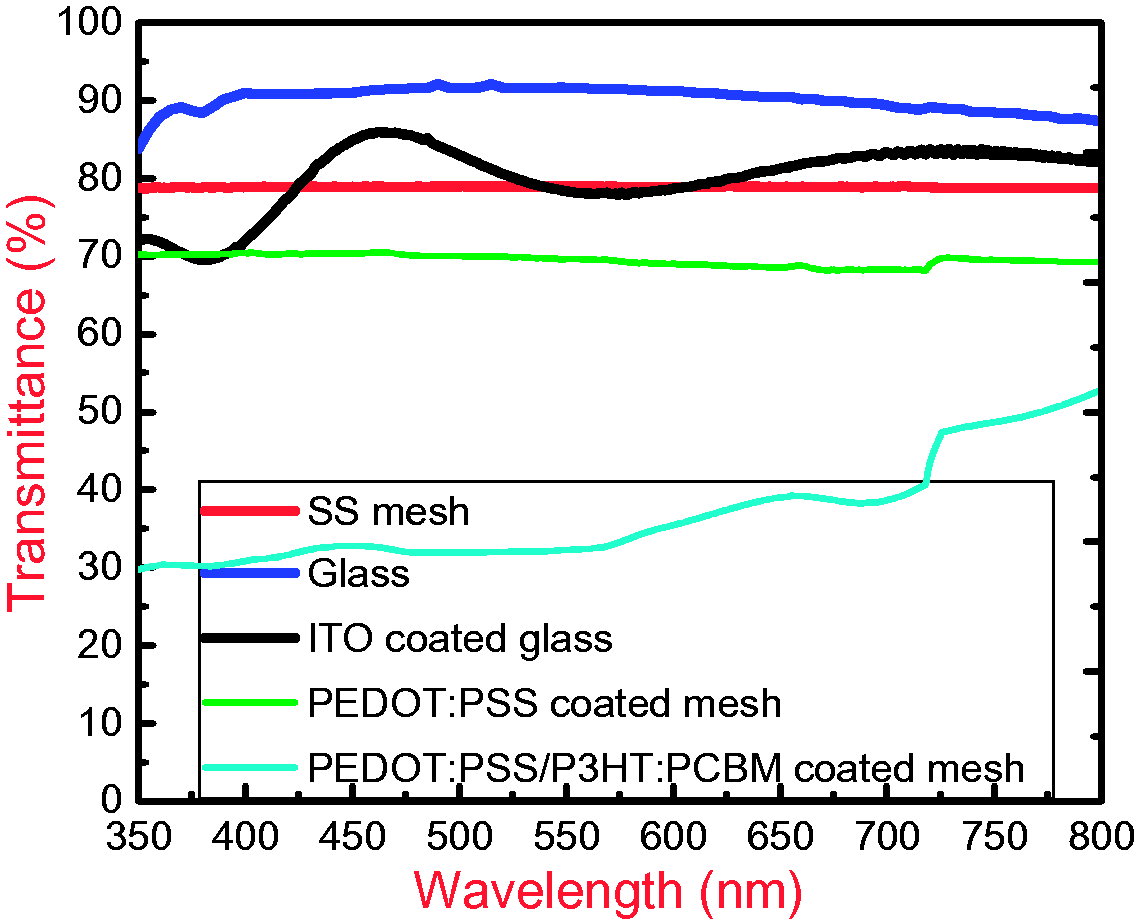
Transmittance curves of SS mesh, ITO-coated glass, PEDOT:PSS-coated mesh, PEDOT:PSS/P3HT:PCBM-coated mesh, and glass as a reference.
Organic PV design is constructed on an SS mesh fabric for power textile applications. A reference cell on an ITO-coated glass with the same materials is fabricated for comparison. Figure 4 shows the current density–voltage (IV) characteristics of the solar cells under AM 1.5 stimulated illumination at an intensity of 100 mW/cm2. The photoelectrical results of the SS mesh fabric solar cell are investigated in this study, and the reference cells are summarized in Table 1.
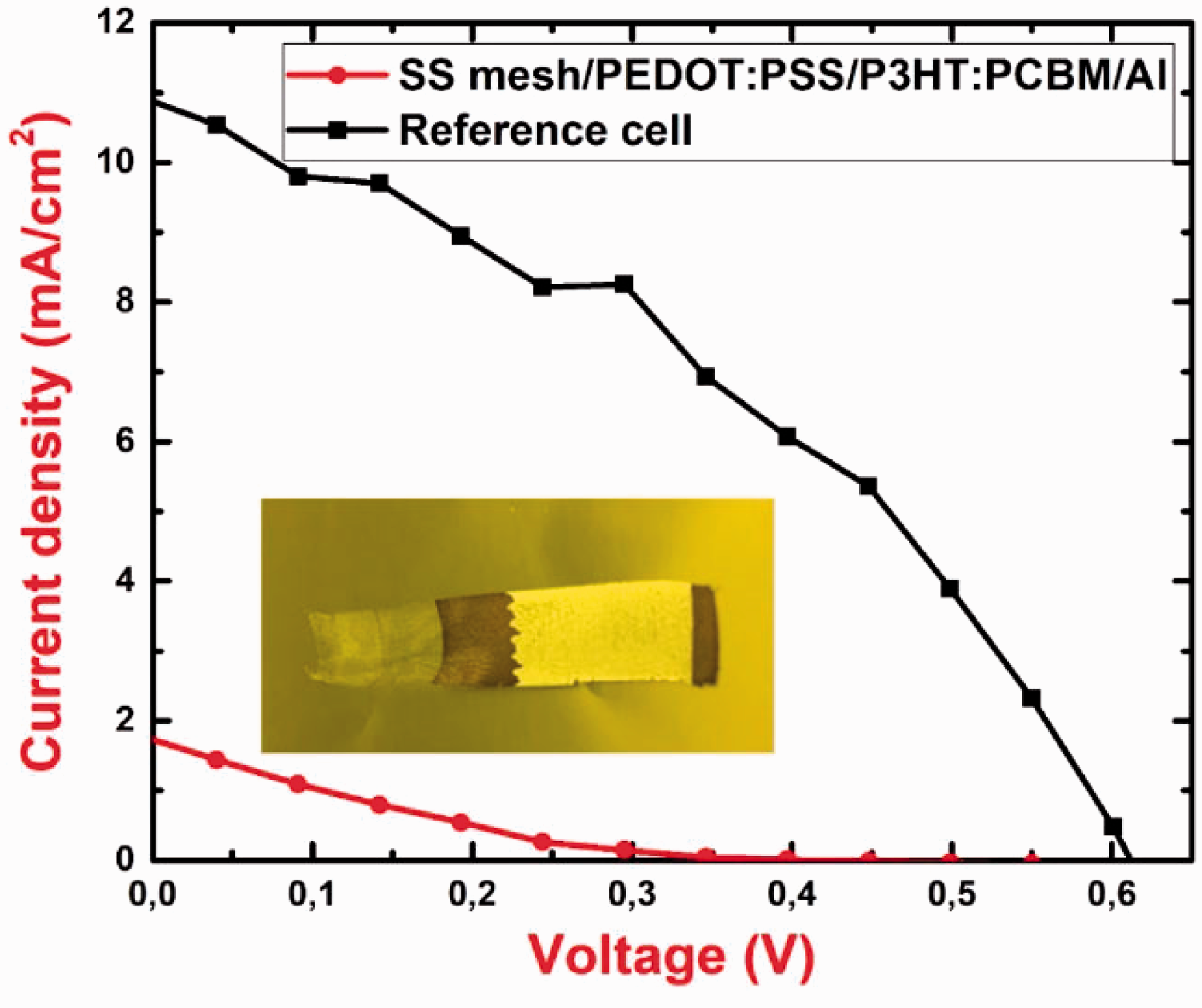
The IV curves of the reference cell and the optical image of the metal (mesh) fabric solar cell investigated in this study.
The IV data of the solar cells on metallic substrates.

The OSCs manufactured with an SS mesh fabrics having the construction of SS/PEDOT:PSS/P3HT:PCBM/Al exhibited the best PCE (ηbest) as 0.69%, which was obtained from the measured short circuit current density (Jsc) of 1.71 mA/cm2, open-circuit voltage (Voc) of 0.410 V, and a calculated FF of 0.11. The mean efficiency (ηmean) and the standard deviation (SD) of the working solar cells of this experimental group have been calculated as 0.06% and 0.11, respectively.
The organic type of solar cells produced with spin-coating technique with the construction of ITO/PEDOT:PSS (P VP AI 4083)/P3HT:PCBM/Al as a reference cell had the best PCE (ηbest) of 2.44%, which was obtained from the measured short circuit current density (Jsc) of 11 mA/cm2, open-circuit voltage (Voc) of 0.601 V, and a calculated FF of 0.35. The mean efficiency (ηmean) and the SD of the working solar cells of this investigational group have been calculated as 1.7% and 0.52, respectively.
Since the layers are only a few hundred nanometers in OSCs, the heaviest part is substrates. Thus, it plays an important role in the advancement of this technology. There are several reports in the literature to compare lightweight solar cells according to a power output per weight. While an ITO-coated 250 µm-thick PET can reach 0.4 W/g, if the thickness of the PET substrate is decreased, the power output increases [34,35,76]. A solar device on an SS mesh textile fabric had an areal density of 5.9 mg/cm2 and power output of 0.18 W/g [23,76]. In another polymer-based solar textile study, areal density is 5 mg/cm2, and specific power is 0.45 W/g [76]. In this study, comparable results were obtained which the specific power output is 0.14 W/g and areal density is 24 mg/cm2.
Conclusions
An organic PV textile structure on a metal fabric has been produced in this study. The promising results can open up new horizons for the future studies. About 0.69% PCE is obtained from metal-based solar fabric while reference solar cell has 2.44% PCE.
It is shown that such a solar cell structure retains the light transmittance and that the metal wires ensure electrical contact for films of the cell layers. It can be concluded that OSCs fabricated on SS mesh fabrics and on conventional ITO-coated glass substrates with the P3HT:PCBM material system have comparable PV characteristics. The principle can be developed to be applicable for mass production similar to textile applications in further studies.
Preliminary results with this study indicated that highly conductive, transparent, and flexible fabric electrodes can be used for innovative solutions. Such electrodes are also suitable for roll-to-roll fabrication systems and similar to textile processes. The SS mesh fabrics can be combined with hybrid solar cells as flexible metal-based PVs due to resistance to high-temperature processes.
In the future work, a transparent top electrode should be deposited on both sides allowing the light to pass through the photoactive layer. This could allow the illumination from either side.
The textile-based metal fabric enables a flexible PV structure that can be integrated on non-planar surfaces to generate electricity, and also mesh structure allows the light to reach the photoactive layer.
Footnotes
Declaration of conflicting interests
The author(s) declared no potential conflicts of interest with respect to the research, authorship, and/or publication of this article.
Funding
The author(s) disclosed receipt of the following financial support for the research, authorship, and/or publication of this article: This study was supported by the Turkish Scientific and Technical Research Council, TUBITAK, Program No: 2214/A.
