




Abstract
The molecular composition, stable carbon and hydrogen isotopes, and light hydrocarbons of the Lower Paleozoic natural gas in the Daniudi gas field in the Ordos Basin were investigated to study the geochemical characteristics. The Lower Paleozoic gas in the Daniudi gas field displays methane contents of 87.41–93.34%, dryness coefficients (C1/C1–5) ranging from 0.886 to 0.978, δ13C1 and δ13C2 values ranging from −40.3 to −36.4‰, with an average of −38.3‰, and from −33.6 to −24.2‰, with an average of −28.4‰, respectively, and δD1 values ranging from −197 to −160‰. The alkane gas generally displays positive carbon and hydrogen isotopic series, and the C7 and C5–7 light hydrocarbons of the Lower Paleozoic gas are dominated by methylcyclohexane and iso-alkanes, respectively. The Lower Paleozoic gas in the Daniudi gas field is mixed from coal-derived and oil-associated gases, similar to that observed in the Jingbian gas field. The oil-associated gas in the Lower Paleozoic gas is secondary oil cracking gas and displays a lower cracking extent than that in the Jingbian gas field. The coal-derived gas in the Lower Paleozoic gas in the Daniudi gas field migrated from the Upper Paleozoic gas through the window area where the iron–aluminum mudstone caprocks in the Upper Carboniferous Benxi Formation were missing. The oil-associated gas in the Lower Paleozoic gas in the Daniudi gas field was probably derived from presalt source rocks in the Lower Ordovician Majiagou Formation rather than the limestone in the Upper Carboniferous Taiyuan Formation. It seems unlikely that the marlstone in the Upper Ordovician Beiguoshan Formation and shale in the Middle Ordovician Pingliang Formation on the western and southwestern margins of the Ordos Basin contributed to the oil-associated gas in the Lower Paleozoic gas in the Daniudi gas field.
Keywords
Introduction
The Ordos Basin, a petroliferous basin located in central China, is the most stable basin in China (Xu et al., 1995). Natural gas exploration targets in the Ordos Basin mainly consist of Upper Paleozoic Carboniferous-Permian strata and Lower Paleozoic Ordovician strata (Dai et al., 2005). Several Upper Paleozoic large gas fields, such as Sulige, Yulin, Daniudi, Wushenqi, and Zizhou, with proven reserves exceeding 100 × 109 m3, have been discovered, and Carboniferous-Permian tight sandstones are the main reservoirs (Dai et al., 2005; Hu et al., 2010; Huang et al., 2015; Yang et al., 2008; Zou et al., 2013). However, only one Lower Paleozoic large gas field, i.e. the Jingbian gas field, has been discovered in the basin, with Lower Ordovician Majiagou Formation (O1m) carbonate rocks as the main reservoirs (Dai et al., 2008a; Liu et al., 2009), and the proven reserves of the field in the Ordovician weathering crust reached 655.2 × 10⁹ m3 at the end of 2012 (Yang and Liu, 2014). In addition to the Jingbian gas field, several gas reservoirs have been discovered in the Ordovician weathering crust in the northwestern Ordos Basin (Zhao et al., 2015), the Daniudi gas field in the northeastern Ordos Basin (Ding et al., 2016), and the presalt Majiagou Formation in the eastern Ordos Basin (Yang et al., 2009), which suggests that the Lower Paleozoic strata in the Ordos Basin have favorable exploration potential.
The geochemical characteristics of the natural gas in the Ordos Basin have been widely studied, and the Upper Paleozoic natural gas is generally considered to be coal-derived gas from the Carboniferous-Permian coal-measure source rocks (Dai et al., 2005; Hu et al., 2008a; Yang and Liu, 2014), whereas the Lower Paleozoic natural gas is commonly believed to be mixed gas (Cai et al., 2005; Zou et al., 2007). However, there is no consensus on whether the Lower Paleozoic natural gas is dominated by coal-derived gas from the Carboniferous-Permian coal-measure source rocks (Dai et al., 2005; Hu and Zhang, 2011; Mi et al., 2012; Xia et al., 1999a; Yang and Liu, 2014) or oil-associated gas (Chen, 2002; Hao et al., 1997; Huang et al., 1996), and Li et al. (2003) considered that the main genetic type of the Lower Paleozoic natural gas is different in different areas of the basin. The oil-associated gas in the Lower Paleozoic natural gas has been considered to be derived from the limestone in the Carboniferous Taiyuan Formation (Dai et al., 2005; Hu et al., 2008a; Xia et al., 1999b), whereas other scholars demonstrated that the Lower Paleozoic natural gas was derived from the Ordovician source rocks on the western and southwestern margins of the basin (Liu et al., 2012) or within the basin (Chen, 2002; Hao et al., 1997; Huang et al., 1996), especially the presalt Majiagou Formation (Liu et al., 2016). Moreover, the carboxylate salts in the marine source rocks with low total organic carbon (TOC) in the Ordos Basin may also be a potential gas source at a high maturity stage (Liu et al., 2013). The source of the controversy on the gas origin is a divergence on understanding the gas geochemical characteristics, and that on the source of oil-associated gas is derived from whether the carbonate rocks with low TOC contents in the Lower Ordovician Majiagou Formation can be considered as the effective source rocks.
The Daniudi gas field is located in the northeastern Ordos Basin, and the Upper Paleozoic gas is coal-derived gas from the Carboniferous-Permian coal-measure source rocks (Hao et al., 2006; Liu et al., 2015). In recent years, gas exploration in the Lower Paleozoic strata has achieved continuous breakthroughs, and industrial gas flows have been obtained in the weathering crust in the fifth member of the Lower Ordovician Majiagou Formation in several drilling wells; e.g. a gas production test has obtained a daily output of 50.4 × 10⁴ m3, thus suggesting a favorable gas exploration prospect. The origin, source, and accumulation patterns of the Upper Paleozoic natural gas in the Daniudi gas field have been widely studied (Liu et al., 2015; Yang et al., 2016), whereas studies on the Lower Paleozoic gas reservoirs have generally concentrated on the characteristics and development regularity of the reservoirs in the Ordovician weathering crust (Ding et al., 2016; Liu et al., 2014), with only a few insufficient studies on the origin and source of the gas (Hui and Jia, 2001). The origin and source of the Lower Paleozoic natural gas in the Daniudi gas field are ambiguous due to the complicated geochemical characteristics of the gas, which has restricted the deepening and expansion of the gas exploration field. Therefore, the authors intend to investigate the geochemical characteristics based on the molecular composition, stable carbon and hydrogen isotopes, and light hydrocarbons of the Lower Paleozoic natural gas in the Daniudi gas field, probe into the origin and source of the gas based on a comparison with the Upper Paleozoic gas in the same field and the Lower Paleozoic gas in the Jingbian gas field and further provide valuable information for resource assessment and a geological basis for an expansion of the gas exploration.
Geological setting
The Ordos Basin, which is located on the western margin of the North China Block and has an area of 37 × 104 km2, is a multicycle cratonic basin with stable subsidence, migrated depression, and various contours in its evolutionary history (Yang et al., 2005). It can be divided into six secondary tectonic units (Figure 1), i.e. the Yimeng Uplift, Weibei Uplift, Jinxi Fault-fold Belt, Yishan Slope, Tianhuan Depression, and West Margin Thrust Belt, and the Ordos Basin is characterized by a gentle structure, stable subsidence, and few faults. The Paleozoic strata of the basin display a two-layer structure (Figure 2), i.e. the Upper Paleozoic strata are mainly composed of Carboniferous-Permian terrigenous clastic rocks and coal measures, with several transitional deposits in the Upper Carboniferous Taiyuan Formation (C2t), and the Lower Paleozoic strata consist primarily of marine carbonate and gypsum-salt rocks in the Lower Ordovician Majiagou Formation (O1m), which are unconformably underlying the Upper Paleozoic strata (Dai, 2014).
The distribution of tectonic units and large gas fields in the Ordos Basin (a) and gas wells in the Daniudi gas field (b). Stratigraphic column of the Daniudi gas field in the Ordos Basin.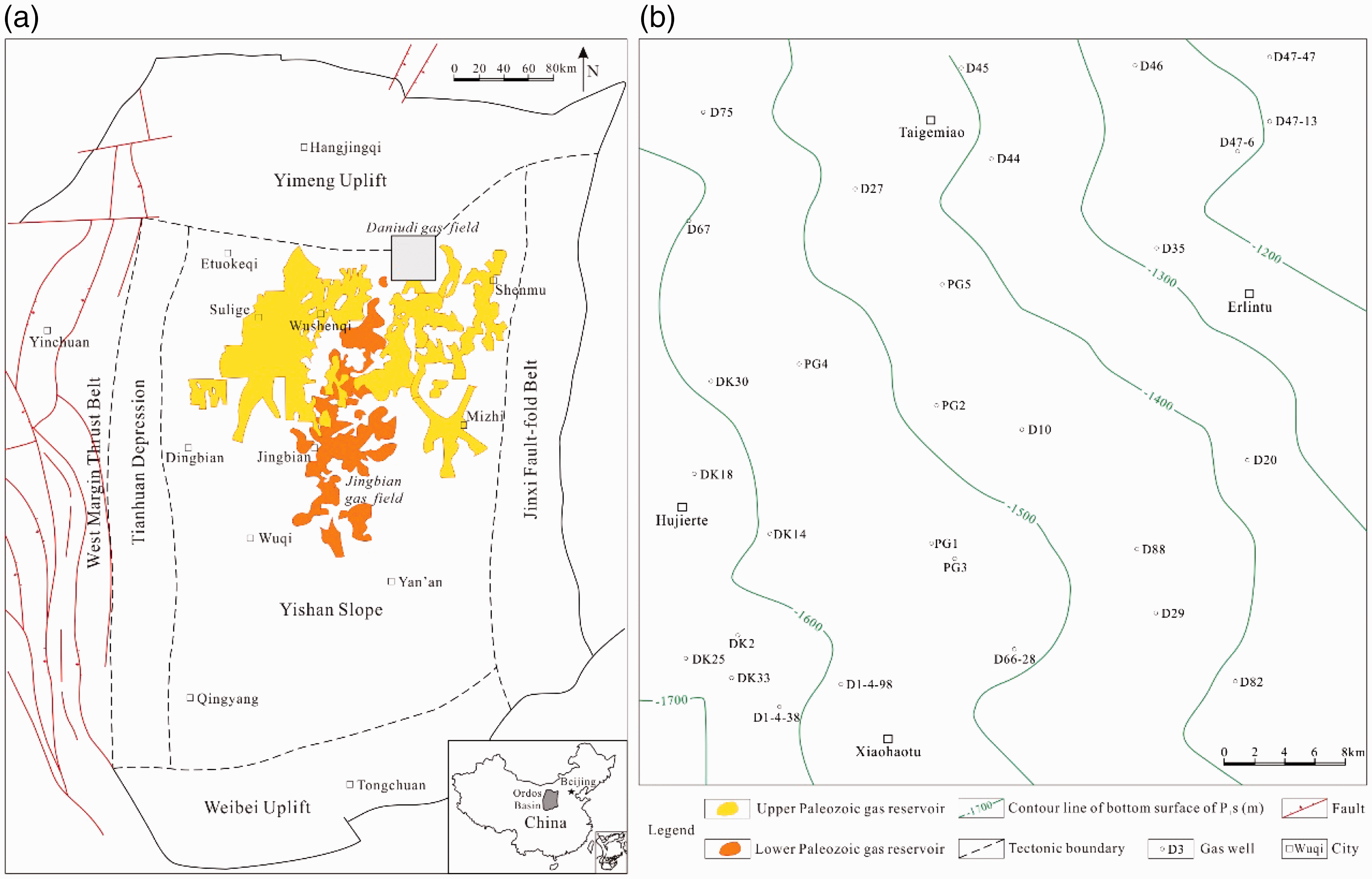
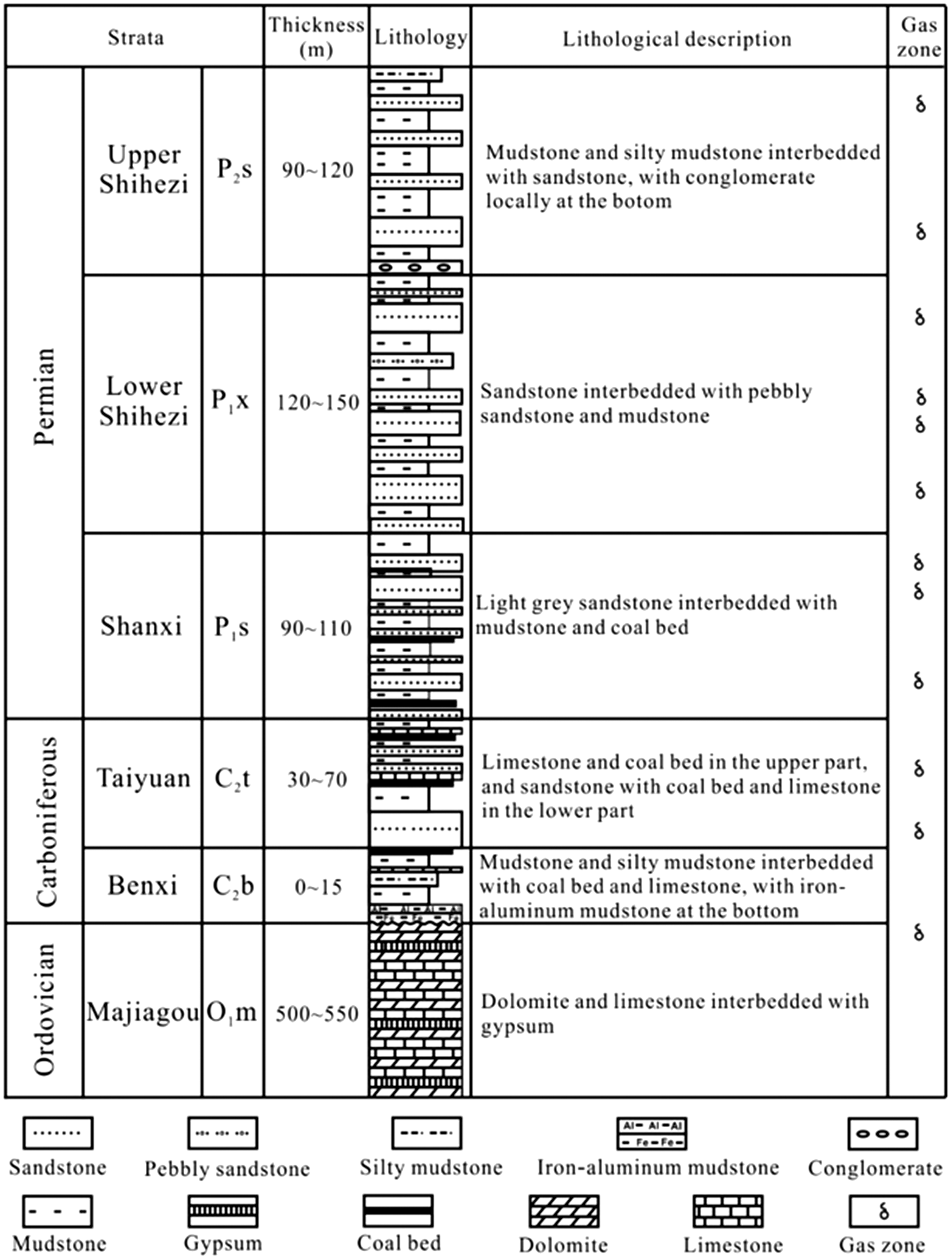
The Lower Ordovician Majiagou Formation in the Ordos Basin can be divided into five members, i.e. O1m1 to O1m5 from bottom to top, and the fifth member (O1m5) can be further divided into 10 submembers, i.e. from
There are two sets of Paleozoic source rocks in the Ordos Basin: the Carboniferous-Permian coal measures, which display humic organic matter and are the main source for the Upper Paleozoic coal-derived large gas fields (Dai, 2014; Xiao et al., 2005), and Ordovician sapropelic source rocks (Dai et al., 2005). It was generally believed that the effective Lower Paleozoic source rocks were the marlstone in the Upper Ordovician Beiguoshan Formation (O3b) and the shale in the Middle Ordovician Pingliang Formation (O2p) on the western and southwestern margins of the Ordos Basin, which have average TOC contents of 0.9 and 0.93%, respectively (Liu et al., 2012). The Lower Paleozoic source rocks within the Ordos Basin are the O1m carbonate rocks, and they were generally believed to be ineffective source rocks as a result of the extremely low TOC contents, which are generally lower than 0.5% (Dai et al., 2005). However, a recent study has indicated that effective source rocks are developed in the pre-salt O1m strata in the central-eastern Ordos Basin, and they display a low hydrocarbon potential, with a gas generation intensity of 1–2 × 10⁸ m3/km2, which is much lower than those of the Upper Paleozoic coal measures (Guo et al., 2014). A statistical analysis indicates that the presalt source rocks have an average TOC content of 0.3%, with type I kerogen, and rock samples with TOC contents higher than 0.4% account for 28.2% of the total samples, suggesting the potential of generating a certain amount of oil-associated gas (Liu et al., 2016). Moreover, the limestone in the transitional Upper Carboniferous Taiyuan Formation (C2t) in the central-eastern Ordos Basin generally displays TOC contents ranging from 0.5 to 3%, and it is believed to have contributed to the Lower Paleozoic gas reservoirs in the basin (Dai et al., 2005; Hu et al., 2008a; Xia et al., 1999b).
The Daniudi gas field is located in the northern segment of the Yishan Slope in the Ordos Basin, and the proven reserves of the Upper Paleozoic natural gas by the end of 2011 reached 416.828 × 10⁹ m3 over an area of 2003.71 km2 (Dai, 2014). The Upper Paleozoic natural gas is reservoired in tight sandstone in the Upper Carboniferous Taiyuan Formation (C2t), Lower Permian Shanxi Formation (P1s), and Lower Shihezi Formation (P1x) (Liu et al., 2015). The Lower Paleozoic natural gas is reservoired in the postsalt marine carbonate rocks in
Samples and analytical methods
Molecular compositions and stable carbon and hydrogen isotopic values of the Paleozoic gas from the Daniudi gas field.
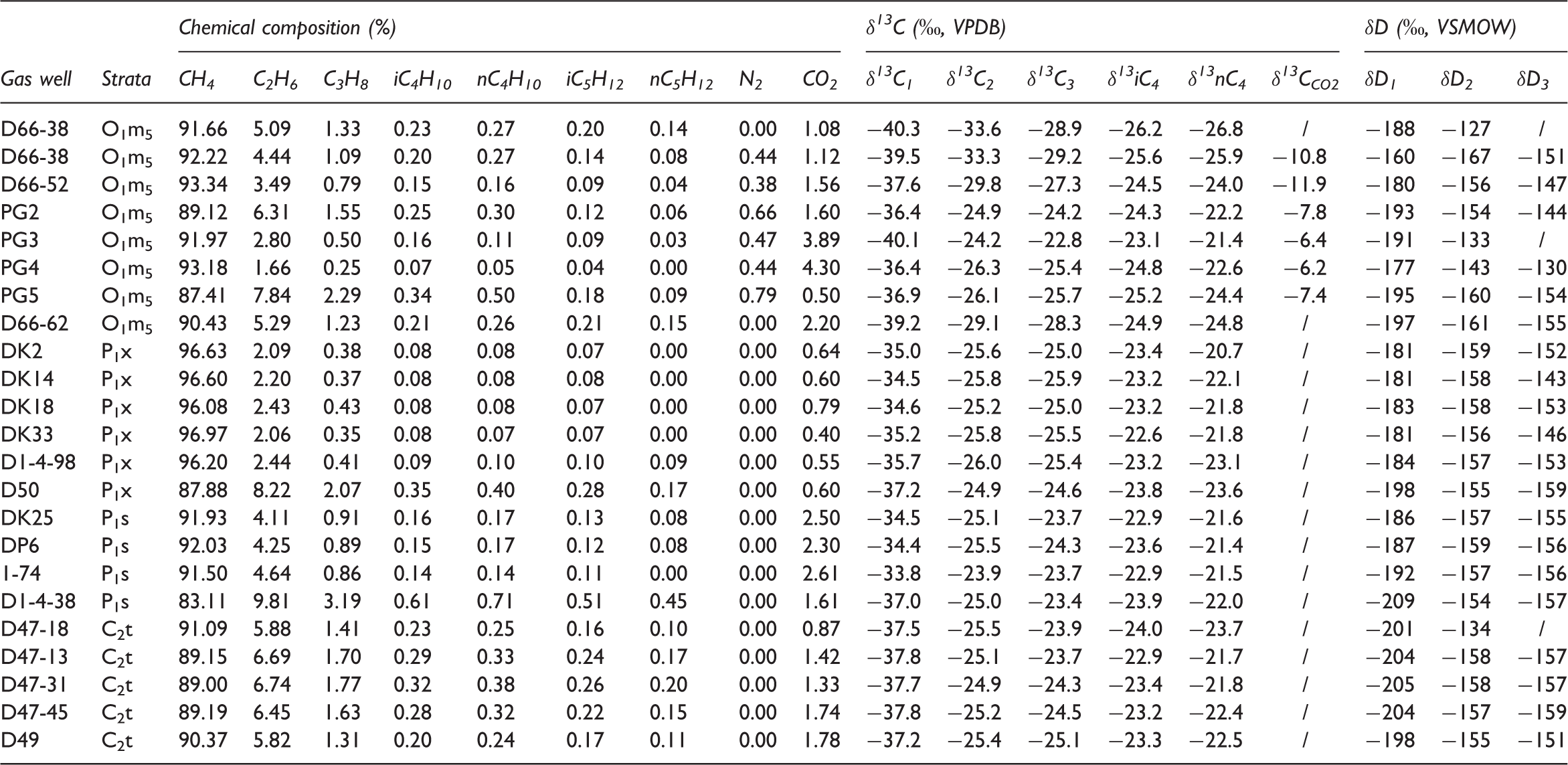
“/” indicates no data.
Results
Chemical composition
The O1m gas in the Daniudi gas field is dominated by alkane gas with methane and heavy alkane (C2–5) contents of 87.41–93.34% and 2.08–11.24%, respectively, and the dryness coefficients (C1/C1–5) range from 0.886 to 0.978, suggesting both dry and wet gases (Table 1, Figure 3). The methane contents and dryness coefficients of the O1m gas in the Daniudi gas field display similar distribution ranges with those of the Upper Paleozoic gas, and they are generally obviously lower than those of the O1m gas in the Jingbian gas field (Figure 3(a)).
The correlation diagrams of dryness coefficient (C1/C1–5) versus CH4% (a) and δ13C1 values (b) of natural gas from the Daniudi gas field. The O1m gas data from the Jingbian gas field are from Dai (2014).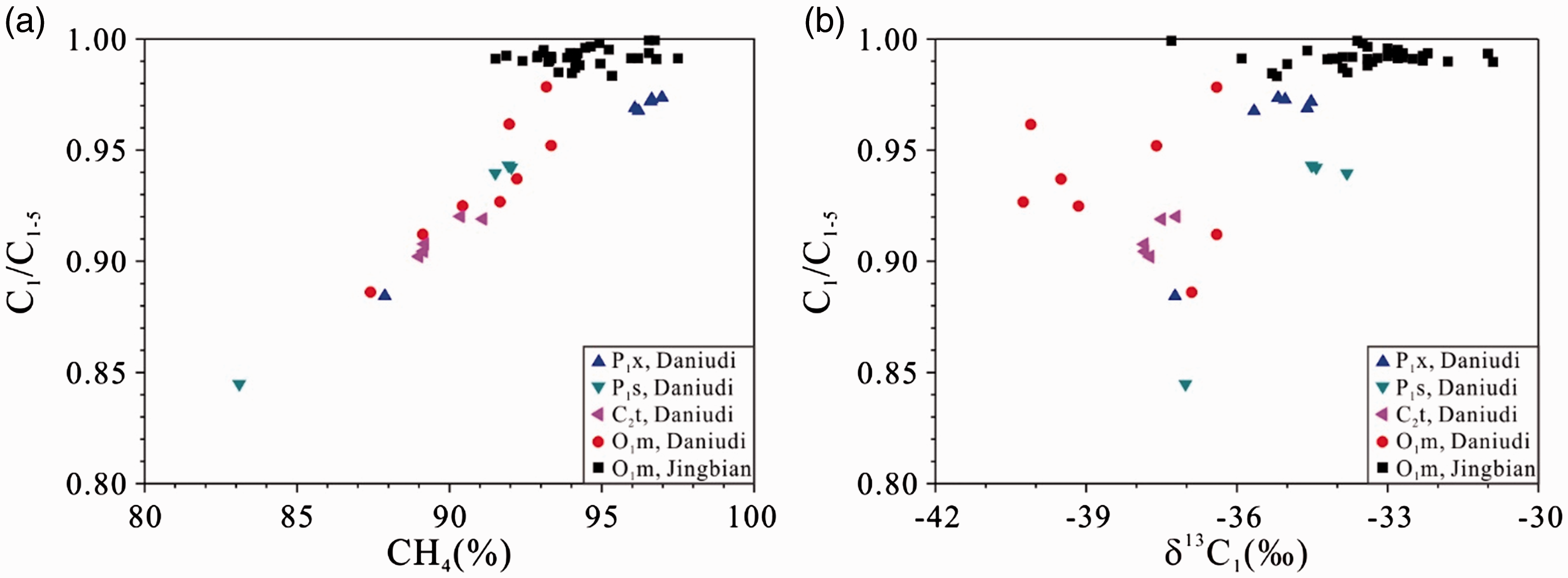
The nonhydrocarbon components of the O1m gas in the Daniudi gas field are mainly CO2 and N2, and they display contents of 0.50–4.30%, with an average of 2.03%, and 0–0.79%, with an average of 0.40%, respectively (Table 1). The Upper Paleozoic gas in the field displays slightly lower CO2 contents in the range of 0.40–2.61%, with an average of 1.32%, and generally contains little N2 (Table 1). The average CO2 and N2 contents in the O1m gas in the Jingbian gas field are 3.65 and 1.04%, respectively (Dai, 2014), which are generally higher than those in the Daniudi gas field. The O1m gas in the Daniudi gas field contains trace amounts of H2S, and the content is lower than the detection limit of the GC. The H2S concentrations in the O1m gases from wells D1 and D2 in the field were measured to be 280 and 330 mg/g by titrimetry, respectively (Wu et al., 2012), which can be separately converted into mole percentages of 0.018 and 0.022%. Therefore, the H2S content of the O1m gas in the Daniudi gas field is slightly lower than the average H2S content (0.13%) of the O1m gas in the Jingbian gas field (Liu et al., 2009).
Carbon isotopes
The δ13C1 and δ13C2 values of the O1m gas in the Daniudi gas field range from −40.3 to −36.4‰, with an average of −38.3‰, and from −33.6 to −24.2‰, with an average of −28.4‰, respectively (Table 1), which are generally lower than those of the Upper Paleozoic gas in the field, which has average δ13C1 and δ13C2 values of −36.0 and −25.2‰, respectively (Table 1). The δ13C1 values of the O1m gas in the Daniudi gas field are generally lower than those in the Jingbian gas field (Figures 3(b) and 4), but the δ13C2 values of the O1m gases from those two gas fields display similar distribution ranges, which are evidently wider than that of the Upper Paleozoic gas in the Daniudi gas field (Figure 4). However, the dryness coefficient and δ13C1 values of the Upper Paleozoic gas are positively correlated, unlike those of the O1m gas (Figures 3(b) and 4).
The correlation diagrams of δ13C versus 1/Cn of the Upper Paleozoic gas (a) and Lower Paleozoic gas (b) from the Daniudi gas field. The O1m gas data from the Jingbian gas field are from Dai (2014).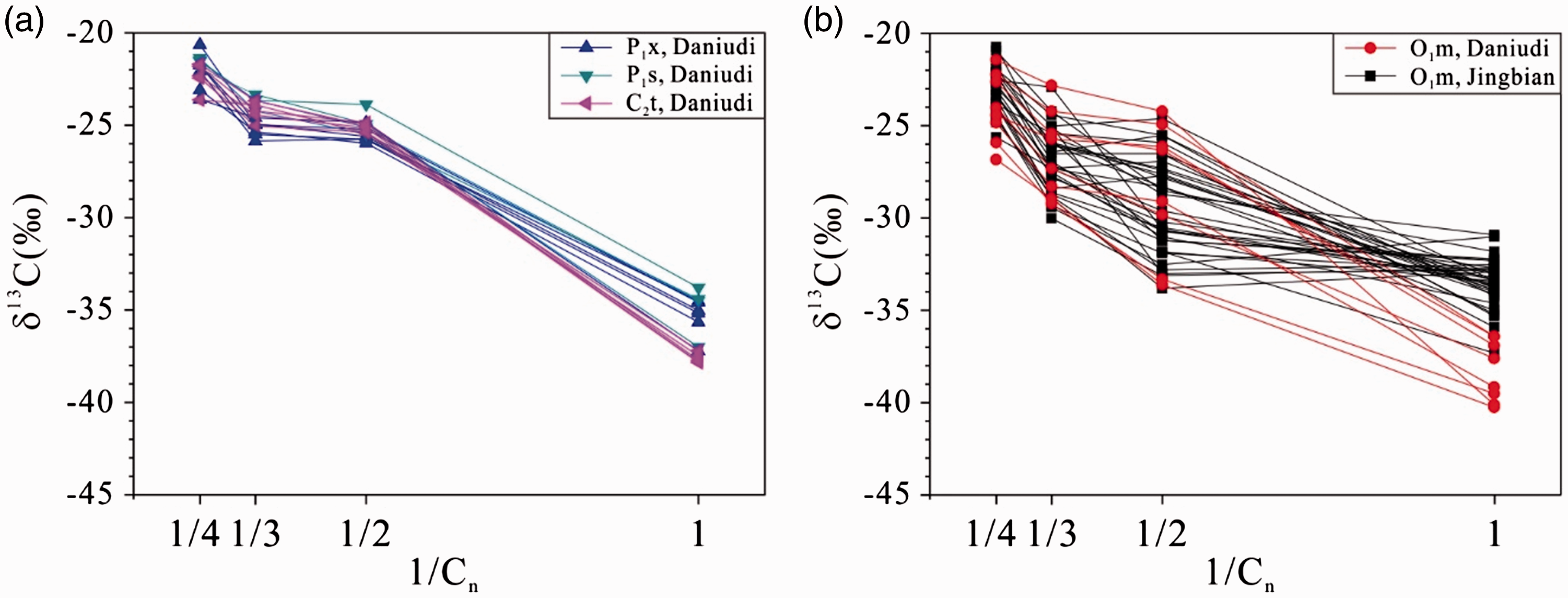
The O1m alkane gas in the Daniudi gas field displays positive carbon isotopic series (δ13C1<δ13C2<δ13C3<δ13nC4) and is consistent with the Upper Paleozoic alkane gas. A few O1m gas samples from the Jingbian gas field display partial reversals between the CH4 and C2H6 (δ13C1 > δ13C2) or C2H6 and C3H8 carbon isotopes (δ13C2 > δ13C3) (Figure 4(b)). The δ13CCO2 values for the O1m gas in the Daniudi gas field range from −11.9 to −6.2‰ (Table 1).
Hydrogen isotopes
The δD1 values for the O1m alkane gas in the Daniudi gas field range from −197 to −160‰, which is generally consistent with that of the Upper Paleozoic gas (Table 1). The O1m alkane gas in the field generally displays positive hydrogen isotopic series (δD1<δD2<δD3) and is consistent with the Upper Paleozoic alkane gas, with only one O1m gas sample from Well D66-38 being partially reversed between methane and ethane (δD1 > δD2) (Table 1, Figure 5). Some O1m gas samples in the Jingbian gas field display partial hydrogen isotopic reversals between CH4 and C2H6 (δD1 > δD2) or C2H6 and C3H8 (δD2 > δD3) or even a continuous hydrogen isotopic reversal among CH4, C2H6, and C3H8 (δD1 > δD2 > δD3) (Figure 5(b)).
The correlation diagrams of δD versus 1/Cn of the Upper Paleozoic gas (a) and Lower Paleozoic gas (b) from the Daniudi gas field. The O1m gas data from the Jingbian gas field are from Dai (2014).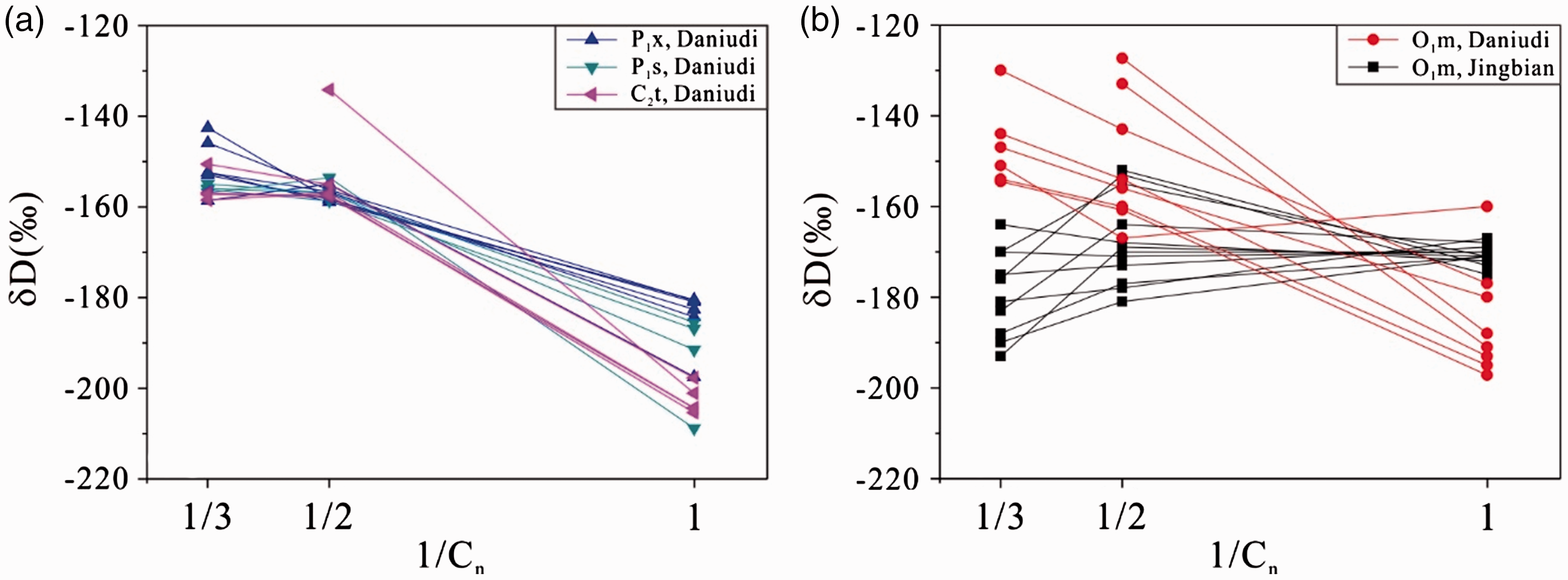
Light hydrocarbons
The C7 light hydrocarbons of the O1m gas in the Daniudi gas field are dominated by methylcyclohexane (MCH), with slightly higher n-heptane (nC7) contents than those of the Upper Paleozoic gas, and the C5–7 light hydrocarbons of the O1m gas are mainly composed of iso-alkanes, which are consistent with those of the Upper Paleozoic gas (Figure 6). The C7 light hydrocarbons of the O1m gas in the Jingbian gas field are also dominated by MCH (Hu et al., 2010; Hu and Zhang, 2011).
Ternary diagrams of C7 (a) and C5–7 (b) light hydrocarbons in natural gas from the Daniudi gas field (modified from Dai et al. (1992)). The O1m gas data from the Jingbian gas field are from Dai (2014).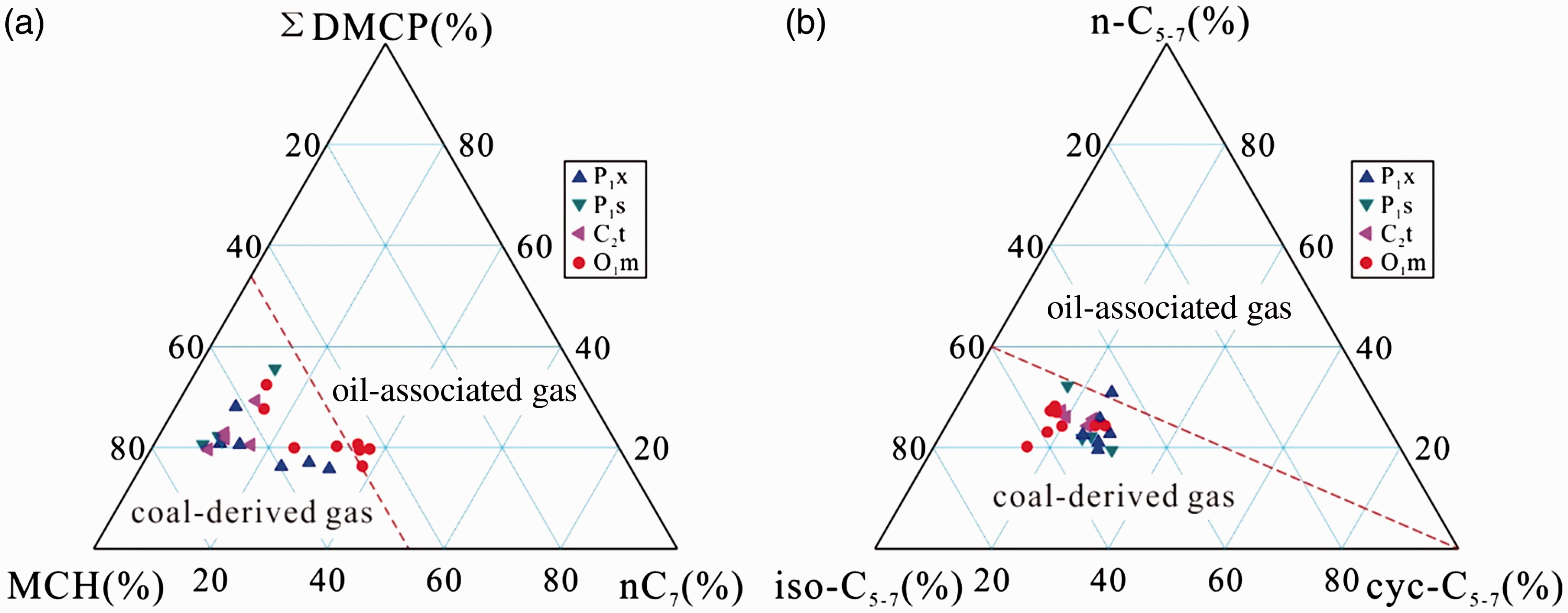
Discussion
Genetic types of natural gas
Natural gas can be divided into biogenic and abiogenic gases based on the different generation mechanisms. The abiogenic gas generally displays negative alkane carbon isotopic series with δ13C1 values above −30‰, whereas the biogenic gas displays positive series with δ13C1 values below −30‰ (Dai et al., 2008b). The O1m gas in the Daniudi gas field in the Ordos Basin displays positive alkane carbon isotopic series, with δ13C1 values lower than −30‰ (Figures 3(b) and 4), and is consistent with the Upper Paleozoic gas (Figure 4), suggesting typical biogenic gas.
The O1m gas in the Daniudi gas field displays obviously higher δ13C1 values than typical bacterial gas (δ13C1<−55‰) and displays the characteristics of thermogenic gas in the modified Bernard diagram (Figure 7). Thermogenic gas can be generally divided into coal-derived gas from humic organic matter and oil-associated gas from sapropelic organic matter (Dai et al., 1992), which follow different trends in the Bernard diagram (Bernard et al., 1976). Although several O1m gas samples in the Daniudi gas field follow the trend of natural gas derived from type III kerogen with relatively low C1/C2 + 3 ratios (<10) and are consistent with the C2t and P1s coal-derived gas in the modified Bernard diagram, more O1m gas samples are located in the transitional zone between gases from types II and III kerogen with relatively high C1/C2+3 ratios (>10), suggesting a mixed origin of the O1m gas (Figure 7).
Modified Bernard diagram of natural gas from the Daniudi gas field (modified from Bernard et al. (1976)). The O1m gas data from the Jingbian gas field are from Dai (2014).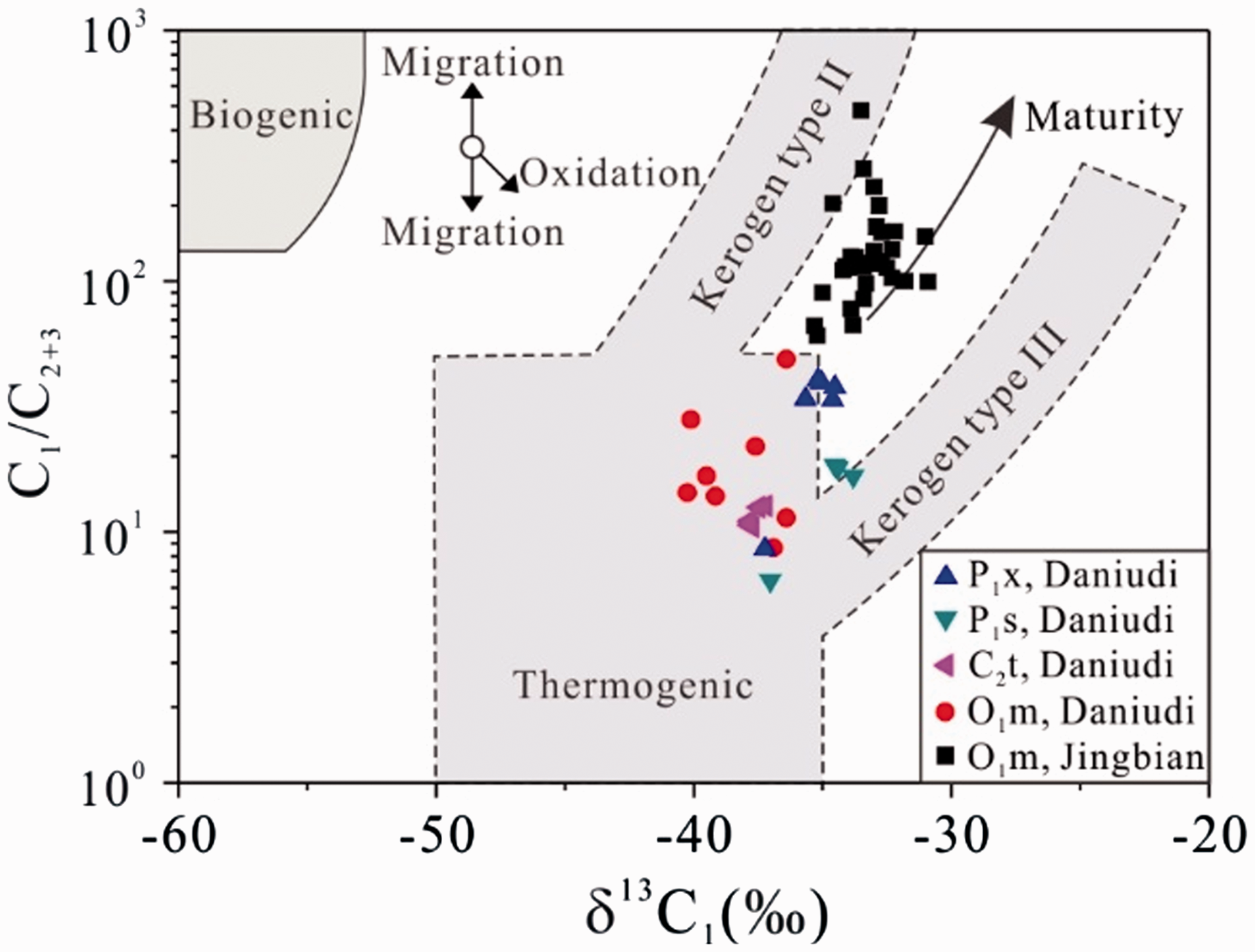
Because coal-derived gas derived from humic organic matter has relatively higher δ13C2 values than oil-associated gas derived from sapropelic organic matter with similar δ13C1 values, the gases derived from different types of organic matter display different evolution trends on the correlation diagram between δ13C1 and δ13C2 values (Rooney et al., 1995). The O1m gas in the Daniudi gas field displays a wide range of δ13C2 values and is consistent with those observed in the Jingbian gas field (Figure 4), and several O1m gas samples display high δ13C2 values (>−28.0‰) and are consistent with the Upper Paleozoic coal-derived gas. The O1m gas samples with high δ13C2 values follow the trend of coal-derived gas from type III kerogens in the Niger Delta or Sacramento Basin, whereas the other O1m gas samples with low δ13C2 values (<−28.0‰) follow the trend of oil-associated gas from the type II kerogen in the Delaware/Val Verde Basin (Figure 8). Therefore, the O1m natural gas contains both coal-derived and oil-associated gases.
The correlation diagram between δ13C2 and δ13C1 values of natural gas from the Daniudi gas field. The trend lines for gases from type III kerogen of the Niger Delta and type II kerogen of the Delaware/Val Verde Basin are from Rooney et al. (1995), and that from type III kerogen of the Sacramento Basin is from Jenden et al. (1988). The O1m gas data from the Jingbian gas field are from Dai (2014).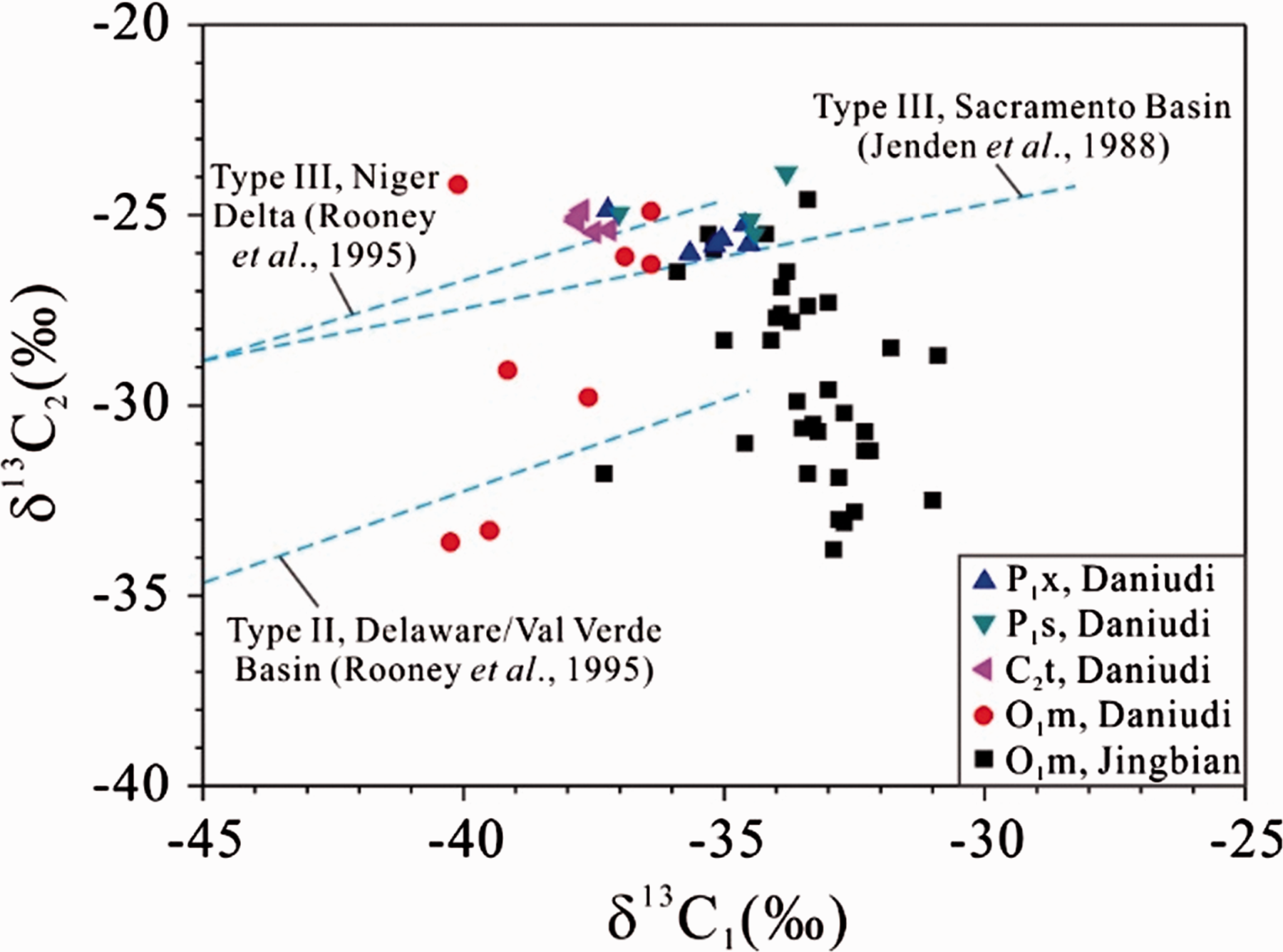
Because the C5 and C5–7 light hydrocarbon compositions can indicate the organic matter types, the ternary diagrams of C7 (MCH, ΣDMCP, and nC7) and C5–7 (n-C5–7, iso-C5–7, and cyc-C5–7) light hydrocarbons were proposed to discriminate coal-derived gas from oil-associated gas (Dai et al., 1992; Hu et al., 2008b). The O1m natural gas in the Daniudi gas field displays C5–7 light hydrocarbons dominated by iso-alkanes and is consistent with the Upper Paleozoic coal-derived gas in the C5–7 ternary diagram (Figure 6(b)). The O1m natural gas in the Jingbian gas field also displays the characteristics of coal-derived gas in the C5–7 ternary diagram (Hu and Zhang, 2011). However, the O1m natural gas in the Daniudi gas field generally displays higher nC7 contents than the Upper Paleozoic coal-derived gas and is situated around the boundary line between coal-derived gas and oil-associated gas, indicating the characteristics of a mixed gas (Figure 6(a)).
Both the correlation diagram between the δ13C2 and δ13C1 values (Figure 8) and the C7 ternary diagram (Figure 6(a)) indicate that the O1m natural gas in the Daniudi gas field contains both coal-derived and oil-associated gases, but the C5–7 ternary diagram indicates that the O1m gas is typically coal-derived gas (Figure 6(b)). This inconsistency may be related to the mixed origin of the gas, e.g. the natural gas in the Kekeya oil and gas field in the Tarim Basin displays similar characteristics (Wu et al., 2014). Because the O1m gas is dominated by methane, with contents of 87.41–93.34%, it may be one sided that only the trace components such as the light hydrocarbons were used to identify the gas origin, and the methane hydrogen isotopic composition could provide additional information for the identification of the gas origin.
The hydrogen isotopic compositions of natural gas are controlled by the types of organic matter, thermal maturity, and environmental conditions of the aqueous medium (Dai et al., 1992, 2012; Liu et al., 2008; Wang et al., 2015). The Upper Paleozoic gas in the Daniudi gas field displays the characteristics of gases from humic organic matter in the correlation diagram between the δD1 and δ13C1 values and follows the maturity trend with a positive correlation between the δD1 and δ13C1 values (Figure 9(a)). The O1m gas in the Jingbian gas field displays similar characteristics, which indicates that the methane is mainly coal-derived. However, the O1m gas in the Daniudi gas field does not display a positive correlation between the δD1 and δ13C1 values or follow the maturity and is mainly located in the mixing or transitional zones, unlike the typically coal-derived or oil-associated gas in the correlation diagram between the δD1 and δ13C1 values (Figure 9(a)), suggesting a mixed origin.
Cross-plots of δD1 versus δ13C1 (a) and δD1 versus δ13C2 (b) for natural gas from the Daniudi gas field (modified from Wang et al. (2015)). The O1m gas data from the Jingbian gas field are from Dai (2014).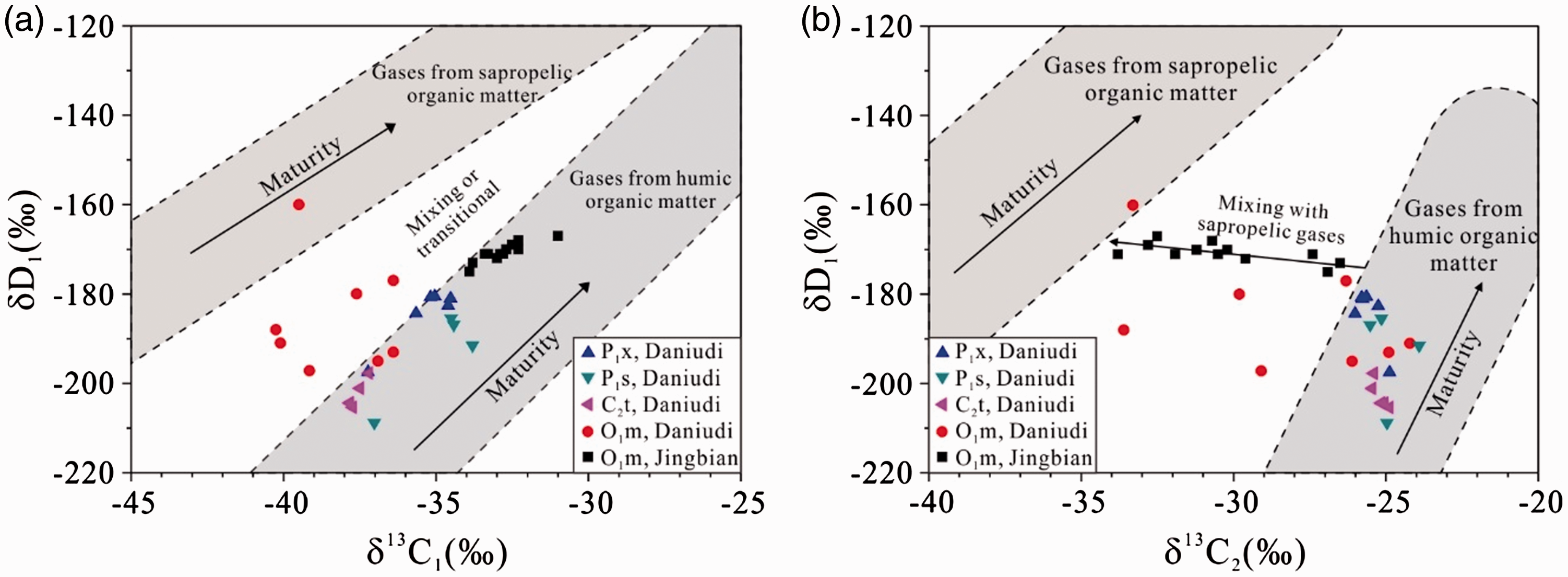
The Upper Paleozoic gas in the Daniudi gas field also displays the characteristics of gases from humic organic matter in the correlation diagram between the δD1 and δ13C2 values (Figure 9(b)), whereas the O1m gas in the Jingbian gas field displays a mixing trend with sapropelic (oil-associated) gases as a result of the wide-ranging δ13C2 values (−33.6 to −24.2‰), consistent with the conclusions on the gas origin by previous studies (Cai et al., 2005; Zou et al., 2007). Although several O1m gas samples in the Daniudi gas field display the characteristics of coal-derived or oil-associated gas, half of the samples display the trend of mixing by coal-derived and oil-associated gases (Figure 9(b)).
The carbon isotopes of ethane and propane were effective indexes for identifying the coal-derived and oil-associated gases, because they generally inherited the carbon isotopes of the original organic matter (Dai et al., 2005). Dai (1999) proposed that δ13C2 and δ13C3 values of coal-derived gas were generally higher than −27.5 and −25.5‰, respectively, whereas those of oil-associated gas were lower than −29.0 and −27.0‰, respectively. The O1m gas in the Daniudi gas field displays the characteristics of both coal-derived and oil-associated gases with wide δ13C2 (−33.6 to −24.2‰) and δ13C3 values (−29.2 to −22.8‰) and it is similar to the O1m gas in the Jingbian gas field and obviously different from the Upper Paleozoic coal-derived gas in the Daniudi gas field (Figure 10(a)).
Cross-plots of δ13C3 versus δ13C2 (a) and δ13C2–δ13C3 versus C2/C3 (b) of natural gas from the Daniudi gas field (modified from Dai (1999) and Lorant et al. (1998), respectively). The O1m gas data from the Jingbian gas field are from Dai (2014).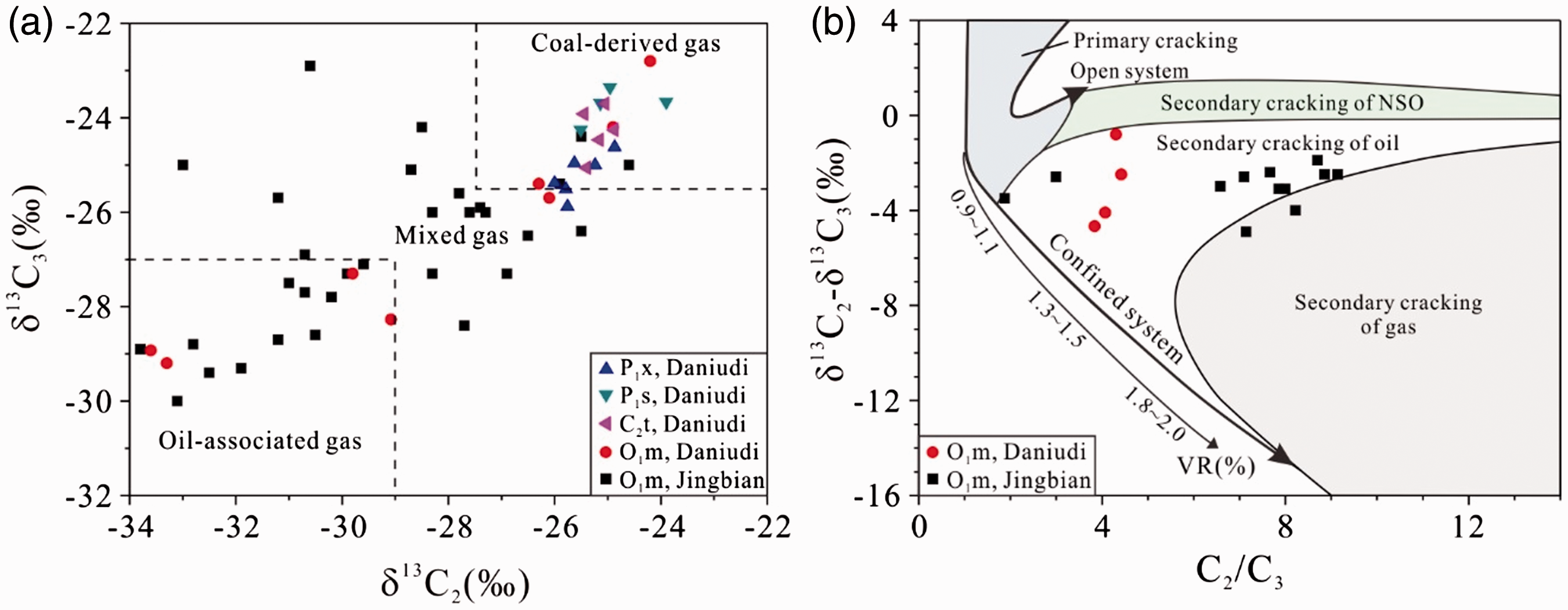
The oil-associated gas was considered to be from the primary cracking of kerogen or secondary cracking of oil according to the generation pathways (Prinzhofer and Huc, 1995), which could be effectively discriminated by the correlation diagram between δ13C2–δ13C3 and C2/C3 (Lorant et al., 1998). The O1m oil-associated gas samples in the Daniudi gas field, with δ13C2 and δ13C3 values separately lower than −29.0 and −27.0‰, display the characteristics of secondary oil cracking gas rather than the primary kerogen cracking gas in the correlation diagram between δ13C2–δ13C3 and C2/C3 (Figure 10(b)). The O1m oil-associated gas in the Jingbian gas field, with δ13C2 and δ13C3 values separately lower than −29.0 and −27.0‰, is generally derived from the secondary cracking of oil, with two samples reaching the stage of secondary cracking of gas (Figure 10(b)), which indicate that the O1m oil-associated gas in the Jingbian gas field displays a higher cracking extent than that in the Daniudi gas field.
Therefore, the O1m gas in the Daniudi gas field is mixed from coal-derived and oil-associated gas, in which the oil-associated gas is secondary oil cracking gas, with a lower cracking extent than that in the Jingbian gas field. The wide variations in the carbon and hydrogen isotopic compositions of the Lower Paleozoic natural gas in the Daniudi gas field might be caused by the different mixing proportions of the coal-derived and oil-associated gases.
The source of natural gas
The Upper Paleozoic coal-derived gas was considered to be from the C2t–P1s coal measures (dark mudstone and coal), which were the only set of humic source rocks in the Ordos Basin (Dai et al., 2005). Previous studies also demonstrated that the Upper Paleozoic coal-derived gas in the Daniudi gas field was derived from the C2t–P1s coal measures (Liu et al., 2015; Yang et al., 2016). The O1m gas in the Jingbian gas field displays the characteristics of a mixed gas and is dominated by coal-derived gas, which migrated downward and laterally into the O1m carbonate reservoirs (Dai et al., 2005; Yang et al., 2014). The O1m gas in the Daniudi gas field partially displays the carbon and hydrogen isotopic characteristics of coal-derived gas and has a good affinity with the Upper Paleozoic gas (Figures 8 to 10(a)). The O1m gas reservoirs in the Daniudi gas field are mainly distributed around the window area where the C2b strata are missing, suggesting the control of the C2b iron–aluminum mudstone caprocks (Sun et al., 2015). Therefore, the coal-derived gas in the Lower Paleozoic natural gas in the Daniudi gas field migrated downward from the Upper Paleozoic gas through the window area where the C2b iron–aluminum mudstone caprocks were missing.
The oil-associated gas in the Lower Paleozoic natural gas in the Ordos Basin was believed to be from the Ordovician (Chen, 2002; Hao et al., 1997; Huang et al., 1996; Liu et al., 2012) or Carboniferous source rocks (Dai et al., 2005; Hu et al., 2008a; Xia et al., 1999b). The C2t limestone is oil prone, with depths reaching 50 m in the central Ordos Basin, including the Jingbian area, and has certain hydrocarbon potential because the TOC content mainly ranges from 0.5 to 3%, with an average of 1.42%; therefore, it is considered to have contributed to the O1m gas in the Jingbian gas field (Dai et al., 2005; Hao et al., 2011). However, the C2t limestone in the Daniudi gas field displays thicknesses of only 0–5 m (Dai et al., 2005) and is only developed in the southern part of the field, and the C2t strata in the northern part of the field is composed of transitional coal-bearing clastic rock series without limestone (Guo et al., 2009). The C2t limestone in the Daniudi gas field has TOC contents of 0.07–0.38%, with an average of 0.16%, and only three out of 16 samples displayed TOC contents higher than 0.2%, suggesting poor source rocks (Hao et al., 2011). Therefore, the oil-associated gas in the O1m gas in the Daniudi gas field was probably not derived from the C2t limestone with extremely low hydrocarbon generation potential, as indicated by the small thicknesses and low TOC contents.
The Lower Paleozoic source rocks with high organic matter abundances were the O3b marlstone and the O2p shale on the western and southwestern margins of the Ordos Basin, which have average TOC contents of 0.9 and 0.93%, respectively (Liu et al., 2012). Therefore, the oil-associated gas in the O1m gas in the Daniudi gas field was considered to be derived from the secondary cracking of oil, which had been generated by those two sets of source rocks, migrated into the basin and accumulated in the central paleo-uplift in the basin, and the oil cracking gas migrated eastwards or northeastwards (Liu et al., 2012). If the O1m gas in the Daniudi gas field migrated from the Jingbian gas field, it should display higher dryness coefficients and lower δ13C1 values than those in the Jingbian gas field as a result of the molecular and isotopic fractionation of migration (Prinzhofer and Pernaton, 1997). However, the O1m gas in the Daniudi gas field displays lower dryness coefficients and δ13C1 values than those in the Jingbian gas field (Figure 3(b)), suggesting a lower maturity rather than migration effect, which is consistent with the lower cracking extent of the O1m oil-associated gas in the Daniudi gas field indicated by the correlation diagram between δ13C2–δ13C3 and C2/C3 (Figure 9(b)). The O1m gas in the Daniudi gas field probably did not migrate from the Jingbian gas field. Therefore, the oil-associated gas in the Lower Paleozoic natural gas in the Daniudi gas was probably not derived from the O3b marlstone or O2p shale on the western and southwestern margins of the Ordos Basin.
The Ordovician source rocks within the Ordos Basin are the O1m carbonate rocks with generally low TOC contents, which hardly meet the hydrocarbon generation standard for the formation of industrial gas reservoirs (Hu et al., 2008a). However, gas exploration in recent years indicated that self-generated and self-reservoired oil-associated gas existed in the presalt O1m strata in the central-eastern Ordos Basin, and effective source rocks were developed to a certain extent and could be the source of the Lower Paleozoic gas (Liu et al., 2016). The presalt O1m carbonate rocks display an average TOC content of 0.3%, with type I kerogen, and the rock samples with TOC contents higher than 0.4% accounted for 28.2% of the total samples, suggesting the potential for generating a certain amount of oil-associated gas (Liu et al., 2016). Therefore, the O1m gas in the Daniudi gas field was probably derived from the presalt O1m source rocks. Because the presalt strata in the Daniudi gas field have not been drilled, the characteristics of the presalt O1m source rocks should be further studied.
Conclusions
The Lower Paleozoic natural gas in the Daniudi gas field is dominated by alkane gas with methane contents of 87.41–93.34% and dryness coefficients (C1/C1–5) ranging from 0.886 to 0.978. The δ13C1 and δ13C2 values range from −40.3 to −36.4‰, with an average of −38.3‰, and from −33.6 to −24.2‰ with an average of −28.4‰, respectively, and the δD1 values range from −197 to −160‰. The Lower Paleozoic alkane gas generally displays positive carbon and hydrogen isotopic series, and the C7 and C5–7 light hydrocarbons of the Lower Paleozoic natural gas are dominated by MCH and iso-alkanes, respectively.
An integrated study on the stable carbon and hydrogen isotopic compositions and the light hydrocarbons indicated that the Lower Paleozoic natural gas in the Daniudi gas field obviously differs from the Upper Paleozoic coal-derived gas in the same field and was mixed from coal-derived and oil-associated gases, similar to the Lower Paleozoic natural gas in the Jingbian gas field. The oil-associated gas in the Lower Paleozoic natural gas in the Daniudi gas field is secondary oil cracking gas, with a lower cracking extent than that in the Jingbian gas field. The wide variations in the carbon and hydrogen isotopic compositions of the Lower Paleozoic natural gas in the Daniudi gas field might be caused by the different mixing proportions of coal-derived and oil-associated gases.
The coal-derived gas in the Lower Paleozoic natural gas in the Daniudi gas field migrated from the Upper Paleozoic gas through the window area where the iron–aluminum mudstone caprocks in the Upper Carboniferous Benxi Formation were missing. The oil-associated gas in the Lower Paleozoic natural gas in the Daniudi gas field was probably not derived from the limestone in the Upper Carboniferous Taiyuan Formation with extremely low hydrocarbon generation potential, as indicated by the small thicknesses and low TOC contents. The Lower Paleozoic natural gas in the Daniudi gas field displays lower dryness coefficients and δ13C1 values than those in the Jingbian gas field, suggesting lower maturity rather than a migration effect. Therefore, the oil-associated gas in the Lower Paleozoic natural gas in the Daniudi gas was probably not derived from the marlstone in the Upper Ordovician Beiguoshan Formation and the shale in the Middle Ordovician Pingliang Formation on the western and southwestern margins of the Ordos Basin. The oil-associated gas in the Lower Paleozoic natural gas in the Daniudi gas field was probably derived from the presalt source rocks in the Lower Ordovician Majiagou Formation, which were developed to a certain extent in the central-eastern Ordos Basin.
Footnotes
Acknowledgements
The authors would like to thank Prof. Jinxing Dai for generous guidance and assistance, the North China Branch Company of SINOPEC for sample collection and technical support, and the Key Laboratory for Hydrocarbon Accumulation Mechanism of SINOPEC for chemical analyses of natural gas.
Declaration of conflicting interests
The author(s) declared no potential conflicts of interest with respect to the research, authorship, and/or publication of this article.
Funding
The author(s) disclosed receipt of the following financial support for the research, authorship, and/or publication of this article: This work was funded by the National Science & Technology Special Project (2016ZX05002-006) and the National Natural Science Foundation of China (41302118 & U1663201).