




Abstract
Rock brittleness is now one of the significant parameters for geological evaluation of shale gas reservoirs due to the wide application of hydraulic fracturing in shale gas development. Currently, the evaluation of shale brittleness is generally based on mineral composition or elastic parameters, which both derive from the exploration experiences in North America. Due to the easier access of mineral composition data through x-ray diffraction method than rock mechanical data through array sonic logging method, the mineral-based brittleness indices have stronger practicability. However, there is not a unified definition of brittle minerals yet, which now usually refers to quartz or quartz and carbonate minerals. Considering the specific conditions of Wufeng–Longmaxi Formation in Southern Sichuan Basin; depositional environment of calcareous shelf; and higher content of calcite, dolomite, and pyrite, we redefined brittle minerals according to the elastic parameters of each mineral, taking quartz, dolomite, and pyrite which best satisfy the standard of “Young’s modulus>30 GPa and Poisson’s ratio<0.25” as brittle minerals to establish a new brittleness index, which was proved to be more accurate and applicable than the current mineral-based brittleness indices. Then we applied the new evaluation model to Well W201, and selected “sweet spot” intervals combining with lithology, total organic carbon (TOC), thickness, and other geological parameters. The results showed that the “sweet spot” interval of this well is the black siliceous shale developed in Rhuddanian–middle Aeronian stage with an average brittleness index of 50.66%, TOC of 2.3–6.2%, and total thickness of about 19 m.
Keywords
Introduction
Brittleness is an important parameter reflecting the fracturing quality of shale gas reservoirs, determining the difficulty degree of fracturing, shapes of hydraulic fractures, and thus the stimulation effect. The brittle shale reservoir is inclined to form fracture networks and get higher shale gas productivity, while the ductile shale reservoir will absorb more energy when breaking, and is inclined to form simple-shape fractures, thus inducing the effect of fracturing stimulation to some extent (Britt and Schoeffler, 2009; Fu et al., 2011; Holt et al., 2015; Jiang et al., 2010; Li et al., 2012a; Tang et al., 2012). Brittleness also determines the development degree of natural fractures and thereby affects the relative content of free gas (Ding et al., 2012; Wang et al., 2016). The fracturing fluid system and proppant should also be chosen based on brittleness characteristics of shale (Fu et al., 2011; Rickman et al., 2008). Therefore, rock brittleness is crucial for the selection of favorable zones and intervals.
China’s shale gas exploration and development started relatively late, reservoir characterization studies are mostly focused on the source rock characteristics, lithology, physical properties, gas content, etc. Studies and evaluation on shale brittleness are still in the exploratory stage. Currently, brittleness evaluation and favorable fracturing interval selection are mainly carried out based on mineral composition or elastic parameters, which both are the empirical formulas coming from the shale gas exploration and development practices in North America (Jarvie et al., 2007; Rickman et al., 2008). However, due to the differences of shale gas geological conditions between North America and China, the applicability and accuracy of these methods are still to be explored.
First, we summarized and analyzed the current major shale brittleness evaluation methods briefly. Aiming at the specific characteristics of Wufeng–Longmaxi shale in Southern Sichuan Basin, we redefined the brittle minerals based on the rock mechanical properties of main mineral components. Then, taking Well W201 in Weiyuan region as an example (Figure 1), we used the new model to evaluate its brittleness and select sweet spot intervals combining with TOC, lithology, and thickness.
Distribution of Wufeng–Longmaxi organic-rich shale and drilling wells in the Sichuan Basin.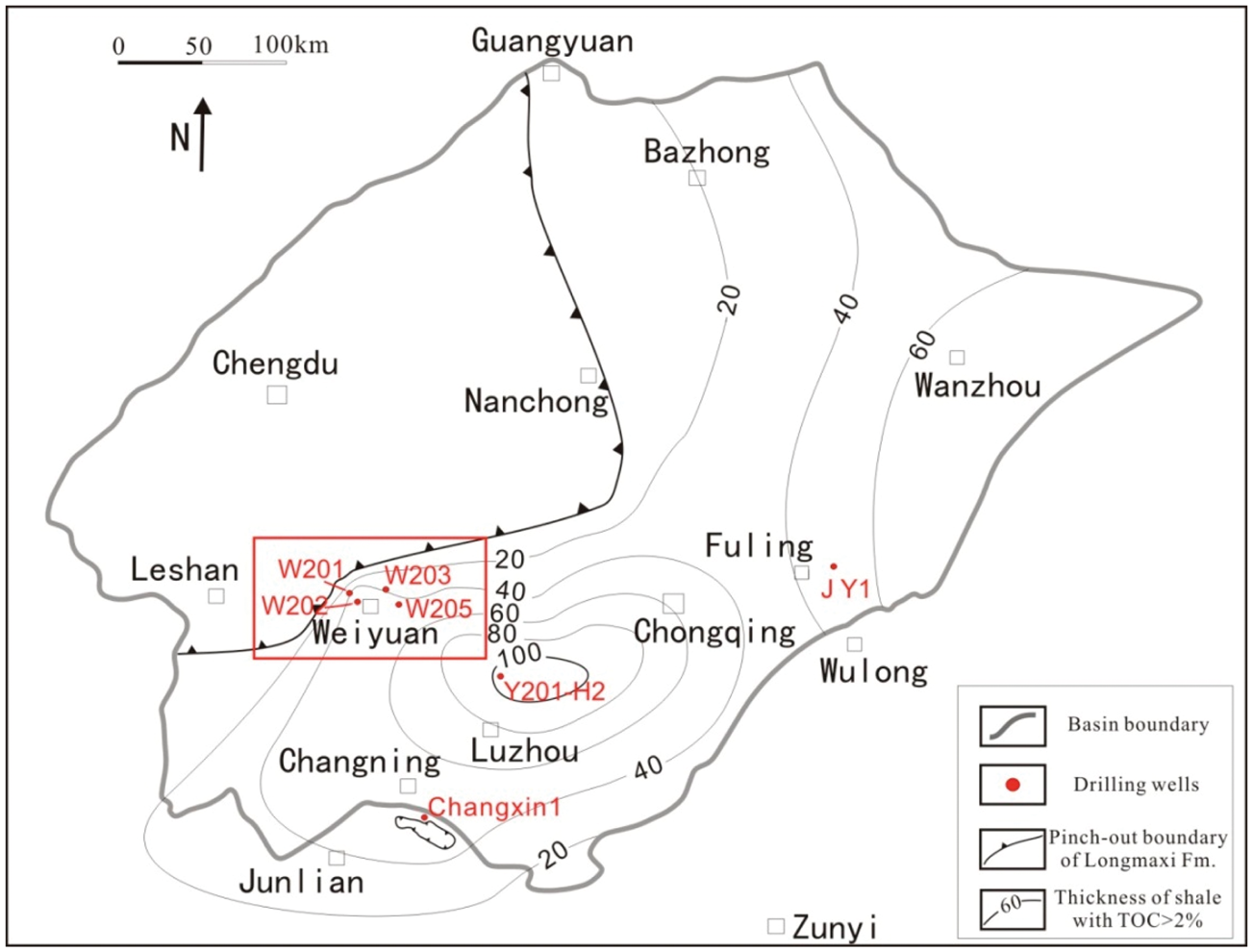
Current brittleness evaluation methods for shale
Rock brittleness
More and more researchers have focused on the study of rock mechanics of shale and its characterization since it is important for shale gas reservoir fracturing stimulation (Abousleiman et al., 2010; Altindag and Guney, 2010; Gholami et al., 2016; Mullen et al., 2007). In rock mechanics, it is considered that brittleness is a property of an object that ruptures with little deformation under stress. On the contrary, ductility refers to a property of an object which can withstand large deformation without losing its bearing capacity. Ductility and brittleness are classified according to the total strain of the rock under stress before failure and the sloping of the negative slope on the complete stress–strain curve (Chen, 2008).
However, there is no unified standard to measure and characterize rock brittleness. Currently, there are nearly 30 indoor evaluation methods based on mechanical experiments for different rock types, including rigidity or toughness tests, compression and stretching resistance experiments, impact experiments or penetration experiments, as well as stress–strain curve tests. Some scholars summed up these methods systematically (Hucka and Das, 1974; Wang et al., 2014).
Shale brittleness indices
Summary of the commonly used shale brittleness evaluation methods.
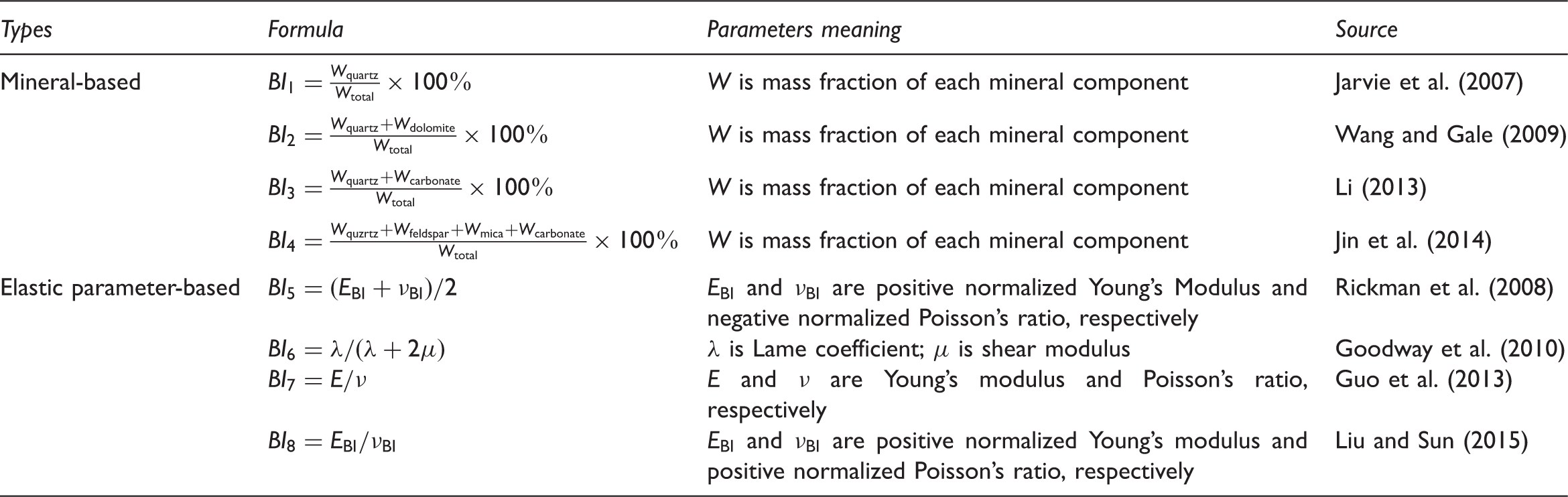
Based on the statistical characteristics of mineral composition of Barnett shale, it is considered by Jarvie that quartz is the main brittle mineral component which can reflect shale brittleness effectively (BI1) (Jarvie et al., 2007). However, in follow-up applications, many scholars proposed improved forms, pointing out that quartz alone cannot reflect the real brittleness level of shale in some specific regions. Wang and Gale proposed to use quartz and dolomite as brittle minerals (BI2) (Wang and Gale, 2009). Li suggested that carbonate minerals, calcite and dolomite are also brittle minerals as same as quartz (BI3) (Li, 2013). Jin further added feldspar and mica to the brittle minerals group (BI4) (Jin et al., 2014). In the mineral-based brittleness indices, the definition of brittle minerals is a key and controversial issue. However, the definition of brittle minerals should accord with the specific conditions in study areas. Mineral-based indices can be calculated through x-ray diffraction (XRD) method or elemental capture spectroscopy logging technology, which are both relatively easy to be realized.
Based on practical experiences of Barnett shale exploration and development, it was considered by Rickman that Poisson’s ratio can reflect the fracturing capability of shale under stress, and Young’s modulus can reflect the fracture retaining capability of shale. Shale with higher Young’s modulus and lower Poisson’s ratio is more brittle (BI5) (Rickman et al., 2008). Other scholars suggested some similar forms with actually the same meaning (BI6, BI7, and BI8) (Goodway et al., 2010; Guo et al., 2013; Liu and Sun, 2015). Elastic parameter-based indices can be calculated through rock mechanical experiments with relatively higher difficultly and higher requirement for shale samples, and array sonic logging techniques which are actually expensive and not commonly used currently. Thus, the mineral-based indices are of stronger practicability.
Shale brittleness computation model for Wufeng–Longmaxi shale in Southern Sichuan Basin
Although mineral-based brittleness index is more practical, its effectiveness and accuracy depend on the scientific definition of brittle minerals. It is key to distinguish the brittleness of main mineral components in shale and determine the most brittle components, on the basis of the actual mineral composition in specific areas.
Lithofacies and petrologic characteristics of Wufeng–Longmaxi shale in Southern Sichuan Basin
In Southern Sichuan Basin of China, a total of five stages and 13 graptolite biozones, including Kaitian, Hirnantian, Rhuddanian, Aeronian, and Telychian Stage are developed in the Upper Ordovician Wufeng–Lower Silurian Longmaxi Formation. The black marine shale has a thickness ranging from 50 m (Weiyuan region) to 200 m (Changning region), mainly distributed in the lower part of Wufeng–Longmaxi Formation with the depositional environment of calcareous deep water shelf.
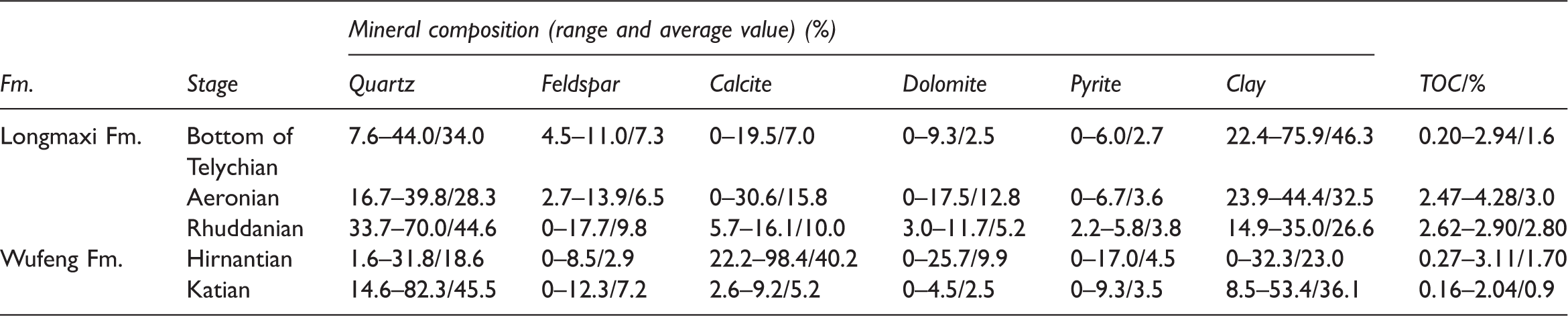
Mineral composition and TOC of Wufeng–Longmaxi shale in Weiyuan region.
TOC: total organic carbon.
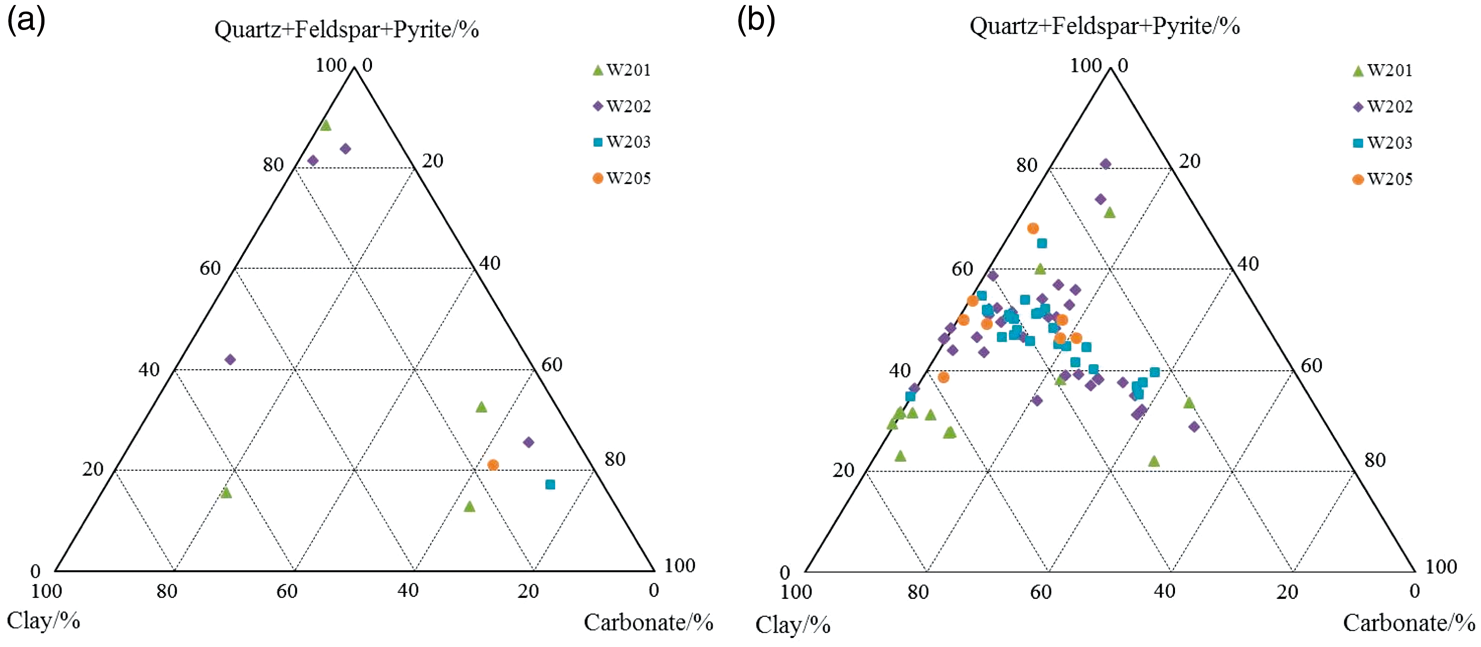
Ternary diagram for mineral composition of Wufeng–Longmaxi shale in Weiyuan region. (a) Wufeng Formation and (b) Longmaxi Formation.
The mineral composition also varies significantly from bottom to top. It is obvious from the vertical variations in mineral composition of the Wufeng–Longmaxi shale in Well W202 and Well W203 that the highest calcite content is at the top of Wufeng Formation, that is the limestone interval deposited in shallow water environment. The content of quartz decreases first and then increases from bottom to top in Longmaxi Formation, while the contents of clay minerals increase slowly. But the contents of calcareous components increase first and then decrease from bottom to top. The vertical variations of mineral composition reflect the characteristics of seawater depth changing from deep to shallow first and then from shallow to deep again in the depositional stage of Longmaxi Formation (Figure 3).
Vertical variations of mineral composition of Wufeng–Longmaxi shale in Well W202 and W203. (a) W202 and (b) W203.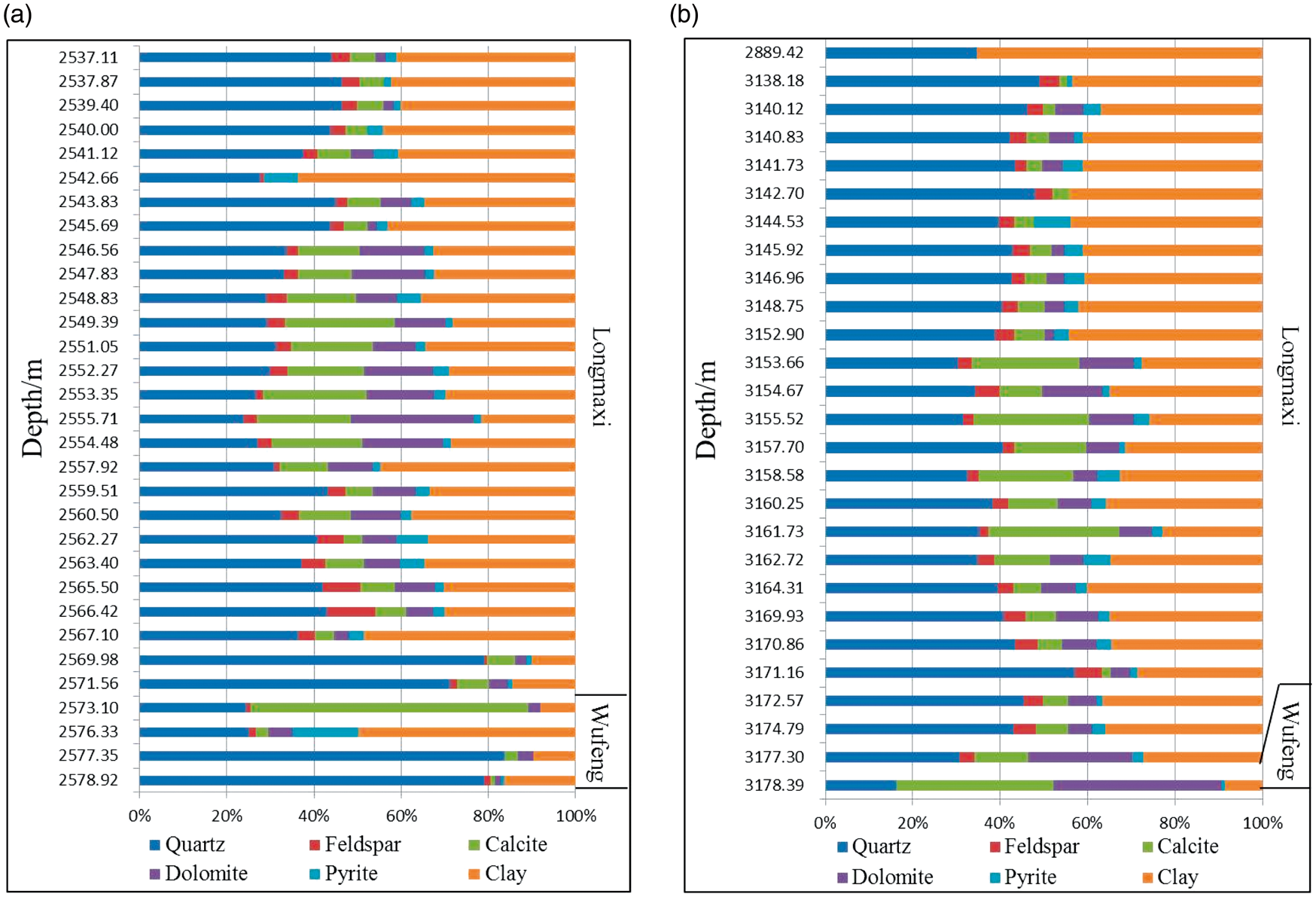
The mineral composition also varies significantly from bottom to top. It is obvious from the vertical variations in mineral composition of the Wufeng–Longmaxi shale in Well W202 and Well W203 that the highest calcite content is at the top of Wufeng Formation, that is the limestone interval deposited in shallow water environment. The content of quartz decreases first and then increases from bottom to top in Longmaxi Formation, while the contents of clay minerals increase slowly. But the contents of calcareous components increase first and then decrease from bottom to top. The vertical variations of mineral composition reflect the characteristics of seawater depth changing from deep to shallow first and then from shallow to deep again in the depositional stage of Longmaxi Formation (Figure 3).
Cross-plot of Young’s modulus and Poisson’s ratio for main minerals in shale (data quoted from Mavko (2008)).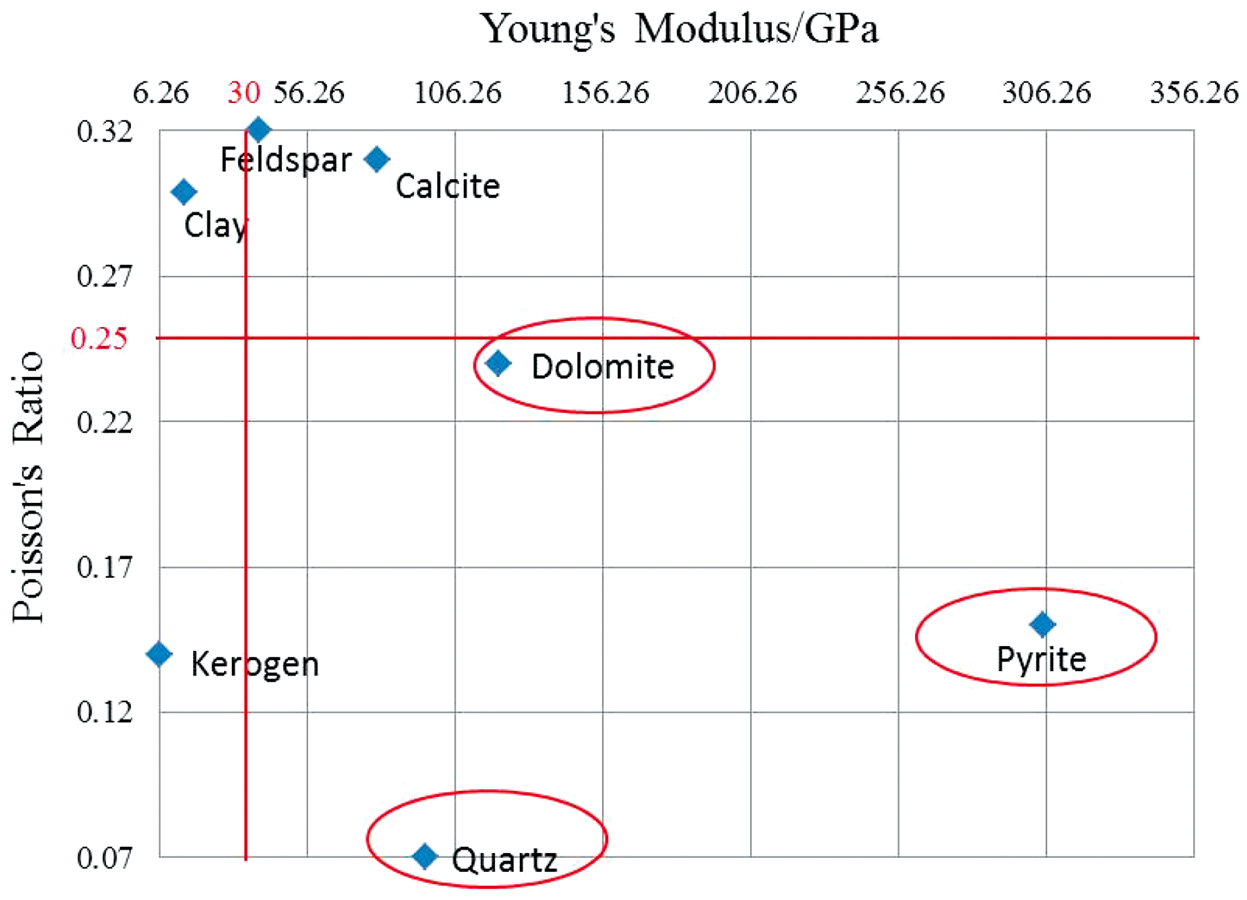
In Kaitian Stage, it includes, on the average, 45.5% quartz, 7.2% feldspar, 5.2% calcite, 2.5% dolomite, 3.5% pyrite, and 36.1% clay; Hirnantian Stage, on the average, 18.6% quartz, 2.9% feldspar, 40.2% calcite, 9.9% dolomite, 4.5% pyrite, and 23.0% clay; Rhuddanian Stage, on the average, 44.6% quartz, 9.8% feldspar, 10.0% calcite, 5.2% dolomite, 3.8% pyrite, and 26.6% clay; Aeronian Stage, on the average, 28.3% quartz, 6.5% feldspar, 15.8% calcite, 12.8% dolomite, 3.6% pyrite, and 32.5% clay; the bottom of Telychian Stage, on the average, 34.0% quartz, 7.3% feldspar, 7.0% calcite, 2.5% dolomite, 2.7% pyrite, and 46.3% clay (Table 2).
It is worth noting that the Wufeng–Longmaxi shale in Weiyuan region is characterized by relatively higher carbonate content due to the depositional environment of calcareous shelf, including calcite and dolomite, and locally high content of pyrite. The maximum content of calcite reaches 98.4% in Hirnantian Stage, presenting main lithology of limestone. And the maximum contents of dolomite and pyrite reach 25.7 and 17.0%, respectively, also in Hirnantian Stage (Table 2, Figure 3).
All these analyses indicate that the mineral composition in this area is more complicated and thus the definition of brittle mineral components should be more careful, instead of just simply borrowing the method of North America, to accurately evaluate shale brittleness.
Brittleness differences among main mineral components in marine shale
That is why we should reexamine the brittleness of each mineral component in order to redefine the mineral-based brittleness index which is indeed applicable in this specific area. In the following, we will distinguish the brittleness of the main minerals in shale through analysis of rock mechanical properties of each mineral.
Mechanical properties of different minerals have significant discrepancies, so their brittleness varies greatly. The definition of brittle minerals should be based on the mechanical properties of each mineral component itself. In the elastic parameter-based brittleness indices, Young’s modulus and Poisson’s ratio are selected as parameters characterizing rock brittleness, which is based on rock mechanical experimental analysis. Rock mechanical experiments indicate that (1) Young’s modulus is a parameter characterizing rock’s deformation resistance capacity. It represents rock rigidity. (2) Volumetric strain represents the rate of changes between the volume of rocks before failure and the volume of rocks after failure, and the volumetric strain increases with Poisson’s ratio (Diao, 2013). Thereby it is considered that the brittleness of rocks with high Young’s modulus and low Poisson’s ratio is stronger.
Therefore, the Young’s modulus and Poisson’s ratio of main mineral components of marine shale in South China are summed up in Figure 4 (Mavko, 2008) (Figure 4). Similarly, brittleness of various minerals is determined from the perspective of “high Young’s modulus and low Poisson’s ratio.” According to the characteristics of main gas-production shale reservoirs in North America and China’s shale gas reservoirs evaluation criteria (Zou, 2011), we take “Young’s modulus >30 GPa and Poisson’s ratio <0.25” as a standard for brittle mineral definition. It can be obviously recognized from Figure 2 that quartz, dolomite, and pyrite have obvious characteristics of high Young’s modulus and low Poisson’s ratio; on the contrary, clay minerals have the characteristics of low Young’s modulus and high Poisson’s ratio, presenting a typical ductility, which meets our empirical knowledge; though kerogen has a low Poisson’s ratio, its Young’s modulus is only 6.26 GPa, and the strength is too low so that it is also ductile; we usually think that feldspar and calcite can be taken as brittle minerals; however, their Poisson’s ratios are greater than 0.3 though their Young’s modulus is greater than 30 GPa, which proves that feldspar and calcite are actually not as brittle as quartz.
On the basis of the above comprehensive analysis of the mineral composition characteristics of the shale in Northern Sichuan Basin and the elastic properties of each mineral component, it is suggested that taking quartz, dolomite, and pyrite as brittle minerals to characterize brittleness of shale in South China is more scientific and reasonable. So a marine shale brittleness computation model is established as follows

It is important to note that although quartz, dolomite, and pyrite are the three most brittle components among the main minerals, they still have different Young’s modulus and Poisson’s ratio, and thus the different brittleness level. If we can further distinguish the brittleness degree of these three minerals, the computation model above will be more accurate. However, currently, we cannot determine the weight of Young’s modulus and Poisson’s ratio in brittleness evaluation, which is now actually the essential problem of elastic parameter-based brittleness index. So we can only recognize the more brittle minerals qualitatively with the standard of “high Young’s modulus and low Poisson’s ratio” instead of quantitatively according to an accurate formula of Young’s modulus and Poisson’s ratio.
Marine shale reservoir brittleness evaluation
Weiyuan, one of the three major shale gas exploration and development blocks in South China, witnessed the first well, Well W201, which realized the strategic breakthrough of shale gas E&D in China in 2010.
Currently, in the reservoir evaluation work for this area, only TOC, physical properties, rock mineral composition, and gas content are preliminarily determined, and the effective reservoir thickness is 30–80 m. But quantitative evaluation of reservoir fracturing quality is insufficient. Therefore, the regularities of “sweet spot” interval distribution are not very clear (Wang et al., 2016). Taking Wufeng–Longmaxi shale in Weiyuan region as an object, on the basis of a comprehensive analysis of lithofacies and Petrologic characteristics above, we carried out brittleness index calculation and fracturing quality evaluation using the new model, and selected “sweet spot” interval combining with lithology, TOC, thickness, and other parameters to provide a geological basis for future exploration and development.
Petrologic characteristics of the Wufeng–Longmaxi shale in Weiyuan region indicate that the mineral composition of shale in this area is complex. Aside from the main brittle mineral quartz, the contents of other two mineral components with high brittleness, dolomite, and pyrite should not be neglected. The maximum content of dolomite reaches 25.7% and the maximum content of pyrite reaches 17.0% (Table 2). Therefore, we use the marine shale brittleness computation model as described in this paper to evaluate brittleness of the Wufeng–Longmaxi shale in the interval of 1491–1558 m in Well W201. In order to compare and verify the advantages of this model (BInew), other two mineral-based brittleness indices (BI1 and BI3) are also used and the corresponding results are also displayed in Figure 5.
Composite columnar section of Wufeng–Longmaxi organic-rich shale in Well W201 of Weiyuan region, Southern Sichuan Basin.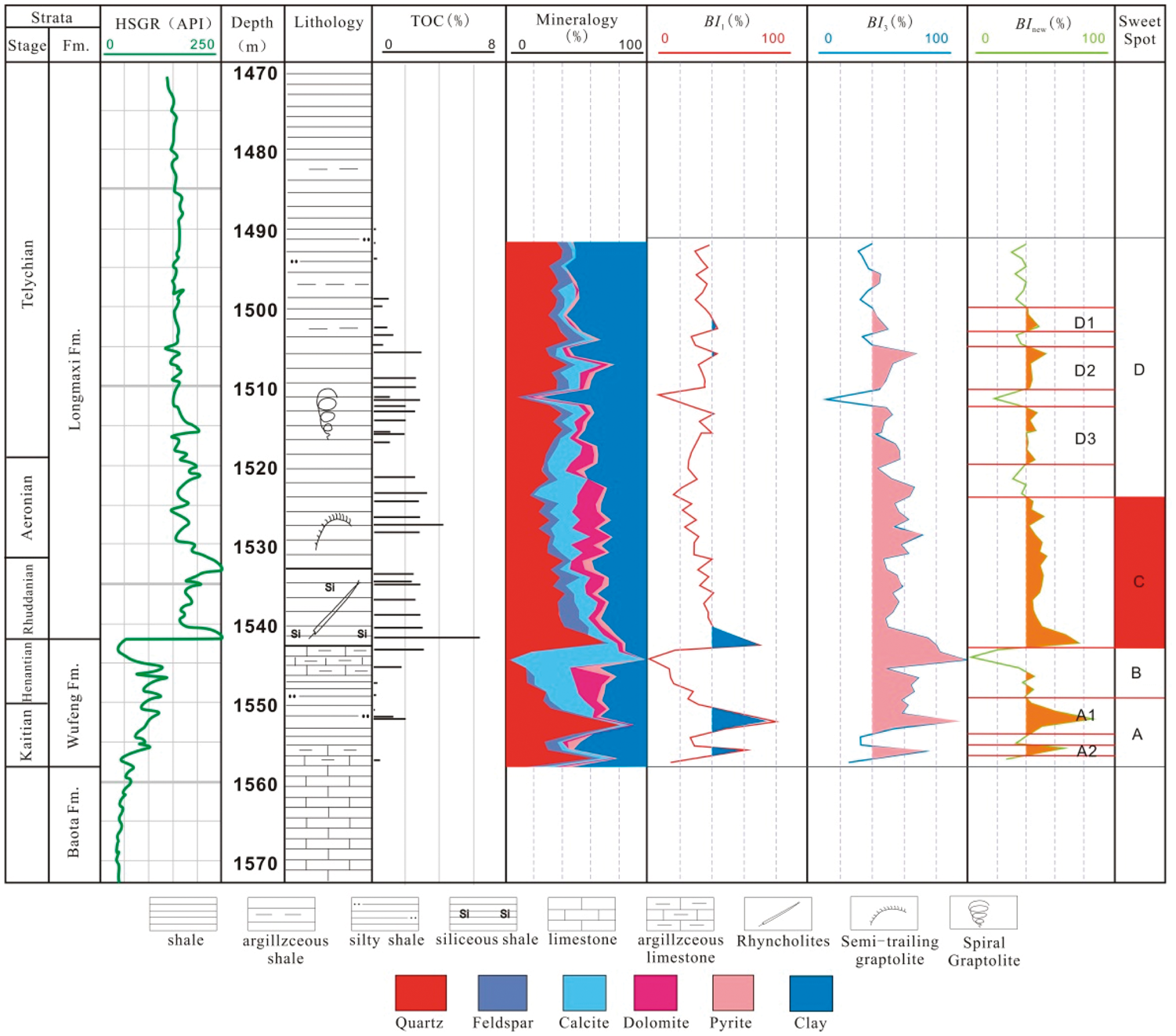
The calculation results of BI1 indicate that the brittleness index of shale in this interval is generally lower than 40%. Only the intervals at the bottom of Rhuddanian Stage and the top of Katian Stage with thickness of around 2 and 3 m, respectively, have good brittleness characteristics. The lower limit of brittleness index for the “sweet spot” interval of Barnett shale is 40% (Zou, 2011). If this is taken as a standard, the shale of this interval does not have preferable fracturing quality. However, it should be noted that shale mineral composition in this area is quite different from Barnett. The contents of calcite, dolomite, and pyrite are obviously higher. Considering the large difference in mineral composition, using the same brittleness index and standard to evaluate will lead to errors in interpretation results.
The calculation results of BI3 indicate that the brittleness index of shale in this interval is generally higher than 60%, and the maximum brittleness index can reach more than 90%. The position with the maximum brittleness is the top of Wufeng Formation with the maximum calcite content. However, such a limestone interval will actually become a barrier for fracture propagation during fracturing, that is, its fracturing quality is actually not ideal.
Geological parameters comparison of four interpretation intervals of Well W201.
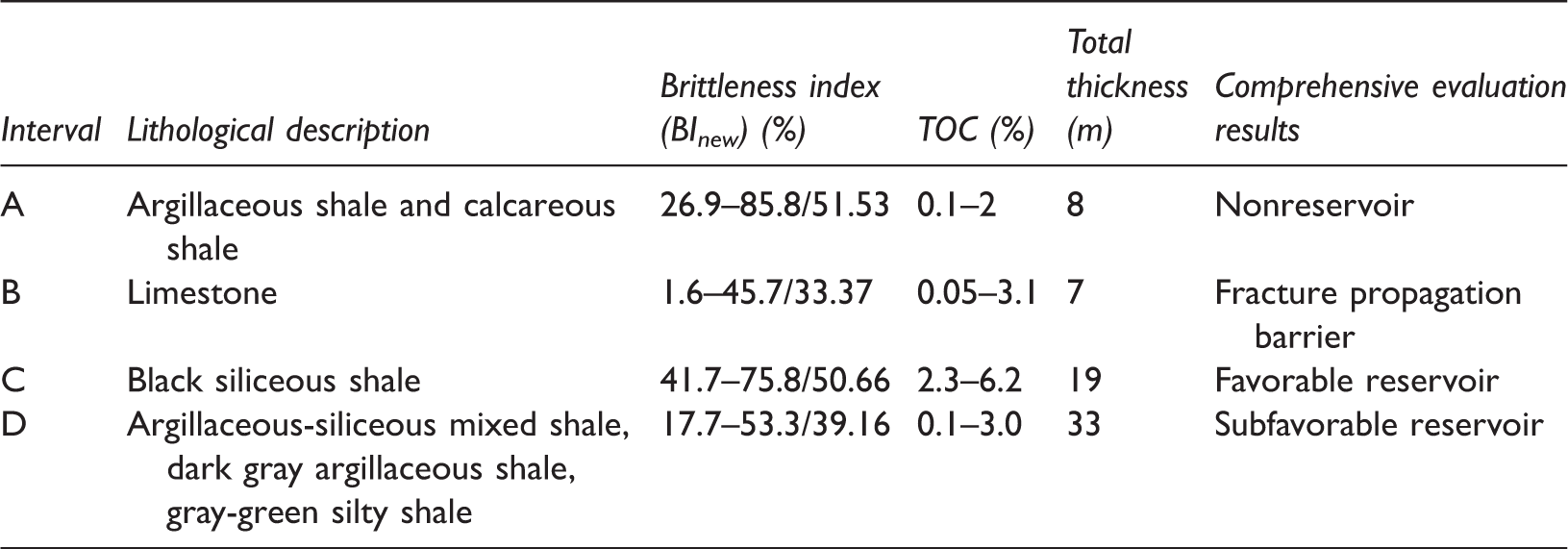
It is considered that the sweet spot interval in Well W201 is between 1524 and 1543 m, corresponding to Rhuddanian Stage to middle Aeronian Stage. Meanwhile, the subjacent part of this interval is limestone (interval B) with a thickness of about 7 m, which can be taken as an effective sealing layer.
Conclusions
Since there is not a unified evaluation method for shale brittleness yet, the mineral- and elastic parameter-based indices are the two types of mainstream methods now. Due to the easier access of mineral composition data through XRD method than rock mechanical data through array sonic logging method, the mineral-based brittleness indices have stronger practicability. However, the definition of brittle mineral components is the focus issue for this method, especially when considering the significant difference of mineral composition among different shale gas areas. The analysis of the lithofacies and petrologic characteristics of Wufeng–Longmaxi shale in Weiyuan region, Southern Sichuan Basin showed that the mineral composition in this area is more complicated with relatively higher content of calcite (maximum value of 98.4%), dolomite (maximum value of 25.7%) due to depositional environment of calcareous shelf, and also locally high content of pyrite (maximum value of 17.0%). This indicates that the definition of brittle mineral components should accord with the specific conditions in study areas, instead of just simply borrowing the method of North America, to accurately evaluate the shale brittleness in this area. In order to distinguish the brittleness differences among the main minerals in marine shale through analysis of rock mechanical properties of each mineral, we compared the Young’s modulus and Poisson’s ratio of each component, and take “Young’s modulus>30 GPa and Poisson’s ratio<0.25” as a standard to define brittle minerals. It is suggested that quartz, dolomite, and pyrite are mineral components with strongest brittleness. Correspondingly, a new brittleness computation model for the marine shale with complex mineral composition in South China was established. We applied the new model to Well W201 in Weiyuan and compared the results with that of the current two mineral-based brittleness indices, proving that the theoretical basis of our model is more adequate and the actual interpretation results are more credible and accurate. The comprehensive evaluation results showed that the sweet spot interval in Well W201 is between 1524 and 1543 m, corresponding to Rhuddanian Stage to middle Aeronian Stage, with a thickness of about 19 m. The subjacent limestone interval with a thickness of about 7 m can be taken as an effective sealing layer.
Footnotes
Declaration of conflicting interests
The author(s) declared no potential conflicts of interest with respect to the research, authorship, and/or publication of this article.
Funding
The author(s) disclosed receipt of the following financial support for the research, authorship, and/or publication of this article: This research was funded by the National Key Basic Research and Development Program (973 Program), China (Grant 2013CB228001).