




Abstract
As an important unconventional gas resource, shale gas has become an important part of gas production in recent years with the advantage of horizontal well drilling and large-scale multi-stage hydraulic fracturing completion technologies. The shale gas reservoir numerical simulation advances were reviewed and a multi-stage fractured horizontal well numerical simulation was performed to qualitatively modeling the well productivity in over-pressured shale gas reservoir based on actual shale properties and well completion parameters. A single horizontal well model was established on the basis of dual-porosity model and logarithmically spaced grid refinement. A comprehensive comparison and analysis of the initial average gas production, daily gas production, cumulative gas production, adsorbed gas and free gas cumulative production were provided to investigate the influence of matrix permeability, SRV permeability, hydraulic fracture conductivity and half length, SRV size, bottomhole pressure on the well performance. The research shows that for the high matrix permeability (Km > 10−7 mD) and low SRV permeability (KSRV < 0.01 mD), the SRV permeability has a significant impact on the initial average gas production. For the high matrix permeability (Km > 10−7 mD) and medium SRV permeability (0.01 mD < KSRV < 0.5 mD), the initial average gas production is controlled by both the matrix and SRV permeability. For the high matrix permeability (Km > 10−7 mD) and high SRV permeability (KSRV > 0.5 mD), the initial average gas production is mainly controlled by the matrix permeability. When the matrix permeability is lower than 10−9 mD, the cumulative gas production is too low to be of economic interest. For the matrix permeability (10−9 mD < Km < 10−5 mD), the matrix permeability and SRV permeability are all important factors that influence the cumulative gas production. For the matrix permeability (Km > 10−5 mD), the matrix permeability has much more impact on cumulative gas production than that of SRV permeability. The daily gas production and cumulative gas production are independent of hydraulic fracture conductivity and half length. The initial gas production of multi-stage fractured horizontal well is also independent of SRV sizes. The SRV size mainly controls the gas production decline characteristic. With the increase of the SRV size, the daily gas production declines slowly. The SRV size determines the cumulative gas production directly. With the increase of the SRV size, the cumulative gas production increases linearly. The bottomhole pressure has a significant impact on cumulative gas production. With the decrease of the bottomhole pressure, the cumulative gas production of 20 years increases linearly.
Introduction
As a kind of unconventional gas, shale gas has become an attractive alternative source of hydrocarbon fuel in recent years with the increase in price of conventional oil and decline in petroleum reserves. Gas shale is organic-rich shale formation and is apparently the source rock as well as the reservoir. The gas is stored in limited pore space and fractures of these rocks, or attached to active surface sites on the organic matter contained within the shale. Together, this combination of interstitial gas and adsorbed gas make up the total gas content of shale gas reservoir (Grieser and Bray, 2007; Jenkins and Boyer, 2008). The pore and throat radiuses in ultra-tight shale gas reservoir have reached to nano scale, and the matrix permeability is often below 0.001 mD (Clarkson et al., 2011). The fluid flow mechanism in shale gas reservoir become more complex, including gas desorption, diffusion, and seepage (Javadpour, 2009; Yu et al., 2012). Horizontal drilling and large-scale hydraulic fracturing are the key technologies in the development of shale gas reservoir. In most cases, economic production is possible only if a very complex, highly nonlinear fracture network can be created that effectively connects huge reservoir surface area to the wellbore. The production performances of shale gas well depend strongly on the existence of a dense and conductive network of fractures in the drainage volume, known as stimulated reservoir volume (SRV) (King, 2010). Therefore, it is of great necessity to better understand the mechanisms that control production in the shale gas reservoir to improve completion strategies and stimulation designs.
Reservoir numerical simulation is commonly the preferred method to predict and evaluate well performance. Shale gas reservoir numerical simulation technology gradually advances with the development of shale gas reservoirs. The main challenges in shale gas reservoir numerical simulation are as follows (Cipolla et al., 2008; Li et al., 2011; Okouma et al., 2011; Tsai et al., 2012): (1) the gas occurrence in shale gas reservoir includes both adsorbed gas and free gas, and the adsorbed gas usually gains a sizable fraction; (2) the gas flow mechanism becomes more complex, including gas desorption, diffusion, and seepage; (3) the fracture system induced by large-scale hydraulic fracturing is impossible to accurately model.
Unlike conventional gas reservoirs, where the gas is mainly stored as free gas in pore spaces, gas in shale gas reservoirs is stored in the form of free gas in fractures and intergranular pores, adsorbed gas on the organic matter surface, and dissolved gas in kerogen and bitumen, as well. Together, this combination of free gas and adsorbed gas make up the total gas convent of shale. During shale gas production, the free gas and adsorbed gas are produced with different production mechanisms. Therefore, the multi-stage fractured horizontal well productivity in shale gas reservoir will be variably influenced by shale gas reservoir properties and completion quality. Currently, there are relatively less researches on productivity sensitivity of multi-stage fractured horizontal shale gas well in China. This study aims at providing a qualitative modeling of multi-stage fractured horizontal well productivity in shale gas reservoir by reservoir numerical simulation. Based on the field shale gas reservoir properties and completion parameters of an exploration well in a specific exploration well of Sichuan Basin, the previous modeling methods are referred to establish a single horizontal well model with dual-porosity model and logarithmically spaced grid refinement. Different cases were designed and simulated to evaluate the well productivity. A comprehensive comparison and analysis of the initial average gas production, daily gas production, cumulative gas production, adsorbed gas and free gas cumulative production were provided to investigate the influence of matrix permeability, fracture permeability, hydraulic fracture conductivity, hydraulic fracture half length, SRV size on the well performance.
Background
In most cases, large-scale multi-stage hydraulic fracturing technology is chosen to generate complex fracture systems in shale gas reservoir. The induced fracture system provides the main seepage channel for the natural gas in reservoir. Therefore, accurately modeling the fracture system is crucial to the simulation accuracy and the actual application of shale gas reservoir numerical simulation. There are three reservoir modeling methods: discrete fracture networks, effective continuum method, and the multiple continuum method (Ghods and Zhang, 2012). (1) Discrete fracture networks (DFN) (Larry and Dogru, 2008; Lim et al., 2009; Vestergaard et al., 2007): DFN assigns a series of specified grid to represent fractures. Fractures are discretely placed in the model and nonlinear partial differential equations (PDE) are solved in the matrix and fractures separately. Matrix–fracture transmissibility controls the fluid flow between the matrix and the fractures. The nonstructural grid and local grid refinement are often used to describe the special properties of fracture and matrix. DFN model can accurately predict the fluid flow behavior in a fractured reservoir and are in better agreement with fractured reservoir’s geometry and physical characteristics. However, there are also several limitations in the application of DFN model. The assumption of DFN is to determine the fracture distribution and conductivity in SRV, which is impossible in the field application. Furthermore, DFN model is not suitable for history matching problems. Conditioning of reservoir models to production data requires adjusting fracture properties such as location, orientation, length, and aperture. Changing the properties affects the entire girding of the system at the time steps in which models are updated, making the problem computationally expensive. The DFN model is commonly used in quantitative analysis and calculation of specific problem. (2) Effective continuum methods (ECM) (Wu, 2002; Wu and Pruess, 2000; Wu and Qin, 2009; Wu et al., 1999): In ECM model, fracture and matrix are represented by a single effective continuum. Though computationally efficient for multiphase nonisothermal flow, ECM is not capable of capturing the complex fluid flow behavior of a shale gas reservoir. (3) Multi continuum methods (Warren and Root, 1963; Odeh, 1965; De Swaan, 1976; Mavor and Cinco-Ley, 1979; Thomas et al., 1983): The multi continuum methods include dual-porosity model, dual-permeability model, and multi-porosity multi-permeability model. Multi continuum methods were first solved by analytical techniques and used for well testing purposes and then were modified and solved by numerical simulation. Unlike DFN model, multi continuum methods are based on specific support areas and are built as separate matrix and fracture domains, each with its unique properties.
Kalantari-Dahaghi (2012) proposed hydraulic fracture simulation method, which had proved the logarithmic local grid refinement can more accurately simulate the pressure and saturation around the fractures. On the basis of logarithmic local grid refinement method, Cipolla et al. (2009), Rubin (2010), and Novlesky et al. (2011) used the DS-LS-LGR (dual-permeability, logarithmic spaced, local grid refinement) method to perform a shale gas reservoir numerical simulation. In the DS-LS-LGR model, the total simulated area is divided into the same basic grid block. The grid size is equal to the maximum fracture spacing. The logarithmic spaced local grid refinement is used around the hydraulic fractures inside the SRV. The DS-LS-LGR method which uses a logarithmic spaced grid with finer spacing around the hydraulic fractures has largely improved the accuracy of fracture system simulation and reduces the computation. In addition to DS-LS-LGR model, Wang and Liu (2011) proposed a kind of simplified dual-porosity model which uses logarithmic spaced grid refinement to simulate shale gas reservoir. The corresponding simulation result was compared with that of a reference model to test its efficiency. At last, the simplified dual-porosity model was applied to Haynesville shale gas reservoir to perform an actual reservoir simulation.
Guidry et al. (1996) defined the effect of shale matrix permeability on well productivity by using numerical simulation and the typical shale parameters in Pike County, Kentucky. The research illustrates that for high matrix permeability (Km > 10−6 mD), the EUR is essentially independent of matrix permeability. The gas well productivity is controlled only by fracture properties and spacing. For low matrix permeability (Km < 10−9 mD), EUR is too low to be of economic interest. Within the range 10−9 mD < Km < 10−6 mD, matrix permeability is one of the important controls on well productivity. Bustin et al. (2008) developed a two-dimensional numerical simulation model study the effect of fabric on the shale gas production. The production of a shale gas reservoir is not only affected by the fracture permeability, but also by the fracture spacing. Cipolla performed a shale gas reservoir numerical study and regarded the conductivity of fracture network and primary hydraulic fracture, the location of the proppant in the fracture network as critical parameters that affect gas recovery. In addition, the Young’s Modulus is also a significant parameter that controls the well productivity. Production from shale-gas reservoirs with lower Young’s modulus could be significantly affected by stress dependent network fracture conductivity—resulting in significantly lower gas recovery than anticipated based on initial well productivity. Rubin and Kalantari-Dahaghi investigated the non-Darcy flow effect in stimulated fractured shale reservoirs respectively by using different numerical simulation methods.
Previous reservoir numerical simulation researches and findings reveal that multi continuum model is more applicable and effective in the simulation of shale gas production. The dual-permeability and dual-porosity models are the most widely used and improved in shale gas reservoir numerical simulation. dual-porosity model has been both used in theoretical research and some typical shale gas reservoirs to perform an actual reservoir simulation. Therefore, the dual-porosity with relatively high applicability is adopted to establish a multi-fractured horizontal well model. Logarithmically spaced grid refinement is applied to finely simulate the artificial fractures created by multi-stage fracturing. Basic reservoir properties and completion parameters are gained from an actual horizontal exploration well in a pilot shale gas block of Sichuan Basin. The primary goal is to qualitatively evaluate the sensitivity of multi-stage fractured horizontal well production and provide certain reference for further exploration and development.
Multi-stage fractured horizontal well model
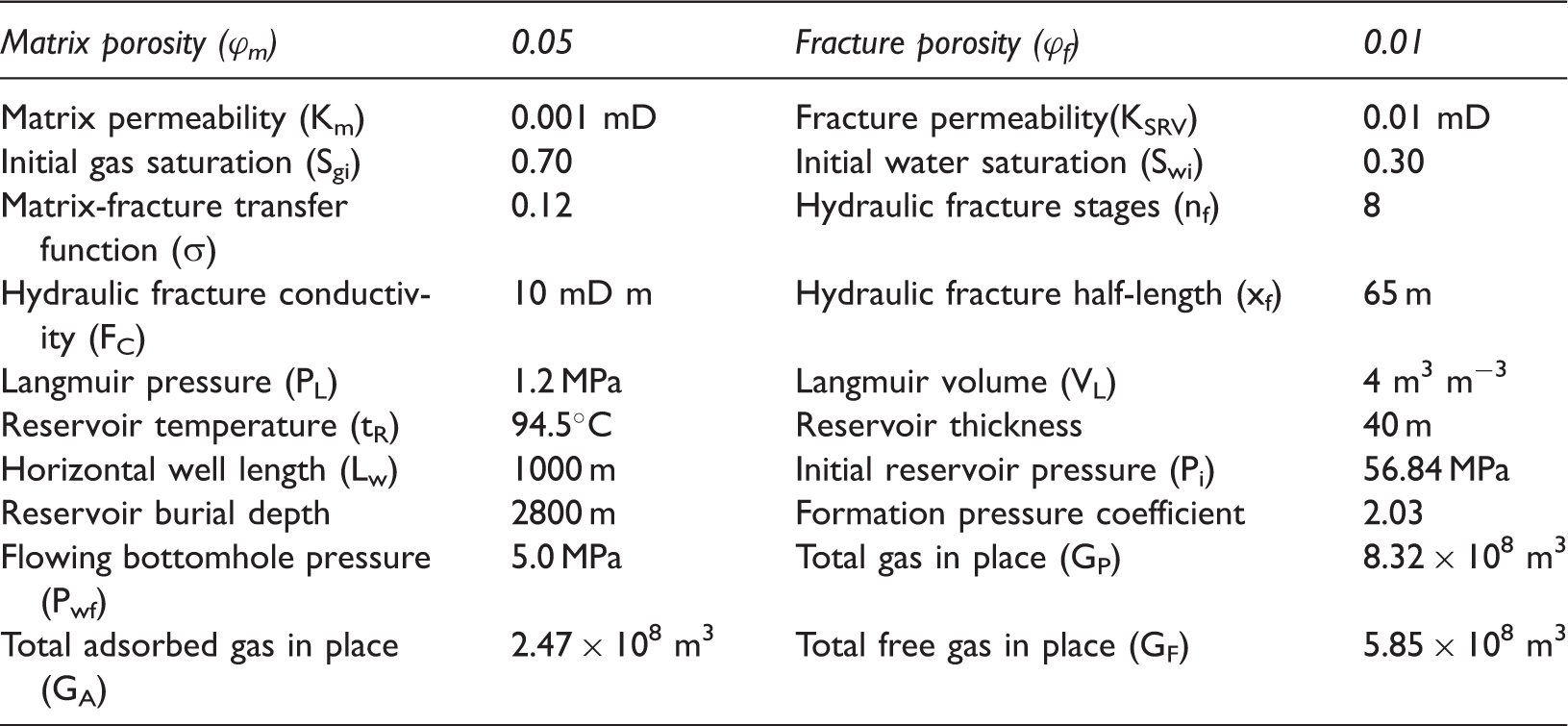
Due to the ultra-low matrix permeability and development of natural fractures, the shale gas reservoir usually behaves as dual porous media. Therefore, the dual-porosity model and logarithmically spaced grid refinement method was used to establish a shale gas reservoir model in this investigation. The three-dimensional two-phase shale gas reservoir model assumed is 1640 m long × 1010 m wide × 40 m thick. The SRV is 1000 m long × 310 m wide × 40 m thick and centered in the model. Only gas is mobile in the reservoir. The reservoir temperature variation and high velocity Forchheimer flow effect were not modeled. The single horizontal well is completed at the center of the model with eight-stage hydraulic fractures. In order to accurately simulate large pressure and flow behaviors near the hydraulic fracture, the cell sizes surrounding each hydraulic fracture increase logarithmically as they move away from each fracture. A total of 19 refined grids were used per stage and the width of the hydraulic fracture grid is only 0.01 m. The grid size of 19 refined grids per stage is presented in Table 1. Figure 1 presents grid map of this shale gas reservoir model and the refined grid map in one hydraulic stage. Using Figure 1, the complexity and the scale of the fracture system can be observed. The simulation model has a dimension of 300 × 101 × 2, a total of 60,600 grid cells.
The multi-stage fractured horizontal well 3-D geological model. The refined grid size in one hydraulic stage.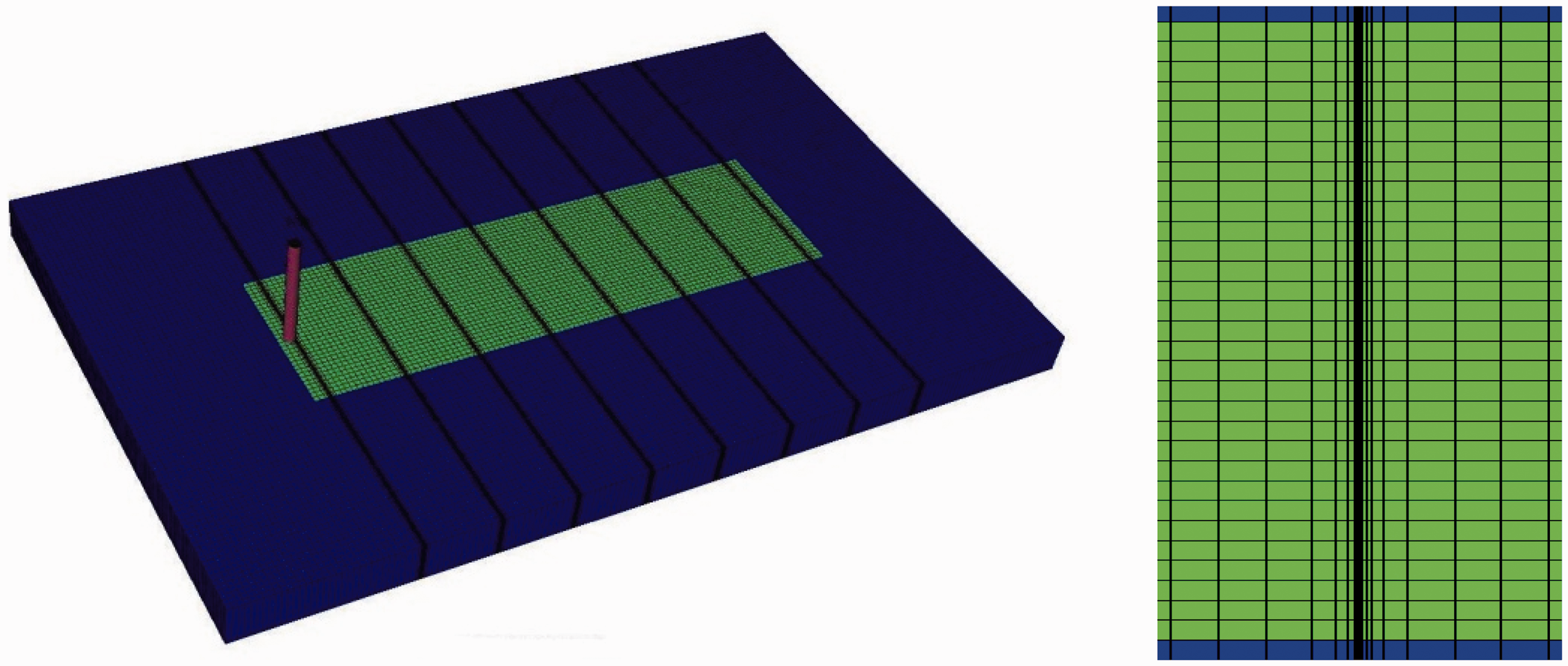

The parameters of multi-stage fractured horizontal well model.
Productivity evaluation
In this part, different cases were designed and simulated on the basis of the above-mentioned multi-stage fractured horizontal well model. The primary goal is to investigate the influence of matrix permeability, fracture permeability, hydraulic fracture conductivity, hydraulic fracture half length, SRV size on the well performance. In all the simulation cases, the bottomhole pressures of the multi-stage fractured horizontal well were kept constant and the simulation time is 20 years.
Reservoir permeability
In this section, a total of 56 cases were designed and simulated to present the effect of matrix and SRV permeability on the initial gas production and the cumulative gas production of multi-stage fractured horizontal well in shale gas reservoir. The matrix permeabilities are set to 10−10, 10−9, 10−8, 10−7, 10−6, 10−5, 10−4, and 10−3 mD, respectively. The SRV permeabilities are 0.001, 0.005, 0.01, 0.05, 0.1, 0.5, 1.0, and 5.0 mD. The initial average gas production and cumulative gas production of different cases are presented in Figure 2.
(a) The initial average gas production and (b) cumulative gas production of different matrix and SRV permeabilities.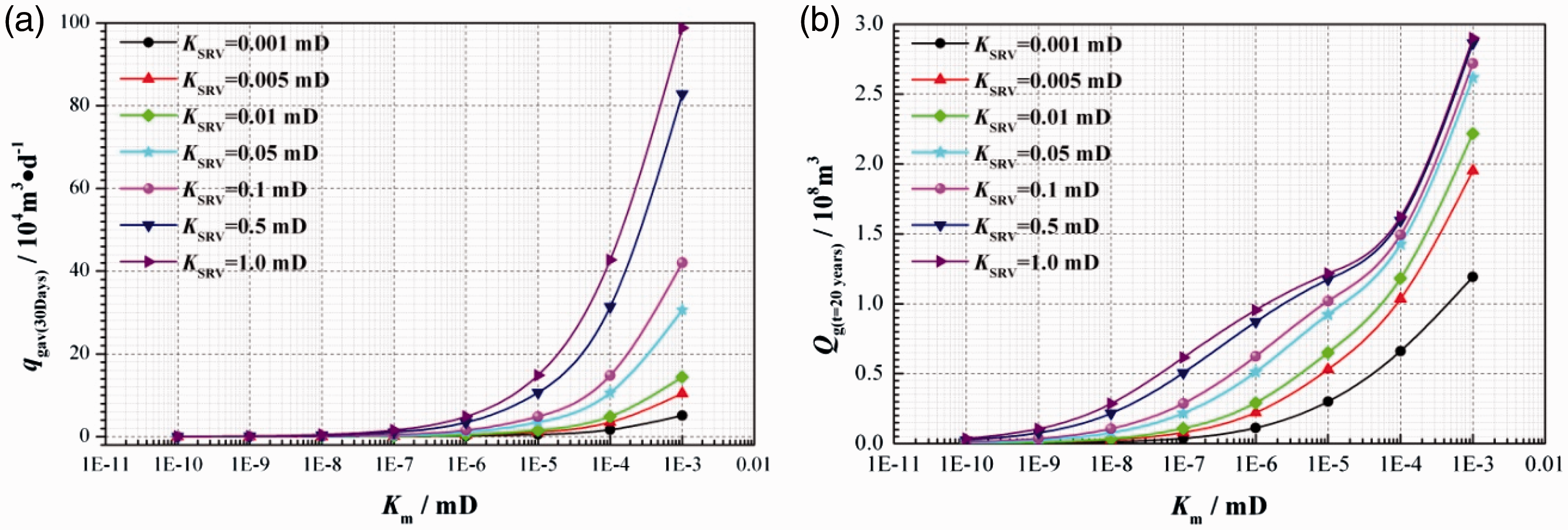
The initial average gas production (Figure 2(a)) indicates that when the matrix permeability is lower than 10−7 mD, the matrix and SRV permeability has little effect on initial average gas production due to the ultra-low matrix permeability. When the matrix permeability is higher than 10−7 mD, the initial average gas production ascends with the increase of both matrix and SRV permeability. For the high matrix permeability (Km > 10−7 mD) and low SRV permeability (KSRV < 0.01 mD), the SRV permeability has a significant impact on the initial average gas production. For the high matrix permeability (Km > 10−7 mD) and medium SRV permeability (0.01 mD < KSRV < 0.5 mD), the initial average gas production is controlled by both the matrix and SRV permeability. For the high matrix permeability (Km > 10−7mD) and high SRV permeability (KSRV > 0.5 mD), the initial average gas production is mainly controlled by the matrix permeability. Figure 2(b) is the cumulative gas production of 20 years under different matrix and SRV permeabilities. The figure shows that when the matrix permeability is lower than 10−9mD, the cumulative gas production is too low to be of economic interest. For the medium matrix permeability (10−9 mD < Km < 10−5 mD), the matrix permeability and SRV permeability are all important factors that influence the cumulative gas production. For the high matrix permeability (Km > 10−5 mD), the matrix permeability has much more impact on cumulative gas production than that of SRV permeability.
Hydraulic fracture properties
In order to investigate the effect of the hydraulic fracture conductivity on the horizontal well productivity, seven cases were designed and simulated. The hydraulic fracture conductivity are 0.0001 mD m (reference case to simulate the condition that the hydraulic permeability is equivalent to the SRV permeability), 0.001, 0.01, 0.1, 1.0, 10, and 100 mD m. Another seven cases were also performed with different hydraulic fracture half lengths. Figure 3 provides the daily gas production and cumulative gas production of different cases. The figure demonstrates that with the increase of hydraulic fracture conductivity and half length, the gas production and cumulative gas production increase slightly. Generally, the gas production and cumulative gas production are independent of hydraulic fracture conductivity and half length.
(a) The daily gas production and (b) cumulative gas production of different hydraulic fracture conductivities and half lengths.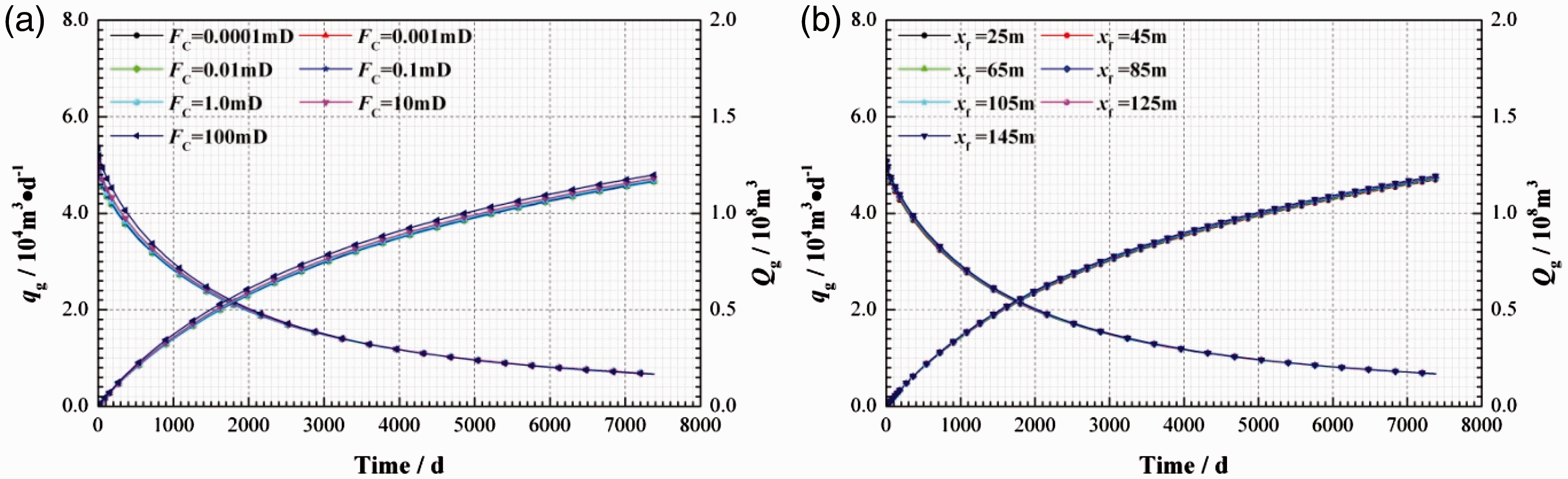
SRV size
The SRV width was varied and eight cases were performed while keeping other reservoir properties constant to study the effect of SRV size on well productivity. The SRV width was set to 260, 300, 340, 380, 420, 460, 500, and 540 m. Figure 4 has given the daily gas production and cumulative gas production of different SRV sizes. The daily gas production (Figure 4(a)) shows that the initial gas production of multi-stage fractured horizontal well is independent of SRV sizes. The SRV size mainly controls the gas production decline characteristic. With the increase of the SRV size, the daily gas production declines slowly. The cumulative gas production of 20 years (Figure 4(b)) indicates that the SRV size determines the cumulative gas production directly. With the increase of the SV size, the cumulative gas production increases linearly.
(a) The daily gas production and (b) cumulative gas production of different SRV sizes.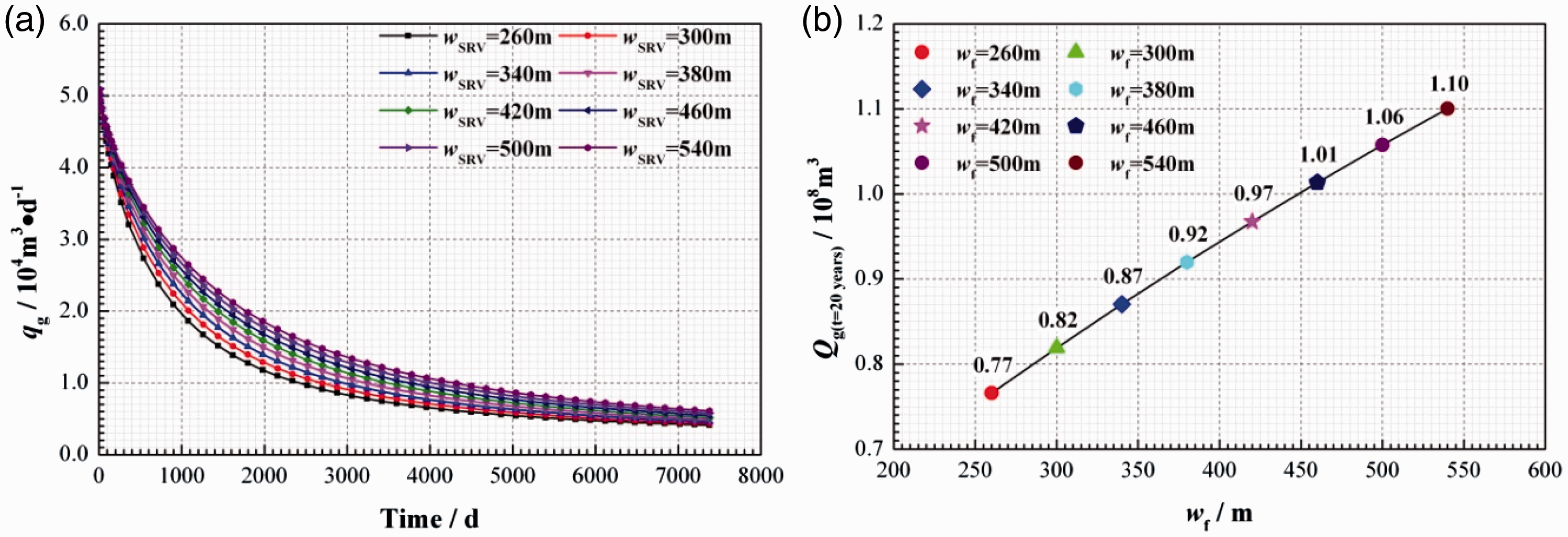
Bottomhole pressure
A total of seven cases were designed and simulated to keep the bottomhole pressure at different degrees. Figure 5 presents the data about cumulative gas production of total gas, adsorbed gas, and free gas. The relationship between bottomhole pressure and cumulative gas production (Figure 5(a)) indicates that the bottomhole pressure has a significant impact on cumulative gas production. With the decrease of the bottomhole pressure, the cumulative gas production of 20 years increases linearly. The cumulative gas production histogram of adsorbed gas and free gas (Figure 5(b)) illustrates that the free gas cumulative gas production contributes an extremely large proportion (more than 95%) to the total cumulative gas production of 20 years, while the cumulative adsorbed gas production only accounts for a small part. Both the adsorbed and free gas cumulative production increases linearly with the decrease of bottomhole pressure.
(a) The cumulative production of total gas, (b) adsorbed gas and free gas production.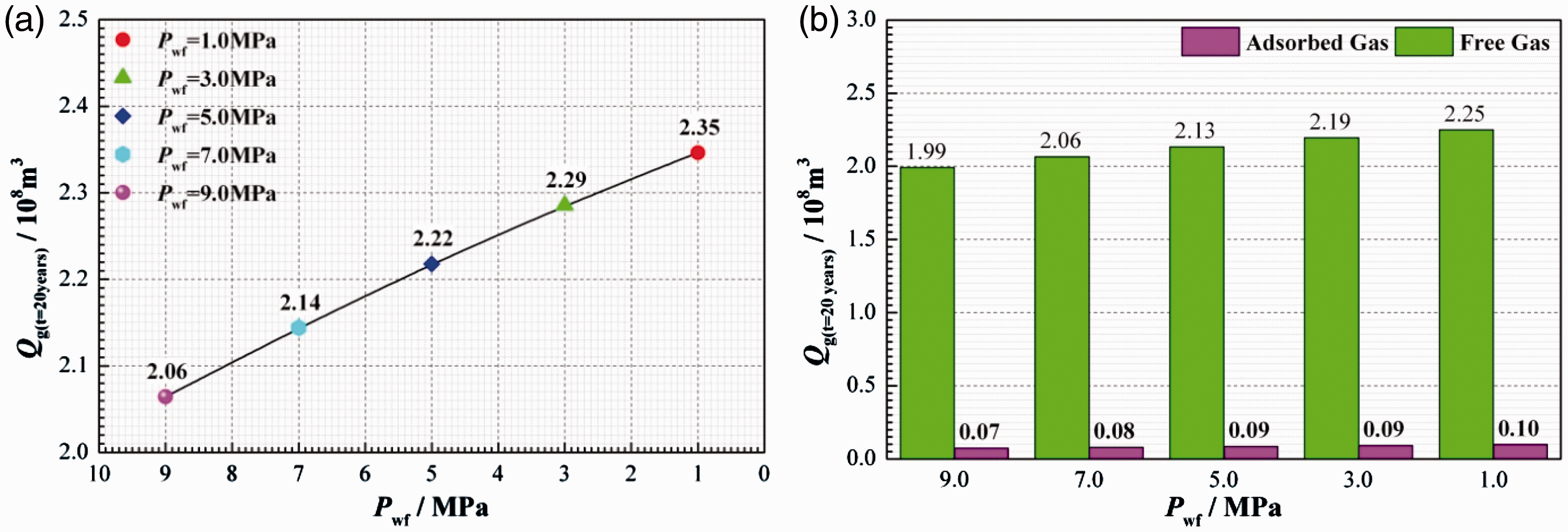
In Figures 2–5, where qgav(30 days) is the initial average gas production of 30 days; qg is daily gas production; Qg(t = 20 years) is the cumulative gas production of 20 years; Qg is the cumulative gas production; wf is the width of the SRV.
Conclusions
In this investigation, the shale gas reservoir numerical simulation was detailed reviewed and a multi-stage fractured horizontal well numerical simulation was performed on the basis of reservoir properties and completion parameters from an actual horizontal exploration well in Sichuan Basin in China. The primary goal is to qualitatively modeling the multi-stage fractured horizontal well productivity of over-pressured shale gas reservoir. The effect of shale gas reservoir matrix permeability, SRV permeability, hydraulic fracture conductivity and half length, SRV size and bottomhole pressure on multi-stage fractured horizontal well was analyzed and presented, and a total of four conclusions can be gained based on this research:
In the development of shale gas reservoir, both the reservoir matrix and SRV permeability have a significant impact on the initial average gas production and cumulative gas production when the matrix permeability is larger than 10−7 mD. For the high matrix permeability (Km > 10−7 mD) and low SRV permeability (KSRV < 0.01 mD), the SRV permeability has a significant impact on the initial average gas production. For the high matrix permeability (Km > 10−7 mD) and medium SRV permeability (0.01 mD < KSRV < 0.5 mD), the initial average gas production is controlled by both the matrix and SRV permeability. For the high matrix permeability (Km > 10−7 mD) and high SRV permeability (KSRV > 0.5 mD), the initial average gas production is mainly controlled by the matrix permeability. The cumulative gas production is too low to be of economic interest when the matrix permeability is lower than 10−9 mD. For the matrix permeability (10−9 mD < Km < 10−5 mD), the matrix permeability and SRV permeability are all important factors that influence the cumulative gas production. For the high matrix permeability (Km > 10−5 mD), the matrix permeability has much more impact on cumulative gas production than that of SRV permeability. The gas production and cumulative gas production are independent of hydraulic fracture conductivity and half length. The SRV size mainly controls the gas production decline characteristic and cumulative gas production. With the increase of the SRV size, the daily gas production declines slowly and the cumulative gas production increases linearly. The bottomhole pressure directly controls the cumulative gas production. With the decrease of the bottomhole pressure, the cumulative gas production of 20 years increases linearly.
Footnotes
Declaration of conflicting interests
The author(s) declared no potential conflicts of interest with respect to the research, authorship, and/or publication of this article.
Funding
The author(s) disclosed receipt of the following financial support for the research, authorship, and/or publication of this article: This work was supported by National S&T Major Project of China (No. 2011ZX05018-05).