



Abstract
In the Swedish labour market, recent research has revealed tendencies of both dualisation – implying growth in temporary employment – and polarisation – referring to increased employment in both low- and high-paid jobs, while middle-paid jobs decrease. This study explores the relationships between changes in the occupational structure and the distribution of temporary employment. Using the Labour Force Survey and comparing changes between 2000 and 2015, the study shows a main pattern of upgrading. However, splitting the analysis into permanent and temporary employment, tendencies of polarisation are revealed: growth at the low-paid end consists of temporary employment, while the increase at the high-paid end is mainly of open-ended contracts. Different kinds of temporary contracts matter – on-call employees are more likely to be found at the low end, and project workers at the high end. The study shows increasing precariousness in the lower end of the occupational structure.
Introduction
In the aftermath of Sweden’s deep recession of the 1990s, the share of temporary contracts on the labour market increased significantly. There is now evidence that the share of temporary employment has stabilised at a high level since the beginning of the 2000s, at around 16% of all employees, with some fluctuations related to the business cycle (Berglund et al., 2017; Holmlund and Storrie, 2002). During this time, Swedish employment protection legislation (EPL) has changed considerably. Regulations regarding temporary contracts have successively become more lax, while the regulation of open-ended contracts has remained strict – a combination described as an EPL gap (Barbieri and Cutuli, 2016). In particular, changes in the legislation in 2007 opened the door for the use of more insecure types of temporary contracts, where on-call contracts now have become the dominant form (Berglund et al., 2017). Consequently, the Swedish labour market can be described as dualised (Thelen, 2014) and implies a shift in the power balance where employers are offering increasingly insecure forms of temporary contracts and employees are accepting them (Baccaro and Howell, 2017; Emmenegger, 2014; Holmlund, 2009).
However, recent research has observed an additional and challenging trend in the Swedish labour market: the occupational structure is tending towards polarisation (Åberg, 2015; Adermon and Gustavsson, 2015; Heyman, 2016). Polarisation refers to a pattern of occupational change where the number of people employed at both the low- and high-paid ends of the occupational distribution increase more strongly than those in the middle of the occupational structure. Such changes constitute a severe challenge to the so-called Swedish model, which still includes characteristics of a solidaristic wage policy (Ibsen and Thelen, 2017; Movitz and Sandberg, 2013; Van den Berg et al., 1997). The solidaristic wage policy puts pressure on firms with low productivity, leaving firms with higher productivity in a beneficial market position. Thus, the solidaristic wage policy is believed to facilitate the growth of ‘good’ jobs, while low-paid jobs decline; in other words, the policy has led Sweden towards the ‘high road’ of job creation (Regini, 2000). Thus, a polarisation of the occupational structure would imply a challenge to this image of the Swedish labour market.
The literature has discussed the two phenomena of dualisation of labour markets and polarisation of occupational structures as separate constructs. Dualisation mainly affects labour market outcomes (such as the level of temporary employment) through institutional changes, particularly where there is more lax employment protection legislation for temporary contracts (Busemeyer and Kemmerling, 2019; Emmenegger, 2014). In the Swedish case, this regulation has evolved in the direction of an EPL gap between temporary and open-ended contracts. Polarisation theory, on the other hand, mainly focuses on the effects of technological change. Some jobs and occupations are expanding, while others are retracting, due to the introduction of (mainly) new digital technology (Acemoglu and Autor, 2011; Autor et al., 2003). However, it is possible that the dualisation and polarisation are interrelated. A more lax employment protection for temporary contracts mainly affecting low-skilled/low-paid jobs could increase the size of the low-paid sector, especially in an otherwise regulated and wage-compressed labour market. This could increase the polarisation of the occupational structure.
The overarching aim of this article is to explore how changes in the occupational structure are related to the distribution of temporary employment contracts in the Swedish labour market. We do this by using data from the Swedish Labour Force Survey (LFS) and comparing changes between 2000 and 2015. We start with a brief overview of the development in Sweden regarding legislation and use of temporary employment, and the Swedish labour market model. We then present previous research about dualisation and occupational change in more detail, as well as hypothesised consequences if these processes coincide in the Swedish labour market. Thereafter, we describe our data and methods, continue with the presentation of the results, and end with a discussion and conclusion.
The Swedish context
In a European perspective, Sweden has an above average proportion of temporary employees, ranking 10th out of 26 European countries in 2018 (Eurostat, 2019). The proportion of temporary employees increased rapidly from 10% in the beginning of the 1990s to 16% by the end of the 1990s and has since oscillated between 15 and 17% (SCB, 2015). In a Nordic context, Sweden and Finland are characterised by significantly higher levels than Denmark and Norway (Berglund et al., 2010).
The increase in the proportion of temporary employees has been facilitated by changes in the Swedish employment protection legislation (EPL) for temporary contracts (Swedish Code of Statutes, 1982:80). Legislation on employment protection was introduced in 1974, which was a clear deviation from the Swedish model, where well-organised employers and employees negotiated wages and other employment regulations without interference from the state. The Employment Protection Act states that open-ended contracts are the norm. However, the legislation also stated that temporary contracts could be used under certain criteria. This was strictly specified as a practice for a specific time, specific season, or for specific tasks. The regulation opened up in 1982 for more types of specific tasks for when temporary contracts were permitted. In 1997 a new type of temporary contract was introduced allowing a maximum of five employees on temporary contracts at the same employer, but without the requirement to specify reasons to employ on a temporary basis. This more lax regulation was important for small business, but did not have much effect on organisations with many employees. Ten years later, in 2007, the restriction on the number of employees on temporary contracts was withdrawn. The new legislation in force since 2007 has specified general temporary employment, substitutes, seasonal work, probationary contracts and specific contracts for employees aged 67 and above (Swedish Code of Statutes, 1982:80). General temporary employment (GTE) means that an employer does not have to state any specific reason for the employment, which is an important difference from previous legislation (Swedish Code of Statutes, 1982:80). GTE includes several different practices of temporary employment, such as project and on-call employment.
The OECD index on the strictness of employment protection (the EPL index, ranging from 0 to 6) shows a significant decrease of regulations for temporary contracts in Sweden, from 4.1 in 1990 to 0.8 in 2008 when the current legislation had been implemented. This is far below the OECD average of 1.7 in 2013. 1 Notably, the employment protection for employees on open-ended contracts is almost unchanged. Thus, Sweden has clearly chosen to give employers greater opportunities to employ on temporary contracts, while retaining protection for regular employees. This liberal regulation of temporary employment distinguishes Sweden from the Nordic pattern.
The distribution of different types of temporary contracts has changed over time (Berglund et al., 2017). In relative numbers, substitutes have decreased from being the clearly dominant form of all temporary employment, from representing approximately half of all temporary employed people in 1992 to just under a quarter of the total temporary employed in 2009. The proportion of on-call employees increased during the same period; the strongest increase occurred during the 1990s, when it approached 20% of all temporary employed. Project employment shows a pattern of its own, with a strong increase during the 1990s, followed by a reduction during the 2000s. The study above also distinguish a category of ‘miscellaneous temporary’. Within this category, since 2005 one form is ‘employed on an hourly-basis with an agreed rota for a specific period’. This group includes people working on an hourly basis, similar to on-call employees. The number of on-call employees and miscellaneous temporary employment levels increased to 45% of all temporary employees in 2009.
The above-mentioned Swedish model is an important contextual factor to consider when it comes to structural and occupational change. This was partly due to the solidaristic wage policy, which essentially meant that wage-earners would have equal pay for equal work, irrespective of the economic performance of the individual company they were employed at. The result of the solidaristic wage policy was that companies and entire industries with low productivity were driven out of competition. This is regarded as an important driver for Sweden moving down the so-called high road to full employment (Movitz and Sandberg, 2013: 41ff.; Schön, 2012).
During the period in focus (2000–2015), the wage dispersion in Sweden did not increase greatly. The ratio between the 90th and 10th wage percentiles was 2.35 in 2000, and had decreased to 2.28 by 2013. 2 In 2013, Sweden’s wage dispersion was the lowest of the Nordic countries (Denmark 2.56, Finland 2.55, Iceland 2.98, Norway 2.40), and lower than Germany (3.38), the United Kingdom (3.55) and the United States (5.08). Still, the dispersion in disposable income on household level did increase: the 90/10 income ratio increased from 2.86 in 2000 to 3.31 in 2013. 3 Moreover, the GINI coefficient indicates increased income inequality. The most equal distribution was found in the early 1980s, with a GINI coefficient of 0.20, after which there was a general increased trend to more than 0.33. 4
It is important to emphasise that wages (on the individual level) are not the same thing as incomes (on the household level). In the Swedish labour market, wages are decided in negotiations on the sector level, where the export-dependent industries determine how large the wage increases are allowed to be. This benchmark sets the wage increase level for the rest of the labour market (Berglund and Esser, 2014). Disposable incomes are surely related to wages, although the earnings are also a function of the number of working hours and the stability of wage incomes (such as the risk of unemployment). Moreover, taxes, redistributions of the welfare state and capital incomes all affect overall disposable incomes.
Dualisation of labour markets
The significant increase of temporary contracts on the Swedish labour market can be understood using theories on dualisation. Emmenegger et al.’s (2012) seminal work, The Age of Dualization, characterised dualisation mainly as a political process that changes and differentiates central institutions by making distinctions between the rights and benefits of so-called labour market insiders and outsiders. This process could relate to welfare and labour market programmes that strongly condition provisions to employment (activation approach), or unemployment insurance that emphasises conditionality on (sufficiently strong) labour market attachment. In Sweden, the liberalisation of temporary employment is an institutional change that both reinforces the difference between a primary and a secondary labour market and increases the size of the latter (Berglund et al., 2017).
According to the dual labour market theory, the dualisation of labour markets is an efficient way to organise work for employers (Doeringer and Piore, 1971). It entails segmentation of the general labour market into a primary or internal labour market and a secondary or external labour market. Employees with skills that are specific to the work organisation are often offered occupational ladders and internal labour markets. This creates incentives for on-the-job training, increases the probability of retaining workers that an employer has invested in, and decreases costs involved in external recruitment. Also, costs associated with the termination of contracts, such as EPL, foster the existence of internal labour markets. External labour markets, on the other hand, relate to mobility between employers, or from unemployment to employment, and are the main alternative for workers who are more replaceable. The segmentation of labour markets lowers the mobility between the primary and secondary labour. However, in times of rapid changes in demand for human capital, and in response to the changing economic environment, mobility between the segments can increase (Scott, 2014).
According to Goldthorpe (1984), dualised labour markets started to emerge after the Golden Years and in the era of stagflation in the 1970s. That theory states that the secondary labour market consisted of non-standard employment (temporary contracts, subcontractors, part-time work) and of a reserve army of immigrant workers, and was used as a deliberate strategy by employers to escape the corporatist structures that had emerged in the 1960s and 1970s. These structures extended ‘industrial citizenship’ and reduced the employer’s prerogative to lead the firm. By increasing the use of non-standard employment, firms regained flexibility.
According to Emmenegger (2014: 195ff.), unions are important actors in processes of dualisation and have strong reasons to protect the rights achieved in strict EPL; that is, as an essential power resource for the employee side. Similarly to Goldthorpe, Emmenegger argued that an employer offensive to decrease the unions’ power resources and increase flexibility occurred in several Western countries during the 1970s and 1980s (see also Baccaro and Howell, 2017). According to Emmenegger (2014: 245ff.), this offensive also appeared in Sweden, albeit in a context of very strong unions, high union density (maximum of 85% in 1995), and with considerable institutional power resources (for example, the Co-Determination Law of 1976). However, the unions’ political allies in the Social Democratic Party were weakened and lost several elections from the mid-1970s onwards. Moreover, the 1990s crises, with a dramatic increase in unemployment (it peaked at 10% in 1997 and has since hovered around 6–7% [see Berglund and Esser, 2014]), further decreased the unions’ bargaining power. Emmenegger (2014: 196) argued that the weakening power forced unions to compromise and consent to the liberalisation of temporary contracts – ‘flexibility at the margins’ – to protect their core members.
The result in Sweden was liberalisation in the EPL on the use of temporary contracts, while keeping the protection for open-ended contracts intact; that is, the emergence of an EPL gap (Barbieri and Cutuli, 2016; Berglund et al., 2017). However, it is important to emphasise that not all kinds of temporary contracts entail flexibility for the employer to adapt to changes in demand. Substitutes are used to replace absent employees and could be seen as a strategy to achieve stability (Jonsson, 2007), which means they are not flexibility-enhancing for the employer. Employees with on-call and seasonal contracts could be added to the ordinary staff, thus implying flexibility. For substitutes, the temporary employment is often followed by better and more secure labour market positions later on in an individual’s labour market trajectory. Those employees with temporary contracts that are used to enhance flexibility have a significantly lower probability of transferring to open-ended contracts (Berglund et al., 2017). Thus, employers demand flexibility by using those forms of temporary contracts, which reinforces the precarious nature of the secondary labour market. However, not every kind of temporary employment implies low job quality (Aronsson et al., 2002). For example, the temporary employed on project contracts have working conditions that are most similar to employees on open-ended contracts.
Occupational polarisation
Apart from dualisation tendencies in many labour markets, other changes are taking place. There is currently a strong focus on the impact of technological progress, particularly computerisation, digitalisation, robotisation and ICT, used for new products and production processes (Brynjolfsson and McAfee, 2017). The impact of digitalisation on the occupational structure and the labour market is believed to be profound.
The earliest evidence for the impact of the new technology was found in the United States in 1970–1990, where low-skilled employment dropped while the demand for highly skilled employees increased (Berman et al., 1998; Katz and Murphy, 1992). These changes were explained with the theory of skill-biased technological change (SBTC). According to SBTC, low-skilled employees become replaced by new labour-saving technology such as computers, ICT and robotics. For highly skilled workers, the new technology augmented the productivity of their work. This development has been described as an upgrading of the occupational structure, leading to increased demand for a highly qualified workforce (Oesch, 2013). The drawbacks of this change are possible structural unemployment for low-skilled labour that is not able to re-skill and transit into growing sectors, as well as a growing earning inequality within the occupational structure.
However, studies of later decades’ occupational change in the US have revealed a pattern of polarisation, indicated by job decrease in the middle of the occupational/wage structure, while the two poles of the occupational distribution increased (Autor et al., 2003, 2006; Mouw and Kalleberg, 2010). To explain this pattern, the effect of digitalisation was specified to mainly replace routine work tasks: that is, routine-biased technological change (RBTC). Moreover, this effect hit routine work tasks in both manual occupations (such as assemblers) and cognitive occupations (bookkeeping, etc.). These jobs are usually placed in the middle of the occupational/wage distribution. On the other hand, digital technology enhanced the productivity of cognitive tasks that have a non-routine character, which are usually quite high-paid jobs (such as technicians). However, digitalisation does not directly affect manual work tasks that mainly are of a non-production character, and thereby difficult to replace with standardised work processes, such as hairdressers, waiters or childcare workers. Consequently, such jobs, which are usually low-paid, remain in the occupational structure, and due to increased purchasing power in the high-skilled strata, the demand for jobs in personal services can even increase (Mazzolari and Ragusa, 2013). The overall effects of these processes are a declining middle and growth at both ends of the occupational structure.
Polarisation tendencies have also been observed in countries such as the United Kingdom (Goos and Manning, 2007) and Germany (Dustmann et al., 2007), while an extensive study of 15 European countries between 1995 and 2007 by Fernández-Macías (2012) found both upgrading and polarisation. Varying tendencies were also shown in a study by Eurofound (2017) that focused on the years following the financial crisis. In a study of occupational change in Sweden during three time periods, Åberg (2015) observed polarisation in the third period, 2008–2012. Polarisation was also found by Adermon and Gustavsson (2015), studying the period 1990–2005, and Heyman (2016), focusing on 1996–2013. However, Oesch and Piccitto (2019), studying the period 1997–2015, did not find polarisation in Sweden. In a recent study comparing three Nordic countries, Berglund et al. (2020) showed a strong pattern of upgrading in Norway from 2000 to 2015, while Denmark clearly moved in the direction of polarisation. The Swedish pattern lies between these two other countries: the general direction is towards upgrading, but the lowest-paid occupations neither declined nor grew during the period in focus.
However, most of the studies above use wages as a proxy for skills; in other words, higher wage jobs are believed to represent jobs that require a higher skill level than lower-paid jobs. This approach has been subject to criticism. Fernández-Macías and Hurley (2017) used direct indicators of the routine component in job tasks and showed that the direction of occupational change in Europe is not related to routinisation. In a Swedish study, Tåhlin (2019) used a direct subjective indicator of how many years of education/training the employee assessed is needed to conduct the job task of the worker to show that the occupational change moves unequivocally in the direction of upgrading.
Apart from technological development, occupational change is also related to different institutional factors and policy measures (see Eurofound, 2017). One such factor is changes in the size of public employment. Berglund et al. (2020) showed strong upgrading tendencies in the public sector in Sweden, while the private sector is polarising. This pattern is due to the privatisation of low-paid activities in the public sector. Åberg (2015) discussed the significance of changing policies for the polarisation that has taken place since 2008. In particular, the introduction of tax reliefs for persons buying domestic services (cleaning, maintenance and laundry) may have increased the number of low-paid service jobs.
In parallel, there is a probability that the outcomes of the dualisation trend in Sweden – that is, increasing levels and much more insecure forms of temporary employment – are related to increased employment in low-paid occupations. Theoretically, strict EPL for regular employees is expected to make employers more hesitant to hire, because the costs of dismissing rise with strict regulations (Skedinger, 2011). In a regulative system with an EPL gap, employers may be more willing to employ on temporary contracts rather than on open-ended contracts if that possibility exists. In line with this expectation, Holmlund and Storrie (2002) showed that, at the end of the 1990s crisis, when the business cycle turned upward again and the employers needed to hire, they chose to hire on temporary contracts as they were unsure how persistent the upturn would be. In particular, this tendency will be the case in industries where labour costs are the main expenses of operations and where demand for products fluctuates. Low-paid service work often has these characteristics, and temporary employment is also more common in those branches (Berglund et al., 2010). Consequently, liberalisation of the use of temporary contracts, while keeping the regulation of open-ended contracts unchanged, may increase the number of temporary employed, particularly in low-paid service jobs. This, in turn, may add to polarisation tendencies in the occupational structure. Moreover, this tendency can be stronger if the supply of job seekers is high, due to unemployment levels or an increasing working-age population. Both of these factors apply to Sweden, which has had rather high unemployment figures and an increase in the working-age population due to immigration (Konjunkturinstitutet, 2019).
Occupational change on a dualised labour market
Previous research shows quite convincingly that the Swedish labour market has dualised features. The employment protection legislation has moved in the direction of an EPL gap with strong protection of permanent employees, while the regulative opportunities to use temporary contracts have become laxer. The outcome is a high level of temporary employment and the composition of temporaries has turned in the direction of more precarious forms of temporary contracts (on-call) during recent decades.
Furthermore, during the period in focus, research also indicates that the occupational structure has turned towards polarisation: that is, the number of employed in both high- and low-paid occupations has increased, while the number of people occupied in middle-level jobs has decreased. However, this description of change is contested, and more research is needed to better understand the development of the occupational structure. The overarching aim of the present study is to explore how changes in the occupational structure are related to the distribution of temporary employment contracts in the Swedish labour market. If temporary employment is systematically related to the changes of the occupational structure – specifically, if temporary employed people risk working in the lowest-paid occupations – some employees may be doubly penalised, both regarding pay and job security. We consider this to be an important research question that has not, to our knowledge, been previously studied in a Nordic context.
Therefore, the following research aims will be the focus of the current study. Firstly, to scrutinise whether there is evidence of changes in the occupational structure in the direction of polarisation and how temporary contracts are distributed within the changing structure. Secondly, to study whether temporary employment also implies a higher risk of working in low-paid occupations and whether this risk has changed over time. Thirdly, to investigate whether the risks differ between different types of temporary employment, as the composition of contract types has changed considerably over time.
Data and method
This study is based on data from the Swedish Labour Force Survey (LFS), which includes detailed data on the adult population and their labour market status. It is composed of three separate monthly samples every quarter, containing approximately 20,000 individuals per sample. The LFS also has a panel design, where each sample consists of eight different panels (rotation groups, R1–R8). This means that each individual is interviewed once a quarter, meaning a total of eight interviews per person over a two-year period. At each quarter, one rotation group is replaced.
In the present study, the LFS is used as a cross-section, comparing the distribution of temporary contracts within the occupational structure between 2000 and 2015. The analyses conducted are, firstly, descriptive analyses of numbers and shares in different positions in the occupational structure. For these analyses, we have relied on Statistics Sweden’s weights to recalculate the yearly samples to population figures. In the first descriptive analysis, we calculated cumulative change per year within the occupational structure of total, permanent and temporary employment. This analysis shows that the occupational structure underwent dynamic changes over time, particularly during the financial crisis of 2008–2009. In a second step, we merged data from 2000–2002 and 2013–2015 and calculated and compared the mean figures of these periods. These years represent positive labour market situations, when the business cycle has turned upwards after severe crises (the 1990s crisis in Sweden and the financial crisis of 2008–2009). The rather long time span between the two comparison periods means that the technological change related to SBTC and RBTC has had time to appear in the occupational structure. Moreover, the time span also implies that changes in the institutional setting related to dualisation have taken place, particularly changes regarding regulations of temporary contracts (in 2007). Another reason for merging years is that there are rather small numbers of observations in some types of temporary employment (for example, project employees).
We also conducted multinomial regression analyses to predict outcomes in the occupational structure comparing the two time periods, and with the main purpose of studying how temporary employment is related to the risk of working in high- and low-paid occupations. However, we only included the first rotation group (R1) of each calendar month of the years. This procedure ensured that every observation across the year was independent (the same individuals do not appear later in the same year) and that the sample sizes do not become inflated by the weights of the data.
The dependent variables in the different analyses are the individuals’ position in the so-called occupational-wage structure (OW structure). Much of the research on occupational change has used wages as an indicator for the price of skills in an occupation, with higher wages indicating a higher skill level (Autor et al., 2003; Goos et al., 2014). This assumption has been criticised as a simplification (Fernández-Macías and Hurley, 2017; Oesch and Piccitto, 2019; Tåhlin, 2019). Wages are also dependent on the system of industrial relations, productivity, labour supply, turnover risks, status perceptions, etc. Still, wages are regarded as an important aspect of job quality (Fernández-Macías, 2012) and related to the development of inequalities in societies (Bussolo et al., 2018).
The primary basis for the OW structure is occupation, which is classified according to SSYK-96 (the Swedish version of ISCO-88) on a three-digit level, including 113 different occupations. Secondly, each occupation is linked to the full-time median wage, based on the Swedish Wage Structure Statistics (Lönestrukturstatistiken). This register collects wages recalculated to full-time monthly equivalences and includes individuals aged between 18 and 64 (SCB, 2014). The register includes all wage-earners working in the public sector, or those employed in private companies with 500 employees or more. Information on the rest of the private sector is collected by sampling. Some wage-earners are not included in the statistics; for example, individuals with less than 5% full-time employment and persons in active labour market measures.
We used the wage distribution across occupations for 2013 (the latest available year with wages, according to the SSYK-96) to rank occupations from lowest to highest pay. There is no real agreement in the literature about which wages over a time period should be the basis for ranking occupations. Some studies have used the wages from a single arbitrary year, mainly due to data availability (see Eurofound, 2017), while others have used the median wage over the whole period (Åberg, 2015). An argument for using the latest year is that the processes in focus are expected to change wages over time, particularly the two tails of the distribution, implying that we observe the resulting wages of these processes (Acemoglu and Autor, 2011). However, correlating the ranking of the OW structure for 2000 and 2015 shows great stability with an r2 of 0.92 (Berglund et al., 2020).
The occupations were arranged from those with the lowest wage to those with the highest wage. We then included the individuals occupying these occupations and calculated the wage level at which the distribution breaks into five quintiles of a more or less equal size (in number of individuals) of the occupation-wage distribution. In choosing to calculate quintiles rather than deciles or quartiles, we follow the dominant trend in research (e.g. Åberg, 2015; Fernández-Macías, 2012). This procedure was done for the first time period (2000–2002) of the comparison. The cut-off points in the structure were then held constant, which made it possible to study changes between years in the job/occupation-wage structure. 5
The independent variables in focus were temporary employment and type of temporary employment. The first variable is a dichotomy between temporary and permanent (open-ended) employment based on LFS questions and classifications. The second variable is also based on classifications within the LFS. We separated temporary employment into five categories (see Berglund et al., 2017): substitutes, probationary employees and internships, summer and seasonal employees, project employees and on-call employees. The last category includes not only people who have been classified as on-call employees in both periods, but also includes the category ‘school staff employed by the term and school year’. However, in 2005 the LFS started to measure two further categories: ‘Employed on an hourly-basis with an agreed rota for a specific period’ and ‘temporary work reference week’. The ‘general temporary employment (GTE)’ category was also introduced in 2008. Some of these categories have increased considerably since their introduction (Berglund et al., 2017). In the analysis, however, we interpret all these different forms as on-call employees.
In the multinomial regressions, we also included gender, age, origin, education and sector as control variables in the analyses. Controlling for these variables accounts for some of the known selection effects related to temporary employment, as women, younger people, lower educated people, immigrants and public sector employed have a higher probability of being employed on temporary contracts (Berglund et al., 2010). Geographic origin and education variables are based on register data from the Longitudinal Integration Database for Health Insurance and Labour Market Studies (LISA), which covers the total Swedish population. Due to Swedish privacy rules, information about origin can only be included in aggregated form, so we used the following categories: Swedish, Nordic, Europeans and non-European origin. Concerning education, the categories were primary (ISCED 0-1), secondary (ISCED 2-3) and tertiary (ISCED 4–6). In the multinomial regressions, the reference outcome category used is Quintile 3, which has been rather stable over time regarding both size and changes of temporary contracts (see below).
Results
We start by focusing on changes in the occupational-wage structure during 2000–2015. Figures 1a–c show the yearly cumulative change of the number of employed persons within the different occupational-wage quintiles. There is strong and persistent growth in Quintiles 4 and 5. Comparing 2015 with 2000, the number of employed in Quintile 5 has increased by more than 340,000 people. Quintile 1, with the lowest-paid occupations, is more or less stable over time, while we see a sharp decline of the number of employed in Quintile 2. The decline became particularly sharp after the financial crises.
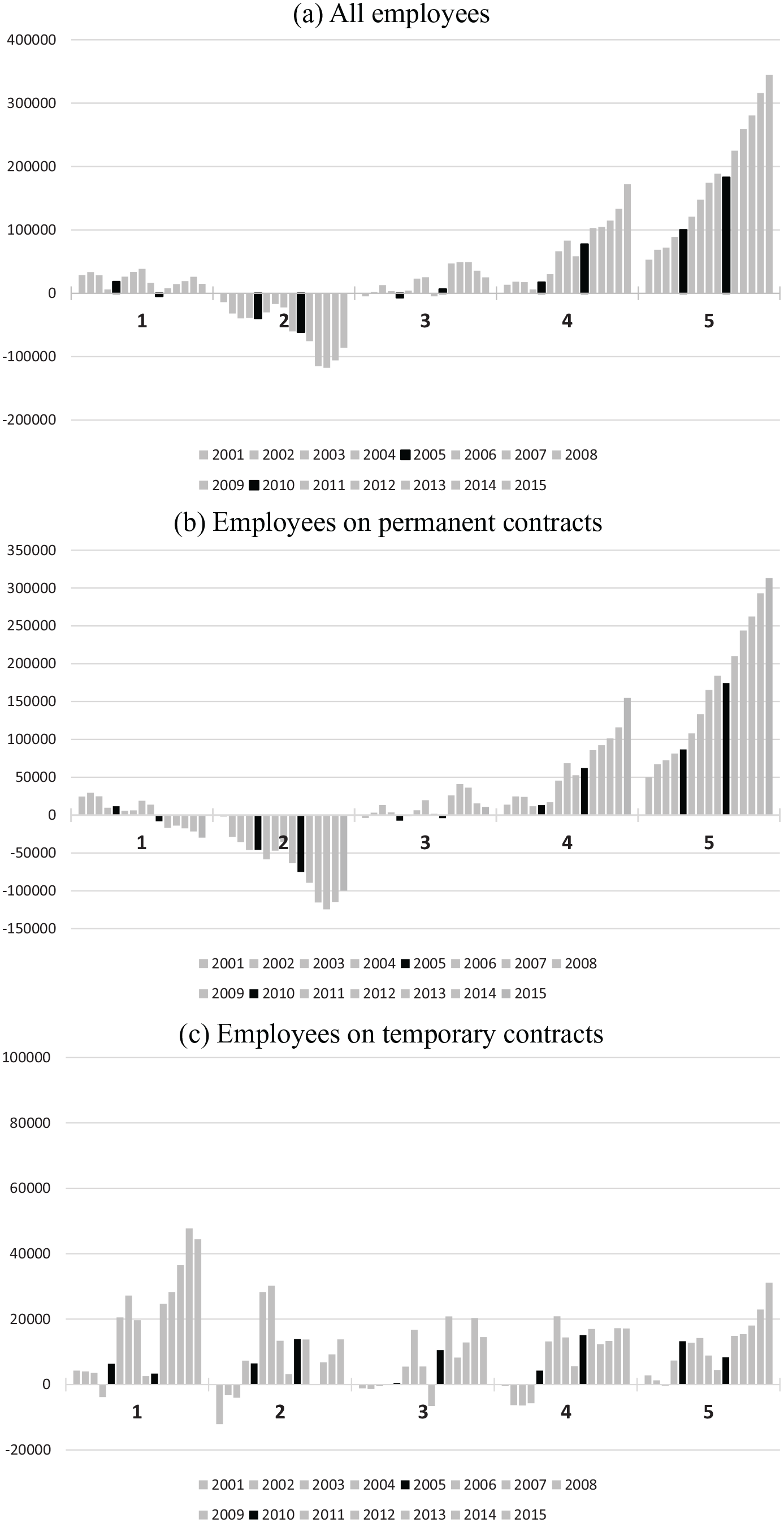
Yearly cumulative changes of the number of employed within quintiles of the occupational-wage structure 2000–2015. Total number of employees, and on permanent and temporary contracts. Years 2005 and 2010 are marked in black for orientation. Weighted LFS data.
Figure 1b shows the cumulative change of employees with permanent contracts (that is, open-ended contracts). The pattern closely resembles what we see for all employees. However, in Quintile 1 there has been a clear decline in the number of employees with permanent contracts. For the whole period the decline is nearly 30,000, and since the peak year (2002), the number has decreased by approximately 59,000 permanent employees. However, the decline in Quintile 2 accelerated after the financial crisis; between 2010 and 2015 the number of employees with permanent contracts decreased by 22,000.
Figure 1c shows the cumulative change in employees with temporary contracts. The largest changes over time are found in Quintile 1, with approximately 44,000 more temporarily employed at the end of the period. Changes within the quintile also seem to be related to the business cycle, where an upturn increased the number of temporaries (2006–2008 and 2011 and forward), while a downturn decreased the numbers (for example, 2004–2005 and 2009–2010). This pattern is in line with Holmlund and Storrie’s (2002) analysis of the 1990s in Sweden, which found a decrease of temporaries in the downturn, while in the upturn, and with the experiences of downsizing fresh in their minds, employers preferred to employ on temporary contracts as long as insecurities persisted. The current analysis qualified their findings as the strongest pattern is found among the lowest-paid occupational categories. However, the general direction of change in Quintile 1 is an increase of the number of temporary employed. A similar pattern is also found in the highest-paid quintile (Quintile 5), but with less strong amplitude of upturns and downturns, while the patterns in the middle three quintiles are less clear.
In conclusion, the time series show a general pattern of upgrading in the Swedish labour market, with very strong employment growth in the highest-paid occupational quintile. However, the lowest-paid quintile did not decline, which makes it difficult to disregard a tendency of polarisation. Moreover, in the lowest-paid quintile the number of employees on permanent contracts has decreased, particularly in the aftermath of the 2008–2009 financial crisis, while the number of temporary employed started to increase strongly. Although the figures reveal some effects of the business cycle, a clear tendency towards an increase in temporary employment, particularly in Quintiles 1 and 5, can be noted for the whole time series.
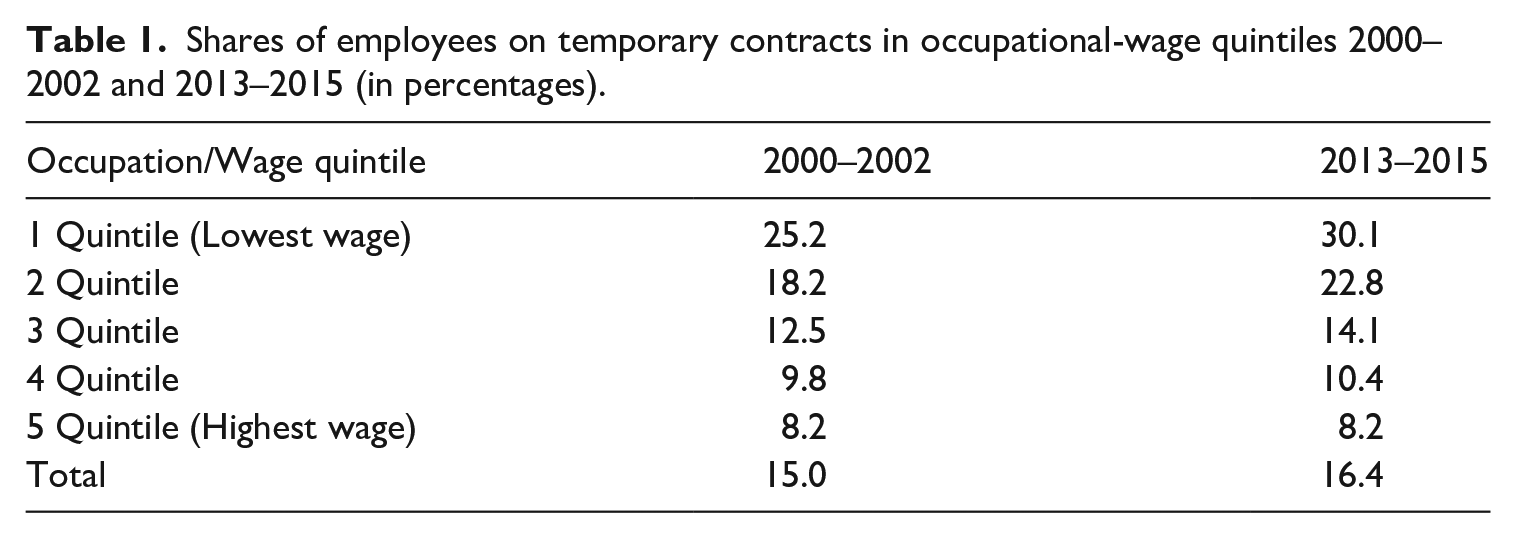
We continue by comparing the end periods of the time series 2000–2002 and 2013–2015, and the characteristics of temporary employment in the occupational-wage structure. The share of temporary employment has increased slightly on the labour market, from 15% of all contracts in 2000–2002 to 16.4% in 2013–2015 (Table 1). Temporary contracts are systematically more common within the low-paid strata than in the quintiles with higher wages. In 2000–2002, 25% of employees had temporary employment in Quintile 1, compared to only 8% in Quintile 5. Between the periods, the share of employees on temporary contracts increased by about 5 percentage points in Quintile 1, but remained the same in Quintile 5.
Shares of employees on temporary contracts in occupational-wage quintiles 2000–2002 and 2013–2015 (in percentages).
In the next step, we continued with regression analyses in order to compare the odds for the different kinds of contract to be found in the different quintiles, controlling for some important background variables. Table 2 presents the odds ratio for employees on temporary contracts, compared to permanent contracts (reference category), to be employed in different quintiles. The general pattern is that temporary employed have a higher risk of being found in the low occupational-wage quintiles and a lower chance of working in high-paid occupations. Checking the control variables, we can also conclude that males have a higher chance of working in high-paid rather than low-paid occupations, and that younger, lower educated and non-native people have a higher chance than the reference categories of falling into the low-wage quintiles. Concerning sector, there is a conspicuous pattern of public employed having higher odds than private employees of working in Quintile 1, while it is the other way around in Quintile 2. This indicates that the lower-paid quintiles are strongly structured by sector, with public sector occupational categories (mainly in personal care and related workers) placed in the bottom quintile, and private sector occupations (mainly in manufacturing) placed in the second lowest quintile (see Berglund et al., 2020; Tåhlin, 2019).
Odds ratio of being employed in a quintile, 16–64 years. All employed.
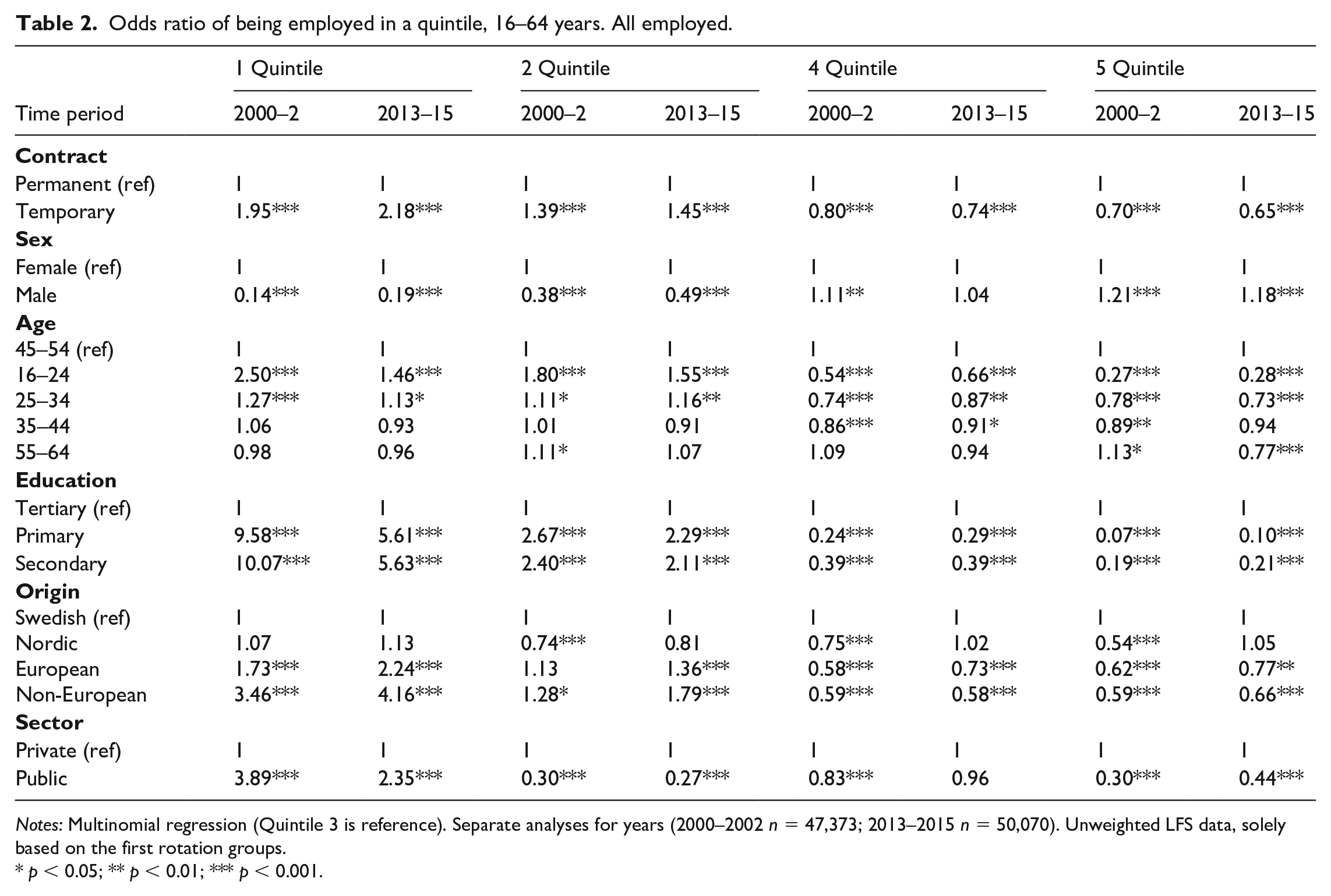
Notes: Multinomial regression (Quintile 3 is reference). Separate analyses for years (2000–2002 n = 47,373; 2013–2015 n = 50,070). Unweighted LFS data, solely based on the first rotation groups.
p < 0.05; ** p < 0.01; *** p < 0.001.
As noted earlier, it is important to consider the different kinds of temporary employment as they imply very different working conditions. The bottom row in Table 3 shows the overall distribution of different types of temporary employment. Compared with previous research (Berglund et al., 2017), the drop in the share of substitutes and the increase in on-call employees has continued in Sweden. From 2000 to 2002, substitutes constituted 32% of employees on temporary contracts, but in the latter period the share dropped to about 19%. Instead, employees on on-call contracts have become the most common type of temporary contracts, from constituting about 23% in the first period to 51% in the latter period. It is important to note that ‘employed on an hourly-basis with an agreed rota’ is a major subcategory within this type of temporary contract. However, the common denominator for all employees in this group is insecurity in wage and working hours.
Type of temporary contract within occupational-wage quintile, 2000–2002 and 2013–2015 (in percentages). Weighted LFS data.
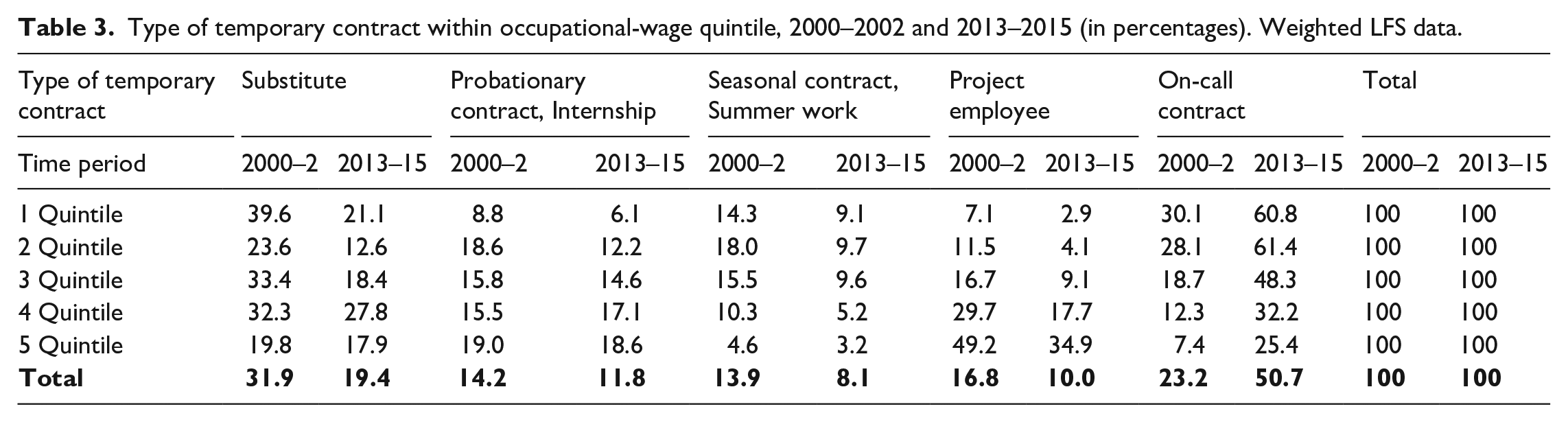
Table 3 also shows the distribution of different kinds of temporary employees within occupational-wage quintiles at the two periods. In 2000–2002, substitutes constituted the largest share within Quintile 1 (39.6%), while on-call was the second largest (30.1%). However, in the latter period, on-call employees became clearly the largest category, constituting over 60% of all temporary employed in the quintile, while the share of substitutes had decreased to 21%. However, on-call increased its share in all quintiles, even in the highest-paid quintile (Quintile 5). Still, the largest share of temporaries in Quintile 5 was temporarily employed in projects (34.9%), although this category has decreased its share considerably over time. The pattern of probationary contracts and internships shows an increase of share with quintile and constitutes 19% of all temporary employed in Quintile 5 in the latter time period. In the period 2000–2002, Quintile 2 had 19% of this category, which the latter period had decreased to 12%.
Table 4 shows the odds ratios of employees with different kinds of temporary contracts having occupations within the quintiles. The highest odds of working in the lowest-paid quintile were found for employees with on-call contracts, while both probationary/internship and project employees have a lower odds than the reference category. Instead, the latter two categories have higher odds of being employed in the highest-paid quintile.
Odds ratio of being in a quintile, 16–64 years. Employees on temporary contract.
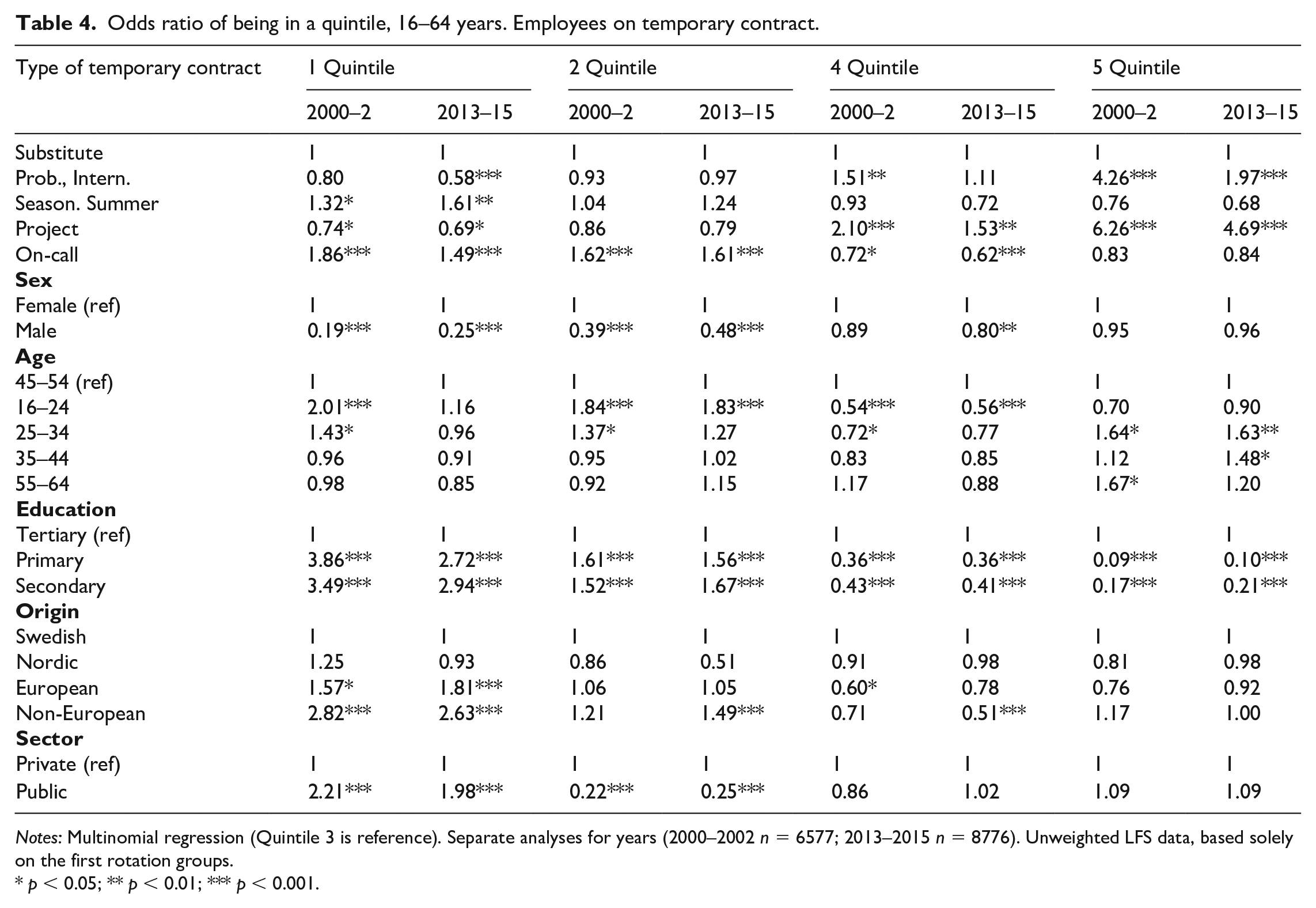
Notes: Multinomial regression (Quintile 3 is reference). Separate analyses for years (2000–2002 n = 6577; 2013–2015 n = 8776). Unweighted LFS data, based solely on the first rotation groups.
p < 0.05; ** p < 0.01; *** p < 0.001.
All of the background variables refer to differences within the category of temporary employed; that is, not including employees on permanent contracts as in the previous analysis. However, the patterns in Table 4 resemble those in Table 2, albeit with some differences. Firstly, no gender differences appear in the highest-paid quintile, while they are substantial in the low-wage quintiles with a lower chance for men. The age patterns are also very similar up to the highest-paid quintile. However, we found that both the 25–34 and 35–44 (the latter period) age categories have a higher chance of being employed in Quintile 5 than the reference of 45–54 years. Furthermore, we can conclude that the educational differences are somewhat reduced concerning the lower-paid quintiles. A similar but less pronounced pattern for Quintile 1 is also found for people of non-European origin.
So far, the analyses have revealed that the occupational changes are related to different kinds of temporary contracts. Below, we will examine whether the risk for being in a low-paid occupation changes over time. Table 5 shows predicted probabilities, presented as percentages, based on mean models of the ones shown in Tables 2 and 4. These add up to 100% per row separately for the two time periods. The mean models estimate the probability of employees with different types of temporary contracts to work in different quintiles of the occupational wages structure; that is, the comparisons are within rather than between contracts. However, these probabilities are estimated for the mean characteristics of the two time periods for the other variables. This implies that demographic and structural changes in these aspects also affect the probabilities shown, to some degree.
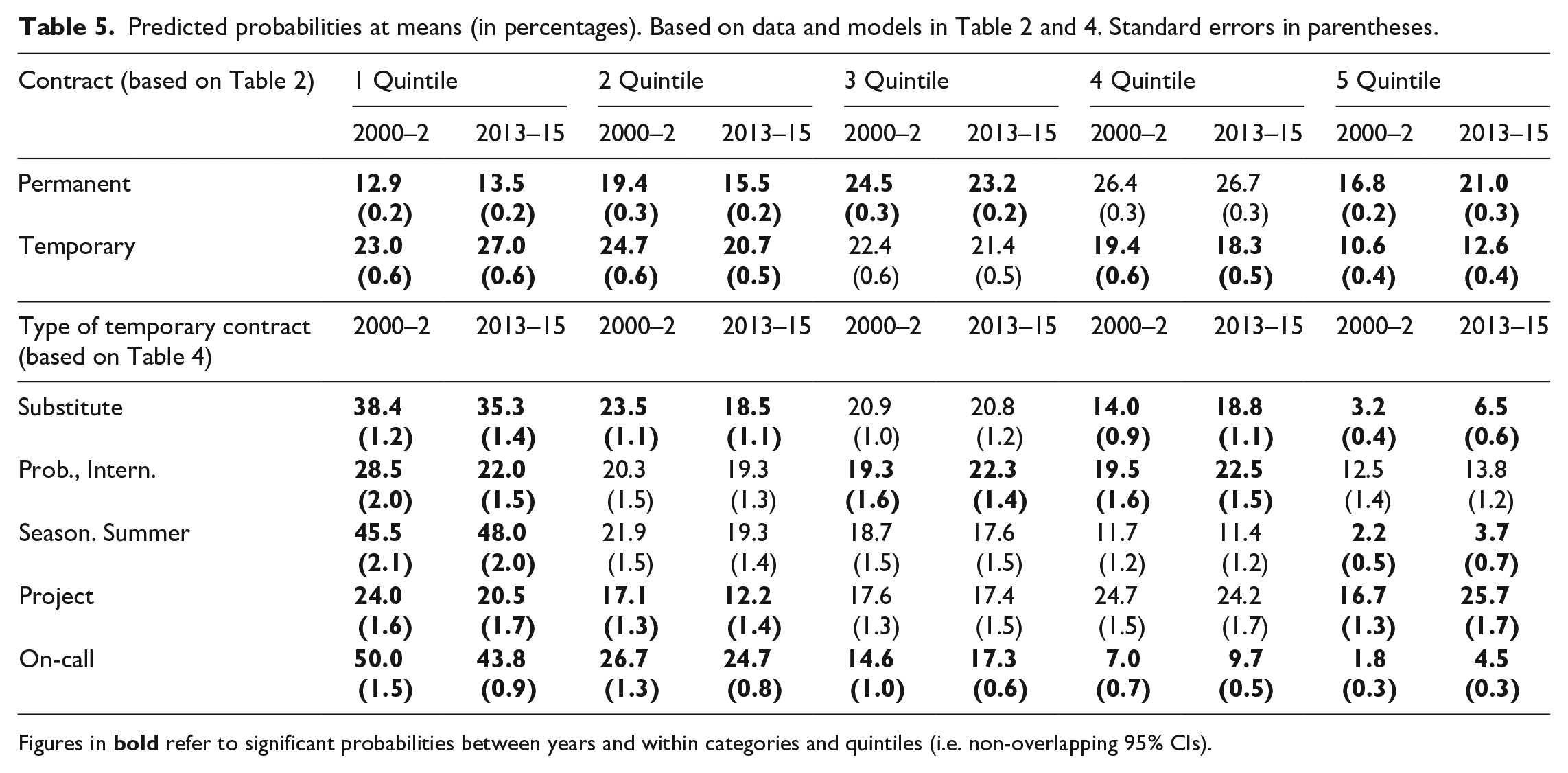
Figures in
Firstly, this analysis shows that the overall probabilities for employees with temporary contracts to work in Quintile 1 rather than in any of the other quintiles have increased over time. The probability of working in Quintile 2 has decreased for both temporary and permanent contract employees, which is certainly an effect of the general decline of the quintile. Concerning Quintile 5, there is a rather strong increase of the probability for employees on permanent contracts to be employed in the quintile, although some increases are also found for employees on temporary contracts.
Secondly, if the analysis is limited to employees on a temporary contract, the highest probabilities of working in the lowest-paid quintile are found among employees with on-call, seasonal and summer contracts. Substitutes also have a high probability of being found in Quintile 1 rather than in any other quintile. The same three categories, on-call, seasonal and summer, have the lowest probability of working in the highest-paid quintile. Project employees have the highest probability of working in Quintile 5, which has clearly increased over time. The latter result must be understood against the relative decline of project employees; that is, the relative decline has not been as strong as in the other quintiles (see Table 3). As expected, all categories show a reduced probability of working in Quintile 2, while the reduction is strongest for those temporarily employed in projects and substitutes. A closer look at the probabilities for employees with on-call contracts shows a significant change downward over time to be working in Quintile 1. However, this change must be understood in relation to the increase of the probability of on-call employment in the three upper quintiles, which change the relative distribution of probabilities within the category.
Discussion
The current study has combined two theoretical perspectives to shed new light on the development of the Swedish labour market from 2000 to 2015. The theory of dualisation asserts that many labour markets, particularly highly regulated ones, have tended to create flexibility on the margins by allowing more precarious employment, and especially temporary employment (Emmenegger et al., 2012). From this perspective, Sweden constitutes a clear example by liberalising the use of temporary contracts, while leaving the regulation of open-ended contracts intact and thereby creating an EPL gap (see Barbieri and Cutuli, 2016). Consequently, the secondary labour market has tended to grow.
In another theoretical strand, today’s labour markets are believed to be strongly affected by technological change. In its positive variant, this leads to an upgrading of the occupational structure (Oesch, 2013). In its more problematic variant, however, labour markets have turned in the direction of polarisation, with growth at both ends of the occupational-wage structure (Åberg, 2015; Adermon and Gustavsson, 2015; Heyman, 2016). The current study shows that there is a strong growth in high-paid employment, indicating an upgrading of the occupational structure. Here, typical occupations experiencing growth are engineers, computing professionals and business professionals (Berglund et al., 2020). The lowest-paid quintile had neither growth nor decline over time, while Quintile 2 show a decline of close to 90,000 employees between 2000 and 2015. However, the different growth rates of the two lowest-paid quintiles make the overall pattern resemble polarisation, and are in line with the routine-biased technological change (RBTC) hypothesis (Autor et al., 2003, 2006). RBTC asserts that the new technology does not substitute the lowest-paid jobs in the service sector, but rather routine jobs higher up in the skill/wage distribution. Typical occupations in Quintile 2 that show reduced numbers of employees are assemblers and office clerks (Berglund et al., 2020). In Quintile 1 there has been strong growth in housekeeping and restaurant service workers. However, the Swedish labour market does not have strong polarisation tendencies, as our analysis was unable to discern real growth in the lowest-paid occupations.
When relating the changing occupational structure to the dualised labour market in Sweden, we discern a more evident polarisation. In Quintile 1, the change consists of a substitution of permanent contracts with temporary contracts, while the growth in the fifth quintile is dominated by permanent positions; hence, a changing occupational structure of strong upgrading, but with a tail of low-paid work held by temporary employees. In conclusion, our analysis reveals an increasing precarisation of the lower end of the occupational structure.
Furthermore, our analysis shows that it is important to distinguish between different kinds of temporary contracts. Previous research has shown that some temporary contracts are more vulnerable than others. On-call workers have fewer opportunities to move from temporary employment to a permanent position compared to substitutes (Berglund et al., 2017), which means they are more exposed to job insecurity and have less opportunity to take part in decision-making and learning and development activities at work (Aronsson et al., 2002). Our analysis reveals that the main type within the low-paid end is on-call employment. This kind of temporary employment is mainly used in manual service jobs that are difficult to replace with new technology, according to the RBTC hypothesis (Autor et al., 2003, 2006). Thus, this group of workers constitutes a secondary workforce and creates the necessary flexibility for organisations when production costs mainly consist of labour power and swift changes in staffing are necessary to avoid losses. For project workers and those on probationary/internship contracts, the picture looks different. They have a significantly higher probability of being positioned in the fifth quintile. The flexibility that temporary contracts, especially on-call contracts, entails may be a prerequisite for employers to be prepared to employ in volatile sectors in an otherwise highly regulated labour market. This can be an additional explanation why we do not see employment decreases in the lower end of the occupational structure, which, according to the function of solidaristic wage policies, should be pressed out due to the few possibilities for productivity increases and relative high wages. However, there could also be other explanations, such as increasing labour supply (immigration) and subsidies (for example, tax reductions for households employing home service workers, labour market policies), which will be left to future research to disentangle.
Conclusions
This article adds to previous research by asking how occupational change is related to the dualised Swedish labour market. The results of this study show that the vast majority of growth in the low-paid end of the occupational structure has been in positions with temporary contracts. Conversely, the significant increase in the high-paid end consists of positions with permanent contracts. Further, taking different kinds of temporary contracts into account, there is a clear trend of precarisation within the group of temporary contracts. On-call contracts have increased in numbers and are more likely than other forms of temporary employment to be found in the lower first quintile of the occupation-wage structure.
The combination of the two perspectives of the current article is also relevant for studies of income inequalities. Paradoxically, the statistics on wage dispersion presented above do not indicate increased wage inequality in Sweden. In this regard, the industrial relations regime that came in place in the 1990s seems to work efficiently, and is probably an important factor for the positive development of high-skilled employment (that is, disciplined wage growth). However, during the same period we find an increase in income inequality. Incomes depend not only on wage levels (per hour), but also on the number of hours worked in a week and the stability of employment (unemployment risks), apart from other factors such as transfers from welfare systems and capital incomes. The kind of temporary contract that has increased most – on-call– usually combines few working hours, job insecurity and low wages. This can have severe effects on income levels for these categories of workers. Thus, an important question for further research is whether the growth of non-standard employment, combined with a changing occupational structure, could be an important factor behind increasing income inequality in Sweden.
Our analysis shows that the dualisation of recent decades, combined with an occupational change with tendencies of polarisation, has severe consequences for the Swedish labour market. The changes have put the renowned ‘high road’ labour market into question. On one hand, an upgrading of the occupational structure is still visible with strong growth of highly qualified and highly paid jobs. This could certainly be an effect of the relative compressed wage structure in Sweden, which – in line with the solidaristic wage principles – ‘subsidises’ employers’ use of high-qualified employment by paying below productivity and market value. On the other hand, the lowest-paid occupations are not pressed out from the market and replaced by better jobs – this process seems to take place higher up (Quintile 2) in the occupational structure. Instead, we find that latter decades’ deregulations of temporary employment contracts hit the lowest-paid strata disproportionally hard. The development revealed in the current study seems to indicate that, alongside the traditional Swedish ‘high road’, the government and the social partners have actively decided to build a ‘crooked and bumpy road’. This road is mainly reserved to specific categories, such as immigrants, the lower-educated and women on temporary contracts.
Footnotes
Declaration of conflicting interests
The authors declared no potential conflicts of interest with respect to the research, authorship, and/or publication of this article.
Funding
This research was funded by the Swedish Research Council for Health, Working Life and Welfare, dnr 2016-07204.
