




Abstract
The labour market dualisation theory claims that labour unions bargain against the interests of temporary workers and that they foster inequalities between temporary and permanent employees. Conversely, the industrial relations literature argues that unions commonly follow solidaristic strategies towards outsiders. This study contributes to the literature by analysing unions’ associations with temporary workers’ hourly wages and the wage gap between permanent and temporary workers in Spain: one of the most prominent examples of labour market dualisation. By analysing cross-sectional surveys, unions’ influence through works councils, collective agreements and union density are studied during a period of economic growth (2006–2007) and a period of recession (2008–2010). Results show that there is generally no association between these three institutions and wage differences between permanent and temporary workers. The associations with temporary workers’ wages are insignificant or positive during both the period of economic growth and the period of recession.
Keywords
Introduction
Temporary workers have lower quality jobs than those of permanent employees. 1 They not only have little or no job security (Parker et al., 2002), but also lower hourly wages compared to permanent workers (Westhoff, 2022). Among the multiple institutional factors that seem to influence the wage differential between permanent and temporary workers, the effects of industrial relations institutions and unions stand out (Arranz et al., 2021; Fauser and Gebel, 2023). Industrial relations scholars generally argue that labour unions improve workers’ job quality, although they also cast doubt on the capacity of unions to deal with the issues that specifically affect temporary workers. Labour market dualisation theorists, on the contrary, argue that unions only benefit labour market insiders (i.e. permanent workers), frequently at the expense of the outsiders (i.e. temporary workers) (Lindbeck and Snower, 2002; Palier and Thelen, 2010). However, they also state that unions could be interested in improving outsiders’ wages to benefit the insiders (Lindbeck and Snower, 2002). Despite this debate, the consequences of unions for temporary workers’ wages and the permanent-to-temporary wage gap have rarely been empirically tested (see Arranz et al., 2021 for an exception).
The goal of this article is twofold: first, to explore the association of unions with the wage gap between permanent and temporary workers; second, to investigate the association of unions with temporary workers’ wages. While the first objective concerns the relative effect of unions on temporary workers’ income, the second refers to the absolute effect. This study explores unions’ consequences for temporary workers in Spain, which has been traditionally considered one of the paradigmatic cases of labour market dualisation in Europe (Cárdenas and Villanueva, 2020; Polavieja, 2003). More specifically, it analyses three institutions – works councils, union density and collective agreements – during a period of economic growth (2006–2007) and a period of recession (2008–2010).
This article makes three contributions to the current literature. First, it explores for the first time the association of unions with temporary workers’ wages, as previous articles focused on the permanent–temporary wage gap (Arranz et al., 2021). Studying both outcomes is necessary to disentangle the origin of the wage gap, since inequalities might increase (decrease) because of better (poorer) standards for the privileged group or due to lower (higher) standards for the disadvantaged one (Pulignano et al., 2020). Second, this study pioneers the exploration of the relationship between works councils and temporary workers’ wages. Due to the characteristics of the industrial relations system in Spain, such an analysis allows obtaining individual – rather than merely aggregate – evidence of the potential effects of unions. Third, this is the first article that performs these analyses for the case of Spain. Most of the literature in the field focuses on the British and German cases. Extending these analyses to other institutional settings contributes to building more comprehensive insight into the consequences of unions for non-standard workers. Moreover, as the analyses are performed during a period of economic growth and a period of recession, they enable exploring whether unions’ associations with temporary workers might have varied depending on the economic climate.
Understanding how industrial relations institutions affect wage inequalities between temporary and permanent workers is crucial as wage inequality is one of the main dimensions of social inequality. This is especially true for temporary workers, whose contracts entail a double disadvantage in terms of both job security and compensation. The findings of this article are therefore especially relevant for legislators, who must evaluate the effects of industrial relations institutions to regulate them, but also for labour unions aiming to assess their capacity to represent the interests of the labour market outsiders.
Literature review
Theoretical approaches: Between inclusiveness and dualisation
The effects that labour unions have for non-standard employees is a recurrent topic at the intersection of sociology, economics and political science. Across disciplines researchers have debated whether labour unions and industrial relations institutions are beneficial or harmful for temporary workers’ job quality and labour market prospects. Two partially opposed views are defended by the industrial relations literature and proponents of the dualisation theory.
The industrial relations literature, relying on the power resources theory (Korpi, 1983) and critical sociology, holds a mostly positive view of the consequences of unions for temporary workers (see Doellgast et al., 2018 for a review). Scholars in this field argue that unions tend to improve atypical workers’ outcomes by exerting and coordinating collective action, although they also acknowledge a certain incapacity of unions to defend and represent the interests of atypical workers. These scholars recurrently study whether unions adopt ‘inclusive’ (Benassi and Dorigatti, 2015) – rather than ‘exclusive’ – strategies towards atypical workers and negotiate ‘encompassing’ agreements (Benassi and Vlandas, 2016) that favour ‘convergence’ and ‘solidarity’ instead of ‘divergence’ and ‘dualism’ (Doellgast et al., 2018; Pulignano et al., 2020) between standard and non-standard employees. Most of these studies provide an insightful and detailed qualitative analysis of the strategies that unions pursue and the outcomes that they achieve regarding atypical workers. However, it is hard to assess to what extent these outcomes are the rule rather than the exception. By reviewing multiple case-specific studies of unions’ bargaining outcomes and strategies across Europe, Carver and Doellgast (2021) find that unions generally benefited both insiders and outsiders, although in a minority of cases (mostly in Germany) unions also fostered dualisation.
As opposed to this, the labour market dualisation theory, which is more prominent in economics and political science, considers that permanent and temporary workers comprise two groups with opposing interests (Rueda, 2007). Their core argument is that labour unions defend and protect the interests of insiders (i.e. permanent workers, union members and full-timers) at the expense of outsiders (i.e. temporary workers, the unemployed, part-timers and non-members) (Palier and Thelen, 2010; Rueda, 2007). They argue that unions would neglect and even bargain against outsiders’ interests because they are not sufficiently represented: whereas permanent workers constitute the core constituency of unions, temporary workers form only a minority of it (Emmenegger et al., 2012). In terms of employment protection, they claim that unions would be interested in fostering inequalities between the two groups to benefit the insiders (Bentolila and Dolado, 1994; Lindbeck and Snower, 2002). Hence, by imposing high dismissal costs for permanent workers, employers would use temporary contracts as a buffer in labour market fluctuations (Polavieja, 2006). This would improve the job security of the permanent workers at the expense of the temporary ones, who would have fewer chances of attaining a permanent contract due to the reluctance of employers to hire workers that are costly to dismiss. While the theory makes claims about the effects of unions for the insider–outsider divide in employment protection and job security, their conclusions are less certain concerning wage inequalities. Lindbeck and Snower (2002: 13) state that unions could be interested in both widening and reducing the wage gap, as well as improving and lowering temporary workers’ wages, always to benefit the labour market insiders. If outsiders’ wages are significantly lower than insiders’, then employers could end up substituting the permanent workforce with temporary employees, thus threatening the insiders’ positions. Conversely, if unions set higher wages for permanent workers, employers would compensate these greater labour costs by lowering the wages of the temporary ones. Evidence tends to support the dualisation assumption in terms of employment protection: stricter dismissals regulations reduce outsiders’ chances of finding a permanent job – at least during some times and for some socio-demographic groups (Barbieri and Cutili, 2016; Gebel and Giesecke, 2016). It is unclear, nonetheless, whether the theory assumptions hold in terms of wages. Benassi and Vlandas (2022) found evidence of wage dualisation in Germany by showing that non-unionised workers are at a higher risk of earning low wages in highly unionised sectors of economic activity. In contrast, in sectors with high collective bargaining coverage, workers without collective agreements have less risk of being low-wage earners, which questions Fitzenberger et al.’s (2013) results for the same country.
These two bodies of literature offer mostly opposite views about the intentions of unions towards atypical workers: for the industrial relations literature, unions act in favour of the collective good, frequently motivated by ideological reasons, while for the dualisation theory, unions are rational actors that try to maximise profits. However, these two frameworks are less contrasting when it comes to the consequences of unions for wage inequalities. In the end, both provide theoretical arguments and empirical findings that suggest that unions might produce dualising or solidary outcomes: that is, unions might promote or hinder wage convergence as well as exert positive or negative effects on temporary workers’ wages.
The permanent-to-temporary wage gap in Spain
The (hourly) wage gap between permanent and temporary workers has been documented across time in a variety of countries with distinct labour market institutions (Westhoff, 2022), but the causes and mechanisms that are at the origin of this wage difference are not fully clear. In Spain, De La Rica (2004) estimates that 42% of the wage gap can be explained by the segregation of temporary workers in lower-paying firms. After accounting for workers’ unobserved characteristics, Mertens et al. (2007) observe that the wage gap between permanent and temporary in the country remained at 4.4 percentage points over the period 1995–2000. Although since 2001 the Workers’ Statute (article 15.6 2 ) explicitly prohibits differences in pay for permanent and temporary workers, studies analysing datasets after the law’s implementation still detect the wage difference (Comi and Grasseni, 2012; 3 Dias Da Silva and Turrini, 2015; Oliver and Sard, 2019).
Other findings indicate that this disadvantage might stem from the inherent situation of vulnerability and lack of job security faced by temporary workers. Engellandt and Riphahn (2005) show that temporary workers are more likely to do unpaid extra hours if their contracts provide higher chances of becoming permanent workers. Polavieja (2006) likewise suggests that temporary workers might have more incentives to display greater effort to obtain a permanent position. This ‘incentive effect of temporary contracts’ might be especially strong in the case of Spain due to the high structural unemployment and the high protection against dismissal for permanent workers (Jimeno and Toharia, 1993: 477; Polavieja, 2006: 72). Obtaining a permanent position would then free temporary workers from the constant threat of unemployment, while obtaining a contract renewal would be a suboptimal alternative to the persistent unemployment. As a result of this ‘incentive effect’, temporary workers would obtain the same salary as permanent employees for a greater unit of work. For these same reasons, temporary workers might be also more likely to accept other kinds of abusive and illegal conditions. Because the compensation against (unfair) dismissals for permanent workers is high, employers face strong barriers to fire non-complying permanent workers, whereas retaliating against non-complying temporary workers comes at a lower cost. Severance pay is notably lower for temporary workers, but not offering a contract renewal frequently entails a dismissal in practice. In consequence, employers in Spain could offer temporary workers a lower compensation than to permanent employees for the same unit of work. Still, the inequalities that emerge on the fringes of the law are insufficient to account for the lower salaries of temporary workers as the wage difference is also detected in studies using surveys that do not capture informal employment (e.g. Dias da Silva and Turrini, 2015; Oliver and Sard, 2019).
Considering some of the mechanisms through which wage inequalities between permanent and temporary workers could arise, the effects of unions on the permanent-to-temporary wage gap must depend on unions’ capacity and will to mitigate or strengthen these mechanisms. Unions’ effects on temporary workers’ wages will not only depend on their talent and capacity to bargain in a broad sense, but on their ability and will to specifically address the precise causes of precariousness and low remuneration among temporary employees. Unions’ influence can then occur through multiple institutions and instruments. For example, unions might widen the wage gap if they are more likely to exert industrial actions for issues that concern permanent workers than for those that concern temporary ones. Collective agreements might also systematically grant benefits and bonuses that in practice only permanent workers can achieve. 4 Alternatively, inequalities could result from the unions’ inability to oppose employers’ abusive and illegal employment conditions towards the temporary workers. Conversely, if unions can effectively enforce encompassing collective agreements, develop industrial action to tackle issues that especially affect temporary employees, negotiate on-the-job training for temporary workers with the aim to improve their productivity (Adolfsson et al., 2022) or provide legal assistance to temporary workers who face abusive working conditions (Heery, 2009), they could then reduce the wage gap and promote higher wages for the temporary workforce.
The industrial relations system in Spain
For the dualisation literature, Spain constitutes a classic and prominent case of dualisation. The fact that the reforms resulting in a dualised labour market were negotiated and supported by labour unions corresponds well with the dualisation narrative (Dolado et al., 2002; Polavieja, 2003, 2006; Rueda, 2007). Labour unions encouraged maintaining the high protection against dismissals for permanent workers but accepted more flexibility for the temporary ones (Dolado et al., 2002). This resulted in a disproportionate rate of temporary employment – it reached 35% in 2006 and was above 30% in the 1990s – and significantly reduced the possibilities of temporary workers to attain a permanent position (Dolado et al., 2002; Polavieja, 2006).
From the industrial relations perspective, labour unions in Spain have not systematically and extensively promoted dualisation and exclusiveness. Pulignano et al. (2016) show that while unions were not actively developing inclusive strategies, they did not pursue exclusion either. The issues that concerned atypical workers were not a priority for unions, but they were at least addressed by the associations of young workers within unions. According to Benassi and Vlandas (2016), Spanish unions instead developed inclusive strategies; for example, by setting an equal pay agreement for temporary agency workers. The authors find that what motivated their solidaristic and inclusive strategies was the union working-class ideology. Jódar et al. (2011) similarly show that union members’ motivation to participate in the union was mostly collectivist instead of individualistic.
As most European countries, Spain has a system of multiparty bargaining, where unions are stakeholders involved in developing policies together with policymakers and the employers’ representatives (even though policy reforms do not need to be accepted by all parties to be implemented). The country combines high collective agreement coverage (about 80%) and low union density (about 15%). Most union members (around 70%) belong to the main nationally representative organisations: the Workers’ General Union (Unión General de Trabajadores) and Workers’ Commissions (Comisiones Obreras), both with a leftist ideology. The remaining 30% of union members belong mostly to regional unions and to the public sector union.
The principal institutions of workers’ representation are works councils (comité de empresa) and the union sections (sección sindical), which are composed of the members of a union at the workplace. Most of the union power and influence is determined by the results of the works council elections (Izquierdo et al., 2003). In these elections, union members from different unions – as well as the non-unionised workers – can compete to become representatives, either as workers’ delegates or within the works council, depending on the size of the company. The elected representatives negotiate firm-level agreements with employers, while the regional and sectoral agreements are negotiated exclusively by the unions with more representation in the sector. For this reason, it is argued that unions in Spain represent voters instead of members, as all workers, regardless of their membership, can influence the union’s power and relevance (Jódar et al., 2011: s164; Martin Valverde, 1991: 24–25; Martínez-Lucio, 1992: 501). Although these elections are open to both union members and non-members, it could be argued that the electoral process is biased against temporary workers as six months of tenure are required to be elected as a representative, and one month is needed to participate in the election.
The analysis focuses on three institutions from among the multiple ones through which unions can exert power: works councils, collective agreements and union density. Analysing multiple institutions provides a wider picture of unions’ influence, as institutions might present different effects (Hübler and Meyer, 2000). 5 Similarly, analysing these institutions during a period of economic growth and economic downturn contributes to our understanding of whether union strategies and outcomes towards the outsiders were shaped by the economic climate. Unions might improve outsiders’ wages when resources are widely available but benefit insiders at the expense of the outsiders when facing pressures to reduce labour costs.
The next sections describe the characteristics of works councils, union density and collective agreements in the context of Spain; review the evidence about their potential effects on wages and wage inequality; and set the hypotheses that will guide the analyses. For simplicity, the term ‘solidarity’ will be used to describe a situation in which unions have equalising and positive effects on temporary workers’ wages, and ‘dualisation’ for the opposite case.
Works councils
All workers in companies with more than six employees are entitled to have an employee delegate (delegado de personal) and to form a works council in companies with more than 50 employees. The main role of works councils is to negotiate collective agreements at the firm level, but they also have the right to consultation and information, which allows them to potentially influence hirings, wages and working conditions. Although workers can elect and become works council representatives regardless of their union membership, in most cases the representatives are also union members (Fulton, 2021).
Research about the consequences of works councils on wages is scarce and based on Germany, where works councils have a similar role to in Spain. Results suggest that they reduce overall wage inequality (Hübler and Meyer, 2000) and the gender wage gap (Heinze and Wolf, 2010) and also exert positive effects on wages across different socio-demographic groups. As previous findings support the solidarity assumption, it is hypothesised that:
(H1a) Works councils are associated with a smaller wage gap between permanent and temporary workers and (H1b) temporary workers in firms with works councils have higher wages than temporary workers in firms without works councils.
Opposite results would suggest that works councils have dualising and negative effects on temporary workers’ wages.
Collective agreements
Negotiations of collective agreements take place at different levels, with a predominance of company and regional bargaining agreements. This system has been largely inclusive, since lower-order agreements could not provide poorer wages and conditions than those agreed at higher levels, but also due to erga omnes (i.e. collective agreements are automatically extended to all workers within a company). In practice, this means that permanent and temporary workers have a similar bargaining coverage and that unions affect most segments of the workforce, regardless of workers’ membership and kind of contract.
Research into collective agreements shows that firm agreements in Spain generate greater wage dispersion (Canal Domínguez et al., 2016, 2020; Dell’Aringa et al., 2007) and benefit workers at the upper end of the income distribution more (Card and De La Rica, 2006; Ramos et al., 2022) compared to sectoral and regional agreements. Nonetheless, collective agreements tend to reduce overall wage dispersion and workers at the lower end of the income distribution benefit from the wage floors that these agreements set (Ramos et al., 2022). Similar equalising effects are observed for the gender wage gap too (Felgueroso et al., 2008). Because of the support for the solidarity assumption, the following hypothesis is tested:
(H2a) Collective agreements are associated with a smaller wage gap between permanent and temporary workers and (H2b) temporary workers with collective agreements have higher wages than temporary workers without collective agreements.
Conversely, the opposite results would suggest that unions have dualising and negative effects on temporary workers’ wages. In fact, results for Germany do raise doubts about the effects that collective bargaining coverage has on uncovered workers. Fitzenberger et al. (2013) observe that collective bargaining coverage seems to exert a downward pressure on the wages of uncovered workers, whereas Benassi and Vlandas (2022) find the opposite: in sectors with high collective bargaining coverage, uncovered workers have higher wages. Given the contradictory evidence, the solidarity assumption is tested among uncovered temporary workers:
(H2c) Temporary workers without collective agreements have higher wages in sectors with high collective bargaining coverage.
Opposite findings would show support for the dualisation assumption.
Union density
Union density is commonly considered to reflect unions’ strength and power to exert collective action in different forms. The association between union density and wages in Spain has not been studied, but the research for other countries is somewhat mixed. Some authors find that union density is related to lower wage dispersion and higher wages for lower earners in Germany (Fitzenberger et al., 2013), Portugal (Addison et al., 2023) and in cross-country studies (Checchi and García-Peñalosa, 2008; Koeniger et al., 2007). Conversely, Hübler and Meyer’s (2000) results for Germany suggest that union density does not reduce wage inequality between skilled and unskilled workers, and Arranz et al.’s (2021) cross-national analyses indicate that it slightly widens the permanent-to-temporary wage gap. Since the evidence is more inclined towards the solidarity assumption, it is hypothesised that:
(H3a) In sectors with higher union density, the wage gap between permanent and temporary workers is smaller and (H3b) temporary workers have higher wages.
Opposite results would give support for the dualisation theory instead.
Besides the permanent-to-temporary workers divide, the effects of union density might also differ for unionised and non-unionised temporary workers. The dualisation theory points out that unions do not defend the interests of temporary workers because they are less likely to be union members and hence to conform the union’s core constituency. However, according to Benassi and Vlandas (2016), unions in Spain have been relatively inclusive towards atypical workers, who presented similar membership rates to permanent employees. It could be argued, then, that union density in the Spanish context might have negative consequences only for non-unionised temporary employees. This is in line with what Benassi and Vlandas’s (2022) results for Germany suggest. Following these findings, the dualisation assumption is tested among the non-unionised temporary workers:
(H3c) Non-unionised temporary workers have lower wages in sectors with higher union density.
Opposite findings would imply support for solidarity.
Data and methods
The analyses primarily draw on the Quality of Working Life Survey (QoWLS), which consists of a series of cross-sectional surveys conducted by the Spanish Ministry of Labour between 2006 and 2010. 6 This survey is representative of the Spanish workforce and includes about 5,700 employees in each round. Its main strength is that it contains individual information about respondents’ union membership, their collective agreement coverage and the presence of a works council in their company. Its main weakness is that the source of the dependent variable (monthly wage) is provided in intervals that are very wide in some segments. This blurs wage differences in hourly wages, even though the analyses do reflect the fact that temporary workers earn significantly less than permanent employees. To calculate the hourly wage, each observation was attributed the mean value of its corresponding wage interval, which was later divided by the monthly number of worked hours. More details about the sample, variables and dataset are provided in the Online Appendix (section 1).
With the purpose of overcoming some of the weaknesses of the QoWLS, to analyse the association of union density with wages (H3a and H3b) the analyses additionally relied on the Spanish Structure of Earnings Survey (SES) of 2006 and 2010. The SES gathers matched employer–employee data for almost 250,000 employees within more than 20,000 organisations. In this case, the information is provided by the organisations instead of the workers. As the questionnaire instructs organisations to draw on pay slips to complete the questionnaire, this information is similar to administrative data and is therefore more accurate regarding wages and hours of work. In contrast to the QoWLS, the SES cannot capture situations of undeclared work and unpaid working hours, which should affect temporary workers more. This bias might be significant in the case of Spain, where the weight of the informal economy and employment is non-negligible (European Commission, 2018). In addition, the SES does not include workers from sectors such as agriculture, fishing and activities of households as employers, which might be especially affected by precariousness and informality. These methodological differences seem to cause some mismatches between the QoWLS and the SES. For example, according to the SES, 95% of workers are covered by a collective agreement, but according to the QoWLS this figure is only about 50% (the ILO indicates that the rate ranged from 75% to 81% for the period 2006–2010). Response bias should also be considered in QoWLS, where about 20% of the respondents do not know if they are covered by a collective agreement. Differences between the two datasets are discussed further in the Online Appendix (section 1).
Variables and analytical strategy
The dependent variable and the control variables presented virtually no missing cases, but collective agreement and works council contained between one-third and one-fifth of missing answers, which were discarded from the analyses. This unavoidably diminished the representativeness of our samples. Upon comparing our analytical samples with the original ones, we observe that workers with lower education and lower occupational status were more likely to present missing values for the independent variables works council and collective agreement. This is unsurprising, as less skilled workers might be less aware of workplace regulations and representation structures. For the same reason, we should also assume that workers with lower propensity to negotiate working conditions and those who are less interested in industrial relations issues are underrepresented in our analytical samples too. This introduces bias in our results and reduces the validity of our findings.
To test the association of works council (H1a) and collective agreement (H2a) with wages conditional on kind of contract (temporary or permanent), the dummy variable temporary contract was interacted with the respective dummy variables for each institution in separate quantile regression models. To test the association of works council (H1b) and collective agreement 7 (H2b) with the wages of temporary workers, these two independent variables were included in (different) quantile regression models containing only temporary workers. Using quantile regression models allowed to explore if the associations are the same across the wage distribution and avoided the influence of extreme values on the mean.
The quantile regression models were executed independently for each year to explore the associations across the period of economic growth and recession. As the variance of the residuals was heteroscedastic, wild bootstrap was used to obtain the standard errors. 8 We also included as control variables different confounders that could simultaneously affect the independent variables (temporary contract, works council and collective agreement) and the dependent one (hourly wage): age (and age squared), gender, education, nationality (native vs foreigner), occupation (ISCO- 1 digit), public sector (vs private), company size, supervisory role, activity sector (NACE, 9 categories), part-time employment (vs full-time), whether it is the first job of the worker, work at weekends, work at night and fixed wage (whether the wage is the same every month or it varies due to incentives or bonuses, for example). We additionally included different interactions as controls. Although some authors suggest that in moderation analyses all confounders should be interacted with the predictors, this approach also presents disadvantages (Keller, 2014). For this reason, we opted for including those interactions that we deemed most relevant. The models analysing the associations of works councils and collective agreements with the permanent–temporary wage gap, and with temporary workers’ wages included two interactions: First, we interacted gender and part-time employment to control for the impact of part-time employment conditional on gender (as suggested by Westhoff, 2022). Second, we included an interaction between age and first job to account for the wage penalty that very young and very old new entrants in the labour market might suffer. The models assessing the permanent–temporary wage gap included three additional interactions. First, we interacted temporary contract and part-time employment to account for the multiplicative negative effects of non-standard contracts on wages and for the fact that workers with a marginal engagement in the labour market might be less willing to form works councils. Second, we interacted temporary contract and public sector. We considered that, because of stricter wage regulations, temporary workers in the public sector suffer a smaller wage penalty. We also considered that public sector workers might be more likely to establish a works council compared to workers in the private sector due to stricter protections against dismissal. Third, we interacted public sector with each respective institution (collective agreement or works council) because the effects of these two labour market institutions might be conditional on sector, given that private and public sector organisations are subject to different industrial relations regulations. Supplementary analyses also included individual union membership as a control (also interacted with temporary contract), as it might be a mediator but also a confounder in the (conditional) association between works council and collective agreement with wages.
To test the association of sectoral collective bargaining coverage with the wages of uncovered temporary workers (H2c; models 1.1–1.2), multilevel models with random intercepts and coefficients were applied, considering the sector (NACE 2 digits) as the cluster unit. These models allowed us to account for the nested structure of the data (workers within activity sectors) and exploit the variation in collective bargaining coverage across activity sectors. Considering the sector as the cluster unit not only replicates the approaches of similar studies in the field (i.e. Benassi and Vlandas, 2022), but also allows us to reflect the system of collective bargaining coverage in Spain, where collective agreements are generally determined at the sectoral and regional level, as we showed in the literature review.
Because of the limited number of observations, the analyses were performed combining two different yearly datasets: one set for the period of economic growth (using the 2006 and 2007 samples) and another set for the period of recession (using the 2009 and 2010 samples). 9 This resulted in between 49 and 71 clusters. The independent macro variable – sectoral collective bargaining coverage – was obtained for each period from the QoWLS. The model also included the sectoral rate of temporary employment (obtained from the QoWLS) as a macro-level control variable: a higher reliance on temporary hirings might lower productivity – and therefore wages – but also impact workers’ capacity to negotiate and enforce collective agreements. Similarly, in those sectors where temporary workers account for a larger share of the workforce, unions might negotiate agreements that are more beneficial for temporary workers. The individual-level control variables were virtually the same as in previous models: age, gender, education, nationality, occupation, public sector, company size, supervisory role, part-time employment, first job, work at weekends, work at night, fixed wage and year. The interaction terms between the individual-level variables were not included to reduce the computational demands.
To analyse sectoral union density, multilevel models with random intercepts and slopes were also used, performing separate analyses for the period of growth and recession. Due to better data availability, the activity sector (NACE 1 digit) by region (NUTS 1 digit) was considered as the cluster unit, resulting in 127 to 164 clusters. Accounting for union density at the sectoral and regional level (rather than only at the sectoral level, as in the previous analyses) is advantageous for two reasons. First, it allows us to reflect more accurately the distribution of power in the Spanish system of industrial relations. As we mentioned in the literature review, unions with more representation at the sector level must negotiate sectoral and regional agreements. Second, by relying on a larger number of clusters we increase the power of our analyses. Therefore, we can test the association of union density with wages by exploiting the variation in union density across multiple industry sectors and regions. Thus, the independent variable (obtained from the QoWLS) captures the sectoral union density by region for each of the two periods (2006–2007 and 2009–2010). As in the previous analyses, the sectoral rate of temporary employment (by region) was also introduced as a macro-level control variable. The association of union density with the permanent–temporary wage gap (H3a; models 2.1–2.4) was tested with a cross-level interaction between the independent macro variable (union density) and the individual-level variable (the dummy temporary contract). These analyses were performed using the QoWLS and SES datasets. The mixed models studying the association of the macro variable union density with temporary workers’ wages (H3b; models 3.1–3.4) were also executed with the two different sets of microdata (QoWLS and SES). Instead, the mixed models that tested the association of union density with the wages of the non-unionised temporary workers (H3c; models 4.1–4.2) were only executed with the QoWLS, since unionised individuals cannot be identified in the SES.
While for the QoWLS the mixed models had two levels (individuals and sectors), the mixed models executed on SES microdata had three levels: individuals, companies and sectors. The analyses using the SES included age, gender, education, nationality, occupation, public sector, supervisory role, part-time employment and main market (where the product is traded) 10 as individual-level control variables. Similarly, as in the previous cases, the analyses using the QoWLS included age, gender, education, nationality, occupation, public sector, company size, supervisory role, part-time employment, first job, work at weekends, work at night, fixed wage and year as individual-level controls. Interactions between the individual-level variables were also avoided to reduce computational demands and convergence problems.
As the estimates of the mixed models could not be obtained across different wage quantiles, approximately the top 0.1% earners in all the samples were discarded to avoid the influence of extreme values. In supplementary analyses, the association of union density with wages was tested for each occupational group separately 11 (see Figures C1.1–C2.2 in the Online Appendix).
One of the points of debate in multilevel modelling is the selection of variables with cluster-varying coefficients. Given Heisig et al.’s (2017) findings, the introduction of random slopes in the two-level multilevel models (those using the QoWLS microdata) was based on changes in the Bayesian information criterion and the results of a principal components analysis, following the authors’ recommendations. However, the process differed from the exact procedure described by the authors due to issues of convergence given the large number of covariates. They propose starting the iterative procedure with a model including all the terms as random slopes and progressively remove them as random components. Unlike Heisig et al. (2017), the procedure started with a model without random slopes (except for the individual-level variable involved in a cross-level interaction) and progressively added other random terms. Although some tests were performed in smaller datasets to ensure that both approaches led to the same optimised model, this should be formally tested in other studies. The method proposed by Heisig et al. (2017) could not be applied to the three-level models (those using SES data), as it is only designed for models with two levels. More details about the procedure can be found in the Online Appendix (section 6).
Finally, additional analyses were performed to address potential concerns regarding the macro-level control variable being a collider and the precision of the macro variable union density. More specifically, the analyses were repeated using the sectoral variation in the number of employees rather than the variation at the sector level by region as a control variable to reflect the variation in labour demand (see section 7 of the Online Appendix for further details). Despite our efforts to improve the accuracy of the multilevel model estimates, none of our analyses enables us to identify effects. Sectors with higher union density and collective bargaining coverage might also present other unobserved characteristics that affect wages, such as productivity, organisational culture and climate. We can neither exclude the possibility of reversed causality.
Results
Works councils
The first column of Figure 1 shows the association between having a works council (yes = 1) and wages conditional on the kind of contract (temporary = 1, permanent = 0) along the wage distribution. The coefficients present negative signs, suggesting a link between works councils and wider permanent–temporary wage gaps, but the associations are rarely significant. Similar results are observed during the period of economic growth (2006–2007) and recession (2008–2010): there is no relationship between works councils and larger or smaller permanent–temporary wage gaps. Only two negative significant associations (in 2006 and 2007) and a positive one (in 2010) can be found. Still, they do not reflect systematic patterns that allow drawing significant conclusions and might be partially attributed to sampling error.
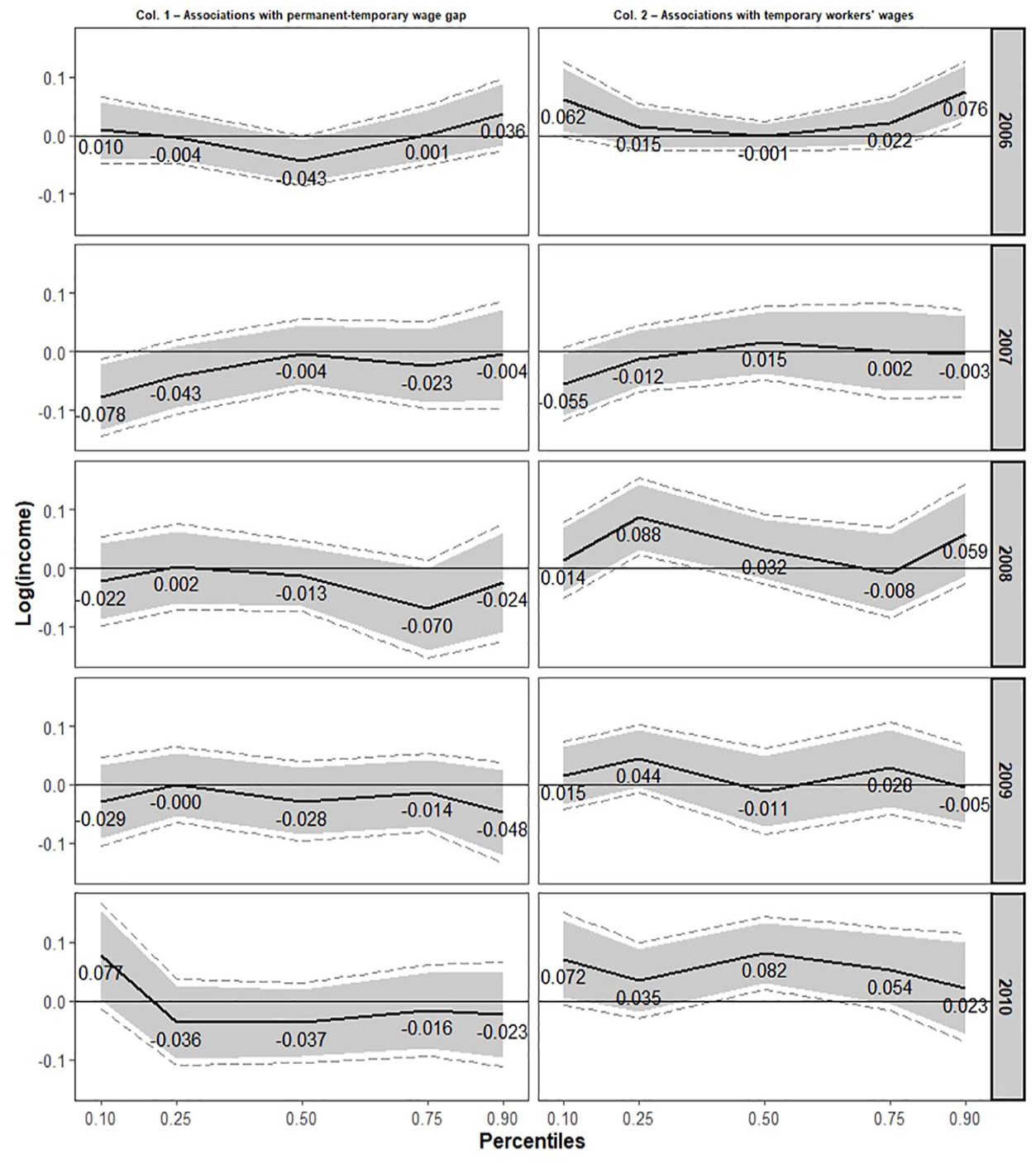
Quantile regression results for the period 2006–2010. Associations between works councils and the permanent–temporary wage gap (Col. 1) and temporary workers’ wages (Col. 2).
The second column of Figure 1 shows the coefficient of the association between works councils and temporary workers’ wages along the wage distribution. Again, most associations are insignificant, indicating that, normally, there is no relationship between works councils and temporary workers’ wages. Still, some positive associations are observed, especially between the bottom and the median of the wage distribution. This occurs in 2006 (B = 0.062), 2008 (B = 0.088) and 2010 (B = 0.072 and B = 0.082), while in 2007 the association at the first decile is significantly negative (B = −0.055).
Overall, the results suggest that works councils and wage inequalities between permanent and temporary workers are not related, thus showing no support for solidarity or dualisation. Therefore, Hypothesis 1a must be rejected. The same applies to Hypothesis 1b. Even though works councils and temporary workers’ wages were positively and significantly associated between the bottom and middle of the wage distribution both before and during the recession period, these results are not consistent enough to confirm the hypothesis. Additional analyses (Figure A in the Online Appendix) including union membership as a control variable leave the results virtually unchanged. While sceptical readers might attribute the lack of significant associations to the overall lack of the effect of works councils on wages, full models show that they are positively and significantly associated with wages (Tables B1.1–B2.5 in the Online Appendix).
Collective agreements
The first column of Figure 2 shows the association between having a collective agreement (covered = 1) and wages conditional on the kind of contract (temporary = 1, permanent = 0) along the wage distribution. In the period 2006–2009, none of the associations are significant and present both positive and negative signs. In 2010, however, the associations are consistently negative and significant along most of the wage distribution, indicating that works councils are related to larger wage differences between permanent and temporary workers. The coefficients range from −0.069 to −0.054 in 2010, showing that works councils are associated with a 5.5–7.1% larger permanent–temporary wage gap.
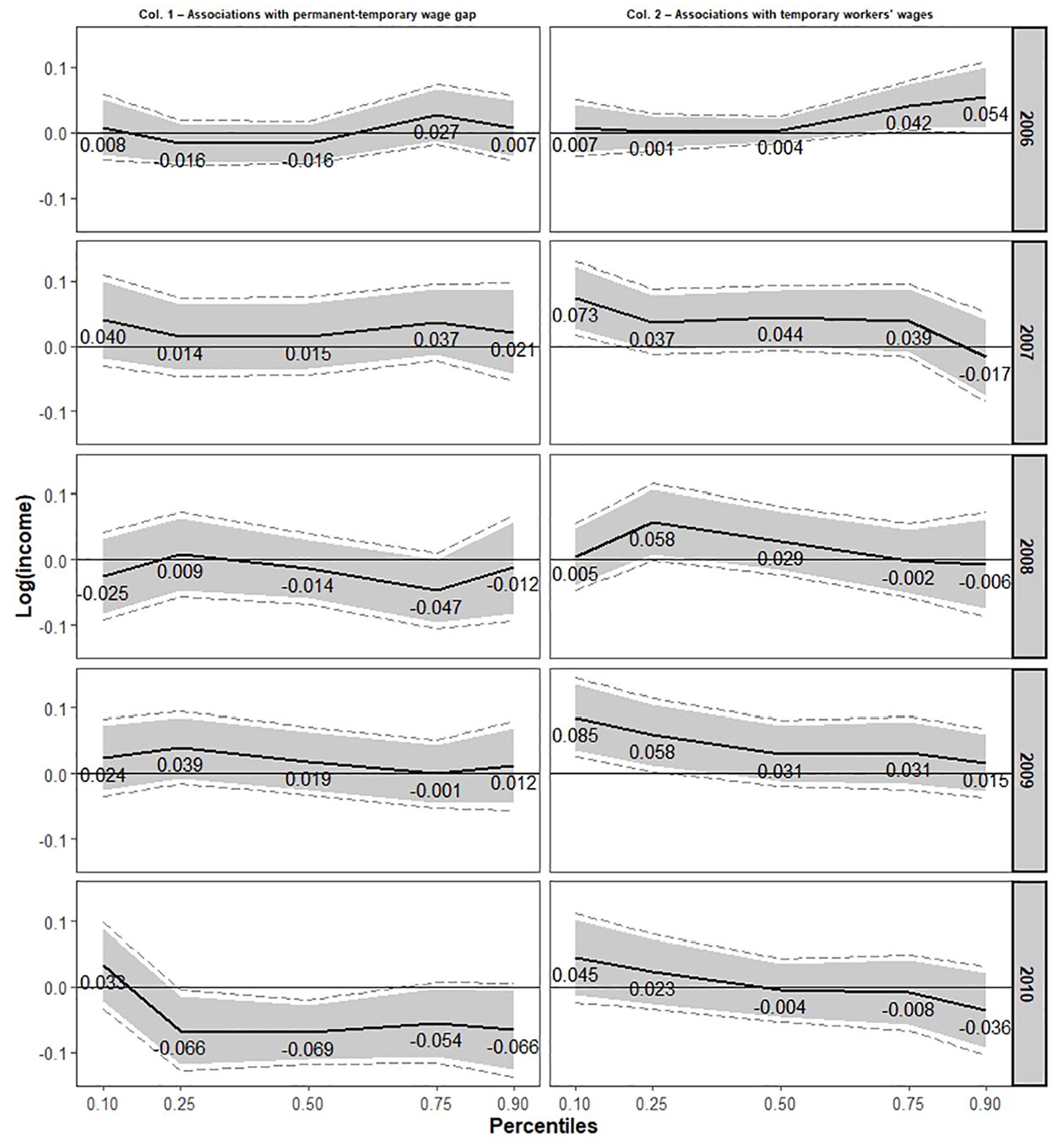
Quantile regression results for the period 2006–2010. Associations between collective agreement and the permanent–temporary wage gap (Col. 1) and temporary workers’ wages (Col. 2).
The second column of Figure 2 shows the association between collective agreements and temporary workers’ wages along the wage distribution. Most associations are not significant and some are positive and significant. For temporary workers, collective agreements are related with higher wages at different points between the bottom and the median in 2007 (B = 0.073; B = 0.044), 2008 (B = 0.058) and in 2009 (B = 0.085; B = 0.058), while in 2006 the associations are positive and significant at the upper end (B = 0.042; B = 0.054). In other words, at these specific points, temporary workers with collective agreements on the left-side of the distribution appear to earn 6–8.8% more than their peers without collective agreements. However, there are no significant associations in 2010.
Finally, Table 1 shows the association of sectoral bargaining coverage with the wages of the uncovered temporary workers. The association is significant for the period of economic growth (B = 0.112) but not for the period of recession (B = 0.062). This suggests that uncovered temporary workers had higher salaries in sectors with higher collective bargaining coverage for the period 2006–2007 but not for 2009–2010.
Results of multilevel models: Association of sectoral collective bargaining coverage with temporary workers’ wages for the period 2006–2010.
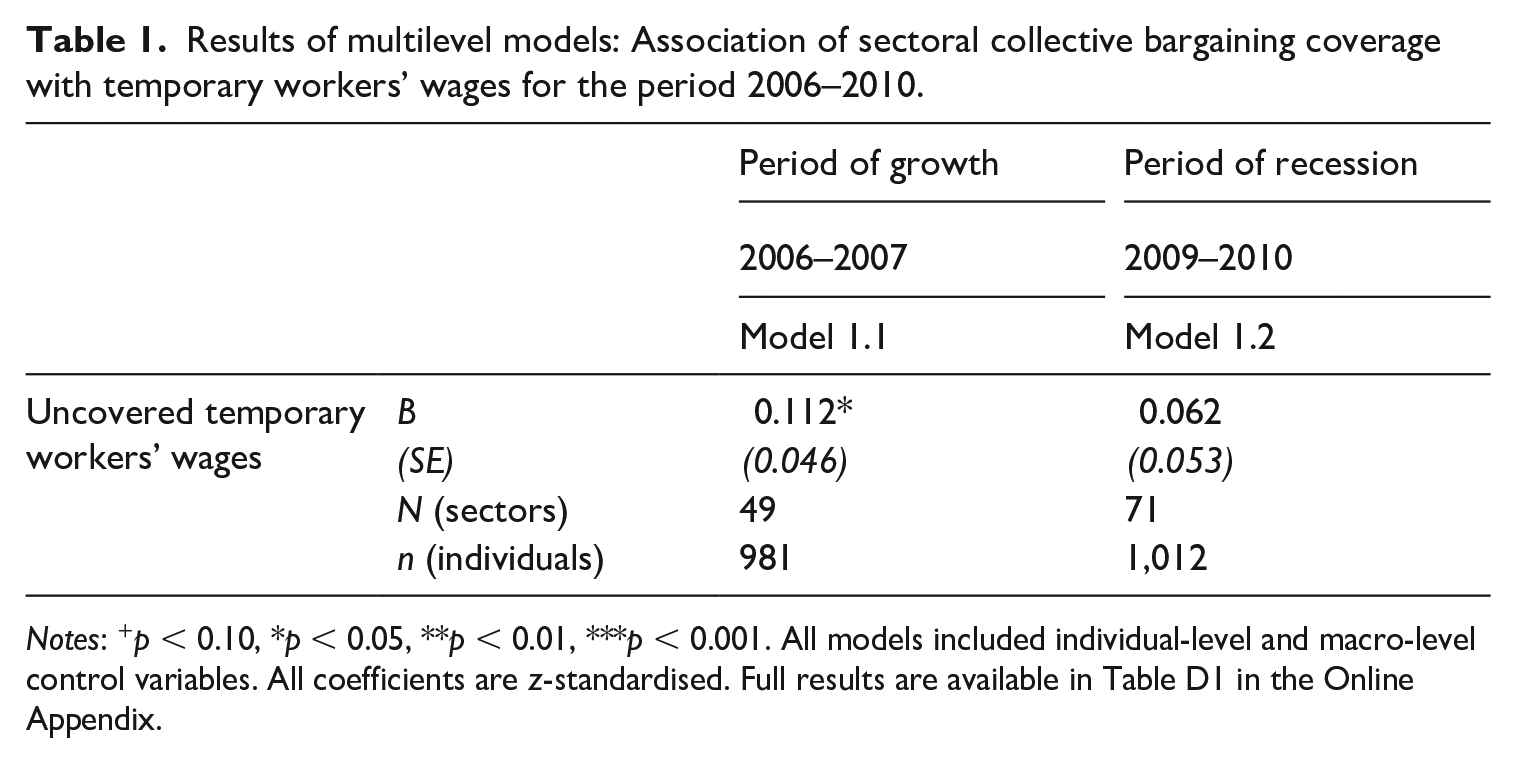
Notes: +p < 0.10, *p < 0.05, **p < 0.01, ***p < 0.001. All models included individual-level and macro-level control variables. All coefficients are z-standardised. Full results are available in Table D1 in the Online Appendix.
Results indicate that Hypothesis 2a must be rejected since collective agreements are not related with smaller permanent–temporary wage gaps. Conversely, collective agreements relate to wider wage gaps in 2010. Hypothesis H2b can be only partially accepted since temporary workers earn higher wages than their uncovered counterparts at different points between the bottom and the median of the distribution, only from 2007 to 2009. None of the previous conclusions is altered when adding individual union membership as a control variable (see Figure B in the Online Appendix). In this case, the insignificant associations in 2008 and 2009 could be attributed to the overall lack of association between collective agreements and wages, whereas in the other periods these associations are significant and positive (see full models in Tables B3.1–B4.5 in the Online Appendix). Hypothesis H2c can be only partially accepted as the uncovered temporary workers had higher wages in sectors with higher collective bargaining coverage, but only during the period of economic growth. Additional analyses, including the sectoral variation in labour demand as a macro control variable, lead to the same conclusion (results in Table E1 in the Online Appendix).
Union density
Table 2 presents the results of the cross-level interaction between the sectoral and regional union density with the kind of contract (temporary = 1, permanent = 0) in 2006 and 2010 using the SES microdata and for the periods 2006–2007 and 2009–2010 using the QoWLS microdata. Results using the SES show that none of the associations is significant, indicating that during both periods the wage gap between permanent and temporary workers was not significantly larger or smaller in sectors with higher union density. Instead, the analyses using the QoWLS show that only in the period of recession was the wage gap wider in sectors with higher union density (B = −0.034). Figures C1.1 and C1.2 in the Online Appendix provide results by occupational groups, showing that in 2006 union density related to significantly smaller wage gaps only among Professionals and intellectuals (second occupational group). The associations with Technicians and associate professionals and Clerks (third and fourth groups) also indicate smaller wage gaps, but they are marginally significant. Results for 2010 show that union density related to wider permanent–temporary wage gaps for Service workers and shop and market sales workers (fifth group), but smaller wage gaps for Technicians and associate professionals and Clerks.
Multilevel model results: Association of cross-level interaction (sectoral union density × temporary contract) with wages for different datasets for the period 2006–2010.
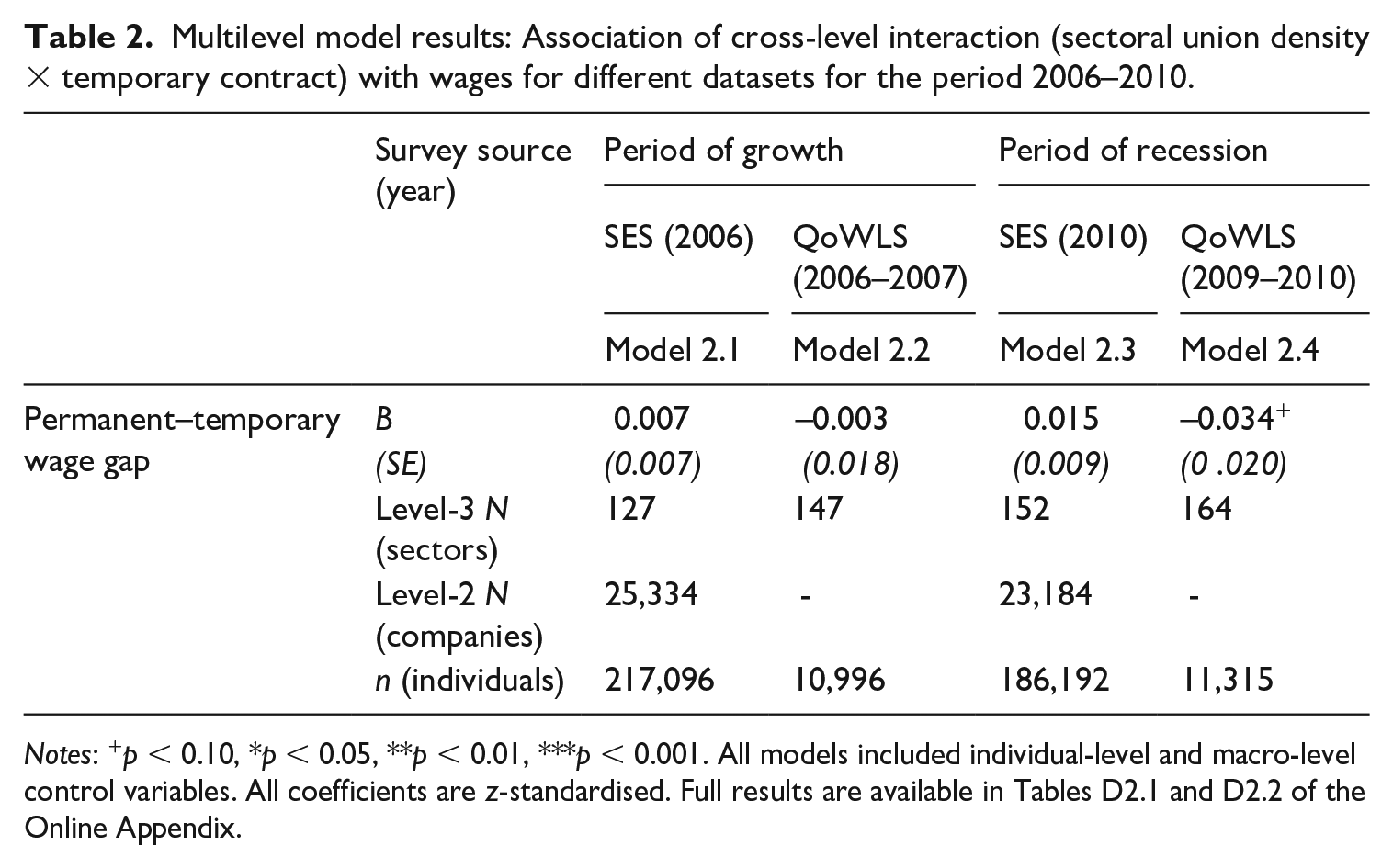
Notes: +p < 0.10, *p < 0.05, **p < 0.01, ***p < 0.001. All models included individual-level and macro-level control variables. All coefficients are z-standardised. Full results are available in Tables D2.1 and D2.2 of the Online Appendix.
The first row of results in Table 3 (models 3.1–3.4) presents the association of union density with temporary workers’ wages using the SES and QoWLS microdata. In both periods (growth and recession) and for both datasets, the associations are positive and significant. They indicate that temporary workers had higher wages in more heavily unionised sectors. Figures C2.1 and C2.2 in the Online Appendix show the same analysis by occupational groups: both in 2006 and in 2010 union density was associated with higher wages for temporary workers for all the occupational categories, except for Professionals and intellectuals in 2010, and Technicians and associate professionals and Service workers and shop and market sales workers in 2006.
Multilevel model results: Association of sectoral union density with temporary workers’ wages, for different datasets and samples for the period 2006–2010.
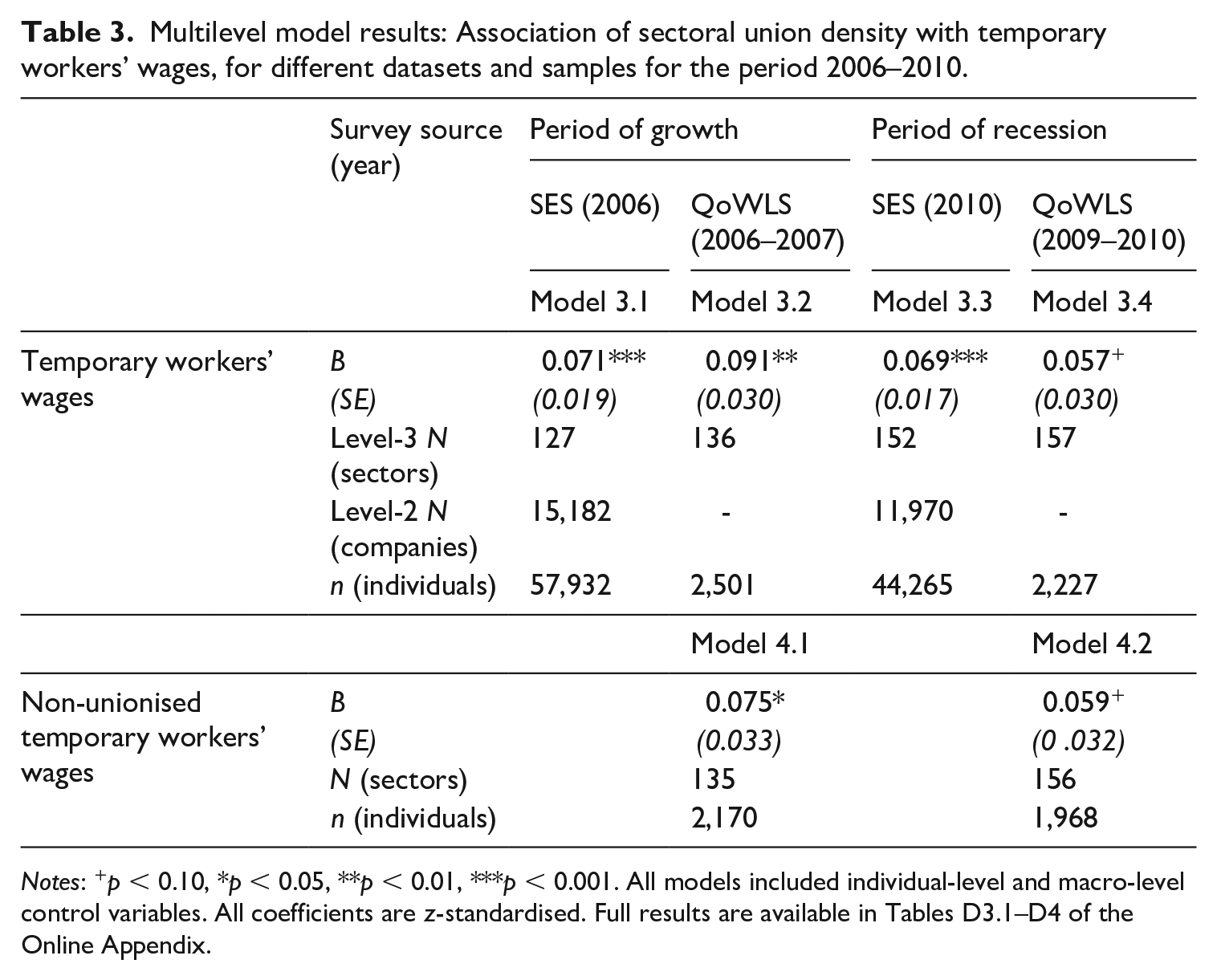
Notes: +p < 0.10, *p < 0.05, **p < 0.01, ***p < 0.001. All models included individual-level and macro-level control variables. All coefficients are z-standardised. Full results are available in Tables D3.1–D4 of the Online Appendix.
The lower panel of Table 3 (models 4.1 and 4.2) shows the association of union density with non-unionised temporary workers’ wages. The associations are positive and significant – only at 10% for the period of recession – suggesting that non-unionised temporary workers had higher wages in sectors with greater union density.
These results lead to reject Hypothesis 3a, since the wage gap is not smaller in sectors with higher union density, and in one year it is larger. Hypothesis 3b is accepted instead, as union density is associated with higher wages for temporary workers. Finally, Hypothesis 3c is rejected. Contrary to what was hypothesised, non-unionised temporary workers had higher wages in sectors with higher union density. Additional analyses including the sectoral variation in labour demand as a macro-level control variable did not alter the main conclusions (results in Tables E2 and E3 in the Online Appendix).
Conclusion
This article analyses the consequences that labour unions might have for temporary workers’ wages in Spain; one of the most notable cases of labour market dualisation. For this purpose, it explores the association of labour unions with the wage gap between permanent and temporary workers and with temporary workers’ wages. More specifically, it examines three institutions: works councils, collective agreements and union density. The analyses are performed for a period of economic growth (2006–2007) and a period of economic crisis (2008–2010).
Overall, works councils are not related with wage inequalities between permanent and temporary workers or temporary workers’ wages. Similarly, collective agreements are not associated with smaller wage gaps – in one year (in 2010) they are associated with wider wage differences – and temporary workers with collective agreements tend to have the same or higher wages. Sectoral collective bargaining coverage, in contrast to Fitzenberger et al.’s (2013) findings for Germany, is positively related with the wages of uncovered temporary workers, but only during the period of economic growth. As regards union density, the results consistently show that it is not related with smaller wage gaps. An association with a larger wage gap was observed in the period of recession in only one of the two datasets analysed. Union density is also positively related with temporary workers’ wages, also among the non-unionised ones, contrary to what Benassi and Vlandas (2022) observed for Germany.
In summary, after adjusting for confounders, the results indicate that labour unions in Spain are not associated with smaller wage differences between permanent and temporary workers and, on a few occasions, they are even associated with increased wage gaps. These larger income differences are partly in line with the dualisation theory and speak against the equalising effects of unions: unions are not associated with smaller wage differences and in some cases are associated with larger differences. Conversely, the dualisation framework seems to inadequately describe the consequences of unions for temporary workers’ wages in Spain. Its claim that unions benefit permanent workers at the expense of temporary ones is not supported by the findings of this article. Evidence does not indicate that unions have negative effects on temporary workers’ wages; instead, associations are found to be insignificant or positive. All in all, the reason why wage inequalities between permanent and temporary workers are sometimes larger in the presence of unions could be that the positive influence of unions is often stronger for permanent than for temporary workers. Hence, the apparent consequences of labour unions for temporary workers’ wages in Spain are more aligned with the recent findings in industrial relations: unions have overall positive but still limited consequences for outsiders (Carver and Doellgast, 2021). These conclusions – except for some differences observed in the analysis of collective agreements – are valid both in the periods of economic growth and recession. In other words, the findings suggest that unions did not follow more dualising strategies when resources became scarcer.
Our results attempt to contribute to the theoretical and empirical literature addressing the consequences of labour unions for temporary workers’ job quality. Due to the changes in the Spanish labour market during the years of the Great Recession it is risky to extrapolate our results beyond the period of analyses. In addition to the economic downturn, in 2010, and especially in 2012, two major labour reforms altered the industrial relations system in Spain and notably weakened the bargaining power of unions. In practice, these reforms put an end to the priority of multi-employer agreements over the company-level ones and they supressed the automatic extension of collective agreements (see Fernández Rodríguez et al., 2016; Meardi, 2012). However, these reforms were mostly reversed in December 2021, leading to a regulatory framework that resembles the one of the period analysed in this article. For this reason, further analyses are needed to shed light on how the erosion and recovery of unions’ bargaining power affected temporary workers’ wages and the permanent–temporary wage gap.
Whereas using different datasets and studying different institutions helped to improve the robustness of the findings, this article has several limitations. First, due to the use of cross-sectional data, the analyses do not allow the identification of causal relationships between institutions and wages. Even though identifying causality was not the aim of this article, the associations found here might result from unobserved confounders. Those companies that have works councils or collective agreements might be simply different from those that do not have them. Similarly, those sectors with greater union density and collective bargaining coverage could also differ in multiple aspects from other sectors where unions are weaker. Therefore, some of the associations that we observed might be driven by differences in terms of productivity, the characteristics of the workforce or even by different managerial practices across sectors and companies (e.g. Acemoglu et al., 2022; Litwin and Shay, 2022), rather than by industrial relations institutions. The risk of reversed causality also exists, but it is less likely to significantly alter the main conclusions of the article. Low wages might trigger unionisation, the formation of works councils and collective agreements. Therefore, if these effects were accounted for, the positive association between unions and temporary workers’ wages could only be strengthened. However, it is less clear how reversed causality would affect the results for the wage gap. Third, two of our independent variables – works council and collective agreement – presented between one-fifth and one-third of missing cases, especially among workers with lower education and less skilled occupations. Hence, some of our analytical samples were not fully representative of the Spanish workforce, namely, the low-skilled workers. Third, industrial relations institutions are complex to operationalise and relevant aspects, such as the coordination level, have not been included in the analyses. Finally, this study assesses the validity of the dualisation framework to explain wage inequalities between permanent and temporary workers, although the main debate speaks about inequalities in employment protection and job security. Future analyses would then make a relevant contribution by exploring whether labour unions affect temporary workers’ transitions towards permanent positions, especially during the recession. For instance, when the crisis began and companies carried out massive layoffs, unions reached agreements that guaranteed jobs at the expense of wages. However, it is unknown if unions also protected the positions of the temporary workers or only those of the insiders.
Supplemental Material
sj-pdf-1-eid-10.1177_0143831X231204449 – Supplemental material for Unions and temporary workers’ wages in Spain: Testing solidarity in the good times and in the bad times
Supplemental material, sj-pdf-1-eid-10.1177_0143831X231204449 for Unions and temporary workers’ wages in Spain: Testing solidarity in the good times and in the bad times by Leandro Iván Canzio in Economic and Industrial Democracy
Supplemental Material
sj-pdf-2-eid-10.1177_0143831X231204449 – Supplemental material for Unions and temporary workers’ wages in Spain: Testing solidarity in the good times and in the bad times
Supplemental material, sj-pdf-2-eid-10.1177_0143831X231204449 for Unions and temporary workers’ wages in Spain: Testing solidarity in the good times and in the bad times by Leandro Iván Canzio in Economic and Industrial Democracy
Footnotes
Acknowledgements
The author would like to thank Felix Bühlmann, Kevin Emery, Michael Grätz, Jan Paul Heisig, Jad Moawad, Daniel Oesch, Luís Ortiz Gervasi and María del Mar Rico Valera for their useful suggestions and feedback, as well as the participants of RC28, SASE and IREC conferences in 2022 for their comments. The author is grateful to the Swiss National Science Foundation for its financial assistance.
Funding
The author disclosed receipt of the following financial support for the research, authorship, and/or publication of this article: This publication benefited from the support of the Swiss National Centre of Competence in Research LIVES – Overcoming vulnerability: Life course perspectives (NCCR LIVES), which is financed by the Swiss National Science Foundation (grant number: 51NF40-185901).

Supplemental material
Supplemental material for this article is available online.
Notes
Author biography
References
Supplementary Material
Please find the following supplemental material available below.
For Open Access articles published under a Creative Commons License, all supplemental material carries the same license as the article it is associated with.
For non-Open Access articles published, all supplemental material carries a non-exclusive license, and permission requests for re-use of supplemental material or any part of supplemental material shall be sent directly to the copyright owner as specified in the copyright notice associated with the article.
