



Abstract
This study compares the labour market trajectories of the temporary employed in Norway with those in Sweden. Sweden’s employment protection legislation gap between the strict protection of permanent employment and the loose regulation of temporary employment has widened in recent decades, while Norway has maintained balanced and strict regulation of both employment types. The study asserts that the two countries differ concerning the distribution of trajectories, leading to permanent employment and trajectories that do not create firmer labour market attachment. Using sequence analysis to analyse two-year panels of the labour force survey for 1997–2011, several different trajectories are discerned in the two countries. The bridge trajectories dominate in Norway, while dead-end trajectories are more common in Sweden. Moreover, the bridge trajectories are selected to stronger categories (mid-aged and higher educated) in Sweden than in Norway. The results are discussed from the perspective of labour market dualisation.
Keywords
Introduction
Temporary employment has grown in several European countries in recent decades (Barbieri, 2009; OECD, 2013). A temporary position can imply high job insecurity for an individual but also a first step towards firmer labour market attachment from a marginalised position outside employment. Previous research has stressed that temporary employment functions either as a bridge to permanent employment or as a dead end, leading to a series of insecure, short-term jobs with high unemployment risks (Barbieri and Scherer, 2009; Gash, 2008). The question of which function prevails relates to employers’ purpose in using temporary employment contracts – for example, as a screening device or to increase numerical flexibility (Atkinson, 1984; Berglund et al., 2017) – and individual factors of the temporarily employed, such as education and age (see, for instance, Dieckhoff and Steiber, 2012; Gebel and Giesecke, 2011; Noelke, 2016). Moreover, the features of the employment protection legislation (EPL) may affect which function prevails. In particular, if regulations of open-ended contracts are strict, while the regulations of temporary contracts are lax, a so-called EPL gap may appear (Barbieri and Cutuli, 2016), causing labour market risks to become dualised and the precariousness of the temporary employed to increase (Gebel and Giesecke, 2016).
Few studies have considered the complexity of how temporary employment integrates into individuals’ labour market careers. Using sequence analysis, Fuller and Stecy-Hildebrandt (2015), McVicar et al. (2019) and Ojala et al. (2017) studied the labour market trajectories of temporary employees in Canada, Australia and Finland, respectively, finding that some trajectories clearly work as bridges, while others are much more insecure. Ojala et al. (2017) discerned six trajectories involving temporary employment. The most frequent were those serving as bridges but some dead-end trajectories led out of the labour market altogether. Fuller and Stecy-Hildebrandt (2015: 91) and McVicar et al. (2019) found pathways that did not fit classifications in previous theoretical frameworks, such as trajectories showing signs of dead ends that end up in permanent jobs, highlighting the diversity of temporary employees’ labour market careers. It is difficult to generalise these findings to other labour market contexts. In particular, temporary employees in inclusive employment regimes (Gallie, 2007), such as Norway or Sweden, may follow different trajectories than liberally regulated countries like Canada and Australia.
This article focuses on 1997–2011 and uses longitudinal data to quantify the incident of bridge and dead-end trajectories, comparing two-year-long labour market trajectories involving temporary employment in Norway and Sweden. These Nordic countries have similar cultures, encompassing welfare states and strong social protection, and strict regulations of permanent employees. However, while the temporary employed are strictly regulated in Norway, Sweden has deregulated the use of temporary contracts (Emmenegger, 2014; Svalund and Berglund, 2018). Hence, this article asks whether such regulatory differences lead to similarities and differences in the labour market trajectories of temporary employees, and whether these trajectories resemble bridges, dead ends, or other pathways. Thus, this study shows the possible consequences when highly regulated labour markets turn towards dualisation by protecting certain categories of workers while reducing the protection of others; that is, risking the creation of an insider/outsider divide (Emmenegger et al., 2012; Lindbeck and Snower, 1988).
Second, few studies have addressed the individual characteristics of people following different labour market trajectories, including spells of temporary employment. In Canada, Fuller and Stecy-Hildebrandt (2015: 92–93) found that temporarily employed youth and those in job contexts conducive to skill development more often moved into permanent work, while elderly people tended to experience temporary jobs as dead ends. However, regulatory differences concerning temporary employment may be more or less favourable for categories with a usually weaker labour market attachment. Thus, this study estimates how individual characteristics such as age, educational level and country of origin influence whether individuals follow bridge or dead-end trajectories in these two Nordic labour markets.
Both Fuller and Stecy-Hildebrandt (2015) and Ojala et al. (2017) studied the trajectories of initially temporarily employed people to discern sequences, without taking into account previous labour market status. McVicar et al. (2019: 108–111) included the possibility of the latter forms of trajectories, finding a larger variety, such as individuals moving from permanent to a short period of temporary employment and back into permanent employment again. The current study provides additional knowledge of how previous labour market statuses influence temporary employees’ future labour market trajectories.
Following an overview of the employment protection regulation and labour markets in the two countries, theoretical considerations are outlined, along with a discussion of the differences in expected outcomes. Thereafter, data and methods are presented, particularly the application of sequence analysis, followed by the results and a discussion of the main findings.
Regulatory and labour market differences between Norway and Sweden
According to the OECD EPL index (ranging from 0 to 6, indicating increasing strictness), Norway and Sweden do not differ greatly regarding the protection of permanent employees. Between 1997 and 2011, the regulation in Norway was stable at 2.38, and in Sweden it decreased from 2.64 to 2.58 in 2002. 1 These countries have much stricter protection of permanent contracts than liberal employment regimes such as Australia, Canada and the UK. Concerning temporary contracts, however, the difference between Norway and Sweden is much larger. In Norway, the regulation was 3.19 in 1992, became slightly less strict from 2001 to 2005 (2.75) and then rose to 3.0 for the rest of the period. During the same period, the regulation of temporary contracts in Sweden became less strict, with the level of regulation dropping from 2.77 in 1992 to 1.44 by 1997 and 0.81 by 2008.
In 2008, employers in Sweden no longer needed to specify a particular reason for using so-called general fixed-term contracts, while they had previously been limited to a maximum of five such contracts. Besides these types, temporary contracts can also be used for fill-ins, trainees, seasonal workers and for workers aged 67 or older. Until 2015 in Norway, temporary contracts could only be used for a temporary replacement or when ‘warranted by the nature of the work and the work differs from that which is ordinarily performed in the undertaking’; or for trainees, people in labour market schemes and people holding certain types of jobs within organised sports (The Working Environment Act § 14.9-2).
Regulations of temporary contracts usually limit how long an employee can hold a temporary job. Until 2007 in Sweden, a person employed as a substitute for three years in a five-year period at the same employer had the right to an open-ended contract. Between 2007 and 2016, an employee on a general fixed-term contract or working as a substitute had the right to a permanent contract if they worked for more than two years during a five-year period. However, employers could avoid this rule by ‘stacking’, which involved changing the type of contract, for example from substitute to general fixed-term, just before the two-year period finished and thereby extend the length of time in temporary positions.
Until 2015 in Norway, a person must hold the same temporary position, or perform the same tasks for a maximum of four years, before being considered permanently employed. Unlike Sweden, Norway’s regulation does not allow general fixed-term contracts or justification of the use of temporary contracts for people of older age, and the temporary contracts must be shorter than in Sweden.
Comparing the share of temporary employees during 1997–2011, the mean share was 9.2% in Norway, with little variation across years, compared to 15.2% in Sweden, ranging from 11.9% in 1997 to 17.2% in 2007 (Eurostat, 2021b).
Differences in employment and unemployment can also influence the labour market careers of temporary employees. The mean unemployment rate during the above-mentioned period was 3.6% in Norway and 7.2% in Sweden, and both countries had high employment rates (76.5% in Norway and 72.3% in Sweden) (Eurostat, 2021a, 2021c).
Labour market models with strong demand and high employment rates have limited room for segmentation (DiPrete et al., 2001). However, the combined effects of the differences between Norway and Sweden in unemployment and employment rates, regulations of temporary employment and the shares in these types of contracts, indicate that segmentation risks may differ between the two countries.
Theoretical considerations
The labour market trajectories of temporary employees are mainly a result of micro-level strategies – employers trying to optimise their use of manpower, and employees trying to find and keep employment and improve their long-term careers. Macro-level institutions (especially the EPL) influence the incentive structure of employers’ hiring and firing decisions and employees’ career decisions (Polavieja, 2003). Moreover, strict dismissal regulations for permanent workers increase incentives for employers to use temporary contracts, whereas regulations for temporary contracts can inhibit their use. The net effect of EPL depends on the regulations for both contract forms (Blanchard and Landier, 2002; Gebel and Giesecke, 2016).
Temporary contracts help employers adjust manpower to meet demand fluctuations or for time-limited tasks (Atkinson, 1984), which creates numerical flexibility for organisations and is most common in positions requiring limited training and low turnover costs (Goldthorpe, 2000). Hence, individuals signalling low human capital, such as those who are less educated, young or of foreign background, are more likely to be found in these jobs (Svalund and Berglund, 2018). Moreover, when strong protection of permanent employment is combined with lax regulation of temporary employment (an EPL gap), employers can decrease turnover costs by replacing permanent employees with temporary ones (Olsen and Kalleberg, 2004; Polavieja, 2003).
An EPL gap can produce company and labour market segmentation between insiders (permanent employees with secure jobs) and outsiders (temporary employees with periods of unemployment), in which the latter group functions as a buffer and securing the jobs of core workers (Olsen and Kalleberg, 2004; Polavieja, 2003). Outsiders have a strong incentive to become insiders, which may mean they are more willing to stay in temporary positions for the chance of earning a permanent contract. Remaining in outsider positions for an extended period may have detrimental effects, as short job durations or spells of unemployment signal low skills or productivity (Barbieri and Scherer, 2009; Korpi and Levin, 2001).
Employers also use temporary contracts to screen less measurable characteristics of potential employees, particularly in countries with strong protection of permanent employees (Berglund et al., 2017; Giesecke and Groß, 2003: 162). Generally, if an employer uses temporary employment as a screening device, rather than as a buffer, the chances of reaching an open-ended contract increase (Berglund et al., 2017; Fuller and Stecy-Hildebrandt, 2015). Higher educated and applicants to higher positions in the organisation are more likely to be subjected to screening when temporarily employed (Kiersztyn, 2016).
Transitions into and out from temporary contracts also can be voluntary; for example, as a supplementary source of income for a young person whose main activity is education (Nergaard, 2016). Temporary contracts can also form a trial-and-error process in finding fitting employment after finishing school, and provide valuable networks and access to unlisted jobs (Granovetter, 1995; McVicar et al., 2016).
Expected outcomes
This section formulates some expected outcomes of the sequence analysis.
First, the most common trajectories will be either bridges or dead-end trajectories, due to employers’ rationales for using temporary contracts either as screening devices or to achieve a numerical flexibility/buffer. However, the latter may be more common in Sweden than in Norway, as the large EPL gap in Sweden makes it possible to use temporary employees on a grand scale, increasing the risk of dead-end trajectories. Norway’s severe regulation of temporary contracts should restrict this strategy; instead, temporary contracts as a screening device may be more functional for employers, making bridge trajectories more typical. These expectations are further strengthened by Norway’s labour market, which was generally better than Sweden’s during the study period.
Second, youth should be more likely to enter bridge trajectories, as employers have an interest in screening the productivity of new labour market entrants with less work experience. Furthermore, those with a higher educational level are expected to have a higher probability of bridging trajectories, while dead-end trajectories are more likely for individuals with low educational levels. Expectations concerning foreign-born individuals are more uncertain. Screening to measure newcomers’ productivity may increase chances for bridge trajectories. However, other processes, such as discrimination, may lead these categories into dead-end trajectories.
Third, relating these considerations to the institutional differences between Norway and Sweden, different selection processes of social categories may apply as a consequence of temporary employment mainly being used for screening purposes or to achieve flexibility. If bridge trajectories are more common in Norway than in Sweden, due to the institutional setting and labour market conditions, the process of selecting stronger social categories (such as higher educated) into these trajectories may be relatively less pronounced in Norway than in Sweden. On the other hand, if dead-end trajectories are more common in Sweden than in Norway, the selection process of weaker social categories (such as lower educated) into such trajectories may be stronger in Norway than in Sweden. Thus, Norwegian employers use temporary employment for categories they find less employable on a permanent basis but have a need for during temporary production tops, while the Swedish EPL enables employers to use temporary employment as a normal practice for achieving flexibility.
This reasoning, however, only applies in a relative sense when comparing the two countries. In absolute terms, the risk of following dead-end trajectories should be higher in Sweden for both weaker and stronger social categories, while in Norway the same applies for bridge categories.
Data and methods
This study used sequence analysis to analyse episodes related to prior and later temporary employment events. This approach is widely used in studies of employment careers, female employment and school-to-work transitions (Blair-Loy, 1999; Brzinsky-Fay, 2007; Davia and Legazpe, 2014; McVicar and Anyadike-Danes, 2002; Zagel, 2014), but is rarely applied in studies of temporary employment (Fuller and Stecy-Hildebrandt, 2015; McVicar et al., 2019; Ojala et al., 2017).
The present study was based on quarterly measured, two-year-long panels of the national Labour Force Survey (LFS), which meant individuals could be followed for eight subsequent quarters with detailed data on labour market status of the adult population. Data were linked to register-based information (FD-Trygd register in Norway and the Longitudinal Integration Database for Health Insurance and Labour Market Studies [LISA] in Sweden) on educational background and receipt of social assistance two years prior to entering the LFS.
The LFS identifies self-employed, temporary and permanent employees, unemployed and those not in the labour force (NiLF). Only individuals in temporary employment at least once during the observation period of eight quarters are included. A quarter-by-quarter trajectory through the five mutually exclusive states above was constructed for each respondent.
Sequence analysis made it possible to capture the heterogeneity of trajectories of the temporary employed, while constituting relatively short-term episodes leading into, or out from, a firmer labour market attachment. Therefore, the distinct trajectories extracted could be different parts of the same identical trajectory, which moves over several years. This limitation should be noted when interpreting the findings. Restricting data to only include ‘labour market entries’ (for example, by only including temporary employees in Quarters 1 or 2 who recently finished their education) left little data for analysis. However, the size differences between trajectories with similar beginnings or endings, as well as differences in typical characteristics of individuals following these trajectories, indicate that the sequences found are not episodes of a single trajectory.
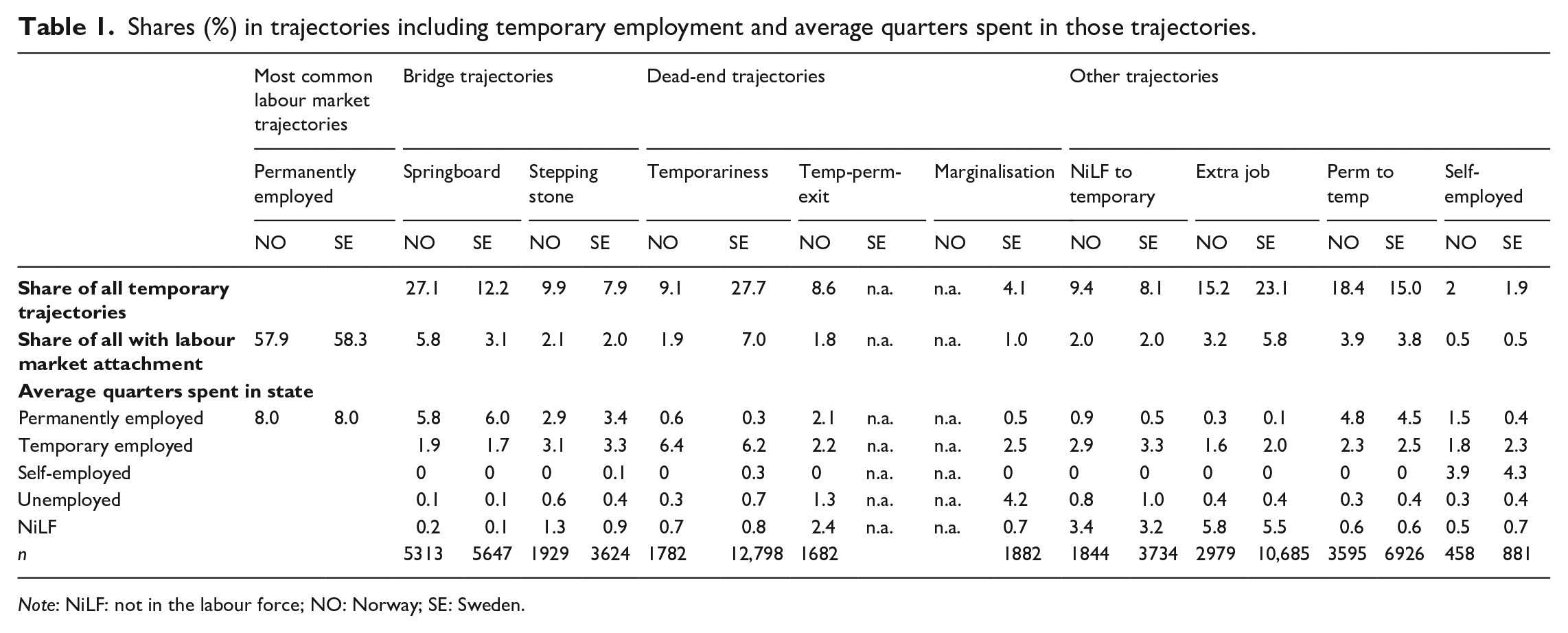
Most respondents (58% in both countries) with a labour market attachment in the two-year period (employed or unemployed) were permanently employed for all eight quarters (Table 1) and used for comparisons with the outcomes of the sequence analyses.
Shares (%) in trajectories including temporary employment and average quarters spent in those trajectories.
Note: NiLF: not in the labour force; NO: Norway; SE: Sweden.
The LFS data for each of the countries during the period 1997 to 2011 were pooled: 19,588 individuals in Norway and 46,177 in Sweden. Missing quarterly information was imputed in cases where the status before and after the missing observation was the same (such as temporarily employed both the quarter before and after the missing observation). Using this method, 7.5% (1476) of respondents in Norway and 7.9% (3640) in Sweden were recovered. The remaining observations with missing information were excluded from the sample. The age range varies over time in Sweden, as the target population of LFS changed from only including those aged 16–64 years before 2005 to those aged 15–74 years since 2005. However, we decided not to correct for this heterogeneity by restricting the samples to only 16–64 years for the whole period, as it would have meant discarding observations, especially in Norway.
A typology of individual employment trajectories was developed using sequence analysis with dynamic Hamming (DH), which preserves the timing of sequences and transforms them by substituting one sequence for another until they are similar (Lesnard, 2010). DH generates a distance matrix of dissimilarities by calculating substitution costs, which are low for common transitions and higher for less common transitions. The DH distances were calculated using the R package TraMineR (Gabadinho et al., 2011). To cross-validate the results, the sequence analysis was also run with Optimal Matching, showing similar results.
Hierarchical Cluster Analysis with Ward’s distance was then used to group employment trajectories with short internal distances. The algorithm initially assumed each separate sequence was its own group and then merged the two most similar sequences into one group. This process continued until a limited number of clusters remained. The number of clusters used in the subsequent sequence analysis was then chosen.
In selecting the number of clusters, the theoretical and empirical meaningfulness of the typology was considered, as the groups should follow identifiable and understandable career patterns. Using this process, 7–10 different clusters in each country were examined. Eventually, eight clusters in both countries were selected. Choosing fewer groups would have meant grouping dissimilar trajectories together, as the self-employment trajectories were mixed with less meaningful trajectories. Choosing a higher number of groups divided the sequences in ways that made them less understandable.
The same analysis was conducted on non-imputed data. In Sweden, the smallest clusters (‘marginalisation’ and ‘self-employment’) did not emerge as distinct sequences in the non-imputed data. In Norway, analysis on non-imputed data gave eight sequences similar to those used here. However, the share of respondents with temporary employment was reduced in certain sequences, probably due to greater non-response in this group. Thus, imputation captured a more complete picture of trajectories involving temporary employment.
First, descriptive analyses of the clusters of trajectories were conducted, also including comparisons with permanent employees for all eight quarters. Then, multinomial logistic regression analysis was conducted with the typology of temporary employment trajectories as outcome variables, with those temporarily employed for all eight quarters as the reference (0) category. Independent variables included in the regression were age at t (first quarter), gender and country of origin, as well as education at t (primary, secondary, and low and high tertiary). Social assistance two years before entering the LFS was controlled as an indicator of previous marginalisation. The regression analyses were performed separately by country because national data laws prohibit pooling the data used.
Results
Figure 1 shows the chronogram of the sequence analysis, representing the main trajectory clusters in Norway and Sweden. Seven clusters were similar between the countries, while one cluster in each country was unique. Table 1 provides additional descriptive statistics about the trajectories.
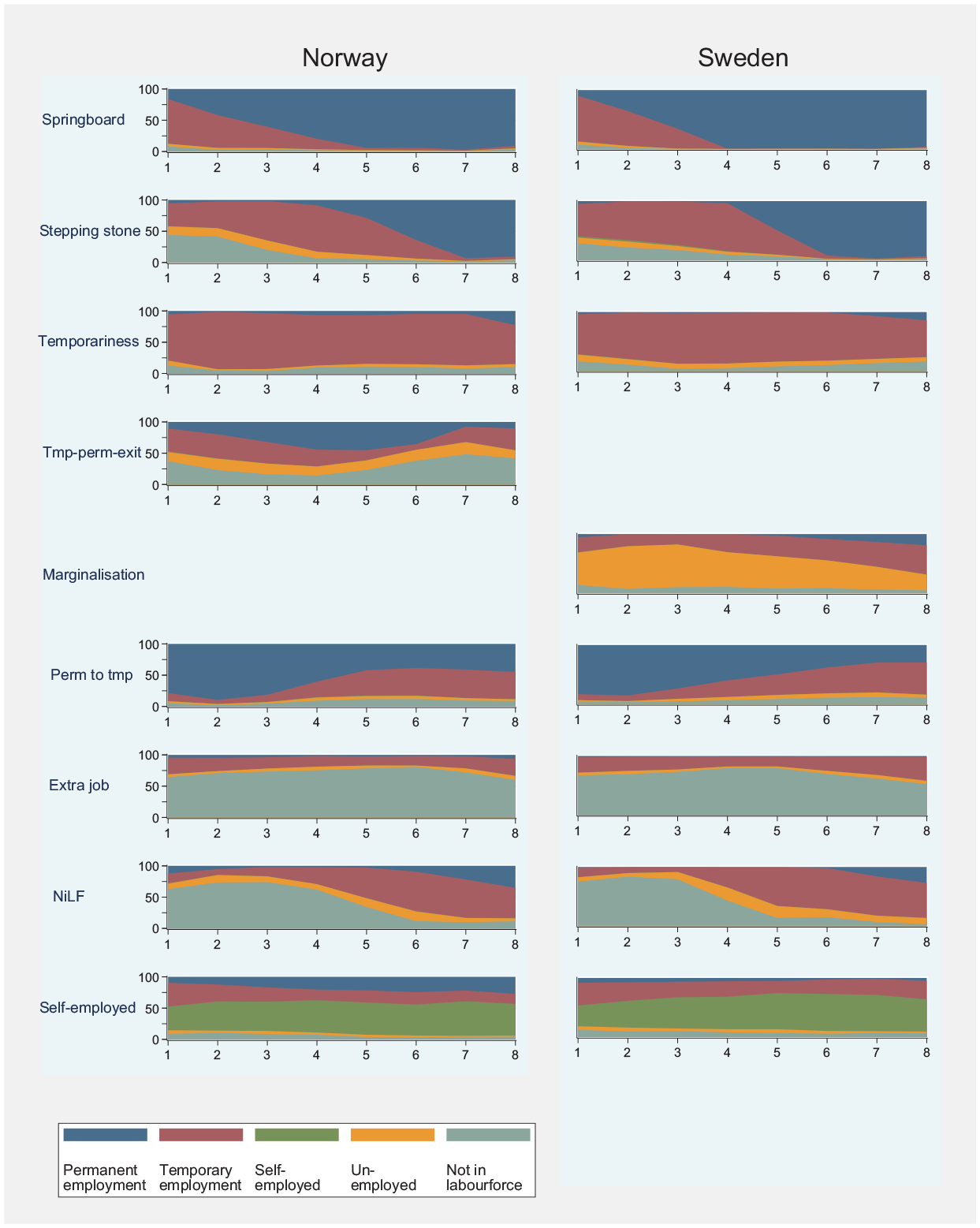
Chronograms of eight quarters of employment trajectories: Norway and Sweden 1997–2011.
According to theory, bridge and dead-end trajectories should be the dominant sequences of the temporary employed. The analysis clearly extracted two trajectories – the springboard and stepping-stone trajectories – that can be understood as bridges into permanent employment. While 37% of the sample followed these trajectories in Norway, only 20% did so in Sweden. The springboard trajectory, representing workers who move from temporary employment into relatively long-term permanent work, was the most common pattern in Norway (27%), compared to 12% in Sweden. Table 1 also shows the average number of quarters that individuals are in different states in the trajectory; in Norway they were temporarily employed for 1.9 quarters (1.7 in Sweden) and permanently employed for 5.8 quarters (6.0 in Sweden). The stepping-stone trajectory also functions as a bridge into a firmer labour market attachment. It was the sixth-largest trajectory in Sweden (8%) and the fourth-largest in Norway (10%).
The trajectories of temporariness, temporary-permanent-exit and marginalisation are all classified as dead ends. The temporary-permanent-exit trajectory was only found in Norway, while the marginalisation trajectory was exclusive to Sweden. As expected, the share of individuals in dead-end trajectories was much larger in Sweden (32%) than in Norway (18%).
While temporariness was the most common trajectory in Sweden (28% of the sample), it was only the fifth most common in Norway (9%). In this trajectory, workers mostly remained in temporary employment and never left within the two-year period (see Table 1). The Norwegian trajectory temporary-permanent-exit (9%) was characterised by transitions from temporary employment and out of the labour force, or from temporary to permanent employment and then out of the labour force. The marginalisation trajectory in Sweden (4%) comprised workers who were mostly unemployed but occasionally held a temporary job.
Finally, four trajectories were hard to classify as bridges or as dead ends within a two-year period (Table 1). Approximately 33% of individuals belonged to these trajectories in Norway, compared to 48% in Sweden. The permanent-to-temporary trajectory, which was the second-largest trajectory in Norway (18%) and third-largest in Sweden (15%), consisted of a relatively high share of youth and people with low educational level in Norway, while Sweden had a relatively high share of individuals in older age groups, and fewer with the lowest educational level (online appendix, Table 1). The young people in this group may have qualified for more attractive but temporary jobs within the two-year period, or perhaps many of these individuals moved from permanent jobs they lost (downsizing), or which were deemed unattractive (bad jobs), to better but temporary jobs. Unfortunately, the data at hand could not decide this issue. The extra-job trajectory was large in both countries (Table 1), consisting of individuals moving back and forth between being outside the labour market (5.5 and 5.8 quarters in Sweden and Norway, respectively) and temporary employment (2.0 and 1.6 quarters, respectively). There were mostly young people in this trajectory, possibly combining education and work (online appendix, Table 1). The NiLF-to-temporary trajectory was clearly a bridge into the labour market but it could not be determined within this two-year period whether it functioned as a bridge into a firm labour market attachment or a step towards a dead end. The trajectory was the fifth-largest in both Sweden (8%) and Norway (9%). In the self-employment trajectory, workers combined self-employment and temporary jobs. Only 2% in each country were in this cluster.
Table 1 also includes each trajectory’s share of all individuals who had at least one quarter in the labour force within the two-year panel period. In Norway, 7.9% were in a bridge trajectory, compared with 5.1% in Sweden, while the corresponding figures in a dead-end trajectory were 3.7% and 8.0%, respectively. The share with permanent employment in all eight quarters was similar in Norway and Sweden during the period under study. However, while the quarterly average in temporary employment was lower in Norway (9.8%) than in Sweden (15.5%), the share with temporary employment in at least one of the quarters did not differ greatly between the countries (Norway 21.2%, Sweden 25.2%). This finding suggests that temporary employment constituted a frequent but short-term status in the Norwegian labour market that may have been used in transitions between jobs.
Table 2 shows the predicted probabilities (at means) of the independent variables found in the outcome trajectories and derived from a multinomial logistic regression (online appendix, Tables 2a and 2b). The probabilities for each row (and in each country) add up to 1 (100%), so we can estimate the relative predicted distribution of the categories between trajectories. Because of the estimated relative size of each trajectory (see Table 1), the probability of being in the most prevalent trajectory, for example, will affect the probability of each category being in the trajectory. This statistical effect makes it difficult to compare the two countries and understand whether a category has a higher or lower risk of following a trajectory. Table 3 therefore shows the relative probability ratios calculated by dividing the probability of a category by the average probability of following the trajectory. The presentation focuses on the main trajectories indicating bridges (springboard and stepping stone) and dead ends (temporariness, temporary-permanent-exit, marginalisation), as one of the article’s principal aims is to study how individual characteristics predict the chances of entering these types of trajectories.
The probability of following different trajectories. Predicted probabilities (fitted probabilities) at means from a multinomial regression model.
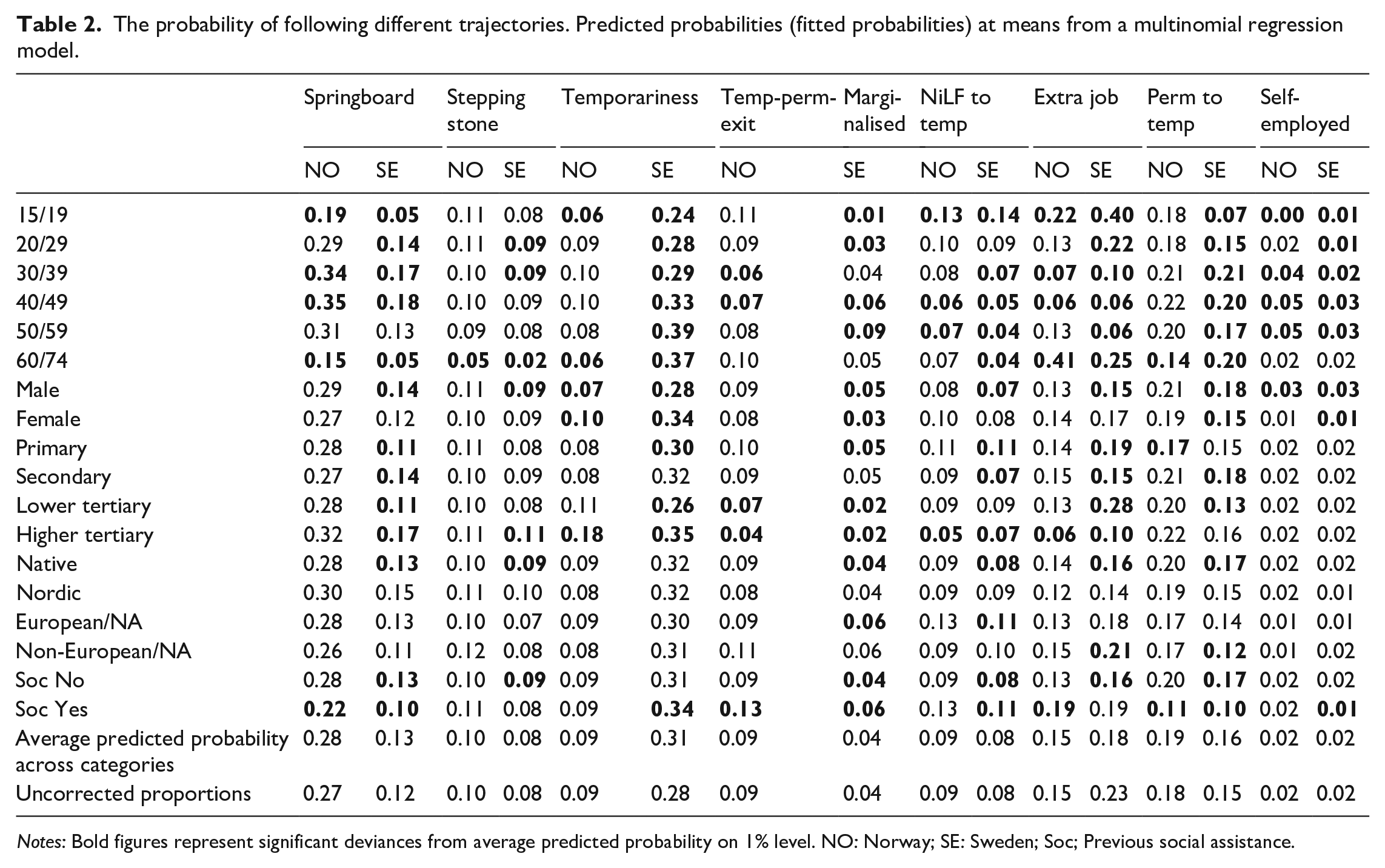
Notes: Bold figures represent significant deviances from average predicted probability on 1% level. NO: Norway; SE: Sweden; Soc; Previous social assistance.
Relative probability ratios of following different trajectories.
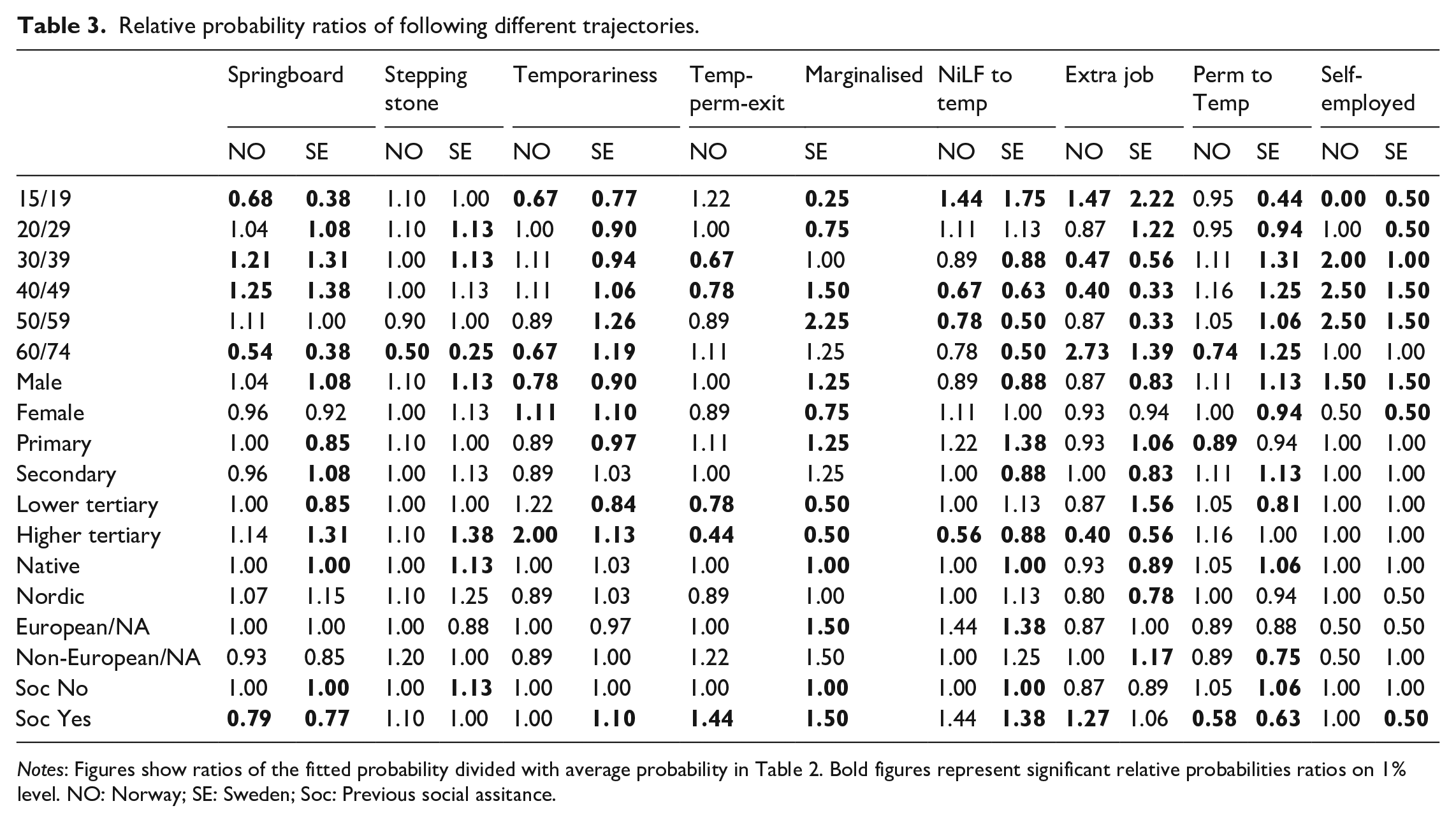
Notes: Figures show ratios of the fitted probability divided with average probability in Table 2. Bold figures represent significant relative probabilities ratios on 1% level. NO: Norway; SE: Sweden; Soc: Previous social assitance.
Starting with the largest bridge trajectory – springboard – some patterns were similar between the two countries (Table 3). In both countries, particularly in Sweden, there was a lower-than-average probability that the youngest and oldest age categories would be found in the trajectory, while the mid-aged were above the average. Moreover, people with previous social assistance were less likely to follow the trajectory. Only in Sweden were the highest educated significantly more likely to follow this trajectory. In both countries, particularly Sweden, the stepping-stone trajectory showed that the oldest age category had a lower average probability of following the sequence. In Sweden, higher tertiary educated also had a somewhat higher probability in this regard.
The main dead-end trajectory was temporariness, particularly in Sweden. The age pattern differed between the countries, although the probability of the youngest age category was below average in both countries. Sweden had a clear linear relationship showing increasing probability with age, while in Norway the relationship had an inverse U-shape. The gender patterns were similar but more distinct in Norway, with a higher probability for women to follow the trajectory. In Norway, there was an above-average probability that higher tertiary educated would be in the temporariness sequence.
In Norway, the other dead-end trajectory was temporary-permanent-exit, which was equal in size with temporariness. The most significant patterns were that mid-age categories and higher educated had a lower-than-average probability of being found in the trajectory, while former social assistance recipients had a higher probability. In Sweden, marginalisation was the other dead-end trajectory. The second-oldest age category (50–59 years) had a higher-than-average probability of following the sequence, together with people of European origin and individuals having received social assistance in previous years, while the youngest age categories and higher educated had a significantly lower probability.
Summing up these results in relation to the theoretical expectations, similar patterns existed in the two countries for bridge trajectories, although they were more exclusive to stronger social categories (higher educated, mid-aged) in Sweden than in Norway, particularly to the springboard trajectory. Contrary to expectations, dead-end trajectories, specifically the temporariness trajectory found in both countries, was not strongly biased towards weaker categories in Norway. Higher educated were even over-represented in the trajectory. However, the exclusive Norwegian and equally sized temporary-permanent-exit trajectory, was more selected towards weaker categories: younger and older, lower educated and people with former social assistance. As expected, in the Swedish case, the large temporariness trajectory showed few strong differences between social categories. However, the small marginalisation trajectory is strongly selected towards weaker social categories.
Conclusions
This is the first study from a European context to examine the trajectories of individuals holding a temporary contract at some point during a two-year period, thereby taking into account previous labour market statuses. The rationale for comparing these similar Nordic welfare states is the substantial difference in the regulation of temporary employment.
Relating to previous research, the expectations of finding trajectories resembling bridges or dead ends are confirmed in the analysis. Bridge trajectories were expected to be more common in Norway than in Sweden, due to a more balanced and stricter EPL, as well as a better labour market situation (lower unemployment). In Sweden, dead-end trajectories were to be more prevalent due to an EPL gap, combining liberal regulation of temporary contracts with strict regulations of permanent contracts, and because of a weaker labour market (higher unemployment) than Norway. The bridge trajectories are more common in Norway, comprising 37% of the sample, compared to 20% in Sweden. In Sweden, 32% move along dead-end trajectories, while only 18% do so in Norway. Consequently, temporary employment constitutes a higher risk of developing weak labour market attachment in Sweden than in Norway.
The composition of individuals’ characteristics within bridge and dead-end trajectories was expected to differ between the countries. In Norway, individuals in the dominating bridge trajectories should be less characterised by vulnerable social categories (such as those with limited education, youth and born outside Europe/North America), while individuals found in dead-end trajectories should be more selected into these categories. In Sweden, where dead-end trajectories are more common, workers with rather strong human capital (such as higher education) were expected to be selected into the bridge trajectories.
The results gave mixed support to these expectations. As predicted, individuals in Sweden with higher education, as well as mid-aged, have a higher-than-average probability of following the springboard trajectory (the main bridge trajectory), while these patterns are less clear in Norway. In both countries, people with an incidence of former social assistance are less likely to follow the trajectory. However, the differences between the countries are not as clear as expected. Concerning the main dead-end trajectory in Sweden (temporariness), and in line with predictions, the differences between social categories are not distinct. In Norway, contrary to predictions, the highest educated have a higher-than-average probability of following the trajectory, while weaker social categories do not. However, an equally important dead-end trajectory in Norway is temporary-permanent-exit, and the patterns follow expectations: higher educated and mid-aged have a lower-than-average probability of following the trajectory, while individuals with former social assistance reception have a higher probability. This Norwegian trajectory is puzzling as it indicated a bridge into firmer labour market attachment, which turned out to be a dead end leading out from employment. However, the trajectory may constitute a logical counterpart to the high incidence of bridge trajectories, implying that the selection processes of who the organisation will ultimately invest in also continue after the individual has signed a permanent contract.
Important to notice is that the above results show relative differences between categories. However, the general findings of the study are that, in Norway, all the studied categories are more likely to be found in bridge trajectories, while in Sweden it is the other way around concerning dead ends.
The present study adds, methodologically and empirically, to Fuller and Stecy-Hildebrandt, 2015, McVicar et al. (2019) and Ojala et al. (2017), by showing how previous labour market careers influence further pathways of temporary employees. For instance, the marginalisation trajectory shows that temporary employment is not an easy way into a stable labour market career for those entering a temporary job from unemployment. Thus, partial deregulation may not be a pertinent choice in order to integrate unemployed individuals into the labour market more permanently.
Using sequence analysis to distinguish different labour market trajectories of temporary employees, this study sheds new light on the mechanisms that produce segmentation and dualisation, demonstrating how temporary employment can have a bridging function for those with higher permanent employment chances to begin with, while often serving as a dead end or trap for less well-equipped groups. Proponents of deregulating temporary employment claim that temporary jobs may function as a bridge for outsiders trying to get into a firm labour market position, while others claim it is a dead end. The current study shows that for youth and those with limited education, temporary employment often leads to dead-end trajectories, while it functions more as a bridge for those nearer to labour market integration to begin with. Consequently, the study highlights that temporary work is not a homogeneous category with similar labour market effects for all individuals.
A potential challenge with the data used is the relatively short trajectories that could be discerned. Some of the trajectories may therefore constitute parts of longer sequences. In, for example, the Norwegian temporary-permanent-exit sequence, is a period of temporary employment before entering the extracted sequence probable. Moreover, the sequence may even signify selection processes taking place within bridge trajectories. Additionally, the extraction of two different bridge trajectories – springboard and stepping stone – could be an artefact of data, as the springboard could be preceded by a longer period in temporary employment. However, the differences in size of the springboard trajectory and the stepping-stone trajectory, particularly in the Norwegian case, indicate that they are unique sequences. Differences can also be seen in the social compositions of the trajectories, indicating that they are unique constructs. Fuller and Stecy-Hildebrandt (2015), McVicar et al. (2019) and Ojala et al. (2017) follow individuals over a longer time span by yearly information. Thus, there is a risk that studies with less frequent labour market information miss changes in employment status, which is important when studying labour market integration by way of temporary employment. As such, the quarterly information in this study provides a more detailed picture of the labour market situation of those at the margin of the labour market. Consequently, the current analysis is a two-year snapshot of selection processes of individuals into different labour market trajectories that may continue over several years.
The present analysis cannot fully capture the institutional mechanisms that may lead individuals out from temporary employment. In the Swedish case, the EPL states that temporary employment as a substitute, or in a general fixed-term contract, should be regarded as an open-ended contract if it has continued for two years (since 2007; previously, a three-year rule only applied for substitutes). In the Norwegian case, similar rules apply after four years. This means that these mechanisms are probably hidden within the trajectories that could be extracted.
Despite these weaknesses, this study shows significant differences in labour market trajectories involving temporary employment in Norway and Sweden. These results are evidently an effect of differences in the regulation of temporary work and the labour market situation in each country. There are clear indications of a more dualised labour market in Sweden than in Norway, with high shares of the labour force circulating between insecure positions in the labour market. Thus, the study confirms the tendency towards more pronounced dualisation in Sweden, as noted by others in recent years (Thelen, 2014). Consequently, the Swedish choice to deregulate EPL by producing an EPL gap (Barbieri and Cutuli, 2016) and creating flexibility at the margin (Emmenegger, 2014) has detrimental side effects. In particular, labour market integration is confined by the dominance of dead-end trajectories, while the bridge effect is restricted to more privileged categories as higher educated.
This study also indicates that temporary employment may play a more dynamic and positive role in the Norwegian labour market. Although bridge trajectories dominate, the less easily classified permanent-temporary trajectory is the second-largest type in Norway and is equally distributed across social categories. Furthermore, the number of temporary employees in the Norwegian labour market is clearly lower than in Sweden, while the differences in flows – the relative shares of two-year trajectories, including temporary positions – are not as large between the countries (21% and 25%, respectively). This indicates that temporary employment is dynamic in the Norwegian labour market, perhaps as a transition between jobs. More studies are needed to answer whether this is the case, particularly to sort out the effects of the favourable labour market situation and the significance of the Norwegian EPL during the period in focus. If the latter is the main explanation, the Norwegian regulations can serve as a guide for productively combining the regulation of permanent and temporary employment in labour markets.
Supplemental Material
sj-pdf-1-wes-10.1177_09500170211031466 – Supplemental material for Temporary Contracts, Employment Trajectories and Dualisation: A Comparison of Norway and Sweden
Supplemental material, sj-pdf-1-wes-10.1177_09500170211031466 for Temporary Contracts, Employment Trajectories and Dualisation: A Comparison of Norway and Sweden by Tomas Berglund, Roy A Nielsen, Olof Reichenberg and Jørgen Svalund in Work, Employment and Society
Footnotes
Acknowledgements
The authors would like to thank the three anonymous reviewers who provided very constructive feedback to improve the article.
Funding
The authors disclosed receipt of the following financial support for the research, authorship, and/or publication of this article: This research was funded by the Research Council of Norway (236901) and the Swedish Research Council for Health, Working Life and Welfare (2016-07204).
Supplementary material
The supplementary material is available online with the article.
Notes
References
Supplementary Material
Please find the following supplemental material available below.
For Open Access articles published under a Creative Commons License, all supplemental material carries the same license as the article it is associated with.
For non-Open Access articles published, all supplemental material carries a non-exclusive license, and permission requests for re-use of supplemental material or any part of supplemental material shall be sent directly to the copyright owner as specified in the copyright notice associated with the article.
