




Abstract
This exploratory study evaluates the effectiveness of an online instructional vocabulary module in enhancing parents’ understanding of early childhood vocabulary development and how to demonstrate this in a home environment. Forty-one parents viewed the vocabulary video and completed pre- and post-surveys. While most parents could define ‘vocabulary’ pre-viewing, post-viewing responses showed improved identification of its importance. Participants were able to apply multiple strategies, including using learning materials and emphasizing vocabulary depth and breadth. The study highlights the potential of such resources to empower parents as active facilitators of language learning, particularly in terms of their children’s vocabulary development.
Keywords
Introduction
Infants can understand adults’ referential intentions, even in complex situations, demonstrating that word learning occurs in a flexible, rather than constrained, manner. Parents, educators, and clinicians often use language milestones (e.g., the first word) as measures of typical development, with significant gains seen within the first 4 years of life (Conti-Ramsden & Durkin, 2012). Early lexical development predicts later vocabulary skills (Lee, 2011), as well as critical literacy skills including reading comprehension and, in turn, academic success (Biemiller, 2006). Because parents are typically their children’s first teachers, some intentionally and actively teach their children new words, while others prefer to expose them to language through rich interactions with the world around them in their daily lives. Some parents, however, may not have the tools or expertise to help guide their child’s vocabulary development (Canadian Children’s Literacy Foundation, 2020). To this end, the present study investigates the effectiveness of an online video module in assisting parents to develop an awareness and understanding of their children’s vocabulary development. The video also offers suggestions for at-home activities to promote vocabulary development in children 3 to 6 years old.
Background
During vocabulary learning, infants and children increase the breadth and depth of their knowledge of words. Vocabulary breadth refers to the number of words learned, whereas depth refers to the profoundness of the knowledge of word meaning (Binder et al., 2017; Dickinson et al., 2019). Vocabulary breadth and depth have been distinguished through observations in early language development (Ouellette, 2006). Although greater vocabulary breadth is associated with more efficient word comprehension (Sterpin et al., 2021), a child may learn a word without fully understanding its meaning (Ouellette, 2006). Moreover, greater depth is associated with stronger lexical-semantic representations (Sterpin et al., 2021). Children add to the breadth of their vocabulary when they learn new words, and they add to the depth of their vocabulary knowledge when they gain deeper understanding of those words. Therefore, both breadth and depth are integral to vocabulary development. Research suggests that children who have a large breadth and depth of vocabulary tend to have stronger reading comprehension skills in primary school (Dickinson & Porche, 2011; Dickinson et al., 2019; Storch & Whitehurst, 2002). Examining social and cognitive development in early word learning can provide us with a deeper understanding of how strategies targeting vocabulary learning are implemented by parents and which strategies are most effective.
A study conducted by Weisleder and Fernald (2013) assessed differences in children’s early language development through recorded parent–infant interactions in their homes. The study was conducted among Spanish-speaking families from low socioeconomic status (SES) households in the United States. Parent–infant interactions were recorded for an average of 11 hr during 6 consecutive days. The objective was to examine the relationship between early experience with language processing skills and how this relationship influences vocabulary development. The authors found significant differences in the amount of child-directed language from parents, ranging from 670 words to over 12,000 words in a day. Importantly, the amount of child-directed language was not correlated with the amount of overheard language. This suggests that the differences in language input given to the children were due to the amount of language directed to them by the caregivers, not the overall talkativeness of the households. Moreover, the differences in child-directed language were predictive of their vocabulary 6 months later. Infants who received more child-directed language input from their parents had larger expressive vocabularies. These findings highlight the importance of parent–child interactions for vocabulary development. Notably, the sample only included low SES families, demonstrating that the variability in parent-directed language was independent of SES. Nevertheless, previous studies have shown that children from lower SES backgrounds display slower rates in literacy development compared to their peers from higher SES backgrounds (Hecht et al., 2000; Hoff, 2003). For instance, SES differences in maternal language in word types and specifically in mean length of utterance have been shown to predict vocabulary growth in preschool-aged children (Hoff, 2003). Moreover, SES has been identified as a significant predictor of reading achievement throughout school years (Sirin, 2005). Consistent with the theory of the social-pragmatic approach to word learning, children learn both from verbal associations and social cues in a flexible environment (Tomasello, 2001; Yu & Ballard, 2007). A considerable body of literature demonstrates that increased parental interaction is positively associated with language development (Biemiller, 2007; Dickinson et al., 2019; Weisleder & Fernald, 2013).
Parents can direct their language to support development of vocabulary breadth and depth through explicit and implicit instruction and exposure to language. For example, parents may use explicit instruction (e.g., providing a direct definition following a new word) or they may show the child a representative photo or object, or some combination of these supports (Dickinson et al., 2019). Implicit instruction can include strategies that offer word-related knowledge such as elaborating on the meaning of the word and related concepts, thereby expanding on prior vocabulary knowledge (Dickinson et al., 2019).
Both implicit and explicit approaches are beneficial to children’s vocabulary development; however, parental awareness of these strategies may play an important role in their ability to implement them. To ensure that parents are aware of these approaches to vocabulary development, an instructional vocabulary module was used in the present study to identify and explain these approaches. We examined parents’ learning from the module, specifically comparing their knowledge of the presented concepts pre- and post-viewing, such as definitions of vocabulary and its importance for early literacy development. We examine if and how the parents apply the strategies learned from the module to teach their child a new word. This study provides a guide for the development of literacy interventions, which builds on the fact that parents/caregivers are their children’s first language teachers. We hypothesize the following:
H1: After watching the instructional vocabulary module, parents will be better at defining vocabulary (both in terms of breadth and depth).
H2: After watching the instruction vocabulary module, parents will be better at identifying the benefits of developing their children’s vocabulary skills.
In addition to examining these hypotheses, the study also explores how well parents transfer knowledge gained from the video to practical vocabulary teaching opportunities for their children. Perceptions about the video can provide a better understanding of what parents found helpful.
Methods
Design
The study used a pre-test/post-test within-subjects design where each parent completed one online pre-test survey, viewed an online video module, and then completed a post-test survey.
Participants
Forty-one parents (nmothers = 39, nfathers = 2; Mage = 37.59 years, SD = 3.96 years) who had a child between the ages of three and five participated in the current study. Over half of the parents reported having two children (53.7%), while the others reported having three children (22.0%), one child (19.5%), or four children (4.9%). The average ages of participants’ youngest child and oldest child was M = 3.09 years (SD = 1.13 years) and M = 6.44 years (SD = 4.21 years), respectively. Most parents reported their current relationship status as married (85.4%), followed by common-law (7.3%), separated (4.9%), and single (2.4%).
All parents resided in a mid-sized city in Ontario, Canada. Most parents were born in North America (65.9%) and had spent the majority of their lives in North America (78.0%). Parents from outside of North America were born in Asia (22.0%), Africa (4.9%), Europe (4.9%), or South America (2.4%). Approximately half of the parents (53.7%) had completed a graduate university/college degree, 39.0% had completed an undergraduate university/college degree, and 7.3% had completed some post-secondary studies.
In terms of English language proficiency and exposure, 65.9% reported English as their first language spoken with 80.5% reporting English as their first language for reading, and 82.9% for writing. When asked to rate their spoken and written abilities in English on a 5-point scale, most parents rated themselves as ‘very fluent/native speaker’ (87.8%), followed by ‘quite fluent’ (9.8%), and only 2.4% indicated ‘a little bit fluent’ (M = 4.83, SD = 0.54). When asked to compare their English vocabulary size to ‘the average person in Canada’ (My = 3.73, SD = 0.98, maximum 5-point scale), 26.8% reported that theirs was ‘the same as the average Canadian’, 41.5% as ‘a little bigger/better than the average Canadian’, 22% as ‘much larger’, 7.3% as ‘a little bit smaller’, and 2.4% as ‘much smaller’.
Parents were recruited through flyers shared on Facebook and at community recreational sites. The study was reviewed and approved by the Research Ethics Board at Wilfrid Laurier University in Waterloo, Ontario. All participants provided their signed informed consent prior to taking part in the study.
Materials
Materials included an online instructional video on vocabulary development, along with pre- and post-viewing surveys.
Online instructional vocabulary video
We used the video entitled ‘Module 4: Vocabulary’, one of five modules in the ‘Partners in Promoting Learning: At Home Literacy Series’ that are freely available online (Wood & Gottardo, 2020). 1 The video lasts 6 min and 42 s in which it: defines vocabulary (breadth and depth), explains the importance of early vocabulary development, discusses how children develop vocabulary, offers strategies that parents can employ to foster breadth and depth of vocabulary acquisition, and provides informal and formal practical examples of child-directed instruction. The module informs parents that vocabulary develops across the lifespan, and that parents can facilitate their children’s vocabulary learning.
The video was developed by two senior academics with expertise in language learning, early literacy development, instructional design, and learning from technology. Evidence-based content was derived from extant research (e.g., Biemiller, 2006; Dickinson et al., 2019), and the design and presentation of content followed Mayer’s (2008, 2009) principles of effective multimedia. A professional video illustrator and professional voice actor provided the visual and voice content with the coaching of the developers.
Pre-viewing survey
A pre-viewing survey gathered the information detailed in section ‘Participants’ about parents’ demographics, language background and skills, etc. The survey also included three open-ended questions: (a) define the word ‘vocabulary’, (b) describe two benefits of developing your child’s vocabulary, and (c) provide examples, if appropriate, of things you are doing to improve your child’s vocabulary. These questions were related to content they would see in the video.
Post-viewing survey
Immediately after viewing the video, parents completed another survey which included Questions 1 and 2 in the pre-viewing survey. Parents could choose to review the video prior to answering the questions. The survey also asked them to indicate how familiar they felt with the information from the video using a 5-point scale (1 = ‘almost all of the information was new to me’ to 5 = ‘I knew all or most of this information’). It also included an applied question in which parents were given three words (brain, carnivore, and cygnet) and their definitions, and were asked to select one word and describe how they would teach it to their child using information from the video.
Finally, parents were asked to rate how well the concepts ‘strategies’ and ‘breadth/depth’ were explained in the video on a 5-point scale (1 = ‘not explained at all in this video’ to 4 = ‘explained very well’; 5 = ‘I don’t recall seeing this’). As a fidelity check to ensure that parents attended to key elements of the video, all parents’ ratings were checked to assess whether there were instances where parents reported not seeing an element that was presented in the video. All participants recalled the concepts of strategies and only one participant did not recall the concepts of breadth and depth.
Procedure
Participants were tested individually via Zoom. The confidential Qualtrics survey link and the video module link were sent through the chat function. Parents privately (screen share was not used) completed the pre-viewing survey, watched the video, and then completed the post-viewing survey, while the session was supervised by a researcher who was able to troubleshoot and answer any questions as needed.
Results
Scoring open ended responses
All statistical analyses were conducted using SPSS 27 by IBM. The same process was used to create a coding scheme for each of the open-ended questions (i.e., defining ‘vocabulary’ and identifying two benefits of vocabulary development). After reading all responses, one rater constructed a 4-point rating scale (0 = no response provided, 1 = incorrect, 2 = partially correct, and 3 = completely correct; see below for description and examples) for each question. Both the definition provided in the video and dictionary definitions were used for defining vocabulary. Information provided in the video and recognized benefits in the vocabulary literature were used as the basis for coding the two benefits. A second rater used each coding rubric to independently score the parents’ definitions of vocabulary and the benefits of vocabulary teaching at pre- and post-test. Cohen’s κ indicated a high level of agreement between the two coders for all questions (i.e., for vocabulary pre-test κ = .920, p < .001 and post-test κ = .825, p < .001; for two benefits pre-test κ = .880, p < .001 and post-test κ = .853, p < .001).
Defining vocabulary
Prior to viewing the online module, 41.46% of parents provided a correct and complete definition (e.g., ‘The words or terms a person knows and uses to communicate’), 43.9% provided a partially correct definition (i.e., a definition that begins to describe vocabulary, but does not indicate complete understanding. Example: ‘Number of words you use’), and 14.63% provided an incorrect definition (i.e., incorrect definition of vocabulary or insufficient detail to indicate their level of understanding. Example: ‘words’). After viewing, 58.54% of parents provided a correct definition, 24.39% a partially correct definition, and 17.07% an incorrect definition.
Parents’ scores regarding definitions of ‘vocabulary’ approached ceiling (maximum score = 3). A paired samples t-test (H1) indicated no significant increase in the accuracy of parents’ definitions of vocabulary from pre-viewing (M = 2.26, SD = 0.71) to post-viewing (M = 2.41, SD = 0.77), t(40) = −1.43, p = .16.
Benefits of vocabulary learning
An examination of the features that parents used to describe the benefits of developing vocabulary indicated that prior to viewing, 21.95% of parents provided a correct response (i.e., provided two benefits of vocabulary learning and enough detail/precision to indicate complete understanding. Example: ‘Having a wide range of words to describe one thing such as cold and freezing. Understanding new words and being able to pass on those meanings to others’), 75.61% provided a partially correct response (i.e., provided two benefits of vocabulary learning but without enough detail/precision in language to indicate complete understanding. Example: ‘Being able to express yourself and communicate with others’), and 2.4% provided an incorrect/incomplete response (i.e., provided only one benefit or incorrect information. Example: ‘Being able to talk to peers’). After viewing, 53.66% provided a correct response, 46.34% a partially correct response, and no parent provided an incorrect response.
A paired samples t-test indicated that parents’ ability to describe benefits for early vocabulary development (H2) increased after watching the video module (Mpre-viewing = 2.19, SD = 0.46; Mpost-viewing = 2.54, SD = 0.50), t(40) = −3.32, p = .002.
Teaching new vocabulary to children
Using open-coding methods, one rater read all responses iteratively to identify themes and theme labels for instructional strategies identified by parents (Boyatsis, 1998; see Table 1). Five themes emerged: learning materials/activities, direct definition, practice/repetition, learning more related words, and expanding on related concepts. A second rater used these themes to independently code eight responses with a high level of agreement between the two coders, κ = 1 for p ⩽ .005 for all but κDepth = .750, p = .028.
Coding rubric for parents’ application of teaching a new word.
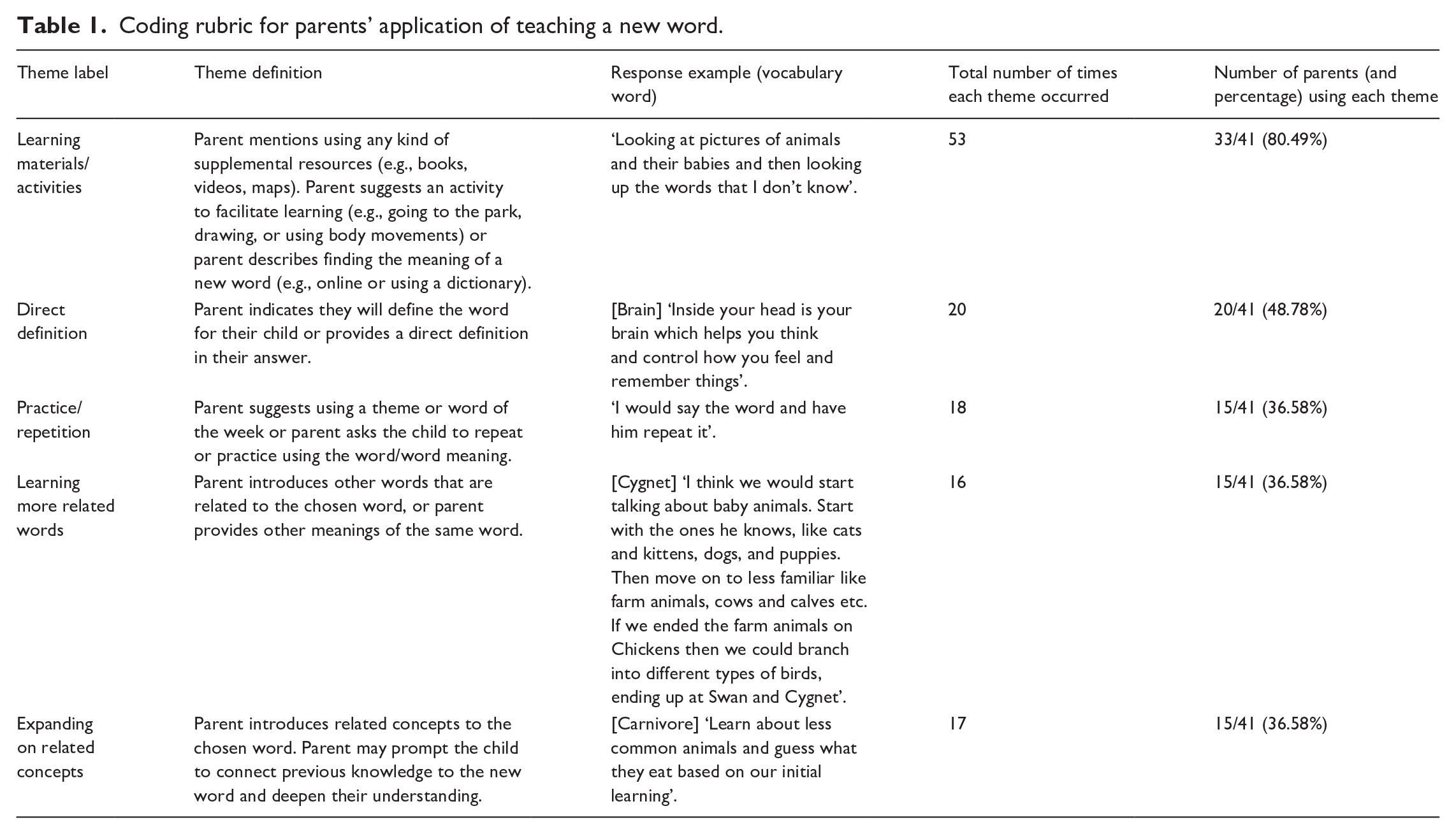
A total of 124 strategies were coded with all parents providing at least 1 strategy. Learning materials/activities was the most frequently generated strategy with 53 instances endorsed by 80.49% parents followed by 20 instances of direct definitions by 48.78% of parents, 18 instances of practice/repetition 36.58% of parents, 17 instances of expanding on related concepts by 36.58% of parents, and 16 instances of learning more related words by 36.58% of parents (see Table 1).
Parent confidence
Overall, parent confidence regarding their ability to teach vocabulary to their child was relatively high (MConfidence = 3.95, SD = 1.05). Correlations indicated that parent confidence ratings were significantly related to both pre-viewing (r = .355, p = .023) and post-viewing (r = .365, p = .019) vocabulary definition scores, but not with identification of benefits for either the pre-viewing (r = −.032, p = .844) or post-viewing responses (r = .145, p = .365).
Parent video content ratings
Explanations of breadth and depth (M = 3.59, SD = 0.55) and strategies (M = 3.88, SD = 0.40) were rated moderately high.
Discussion
The present study assessed whether a freely available online video on vocabulary was perceived to be useful by parents and whether their knowledge about early vocabulary development increased after viewing the module. The findings suggested that although most parents were able to define the term ‘vocabulary’ prior to viewing the video, they showed learning gains in terms of identifying the benefits of teaching vocabulary to their children. Moreover, after viewing the video, parents demonstrated the ability to apply teaching strategies to their child’s vocabulary learning.
Parents’ knowledge
It was expected that parents would be better able to define ‘vocabulary’ after viewing the video module. However, this hypothesis (H1) was not supported, likely due to ceiling effects. Parents’ scores approached ceiling at both pre- and post-test indicating that defining the concept of vocabulary was not a challenge for this group of participants, potentially because of their relatively high level of education. Conceptual knowledge can help parents to understand that vocabulary teaching and learning are not just about fostering stronger vocabulary, but that it also includes learning more about word meanings and related concepts. Moreover, conceptual knowledge can increase parents’ intentionality when discussing words with their children. Vocabulary learning can occur at any age and at any time through informal everyday interactions (e.g., playing in the park, going to the grocery store). To determine whether providing a definition is a necessary component of the video for a broader representation of parents, for example, for those with less education, lower SES, or other vulnerable or marginalized groups, it may be useful to examine a more diverse group of participants. It was also expected that parents would be better able to identify the benefits of vocabulary development after watching the instruction vocabulary module (H2). This hypothesis was supported as shown by significant gains in parents’ understanding from pre- to post-viewing. Together, these findings suggest that parents were aware of what ‘vocabulary’ is, but less aware of why vocabulary development is important. Given the importance of early vocabulary development for later skills, (Ouellette, 2006; Weisleder & Fernald, 2013), enhancing parental awareness about the importance of vocabulary development could promote the skills needed for their child’s future success. Exposure to accessible and informative resources on vocabulary learning in the home may help parents to gain the theoretical knowledge of why this is important, as well as the subsequent practical strategies that they can implement with their child.
Parents’ transfer of skills
Parents were asked to apply what they learned from the module by explaining how they would teach a new word to their child. Interestingly, the most common response was the use of learning materials and activities. Strategies associated with this theme include using materials in the home such as picture books, photos, and videos, or daily activities that occur outside the home such as going on walks and pointing out things to their children as illustrative resources to help convey the meaning of new vocabulary words. This approach to vocabulary learning aligns with association and social pragmatic theories of word learning (Tomasello, 2001; Yu & Ballard, 2007), as parents incorporate multiple references to the word they are teaching within a natural environment. Approximately 33% of participants demonstrated strategies of learning more related words and expanding on related concepts, and others employed repetition strategies. Evidence for the efficacy of direct or explicit instruction for teaching early literacy skills has been evident for several decades; however, the best learning outcomes appear to emerge when these more rote learning strategies are coupled with other strategies that encourage deeper processing (e.g., Pressley et al., 1998). Consistent with this notion, many parents identified the use of more than a single strategy in their instructional approach; however, this was not the case for all parents. However, no single strategy was selected by all parents. The proportion of time that the module content aligned with each strategy may also provide insight on the parent’s strategy selections. In total, 3.6 min of the module directly aligned with the themes extracted from the parents’ responses. Of this content time, 29.17% was aligned with the learning materials and activities’ theme, 6.94% aligned with direct definitions, 6.94% with practice/repetition, 27.78% with learning more related words, and 29.17% with expanding on related concepts. Direct definitions had a low proportion of time in the video content, yet were used by nearly half of the parents, which may suggest that doing so was already a familiar strategy for parents. While concepts aligning with learning materials/activities were discussed to a similar extent as learning more related words and expanding on related concepts, about 80.49% of parents referenced use of learning materials/activities while only about 36.58% referenced each of the latter themes.
Notably from the parents’ feedback ratings of the video module, the mean ratings of explanations of breadth and depth were above the midpoint, but below ceiling. This suggests that further explanation and examples may be needed for parents to more fully demonstrate the array of strategies provided. Previous research involving teachers, parents, and students who were asked to assess learning modules has shown that added examples and explanations are beneficial for learning (Añoda, 2022). Determining how much additional information and/or examples may be needed should be an important goal for future research.
Alternatively, it may be that the single viewing of the video was not sufficient to fully illustrate all the strategies, or it may be that selecting one word as an example may not have been sufficient for parents to demonstrate their use of all strategies. Parents may need additional exposure to the information or additional transfer tasks to fully understand or demonstrate their learning of content. Many parents indicated that they would use the video in the future, suggesting that they could benefit from additional exposure. Future research should endeavor to determine whether additional exposure to the same video versus added content is most beneficial, or whether more transfer tasks would allow parents to demonstrate their knowledge. Such research may help identify the most effective way of delivering and assessing impactful learning modules to parents.
Limitations and future directions
The parents in this exploratory study reflect a highly educated group who were observed throughout the surveys and the video-viewing. However, some gains may have been missed, while others may have been enhanced. Direct observation of parent–child interactions can help elucidate vocabulary strategies used by parents/caregivers’ before/after watching the module. Extending the sample to include a more diverse group of parents and a more naturalistic viewing context may be an important future step. For example, the present findings reflect a single exposure. In addition, parents may have been sensitive to time constraints or pressures of being observed. An important next step would be to allow parents to watch the video at their own pace and as many times as desired. Learning may be enhanced by multiple viewings, which would provide parents the opportunity to more deeply reflect on and practice the strategies presented. In addition, although the pre-test/post-test surveys in this exploratory study provided some basis for comparison of gains, the inclusion of a no-exposure control group in future studies would allow a more complete assessment of gains afforded through video viewing. Finally, we did not examine whether parents actually applied the content from the module to enhance their child’s learning as part of their daily lives. Future research could include follow-up sessions with parents to determine if they used any strategies learned in the video and if so, whether they were effective.
Conclusion
Well-designed online video modules are a convenient and effective resource for enhancing parent knowledge and attitudes towards learning interventions (Hall & Bierman, 2015). The findings of the present study suggest that the instructional vocabulary module was beneficial to parents’ learning of the content. This was indicated by their ability to correctly identify benefits of vocabulary development and to transfer the knowledge gained to a novel teaching situation. Outcomes suggest that sharing this module with literacy centers and educators could benefit parents, especially those less familiar with concepts related to vocabulary development.
Footnotes
Author contributions
Funding
The author(s) disclosed receipt of the following financial support for the research, authorship, and/or publication of this article: This study was partly funded by a grant from the Social Sciences and Humanities Research Council of Canada.
