




Abstract
A growing body of research suggests that fine motor skills (FMS) are associated with language development. In this study, we examined 76 children aged 3–6 years assessing the link between language and FMS. Specific measures included receptive and expressive vocabulary, oral narrative skills, and various fine motor tasks. Hierarchical linear regressions revealed that FMS predicted receptive and expressive vocabulary as well as oral narrative skills. Overall, FMS were most strongly linked to children’s oral narrative skills. Educational implications, as well as limitations and the need for further studies on the link between language and FMS, are discussed.
Keywords
Philosophers, educationalists, and linguists have attributed an important role to the sensorimotor system in semantic processing and mental development (Montessori, 2013; Pexman, 2019; Piaget, 1983). Indeed, an increasing number of researchers have found that motor skills are an important factor in children’s language outcomes (Iverson, 2010; Walle, 2016). Webster et al. (2006) have shown that motor skill deficits and language deficits often coincide. Furthermore, various studies have found links between Fine Motor Skills (FMS) and different language outcomes (Houwen et al., 2016; Kobaş et al., 2021; Muluk et al., 2014; Suggate & Stoeger, 2014; see Gonzalez et al., 2019 for an overview) and that speech production (Tokimura et al., 1996) and language perception (Flöel et al., 2003) activate the hand area of the motor cortex.
There are a number of non-mutually exclusive reasons for why this link between motor and language development could exist. First, studies show that children who are able to walk carry objects more frequently than crawlers and are also more likely to share those objects with their caregivers, thereby receiving more linguistic input (Karasik et al., 2011). Second, Iverson (2010) argues that emerging motor abilities support the acquisition of language, providing cognitive stimulation and language-learning opportunities. This is in line with the developmental cascades view, specifying that advances in motor skill learning can have cascading effects on other domains, such as language learning and vice versa (Oakes & Rakison, 2019). Finally, findings from neuroimaging studies have further shown that motor and language skills frequently utilize the same cerebral areas, such as the primary motor cortex (Kana et al., 2015) and the inferior frontal cortex (Adamaszek & Kirkby, 2016). Despite this initial work, it is still unclear what aspects of language relate to FMS. Therefore, in this study, we examined children’s FMS and their contribution to language while looking closely at three different language outcomes – receptive vocabulary, expressive vocabulary, and narrative skills.
Fine motor skills
FMS can be defined as ‘small muscle movements requiring a close eye-hand coordination’ (Luo et al., 2007, p. 596). From a musculoskeletal and sensory point of view, the hand is the most complex peripheral organ in the body (Apenfels, 1955; Wilson, 1999) and hence a disproportionate volume of the sensorimotor cortex is devoted to the hand (Penfield & Boldrey, 1937; Pulvermüller et al., 2005). FMS incorporate a wide range of different subtypes, such as graphomotor skills, speed-dominated FMS, and dexterity. Evaluating FMS often includes measures such as pencil usage to draw symbols (graphomotor skills), tapping (speed-dominated FMS), and coin posting tasks (dexterity). FMS have displayed distinct links to language outcomes (see Gonzalez et al., 2019 for an overview), such as phonological awareness (Cameron et al., 2012), receptive vocabulary (Dellatolas et al., 2003; Muluk et al., 2014), and expressive vocabulary (Cameron et al., 2012; Muluk et al., 2014). Relevant studies are presented in more detail below. Of the different aspects of FMS, previous studies have found dexterity, that is, the skillful manipulation of small objects (Backman et al., 1992) to have the strongest associations with cognitive variables and academic skills (Gandotra et al., 2022; Martzog et al., 2019). FMS involving dexterity have been shown to be stronger predictors of intelligence than speed-related FMS (Martzog et al., 2019).
Vocabulary development and FMS
To date, studies that have examined the relationship between motor skills and language skills have focused almost exclusively on vocabulary. Vocabulary is a key building block of language (Nation, 2006), essential for communicative and social development. This includes both receptive vocabulary skills (words that can be understood by a person) and expressive vocabulary skills (words that a person can produce). Beginning with infants, Kobaş et al. (2021) investigated whether FMS at 14 months predicted receptive vocabulary skills at 25 months. They found that early FMS were significantly related to children’s later object word comprehension. A study carried out by Houwen et al. (2016) more closely examined the link between FMS and receptive communication (word and language comprehension) as well as expressive communication (preverbal communication and expressive vocabulary). The authors assessed 130 children aged 1–3 years old. They found a moderate correlation between different FMS-dimensions (speed-related FMS, dexterity, and so on) and both receptive and expressive communication. Evidence for a relationship between FMS and vocabulary has also been found in preschool and kindergarten age children (Dellatolas et al., 2003; Pagani et al., 2010). Muluk et al. (2014) found that FMS, specifically graphomotor skills, significantly related to receptive and expressive vocabulary in 402 3–6-year-old children. They also found FMS to be more strongly correlated with vocabulary than with gross motor skills and social skills. A study by Cameron et al. (2012) on school-readiness factors found a significant relationship between FMS requiring manual dexterity and expressive vocabulary in 3- and 4-year-old children, indicating that children with higher FMS scores also had greater expressive vocabulary skills. Looking at different aspects of FMS, specifically dexterity and graphomotor skills, and language development, Suggate and Stoeger (2014, 2017) assessed children aged 3–6 years, using different dexterity measures and a measure for receptive vocabulary skills. The results showed a significant positive correlation between FMS and vocabulary.
Although this literature strongly points toward a relationship between FMS and vocabulary (both receptive and expressive vocabulary), investigating relationships between FMS and language skills solely by focusing on vocabulary knowledge seems limited (Branum-Martin et al., 2009). This kind of assessment fails to capture other important aspects of language pertaining to semantic and pragmatic domains. One such broader language aspect is oral narrative skills, which is a well-established and reliable measure of higher-order language ability (Massonnié et al., 2022).
Oral narrative skills and FMS
Oral narrative skills represent the ability to produce spoken language stories or dialogues that provide information about characters, temporal sequences, events, and settings (Reese et al., 2010). Through narrative skill assessment, such as retelling a story, information can be gathered about multiple levels of language and understanding, such as grammar and expressive vocabulary, as well as higher order language skills, such as story structure or character motivation (Schneider et al., 2006). In addition, children seem to be more engaged in this type of assessment than in standard vocabulary tests, as they enjoy telling stories (Reese et al., 2010). Recently, researchers have emphasized children’s oral narrative skills as constituting an important contributor to later reading and language development. Children’s early narrative skills predict reading fluency (Reese et al., 2010), later reading skills (Griffin et al., 2004), and reading comprehension (Dickinson & Tabors, 2001). Furthermore, narrative skills predict the academic achievement of both typically developing children (O’Neill et al., 2004) and children with learning disabilities (Feagans & Appelbaum, 1986).
To the best of our knowledge so far, no studies have assessed the link between narrative skills and FMS; therefore, we can only speculate as to the theoretical relationship. As reviewed, both receptive and expressive vocabulary skills show a link to FMS (Cameron et al., 2012; Suggate & Stoeger, 2014, 2017; but cf. Wassenberg et al., 2005). Narrative skills, in turn, have been shown to relate to vocabulary skills. For example, Uccelli and Pàez (2007) found expressive vocabulary to be positively associated with narrative skills in bilingual 4-year-old children. Furthermore, Uchikoshi et al. (2018) found significant correlations between receptive vocabulary and narrative skills in a study assessing the impact of narrative skills on reading comprehension in dual-language learners aged 4–5. Taking the results on relations between FMS and vocabulary and between vocabulary and narrative skills into consideration, it may be possible that FMS and narrative skills show a link.
At a theoretical level, the ability to plan, coordinate, and execute both FMS and narrative skills might share underlying processes (Casado et al., 2018; Franz et al., 1992). For instance, sequencing, ‘the ability to perceive, represent and execute a set of actions that follow a particular order’ (Savalia et al., 2016, p. 1), plays an important role both for narrative skills such as story-telling and for complex motor actions. As both require a significant amount of temporal organization, theoretically, narrative skills may show a connection to FMS, at least to complex fine motor tasks. Alternatively, advances in FMS may lead to more interactive experiences that then facilitate oral narrative development, in line with a developmental cascade view (Iverson, 2021). However, no research has established links between FMS and narrative skills in the first place, warranting a study looking at this relationship.
This study
Previous research seems to point toward a link between language development and FMS (Cameron et al., 2012; Pagani et al., 2010). However, the majority of studies used vocabulary measurements as the sole indicator for language development, necessitating a study that contrasts different measures of language skills, such as receptive vocabulary, expressive vocabulary, and oral narrative skills. Adding oral narrative skills allows us to investigate different dimensions of the language system, such as knowledge of syntax or semantic skills. Accordingly, we evaluated the link between FMS and different language variables in this study. Preschool children completed tests of receptive vocabulary, expressive vocabulary, oral narrative skills, and FMS. We opted to assess preschool children (ages 3–6) as these years are critical in the development of FMS as well as language skills, which in turn are essential dimensions needed during the kindergarten years for school readiness (Kagan et al., 1995). We measured FMS dexterity using coin-posting and bead-threading tasks, which have shown links to language (Suggate & Stoeger, 2017; Winter et al., 2021).
With this study, we pursued two research aims. First, we aimed to expand the research on links between FMS and receptive and expressive vocabulary. Previous research has found that children with more pronounced FMS also show better receptive vocabulary skills (Dellatolas et al., 2003) and expressive vocabulary skills (Cameron et al., 2012). However, these studies usually assess vocabulary as part of larger developmental studies without a differentiated focus on receptive and expressive vocabulary. Previous studies seem to point toward a role of FMS in language development, therefore, although explorative, we tentatively hypothesize that FMS will explain unique variance in receptive and expressive vocabulary skills.
Second, we tested whether these findings can be extended to oral narrative language skills. No studies, so far, have assessed oral narrative skills in relationship to FMS. We aim to close this research gap by incorporating oral narrative skills into our research design. Given the lack of previous research on this topic, we had no clear expectations. Based on theoretical assumptions, a relationship between FMS and narrative skills can be expected.
Method
Participants
Seventy-three children aged 48 to 78 months (M = 62.43, SD = 7.73 months) participated in this study, of which 53.9% were female and 46.1% male. The children were recruited from eight kindergartens. The kindergartens were located in a city in western Germany with a population of approximately 320,000 people. In total, 88.2% of children were right-handed, 10.5% left-handed, and 1.3% could not be unambiguously categorized. Based on information provided by the parents, about 30.3% of children spoke a language other than German at home. In terms of parental education, 53.9% of mothers and 55.3% of fathers had acquired a university degree. As the German average is 32% (OECD, 2022), this represents a highly educated sample. Therefore, this variable was included in subsequent analyses. A post hoc power analysis using G-Power testing for a medium effect in a regression model with six predictors, two tested predictors (F2 change) resulted in a power estimate of 0.85.
Measures
Measures included demographics, handedness, parent-assessed home language quality, home FMS environment, German language spoken at home, maternal education, FMS, as well as receptive vocabulary, expressive vocabulary, and oral narrative skills.
Demographic information
As prior studies have shown age, parent-assessed home language quality (Duncan et al., 2020), home FMS environment (Wang et al., 2014), language spoken at home, and maternal education (Dollaghan et al., 1999) to have an impact on language skills, we added these as control variables to this study.
Demographic information on age, place of birth, and whether German was spoken at home, was assessed via questionnaire. Maternal education was rated by asking about the highest level of educational attainment, as it corresponds to the school situation in Germany (no school qualification, middle school qualification, vocational school, university entrance, and university graduate). However, given the difficulty in ranking these different qualification levels, we reduced the complexity to whether mothers had attained a university degree or not. Both maternal education (University education = 1) and the language spoken at home (German = 1) were entered as dummy variables into the regression analysis.
Home FMS environment
A measure of home FMS activities was used (Suggate et al., 2017). This measure contains 10 items tapping general play activities thought to require FMS (e.g. ‘My child writes letters or draws symbols’ or ‘My child ties knots, bows, braids, thread beads’). Responses were provided on a 5-point Likert-type scale (1 = never to 5 = very frequently). Previous research has found that the 10 items group into three different types of FMS activities that likely vary as a function of gender and social/parenting factors (Suggate et al., 2017). For example, just because a child writes letters and symbols it does not mean that they also engage in block tower building or crafting, although all activities involve FMS. Accordingly, the internal consistency across this scale obtained in this study was moderate, αcr = 0.48, and a specific calculation at the level of the subscales is not possible because responses do not consist of individual items.
Parent-assessed home language quality
Furthermore, parents were asked to complete a self-developed questionnaire on the parent-assessed home language quality. The questionnaire contained 11 items, including questions such as ‘I tell or read stories to my child’ or ‘I praise my child when I notice progress in language use’ (see Supplementary materials). Responses were provided on a 5-point Likert-type scale (1 = never to 5 = very frequently) and were summed to create a composite score. The internal consistency of this scale was satisfactory, αcr = 0.72.
Handedness
A brief handedness screening was performed in which the children were asked to show how (a) they clean their teeth and (b) how they draw a picture. The experimenter then wrote down the hand used to perform these two make-believe tasks.
Fine Motor Skills
FMS were assessed using two tasks of the German adaptation of the Movement Assessment Battery for Children (M-ABC 2; Petermann et al., 2011), namely coin-posting and bead-threading.
Coin-posting
Children were asked to post coins into a plastic blue box with a slot on the top. As per test instructions (Petermann et al., 2011), yellow plastic coins were laid out in front of the hand to be tested on a non-slip deskpad, with 6 coins for children aged 3–4 years, and 12 for those aged 5–6 years. The experimenter demonstrated the task, and then asked the children to follow suit. If the child made an error such as dropping a coin on the floor, or did not finish the trial within a certain time specified in the manual (between 12 and 25 seconds, depending on age), a second trial was undertaken, after which the procedure was repeated for the non-dominant hand. Responses were recorded in seconds and transformed into age-adjusted standard scores, according to the test manual. The test manual presents data indicating good test–retest reliability, r ⩾ 0.93.
Bead-threading
The bead-threading task requires children to hold a short shoelace like thread in one hand and place beads one by one on the end of this thread, until all have been woven onto it. As per the test manual (Petermann et al., 2011), 3–4-year-old children were to thread six beads, and 5–6-year-olds 12 beads. Two trials were possible, depending on whether the first trial was completed within a certain time frame (41 to 73 seconds depending on the precise age). The thread is placed directly in front of the children and the beads are placed with their holes facing upward in a row directly behind the thread, well within reach of the children on a non-slip deskpad. Children place their hands on the edge of the table and when they lift these to begin the task, the time needed until the last bead slides onto the thread is recorded and represents the raw score. In accordance with the test manual, the raw scores were converted into age-corrected standard scores. The test manual presents data indicating good test–retest reliability for all tasks, r = 0.92.
Language
Receptive vocabulary
The Peabody Picture Vocabulary Test – German Adaptation (PPVT; Lenhard et al., 2015) was used as a measure for children’s receptive vocabulary skills. The widely used PPVT measures a child’s ability to listen and understand single-word vocabulary, without having to speak, read, or write. The experimenter states a word and the participant must indicate which of the four pictures presented corresponds to the word. The difficulty increases over the course of the test, the test is continued until a ceiling criterion (8 incorrect in a set of 12 items) is reached or the test ends. The theoretical maximum number of items was 216. The PPVT shows excellent internal consistency, Cronbach’s α = 0.97.
Expressive vocabulary
The expressive vocabulary task of the German version of the Wechsler Preschool and Primary Scale of Intelligence (WPPSI-III; Petermann & Lipsius, 2014) was used to assess children’s expressive vocabulary skills. The task is a one-word vocabulary test, in which a child must correctly name 26 items that are displayed in a stimulus book. The items become increasingly more difficult throughout the test. The test is continued until the child gives five consecutive incorrect answers or the test reaches its end. The German manual reports a split-half reliability coefficient for the expressive vocabulary test of r = 0.89.
Narrative skills
Oral narrative skills were assessed using a picture narration task, based on the Edmonton Narrative Norms Instrument (ENNI; Schneider et al., 2005). Oral narrative tasks can be administered using a range of stories as long as these provide sufficient material to the children to stimulate an oral (re-)telling (Reese et al., 2011). Although we followed the ENNI closely with regards to the scoring procedure, we opted for new picture stimuli choosing those that we thought were more relevant to the Central European context. The story chosen centered around a child lying sick in bed, the sun shines, she feels better and goes for a walk, a thunderstorm approaches, her umbrella flies away, it rains and she gets soaked, and finally a donkey finds the umbrella and returns it to the girl. Children were presented with six pictures that portrayed the story and were subsequently encouraged to retell the story while viewing the pictures.
Children’s stories were recorded, transcribed, and scored based on the ENNI scoring scheme, namely, story grammar and first mentions (Schneider et al., 2005). Story grammar was scored out of 19 possible points, with points being awarded for mentioning key aspects to do with the setting and characters, actions, and causal events (i.e. child, home/bed, umbrella, sun, rain, weather change, wind/storm, donkey, waking/sleeping, going for a walk, using umbrella, wet shoes, donkey with brolly, sunshine again, wants to go walking, relief, umbrella blowing away, donkey returns umbrella). Children were still awarded points for some inaccuracies, for instance, they could call the child either a boy or a girl, or a point was still awarded if a similar looking animal to a donkey was named. First mentions was also taken from the ENNI, with the idea being that children often introduce key characters and objects in a confusing way (Schneider et al., 2005). Accordingly, we scored the way the child, umbrella, and donkey were first mentioned following the ENNI. Thus, three points for an indefinite article or a name (e.g. ‘a [girl]’, ‘Anna’ or even ‘I’), two points for a definite article ( ‘the’ [girl]), and one point for a personal pronoun ( ‘he or she/it’) were awarded. This gave a total of nine points for first mentions. Interrater reliability was estimated from 15% of the transcripts by the first scoring, a trained post-graduate researcher, and the third author. For story grammar, 91% agreement was obtained with kappa = 0.77: for first mentions, 94% agreement was obtained with kappa = 0.87. The scores for story grammar and first mentions were then combined to obtain an overall value for children’s oral narrative skills.
Procedure
Written consent forms, parent questionnaires, and information about the testing procedure were distributed via kindergartens to the parents before the study. Only children whose parents had given their prior consent were invited to join this study (⁓50%). The children were then tested individually on site in their kindergartens in a session of approximately 45 minutes. To determine the dominant hand for the FMS tasks, a handedness test was conducted. Following this, the PPVT and then the FMS measures were administered. Subsequently, the expressive vocabulary skills were evaluated via the WPPSI. Finally the narrative skills task was executed. For each finished task, the participants received a sticker as a reward. The experiment was run by trained undergraduate and graduate education students and conducted in accordance with APA ethical principles. The study was conducted in German.
Results
The narrative skills datasets of two participants were discarded due to technical problems during the recording of the narrative skills task that resulted in missing data. Descriptive statistics for all variables (FMS, receptive vocabulary, expressive vocabulary, oral narrative skills) were calculated and are presented in Table 1. Three children had expressive vocabulary scores at more than two standard deviations below the norm mean, according to test norms. Three children had expressive vocabulary scores at more than two standard deviations below the norm mean, according to test norms. The corresponding distributions, skew, and kurtosis values were calculated. Skew was generally up to around ±0.5 (SE ≈ 0.28), with oral narrative skills (skew = –1.13, SE = 0.28) and expressive vocabulary (skew = –1.05, SE = 0.28) exceeding ±1. The kurtosis for oral narrative skills was the only value above 1 (kurtosis = 1.88, SE = 0.55), albeit with a larger standard error. Inspection of the boxplots revealed that there were five slight outliers in the oral narrative skill task driving the kurtosis and small skew. Overall, given our preference to not transform data and the lack of treatments for kurtosis, and in line with previous guidelines, values were deemed acceptable (Gravetter & Wallnau, 2014). To create a general estimate of FMS, a principal component analysis with a varimax rotation was carried out using SPSS. All FMS tasks (posting coins with the dominant and the non-dominant hand, threading beads) loaded onto a single factor (factor loadings of 0.78, 0.83, and 0.73, while explaining 61.35% of the variance). The FMS scores were therefore combined to be represented by a single z-factor (similar to the analysis reported by Suggate & Stoeger, 2014). Subsequently, gender differences concerning receptive and expressive vocabulary, narrative skills and FMS were explored, but yielded no significant results (all values of p > 0.13).
Descriptive statistics for FMS, receptive vocabulary, expressive vocabulary, and oral narrative skills measures.
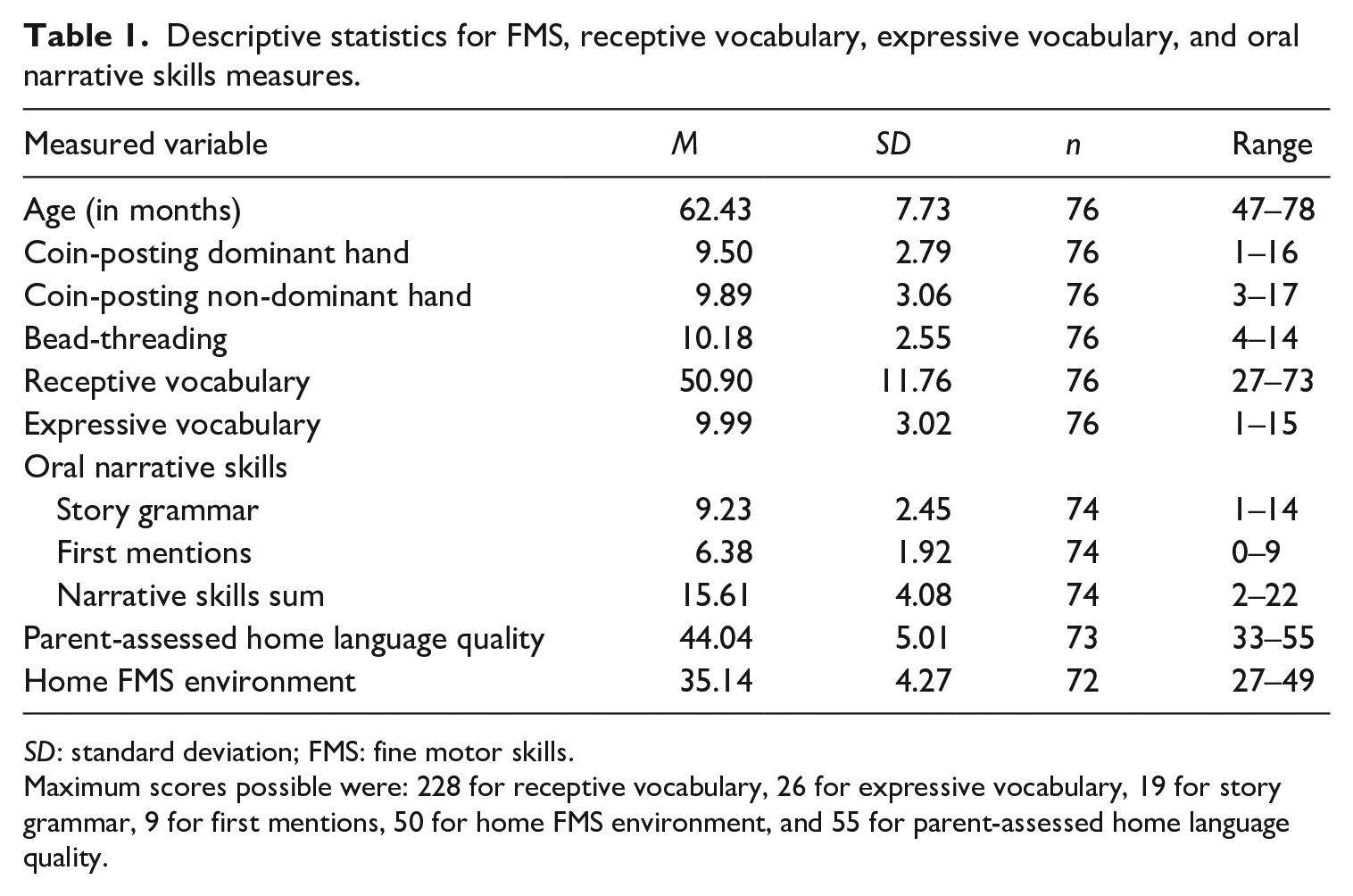
SD: standard deviation; FMS: fine motor skills.
Maximum scores possible were: 228 for receptive vocabulary, 26 for expressive vocabulary, 19 for story grammar, 9 for first mentions, 50 for home FMS environment, and 55 for parent-assessed home language quality.
To investigate whether FMS are associated with language skills, partial correlation coefficients were calculated between FMS, receptive vocabulary, expressive vocabulary, oral narrative skills, parent-assessed home language quality, and home FMS environment (presented in Table 2). These correlations controlling for age showed that links between FMS and oral narrative skills remained, r = 0.43, p < 0.001, while additionally revealing a small but significant relation between FMS and expressive vocabulary, r = 0.25, p < 0.045.
Correlation coefficients between FMS, receptive vocabulary, expressive vocabulary, oral narrative skills, home FMS environment, and parent-assessed home language quality corrected for age.
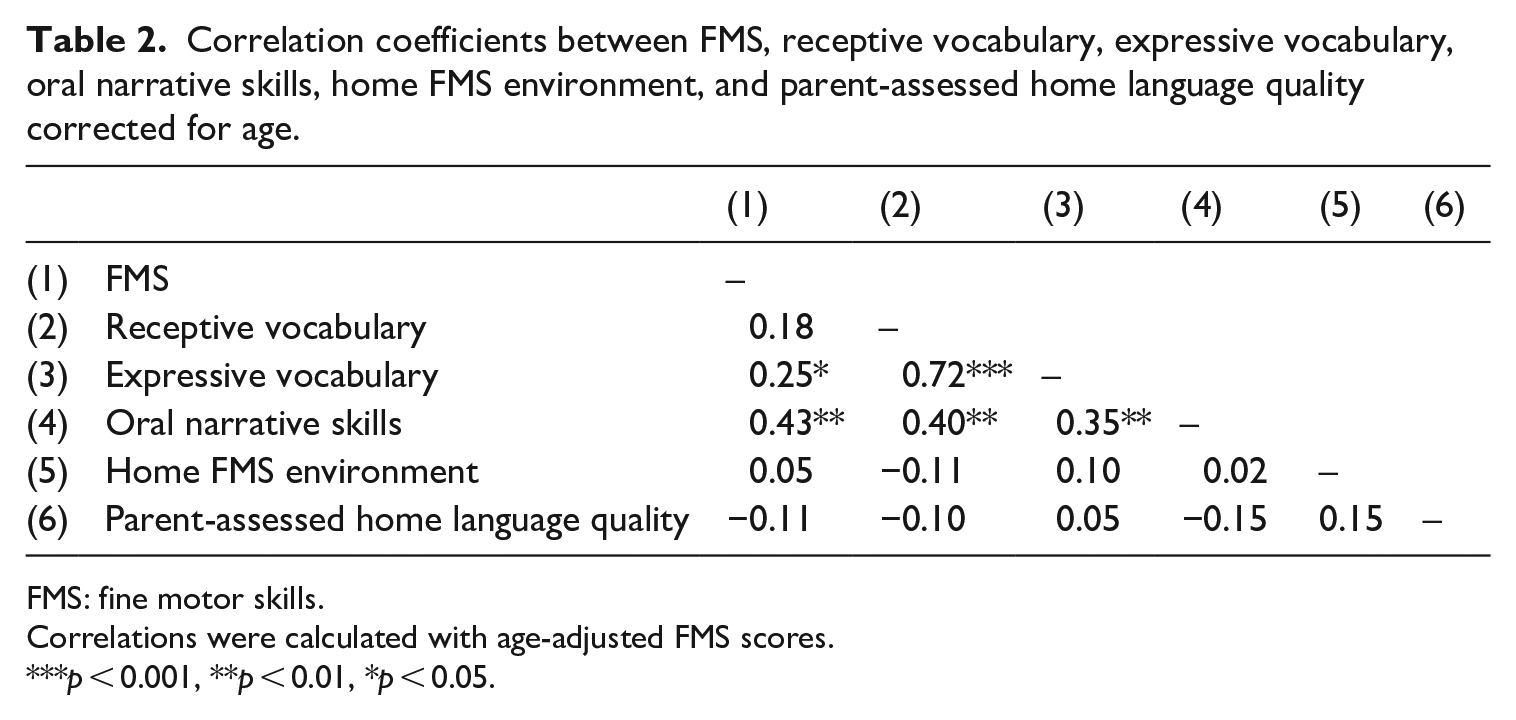
FMS: fine motor skills.
Correlations were calculated with age-adjusted FMS scores.
p < 0.001, **p < 0.01, *p < 0.05.
To assess the role of FMS for the different language variables, three separate hierarchical linear regression analyses were conducted. These analyses were administered to evaluate whether FMS uniquely predicted receptive vocabulary, expressive vocabulary, and oral narrative skills over and above the control variables age, parent-assessed home language quality, home FMS environment, language spoken at home (1 = German, 0 = other), and maternal education. Thus, the control variables were added as a first step, with FMS added as a second step. The results show that adding FMS to the models improved these, with FMS also being a significant predictor for all three different language measures, indicating that children with higher FMS scores also showed higher receptive and expressive vocabulary scores and more pronounced oral narrative skills. Language spoken at home showed a significant link to both receptive and expressive vocabulary but only a marginally significant link to oral narrative skills. Interestingly, age emerged as a significant predictor for oral narrative skills and a marginally significant factor for receptive vocabulary. Thus, older children showed better oral narrative skills, whereas expressive vocabulary skills were not related to age. No other variables emerged as significant predictors (see Table 3).
Hierarchical regression analysis testing links between FMS and language controlling for age, home FMS environment, German spoken at home, parent-assessed home language quality, and maternal education.
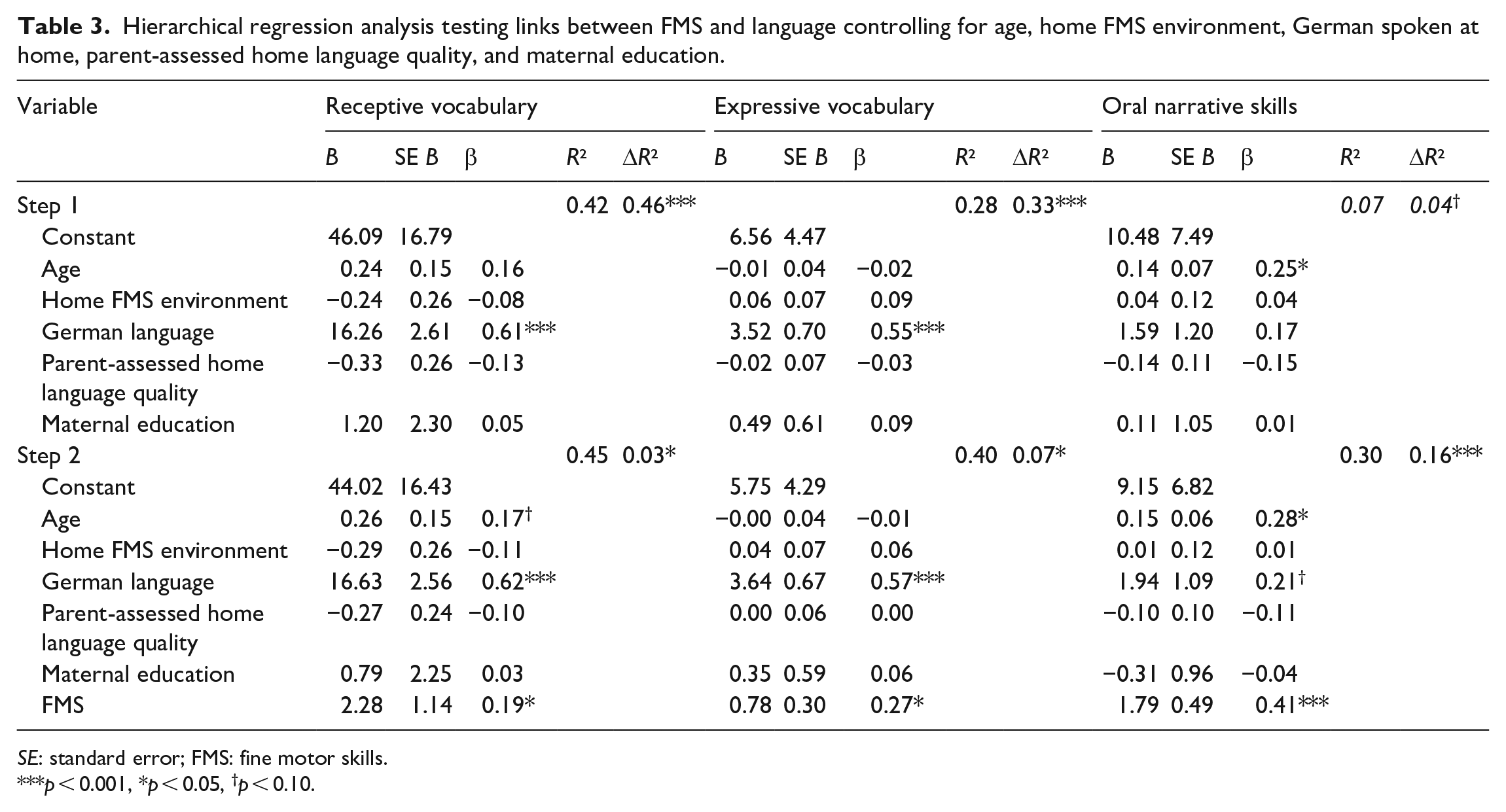
SE: standard error; FMS: fine motor skills.
p < 0.001, *p < 0.05, †p < 0.10.
In a more conservative analysis, we tested whether adding receptive vocabulary to the regression model as a general control for cognitive functioning would yield similar results. Therefore, we entered age, parent-assessed home language quality, German spoken at home, maternal education, and receptive vocabulary skills as control variables in Step 1, with FMS added as a Step 2 variable. Although receptive vocabulary as a general cognitive control emerged as a significant predictor of narrative skills in Step 1 of the regression, this contribution decreased once FMS were included in the analysis (see Table 4). However, FMS were still a significant predictor in this model.
Hierarchical regression analysis testing links between FMS and oral narrative skills controlling for age, home FMS environment, language spoken at home, parent-assessed home language quality, and maternal education, and receptive vocabulary.
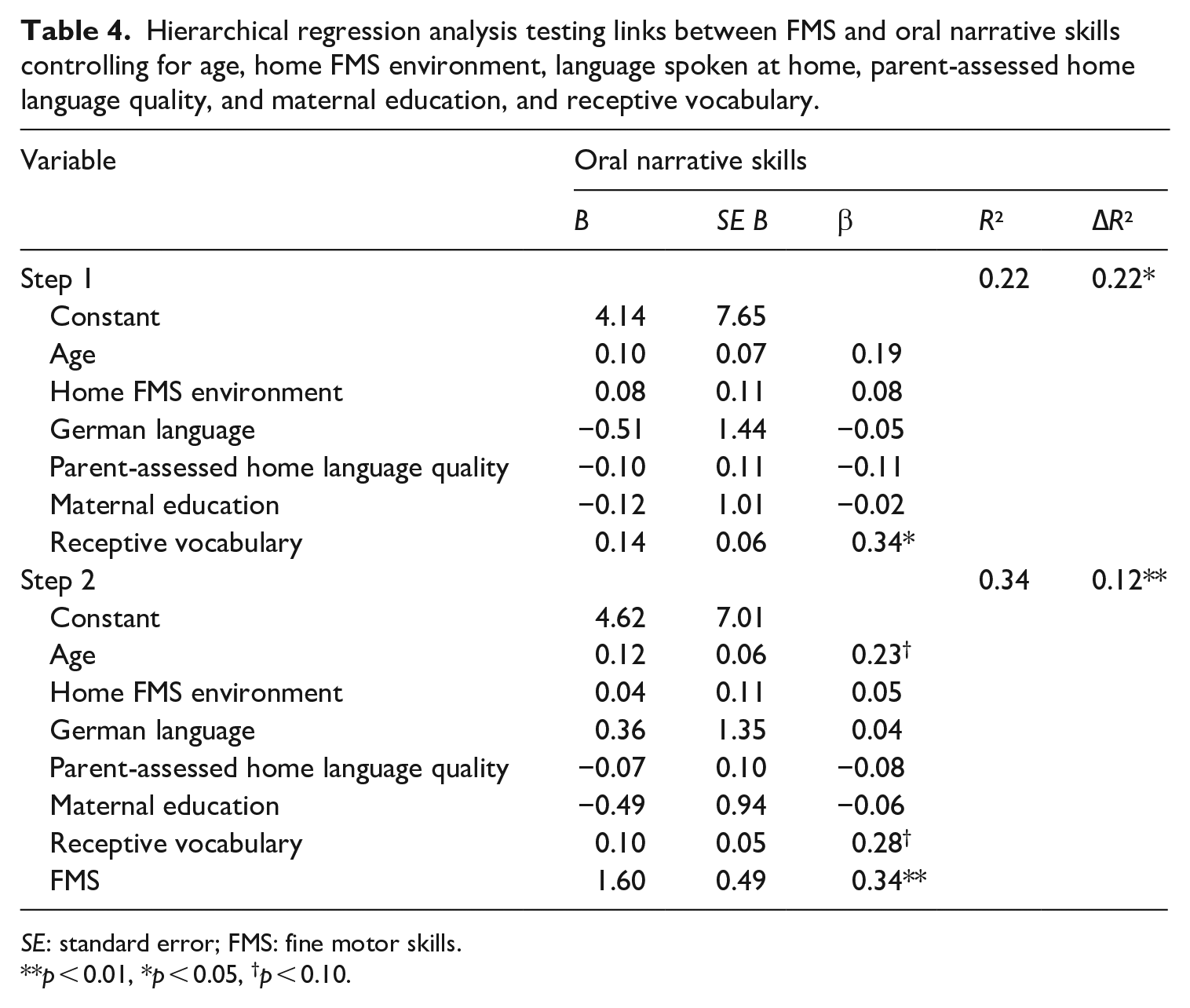
SE: standard error; FMS: fine motor skills.
**p < 0.01, *p < 0.05, †p < 0.10.
Discussion
The aim of this study was to gather systematic insight into the relationship between FMS and language development, specifically testing links with receptive vocabulary, expressive vocabulary, and oral narrative skills. Findings largely indicate a strong relationship between FMS and language in typically developed children, being generally consistent with the hypotheses that FMS contribute uniquely to receptive and expressive vocabulary skills as well as to oral narrative skills.
Specifically, our results indicate that children with better FMS also show more pronounced receptive vocabulary skills after controlling for children’s age, home FMS environment, German spoken at home, parent-assessed home language quality, and maternal education. Our analyses show a distinct relationship between FMS and expressive vocabulary, both in the correlation analysis and the hierarchical regression. Children showing better FMS also exhibit higher expressive language skills. These results are consistent with previous research, showing FMS to predict expressive language skills (Cameron et al., 2012; Pagani et al., 2010).
A key finding of our study is the clear association between FMS and oral narrative skills. To our knowledge, this is the first study to assess this relationship, therefore our results offer new and unique insights. Including oral narrative skills promises a novel and more extensive look at language development in context of FMS. Oral narrative skills include, among others, aspects such as syntax, grammar, story structure, or character motivation. Our results, therefore, indirectly suggest that a role might be afforded to these aspects. Our correlation analysis, as well as our regression models, demonstrated a strong connection between the ability to skillfully use one’s hand and being able to produce speech in a communicative environment.
A possible explanation for this finding might be underlying commonalities that link FMS and narrative skills. One such feature could be the aforementioned sequencing (Savalia et al., 2016). Children exhibit clear changes in their language sequencing abilities during their early development. From ages 3–5, children move from merely describing objects and events, to showing clear signs of a temporal organization when telling stories. Therefore, sequencing seems to manifest in language production during that developmental period (Berman & Slobin, 1996). Interestingly, the ability to plan and coordinate in a coherent sequence, is not only essential for narrative skills, it also is a crucial component of complex fine motor actions. For example, when learning a novel fine motor action, motor sequences have to be organized, so that they can be executed efficiently (Contreras-Vidal et al., 2005). Future studies should investigate this possible pathway further and assess narrative skills, FMS, and sequencing skills separately, including the latter as a mediator in the models. A different approach might be to adjust the sequencing demands during FMS and narrative skill tasks and observe whether participants’ performances are affected by the increase or decrease of sequencing demands.
Interestingly, there was no correlation between home FMS activities and FMS. First, we note that the validation study for this measure (Suggate et al., 2016) had three times as many participants as we did. In addition, Suggate et al. (2016) found that one sub-category of FMS, namely crafting, predicted FMS, whereas we chose to combine the subscales in this study to better capture a range of FMS and to avoid low statistical power by adding extra predictors to the model. It is, however, possible that this was not sufficiently differentiated and sensitive.
Overall, our study seems to support the view of developmental cascades (Oakes & Rakison, 2019). Our results show a strong link between all three language measurements (receptive vocabulary, expressive vocabulary, and oral narrative skills) and FMS, leading to the assumption that these developmental domains are intertwined in some form. It seems that modifications in one domain can lead to opportunities for changes in the other developmental domain, although longitudinal research would be needed to test this.
Limitations
This study provided interesting insights into the link between FMS and language skills. Nevertheless, due to methodological and conceptual reasons, we interpret these findings with caution. First, we did not measure cognitive skills using a standardized test, but rather utilized receptive and expressive vocabulary skills as a control for general cognitive abilities in one of the hierarchical regression models (predicting narrative skills). As producing and comprehending language includes several processing steps, it can be considered a very complex human cognitive skill. However, both receptive and expressive vocabulary skills strongly correlate with oral narrative skills. Future studies should, therefore, assess general cognitive abilities using a language-independent test to minimize confounding.
Second, we only used dexterity measures to assess FMS. We did this, because previous studies have shown dexterity to have the strongest associations with cognitive variables (Gandotra et al., 2022; Martzog et al., 2019). However, it might still prove fruitful to look into different FMS domains. Especially in a preschool setting, it may be interesting to look at graphomotor skills and their link to vocabulary and oral narrative skills. As both graphomotor skills (Suggate et al., 2022) and vocabulary skills (Bleses et al., 2016) have emerged as strong predictors of academic skills, it may be promising to take a closer look at their interconnection in the early years.
Finally, as this is a correlational study, a causal explanation of the links between FMS and language should be avoided. Conceptually, three kinds of influences are conceivable. FMS may improve exploration and thereby language development (Iverson, 2010). Alternatively, language might improve opportunities to engage in FMS enhancing activities. Finally, it could be that common shared processes, such as sequencing, via embodied cognition (Suggate & Stoeger, 2017), or through executive functions, are central to both. Although executive functions have not explained away links between FMS and cognitive development previously (Gandotra et al., 2022), research on language development specifically is missing. In addition, future work would ideally be longitudinal or experimental to test for directionality of influences between FMS and language skill.
Educational implications
The current findings have educational implications, highlighting once again the importance of viewing motor and language development as intertwined ( Iverson, 2010; Suggate & Stoeger, 2017). It seems that a specific competency such as motor skills, acquired during a specific developmental stage, can influence a different skill, that is, language, over time (Iverson, 2021). Of course, a correlational study, such as ours, does not allow concrete recommendations for professional practice. Rather, our results, in combination with findings from other studies, suggest that FMS play an important role in language development. Therefore, it could prove useful to intentionally refine FMS in children. This cannot and should not replace language enrichment, but instead complement it. Therefore, children should have the opportunity to engage in fine motor activities, both in kindergarten and school, as this in turn may help facilitate vocabulary learning and narrative story telling. Informal observations of children busy crafting in educational settings, while also engaging in conversations with their neighbor, are not uncommon. Indeed, from a philosophical point of view, it is also likely that motor actions form a corporeal foundation of concepts, a phenomenon recently termed embodied cognition (Barsalou, 1999).
Somewhat alarmingly, the results of a study (Gaul & Issartel, 2016) have shown that children’s FMS proficiency has fallen below developmental norms in some age brackets. The findings of Gaul and Issartel (2016) are in line with the downward trend observed in other research on children’s motor skills (Bardid et al., 2015; Hardy et al., 2013). This may, in part, be due to the advance in technology and the decrease in traditional leisure activities (Martzog & Suggate, 2022), such as jigsaws or board games, which are heavily FMS-based activities. Without sufficient opportunities to further engage children’s FMS, it might be expected that the downward trend in FMS might spill over to other developmental areas, such as language. Viewing this through the eyes of developmental cascades, well-timed and specific interventions may be able to counteract negative, or promote positive, cascades and therefore open up new and interesting avenues to explore. Accordingly, the development and evaluation of FMS interventions alongside existing FMS and language interventions would appear worthy of pursuit. Interventions could start at a very young age by helping children in the toddler period with FMS such as provision of materials that entice them into writing/copying, drawing or manipulating objects, along with opportunities to engage in language interactions.
Interventions during the school years may also be promising. During a typical school day, 46% of time is spent doing FMS based activities, such as coloring or writing (Marr et al., 2003). Furthermore, studies on the link between FMS and language skills in school aged children have shown FMS to be a strong predictor of language (Morales et al., 2011). Therefore, it might be interesting to make use of this relationship and implement FMS in language learning in the classroom.
Moving to the other end of the life span, it may be promising to also extend this work to older individuals. It is well known that both motor skills and cognitive functions change over the course of a lifetime (Contreras-Vidal et al., 1998; Hedden & Gabrieli, 2004; Nilsson, 2003). Studies have found a decline in FMS with aging (Hoogendam et al., 2014). Language production, especially word-retrieval, also consistently shows age-related declines (Cohen & Faulkner, 1986). Therefore, it might prove fruitful to take a closer look at the exact relationship of FMS and language in an older population, as the literature here is, essentially, non-existing.
Conclusion
This study adds to the small literature on links between FMS and receptive vocabulary development, to the even smaller literature on FMS and expressive vocabulary, and to the previously absent literature on FMS and oral narrative skills. Although findings indicate that language and FMS are interconnected, more work is needed at a theoretical and empirical level to understand causality and to develop interventions.
Supplemental Material
sj-docx-1-fla-10.1177_01427237241233084 – Supplemental material for Fine motor skills and their link to receptive vocabulary, expressive vocabulary, and narrative language skills
Supplemental material, sj-docx-1-fla-10.1177_01427237241233084 for Fine motor skills and their link to receptive vocabulary, expressive vocabulary, and narrative language skills by Rebecca E. Winter, Heidrun Stoeger and Sebastian P. Suggate in First Language
Footnotes
Acknowledgements
We would like to thank Victoria Piel for help with data collection.
Author contributions
Declaration of conflicting interests
The author(s) declared no potential conflicts of interest with respect to the research, authorship, and/or publication of this article.
Funding
The author(s) received no financial support for the research, authorship, and/or publication of this article.

Supplemental material
Supplemental material for this article is available online.
References
Supplementary Material
Please find the following supplemental material available below.
For Open Access articles published under a Creative Commons License, all supplemental material carries the same license as the article it is associated with.
For non-Open Access articles published, all supplemental material carries a non-exclusive license, and permission requests for re-use of supplemental material or any part of supplemental material shall be sent directly to the copyright owner as specified in the copyright notice associated with the article.
