




Abstract
Vocabulary size is a crucial early indicator of language development, for both monolingual and bilingual children. Assessing vocabulary in bilingual children is complex because they learn words in two languages, and there remains significant controversy about how to best measure their vocabulary size, especially in relation to monolinguals. This study compared monolingual vocabulary with different metrics of bilingual vocabulary, including combining vocabulary across languages to count either the number of words or the number of concepts lexicalized and assessing vocabulary in a single language. Data were collected from parents of 743 infants and toddlers aged 8–33 months learning French and/or English, using the MacArthur-Bates Communicative Development Inventories. The results showed that the nature and magnitude of monolingual–bilingual differences depended on how bilinguals’ vocabulary was measured. Compared with monolinguals, bilinguals had larger expressive and receptive word vocabularies, similarly sized receptive concept vocabularies and smaller expressive concept vocabularies. Bilinguals’ single-language vocabularies were smaller than monolinguals’ vocabularies. The study highlights the need to better understand the role of translation equivalents in bilingual vocabulary development and the potential developmental differences in receptive and expressive vocabularies.
Age-appropriate vocabulary size is an important marker of typical language development and predicts a variety of language, literacy, and academic outcomes (Duff et al., 2015; Marchman & Fernald, 2008). Given the growing number of immigrant children and bilingual families (Luk, 2017; Prevoo et al., 2016; Schott et al., 2022), there is an increasing need for understanding how to best quantify vocabulary development in bilingual toddlers. For monolingual children, the words a child knows can simply be counted to yield a receptive (words understood) or expressive (words produced) vocabulary score, which can be compared with age-referenced vocabulary norms (Fenson et al., 2007). Measuring vocabulary is more complex in bilingual toddlers, as they learn words in two languages from early in development (Petitto et al., 2001).
Bilingual children’s vocabulary can be measured either in a single language or by combining their knowledge across their languages. Such measures might point to different aspects of children’s development. For example, single-language measures might reflect children’s ability to communicate in monolingual social or educational situations, whereas measures that combine across languages might more closely reflect children’s overall level of conceptual and/or linguistic development. A recent review found that most studies that measured vocabulary in young bilinguals reported single-language measures in each language (68%), but many fewer reported a combined measure (43%; Weisleder et al., 2022). When single-language vocabulary is measured, bilingual children tend to have smaller productive vocabularies than monolinguals (e.g. Bialystok et al., 2010; Hoff & Ribot, 2017; Pearson et al., 1993; Thordardottir et al., 2006; Uccelli & Páez, 2007). This monolingual–bilingual difference is typically larger in children’s non-dominant (weaker/least-heard) language than in their dominant (stronger/most-heard) language (Altman et al., 2018; Cattani et al., 2014; Thordardottir, 2011).
To overcome the limitations of single-language vocabulary assessment, researchers have long advocated for assessing bilingual vocabulary in a way that considers both languages (Kohnert, 2010; Pearson et al., 1993). ‘Total vocabulary’ and ‘total conceptual vocabulary’ are two commonly used combined metrics of bilingual children’s vocabulary development. In the current study, we have updated these terms to be more concise and transparent, to clarify the interpretation of the outcomes they provide. We call word vocabulary the measure that combines the total number of words the child knows in each of their languages (historically referred to as total vocabulary), while we call concept vocabulary the measure that only includes the number of concepts the child knows in either language (historically referred to as total conceptual vocabulary). These two metrics differ in their treatment of translation equivalents (i.e., cross language synonyms like English ‘dog’ and French ‘chien’): word vocabulary gives credit for all words the child produces, including translation equivalents, whereas concept vocabulary does not give double credit for translation equivalent pairs. As an example, a child who knows both ‘dog’ and ‘chien’ would obtain 2 points for word vocabulary (since they know both words) but only 1 for concept vocabulary (since both words refer to the same concept).
The key difference between word and concept vocabularies is how they credit children’s knowledge of translation equivalents, so it is important to consider how young bilinguals learn translation equivalents compared with singlets (i.e. words without a known translation equivalent). Some theories posit that bilingual children avoid learning translation equivalents due to constraints on learning two labels for the same object (Volterra & Taeschner, 1978), while others posit that children prefer to learn translation equivalents if it is easier for them to associate a new label with an already lexicalized referent than to associate a word with a referent that is not already in the lexicon (Montanari, 2010). Finally, it is possible that bilingual children learn translation equivalents with equivalent difficulty/ease as they learn singlets (Pearson et al., 1995). In a recent large-scale study, Tsui et al. (2022) found that for children with larger vocabularies, children’s knowledge of translation equivalents was nearly exactly what would be expected by chance overlap in the vocabularies in each language. That is, children neither preferred to learn translation equivalents, nor avoided them. However, children with smaller vocabularies showed some preference for learning translation equivalents, which is in line with some other studies (Bilson et al., 2015). Related back to the different combined vocabulary metrics, if translation equivalents are learned with similar difficulty as singlets, then as for word vocabulary they should be counted twice to yield a score that is comparable across monolinguals and bilinguals. Alternatively, if translation equivalents are learned more easily than singlets, then as for concept vocabulary they should not be double counted to yield a vocabulary score similar across monolinguals and bilinguals.
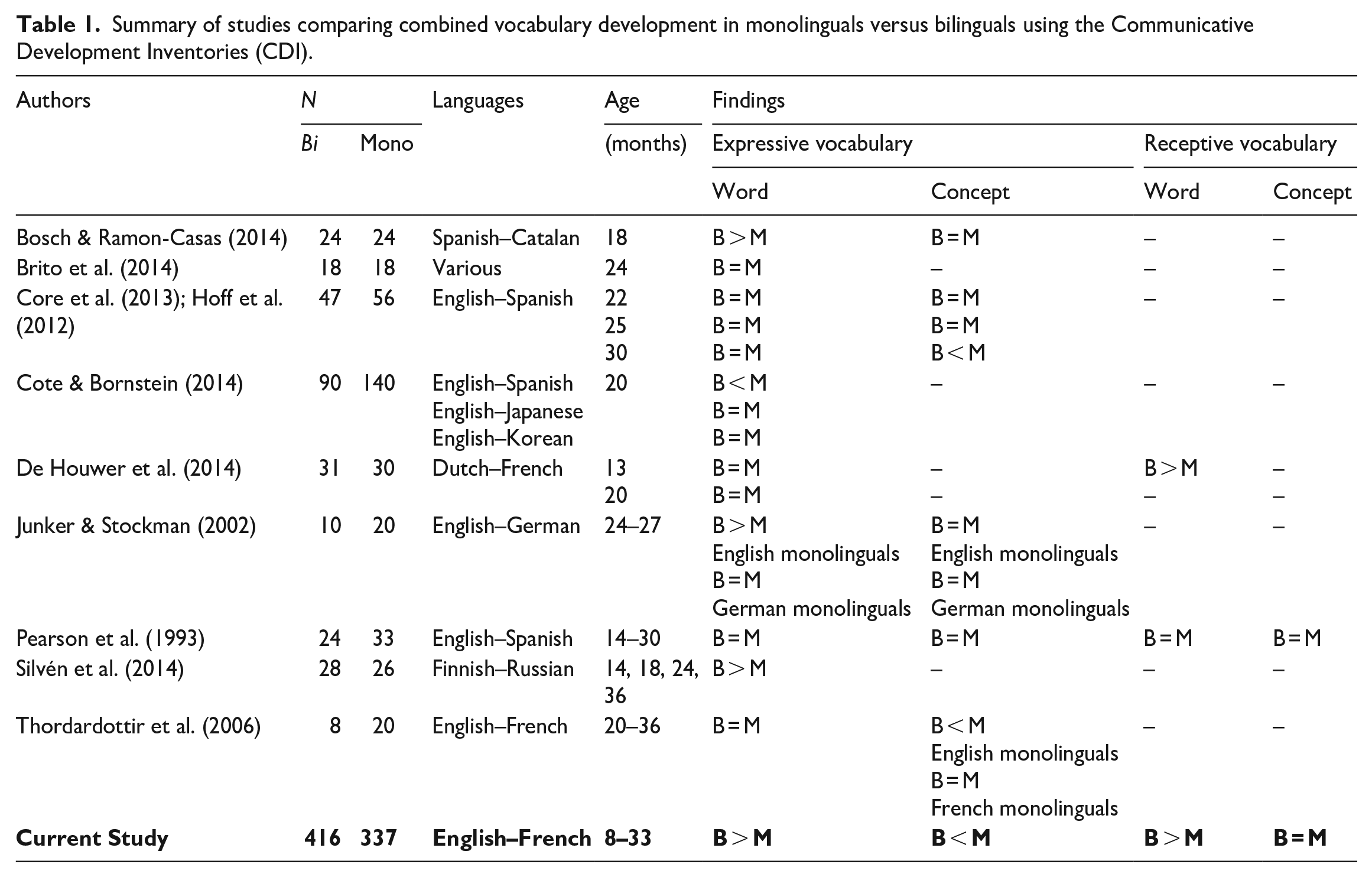
A number of studies have compared monolinguals and bilinguals on concept and/or word vocabulary. When comparing expressive word vocabularies at various ages between 14 and 36 months, multiple studies have reported that bilinguals have similar vocabulary scores to monolinguals (Spanish–English, Core et al., 2013; Hoff et al., 2012; Various language pairs, Brito et al., 2014; Russian–Finnish, Silvén et al., 2014). However, other studies reported that bilinguals have larger expressive word vocabularies than monolinguals at 18 months (Spanish–Catalan; Bosch & Ramon-Casas, 2014) and 24 months of age (English–German; Junker & Stockman, 2002). Of interest, one study of 20-month-olds found different results depending on cultural and/or linguistic context: English–Japanese and English–Korean bilinguals had similar expressive word vocabularies to their monolingual peers, while Spanish–English bilinguals had lower word vocabularies than either Spanish or English monolinguals (Cote & Bornstein, 2014).
In relation to concept vocabulary, some studies have found that this measure disadvantages bilinguals (Spanish–English expressive vocabulary, Core et al., 2013; French–English expressive vocabulary, Thordardottir et al., 2006), while other studies have found that this approach yields comparable scores across monolinguals and bilinguals (e.g. Dutch–French receptive and expressive vocabulary, De Houwer et al., 2014; English–German expressive vocabulary, Junker & Stockman, 2002; Spanish–English receptive and expressive vocabulary, Pearson et al., 1993). Studies that have looked at both word and concept vocabulary have had mixed findings, with some suggesting that word vocabulary (e.g. Core et al., 2013), and other studies suggesting that concept vocabulary (Junker & Stockman, 2002), is most similar between monolinguals and bilinguals, and still others finding that both metrics are comparable (De Houwer et al., 2014). Finally, another approach has been to develop bilingual-specific norms (receptive and expressive vocabulary in learners of English and another language, Floccia et al., 2018; receptive vocabulary in multiple language pairs, Gampe et al., 2018), although currently these are only available for children of very specific ages.
Additional large-scale data are needed given the mixed findings in the literature regarding how bilinguals compare with monolinguals when measured on different vocabulary metrics, particularly given the small sample sizes and/or limited ages assessed in most previous studies (for a summary of the studies using the [Communicative Development Inventories] CDI, see Table 1). Such information can provide theoretical insight into the nature of bilingual vocabulary development, the role of translation equivalents, and the development of receptive versus expressive vocabulary. The research question for the current study was how young monolinguals and bilinguals compare across age on different vocabulary metrics.
Summary of studies comparing combined vocabulary development in monolinguals versus bilinguals using the Communicative Development Inventories (CDI).
We examined the vocabularies of 743 children aged 8–33 months, a much larger sample than in previous studies. Children were learning French and/or English in a community where languages have similar sociolinguistic status, providing an optimal control for potentially confounding variables that may differ systematically between monolinguals and bilinguals in some contexts. While vocabulary development is influenced by multiple variables such as language quality, family language strategies, variation in language exposure, and age of exposure to each language (e.g. De Houwer, 2011; Unsworth, 2016; see Byers-Heinlein et al. 2019 for a discussion of key variables in bilingual language development), in this study we focused on vocabulary metrics that have been consistently used to describe vocabulary development in bilingual children. Uniquely, our study examined both receptive and expressive vocabulary across four metrics: word vocabulary, concept vocabulary, dominant language vocabulary, and non-dominant language vocabulary. For single-language vocabularies, both dominant and non-dominant, we predicted that bilinguals would have smaller vocabularies than monolinguals. For combined vocabularies, we predicted that bilinguals and monolinguals would have more similar vocabularies, although we did not make specific predictions as to whether word vocabulary or concept vocabulary would yield the most comparable score.
Method
This research was conducted according to the Declaration of Helsinki, and was approved by the Human Research Ethics Board of Concordia University (certification numbers UH2011-041-1 and 10000439). Parents provided informed consent.
Participants
Data were collected from parents of typically developing infants aged 8–33 months (47% female) between 2010 and 2018. Recruitment was carried out through government birth lists, daycares, and online ads. Data were largely cross-sectional, although a subset of children contributed data at multiple time points (see data analysis section for details on how statistical analyses accounted for these repeated measures). Children visited the lab one (75.4%), two (19.9%), three (4.2%), or four (0.5%) times for experimental studies, and vocabulary data were collected on each visit (see following section for details on data collection procedures). The analyzed dataset included data from 743 infants who collectively took part in 947 lab visits. Following criteria similar to the norming sample for the American English CDI (Fenson et al., 2007), we excluded children who were born premature (< 36 weeks gestation), who had low birth weight (< 2500 grams), who presented with major medical conditions (e.g. meningitis, major surgeries), or who fell outside our target age range of 8–33 months. Children were mainly reported to be of European descent (48%), followed by Other (12%) and Multiple Ethnicities (10%). Sixteen percent of parents did not report their child’s ethnic background. Other ethnic groups each made up 5% or less of the sample.
Families lived in Montréal, Québec, a multicultural Canadian city where English and French are regularly used in everyday life and are both held in high regard (Kircher, 2014). While French is the official language provincially, French and English have official status federally. Public schooling is available in both languages, and 46% of individuals living in Québec identify as French–English bilinguals (Statistics Canada, 2022). These attributes are ideal for comparison of the two groups, as they avoid confounds often present in studies that compare monolingual and bilingual samples that differ in the proportion of immigrants, socioeconomic status, social prestige, and official status of the two languages (e.g. Cattani et al., 2014; Floccia et al., 2018; Hoff et al., 2014). Parental education was used as a proxy for socioeconomic status; maternal education was reported for 98.5% of participant visits, paternal education was reported in a further 0.3% of visits, and parental education was not reported for 1.2% of visits. Overall, parental education was high, with an average of 16.7 years for parents of monolinguals and 16.9 years for parents of bilinguals. All parents with the exception of four mothers of monolinguals and 10 mothers of bilinguals reported at least some post-secondary education.
Language background assessment
Children’s language background was gathered through a comprehensive interview and defined based on lifetime exposure to different languages, as assessed by the Language Exposure Questionnaire (Bosch & Sebastián-Gallés, 2001) using the Multilingual Approach for Parent Language Estimates (Byers-Heinlein et al., 2019), which has good reliability for this population (r = .88; Orena et al., 2019). Monolingual children were exposed to either English or French 90% of the time or more. Following prior research (e.g. Byers-Heinlein & Werker, 2009), bilingual children were exposed to both English and French 25%–75% of the time, with no more than 10% exposure to a third language. Language exposure was assessed at each lab visit. Children were classified as monolingual at 437 lab visits and bilingual at 510 lab visits. Ten children who participated at multiple ages experienced differences in their language exposure between visits great enough to switch their language background category from monolingual to bilingual or vice versa.
A child’s dominant language was deemed to be the language the child had greater exposure to (or for most monolinguals, exclusive exposure to). For children with perfectly balanced exposure (50% of exposure to each language), the dominant language was the one in which the child was reported to produce the most words. English was the dominant language at 523 lab visits, and French at 424 visits. For 17 children who participated at multiple ages, the language assessed to be their dominant one switched from English to French or vice versa between visits.
Vocabulary measures
The words children knew in English and/or French were measured via American English and Québec French adaptations of the MacArthur-Bates CDI (Fenson et al., 2007; Trudeau et al., 1999), using the Words and Gestures form for children aged 8–16 months (which measures both receptive and expressive vocabulary; 396 items in English, 414 items in French) and the Words and Sentences form for children aged 17–33 months (which measures expressive vocabulary only; 680 items in English, 664 items in French).
CDIs were administered at each lab visit. Parents completed the CDI either on paper or on a tablet computer. We asked that the caregiver who was most familiar with the child’s vocabulary in the specific language being evaluated complete the questionnaire. Each completion of a specific CDI form (i.e. in English or French) at a specific age was considered one administration. CDI administrations for monolingual children were filled out mainly by mothers (59%), fathers (4%), or both parents (1%); the respondent was not indicated for 36% of administrations. CDI administrations for bilingual children were completed by mothers (63%), fathers (7%), both parents (4%), or other family members (< 1%; e.g. grandmother); the respondent was not indicated for 25% of administrations. We note that among French–English bilingual families in Montreal, the most common family language strategy is where both parents use both languages with their child (Sander-Montant et al., 2023), and moreover Canadian mothers spend more time caregiving than Canadian fathers (Houle et al., 2017). These factors likely explain why mothers were most often judged by families to be the best person to complete the CDI in both languages.
The analyzed dataset consisted of 1338 CDI administrations (n = 647 Words and Gestures administrations; n = 691 Words and Sentences administrations). We retained the data from all administrations wherever possible, as our statistical models were able to account for dependencies in the data for children who contributed data at multiple ages and children whose language group or language dominance switched between lab visits, and because the additional data increased statistical power and reliability.
For monolinguals, there were a total of 510 administrations: 277 administrations in English-learning children (nchildren = 217) and 233 administrations in French-learning children (nchildren = 199). For bilinguals, there were a total of 828 administrations: 472 administrations in English-dominant children (nchildren = 196) and 356 administrations in French-dominant children (nchildren = 157). The proportion of administrations where English was the native/dominant language was similar across monolinguals (54%) and bilinguals (57%). In cases where bilingual children had missing data in one of the CDI questionnaires (n = 46, 11 cases missing data in the dominant language, 35 cases missing data in the non-dominant language), data were excluded for analyses that required the combination of both questionnaires (e.g. concept vocabulary, word vocabulary), but were included in analyses that focused on one language (e.g. dominant language, non-dominant language).
Monolinguals’ vocabulary scores were determined by tallying the number of words children produced and (when available) understood in their single native language. For bilinguals, four different scores were calculated for expressive and (when available) receptive vocabulary. Dominant and non-dominant language vocabulary were calculated by tallying the number of words bilinguals knew in either English or French, depending on the child’s dominant and non-dominant languages. Word vocabulary counted the words bilinguals knew in both languages (English + French). Concept vocabulary counted the concepts for which bilinguals produced or (when available) understood a word. To do so, it was necessary to identify words across the two languages that refer to the same concept (i.e. translation equivalents; a full list of these pairs is available at https://osf.io/78hua and methodological details are reported in Tsui et al., 2022), then subtracting these from bilinguals’ word vocabulary.
Results
Data were analyzed using R Version 4.1.3 (R Core Team, 2022). Analysis scripts and the full dataset are available at https://osf.io/78hua .
Analytic approach
We conducted a series of regression models investigating how bilinguals compared with monolinguals in receptive and expressive vocabulary – with age as an additional predictor – across four ways of measuring bilinguals’ vocabulary: dominant language, non-dominant language, concept vocabulary, and word vocabulary. In each model, the same score was entered for monolinguals (i.e. their vocabulary size in their single native language). Because some children contributed vocabulary data at more than one age, we used the lmerTest package (Kuznetsova et al., 2017) to fit linear mixed-effects models that included random intercepts for participants, accounting for repeated measures of the same individual (Bates et al., 2015). 1
Previous research has suggested that patterns of early vocabulary size across age are quadratic (Bauer et al., 2002; Huttenlocher et al., 1991). Data visualizations and model comparisons showed that a quadratic age term improved fit for expressive vocabulary models (see https://osf.io/78hua), but not for receptive vocabulary models, possibly due to the smaller age range available for receptive vocabulary. We thus included a linear age term for all models, and a quadratic age term for expressive models only. The expressive models were fit with orthogonal polynomials to remove collinearity of the age predictors, thus, the intercept represents the number of vocabulary words at the average age in the dataset. To ease comparing expressive and receptive models, and because an intercept of 0 months would be outside our data range, we centered the age term in the receptive vocabulary models at 12 months. We also included the interactions between linear (and for expressive models, quadratic) age terms and language group, to examine whether the effect of age on these vocabulary measures was similar for monolinguals and bilinguals. We present analyses for expressive vocabulary prior to those for receptive vocabulary, as all children contributed expressive vocabulary data but only children 16 months and under contributed receptive vocabulary data.
Expressive vocabulary
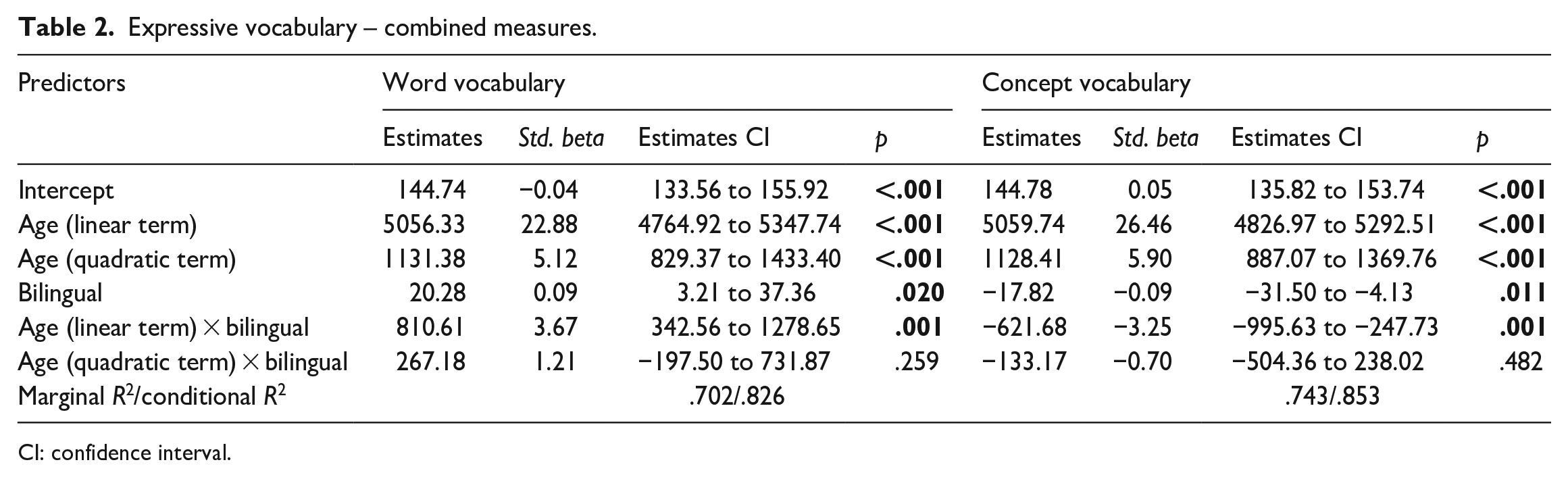
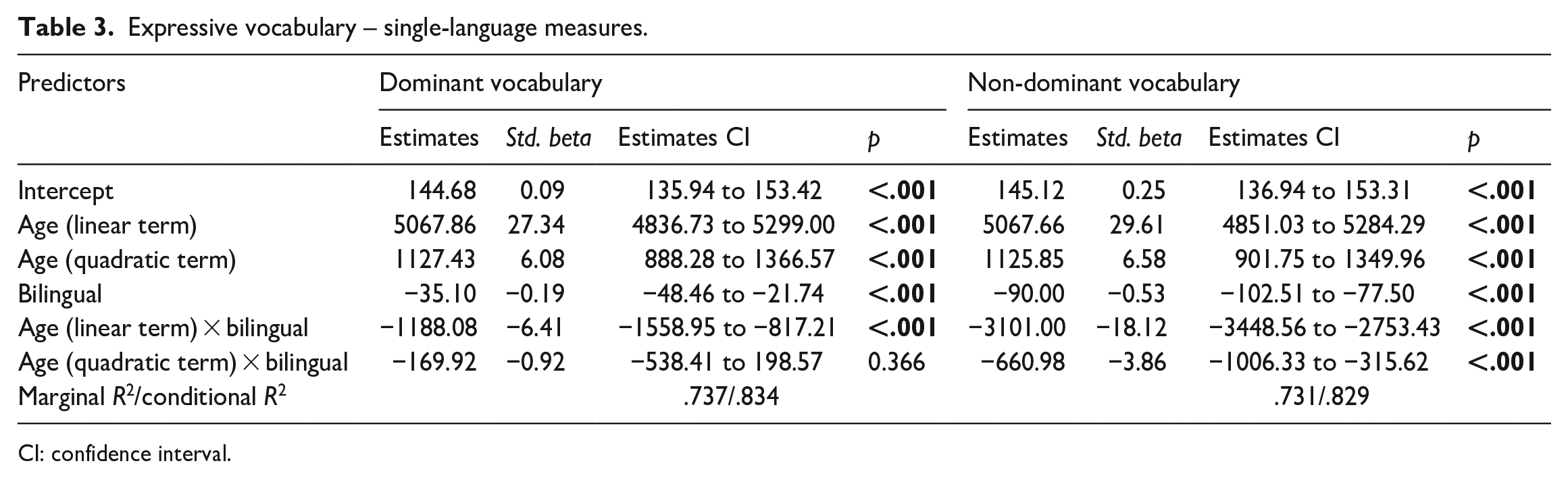
Figure 1 displays children’s expressive vocabulary across age, comparing monolinguals with bilinguals measured on word, concept, dominant, and non-dominant language metrics. Linear and quadratic terms for age were positive and significant for all models, showing that productive vocabulary size increased in an accelerating fashion (see Tables 2 and 3). All models showed significant interactions between age term(s) and language group indicating different patterns of vocabulary size across age, but the nature and the direction of the effect depended on bilinguals’ vocabulary measure. Bilinguals had a steeper increase in word vocabulary size with age compared with monolinguals, as shown by the significant positive interaction between linear age term and language group. By contrast, when bilinguals’ concept vocabulary or dominant vocabulary was measured, monolinguals had a higher and more steeply increasing vocabulary, as indicated by the significant negative interaction between the linear age term and language group. Monolinguals had larger, more steeply increasing, and more accelerated vocabulary slopes compared with bilinguals’ non-dominant vocabulary, as indicated by significant negative interactions between language group and both linear and quadratic age terms.
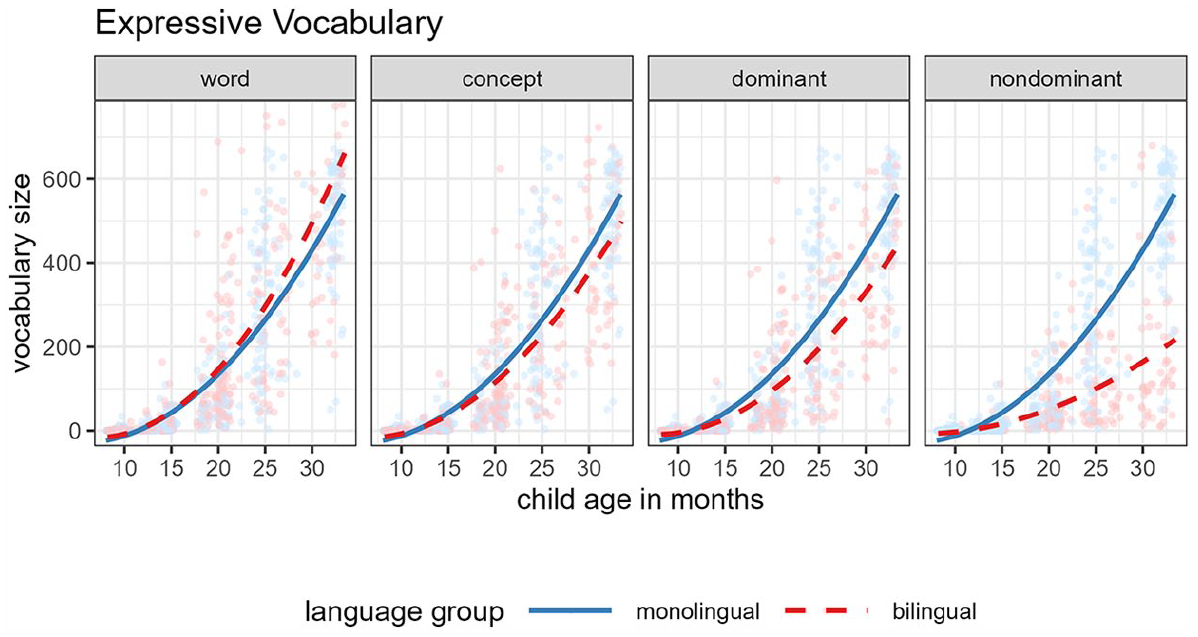
A Comparison of Monolinguals’ Expressive Vocabulary Size Across Age to Bilinguals’ Vocabulary Measured Via Four Different Metrics.
Expressive vocabulary – combined measures.
CI: confidence interval.
Expressive vocabulary – single-language measures.
CI: confidence interval.
In sum, when measured by word vocabulary, bilinguals’ expressive vocabulary development outpaced monolinguals’, whereas when bilinguals’ vocabularies were measured by concept, dominant, or non-dominant language vocabulary, monolinguals’ development outpaced bilinguals’. The differences with monolinguals were largest when bilinguals’ vocabularies were measured in a single language (i.e. dominant and non-dominant vocabulary).
Receptive vocabulary
Figure 2 displays monolinguals’ receptive vocabulary across age compared with bilinguals’ word, concept, dominant, and non-dominant language metrics. Receptive vocabulary size increased with age, as indicated by the significant linear term for age across all models (see Tables 4 and 5). For word vocabulary, the pattern for receptive vocabulary was similar to that seen in expressive vocabulary: word vocabularies for bilinguals increased faster than for monolinguals, as evidenced by the higher bilingual intercept and significant positive interaction between language group and age. For bilinguals’ concept vocabulary, however, there were no statistical differences in vocabulary size across age compared with monolinguals. Monolinguals had slightly larger vocabularies when bilinguals’ dominant language vocabulary was measured, although the change in vocabulary size across age was similar for both language groups, indicated by the positive baseline age term and its non-significant interaction with language group. Monolinguals again had steeper changes in vocabulary size across age when bilinguals’ non-dominant vocabulary was measured, as shown by the positive age term and its negative significant interaction with language group.
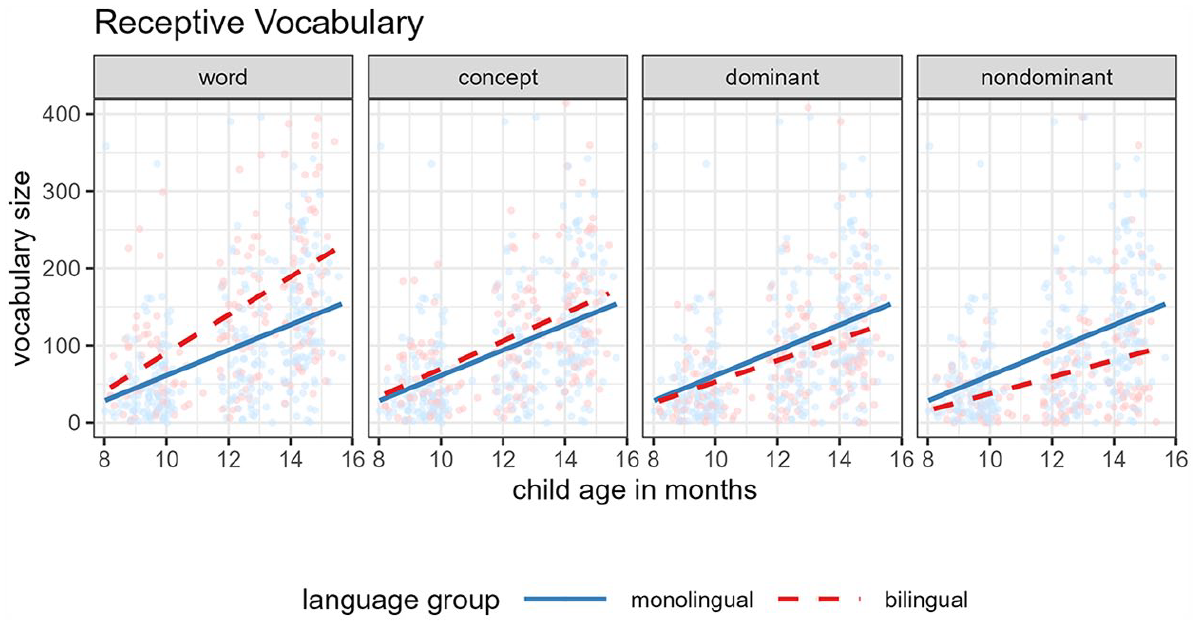
A Comparison of Monolinguals’ Receptive Vocabulary Size Across Age to Bilinguals’ Vocabulary Measured Via Four Different Vocabulary Metrics.
Receptive vocabulary – combined measures.
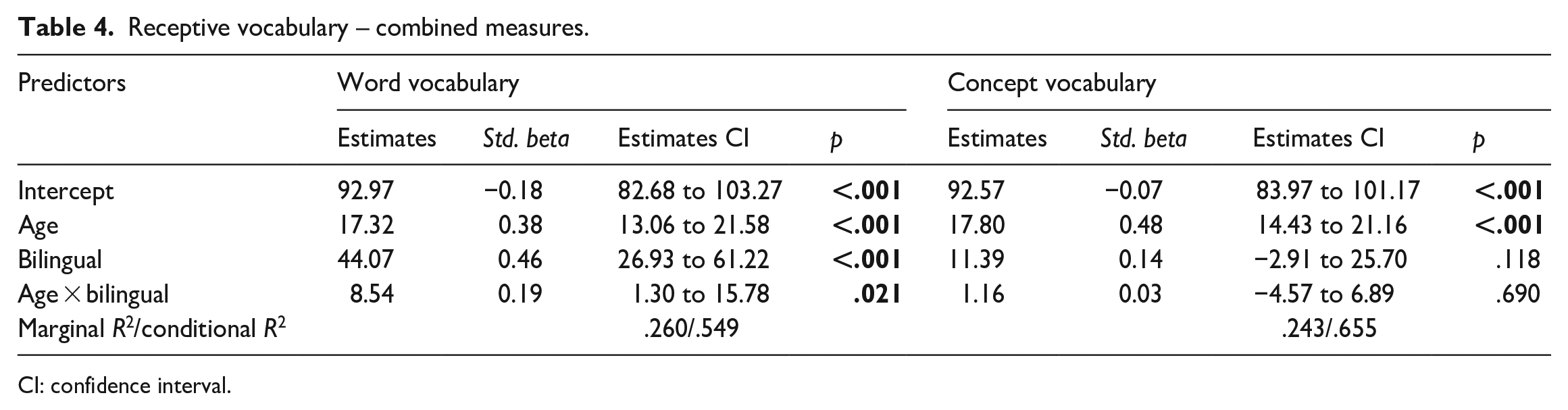
CI: confidence interval.
Receptive vocabulary – single-language measures.
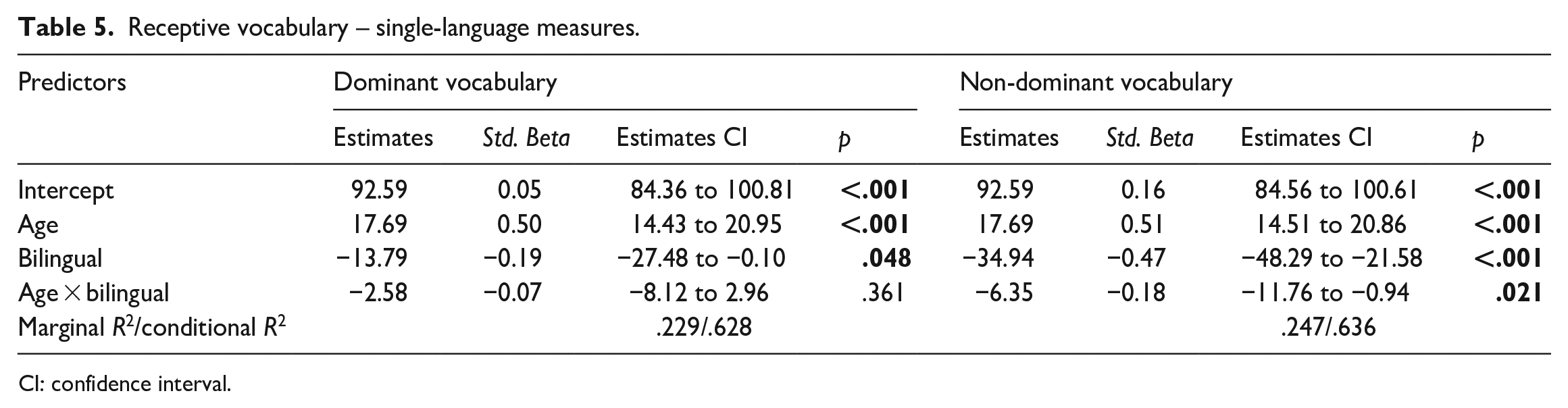
CI: confidence interval.
To summarize, when measured by combined vocabulary metrics – word vocabulary or concept vocabulary – bilinguals had receptive vocabularies either larger than or similar to monolinguals’ vocabularies, depending on the bilingual measure. For single-language vocabulary, whether bilinguals were measured in the dominant or non-dominant language, monolinguals had larger vocabularies, but the differences were less pronounced than for expressive vocabulary.
Discussion
Monolingual and bilingual children face different tasks in building vocabularies, as only bilinguals must learn words from two different languages. We examined how monolingual and bilingual language experience impacts vocabulary development across age. In a large sample of 1338 CDI administrations for 743 children learning French and/or English, we compared monolingual and bilingual children’s expressive (8–33-month-olds) and receptive (the subset of children who were 8–16 months old) vocabulary sizes. The size of our sample gave us the statistical power to detect effects that might have been missed in previous studies.
First, we confirmed that assessing bilinguals in a single language – whether their dominant or non-dominant – yielded a smaller vocabulary size for bilinguals relative to monolinguals for both expressive and receptive vocabulary, replicating and extending previous findings (Bialystok et al., 2010; Thordardottir et al., 2006). Bilinguals’ single-language vocabularies reflect their reduced exposure to these languages compared with monolinguals, with a larger discrepancy when bilinguals were measured in the non-dominant (least-heard) compared with the dominant (most-heard) language. While single-language measures might be appropriate for measuring some aspects of bilingual children’s ability to communicate in monolingual situations, they do not provide an adequate measure of their overall conceptual or vocabulary development.
Second, we found that traditional metrics combining bilinguals’ vocabularies across the two languages also resulted in significantly different patterns of vocabulary size across age compared with monolinguals. Word vocabulary (traditionally referred to as total vocabulary size) – which counts all words children know regardless of whether they know its translation equivalent – advantaged bilinguals in comparison to monolinguals. This effect was particularly strong in receptive as compared to expressive vocabulary, and was magnified at older ages. Concept vocabulary (traditionally referred to as total conceptual vocabulary size) – which gives no additional credit to words for which children know a translation equivalent – disadvantaged bilinguals in comparison to monolinguals, although only for expressive vocabulary. On the surface, our results appear to differ from most previous studies undertaking monolingual–bilingual comparisons on combined metrics, which have largely not found statistically significant differences in word and/or concept vocabulary (expressive concept vocabulary in Bosch & Ramon-Casas, 2014; 5 out of six comparisons in Core et al., 2013; two out of three comparisons in De Houwer et al., 2014; three out of four comparisons in Junker & Stockman, 2002; four out of four comparisons in Pearson et al., 1993). Nonetheless, when differences have been reported, the pattern was the same as in the current study: bilinguals had larger word vocabulary than monolinguals (expressive word vocabulary in Bosch & Ramon-Casas, 2014; receptive word vocabulary at 13 months in De Houwer et al., 2014; expressive word vocabulary in bilinguals compared with English monolinguals in Junker & Stockman, 2002; Silvén et al., 2014 although see Cote & Bornstein, 2014, for a counter-example) and monolinguals had larger concept vocabularies than bilinguals (30-month-olds in Core et al., 2013; bilinguals compared with English monolinguals in Thordardottir et al., 2006).
One potential explanation for these patterns is that our sample was larger by an order of magnitude than those of previous studies (hundreds of children and over a thousand CDI administrations vs. a few dozen at most). A lack of statistically robust monolingual–bilingual differences in previous studies might be due to low statistical power and/or a narrower age range than in the current study, rather than a true null effect. Moreover, our results indicate that monolingual–bilingual differences in vocabulary size are larger for older children, which would suggest that previous studies with younger children in particular might have lacked statistical power to detect monolingual–bilingual differences. Our study maximized sample size and thus statistical power by combining both cross-sectional and longitudinal observations, while controlling for dependencies in our data using linear mixed-effect models. Furthermore, by modeling age continuously rather than comparing monolinguals and bilinguals at either a single or a small set of ages, we were able to detect age-related effects that may not have been apparent in previous studies. Future studies with large samples that include children of different ages – both cross-sectional and longitudinal – will be needed to confirm our results.
The findings with regard to concept and word vocabularies have implications for understanding the nature of word learning in bilinguals, particularly regarding translation equivalents. When evaluated based on whether they yield comparable scores for same-aged monolinguals and bilinguals, traditional combined metrics of bilingual vocabulary implicitly assume that learning a second label for a referent is equally difficult to learning the first label (word vocabulary) or that it is essentially trivial (concept vocabulary). Our data suggest that the truth lies in between, consistent with studies reporting a moderate bilingual advantage for translation equivalent learning (Bilson et al., 2015; Tsui et al., 2022). In the future, it may be possible to develop a ‘bilingual adjusted vocabulary’ metric, whereby monolingual and bilingual vocabularies can be equated by giving bilinguals partial credit for translation equivalents, perhaps even in a way that changes across development.
Our study also demonstrates developmental differences in receptive versus expressive vocabularies across monolinguals and bilinguals. For word vocabulary, bilinguals’ receptive vocabulary development strongly outpaced that of monolinguals, with a much smaller advantage seen in expressive vocabulary. For concept vocabulary, bilinguals did not differ from monolinguals in receptive vocabulary, whereas monolinguals outpaced bilinguals in expressive vocabulary. This pattern is consistent with the so-called receptive–expressive gap in bilingual children, whereby bilinguals’ receptive language ability often outpaces their expressive ability (Gibson et al., 2014; Giguere & Hoff, 2020, 2022; Kan & Kohnert, 2005; Mancilla-Martinez et al., 2018). At the same time, due to the instruments we used, our study examined receptive vocabulary across a more restricted age range (8–16 months) than expressive vocabulary (8–33 months), which could attenuate differences as our results consistently showed greater divergence between language groups at older ages. The only monolingual–bilingual comparison that did not show group differences was in receptive concept vocabulary, and it is possible that a difference would have emerged at older ages. Moreover, it is also possible that parents are less accurate in estimating receptive than expressive vocabulary (although see Ring & Fenson, 2000). Future studies could test older children using instruments appropriate to those ages, to see if our observed patterns hold.
The current findings are relevant for clinicians in assessing bilingual vocabulary using the CDI (e.g. Core et al., 2013; Hoff & Core, 2015). Although bilingual norms have been developed for specific ages and language pairs (e.g. Floccia et al., 2018), they are currently limited in their coverage of children learning different languages and of different ages. In recent years, professional organizations and researchers have increasingly recommended evaluating bilingual children in both of their languages (American Speech-Language-Hearing Association, 2004; Bedore & Peña, 2008; Kohnert, 2010), but there are not yet clear guidelines for how to interpret the results obtained from this assessment. Our results confirm that using a single-language CDI for bilinguals may not yield a score comparable to monolinguals as they only partially measure bilinguals’ knowledge, and thus is typically inappropriate except possibly when children are strongly dominant in one language (Cattani et al., 2014; see also Vagh et al., 2009). Both word vocabulary and concept vocabulary yield bilingual scores that are more similar to monolinguals’ scores, although neither exactly equates the two groups, and on both measures the word gap between the two groups increases with age. In practice, given the high level of individual variability observed across both monolinguals and bilinguals, either word vocabulary or concept vocabulary might be appropriate for the assessment of vocabulary knowledge, with concept vocabulary being more conservative and word vocabulary being more liberal. Finally, our results revealed that bilinguals strongly outpace monolinguals in early receptive word vocabulary, thus bilinguals who show limited early comprehension when both languages are considered might be of particular clinical concern.
Finally, we note that our study examined one particular group of bilinguals, those learning French and English in Montréal, where both languages have high sociolinguistic status. A strength of data from this population is that results are unlikely to be due to confounding variables such as socioeconomic or immigration status. However, many bilingual populations do differ from monolinguals on these dimensions, and it is important to understand their development as well. Future studies will be needed to understand the extent to which our results generalize to bilinguals growing up in other contexts, and learning other language pairs.
Footnotes
Acknowledgements
The authors are grateful to all the families who participated in this research and the research assistants who assisted with data collection.
Author contributions
Declaration of conflicting interests
The author(s) declared no potential conflicts of interest with respect to the research, authorship, and/or publication of this article.
Funding
The author(s) disclosed receipt of the following financial support for the research, authorship, and/or publication of this article: This work was funded by grants from the Natural Sciences and Engineering Research Council of Canada (NSERC 2011-402470, 2018-04390), grants from the National Institutes of Health (NIH R03HD079779, 1R01HD095912-01A1), and a Fonds de Recherche du Québec-Société et Culture grant (FQRSC 2012-NP-145009) to Byers-Heinlein, by a FQRSC (2018-B3-205717) postdoctoral fellowship to Gonzalez-Barrero, and by a FQRSC graduate fellowship and Concordia University graduate fellowship to Schott. Krista Byers-Heinlein holds the Concordia University Research Chair in Bilingualism.
