




Abstract
This special issue investigates the use of referential expressions in elicited picture-based narratives by children with and without developmental language disorders, across a range of languages and language combinations. All contributions use the Multilingual Assessment Instrument for Narratives (MAIN, Gagarina et al. 2012, 2019). The studies featured in this issue cover monolingual and bilingual children aged 4–11 years, but focus mainly on age 4–7, a period in a child’s life where great strides are made in the development of narrative skills. This collection of papers offers a new perspective on referentiality for several reasons: all studies use the same stimuli and by and large the same procedure for the elicitation of narratives. The stimuli, four picture-based stories, are controlled for comparability of protagonists, plot and story structure. They were designed as a ‘visual’ representation of a multidimensional model of story grammar. This methodological and theoretical base allows for a comparative investigation of referentiality (including reference introduction, maintenance and reintroduction) in narratives, across languages and populations. This introduction addresses theoretical aspects of referentiality in decontextualised discourse and reviews the literature regarding the impact of language-specific referential systems and the age and path of acquisition in typically developing children and children with developmental language disorders. We also discuss methodological aspects of eliciting referentiality in narratives in detail. This introduction thus seeks explanations for the diverse and sometimes contradictory empirical results regarding children’s mastery of referentiality. Finally, an overview of the contributions in the special issue is given.
Referentiality and decontextualised discourse
Fictional narratives are well suited to the study of referentiality, as they are a type of decontextualised discourse where referents are distanced in time and place from the context of the interaction. In order to become proficient storytellers, children need to learn to communicate story events in a temporally and causally coherent fashion that makes it understandable for the listener what happened to whom and why. This requires the child to introduce story characters and other entities in such a way that there is sufficient common ground between listener and storyteller. Also, when mentioning these characters again in the course the narration (i.e. maintenance and reintroduction), the storyteller must judge whether or not the referent is currently accessible to the listener, and choose an appropriate linguistic form. To be grammatical, this form needs to correspond to the morphosyntactic rules and paradigms of the language in question. To be discourse-appropriate, the form needs to match the information status of the referent.
Thus, referentiality can be examined from the perspective of grammaticality, that is, the morpho-syntactic appropriateness of a form, and from the perspective of discourse-pragmatics, which includes how activated/accessible encoded entities are for the speaker/listener. Most approaches to the investigation of referentiality pursue the latter perspective (e.g. binary models of given or old vs new information, hierarchies of topic/character accessibility, and scales of activation states) and share the idea that referents that are not (or less) active in the mind of the interlocutor are linguistically encoded by the speaker with full forms (such as lexical noun phrases [NPs]), whereas referents that are highly activated, that is, accessible in the mental representation, are typically encoded with reduced referential devices (such as pronouns, clitics or null forms).
Accessibility of the referent is generally assumed to be influenced by properties of the immediate discourse context (e.g. Allen et al., 2015; Arnold, 2008; Bamberg, 1986; Chafe, 1976; Gundel, 2010; Gundel et al., 1993; Kibrik, 2011). Such properties are recency of prior mention, frequency of appearance, point of appearance (earlier or later), topichood, agency (e.g. agent/patient), argument structure (e.g. subject/object), as well as (un)ambiguity, that is, whether or not there are potential competitor referents in the discourse (or are physically or visually present). Accessibility can also be influenced by properties of the referent that remain constant throughout the discourse, such as (in)animacy and humanness (e.g. Karmiloff-Smith, 1981; Küntay, 2002; Lindgren & Vogels, 2018; Serratrice, 2013), as well as protagonisthood, that is, whether the referent is a main character or a secondary one (e.g. Aksu-Koç & Nicolopoulou, 2015; Kail & Sanchez y Lopez, 1997). Thus, there are many different factors that may influence the cognitive accessibility of referents and, in consequence, the choice of referential expression. Theoretical approaches assume that proficient speakers construct a discourse model that keeps track of the accessibility of the discourse referents for the interlocutor. Maintaining and continually updating such a model will be especially demanding for children, when their linguistic and general cognitive capacities are still developing (De Cat, 2015; Whitely & Colozzo, 2013).
In interactions of spontaneous speech, children have been shown to be sensitive to grammatical and discourse-pragmatic features from early on, and have been found to be able to make target-like referential choices already from around age 2 (e.g. Bohnacker, 2003, 2007; Gundel & Johnson, 2013; Kupisch et al., 2009; Serratrice, 2005; Skarabela et al., 2013). In such interactions, children’s referential choices are aided by the context of shared knowledge: There is a common ground of the ‘here and now’, a focus on familiar topics, on concrete objects and familiar people, with shared visual attention between child and interlocutor, and thus also the possibility of gesturing, pointing, eye gaze and using deictic expressions and/or zero anaphora.
By contrast, when children are telling elicited fictional narratives, appropriate referential choices may be harder to achieve. When there is little in the way of an already established common ground, and also when there is no shared visual attention, storytellers need to be linguistically much more explicit in the way they introduce story characters and other referents for the listener. Maintaining reference to these characters, or reintroducing them in the course of the story, also needs to be done explicitly via language. In order to do this, the child must have acquired the particular linguistic forms for marking information status of the referent in a certain language. And, to achieve discourse-appropriateness, the linguistic form should match the current state of accessibility of the referent, even when there are competing referents and topic shifts in the discourse. Here, children appear to be less capable to adjust their referential choices to the listener’s perspective. Elicited fictional narratives are also typically produced by the child alone, monologically, with little or no scaffolding from the listener (who, in addition, is often an unfamiliar experimenter). These factors increase the cognitive load on the child, and it is therefore not surprising that studies have repeatedly found that referential choices in narrative contexts are not yet fully mastered by (typically developing [TD]) children before age 7 or 9 (e.g. Colozzo & Whitely, 2014; Hickmann & Hendriks, 1999; Hickmann et al., 1996; Kail & Hickmann, 1992; Karmiloff-Smith, 1981; Küntay, 2002; Schneider & Hayward, 2010; Serratrice, 2007; Warden, 1976; Wigglesworth, 1990).
Fictional, third-person, oral narratives, particularly those elicited in the absence of shared knowledge, are thus a more complex, ‘harder’ type of discourse. They encourage the use of discourse-internal referential cohesion markers, in fact they require it. Thus, studying narratives allows us to observe children’s later development of referentiality. Moreover, the content of fictional narratives and their context of elicitation can be better controlled than the content, type and number of referents in personal narratives or spontaneous conversation. This aids comparability across different children, languages and groups.
Language-specific systems of referentiality and age
In a recent overview chapter, Hickmann et al. (2015) summarise the acquisition literature on referentiality in narratives as follows: Young children (under 5–6 years) rarely use light forms for referent introductions, but they use both definite and indefinite nominals for this function, as well as a substantial number of light forms for referent reintroductions until a late age (7–10 years), suggesting the relatively late development of these functions. Overall, referring expressions seem to be relatively well mastered for reference maintenance to highly presupposed topical entities at all ages, but not for referent introductions nor for reintroductions (respectively, until 4–6 years and 7–10 years, depending on the study). (p. 192)
While Hickmann et al.’s generalisation may apply to the most frequently studied languages (including English), for many languages referentiality in child narratives has not been studied yet. There may also be cross-linguistic variation.
Indeed, studies on the acquisition of referentiality often report contradictory results as to which types of referential forms emerge first in child speech or are mastered first, in which contexts they occur first or are mastered first, and with what kind of function(s), and also at what age referential adequacy (or adult-likeness) is reached. It is therefore difficult to generalise about developmental trajectories or what to expect of a TD child of a certain age. Moreover, for children growing up with more than one language, the literature is not in agreement about whether their development of referentiality matches that of monolingual peers, and whether there is cross-linguistic influence (Andreou et al., 2015; Jia & Paradis, 2015; Lindgren, 2018b; Serratrice, 2007).
Some of the contradictory findings regarding the age(s) at which referential functions are mastered by children are likely due to language-specific differences. Languages have different referential systems that may or may not include overt (in)definite markers such as articles, or allow subject- and/or object-drop, that is, null forms. Languages also vary greatly concerning the salience, transparency and complexity of morphological, phonological and syntactic markers of referentiality, as well as their frequency and/or regularity in the input. Languages may also vary concerning the particular aspect(s) of referentiality they encode. As a consequence, there may be cross-linguistic differences in the ‘typical’ course and speed of acquisition. To provide one such example, Aksu-Koç and Nicolopoulou (2015) compared character introductions produced by 157 monolingual Greek, English and Turkish 3- to 5-year-olds doing the same narrative tasks. They found that only the Greek-speaking children produced substantial proportions of indefinite NPs already at age 3, and predominantly so at age 5. The English and Turkish language groups lagged well behind. Overall, the authors found appropriate character introductions to be produced by the Greek-speaking children to a much higher degree than by the English-speaking children, who in turn performed better than the Turkish-speaking children. This may indicate that in some languages, mastery of form and referential adequacy is reached earlier. Indeed, Aksu-Koç and Nicolopoulou (2015) proposed that when a language (such as Greek) has a rich morphological system to mark the information status of referents, children reach referential adequacy earlier than in other languages. It remains to be seen whether such claims can be empirically verified beyond Greek and beyond character introduction. For example, a comparison of referentiality in German and Russian, two languages with different systems of encoding definiteness on NPs, showed that Russian-speaking children already at age 3 are much closer to adults in their distribution of NP types and pronouns than German-speaking children (Gülzow & Gagarina, 2007). Target-like referential relations throughout a narrative were found earlier for Russian-speaking children than for their German-speaking peers. This might be due to the differences in the referential systems which encode (in)definite referents in different ways.
Other studies have reported sometimes similar, sometimes divergent, ages of mastery of referentiality in narratives elicited in different languages under identical conditions (e.g. Kail & Hickmann, 1992, and Kail & Sanchez y Lopez, 1997, for French and Spanish; Hickmann et al., 1996, and Hickmann & Hendriks, 1999, for Mandarin Chinese, English, French and German). In general, large-scale cross-linguistic comparisons where methodology is kept constant, as in Aksu-Koç and Nicolopoulou (2015), are rare. It is therefore not entirely clear yet which effect language structure has on the developmental path towards using referents appropriately in narrative discourse.
Reference elicitation and methodology
Contradictory results may also be due to differences in methodology between studies. Here the type of stimulus material and the elicitation method chosen may greatly influence children’s use of referring expressions. Studies of children who are reported to perform well already at age 2–3 generally use relatively simple procedures and materials with few characters that are easily distinguishable from each other and that have simple plots and episodic structure (e.g. De Cat, 2013; Emslie & Stevenson, 1981). By contrast, studies that report later mastery of appropriate referent introduction or maintenance (e.g. at age 7–9 or beyond) often use more complex story elicitation materials, such as the Frog story (Mayer, 1969), a 24-page picture book, or picture sequences with a plot that includes several complications or episodes. Such specific factors of story design may critically influence results. Performance is also affected by the number and type of characters in these materials (animals vs humans, main characters vs secondary characters), prototypicality and recognisability of characters, as shown by studies that systematically vary one or several of these variables in the materials used to elicit narratives from the same children (e.g. Kail & Hickmann, 1992; Küntay, 2002; Lindgren, 2018a). In other studies, differences in story elicitation materials that were not spotted prior to data collection have led to unintended and unexpected effects on children’s use of referential devices (e.g. Colozzo & Whitely, 2014).
In addition, children’s use of referring expressions can be greatly influenced by details in the administration of the narrative task. How much shared knowledge is there in the speech situation? If the visual information (e.g. a picture book or picture sequence) is available to both the child and the interlocutor, it is licit for the child to be less explicit in her or his first mention of referents, and not to distinguish linguistically between them in the course of the story. To offset this possibility, experimental narrative settings often use a (seemingly) naïve listener and non-shared visual attention. Who does the child tell the story to, a listener who says that she or he does not know the story and cannot see the pictures? Is there truly no shared visual attention? Might the handling of the stimulus materials and/or the prompts that are used nevertheless lead the child to assume that the listener is familiar with the story, and that sufficient common ground is established? If so, the child may assume, for instance, that character introductions need not be encoded via indefinite lexical NPs (in a language that encodes indefiniteness morphologically).
We believe it is fair to say that both language-specific differences and commonalities across languages in the course of acquisition of referentiality are currently obscured by the enormous variety of materials and methods used in different studies. This concerns both stimulus materials and data elicitation methods, as well as coding and analysis.
Referentiality and developmental language disorder
As regards children diagnosed with developmental language disorder (DLD) or (specific) language impairment (SLI), the empirical evidence on the acquisition of referentiality in general, and on referential adequacy in particular, is patchy as well as inconsistent. Oral narrative productions of children with language impairment have sometimes been described as less mature, containing fewer cohesive devices, and exhibiting greater problems with topic maintenance than TD children (Liles, 1985, 1993; Miranda et al., 1998). At the same time, children with DLD – like TD children – have been found to prefer to use full lexical NPs for introducing referents in discourse, and to prefer reduced forms (e.g. pronouns) for maintaining reference to previously mentioned referents, again like TD children (e.g. de Weck & Jullien, 2013; Norbury & Bishop, 2003). However, some researchers report that children with DLD overuse lexical NPs for maintaining reference, that is, they do not switch from an NP to pronominal or null forms, and that such over-specification is more common than in TD age-matched children (Peristeri & Tsimpli, 2021, for Greek). Alternatively, children with language impairment are reported to use pronouns for both referent introduction and subsequent mentions, which might indicate that the activation status of a referent is not sufficiently monitored. This strategy has been called ‘referential device monotony’ (Gagarina, 2012, for Russian, cf. Sleight & Prinz, 1985, for language disorders; Ripich & Griffith, 1988, on inadequate referencing skills in children with learning disabilities). Also, other researchers report that children with DLD do not introduce characters appropriately to the same degree as TD age peers doing the same narrative task, and/or that they generally use a greater number of ambiguous pronominal references (for English, e.g. Baltaxe & D’Angiola, 1992; Finestack et al., 2006; Miranda et al., 1998; Norbury & Bishop, 2003; Schneider & Hayward, 2010; for French, De Weck & Jullien, 2013; for Hebrew and Russian, Fichman & Altman, 2019). DLD children’s higher proportions of underspecified referential forms and of overspecified referential forms compared with age-matched TD children could indicate a processing deficit or a pragmatic deficit, a difficulty with taking the listener’s perspective into consideration.
As far as the timing of the acquisition of referentiality in DLD (compared with TD) children is concerned, studies also come to different conclusions. While some researchers report a considerable delay in the acquisition of referentiality for DLD children (Liles et al., 1995), others do not find any significant differences between DLD and TD children (van der Lely, 1997). Theoretically, some studies have moved from one-dimensional investigations of referentiality to the examination of a variety of discourse features that impact referentiality in narratives and its acquisition. For example, in the so-called comprehensive multidimensional approach of Miranda et al. (1998), five dimensions of referentiality – topic maintenance, event sequencing, explicitness (including reference), conjunctive cohesion and fluency – were compared in the narratives of age- and language-matched DLD and TD children. The authors found that topic maintenance, event sequencing and explicitness caused the most problems in DLD children, with an ensuing lag in referential adequacy behind TD peers.
However, not all studies find that DLD children generally fall behind TD age peers regarding referential adequacy in narratives (e.g. Mäkinen, 2014, for Finnish). Again, methodological differences between studies may lie behind these contradictory results. It could also be that the narrative profiles of individual children with DLD vary a lot (Liles, 1993). These profiles might reflect various problems with referentiality, since it is composite in nature and its adequacy can only be correctly evaluated if a range of aspects is considered. The literature is not extensive in this domain, and covers only few languages. It remains to be seen whether measures of referential accuracy and adequacy in elicited narratives reliably distinguish between DLD and TD children, for monolinguals and bilinguals.
The elicitation materials of MAIN
Not many studies of referentiality in children have employed visual elicitation stimuli that were designed on the basis of a theoretically grounded model of narrative macrostructure and were controlled for cognitive complexity and the role, size, and order of appearance of story characters and other referents. Controlling such factors makes the elicitation of referentiality more effective and comparable across languages, stories and populations. The contributions in this special issue use such stimuli, the Multilingual Assessment Instrument for Narratives (MAIN, Gagarina et al., 2012, 2019). 1 MAIN provides four sets of coloured picture sequences of six pictures each to elicit four stories: Cat, Dog, Baby Birds and Baby Goats. As suggested by the titles of these stories, the main characters are animals, though Cat and Dog also include a human main character (see below). Since MAIN is available for more than 60 languages, researchers working on different languages and populations can use one and the same protocol for narrative elicitation and analysis to investigate referentiality, and (hopefully) achieve greater comparability. This constitutes the empirical and theoretical novelty of this special issue.
Administering MAIN to elicit storytelling
Since previous work (using other materials) has shown that referential adequacy in narratives greatly depends on the elicitation setting, a standard procedure for administering MAIN for storytelling (i.e. story generation without a prior model story provided by the experimenter) was developed. This procedure minimises effects of shared knowledge and ensures comparability of the elicited referentiality. The procedure is as follows (for details and prompts, see the MAIN protocols, Gagarina et al., 2019).
After an initial warming-up conversation, the child sits behind a table facing the experimenter and is presented with three envelopes, each containing an identical copy of one of the MAIN picture sequences as a 6-picture fold-out strip. The child is told that the envelopes contain different stories, and asked to choose one envelope, take out and unfold the pictures and look at them, but not to let the experimenter see them. (Prompt: Look at the pictures but don’t show them to me. Only
When the child is ready, the pictures are folded up again so that only the first two are visible, and the child is asked to tell the story. (Prompt: Now I want
The MAIN picture sequences
In contrast to conventional picture books, such as the wordless picture book Frog where are you? (Mayer, 1969) and related Frog stories that are often used in child language research, the MAIN stimulus materials were constructed to be of comparable macrostructural and referential complexity, and with identical overall story and episode structure based on story grammar (for details, see Gagarina et al., 2012). The picture sequences were controlled for the number of characters, their animacy and humanness, agency and point of entry in the story, designed in a specific way to control for the introduction, maintenance and reintroduction of referents (see below).
Parallel picture sequences can be used to elicit comparable narratives from a bilingual child in two languages, without the child telling the same story twice. They can also be used to elicit comparable narratives in different modes (e.g. story generation vs retelling) from a child, without using the same stimulus material twice, in order to explore the effect of shared versus non-shared knowledge on narrative production. The picture sequences are available via the MAIN website https://main.leibniz-zas.de/ after user registration.
In contrast to a number of black-and-white materials that are used in research on referentiality, such as the Frog story, the Balloon vendor cartoon (Karmiloff-Smith, 1981; Küntay, 2002), or the line drawings of the ENNI (Edmonton Narrative Norms Instrument, Schneider et al., 2005), MAIN uses fully coloured picture sequences. During materials development, piloting showed that children not only favoured pictures with colours and a clean drawing style, but that this also enhanced referential identification. We mention this here because better recognisability of characters can make a difference for children’s narrative performance, and for the conclusions drawn concerning their ability to encode referents at a certain age. Indeed, Lindgren (2018a) found that when picture-based narratives of similar length with exactly the same number of characters were elicited with MAIN (Cat, Dog), and with ENNI (A2, B2) from 72 Swedish-speaking children (ages 4, 5 and 6), the children performed far better referentially on MAIN than on ENNI, even though MAIN was episodically more complex. In Lindgren’s (2018a) study, the proportion of fully appropriate, mainly indefinite, NPs was higher in the MAIN narratives than in ENNI narratives for all age groups. Conversely, the proportion of (inappropriate) pronouns used for character introduction was lower for MAIN than for the ENNI black-and-white line drawings. The same pattern was found for 48 Turkish–Swedish and 46 German–Swedish bilingual children: fully appropriate lexical NPs for character introductions were produced nearly twice as often in MAIN than in ENNI, and underinformative (and thus inappropriate) pronouns were used for character introduction three times as often in ENNI than in MAIN (Lindgren, 2018b, pp. 125−135). This indicates that children’s linguistic encoding of referents in narratives can be strongly influenced by the way the stimulus materials are designed.
During materials development, each MAIN story and each of its episodes was carefully scripted to achieve maximal parallelism. Working closely with a professional illustrator, the pictorial sequences were designed to portray clearly depicted and thus easily recognisable actions, characters and objects, and to be cross-culturally robust. Over a period of 2 years, the plots and pictures were repeatedly piloted in more than 15 countries with children of different backgrounds and continually revised to create the best stimulus materials (more than 200 changes were made). A detailed description of the materials development and the rationale behind it can be found in Gagarina et al. (2012, pp. 21−48). Some of the details attended to were the following.
Protagonists
As the instrument targets children from 3 to 10 years, animal protagonists were selected that would be familiar to children of different ages across a variety of cultures. Birds, cats and dogs, goats, foxes/wolves are frequent in fairytales and in children’s and child-directed speech, and pre-testing showed them to be identifiable by a wide range of children. The human character included in the Cat and Dog stories, a boy, is also easily identifiable. Moreover, children are not ‘penalised’ in the protocol for referring to the protagonists with semantically related labels (e.g. such as calling the goats sheep/cows, or referring to the boy as a child/girl/man/guy) during narration.
The picture sequences are parallelised concerning the timing of first appearance, the sequence of appearance, the size and position of characters in relation to other characters and objects. For example, when the second protagonist appears, she/he/it is shown partially in Picture 2 in order to convey a process of ‘entering’ the scene at that point.
The picture sequences are controlled for the number of story characters and other referents, their physical appearance and visual salience. Cat and Dog contain three main characters each, the only difference lies in the actual characters and objects in the stories. The other two picture sequences, Baby Birds and Baby Goats contain five animals each, whereof three (two babies and a big one/parent) make a family. This makes them somewhat more complex than Cat and Dog, as far as the number and constellation of characters is concerned.
Foreground and background
Background details are kept to a necessary minimum in order not to distract the child from the primary content and structure. What is shown in the foreground versus background is motivated by the plot and the actions of the story characters, with similar visual representation density across pictures and stories. The expanse of water, the shoreline, the bush and the tree are presented in shapes that are familiar to children in different cultures and may be found in different geographic regions and continents, for example, the light blue shape of water might be perceived as a pond, river, lake, sea, and ocean (and it is indeed interpreted so by children and adults). The shapes in the foreground and background as well as the colouring and drawing style of objects, protagonists and other details were repeatedly discussed by the members of the COST Action and communicated to the artist, who revised them many times before the final version of the visual stimuli was agreed upon, to be appropriate for many cultures and populations. Later on, a few more culture-appropriate adaptations were made (see Bohnacker & Gagarina, 2020b, for details).
Story structure
Each picture sequence was designed and scripted to maximise parallelism in story structure, without making the stories ‘too alike’ so as to feel repetitive or boring for the child. Every story is made up of three interlaced episodes, where each episode consists of a core goal-attempt-outcome sequence. 3 There are two story pairs (Cat/Dog; Baby Birds/Baby Goats). Cat and Dog are strictly parallel in plotline, story grammar, number and function of the protagonists; the only difference lies in the actual characters and objects in the stories. The same goes for the Baby Birds and Baby Goats story (see below).
For illustration, let us now take a closer look at the Cat story, which consists of three partially overlapping episodes with three characters, a cat, a butterfly and a boy, and some objects, which include a bush, a ball and a bucket of fish (see Figure 1). In what follows, we describe these three episodes and the appearance of the referents in the pictures. In parentheses we also illustrate which first mentions (character introduction) and subsequent mentions (instances of maintenance and reintroduction) the pictures may elicit. Note that the way proficient storytellers encode referents need not be fully identical to the visual appearance in the picture sequence, and here we only illustrate some likely options.

Small-scale Copy of the MAIN Cat Picture Sequence (Gagarina et al., 2019).
In the first episode of the Cat story, a cat wants to catch a butterfly sitting in a bush. Both characters make their first appearance in Picture 1 (likely first mentions [referent introduction]: a cat, a butterfly, potentially also first mention of inanimate object a bush). As shown in Picture 2, the cat jumps and goes after the butterfly (likely subsequent mentions [maintenance] the cat or she/he/it, the butterfly or it), but the cat lands and gets stuck in a bush (Picture 3, likely referent maintenance of cat she/he/it; likely subsequent mention of object a bush or the bush).
Partially overlapping with the first episode, Episode 2 starts when a boy carrying a ball, a fishing rod and a bucket of fish enters the scene. Picture 2 shows the boy for the first time, smaller in size in the background and only partially visible (likely first mention [introduction of a new character] a boy; potentially also, introduction of new inanimate objects carried by the boy). The boy sees the commotion of the cat and the butterfly (likely subsequent mentions [referent maintenance]); surprised, the boy accidentally drops his ball (Picture 3, likely subsequent mention [reintroduction or maintenance]: the boy or he; likely reintroduction of the ball), which rolls into the water (Picture 4, likely maintenance of the ball: it). The boy tries to get the ball out again with the fishing rod (Picture 5, likely referent reintroduction or maintenance the boy or he, and of utensils).
In Episode 3, partially overlapping with the second episode, the cat spots the fish in the bucket that the boy put down on the ground (Picture 4, likely referent reintroduction, the cat; likely reintroduction of the fish and/or the bucket), and the cat decides to steal the fish. In the end, the cat takes the fish (Picture 5, likely subsequent mention of the cat or she/he/it, and of the fish) and eats them (Picture 6, likely referent maintenance of cat she/he/it, and of the fish). At the same time, the boy manages to take his ball (Picture 5, likely referent reintroduction the boy and the/his ball) and is happy about that (Picture 6, likely referent maintenance he). The boy has not yet realised that the cat has stolen his fish (possibly, subsequent mention of these referents).
In the Dog story, the plotline is identical to the Cat story, only with different characters and objects. The characters are a boy, a mouse and a dog, and the objects include a tree, a balloon and a bag of sausages. In Episode 1, a dog sees a mouse and tries to catch it. The dog jumps forward, but misses the mouse who gets in underneath a tree trunk, and as a result he hits its head on the tree. In Episode 2, a boy comes with a balloon on a string and a bag of sausages in his hand and sees the two animals. Surprised, he accidentally lets go of his balloon, which flies up into the tree. The boy puts his bag of sausages down on the grass and tries to reach his balloon by climbing the tree. Seeing the sausages, the dog decides to steal them in Episode 3. While the dog grabs and eats the sausages, the boy gets the balloon back and is happy about that. He has not yet noticed that the dog has stolen his sausages.
The other two picture sequences, Baby Birds and Baby Goats, are also parallel in plotline, story grammar, number and function of the protagonists. They have five animal characters each and are both about a family (of birds/goats), an attacker and a rescuer. Figure 2 shows the Baby Birds story.

Small-scale Copy of the MAIN Baby Birds Picture Sequence (Gagarina et al., 2019).
In Baby Birds, Episode 1 begins with a nest of two hungry baby birds up in a tree, crying for food to their mother/parent (depicted as a larger bird). The mother bird flies away to bring a worm for them to eat. Meanwhile, in Episode 2, a cat sees that the baby birds are alone and decides to catch them. The cat starts to climb the tree and grabs at them. In Episode 3, a dog sees the cat and decides to rescue the baby birds, so the dog jumps and grabs the cat’s tail, pulls it down and the cat runs away from the dog. The birds are together and safe.
In the Baby Goats story, the general episodic structure, the number of characters and their points of entry are identical to Baby Birds, even though the content of the first episode is somewhat different. Here, a family of goats is in a meadow by a lake, one baby goat is drowning in the lake and the mother/parent goat (depicted as a larger goat) runs down into the water to rescue it. Meanwhile in Episode 2, a fox sees the other baby goat feeding on the grass and wants to catch it. The fox jumps out from behind a tree towards the baby goat and grabs its hind leg. In Episode 3, a crow sees this situation and intervenes by attacking the fox and rescues the baby goat. The fox runs away from the crow. The baby goat is safe, and the goat family is reunited.
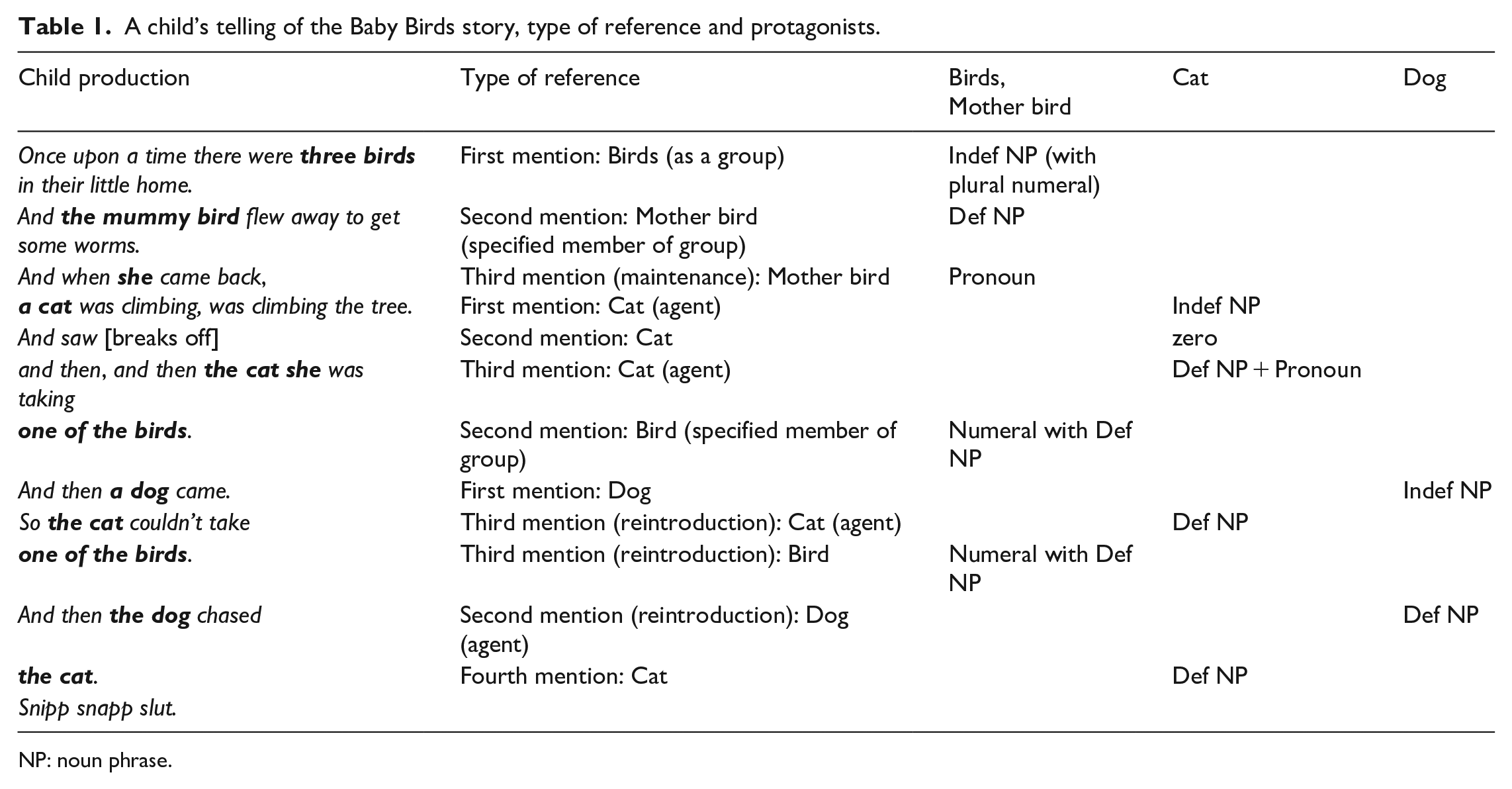
For the Baby Birds story, we will illustrate the introduction, maintenance and reintroduction of referents, triggered by the pictorial stimuli, using an authentic child narrative as an example. Table 1 presents the English telling of the Baby Birds story by a bilingual English/Swedish child at age 4;11 (the transcript is slightly simplified).
A child’s telling of the Baby Birds story, type of reference and protagonists.
NP: noun phrase.
The child’s narrative is short and only conveys the bare bones of the picture sequence. Referentially, it is fully appropriate. All characters are introduced. The child starts off with a stereotypical fairy-tale opener Once upon a time and an introduction of the referents visible in Picture 1. All characters are introduced with appropriate indefinite lexical NPs (three birds, a cat, a dog). Subsequent references to these characters are unambiguous (definite lexical NPs, pronouns, and one null form that is rephrased into a definite NP plus pronoun). The child often switches agents between her utterances, which precludes the use of long pronominal chains for maintaining reference. Instead, the child reintroduces previously mentioned characters as the agent of the respective utterance with definite lexical NPs (the cat, the dog). In general, the child uses more informative, and thus disambiguating, referential expressions when the use of a light form (pronoun) might lead to potential ambiguity. This can be interpreted as the child taking the naïve listener’s perspective into consideration. The child ends her story with a code-switched Swedish pat phrase (snipp snapp slut ‘snip-snap finished’).
Using MAIN narratives to investigate aspects of referentiality
Many aspects of referentiality can be researched with the help of narratives elicited with MAIN. Development with age can be explored by a longitudinal design or cross-sectional designs with different age groups. Cross-linguistic variation can be studied by comparing age-matched children speaking different languages, or bilingual children doing parallel storytelling tasks in both of their languages. Referentiality can be addressed from different perspectives such as the grammaticality of referential expressions, their discourse-pragmatic appropriateness, as well as more general questions dealing with the characteristics of the main protagonists and macrostructure of narratives. These perspectives can be embedded into the acquisitional context. Examples are given below.
Which are the linguistic referential devices used by the children? At what age(s)? How frequently? What types of NPs: overt lexical, indefinite, definite, bare? Pronouns? Clitics? Null forms? Are these forms grammatical (morphologically target-like)? Are they referentially adequate and appropriate in the narrative discourse context?
Are all story characters introduced explicitly by the child? How are story characters introduced? Which linguistic forms are used? In which constructions are characters introduced (subject, object, predicational, presentational, cleft, etc.)? How is reference to story characters maintained? How are characters reintroduced? Are there effects of age? Of language?
How do properties of the immediate discourse, such as recency of mention, topichood or agency, influence children’s referential choices? Does the presence of a potential competitor referent in the stimuli pictures affect referential choice? Is it the same or different for children compared with adults? Is it the same in narratives elicited in different languages? Are different referential choices made if the language in question has certain forms of disambiguation, such as gender marking?
How do properties of a referent that remain constant throughout discourse, such as animacy and humanness, influence children’s referential choices? Are they the same as for adults?
Study designs that compare monolingual and bilingual data, or that compare narratives in the two languages of bilingual children, can reveal cross-linguistic differences and/or cross-linguistic influence (transfer), for instance, overuse or underuse of certain forms. Close-up case studies of narratives told by individual children, as well as group comparisons of children with different backgrounds regarding language exposure, language proficiency and/or literacy, may inform us about individual variation, and the factors that may lie behind such variation. And finally, comparisons of children with DLD and TD age-matched or language-matched children can expand our currently rather scanty knowledge concerning the acquisition of referentiality in children with language impairment.
This special issue
The studies featured in this special issue cover monolingual and bilingual children aged 4–11 years, with a focus on ages 4−7, a period in a child’s life where great strides are made in the development of narrative (Berman & Slobin, 1994; Schneider et al., 2006). Five original research papers investigate referentiality in eight languages, Croatian, English, German, Greek, Hebrew, Polish, Russian and Swedish as a first or early second language. All languages distinguish between lexical referential devices (full NPs), and reduced ones (including personal pronouns, demonstratives and zero forms). Discourse referencing features in one group of these languages (Croatian, Polish, Russian) can be characterised by the absence of an article system for marking new information status, by rich inflectional noun morphology, and, to varying degrees, by the occurrence of null forms (zero anaphora). In another group of languages, English, German and Swedish, with poorer noun morphology, fully fledged article systems are used to mark both indefiniteness and definiteness morphologically. For referent introductions (first mentions), these languages make use of indefinite articles. Definite articles are typically used for subsequent mentions that need to be lexically informative, such as referent reintroductions, as well as for referent maintenance for disambiguation in contexts that involve competitor referents. In other maintenance contexts, these languages typically use pronouns (but rarely null forms). Hebrew and Greek belong to neither of these two language groups; both languages have definite articles, and Greek, moreover, has clitic pronouns. Such typological differences may have an impact on the acquisition of referentiality by monolingual as well as bilingual children, an issue that is investigated in the contributions of this issue.
In the following, the five research papers of this special issue are briefly described.
Otwinowska et al. (2022) compare the narratives of two groups of 4- to -6-year-olds: 92 monolingual Polish children in Poland (age 4;3–7;0) vs 92 bilingual Polish/English children in the United Kingdom (age 4;5–6;9). Storytelling (story generation) in Polish was elicited with the MAIN Baby Birds and Baby Goats picture sequences; Cat and Dog were used for retelling. For both elicitation modes combined, Otwinowska et al. find that the bilingual group produces overt pronouns and articles more frequently than the monolingual group. This may point to inappropriate ‘overuse’ of referential markers due to cross-linguistic influence from English, which, unlike Polish, requires overt pronouns and articles. This overuse results in inflated mean length of utterance (MLU) counts in the bilingual children’s narratives.
Hržica and Kuvač Kraljević (2022) compare 50 monolingual Croatian children aged 6;0–6;11 with 50 monolingual Croatian adults with regard to ‘reference chains’, that is, character introduction and the next mention of the character (maintenance or reintroduction). They administered Baby Birds and Baby Goats, which are parallel in the numbers and functions of story characters, but differ in grammatical gender in Croatian. In one story, the characters are of different genders, while in the other story, they are of the same gender. The use of a pronoun to refer back to a character can be ambiguous in the same-gender condition. The authors find that 6-year-olds and adults all use lexical NPs for character introductions, but differ with regard to character maintenance: While the children mostly use lexical NPs, the adults maintain reference to different-gender story characters with pronouns. In the story with same-gender characters, the adults prefer lexical NPs for maintenance, which disambiguates the potential competitor.
Lindgren et al. (2022) explore character introductions in 40 bilingual German/Swedish preschoolers (20 4-year-olds, 20 6-year-olds). The Cat and Dog picture sequences were used to elicit storytelling (story generation) in both languages. German and Swedish have similar referential systems with overt articles and pronouns, akin to English. The children’s use of referential expressions for character introductions and the developmental trajectory (ca 50% indefinite NPs at age 4, and ca 80% at age 6) is found to be very similar in the two languages. Animacy is also found to affect referential form, with a higher use of pronouns for the human story character than for non-humans. Lindgren et al. find clear effects of age, but no effects of language proficiency (an independent vocabulary measure) or language exposure. In a qualitative study, the authors explore which syntactic constructions the children’s indefinite NPs occur in, in what kind of function (naming/labelling, presentation) and in what kind of context (e.g. prompted or not by the experimenter). Here, both individual differences and differences between the two age groups are documented.
Fichman et al. (2022) report on 51 Russian- and Hebrew-speaking children aged 5;6–6;7 with and without a diagnosis of DLD: 17 Russian monolinguals (9 DLD, 8 TD), 16 Hebrew monolinguals (5 DLD, 11 TD) and 18 sequentially bilingual first language (L1)-Russian/second language (L2)-Hebrew children (8 DLD, 10 TD). The languages differ typologically in the referential domain: Hebrew has overt articles which Russian lacks, pro-drop differs somewhat and Russian has more complex gender-marking. Storytelling (story generation) was elicited with Cat and Dog. The authors present results for character introduction and maintenance, comparing impairment status, mono- versus bilingualism, and language. They find no differences between the groups for character introduction, as the children always use lexical NPs (though they produce both indefinite and definite NPs in Hebrew where indefinites would have been appropriate). As regards referent maintenance, the children employ personal pronouns to different degrees in the two languages. For the DLD children, difficulties with the morphological form of the pronouns are reported. As regards lexical NPs for maintenance, the L2-Hebrew DLD children omit more definite articles in Hebrew than their L2-Hebrew TD peers and than the L1-Hebrew children (TD and DLD). This points to the influence of L1-specific typological influences on the use of referential expressions in the L2.
Andreou et al. (2022) investigate reference maintenance in the narratives of 100 sequentially bilingual children with and without a diagnosis of DLD across a relatively large age range (5–11 years): 50 with L1 Albanian (25 DLD, 25 TD) and 50 with L1 Russian (25 DLD, 25 TD). Albanian has overt articles, and clitics and widespread null subjects, similar to the target language Greek, while Russian lacks articles, clitics and is more restrictive concerning subject-drop. The Cat and Dog picture sequences were used to elicit narratives in Greek. The authors analyse referentially (in)appropriate uses as well as (un)grammatical forms. All groups are found to improve with age and not to differ in the overall rate of (in)appropriate references for maintenance. The authors interpret this as DLD not affecting discourse appropriateness. However, ungrammatical forms are more common in the DLD than in the TD groups (mainly pronoun drop in object position and article drop, the latter especially in the Russian–Greek children). Moreover, the Russian–Greek children (DLD and TD) use more definite NPs, fewer clitics and fewer null subjects than the Albanian–Greek children, which suggests cross-linguistic L1-influence. Early child L2 referential use thus appears to be influenced both by L1 typological properties and by language impairment status.
The special issue concludes with a Commentary by De Cat (2022), who focuses on methodological challenges for the analysis of narratives and identifies some outstanding questions.
Footnotes
Funding
The author(s) disclosed receipt of the following financial support for the research, authorship, and/or publication of this article: This work was partly supported by the Open Access Publication Funds of the Leibniz Association to Natalia Gagarina, by a guest professorship from Uppsala University to Natalia Gagarina, and by a Bank of Sweden research grant (Riksbankens Jubileumsfond P19-0644:1) to Ute Bohnacker.
