




Abstract
Background
Maximizing the value of introductory courses that both support student wellbeing and develop scientific thinking is increasingly important in the post-COVID-19 context.
Objective
In an introductory psychology course framed by psychological literacy, the aim was to explicitly support the satisfaction of students’ academically related psychological needs (thus supporting well-being) in the context of acquiring foundational research skills.
Method
Innovative teaching and assessment strategies for scaffolded collaborative research skill acquisition are described. Students were invited to complete an evaluation survey.
Results
The hypothesis that students would indicate that the course contributed to (a) satisfaction of their psychological needs, (b) intrinsic motivation, (c) well-being, and (d) development of psychological literacy was supported. The hypothesis that psychological need satisfaction would predict both intrinsic motivation and well-being was supported. The hypothesis that students would indicate that the course contributed to increased competence in research and experimental design was supported.
Conclusion
Explicitly framing the pedagogical approach in terms of psychological literacy and the satisfaction of psychological needs, and scaffolding research skill development, is a promising approach in courses emphasizing the value of psychological science.
Teaching implications
Teachers can readily adapt this approach to their own context, making use of our open course materials.
Keywords
Introductory courses should provide students with the capabilities to maximize their success at university (Kift, 2015). The context of undergraduate psychology education, however, has changed significantly over the past decade. For example, the COVID-19 pandemic highlighted and sometimes exacerbated existing societal issues, such as mental ill-health among university students (Dingle et al., 2024; Kumar et al., 2021), reinforcing the need for curricular strategies that support student success and wellbeing (e.g., Morris & Cranney, 2022). Moreover, in many countries, there is public devaluing of science (e.g., Rutjens et al., 2022), including psychological science (e.g., Anvari & Lakens, 2018), which may be associated with the increasing (and often uncritical) use of social media as a key information source (e.g., Lim et al., 2022). This underscores the importance of psychology students developing research skills, as emphasized in the recent International Competences for Undergraduate Psychology model, in which one of the seven foundational competence categories is Psychological Research Methodologies and Methods (Nolan et al., 2025). An early start on developing those skills will facilitate their success as psychology students. In summary, there is a need to support student wellbeing through curricular strategies, to build their research capability, and, critically, to support students’ metacognitive awareness of it. This paper describes an introductory course that was uniquely designed to meet these needs.
In this course, the guiding pedagogical philosophy, a concept which Goodyear (2005) placed at the top of his pedagogical framework for learning design, is related to psychological literacy (PL). PL, as conceptualized by McGovern et al., 2010, was recently defined by Nolan et al. (2025) as the capacity to intentionally apply “psychology knowledge, skills and values to achieve personal, work and community (local to global) goals; the integration and application of foundational psychology competences within an UG program should lead to psychologically literate graduates” (p.12–13). Educators who adopt psychological literacy (PL) as a pedagogical philosophy (a) utilize “evidence-based strategies to support student learning in general, and the metacognitive acquisition of psychological literacy by our psychology undergraduates in particular" (Cranney & Morris, 2021, p.323), and (b) model PL in their interactions with students (Morris et al., 2021). Harris et al. (2024) also argued that the intended outcome of PL should be made explicit to undergraduate psychology students.
Given this pedagogical philosophy, in a specialist introductory psychology course provided only within the Bachelor of Psychology degree program, we sought to support the metacognitive acquisition of PL by students by encouraging awareness and reflectivity regarding the intentional application of psychological science to their personal and professional lives. We utilized Ryan and Deci's (2000) self-determination theory (SDT) as high-level pedagogy (the level below pedagogical philosophy in Goodyear's [2005] framework; see also Cranney & Morris, 2021), and designed and delivered course-related approaches to the satisfaction of the basic psychological needs of competence, relatedness, and autonomy (= pedagogical strategies in Goodyear's framework). The satisfaction of these needs leads to increased intrinsic motivation (e.g., Deci & Ryan, 2008; Goldman et al., 2017) and well-being (Ryan & Deci, 2000; Sheldon & Elliot, 1999), and this approach has been utilized by educators in supporting student academic success and well-being (e.g., Baik et al., 2017). For example, Morris and Cranney (2022) reported that a general education course on the science of wellbeing, framed by PL and SDT, received highly positive course evaluations across several years, notwithstanding the disruptions of the COVID-19 pandemic and of a change to the academic calendar.
In the course described here, in addition to the explicit signaling to students of the overarching PL framework and the SDT-related activities designed to support need satisfaction and thus well-being, an additional explicit focus on competence development involved providing students with multiple scaffolded opportunities to develop research skills, particularly experimental design. Numerous explicit links between PL and research capabilities were made; for example, during tutorial exercises, students were required to apply their developing experimental design skills to the analysis of hypothetical media-based claims about causation. That is, throughout the course, students were consistently made aware of these deliberate pedagogical intentions regarding PL, SDT, and research training, and were surveyed about their perceptions of them in the bespoke course evaluation.
The specific objectives of this paper were to share the practice of the pedagogical framing emphasizing PL, SDT, and research training in this introductory psychology course, and to report on the testing of three a priori hypotheses:
Students will indicate that the course contributed to (a) satisfaction of their basic psychological needs, (b) intrinsic motivation, (c) well-being, and (d) development of psychological literacy. Satisfaction of psychological needs will predict intrinsic motivation and well-being. Students will indicate that the course contributed to increased competence in research and experimental design.
An important point needs to be made about the methodological approach taken in this study. First, it is assumed that educators with a professional attitude toward their teaching practice intend their teaching strategies to facilitate desired learning outcomes (Hulme & Winstone, 2017). Second, as in most practice settings, it can be difficult, if not impossible, to conduct experimental research that allows for strong causal inferences between teaching strategies (the independent variable or “intervention”) and educational outcomes (the dependent variables; see Stanovich, 2019). The methods in this study do not allow such causal inferences. Rather, we are investigating whether students perceive a causal relationship between the teaching strategies and the intended positive educational outcomes. Given our efforts to consistently make students aware of the deliberate pedagogical intentions regarding PL, SDT, and research training, this allowed us to state Hypotheses 1 and 3 as a priori. If there is evidence of student perceptions of causal links between teaching strategies and educational outcomes, this does not mean that there is actual causality. Different methodological approaches (if feasible) would be required to investigate that possibility. Note that Hypothesis 2 is a direct test of predictions based on SDT.
Method
The primary method of data collection was a bespoke survey at the end of the term. Ethical approval was given by the University of New South Wales Human Research Ethics Committee (#HC3701). The primary approach was quantitative; however, in response to a reviewer's suggestion, a qualitative analysis of the responses to an open-ended survey question was undertaken, utilizing a priori categories related to hypotheses from the above-mentioned quantitative approach (see Morris et al., 2026, Supplemental Material Section 7 [SM-7] for a description of the method and results).
Participants
In total, 34 of 217 students responded, for a response rate of 15.67%. The mean age of the sample was 21.74 years (SD = 4.93). Thirty-three students identified as female (97.06%) and one as male (2.94%). See Morris et al. (2026) SM-1 for more details. There were no missing data and no participant exclusions. As we used a convenience sample, no a priori power analysis was conducted. Sensitivity analyses were conducted in G*Power (Faul et al., 2009) to determine the minimum overall effect size detectable with our sample. For linear regression models with a single predictor (α = 0.50, power = 0.80), the minimum detectable effect size was f2 = 0.25 (or R2 = 0.20). For t-tests examining differences from scale midpoints (Bonferroni adjusted α = 0.005, power = 0.8), the minimum detectable effect size was d = 0.63. The observed effect sizes for our analyses exceeded these thresholds.
Teaching and Assessment Strategies
A critical aspect of the pedagogical aims of this course was to make explicit, within the overarching framework of PL, the learning activities and course content that were designed to (a) meet students’ academically related SDT needs (and thus support well-being), and (b) build scientific literacy through the development of research competence. The links among PL, SDT, and research training were emphasized throughout the lectures and practicals. The course consisted of two 1-hour lectures and one 2-hour practical/tutorial per week across nine term weeks. The textbook (Stanovich, 2019), lectures, and practicals were designed to foster a “psychological science mindset” (Cranney et al., 2008). Specifically, nine lectures covered the textbook material, research methods and design, cognitive fallacies and biases, and psychological literacy. Eight of the interactive practicals focused on research design and discussion, research design issues (e.g., confounding variables), operationalizing variables, and working on group research projects. Almost all assessments were related to research capability. That is, a primary focus of the course was developing students’ understanding of research and scaffolding the development of research design, implementation, and communication skills. These activities were expected to lead students to agree that the course developed their research capabilities.
Numerous individual and collaborative research design activities were completed throughout the term, ranging from a low-stakes individual research design, through to an eight-week group research project encompassing design, data collection, and presentation. Summative feedback from the tutor, and/or formative feedback from peers and/or tutor was provided for each task. A final exam research design question was provided, including a brief background and a research question. See Morris et al. (2026) SM-2 for further details regarding Research Tasks and Assessments and Morris et al. (2025) for adaptable course materials.
In addition to the scaffolded strategies regarding competence in research, satisfaction of the psychological need for competence was further emphasized, including: (a) a Week 3 multiple-choice test on the textbook content, and (b) multiple assessed reflections on students’ learning (all prior to the final examination). In summary, these activities were expected to lead students to agree that the course developed their research skills and met their need for competence.
In terms of the psychological need for relatedness, the small class context is an ideal environment to experience personalized and collaborative learning, develop interpersonal communication skills, benefit from peer learning and peer feedback, and be exposed to diverse perspectives (Jacques, 2003). Explicit curricular strategies to foster student relatedness included: (a) highly interactive peer-to-peer activities within practicals; (b) group research projects, whereby team-supportive strategies were built into the practical (e.g., activities to ameliorate group process issues), and (c) structured interaction on the learning management system (LMS; e.g., a discussion forum task where students identified commonalities with other students). In terms of autonomy, strategies included group choice of research topic (e.g., within a topic such as complex problem solving, students could freely choose their research question, stimuli/task, and variables, subject to ethical guidelines). Importantly, the relevance of activities to psychological needs was made explicit throughout the course to enhance students’ awareness. See Morris et al. (2026) SM-3 for further details. In summary, the combination of strategies designed to build a sense of competence, relatedness, and autonomy was expected to lead students to agree that the course contributed to their need satisfaction, intrinsic motivation, and well-being. Finally, the frequent explicit signaling of PL across the course, including of how the research training and SDT-framed activities were related to the overarching framework of PL, was expected to lead to high ratings of PL.
Measures
Prior to the end of the term, students were invited to complete a survey consisting of the following scales/items.
Student Psychological Needs Scale-Modified (SPNS-M)
This nine-item scale, based on a subset of Goldman et al.'s (2017) SPNS, measured the extent to which the course supported student psychological need satisfaction. Three items were chosen for each of the “need” subscales (see Morris et al., 2026, SM-4; e.g., for autonomy: “I have the freedom to succeed however I want to in this course”). Participants rated their extent of agreement to each of the items on a 7-point scale, from 1 (strongly disagree) to 7 (strongly agree). For this study, the word “class” was replaced with “course.”
Course-Specific Measures
These single-item measures assess key course-specific variables relevant to the hypotheses: perceived development of psychological literacy, perceived competence in undertaking psychological research and designing experiments, and perceived academic goal success and course-related well-being (see Table 1 footnote). Responses were measured using the same rating scale as the SPNS-M.
Means, SDs and Comparisons to Scale Mid-Points for the Survey-Based Dependent Variables.
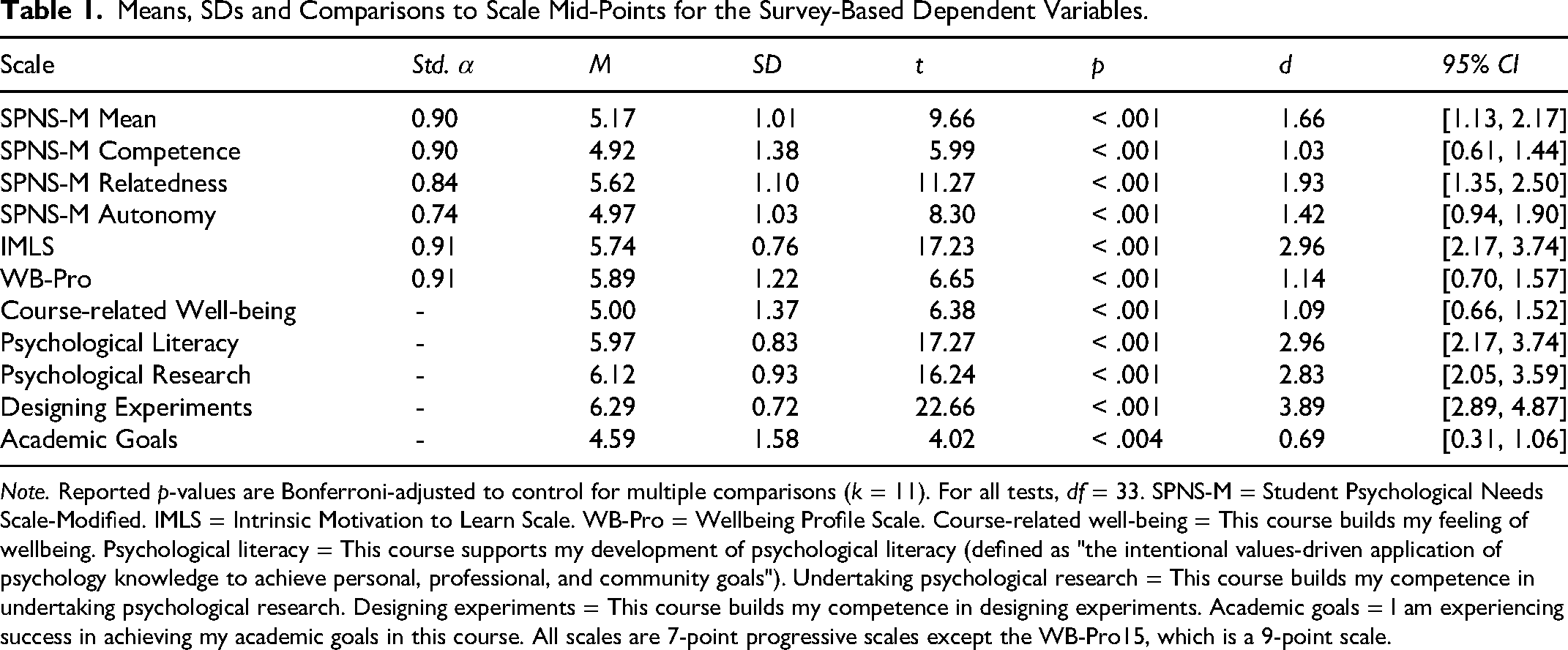
Note. Reported p-values are Bonferroni-adjusted to control for multiple comparisons (k = 11). For all tests, df = 33. SPNS-M = Student Psychological Needs Scale-Modified. IMLS = Intrinsic Motivation to Learn Scale. WB-Pro = Wellbeing Profile Scale. Course-related well-being = This course builds my feeling of wellbeing. Psychological literacy = This course supports my development of psychological literacy (defined as "the intentional values-driven application of psychology knowledge to achieve personal, professional, and community goals"). Undertaking psychological research = This course builds my competence in undertaking psychological research. Designing experiments = This course builds my competence in designing experiments. Academic goals = I am experiencing success in achieving my academic goals in this course. All scales are 7-point progressive scales except the WB-Pro15, which is a 9-point scale.
Intrinsic Motivation to Learn Scale (IMLS)
Average rating on the IMLS (Goldman et al., 2017) was used to measure participant intrinsic motivation to learn within the course (e.g., “It is personally satisfying for me to learn new concepts in this course”). Participants rated their extent of agreement to each of the ten items on a 7-point scale, from 1 (strongly disagree) to 7 (strongly agree). Again, the word “class” was replaced with “course.”
The Wellbeing Profile Scale (WB-Pro15)
WB-Pro15 (Marsh et al., 2020) is a measure of subjective well-being, and the average ratings of the fifteen items were used to assess students’ general well-being (e.g., “All things considered, I would describe myself as a happy person”). The WB-Pro shows good reliability, test-retest stability, and convergent and discriminant validity (Marsh et al., 2020). Participants rated their extent of agreement to each of the items on a 9-point scale, from 1 (completely disagree) to 9 (completely agree). Item 5 was reverse-scored.
Results and Discussion
All quantitative analyses were undertaken in R (version 4.3.1). Correlations are presented in Morris et al. (2026) SM-5, exploratory analyses in SM-6, and the deductive qualitative analysis in SM-7.
Hypotheses 1 and 3
Mean scores of participants’ ratings were significantly above the scale midpoint for all dependent variables of interest (see Table 1), thus indicating agreement with the scale items and supporting Hypotheses 1 and 3. Regarding Hypothesis 1, students indicated that the course contributed to (a) satisfaction of their basic psychological needs, (b) intrinsic motivation, (c) well-being, and (d) development of psychological literacy. This extends Morris and Cranney's (2022) finding of consistently positive overall evaluations of their introductory “science of well-being” course, which was also framed by PL and SDT, and suggests that the pedagogical intent of supporting student success and well-being was successful. Regarding Hypothesis 3, students indicated that the course supported their development of research skills; this finding aligns with recent international guidance on foundational undergraduate competences (Nolan et al., 2025). We speculate that by consistently emphasizing all these elements throughout the course, students were able to identify the elements and their impact.
Hypothesis 2
Intrinsic Motivation
A simple linear regression was conducted to examine whether psychological need satisfaction predicted intrinsic motivation. The model was significant F(1,32) = 8.94, p < .001. Psychological need satisfaction significantly positively predicted intrinsic motivation, B = 0.35, SE = 0.12, t = 2.99, p = .005. The model explained approximately 19% of the variance in intrinsic motivation, R2adj = .19.
Course-Related Well-Being
A simple linear regression was conducted to examine whether psychological need satisfaction predicted course-related well-being. The model was significant F(1,32) = 27.46, p < .001. Psychological need satisfaction significantly predicted course-related well-being, B = 0.92, SE = 0.18, t = 5.24, p < .001. The model explained approximately 45% of the variance in course-related well-being, R2adj = .45.
General Wellbeing
A simple linear regression was conducted to examine whether psychological need satisfaction predicted general well-being. The model was significant, F(1, 32) = 12.68, p = .001. Psychological needs significantly predicted general well-being, B = 0.64, SE = 0.18, t = 3.56, p = .001. The model explained approximately 26% of the variance in general well-being, R2adj = .26. In summary, Hypothesis 2, that the satisfaction of psychological needs will predict intrinsic motivation and well-being, was supported, and is consistent with past research (Deci & Ryan, 2008; Goldman et al., 2017; Sheldon & Elliot, 1999).
Summary of Qualitative Analysis Findings
In response to a survey question with an open-ended response format (“What has been the most useful aspect of this course… in terms of supporting your academic success and wellbeing?”; see Morris et al., 2026, SM-7), almost half of the participants mentioned that the course had supported the development of their research capacity. Overall, need satisfaction was mentioned as an outcome of the course by the majority of students. Less than a quarter of students mentioned that the course had supported their motivation. In contrast, more than a quarter mentioned well-being, which is to be expected given a significant emphasis on the latter in the course content. In terms of PL, over half of the participants mentioned some aspect of the application of psychology to personal or work contexts, or more generally. Overall, these findings support those of the main quantitative analyses.
Limitations and Future Research
First, this study did not include the features of a true experimental design that would allow causal inferences regarding the educational strategies and the outcomes. Although there was evidence of student perceptions of causal links between teaching strategies and educational outcomes, this does not mean that there is actual causality. Different methodological approaches (if feasible) would be required. Second, the sample is small, so there is a risk of the course cohort not being representative. As indicated in Morris et al. (2026) SM-1, no difference was found in the final course grade between the course “population” and the study sample. Students are usually overwhelmed by final assessments toward the end of the term and are thus unlikely to complete surveys. Future research could increase sample size by integrating student ratings (and associated explanations) as part of assessable reflections (although these would need to have low mark weightings to decrease the influence of demand characteristics). Third, the primary dependent variable is subjective (ratings); thus, it is susceptible to bias, and future research should utilize objective measures if feasible.
Additionally, future research with an adequate sample could use path analysis to test aspects of models such as Sheldon and Elliot's (1999) self-concordance model, including predictions about the role of course-related academic goal attainment, which our participants rated positively (see Table 1). Moreover, future research could assess the status of, and relationships among, the target variables at a more advanced stage of the program (e.g., in a capstone course). Finally, future research could explore the impact of research training on the valuing of psychological research.
Conclusions and Teaching Implications
The findings of this study, although limited in terms of generalisability and causal inference validity, emphasize the value, from a student perspective, of educators adopting psychological literacy as a pedagogical philosophy and of using SDT as a high-level pedagogy for curricular design and delivery (Goodyear, 2005). Consistent with the literature (Goldman et al., 2017), course-related need satisfaction predicted intrinsic motivation, potentially creating an “upward spiral” (Sheldon & Houser-Marko, 2001) by promoting continued engagement with the course's learning activities. The finding that need satisfaction predicted course-related well-being is important for educators to note, particularly given that the measures were grounded in actual classroom practice.
Overall, our findings that students gave high ratings of course-related well-being and of research capability development are of high value, given the current evidence for poor psychological health amongst university students (e.g., American College Health Association, 2025), and the lack of scientific and critical thinking amongst the general public (e.g., Rekker, 2021). The value of developing student research skills is amplified, given that graduates of foundational undergraduate psychology programs have significant potential to adaptively influence their communities (Hulme & Cranney, 2022).
We argue that the unique approach of explicitly and continuously signaling the relationships amongst PL, SDT, and research training contributed to students’ metacognitive awareness of the pedagogical aims of the course, such that they came to understand the value of the course activities with respect to their professional (and personal) development, which is essential to student learning and motivation. My thinking regarding the application of psychological skills has changed as a result of this course. Before this course, I thought that psychological skills were primarily applied in a clinical setting. However, after a few lectures, my thinking changed, and I now understand the many ways psychological skills can be applied, such as psychological literacy, where psychological students who acquire this have a somewhat social responsibility to apply their knowledge to benefit society. The psychological skills learnt in our course can also be applied to our everyday lives, such as to improve studying. I feel as though my previous attitudes towards psychological skills were one-dimensional, and I have a more diverse understanding of how they can be applied now. (Student quote from Final Reflection assessment; punctuation added for clarity)
We invite other educators to (a) explore the utility of Goodyear's (2005) approach to conceptualizing learning design, and more particularly, (b) embrace the pedagogical aims described in this study. We freely provide our course materials for that purpose (Morris et al., 2025).
Footnotes
Acknowledgements
We gratefully acknowledge the participation in this study of 2023 and 2024 PSYC1021 students. Portions of these findings were presented at the 2023 and 2025 AusPLAT Conferences. This research was produced in whole or part by UNSW Sydney researchers and is subject to the UNSW Intellectual property policy. For the purposes of Open Access, the authors have applied a Creative Commons Attribution CC-BY licence to any Author Accepted Manuscript (AAM) version arising from this submission.

Ethical Considerations
This research was approved by the University of New South Wales (UNSW) Human Research Ethics Committee, Panel C (Approval #HC3701) on 13th February 2023.
Consent to Participate
At the beginning of the survey, a Participant Information Statement and Consent Form (PISCF) was provided, which contained detailed information about the study, and a participant consent declaration. The participant then chose to start or exit the survey.
Consent for Publication
The PISCF contained the following information: “Your de-identified information will be used as part of the data set that will be analysed and reported (in the form of quantitative and qualitative summary data, and some anonymous quotes) in presentations, reports, and publications.”
Author Contributions
Sue Morris played: (a) a leadership role in investigation and resources; (b) an equal role in conceptualization, methodology, project administration, writing-original draft, writing-review and editing; (c) a supporting role in data curation, formal analysis, and validation. Elizabeth Summerell played (a) a leadership role in data curation, formal analysis, validation; (b) an equal role in writing-original draft and writing-review and editing; and (c) a supporting role in conceptualization, investigation, and resources. Jacquelyn Cranney played: (a) a leadership role in writing-original draft; (b) an equal role in conceptualization, methodology, project administration, writing-review and editing; and (c) a supporting role in investigation, resources, data curation, formal analysis, and validation.
Funding
The authors received no financial support for the research, authorship, and/or publication of this article.
Declaration of Conflicting Interests
The authors declared no potential conflicts of interest with respect to the research, authorship, and/or publication of this article.