



Abstract
Climate change makes stringent demands on thinking about our future. We need two-sided reasoning to contend equitably with the risks of climate change and the risks of “solutions.” We need to differentiate the future 500 years from now and 50 years from now. This essay explores three pressing climate change issues, using both the 500-year and the 50-year time frames: sea level rise, the nuclear power “solution,” and fossil carbon abundance.
Keywords
Many of us spend a lot of time thinking about the future well beyond our lifetimes. Yet when we make decisions that affect future generations we are inconsistent and not guided by general principles. Notably, we are confused about future time. We find it hard to separate the far future (say, 500 years from now) from 50 years from now. Five hundred years ahead, we have almost no idea what people will be like but we are pretty sure that people’s needs and capabilities in 50 years will resemble ours. I can imagine that scholars, quite soon, will create a new academic field to help us think coherently about future time and the planetary vulnerabilities that will constrain what we are able to do. This discipline might be called Destiny Studies.
Climate change would be a central issue for Destiny Studies—both the problem and its “solutions.” Climate change makes more stringent demands on thinking about the future than any other societal problem I know. To see where Destiny Studies might take us, three pressing climate change issues are explored here, using both the 500-year and the 50-year time frames: sea level rise, the nuclear power “solution,” and fossil carbon abundance.
Sea level rise: 500-year and 50-year issues
Sea level rise is a particularly dramatic example of the challenge of coming to terms with future time. Sea level has been uncharacteristically constant over the past 5,000 years. But over the past 20,000 years, as the Earth emerged from the last ice age, the immense ice sheet over Canada receded and sea level rose 120 meters. Early humans migrated by land from Siberia to Alaska, but then their route was closed by the Bering Sea.
The main sources of a continuation of this rise of sea level are the melting of the Greenland Ice Sheet and the West Antarctic Ice Sheet. A complete melting of the Greenland Ice Sheet would yield seven meters of sea level rise, and a similar rise is at stake from the West Antarctic Ice Sheet, when some likely additional melting from elsewhere in Antarctica is taken into account.
Consequently, two central questions for climate science are: When might this happen, and how quickly? A question for Destiny Studies is how to evaluate whatever climate science learns.
For the sake of argument, suppose we knew that ahead there would be one meter of sea level rise per century, continuing for many centuries. The impact of 1, 2, 4, and 8 meters of sea level rise on Florida and the Gulf Coast is seen in Figure 1. For such a future, the corresponding dates would be 2100, 2200, 2400, and 2800, respectively.
Changes in the southeast US coastline with sea level rise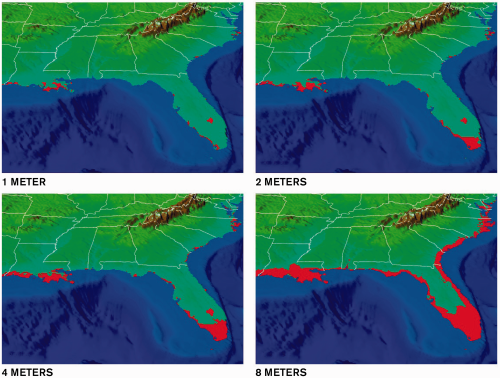
Sea level rise, 500-year issues: Land masses disappear, cities move inland
How much do we care, and should we care, about a southern Florida that is underwater in the year 2500? If, in 500 years, our successors will have unknowable appetites and capabilities, what is the ethical content of their being behind this veil of ignorance? Does it matter how closely they will resemble us? Does it matter whether they will be more technologically capable than we are? Does it matter how they will perceive their obligations to generations that are in their future? Even though none of these questions is answerable, are we obligated to act as if the answers were knowable? Are we obliged to assume those answers that place the largest responsibility and cost upon us, alive in 2015—that people living 500 years from now will be approximately like us, not much more capable, and at least as concerned about the welfare of generations after them?
While I was writing this essay, a paper appeared by NASA climate scientist James Hansen and others (Hansen et al., 2015) that proposes a new mechanism by which ice sheets could melt rapidly. The paper generated broad discussion, and the science was not dismissed. Some commentators, however, observed that determining whether the new mechanism could operate in this century was beyond the capability of today’s science and that, without this additional information, the paper was “just science” —that is, not relevant to the question of how strong climate policy should be today. Really, “just science”? By excluding the policy-relevance of damage after 2100, these commentators are making reflexive judgments about how to view the veil.
Sea level rise, 50-year issues: Adaptation
Given the possibility of one meter of sea level rise by the end of this century, coastal cities such as New York City are making plans for the future (Jacobs, 2015). The anticipated damage is both episodic (extreme storms) and steady (relentless encroachment). Owners of office buildings and banks are already moving backup electricity generators out of basements. Planners are considering placing artificial islands strategically off-shore to soak up the energy in storm surges. Governments may also prohibit resettlement on some coastal land. The relentless invasion of the sea will eventually affect property values and should be easy to measure.
One of the misconceptions about climate change is that the science is nearly complete. On the contrary, there is still substantial uncertainty—not about whether we are changing the planet but about how quickly we will see the consequences of our actions. Anyone who reads articles or summaries about sea level finds abundant evidence of the uncertain pace of change. Sea level is indeed rising, but the rise could be more than a meter by 2100 if various positive-feedback loops have been underestimated. The rise could be well below a meter if the most favorable assumptions about the durability of ice sheets were to turn out to be correct and human emissions are strongly curtailed. This incompleteness of knowledge is a core feature of Destiny Studies.
The nuclear power solution: 500-year and 50-year issues
One way to respond to the problem of climate change is to shift the global energy system toward nuclear power. Over the next 50 years, this “solution” is fraught with danger. Over 500 years, it provides textbook examples of our incoherent thinking about deep future time.
Nuclear power, 500-year issues: The fiasco of nuclear waste
In a quest for ethically responsible nuclear waste disposal, policy makers soon after World War II sought to establish the operative time frame. They drew on the half-lives of isotopes—notably, the half-life of plutonium 239, which is 24,100 years. The standards that emerged, in essence, invoke a human being living close to a disposal site 24,100 years from now, farming and eating and drinking much as today, who is to be protected from getting cancer from leaking radiation. There are very few other domains where present actions are circumscribed by obligations of such durability.
Physicists and geologists may have been the drivers of half-life-based standards. With hindsight, hubris was at work. For every proposed disposal site, a red team seems always able to come up with leakage mechanisms that the blue team can’t reject, when the time frame for near-perfect storage is many millennia. One alternative would be to write rules now only for interim storage (say, for 50 years), and to provide permits only for “retrievable” storage (reversible storage). Because such rules would burden future generations with further action, they are considered not good enough.
Public opinion is unlikely to allow the substantial rollback of nuclear waste management standards that would create consistency with the treatment of the future in other domains of current life. However, it is not too late to avoid excessive stringency in new areas. An important example is the emerging standards for another low-carbon technology: carbon dioxide capture and storage. Rules are being debated that will govern the leakage of carbon dioxide to the atmosphere after the carbon dioxide has been pumped underground into deep geological formations—carbon dioxide that has been captured from the flue gases of coal and natural gas power plants. Right now, the dominant view seems to be that the rate of leakage from these reservoirs must be low enough to assure that if someday enormous volumes of carbon dioxide are stored, leakage will create negligible climate change. Rules so demanding may well lead to another stalemate. As with nuclear waste, the concepts of iteration with experience and progressive tightening are missing from the discourse.
Nuclear power, 50-year issues: Three denials of linkages to nuclear weapons
No one can discern how much nuclear power there will be in the world in 50 years. Right now, Asia is building away: 50 nuclear reactors operating or under construction in China, or half as many as are operating in the United States (Zhang, 2015). Meanwhile, Europe, Japan, and the United States are facing replacement of their aging reactors.
With global nuclear power comes the prospect that additional nations will develop nuclear weapons, an outcome that many readers of the Bulletin consider the most dangerous aspect of nuclear power. Oddly, three important constituencies are largely in denial about this prospect: the nuclear power establishment, the nuclear reactor research community, and advocates of aggressive climate change policy.
The nuclear power establishment generally denies the saliency of linkages between nuclear power and nuclear weapons. One of its ways of dismissing the subject is: “The genie is out of the bottle.” Might this era of rejection of responsibility finally be coming to a close as a result of the Iran nuclear agreement, given that one of its objectives is to delink nuclear power and nuclear weapons? Might a 50-year regime emerge for nuclear power, where the new norms of world order proposed for Iran are widely adopted? Malfeasance and chicanery are assumed, and international institutions for surveillance are strengthened so that with high probability they will detect any illicit production of the two “special materials” of nuclear weapons: plutonium and highly enriched uranium.
The nuclear reactor research community pays almost no attention to today’s commercial nuclear power, in favor of work on future “generations” of reactors. Had the nuclear power research community—largely working in government laboratories—given greater priority over the past 50 years to improving current reactors, there could have been a stream of upgrades. Reactors could have become better at reporting the wear and tear that accompanies aging, which would help with decisions about how long to operate. They could have become more agile partners of intermittent energy sources, such as solar and wind power, by becoming better at fast and deep changes in power production (“load following”). Perhaps their fuel cycles could have become more proliferation-resistant.
Most advocates of vigorous climate change policy deny the significance of nuclear power. Nuclear power is a form of energy that emits little carbon dioxide, yet one can attend a multi-day meeting on climate change, especially if it is in Europe, and not hear nuclear power mentioned. The presumption seems to be that ignoring something makes it go away.
Destiny Studies encourages examination of the conditions under which the global expansion of nuclear power, as a cure for climate change, is worse than the disease. How credible is a regional nuclear war, somewhere on this planet, emerging from lightly monitored national nuclear power programs? Over the next 50 years, could the current taboo on using nuclear weapons be strengthened—in contrast to what has been happening today? Could the separation of reactor plutonium cease? Going beyond the Iran agreement, could all uranium enrichment be internationalized? Could a world emerge where there is broad agreement that global nuclear power is less dangerous than climate change?
Generalizing, I advocate two-sided reasoning that takes into account both the damage from climate change and the damage from solutions. Every “solution” to climate change has a dark side that makes it dangerous. Some of the comprehensive solutions involving renewable energy can result in the transfer of significant damage from the atmosphere to the land’s surface. Solutions involving carbon dioxide capture and storage would create a new intrusive infrastructure as large as the current oil and gas system, just for handling waste. Geoengineering—the newcomer on this list, and an untried, more speculative technology (Robock, 2015)—has the potential to cede excessive authority to technocrats, who may tend toward excessive fondness for a fully managed planet. Even efficiency, if championed with unconstrained zeal, can create its own horrors of excessive regimentation and state control.
Every proposed solution can surely be strengthened by the inclusion of environmental and social restrictions that have a good chance of mitigating the solution’s defects. The structure of the climate change problem is analogous to that of a sick patient for whom strong drugs are proposed that may help her but also may make her worse. A modern version of the Hippocratic Oath, written by medical professor Louis Lasagna in 1964, captures this two-sided reasoning: “I will apply, for the benefit of the sick, all measures that are required, avoiding those twin traps of overtreatment and therapeutic nihilism” (Tyson, 2001). In the spirit of this oath, if a strict greenhouse target requires casting caution to the wind, it cannot be optimal.
Carbon abundance: 500-year and 50-year issues
To appreciate “carbon abundance,” some background on fossil fuels is helpful.
For a few years about a decade ago, a narrow hypothesis, called “Peak Oil,” was promoted by academics who asserted that nearly half of the world’s conventional oil had already been produced and that a slow, steady decline in production inevitably lay ahead. The proponents of Peak Oil had taken little notice of “unconventional” oil, and they hadn’t mentioned coal one way or the other. Nonetheless, a public hungry for reassuring news about climate change inferred that the end was near for all fossil fuel, and that the world would be rescued from climate change by physical depletion.
The recent commercialization of shale gas and shale oil has brought this wishful thinking to a close. Fuel extracted from these sources represents an entirely new category. Nearly all conventional oil and gas comes from hydrocarbons that leaked upward over geological times, out of a “source rock” where it was generated and into a “host rock” where it was trapped beneath an impermeable cap—in other words, conventional oil and gas are the leaks that didn’t find their way to the surface. By contrast, shale oil and shale gas hardly moved. They are being extracted from their source rock. The resource is huge.
The lesson here is that commercially attractive fossil fuels are abundant, rather than scarce. As a result, to address climate change the world will need to make a conscious choice and deliberately leave most of these hydrocarbons underground.
What will be left behind is now being called “unburnable.” We aren’t yet sorting out what this means. Superimposing the 500- and 50-year perspectives can help.
Abundant carbon, 500-year issues: The duration of the fossil fuel era, if climate change weren’t an issue
A critical distinction must be made between resources and reserves, and it applies to both minerals and fuels. Resources are physical stuff, while reserves are physical stuff that meets economic and political criteria. Simplifying, a reserve is what can be produced profitably at a given time with known technology. If the political landscape changes and inhibits production of copper from a mine somewhere—say, because the mine is included in a new national park—then that copper reserve can disappear. A new generic technology that improves extraction of natural gas can make all natural gas reserves larger. Institutions like the Securities and Exchange Commission in the United States have strict rules about what can be called a “booked” reserve. Given the time value of money, it isn’t worth a company’s or a government’s time to delineate those resources that will become reserves, unless these reserves will be produced within roughly two decades. That’s why the “reserve-to-production ratio” is usually about 15 years—that is, 15 years of constant production will use up the “reserve.”
Estimates of resources are squishy. How much coal or tin is in this mountain? What fraction might ultimately be produced? There are no rules here. Nonetheless, a few bold scholars have combed the geological literature and provided well-documented estimates of the energy and carbon in fossil fuel resources. Hans-Holger Rogner, who may be the most prominent of them, estimates that 80,000 billion tons of carbon dioxide would be created by burning all of the world’s oil, natural gas, and coal resources, both conventional and unconventional (Rogner et al., 2000). To put this immense number into perspective, we are producing about 40 billion tons per year of carbon dioxide emissions by burning fossil fuels today, and so his estimate means that there are 2,000 years of emissions at today’s rate. His estimate is also more than 25 times larger than the 3,000 billion tons of carbon dioxide in the atmosphere right now.
About 30,000 billion of Rogner’s 80,000 billion ton estimate comes from conventional and unconventional oil, gas, and coal—about two-thirds coal and one-third oil and gas. The rest, more than half, is resources in the form of methane hydrates, also known as “clathrates,” which are ice crystals with methane molecules in their interstices. Clathrates can exist within only narrow ranges of temperatures and pressures, but such ranges are found in the arctic onshore beneath the permafrost and on the boundaries of continents just below the sea floor. Pilot projects to extract clathrates are already under way in Japan. Will these immense resources of clathrates become reserves? Destiny Studies will ask whether, taking into account the dangers of climate change, it would be better never to find out.
Abundant carbon, 50-year issues: Unburnable carbon
The “carbon budget” is a key concept for coming to grips with questions about permissible fossil fuels. The carbon budget measures the total quantity of carbon in fossil fuel that will be extracted, ever. Because nearly all fossil carbon brought into commerce becomes atmospheric carbon, a fossil carbon budget is nearly the same as a carbon dioxide emissions budget, except when carbon dioxide capture and storage is used.
The latest international climate reports assert that the ultimate rise in the Earth’s average surface temperature is approximately proportional to the carbon budget, and provide estimates for one, two, and three degrees of warming. (All figures are in degrees Celsius, or degrees C.) The 1,600 billion tons of carbon dioxide emitted so far will bring 1 degree of warming, and budgets of 3,200 and 4,800 billion tons of carbon dioxide of total emissions (past and future) will bring two and three degrees of warming, respectively. The future emissions of the two-degree budget are 2 percent of Rogner’s 80,000 billion tons of carbon dioxide; for three degrees, these emissions are 4 percent.
The two panels in Figure 2 show examples of these budgets. The dark triangles represent emissions to date. Panel A models the two-degree rise; it has no plateau at all and it mimics Peak Oil—we are halfway done. Panel B (“three degrees”) adds a brief, 40-year plateau at today’s emissions rate. The emissions scenario in Panel A—which depicts cutting our carbon dioxide emissions in half in 40 years—is a fair representation of what is required to meet the demanding two-degree target that will be the focus of negotiations at the 21st Conference of the Parties to the United Nations Framework Convention on Climate Change in Paris, occurring just weeks after this Bulletin 70th Anniversary Issue appears. The extra four decades in Panel B relative to Panel A produce an additional whole degree of surface temperature rise in exchange for a calmer transition out of fossil fuels. Even the Panel B trajectory, however, affects exploration for new fossil fuels, because the strategic decisions by governments and companies, such as whether to develop resources in the Arctic, entail commitments to emissions many decades from now.
Fossil fuel era: Curtailed fossil fuel use under climate constraints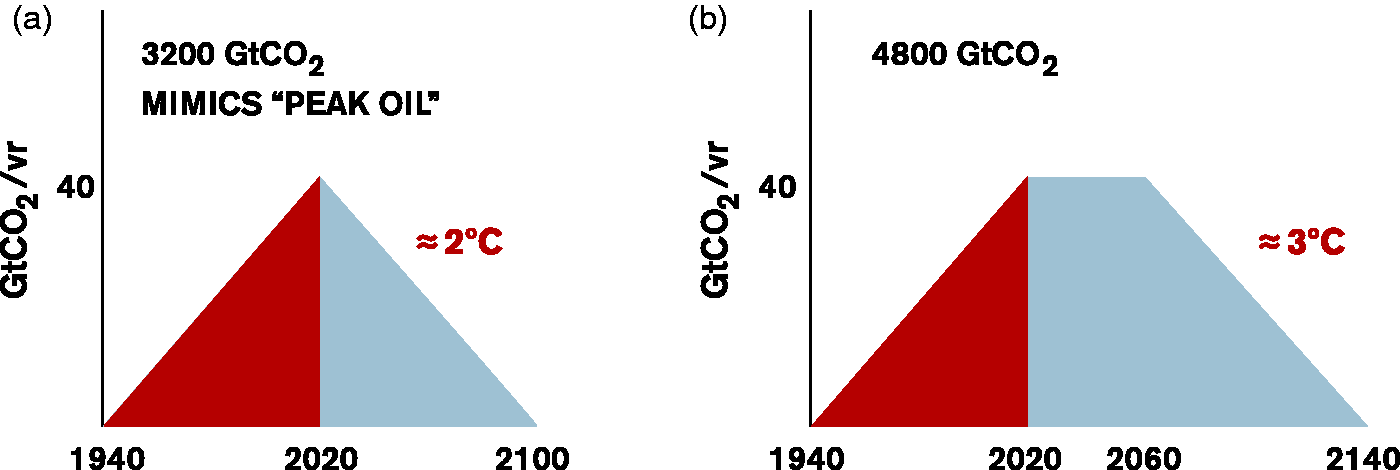
The implications of the carbon budgets in Panels A and B are profound and nasty, and raise the following questions: When should fossil fuel be extracted? (Reflecting the long life of carbon dioxide in the atmosphere, the budget is the same whether a gas field is developed in 2020 or 2040.) From which countries should fuels be extracted and in which countries should they be consumed? For what purposes? In each case, who judges?
One looks for precedents, where production and consumption have been constrained. Rationing? Since it works best during wars, must the world move to a war footing? Prohibition? Its terrible track record alerts us to the need to design against black markets. Sin taxes? Taxing bads like cigarettes and alcohol uses the market to discourage consumption. The stronger the competitors of fossil fuels—such as improved efficiency, renewables, nuclear power—the lower an effective tax can be.
Budgets are less painful when alternatives are superior overall. But it may be that every alternative, deployed at scale, is inferior to fossil fuels in some important attribute. In that case, for even a weak climate target, strong policy (a hefty carbon price) will be required to assure that otherwise attractive fossil fuel will be left in the ground. Over the next 50 years, constraining “unburnable” fossil fuel will occupy center stage.
Fitting on the Earth: Unprecedented questions, indispensable tools
For the first time in the history of human civilization, our species is capable of changing our planet in ways that affect our own well-being. The nuclear age brought forth pathways to doom via nuclear warfare, such as, for example, a nuclear winter. A global high-consumption lifestyle dependent on fossil fuels does not lead to doom, but it could lead to centuries of effort to deal with the consequences of present actions. It is a more silent crisis than nuclear war, but nonetheless potentially devastating in its own way. Grappling with the implications of climate change requires new thinking, which would become the task of the new discipline of Destiny Studies.
What specific concepts might this new field illuminate? Each of the three topics discussed above offers an answer. Generalizing from sea level rise, Destiny Studies would focus upon habitability. Profound uncertainty about the pace of change complicates any strategy to move a drowning city inland—and to stop farming a continental interior experiencing dangerous summer heat. An inexorable erosion of communities lies ahead as they abandon unlivable land. One can expect, as well, settlements in newly livable territory.
Generosity toward distant descendants is a second concept ready for deepening, as the sad example of nuclear waste reveals. We need mechanisms to prevent us from adopting strategies nominally designed to avoid injuring future individuals but that actually immobilize ourselves. Might we need something comparable to the statute of limitations to bound our obligations to the future?
Abundance will keep us busy as well: Our endowment of plentiful fossil fuel is just one of a class of temptations that could lead human beings to burst our planet’s seams by producing and consuming too much of a good thing. More kids, more meat, more leisure travel—all are problematic.
Habitability, generosity, abundance: These are some of the themes that would provide grist for the new mill of Destiny Studies.
Fitting on the Earth, 500-year issues: Our collective afterlife
Climate change, by extending our time horizon well beyond 500 years, asks how important it is for humanity to continue. Sam Scheffler, a professor of philosophy at New York University and the author of Death and the Afterlife, answers that it is very important. He observes that human life derives much of its meaning from being embedded in a “thriving ongoing exercise,” and that “humanity itself as an ongoing project provides the implicit frame of reference for most of our judgments about what matters.” Our connectedness to future generations “staves off nihilism.” We do not want to live forever; but we want the human project of which we are a part to endure (Scheffler, 2013: 59–69).
Of central importance to many of us is that a durable collective afterlife enables the perpetuation of the current global scientific enterprise that is revealing the story of our existence. Human science is producing a level of self-awareness that perhaps hitherto has never been achieved in our universe. Its continuity provides additional reasons for our continuity.
Fitting on the Earth, 50-year issues: Vigorous climate science
Over the next 50 years, will we become truly scared of climate change? It will depend on what the Earth tells us about itself by then. Right now, the best and the worst outcomes 50 years from now that are consistent with climate science are very different: climate change could vary dramatically from the central estimate that is inserted into most policy models. Gradually, during the coming 50 years, the Earth will give us clues about its variability and its feedback loops (involving clouds, ice, forests). The climate change that results from human activity will be considerably better delineated than today—provided that climate science (observation, lab studies, modeling, theory) flourishes.
We cannot afford to shoot out the headlights of climate science. But that is what so-called “climate skeptics” encourage when they tell the public that climate science should be ignored, even discarded, because it is somehow deficient—corrupt, answer-driven, ideological (Mann, 2015). Nor are the skeptics the only ones responsible for the polarization of climate change. I dislike as much as anyone the refrain that “97 percent of climate scientists believe in climate change.” Science has never been defined by voting.
Even though the overwhelming majority of climate science is conducted within the norms of science as a whole— where evidence is weighed, interim conclusions are continually revised, and disagreements provide the ferment for the next investigations—another 50 years of vigorous climate science is not assured. In particular, the current undermining of climate science may lead bright and motivated students, either on their own or following their mentors’ advice, to abandon climate science and to spend the next 50 years in less turbulent fields.
What it all means: Muddling through, one half-century at a time
Not only climate change will benefit from Destiny Studies. So too will the exhaustion of underground water resources, species extinction, and shrinking and aging human populations. My expectation is that Destiny Studies, in its investigations in all these fields, will confirm the value of blending caution with action—of muddling through.
What are the biggest challenges for the next 50 years? For climate change specifically, they are to develop wholesome alternatives to fossil fuels; reduce energy demand by ensuring universal “smart” energy use; remove the attractiveness of nuclear weapons; and come to terms with leaving carbon in the ground. Across all these fields, the goal should be to foster science and technology, to intensify planetary consciousness, to strengthen those international institutions that reinforce the reality that all countries are in one boat, to resist over-managing the planet, and to learn to think coherently about future time.
The world will be well served if a slew of universities worldwide have programs in Destiny Studies in 10 years—and high enrollments in their core courses on climate change.
Footnotes
Funding
This research received no specific grant from any funding agency in the public, commercial, or not-for-profit sectors.
Author biography
 ), under which he has helped launch new coordinated research in environmental science, energy technology, geological engineering, and public policy. Socolow’s research seeks to develop new decades-scale conceptual frameworks that are useful for climate policy. He and ecologist Steve Pacala are the authors of “Stabilization wedges: Solving the climate problem for the next 50 years with current technologies” (Science, August 13, 2004). Socolow is a member of the American Academy of Arts and Sciences, and a fellow of both the American Physical Society and the American Association for the Advancement of Science.