




Abstract
Will rising sea levels cause mass migrations of people from low-lying, impoverished equatorial areas into regions of higher ground—and if so, what will their reception be by their hosts? What can world leaders do to prepare for the population shifts likely to come from sea level rise already under way from the current high levels of carbon dioxide in the atmosphere? Building upon existing international law, such as the 1954 Refugee Convention, the work of the United Nations High Commissioner for Refugees, and Articles 3.1 and 4.8 of the United Nations Framework Convention on Climate Change, the authors look into the social effects of sea level rise caused by global warming on human populations and underscore the need to have a protocol that provides rights to climate exiles.
Keywords
In September 2013, the Immigration and Protection Tribunal of New Zealand turned down an asylum applicant known as “AF” who based his application for residency on the claim that he was being internally displaced from his small island home country of Kiribati due to rising sea levels caused by climate change. While accepting the reality of climate change, the tribunal said that there was no evidence of a connection between the environmental conditions he faced back home and the likelihood that he would not be able to resume his life there with dignity.
The tribunal’s findings were no surprise, given that other courts in Australia and New Zealand, as well as immigration officials, have resolutely refused to accommodate “boat people” from the Pacific islands, especially those claiming to be environmental refugees. Strictly speaking, the term refugee did not have any legal weight because the 1954 Refugee Convention restricts this definition to persons who have “a well-founded fear of being persecuted for reasons of race, religion, nationality, membership of a particular social group, or political opinion,” which does not apply to those forcibly displaced by climate change.
Despite this negative reception, that same month the president of Kiribati, Anote Tong, made a formal declaration that defied such policies. Among other things, he told the United Nations General Assembly that as part of his government’s strategy to adapt to climate change, Kiribati was trying to help its citizens relocate, in part by training them to become more skilled and desirable workers to potential overseas employers. He added: “[We] want our people to have the option to migrate with dignity should the time come that migration is unavoidable. And all the science is telling us that it is just a matter of time” (Radio Australia, 2013).
In his eyes, the Kiribati people were not cynically gaming the climate crisis in hopes of securing better lives outside their homeland. Instead, they were seeking to cope with an untenable situation. A developing country of more than 100,000 people living on a series of atolls in the Pacific that barely poke six feet above mean sea level, Kiribati is on the front line of climate change. And its worries are shared by other low-lying island-states, including the Cook Islands, Marshall Islands, Palau, and Tuvalu, along with dozens of others; overall, the collective population of these islands numbers in the tens of millions. In some cases, the governments of countries such as the Maldives—a low-lying atoll nation in the Arabian Sea—have expressed interest in buying land elsewhere, so its people have somewhere to move to.
Pictures of these islands appear stunningly beautiful, but life on them is becoming unviable. Forced to move as a result of the impact of climate change, the number of climate exiles is expected to increase dramatically over this century as the world heats up. And the issue is not just confined to small islands. Hundreds of millions of other people who live in low-lying delta regions of the world’s great rivers are also vulnerable: the Sundarbans of Bangladesh, the Mekong Delta in Vietnam, and the lowlands of Egypt. In these regions, coastal erosion, storm surges, flooding, and saltwater seeping in to contaminate the drinking water supply have already become common (see Figure 1). These problems are likely to become even more serious in coming decades.
The main map shows areas of the Ganges Delta with the greatest population density. Areas affected by a one-meter sea level rise are shown in dark blue; areas inundated by a two-meter rise—which would affect about 9.4 million people—are in lighter blue. The inset map at top left shows areas most frequently hit by tropical cyclones; note where they overlap with heavily populated areas. The middle inset map depicts the distribution of agricultural lands. About 486,000 hectares of the delta would be inundated by a two-meter rise in sea level. The bottom left inset map depicts the area affected by the 2007 flood.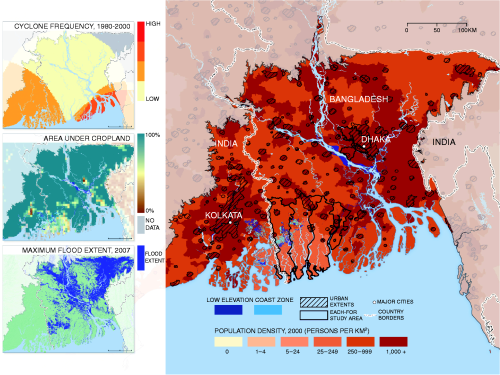
Where will these people go, and how will host countries receive them? To our minds, it is only just and proper that those countries that have contributed the most to the problem of global warming should provide the most help in dealing with its effects. Therefore, climate exiles and migrants—those coming from areas likely to be obliterated or otherwise rendered uninhabitable by rising sea levels—should be provided the option of early migration to other countries, preferably to those of their choice. (We use the terms “climate migrants” and “climate exiles” to refer to the victims of sea level rise attributed to climate change. The former includes all those who are displaced because of the effects of climate change, while the latter refers to a special category of climate migrants who will have lost their ability to remain well-functioning members of political societies in their own countries, often through no fault of theirs.) The right to free movement that we are proposing would be built upon well-established, existing international frameworks regarding refugees, preferably under the United Nations Framework Convention on Climate Change (Byravan and Rajan, 2010).
Why rising, why now?
The rise in sea level is largely due to the expansion of water and the melting of glaciers on land, although human activity that leads to land subsidence also contributes to coastal flooding. Greenland and Antarctica contain enough ice to cause nearly 400 feet of sea level rise if it all were to melt. While no one anticipates that this complete melting could happen in this century, the median projection of the Intergovernmental Panel on Climate Change (IPCC) is that the sea level will rise about two feet—a figure that may be too conservative, as paleoclimate records suggest that there could be much higher average sea levels. For example, during the Pliocene epoch—the time period between about 5.3 million to 2.6 million years ago—sea levels were about 100 feet higher than they are today, while average global temperatures were only about three to four degrees Celsius warmer. Given that the understanding of land ice dynamics is still relatively undeveloped, no one can say, for example, how quickly the vertical shafts within glaciers (known as “moulins”) in Greenland will carry meltwater from the surface down to the underlying rock—effectively greasing the way for glaciers to be transported more swiftly into the sea. Nor can scientists predict precisely when the West Antarctic Ice Sheet might collapse, or how warming ocean currents could accelerate such a change. These and other feedback loops in the climate system remain poorly understood. And yet abrupt climatic change could theoretically help to cause the seas to rise tens of feet by the century’s end, although most climatologists project it would be in the range of three to six feet.
Because of these concerns, some scientists have accused the IPCC of being “reticent” (Hansen, 2007) on the issue of sea level rise (Smith et al., 2009). The IPCC is not alone in this foot-dragging; there has been virtually no acknowledgement by the major emitters that they have caused tens to hundreds of millions of people to be at permanent risk of losing their homes—and possibly their countries—by the end of the 21st century.
In addition, the dire consequences of sea level rise are not limited to just the physical act of water covering the land on which one lives. Long before there is complete permanent submersion, rising sea levels cause wells to be flooded with saltwater, coastlines to erode, shoreline homes to wash away, more frequent and deeper floods to occur, and more intense storms to strike, all of which render large swathes of land unfit for human life and activities.
Consequently, even when there is less than two feet of sea level rise, many coastal regions of the world could become difficult, if not impossible, to inhabit. This is true not just for the people living on small islands, but also for the residents of many low-lying delta regions. A foretaste of these pre-submersion effects can already be seen in the Pacific islands and in low-lying deltas such as the Ganges and the Brahmaputra (CARE International, 2009).
How many people would be affected?
For thousands of years, people have chosen to live along coastlines because of their rich and diverse ecosystems and the livelihoods they offer. For this reason, most of the world’s megacities are along the coast: New York City, Shanghai, Mumbai, Dhaka, and Ho Chi Minh City. In fact, about 10 percent of the world’s population lives within a mile or so of the shoreline and below 10 meters in elevation.
Consequently, there are millions of people living in densely populated coastal cities and deltas who are vulnerable to the changes expected from global warming. In countries like Bangladesh, Vietnam, Egypt, and Guyana—where a significant fraction of the population lives near coastal deltas—a rise in average sea levels beyond three to four feet could be devastating. In a recent paper for the Proceedings of the National Academy of Sciences, researchers estimated that a four-foot rise in sea level by the end of the century would mean that nearly five percent of the world’s population would be subject to annual flooding (Hinkel et al., 2014).
If forced to relocate to other countries because of sea level rise, these climate exiles would have little or no legal standing under current international law. Their numbers would be huge: In Bangladesh alone, roughly 75 million people, or about 40 percent of its projected population for the year 2100, would be affected. Their entire country would become non-viable as an entity, with most of its productive agricultural land inundated and its economy defunct (Byravan and Rajan, 2008).
And these coastal dwellers are not vulnerable to sea level rise alone: Multiple, simultaneous other environmental and economic changes would also take place. For example, in addition to experiencing more frequent and intense cycles of drought and flooding, afflicted communities would also suffer from famine, disease, inflation, loss of income, siltation, and the introduction of pollutants to their environment. Understanding vulnerability and how to respond to it therefore becomes a complicated issue.
Making the situation worse, the most drastically afflicted regions are likely to have the fewest tools to combat the effects of sea level rise caused by global warming. In developing countries, where most of the affected live, people are poor, their economies are still emerging, and there is not much technological infrastructure. Realistically, they cannot build dikes or seawalls or floating cities—and in any case, even rich countries that can afford these expensive technological fixes find that they are not fully protective. Given this situation, plus their extreme vulnerability and the minuscule contribution of developing countries to the problem of climate change, it is imperative that these developing countries be compensated for their losses by the rest of the international community (Byravan and Rajan, 2010).
Unfortunately, concerns about the arrival of a large number of climate exiles or boat people knocking on their doors has driven some countries to build even stronger borders. Such “fortress worlds” promote even stricter migration policies toward affected neighbors. We argue that such fortresses are unethical, since climate exiles are hardly responsible for their plight, and it is the duty of those responsible to recognize this fact and provide assistance. In addition, it is likely that an influx of new citizens, with their talents and skills, would generate net economic benefits for host countries—particularly those with declining birthrates—and legal immigration would provide a prudent long-term answer to tensions relating to international refugee crises.
While assistance in combatting sea level rise could take several forms, migration and permanent resettlement would seem to be the only possible “adaptation” strategies available for the millions of people whose countries and lives are at extreme risk. Unfortunately, existing international law provides no help for these individuals; the closest legal mechanism is the 1954 Refugee Convention, designed to protect those forced to flee their homes as a result of war or persecution.
Legally speaking, at present those forced to move due to environmental or climate reasons cannot be referred to as refugees.
What should we do?
The only just remedy to the climate-driven migration problem would seem to be the development of a new, special right of free global movement and resettlement in regions and countries on higher ground, in advance of actual disaster.
Some of this could fall under the rubric of Loss and Damage, a legal concept originally introduced through the Association of Small Island States and Bangladesh, which has received support from other developing countries (UNFCCC, 2008). The idea is rooted in the principles of state responsibility under international law, and began to get more visibility after the UN Framework Convention on Climate Change held its conference in Poznan, Poland, and was further reinforced after the Cancun Climate Change Conference of 2010.
Until quite recently, advocacy groups that worked on issues of migration, human settlement, and relocation—including Oxfam and World Vision—considered the problems related to poor countries suffering damage from climate change mostly as a human rights concern. While this is an important approach and acknowledges that there is a positive duty to help people who are suffering, it does not grapple with the responsibility that rich countries have toward poor countries for occupying their global development space and causing them harm through the effects of global warming; rich countries have an obligation toward poor countries as a consequence of the cumulative burden of greenhouse gas concentrations they have contributed to in the past (Byravan and Rajan, 2010; cf. Pogge, 2005). In other words, while providing support to climate exiles as a charitable effort to assist people in harm’s way is certainly necessary, those countries that have historically been large emitters have contributed the most to the burden of greenhouse gas stocks in the atmosphere and therefore have a special responsibility to make proportionate amends to those who are experiencing destruction from global warming.
In policy terms, it is important to recognize that climate exiles are a special category of international migrants who need protection of an even stronger sort than that given to other refugees. They are stateless persons who are either already or soon will be stripped of rights—but what is exceptional about them is that theirs will be a permanent condition, unlike most other types of statelessness, since the original state and its territory either no longer exist or will be rendered largely unviable for all practical purposes. They will therefore need special protection in terms of being provided civil, political, and economic rights, typically by becoming full citizens in countries away from their original homes. This could mean that climate exiles need to be recognized as such and given special status, either through a new international treaty or through some framework of regional and international cooperation.
One way this could take place would be by including the millions of people who live on small islands in the existing immigration quotas of rich countries—who are the most responsible for the cumulative effects of greenhouse gases in the first place. Accordingly, we have proposed (Byravan and Rajan, 2006) that rather than deal with climate exiles in an ad hoc manner as the problem arises, there should be a mechanism in which these exiles would be given accelerated immigration benefits. Under our proposed framework, people living in areas likely to be obliterated or rendered uninhabitable would be provided the option of early migration after having received some training and skills to be prepared to be full citizens of host countries. Thus, host countries could demonstrate their commitment to climate justice and provide a pragmatic solution to the problem.
Such a mechanism, operating in advance of climate-induced disaster, would be a fair way of addressing the problems faced by climate exiles and offer a modicum of climate justice. Once the basic principle is accepted, there could be several ways to determine who should be considered for immigration benefits, which countries should bear the costs of immigration, and what institutional and political mechanisms should be established to minimize the risk of a massive refugee crisis as climate impacts become more severe.
There are other approaches as well. For instance, regional agreements could identify potential hosts for their more vulnerable neighbors without having to wait for international negotiations to provide a solution. Large countries that are themselves not at risk could take the initiative in these processes. For instance, the Maldives and Bangladesh face the greatest danger of obliteration in the South Asian region; therefore, India could take the lead in promoting an agreement for phased migration to India and other countries in the region over the course of this century. Similar efforts could be led by Australia in the Indian Ocean and parts of the Pacific, and by China and the United States for the Americas and island regions within their respective spheres of influence. Even here, subsequent international treaties would be necessary to seal these relationships and provide formal ways of sharing the financial costs associated with putting them into effect.
Regional agreements are more important than experts and negotiators usually recognize, because of the synergies they generate for peace and prosperity among neighbors. In many cases, regions experience the same climatic disaster events such as cyclones and floods, and share similar weather-related systems (such as monsoons and melting glaciers) and comparable cultural features and histories. But not all regional neighbors have neighborly relationships, and that could be a big challenge. In South Asia, for example, while India and Nepal have a relatively relaxed policy on movement between countries, the same cannot be said of the other countries around India.
The issues related to cross-border migration, unfortunately, are almost always viewed through the lens of a national security threat. In light of cross-border migration pressure from climate change and weather-related disasters, however, there are many opportunities to be explored regarding new regional policies on labor, migration, and adaptation.
While there appears to be some acknowledgement of the challenge of climate exiles within the international community, much more needs to be done. Article 3.1 of the United Nations Framework Convention on Climate Change, stressing common but differentiated responsibility, has been one of the core principles behind the concept that wealthier nations would contribute more to resettlement efforts, but unfortunately that concept has been eroded bit by bit in recent years, becoming nearly irrelevant in the current negotiations. Similarly, the legal concepts of Loss and Damage and other initiatives could fall by the wayside in their usefulness for vulnerable populations unless these are fortified through legal protection and regional cooperation.
Adjusting to living in a warmer world and reducing the greenhouse gas emissions responsible for global warming are dual responsibilities, shared by all. Both of these are huge challenges that the world will have to deal with in the coming centuries.
Footnotes
Funding
The Heinrich Boell Foundation funded a small portion of the research used in this article.
Author biographies
 ) in Bangalore, India..
) in Madras, India..