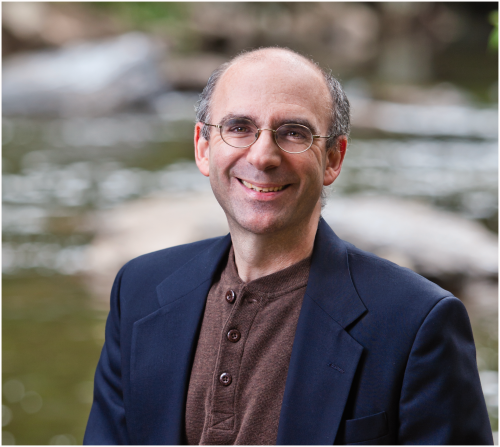
In this interview, physicist and climate change blogger Joe Romm speaks with the Bulletin’s Dawn Stover about whether nuclear energy will be a major player in efforts to mitigate global warming. Romm points to economics as a limiting factor for nuclear power, at least until the world grows more desperate to reduce carbon pollution. He explains the reasons why nuclear energy is expensive in the United States and Europe but expanding in China. Although pessimistic about nuclear, Romm is optimistic that the world has reached a turning point for the adoption of renewable energy generation and storage technologies, energy efficiency, and carbon abatement policies.
The son of a newspaper editor and an author, Joseph (Joe) Romm is a writer who has published eight books and was named by Time as “the Web’s most influential climate-change blogger.” His ninth book, Climate Change: What Everyone Needs to Know (Oxford University Press), is scheduled for publication in November 2015. Romm is a senior fellow at the Center for American Progress, where he founded the blog Climate Progress, and chief science adviser to the 2014 Emmy-winning documentary television series on global warming Years of Living Dangerously. He was acting assistant secretary for energy efficiency and renewable energy in the Clinton administration, overseeing $1 billion in low-carbon technology development and deployment, and worked at the Energy Department for five years. Prior to that, he worked as special assistant for international security at the Rockefeller Foundation, and as a researcher at the Rocky Mountain Institute, after earning a doctorate in physics from MIT. As a climate communicator, Romm emphasizes the importance of storytelling. Here he talks about where nuclear energy fits in the climate story.
BAS: What role do you see for nuclear power in the response to climate change? How big of a player should it be?
Romm: If one is going to avoid catastrophic warming and keep things below 2 degrees Celsius, which is certainly a great challenge, then you can’t rule out any carbon-free source. New nuclear plants are very expensive, which is why there has been exceedingly little construction in any market economy. Beyond China and India, you just don’t see a lot of sales, so I think the challenge for nuclear will be to maintain its market share. In the most optimistic projections, it can expand a little bit in the coming decades, but that will require a fair amount of sales because as plants get older in theory they have to be decommissioned. At some point, the world is going to get considerably more desperate to reduce carbon pollution than it is now. When we hit that phase, whatever is plausible and affordable and scalable is going to see massive deployment. To the extent that all these countries are already making serious commitments, then certainly people will take a second look at nuclear. If it could get its act together and come up with a modular design that was standardized and not too expensive, it might be able to see some growth.
BAS: Your last book, Hell and High Water: Global Warming—The Solution and the Politics—And What We Should Do, came out in 2007. What has changed since then?
Romm: The most encouraging thing is that the forecasts about clean energy technologies came true. Back then, you had to believe the experts, much as you had to believe the warnings of extreme weather and sea level rise. Since then, we’ve had Hurricane Sandy, and the science on what’s happening in Greenland and Antarctica has been mind-boggling, as has the loss of Arctic ice. We’ve seen the latest assessment report of the Intergovernmental Panel on Climate Change, which is quite clear that we’re entering territory where multiple irreversible impacts are going to be setting in. We definitely know that the economic cost of action is quite low and the economic, human, and societal cost of inaction is simply incalculable—but it’s certainly a large fraction of GDP.
BAS: You criticize nuclear power as expensive. Do you see that as its biggest disadvantage, compared with things like waste and safety issues or proliferation?
Romm: You can’t separate them entirely; one of the reasons nuclear plants are so expensive is that you have to have a lot of safety redundancies. The system failure costs are so high, compared to other systems, that this notion that you can just chug out cheap nuclear power plants and have anybody run them—that can’t happen. But yes, given that the competition has vastly improved, nuclear has not been heading in the right direction. As I said, when we get desperate I’m sure people will want to build some nuclear power plants. And China, in its own way, is desperate to get off coal.
BAS: China has at least two dozen nuclear reactors under construction, more than any other country, and additional ones are planned. If nuclear power doesn’t make economic sense in the United States, why does it make sense in China?
Romm: China’s not a market economy, so economics is not the driver. China is trying to be a semi-market-oriented Communist country, so it’s promoting entrepreneurship from the bottom up, which is great, but nuclear power plants aren’t a bottom-up, mom-and-pop type of thing.
BAS: But if safety is what makes nuclear power so expensive in the United States, what does that say about China?
Romm: There’s also labor. If you have a labor force that’s not getting paid much, and you have a centralized government, you can essentially mandate things and influence the distribution of raw materials.
BAS: So you’re not saying they’re skimping on safety?
Romm: Do I have confidence that they have the same standards as countries in the West? I don’t. Do I know that they are unsafe? I don’t. I just know if you are building a lot of something, in a country that doesn’t have transparency, then you’re taking a risk. But the Chinese aren’t dumb. They see what happened in Japan.
BAS: In both the United States and China, it seems like the most significant reductions in energy consumption (and, by extension, in emissions) have happened more as a result of economic downturns than because of policy changes.
Romm: That’s a very hard calculation to do. The economic downturn certainly played a role in the United States. So has the low price of natural gas. So has the explosion in renewables, and energy efficiency has become quite popular in a lot of states now, and with a lot of utilities. So it’s a combination of all those things. In China, I don’t believe it’s at all fair to say that the changes are primarily due to “the economic slowdown.” China has clearly realized that it must shut down coal plants. The Chinese are exceeding every single target on solar and wind, and they have the biggest targets in the world. They are shutting down coal plants, and they have been starting to shift away from heavy industry run on coal, toward a more service economy. There was no way that they could sustain the rate of economic growth of 10 years ago. The heavy industry sector is simply not economically viable; it’s running on subsidized energy costs. China made its 2030 peak carbon dioxide commitment with the United States in November 2014.
BAS: But they didn’t actually say what the peak would be.
Romm: They didn’t, but they said, “We’re going to do our best to peak earlier.” And within a few weeks, they announced that coal would peak in 2020. Now, you go to Beijing and you talk to all the experts, and everybody says they’re going to peak by 2025 in carbon dioxide, and the modeling typically shows the coal peak is a decade earlier. It is entirely possible that they’ve peaked in coal already, and I think it’s pretty safe to say that if they haven’t peaked then they’ve basically plateaued. Then you have the renewable energy commitment: They said, “Carbon-free energy is going to become 20 percent of our energy in 2030, a doubling”—which is 800 to 1,000 gigawatts of carbon-free power, about the equivalent of the US electric grid. That means that all the economies of scale and the learning curve on renewables are going to continue, and it raises the question of why other countries can’t do the same.
BAS: What announcements do you expect at the Paris climate talks?
Romm: Presumably the nations of the world are going to have a relatively serious agreement that is going to send a signal to the world that we’re on the path to zero fossil fuels, and we mean it. That is a psychology change in the market. It cannot be long before people realize that the divestment movement is correct, that we simply are not going to burn all the fossil fuels that companies keep spending tens of billions of dollars to extract.
BAS: What sort of portfolio will be needed to meet the Paris targets? According to the wedge theory—which says that a combination of strategies can together stabilize the climate—we’d need to triple the world’s current nuclear capacity just to cut emissions by one wedge, out of eight needed.
Romm: The International Energy Agency teamed up with the Nuclear Energy Agency to release a report earlier this year on their optimistic scenario, in which nuclear power sees modest growth in its share. Nuclear is not going to be the big contributor to the solution, if by big one means more than 10 percent; 80 to 90 percent of what we do is going to be other stuff. I am not in favor of shutting down nuclear plants, by the way. I don’t think that makes sense unless a plant isn’t safe.
BAS: The final version of Obama’s Clean Power Plan doesn’t give any financial incentives to keep existing nuclear plants operating. Do you think that’s a mistake?
Romm: That is a very complicated question, because we’re at the intersection of what is economically desirable, what’s environmentally desirable, and what is “fair.” If a power plant has made all of its money back, and is generating essentially pure profit after a few decades, do you have to pay them more to keep it running?
BAS: What about a plant like Kewaunee, in Wisconsin, which closed recently because it couldn’t complete with cheap natural gas?
Romm: I think the most important thing to do is what the plan does, which is emphasize renewables—and new nuclear, that’s fine. If the nuclear folks can make a cost-competitive product, then they’ll be incentivized. If they can’t, then they won’t. I’m not worried about whether the United States is going to hit its 2025 target. I have no doubt we will surpass it. The science is just going to get stronger and stronger, and the economics of renewables and storage and all that are just going to get better and better. Obviously a lot depends on the next president though.
BAS: It often seems that the debate over climate action in the United States is entirely political. As someone who has a close eye on what’s happening in D.C., do you see an overlap between support for nuclear power and support for climate legislation?
Romm: No. I certainly know progressives who support nuclear, and I know conservatives who aren’t that thrilled with it. But, by and large, the people who have been the most vocal on the science are not the same people who are the biggest supporters of nuclear. On the other hand, that’s how deals get made, so the 2009 climate bill that failed had plenty of incentivization for things like nuclear and carbon capture and storage. I think we’re now on the inflection point of the public’s—and the policymakers’ and intelligentsia’s—understanding of the climate situation. And I think we’re on an inflection point about the cost competitiveness of renewables and storage, and the related perception of those costs. The world is going to look at things completely differently in a number of years. It seems very unlikely to me that the flip won’t happen by the mid- to late 2020s, when coastal property values collapse.
BAS: Is carbon pricing absolutely necessary to mitigate climate change? Or do you think there are enough positive things happening now, particularly if all goes well in Paris, that a tax might not be needed?
Romm: It is very hard to replace the value of a carbon price. The European Union plans to meet its commitment by continuing its trading system. At the same time, we see a South Korean market, and China is experimenting with some trading markets. And of course, any state that wants to can meet its EPA Clean Power Plan target through a price—which was always the center-right, business-friendly, economist-friendly, moderate Republican approach. If you don’t have pricing, you are stuck with regulation. For a long time people were saying, “We just need to spend a moon-shot program’s worth on energy R&D,” but 25 years of dawdling have ended the possibility that we can wait around for some miracle 10 years from now. The miracles are here; we just have to start deploying them.
BAS: Isn’t that something of the problem with nuclear too? In discussions about nuclear power, people often aren’t careful to distinguish between what is deployable now and hoped-for designs that take a long time to prove out in the marketplace.
Romm: That is endemic to the nuclear industry. New technologies take time to mature, and for the bugs to be worked out. At the same time, your competition isn’t standing still. To compare what nuclear could be in 10 years of successful R&D to what renewables or anything costs today is pointless. We’re now stuck in a position where we need programs that get trillion-dollar deployments over the next 10 to 20 years, because that’s the size of the market. And we should be spending a lot more on R&D, but we’re really talking in the tens of billions of dollars there.
BAS: The headline for one of your blog posts was “Deploy, deploy, deploy, research and develop, deploy, deploy, deploy.”
Romm: One of the points that I tried to make in that post was that obviously a lot of innovation comes from the lab, but innovation also comes from getting your product in the marketplace and seeing what works and what doesn’t. The entire transformation of the solar market was a financing revolution—customers leasing solar panels rather than buying them—and that has completely changed the market. Sales had to reach a certain level before banks and financial institutions would see the technology as serious and reliable enough to do packaged deals. If you have the certainty that an investment is going to pay for itself over 20 years, then you will see the private sector do lots and lots of R&D. It’s just because carbon has zero price that, understandably, the marketplace is not spending a lot of money figuring out how to get it out of the system. A lot of smart people have been doing amazing things in information technology and software and phone apps, and they’ve transformed the world. Many of them are starting to think about the environment. But nuclear hasn’t proven it’s not still a dinosaur.
BAS: Tell me about your experience working on the TV series Years of Living Dangerously. The website casts energy choices as “dirty vs clean,” but it’s a little cagey about where nuclear fits. What were your behind-the-scenes discussions about nuclear power and where it belongs in those two camps?
Romm: The show had nine hours and a gazillion potential stories, and they picked the most interesting characters, interesting stories, interesting visuals. We didn’t do China, which we’re going to do in Season 2. I understand how people try to use nuclear energy as a litmus test to see whether you’re “really serious” about climate change. But once you understand what we have to do and what we’re currently capable of doing, then you know that nuclear, if it makes advances, will be a slightly bigger player—and if it fails to, it will be a smaller player. Even the Nuclear Energy Agency understands that nuclear will not be a majority of the solution. If you have your A-list players and your B-list and your C-list, then it’s on the B-list. It’s had 20, 30 years to get its act together, to agree on a modular design and figure out how to deal with the scalability issue, and come to some agreement on the waste issue. The literature makes clear that economics is the main reason it’s not taking off in any market economy.
BAS: How would you rate the media coverage of nuclear energy with respect to climate change?
Romm: It’s hard to get the media to cover things where there isn’t a lot of news.
BAS: Even the new nuclear plants being built don’t seem to be getting much attention.
Romm: Is it a dynamic industry in this country? No. Is the new stuff completely different from the older stuff? No. When I was at the Department of Energy, we couldn’t get the media to cover renewables. The news media never leads on anything. Stuff has to bubble up to a point where it’s a trend. The leading headline for every major newspaper, for the past 20 years, should have been “World Continues to Fail to Address Biggest Threat to Humanity.” That’s the news. That’s the most important story. But the majority of even very influential, educated people still don’t get it.