




Abstract
Many nuclear power plants were situated next to the ocean to have ready access to huge volumes of water, and sometimes they were built on land that was not very high above mean sea level. These characteristics may cause problems if ocean levels rise the one or two meters that most climatologists project as a result of climate change. The core of the problem resides in nuclear power’s dependence on two things: water and off-site power. Operating and safely shutting down a nuclear power plant require large supplies of cooling water, as well as the power to operate the control panels and the pumps that circulate the water. The Fukushima Daiichi accident happened after the facility lost its connection to the electrical grid and floodwaters caused the backup diesel generators to fail. While an earthquake caused the tsunami that led to the situation, a severe storm coupled with rising sea levels could have the same end result, especially in low-lying areas suffering from increased erosion caused by climate change. Off-site power losses, or “station blackouts,” have long been a commonly recognized risk at nuclear power plants. Backup systems have worked in the past, but dramatically rising sea levels, more frequent and intense storms, and the associated erosion that goes with them could make backup electrical systems problematic. To complicate the situation, the same storm and flood that affects a given power plant also interferes with the plant’s communication and transportation networks, hampering the ability of personnel to respond to any crisis at the facility. At a minimum, climate change and the resulting rise in sea level will lead to concerns about the safety and cost of nuclear power plant operation and construction.
Nuclear power plants need lots of water: to fill cooling ponds that prevent control rods from overheating, to cool steam used to generate electricity so it can be used in another cycle of production, for cooling auxiliary safety equipment and the used fuel rods “temporarily” stored on-site, and for cooling the reactor in the event of an emergency (Union of Concerned Scientists, 2015). Consequently, nearly all nuclear power plants in the United States have been situated close to large bodies of water, especially oceans. But with climate change expected to raise the level of the seas, many of these power plants will be subjected to deeper, more frequent flooding—especially for those plants sited in low-lying areas next to the ocean, many of which were built long before many architects and engineers had ever heard of global warming.
Climate change will cause rising water levels, more frequent flooding, and more bouts of more extreme weather, all of which will affect not just a nuclear power plant’s buildings and storage areas, but also its access roads, backup systems, security, and even the electricity needed to operate the plant itself. Increased amounts of storm-induced erosion, also known as “scour,” will also affect nuclear plants. With ocean levels predicted to rise as much as six feet by the year 2100, such climate effects will present real problems; imagine if the tsunami that struck Fukushima Daiichi had an initial starting point that was six feet higher.
Will maintaining safety even be achievable, given the multiple hazards? Regulatory bodies such as the US Nuclear Regulatory Commission (NRC) and the International Atomic Energy Agency (IAEA) have reported on the lessons learned from past extreme weather events, but the same problems keep recurring. Even conservative models of sea level rise, such as those used for this article, show that there will be increased flooding and storm-induced damage in the future, particularly for new and existing nuclear power facilities in South Florida, where the average elevation is barely six feet above sea level—and some places are much lower (Lemonick, 2012). Permanent solutions to protect existing sites will likely prove difficult and costly, while construction costs for new facilities will go up because of a need for extensive additional protections. Careful monitoring and diligence, along with the erection of massive seawalls, drainage systems, pumps, piping systems, and the like may prove effective in the continual fight against sea, storm, and scour. So would relocating entire nuclear power plants to higher ground. But these endeavors may not be effective in every situation, and they will undoubtedly add hugely to the operating costs of nuclear power—and low operating costs have traditionally been portrayed as one of the industry’s chief benefits.
Proponents of nuclear power like to stress that in comparison to other energy options such as coal and natural gas, nuclear power produces zero greenhouse gas emissions during energy production; compared to wind and solar, nuclear is a more reliable energy source, independent of the weather. But the changes wrought by climatic extremes may tilt the balance away from nuclear energy.
The trouble with water
The location, design, and construction of nuclear power plants must take into account climatic extremes and flooding. During massive storms, or what meteorologists like to call “severe weather events” (Atwood et al., 1998), there is a greatly increased chance of the loss of power at a nuclear power plant, which significantly contributes to safety risks. Vital cooling systems can fail when the site loses power or when flood-borne debris blocks inlets for cooling water (Eide et al., 2004; IAEA, 2003b). In addition, moisture accumulation and immense pressures caused by floodwaters can damage a plant’s safety systems (IAEA, 2003b). Flooding of a facility can cause an emergency by hindering communication and transportation; floodwaters can also contaminate the plant’s innards by introducing algae, salt, kelp, and other materials into places not designed for them (IAEA, 2003b).
And the problem is a two-way street: As well as contaminants coming into the reactor site from the outside environment, there is the problem of newly radioactive water inside the plant leaking back out to contaminate the environment—a continuing difficulty at Fukushima Daiichi (Obayashi, 2014).
To understand how well nuclear power plants will handle future flooding and erosion from sea level rise and storms, and what adaptation measures have worked best, it is necessary to examine the problems that arose during floods in the past (IPCC, 2007b).
Until recently, nuclear power benefited from operating in a relatively calm coastal environment. Compared to longer time scales, until the 1990s there were few hurricanes on the East Coast, and California’s storms were also much less intense and much less frequent than in the past (Griggs et al., 2005; Kuhn and Shepard, 1981; Neumann et al., 2000). Nonetheless, even under these benign conditions a review of “loss of off-site power” events because of severe weather at US nuclear power plants found that 16 of the 22 events happened at just five sites, all located close to the East Coast (Atwood et al., 1998).
Such events are troublesome and potentially dangerous. Although it may seem counterintuitive at first, a nuclear power plant actually needs a source of off-site power—it cannot just use the electricity that it generates itself. The rationale is that something is needed to provide power to the control equipment if the plant is ever forced to shut down, as well as to generate the electricity to operate the plant’s lights, pumps, computers, and everything else. Hence, a “loss of offsite power,” also known as a “station blackout” (Lochbaum, 2011a), is considered a serious event, and so the Nuclear Regulatory Commission requires that emergency diesel generators and large storage batteries be kept on the premises, ready to go. As spokesman Scott Burnell of the NRC explained to the press shortly after the Fukushima Daiichi disaster: As a basic design feature in the United States, plants are not literally self-powering. That’s by design, because you don’t want to end up in a situation where a problem at the plant cuts off its own power source. Therefore, the primary means of power for a plant in order for it to run is electricity from the grid. As a general matter, for US plants, if you can’t use power from the grid, you shut down. (Biello, 2011)
Regardless of the distinctions between an incident and an accident, there have been some very threatening situations caused by the weather, of which Hurricane Andrew is a prime example. This 1992 storm marked one of the first times that a hurricane had a significant impact upon a nuclear facility, when it made a direct hit on Turkey Point Nuclear Power Plant, 24 miles south of Miami. Later determined to be a Category Five hurricane—the highest level for a tropical cyclone under the Saffir-Simpson scale, which is to the measurement of storms what the Richter scale is to the measurement of earthquakes—Hurricane Andrew was one of the biggest and most devastating storms to ever hit the United States since record-keeping began, with top wind speeds reaching more than 155 mph. Hurricane Andrew caused 26 deaths and more than $25 billion of damage in 1990s dollars, and destroyed 49,000 homes (National Weather Service, 1992).
During the hurricane, there were five days when there was no off-site electricity available to the nuclear power plant and backup diesel generators had to be used—and then one of the generators had to be shut down before it overheated (IAEA, 2003a). Authorities were forced to use helicopters to transport fuel and supplies to the site because all the access roads were blocked by debris. It was so difficult to get from one place to another that when alarms sounded at the plant’s spent fuel storage area, that area could not be reached. (Luckily, these alarms turned out to be false (IAEA, 2003a)). During the hurricane’s height, a water tank collapsed onto fire hoses, knocking out the plant’s fire-fighting system (Nuclear Regulatory Commission, 1994). In addition, the plant’s telephone lines were downed and its radio antennas damaged; with the exception of a single handheld radio, the plant had virtually no means of electronic communication with the outside world for 24 hours after the storm (Lochbaum, 2011b).
After these experiences, the flood wall at Turkey Point was modified and emergency procedures overhauled.
Yet many of the same problems occurred again, more than a decade later. During the 2003 and 2004–2005 hurricane seasons, there was a loss of off-site power, inoperable emergency alarms, damage to security systems, loss of communication, and disrupted transportation networks (IAEA, 2003a; Kauffman, 2005; Nuclear Regulatory Commission, 2005, 2006; Washington staff, 2003).
And the problem is not confined to this one facility, nor to the state of Florida. When Hurricane Katrina struck in 2005, plant operators at the Waterford Nuclear Generating Station in Louisiana hoped that their satellite phones would forestall any communications problems, but the storm’s cloud cover interrupted satellite coverage to such an extent that it eliminated that possibility (Leach et al., 2006).
And during the 2004–2005 hurricane season, at one site, system-wide failures happened because the licensee did not realize that the moisture accumulating inside the plant’s electrical equipment was causing a problem. In addition, the massive shield doors used to protect safety equipment from debris were found open after a hurricane had passed a site in Florida; according to the licensee, they may have remained open for years (Kauffman, 2005).
After the accident at Fukushima Daiichi in 2011, the NRC adopted a strategy of storing additional backup equipment in many locations to maintain cooling during any loss of power (NEI, 2014). A year after Fukushima, Hurricane Sandy hit the East Coast, affecting the nuclear facilities at Oyster Creek, Salem, and Hope Creek in New Jersey. Many of the reactors in states affected by the hurricane were already shut down for scheduled refueling, including Oyster Creek; nevertheless, Oyster Creek operators had to declare an alert due to high water levels at the intakes. Meanwhile, Salem’s Unit 1 had a five-day forced outage after debris blocked its cooling water intakes and caused four of its six circulating water pumps to stop working (DeNight, 2014). It turned out that in both cases the plans for dealing with severe weather did not account for wind direction, tides, and debris—or potential errors with hurricane forecasting (Nuclear Regulatory Commission, 2012).
The problems showed that additional waterproofing was needed, along with extra shoring-up of substations and access roads (DeNight, 2014). Each incident provides valuable lessons for future operation, but can all of the issues ever be addressed? Can anyone safely say that all the lessons have now been learned regarding floods, storm, debris, and erosion?
According to an International Atomic Energy Agency publication, the Fukushima Daiichi accident taught nuclear operators and regulators about the need to improve measures against extreme external events, consider issues arising from events impacting multiple reactors or multiple sites, and ensure electricity supply for safe operation and shut-down—but some would argue that the industry already knew enough to expect these issues before the accident. According to the IAEA (2003a):
Extreme external events with very low probability of occurrence could have effects not properly foreseen in terms of their action on the plant and/or their magnitude; the estimation of the effects from extreme external events is affected by gross uncertainties not explicitly considered in a deterministic design and there is an intrinsic lack of operating experience concerning the effects that such extreme events could have on plant safety.
The inability to predict future flood levels and effectively monitor changes could seriously affect safe operations. In France, flood levels exceeded the maximums predicted prior to design and the siting of the country’s Le Blayais plant caused significant flooding and damage (IAEA, 2003a). Implementing flood reassessments and other lessons learned from the Fukushima accident continues to require more time to complete (NRC, 2014).
An uncertain future
To get a better sense of what could happen in a severe storm that starts from a higher sea level, I attempted to model the impacts of climate change for the future, using projections of sea level rise at nuclear power plants located within two miles of the US coast, gathered from sources such as the 2007 Intergovernmental Panel on Climate Change (IPCC). Projections were made for currently operating reactors, using the global average of a 3 millimeter rise in sea level per year, while at sites in the northeastern United States a figure of 4.3 mm per year was used to account for land subsidence. To see if sites would be appropriate for future reactor construction, the upper limit of the low and high emission scenarios from the IPCC report were used (IPCC, 2007a).
Projections were completed for 100 years and 150 years to allow for construction and planning time. (A given site for a nuclear reactor needs to be suitable for the life of the reactor, including decommissioning time, or 100 years at an absolute minimum (IAEA, 2003b; IAEA and WMO, 2011). Digital elevation models provided a simple, commonly used method for determining the locations that would be inundated by sea level rise. Storm data was incorporated by searching the written record for storms in each region and modeling one storm category higher. The National Weather Service (2007) provided surge levels for each hurricane category; although in reality, determining a storm surge in detail involves more site-specific calculations that account for bathymetry—the shape of land features under the water.
It is important to note that even with detailed site-specific knowledge determining a storm surge can be problematic. Models for predicting erosion can produce different results due to the particular effects caused by landforms, soil conditions, water depths, and other factors at each location (Dickson et al., 2007; Zhang et al., 2004). Sometimes there are special circumstances; for example, a hurricane that blows for a long time over large areas of shallow water produces extra-large surges in comparison to an identical site in which the same hurricane blows for a short time over small areas of deep water. In addition, higher water levels due to sea level rise may allow waves to hit further up the shore and thereby worsen erosion. With these factors in mind it is easy to see why, after a 1975 hurricane, more than 2.8 meters (over 9 feet) of the storm surge could not be accounted for in the calculations. (The discrepancy is now considered likely to have occurred due to large breaking waves (Simpson and Riehl, 1981)).
In order to help account for some of the more complicated processes of wave-breaking and erosion at any given location, this assessment included the level of coastal vulnerability as determined by the US Geological Survey (Thieler and Hammar-Klose, 1999). Nevertheless, the method used here to calculate storm surges should be considered to be likely to err on the side of being overly cautious and conservative.
Vulnerability at nuclear power plants within two miles of the US coast
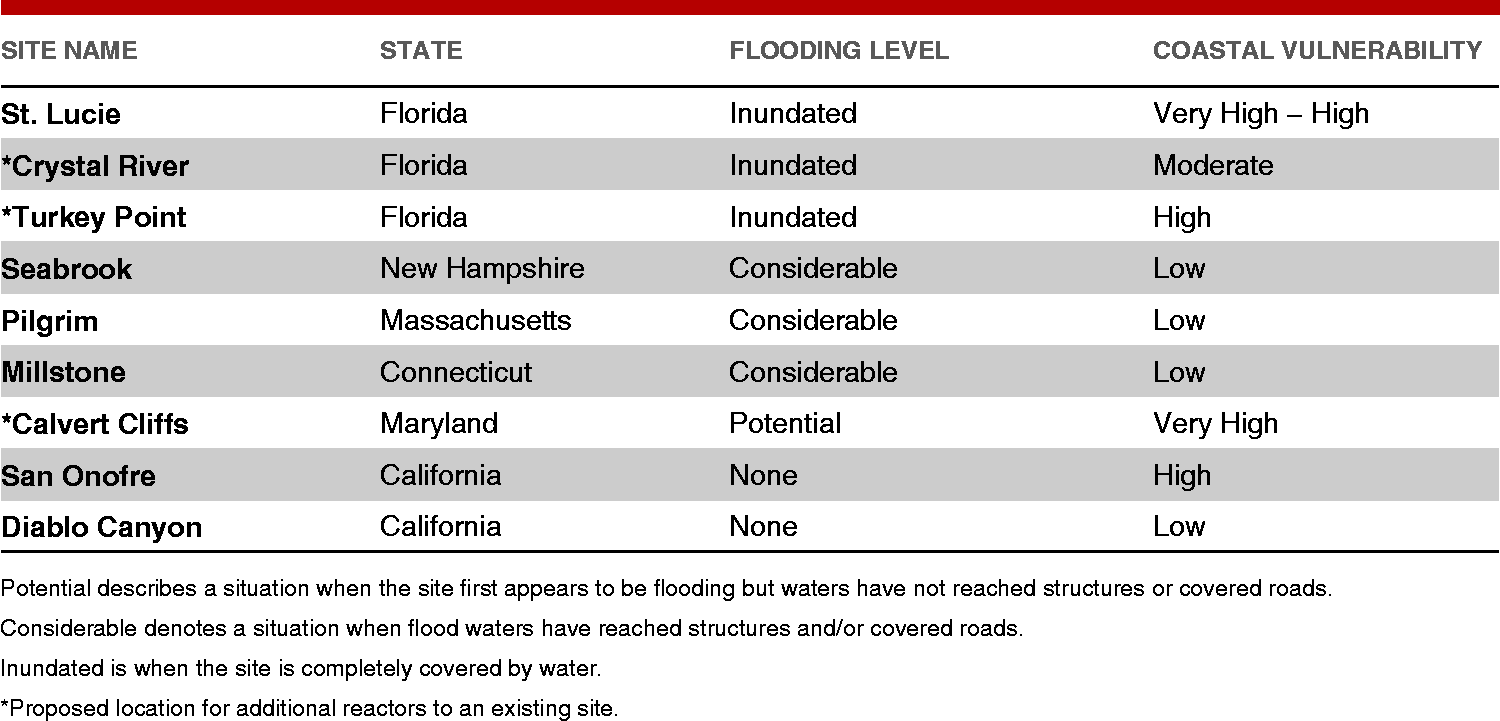
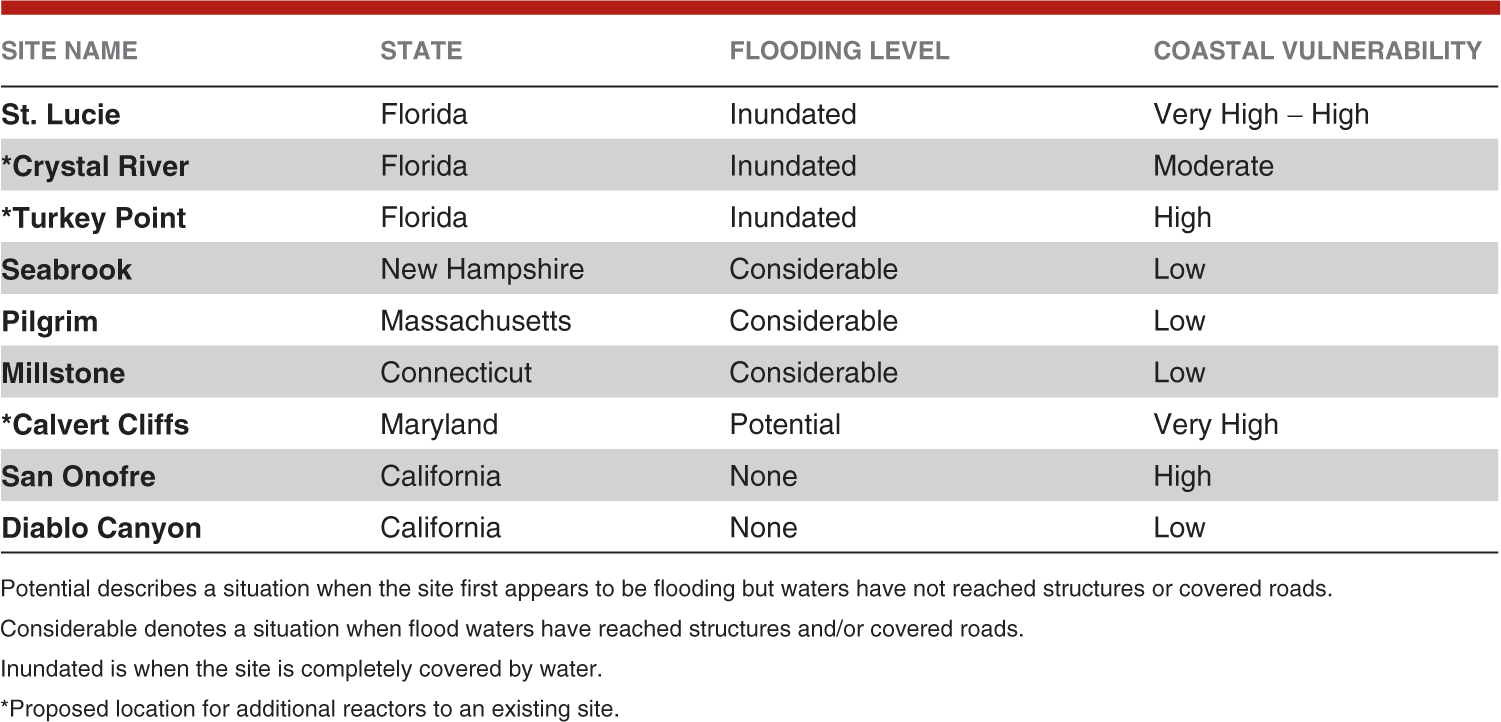
From this analysis, some sites especially stand out. For example, all the nuclear power plants in Florida are likely to experience a great amount of flooding, largely because of their low site elevations. But while they will all have to contend with the problem of rising waters—independent of the effects of more violent, climate-induced storms—the state’s St. Lucie site is particularly vulnerable because during the reactor’s lifetime it is projected to encounter a rise in sea levels that exceeds its flood design. In addition, the St. Lucie plant’s location on a barrier island leaves this nuclear power station extremely vulnerable to coastal storms and erosion. Thus, this one plant is threatened in a number of different ways at once, all worsened by climate change. (And even without the effects of climate change, the nuclear power plant at St. Lucie was probably always at risk, because barrier islands are prone to move by their very nature.)
At a more moderate level, Florida’s Crystal River and Turkey Point nuclear power plants are also at high risk for flooding, if not for coastal erosion.
Another individual plant to keep a particularly close eye on is located in Maryland. The Chesapeake Bay region as a whole ranks as the third most vulnerable coastline in the United States, just behind Louisiana and southern Florida (Maryland DNR, 2007). So, although it is positioned on high land, the nuclear power plant situated on Maryland’s Calvert Cliffs is very vulnerable, less because of high water than because of the accompanying sudden storm-induced erosion, whose effects can be somewhat likened to a mudslide (Kuhn and Shepard, 1984; Ward et al., 1999).
And on the West Coast, California’s San Onofre Nuclear Generating Station is also very vulnerable due to the high chance of landslides caused by storm rains and the large storm swells that occur adjacent to this power plant (Kuhn and Shepard, 1983). San Onofre’s reactors are placed so close to the shore—just a couple of hundred feet—that in photographs San Onofre’s containment buildings look like they have their own private beaches.
And to reiterate, these are conservative projections. The latest IPCC reports still cannot determine the upper limit for sea level rise, due to the uncertainties related to ice-sheet contributions and the regional differences in both sea level rise and storminess (IPCC, 2013). Moreover, different regional social and economic scenarios, varying assumptions about future emissions of greenhouse gases, and disagreements between global climate models and the subjective interpretations made by hazard experts contribute to the uncertainty of the precise impacts at a given geographic location (IAEA and WMO, 2011). Thus, much like forecasting the weather, we can know the big picture region-wide on a given day but be unable to say precisely what will happen in someone’s backyard at a given hour.
In the end, a compromise must be made between the time and effort required to assemble a technically complete database and the degree of certainty that analysts need to make evaluations (IAEA and WMO, 2011). Perhaps with more careful monitoring and some massive upgrades to coastal defenses at vulnerable sites, accidents will be prevented.
Entire nuclear power plants cannot be moved farther inland, but if it were possible it would be prohibitively expensive and not at all cost effective.
Increased expense is also likely to be a factor in building brand-new coastal reactors that are farther inland from the water and more storm-proof. Adding more piping, pumps, seawalls, and supportive footings to make a new nuclear power plant sufficiently away from the shore to be safe—but close enough to a large body of water to slake its thirst for water—will inevitably add to construction costs.
Here it must be noted that the state-owned firm of Electricity of France (EDF) recently announced that its new reactor on the Normandy coast—overlooking the English Channel—will not be completed until 2017, adding yet another extension to a reactor originally scheduled to go online in 2012. (The potential safety of the new Normandy plant has also been questioned, in part due to the danger of the occurrence of the kind of flooding that happened at a similar plant operated by EDF in Blayais 16 years ago, when a combination of tides and winds from a storm led to seawater overwhelming the seawall at Blayais, flooding portions of the facility and knocking out the plant’s off-site power and several safety systems (Mattéi et al., 2001).) A similar reactor under construction in Finland has seen its costs more than double, from 3.3 billion to 8.5 billion euros ($10.7 billion) (Patel, 2014).
To sum up: While extreme weather events do not affect nuclear power plant safety often, when they do the consequences are serious (IAEA, 2003a). Flooding can result in a loss of vital cooling, with multiple reactors affected at a single site. Floodwaters hamper access and communications, making an emergency response even more difficult. While an accident has never happened due solely to sea level rise and storms, the flooding experienced at Fukushima resembles what could occur in the future from sea level rise. Moreover, storms and flooding have caused troubling problems in the past, as seen by the cases highlighted here. While each incident provides an opportunity to learn and improve safety, these lessons do not seem to be transferred beyond the operators of that one particular site. The Fukushima accident prompted a reassessment of flood projections and demonstrated the necessity of additional backup power sources, but these measures should have happened prior to the accident. The exact dimension of future sea level rise caused by climate change remains uncertain, making it difficult to precisely address safety concerns; careful monitoring, early preparation, and quick action might ensure accidents do not happen. But the ensuing additional cost needed to defend nuclear power plants in such an uncertain environment will likely reduce nuclear power’s economic viability.
Footnotes
Acknowledgements
The author would like to thank colleagues and staff at The Evergreen State College for their support, particularly John Perkins, Greg Stewart, Michael Mariotte, and Kathleen Saul. A special thank you goes out to everyone who made a trip to Chernobyl possible, and especially to Tanya Murza, our guide in Ukraine.
Funding
This research received no specific grant from any funding agency in the public, commercial, or not-for-profit sectors.
Author biography
 ).
).