




Abstract
Swift and deep reductions in emissions of greenhouse gases, chiefly carbon dioxide, are necessary to help avoid some of the most devastating effects of climate change. One aspect of US climate policy that is particularly contentious is the issue of the best economic tool to employ to reduce emissions: a carbon tax or a cap-and-trade system. This unnecessarily polarized debate has damaged the effectiveness of climate policy supporters in securing climate legislation. The logical way forward is a hybrid of the two policies—an approach incorporated in some of the recent climate bills, though it was not properly explained or highlighted. This approach would be a practical starting point when the United States next takes up a climate bill, the author writes.
Keywords
The United States—among the world’s top carbon emitters in both cumulative and per-capita terms—is responsible for about a fifth of current global carbon emissions, the main driver of climate change. Several recent studies indicate that to help avoid some of the most devastating climate impacts, US emissions must be reduced on the order of 80 percent, alongside deep reductions from all other major emitting nations, by 2050 (Luers et al., 2007; National Academy of Sciences, 2010) —a goal also endorsed by the Obama administration. These impacts include increases in extreme weather like heat waves, droughts, and heavy precipitation, a decline in agricultural yields and consequent threats to food security in developing countries, sea-level rise of 0.8 to 1.6 meters in the next 100 years, and the rapid loss of snowpack and glaciers that supply fresh water to one-sixth of the world’s population (Barnett et al., 2005; Meehl et al., 2007; Nelson et al., 2009; Pfeffer et al., 2008). If the world continues along a high emissions path, projections from climate models show that we risk locking in a rise of 2 to 5.4 degrees Celsius by 2100 (Meehl et al., 2007). The upper end of that range is considered catastrophic.
A variety of policy tools are needed to help transition the global economy away from fossil fuels, promote energy efficiency and clean energy, and reduce tropical deforestation (Cleetus et al., 2009). Unfortunately, the necessary policy changes are not easily forthcoming. At the United Nations Framework Convention on Climate Change (UNFCCC) negotiations, there has been a disappointing lack of commitment from major emitting nations to curtail their greenhouse gas emissions and help developing nations cope with unavoidable climate change. And a long year of campaigning for comprehensive climate and energy legislation in the United States ended in defeat when the Senate failed to follow the example of the House of Representatives in passing a comprehensive climate and energy bill.
These failures underscore the profound challenge of moving the global economy from fossil-fuels to renewable forms of energy. Agreements must be brokered among parties with widely divergent views and interests in order to enact a suite of ambitious energy and climate policies. A recent report by the Center for Responsive Politics (CRP, 2010) estimated that the fossil fuel industry spent $175 million in 2009 to lobby against a climate bill. Environmental groups spent a mere $22.4 million in that period.
Placing a price on carbon emissions is a critical climate policy. A sharp debate has broken out over whether the best approach is a flat tax on carbon emissions, or an overall cap on emissions with tradable emissions permits. The misleading dichotomy and florid rhetoric that has often characterized this debate has contributed to a failure to get a carbon price policy enacted. A hybrid of the two policies—an approach incorporated in some of the recent climate bills in the form of a “price collar”—could help forge a useful middle ground whenever there is a fresh opportunity for legislation.
Putting a price on carbon emissions
A core element of climate policy is ensuring that we set limits on the harmful emissions that are causing global warming. We have to price what was once free and thus encourage a transition to cleaner energy technologies. This limit on emissions should be set by what climate science indicates is required, and updated as scientific knowledge advances. Of course, other “non-price” complementary policies—such as efficiency standards, renewable electricity standards, incentives for research and development of low-carbon technologies, and incentives for preserving and enhancing soil and plant carbon—are also equally vital and can help achieve the needed emissions reductions at significantly lower costs than any single policy (Cleetus et al., 2009; Fischer and Newell, 2008).
Economic theory shows that there are two basic options for implementing a carbon price: We can set a cap on the quantity of emissions and allow the market to determine the resulting price (via a cap-and-trade program); or we can set a price and allow the market to determine the corresponding quantity of emissions (via a carbon tax). In a perfect world, we can choose a quantity and a price that make these policies essentially equivalent (see Figure 1). A great deal of argument has emerged about which choice is superior: greater certainty about the price of carbon (via a tax) or greater certainty about the quantity of emissions (via a cap). Here theoretical characterizations are of limited value because they do not capture the complexities of these policies as implemented.
A carbon tax, a cap on emissions and a price collar.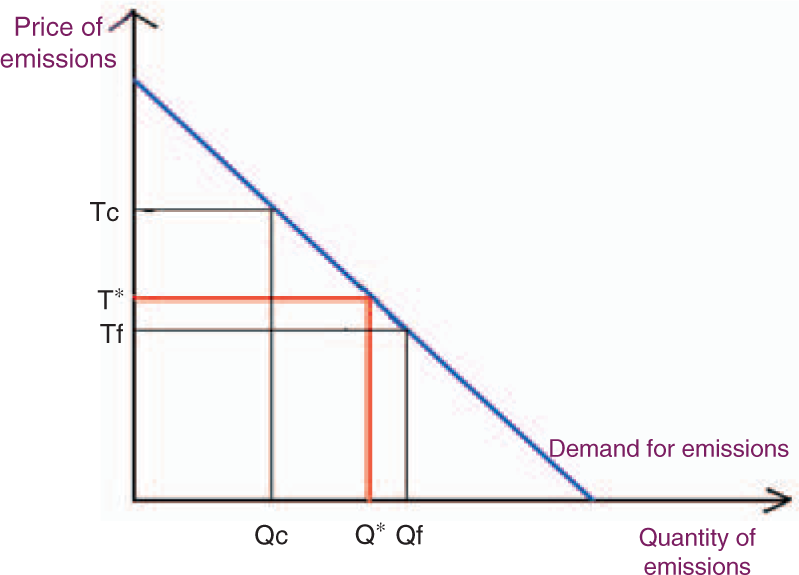
A carbon cap-and-trade system was the controversial centerpiece of recent climate bills—such as the Waxman-Markey bill (the American Clean Energy and Security Act), the Kerry-Lieberman bill (the American Power Act) and the Cantwell-Collins bill (Carbon Limits and Energy for America’s Renewal Act). On the left, many believe such a system is inherently open to corruption and that a “simple and transparent” carbon tax should instead prevail. Ironically, commentators on the right invoked the slogan “cap-and-tax” to help defeat the climate bills. The politics of the US Congress clearly seem to argue against the imminent feasibility of a carbon tax proposal, especially one that has “teeth.” 1 Furthermore, any tax legislation that passes our Congressional process is unlikely to be simple or transparent.
The simple fact is that any serious carbon price policy—one that would force a fundamental transformation of America's enormous energy system, currently managed by some of the world’s largest and most powerful corporations— would face stiff political opposition, regardless of the form it takes. Rather than pitting these two policy options against one another, perhaps the time has come to acknowledge their similarities (both strengths and weaknesses) and move the conversation to a more productive middle-ground approach on carbon pricing. This will allow a better focus on the true barrier to getting strong climate policies enacted in the United States: the power of the coal and oil lobbies.
Commonalities between a carbon tax and a cap-and-trade system
1. In many ways, a tax and a cap fulfill the same function
They each ensure that carbon emissions are priced and can no longer simply be emitted for free. This sets up a host of economic incentives for consumers and businesses to switch to low carbon choices. Businesses will find it profitable to look for opportunities to reduce their emissions. Consumers experiencing a rise in energy prices will also have the incentive to use energy more efficiently and invest in efficient technologies that help lower their bills. Simultaneously, developers of clean technology will experience greater demand for their products.
2. Either must go through the same political system to get passed
To become law, climate legislation requires approval from Congress and the president. During the legislative process, the authors of the proposed cap-and-trade bills underwent significant pressure to recognize myriad special interests—as is evidenced by their complex emission allowance allocation formulas. If a carbon tax of any significance were on the legislative slate tomorrow, it too would undergo enough contortions so as to have small resemblance to the theoretically pure solution some advocate. It would be dangerously naïve, and out of keeping with all previous experience, to assume that a tax would pass this process unscathed. The same players who worked successfully to lower the stringency of the cap would now be lobbying for lowered tax rates, exemptions, delays, inclusion of offsets, and other loopholes. Also, the fights over allowance allocations would now shift to the division of tax revenues through appropriations.
3. Both will generate significant revenues that could be used for the public benefit
For example, the revenue from either the tax or the cap could be used to offset payroll or income taxes, to fund efficiency programs that lower consumer energy bills, or to help offset the impact on low-income communities that are disproportionately affected by energy price increases. Policy makers can design a cap-and-trade program so that the allowances are allocated up-front, or they can set up a framework for auctioning the allowances with the revenues available for division (as with carbon tax revenues), or some combination of the two. Allowance allocations could be decided within the framework of the legislation itself. However, the distribution of carbon tax revenues and revenues from auctioned allowances must be decided through the usual, highly politicized, appropriations process. Thus, while the pressure point shifts to a different arena, there is no reason to expect that this process would be any more or less vulnerable to special interests.
On the surface it may seem best to give all these revenues back to the American people via rebates or tax cuts, and perhaps this solution has populist appeal. This may not be the most equitable solution if policy makers are trying to offset some of the impacts of climate policies because these policies affect different segments of the population in different ways. For example, funding for home weatherization for low-income households could help lower their energy bills. A 100 percent dividend approach would leave no money for these targeted forms of assistance. In addition, a tax and dividend policy (or a cap-and-dividend policy) would depend solely on price signals to stimulate new technology. In that case, a much higher carbon price (carbon tax or allowance price) would be required than if some of the revenues collected were directed toward stimulating efficiency and clean technology. The 100 percent dividend approach also does not acknowledge the United States’ obligation, as a leading source of emissions, to fund emissions reduction efforts and climate-change adaptation abroad.
4. Both will only be effective if they are stringent and designed well
In the case of a cap, a strong policy means setting a tight, declining cap on emissions that is informed by the latest science. The recent US climate bills—with goals of a 17 percent reduction in emissions by 2020 and an 80 percent reduction by 2050—clearly do not have strong enough short-term emissions reduction targets. They do have a “science review” provision that leaves open the possibility of later tightening the cap. This is akin to the strengthening of the Clean Air Act as it went through amendments. Under a cap-and-trade system, carbon prices adjust automatically in keeping with general economic conditions: For example, in recessionary times when productivity and energy use are low, the allowance price would be relatively low and vice versa in periods of expansion. However, this could also leave the system vulnerable to price volatility, which could lead to greater uncertainty for business investment decisions. Price volatility is a fact of life in all markets including those for oil, coal, and natural gas—and financial markets have found different ways to deal with it including long-term contracts and hedging options. A transparent carbon market, with good oversight and good real-time access to emissions and trading data for participants; banking and borrowing of allowances within limits; and an allowance reserve would help dampen volatility.
A tax would need to start at a high enough level and then increase over time to ensure we get the deep emissions reductions we need. There is a lot of uncertainty about what that level of tax needs to be and at what rate it should be increased over time. This uncertainty is a major short-coming because the core metric of success of climate policy must, of course, be the emissions levels. 2 Because taxes are so vilified in our political process, tax rates are notoriously difficult to increase, so it is hard to imagine how such a system would continue to be viable and consistent with science-based emissions targets over the long term. A major advantage of a tax, on the other hand, is that the carbon price is readily apparent to consumers and businesses. This could, for example, make it easier for businesses to make long-term planning decisions.
5. Offsets could be used to comply with both policies
A major concern with cap-and-trade programs is that a large number of offsets— emission reductions from sectors or countries outside the cap purchased by regulated entities to demonstrate compliance—could seriously compromise the efficacy of the program. However, shifting to a carbon tax does not get around this problem because the use of offsets could easily (and would likely) be extended to this policy. A covered firm could buy an offset and reduce its taxable emissions by the amount of offset credits purchased. If too many offsets are allowed under either policy, regulated firms can avoid having to make any reductions in their own emissions. Thus they could lock us in to long-lived high carbon infrastructure, such as new coal-fired power plants. Furthermore, if the offsets themselves turn out to be fraudulent, then emissions will continue to increase. The House-passed and proposed Senate bills did include language about monitoring and enforcing strong quality standards for offsets. Such quality standards and a much tighter limit on the amount of offsets allowed are key provisions to fight for in future climate bills, whether they take the form of a tax or a cap-and-trade program.
6. Any climate policy must be designed to be flexible
Such policy must incorporate the latest scientific information about the benefits and costs of reducing emissions. This is one of the key lessons from the pioneering example of a cap-and-trade program—the sulfur dioxide trading program, which was part of the acid rain program and created under the 1990 Amendments to the Clean Air Act. It has generally been regarded as very successful in reducing power-plant emissions. The program achieved the emissions reductions at a quarter of the costs initially estimated by the Environmental Protection Agency, has provided billions of dollars of net environmental and public health benefits (Banzhaf et al., 2004; Burtraw et al., 1998) and has a benefit–cost ratio of more than 40:1 (Office of Management and Budget, 2003). However, scientists now believe that emissions must be reduced by two-thirds or more beyond current requirements to allow ecosystems to recover (EPA, 2002). Some have pointed to this as evidence of program failure. It is important to realize that this was not a failure of the cap-and-trade mechanism; it was a failure to set the cap at the right level initially and allow for the EPA to update it. 3 This kind of flexibility in program design—regardless of whether we implement a carbon tax or a cap-and-trade—is even more critical in the case of climate policy where arguably the uncertainties, risks, and benefits are far greater. An update to an emissions cap could happen through a regulatory process without Congressional action, if the legislation allowed such an update. As previously mentioned, legislating a tax increase potentially presents a much greater political challenge.
Finally, neither a tax nor a cap-and-trade program will be enough on their own. We clearly need other complementary policies (e.g. efficiency standards and tax incentives) to overcome the multiple market barriers that stand in the way of a clean energy economy.
A hybrid carbon pricing system
Recognizing that a carbon tax and a cap-and-trade program both have important strengths, we can work toward common ground by choosing a hybrid of the two systems. Recent House and Senate climate bills took a step in that direction: by setting a cap on emissions but also mandating a price floor (or minimum price) and a price ceiling (a maximum price) for emissions allowances—a price collar mechanism— these bills effectively created a hybrid of a carbon tax and a cap-and-trade system.
The price collar doesn’t set an exact carbon price (the way a carbon tax would) nor does it guarantee a specific level of emissions (as a cap would) but it does set limits within which each of those can vary (see Figure 1). Creating an effective hybrid requires ensuring that the price floor and ceiling be set high enough to ensure a robust market signal favoring more low-carbon energy, and yet the ceiling should not be so high as to allow for economically destabilizing price spikes.
Price floors and ceilings in recent climate bills
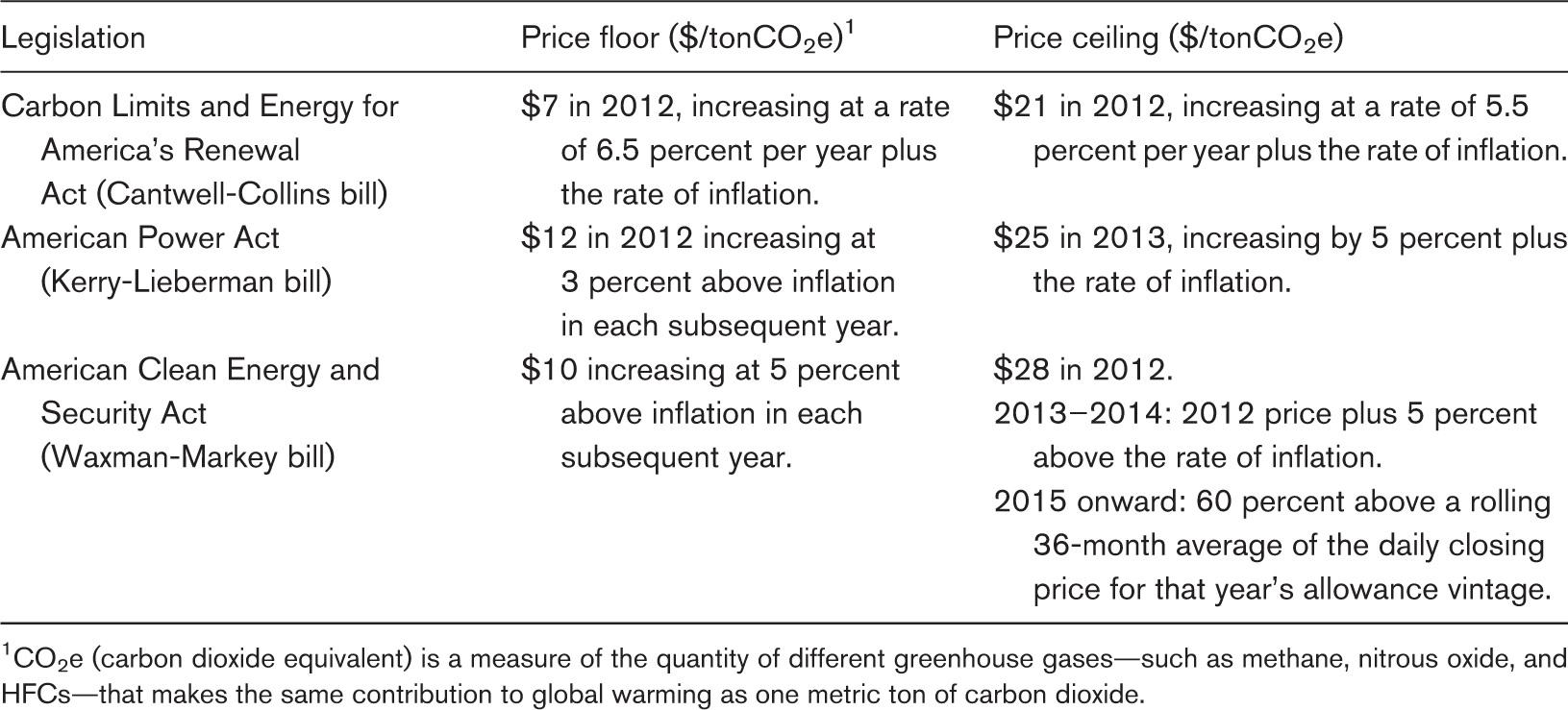
CO2e (carbon dioxide equivalent) is a measure of the quantity of different greenhouse gases—such as methane, nitrous oxide, and HFCs—that makes the same contribution to global warming as one metric ton of carbon dioxide.
The price collar draws on the strengths of both a cap and a tax, balancing valid concerns about each. It provides a reasonable degree of certainty around both the price of carbon and the quantity of emissions. This means that it can help provide greater market stability and allay the concerns of the business community worried about carbon price spikes and price volatility. Although, it should be noted, recent experiences with cap-and-trade programs—such as the Regional Greenhouse Gas Initiative (the only mandatory carbon market in operation in the United States, which covers power plant emissions in 10 Northeast and mid-Atlantic states) and the European Union Trading Scheme (the world’s first and largest program, which covers industrial and power plant emissions in 29 EU countries)—show that the danger of a price collapse (i.e. prices being too low) has been much more of a problem than prices being too high (Burtraw et al., 2009). The use of a price collar also recognizes the fundamental concern that there must be some certainty that the emissions reductions achieved by the policy are in line with what scientists say is necessary to help confront climate change. Businesses also need the basic level of certainty, provided by an adequate carbon price, that their investments in clean technologies will be profitable.
The way forward
Recent scientific observations all point toward the growing risk of catastrophic climate change and thus a greater urgency to act. Because our current pattern of rising emissions is so incongruent with what is necessary, it would be difficult to justify a policy approach that does not present emissions reductions as the central goal. This is true not simply from a climate science perspective, but from the strictly economic perspective of avoiding the prohibitive costs of runaway climate change (Stern, 2007) and of risk aversion (Weitzman, 2009).
Enacting comprehensive climate and energy legislation in the United States will by no means be easy. Considering the Senate’s failure to pass a climate bill and the outcome of the 2010 elections, many policy experts believe it will be at least two more years before there is another opportunity for comprehensive national climate policy. The main obstacle to getting a robust carbon price is the outsized influence of entrenched fossil fuel interests. Assuming we find a way to address that, fostering a better understanding of carbon pricing policies and the use of a price collar can help show the way forward.
Footnotes
1
There has not been a serious recent attempt to bring carbon tax legislation to the floor. Perhaps this is a result of the experience of the infamous “BTU tax” proposed under the Clinton Administration in 2003. The proposal was to tax all forms of energy (based on BTU content) as a means to reduce the deficit while also cutting pollution, increasing energy efficiency, and increasing economic independence. It was savaged by industry groups, including the oil companies, the US Chamber of Commerce, and the National Association of Manufacturers—the same groups that opposed climate legislation this past year—and they successfully lobbied to defeat the bill in its original form.
2
Note that uncertainty about emissions levels is also created when any climate policy has excessive loopholes for covered entities (very high offsets levels, exemptions for specific entities, etc.).
3
In the case of the Acid Rain program, the law required Congressional action to adjust the cap and those efforts proved unsuccessful (McAllister, 2009). The EPA's efforts to regulate emissions via the Transport Rule could provide a way forward.
Author biography