




Abstract
Avoiding catastrophic climate change will require rapid decarbonization of the world’s energy supply systems, and achieving such a significant transformation will involve a range of social and psychological challenges. The authors write that public consent and acceptability will need to be fostered if plans for large-scale renewable energy systems are to be realized. Despite highly favorable views in national polls, some renewable projects have already encountered severe public contestation. The authors write that valuable lessons can be learned from existing research on the siting controversies that have surrounded nuclear power and radioactive waste facilities. A range of contextual factors drive local opposition: lack of tangible local benefits, threats to valued landscapes or community identity, and distrust of outside agencies. Poorly executed dialogue and communication processes also serve to rapidly escalate concerns. The “facility siting credo” provides an important set of evidence-based principles for those seeking to engage communities about new renewable energy infrastructure projects.
Keywords
Best-known for Britain’s only preserved eighteenth-century cockfighting pit, Welshpool—a Welsh village in Powys County, only four miles from England—made headlines in 2008, when its scenic county was named the happiest place in Britain (McGrath, 2008). But three years later, when plans were announced to build several large onshore wind developments, this county was anything but happy, and 1,500 people gathered in Welshpool to say so.
In 2011, protesters came together to challenge renewable energy developers and the UK National Grid company that planned to build wind farms and associated transmission infrastructure. The proposed transmission station meant that power from this rural farming area of Wales would be moved into England—and it also meant that many miles of overhead power cables and new pylons would stretch through this and other counties. Pointing out that the Powys community would not, itself, benefit directly from the power produced by the wind turbines, protesters also argued that the structures would cover the natural countryside in concrete and metal, destroying its verdant, picturesque beauty (Williams, 2011).
Eventually, the county council called for a moratorium on all new wind-farm applications. Commenting on this decision, the councillor who had proposed the motion told the press that there was a better carbon-neutral alternative for Wales: a new nuclear power station that was planned in the north of the country, on the Isle of Anglesey.
Developers of new energy technologies often look at “progress” quite simplistically: It can be achieved by creating a new, cheaper, or more efficient machine or system that answers a defined problem, like climate change— with little regard for people’s perceptions of the risks, benefits, or level of societal dialogue that may be required. It remains a curious, if often unremarked fact that, despite the very obvious human, social, and cultural drivers of climate change—from unsustainable food, manufacturing, and consumption patterns to population growth—the proposed solutions are, by and large, dominated by engineering, the physical sciences, and economics. A key assumption is that new technologies, fostered through appropriate market instruments, will lead to the necessary reductions in emissions.
Unarguably, the technological and economic challenges of decarbonizing the world’s energy supply systems will be significant over the coming years and decades—involving greater reliance on electricity for heating and transportation, and through a variety of non-fossil fuel sources. However, the social and psychological dimensions of energy-system transformations are likely to be equally challenging. On the demand side, people must alter their future modes and patterns of travel and radically change the way they use energy in both the workplace and the home. On the supply side, the degree of public support may well determine the difficulty—or impossibility—of implementing certain low-carbon infrastructure projects.
Though certainly important, protests over renewable developments, such as onshore wind, are nothing new. Historically, technological innovation, for better or worse, has gone hand in hand with public hostility and controversy: food irradiation, agricultural biotechnology in Europe, waste incineration, overhead electrical power lines, to name just a few. But what is new is that over the past decades researchers have scrutinized the public process surrounding nuclear power and radioactive waste—thus, as countries around the world consider the transition toward future large-scale renewable energy sources, there is more understanding of siting, perceived risk, and trust.
So what lessons have communities learned from these earlier public controversies surrounding nuclear power, and to what extent can this understanding help with anticipating and planning for siting controversies surrounding current and future large-scale renewable energy systems? These are important questions to ask, for the sooner they are answered, the closer the world will be to a greener and cleaner energy future.
Public attitudes and nuclear power
Throughout many Western countries in the 1970s and 1980s, at the height of the Cold War, public concern steadily increased about environmental protection and the threat of atomic annihilation—not to mention nuclear power, its risks, staggering expenses, and enduring links with military programs. 1 It is worth highlighting that this trend was reinforced, rather than driven by, the catastrophic accidents at Three Mile Island in 1979 and Chernobyl in 1986; in fact, 20 percent of Americans opposed new nuclear plants in the mid-1970s. That community grew to more than 60 percent in the early 1980s (Rosa and Dunlap, 1994).
Though new technologies, in general, have a way of inspiring protests, what was unique about nuclear power dissent was its widespread and seemingly intractable nature—particularly when set against the assurances of engineers and plant designers, who argued that risk levels were acceptable and that, internationally, policymakers had accorded the strategic placement of this technology. 2 It was this apparent paradox that piqued the interests of many social scientists and researchers, who wanted to find out why and how nuclear energy was such an emotional and political issue for the public, paving the way to new approaches to measuring human response to risk issues.
A timeline of distrust and attitudes
Between 1975 and 1990, social scientists and psychologists developed psychometric surveys to study public perceptions of nuclear power and its risks; the respondents identified the power source as “dreaded,” meaning it was not only viewed as a catastrophic risk unknown to the public and to scientists, but it was also believed to be a technology that offered relatively few perceived benefits (Pidgeon et al., 1992; Slovic et al., 1980). Among other things, the surveys found that distrust has two major sources: the authorities—the nuclear industry is cloaked in secrecy and hubris, 3 which, historically, have been the most powerful drivers of the public’s wariness toward the technology; 4 and the media—intense international coverage of the disasters at Three Mile Island, Chernobyl, and the Fukushima Daiichi Nuclear Power Station has shaped public attitudes (Friedman, 2011). 5
Around the world, and as memories of Chernobyl began to fade, public attitudes toward nuclear power between 1990 and 2010 gradually became more positive in a number of countries with nuclear programs (OECD, 2010), reflecting also the growing concerns about energy security and the necessity of fossil fuel alternatives. 6 However, concerns persist about both the economics of nuclear power and waste disposal, and many remain ambivalent about the acceptability of this technology—a conditional or reluctant acceptance, at best (Pidgeon et al., 2008). The accident in March 2011 at the Fukushima Daiichi Nuclear Power Station has changed all of this, prompting strong public opposition to resurface in Germany, Japan, and France—countries with a significant dependence upon nuclear power—as compared with the public in the United Kingdom and United States, where small majorities still favor the technology even after the catastrophe (Butler et al., 2011).
Governments, industry, and environmental organizations are shifting their focus from yesterday’s benefits of nuclear power, to the future prospects of renewable energy. For many nations, the question is not whether the transition to renewables will happen, but rather a question of how and when. Germany, in particular, is set to be a key test case over the coming two decades; after the Fukushima disaster, its government announced plans to completely phase out its extensive nuclear program. Doing this, while also moving to decarbonize its electricity supply, has set in motion a critical experiment: It may well require all the ingenuity and resources of this significant and technologically sophisticated nation to demonstrate how a high-technology, but fully renewable, energy system can be constructed.
Incorporating past lessons in future processes
Many of the issues surrounding public acceptance and risk perception raised by previous nuclear facility and other siting controversies—particularly those that manifested at the local community level (Boholm and Löfstedt, 2004)— seem guaranteed to be resurrected with some large-scale renewable energy developments, such as onshore wind or solar farms, biomass incineration, and marine and tidal systems (Devine-Wright, 2011). The protest in Wales serves as a recent case in point. Developments often involve upgrades or an entirely new electricity grid infrastructure, which is usually sited in sensitive rural locations or in places where the local population, actually living near power lines, does not benefit from the energy-generating facility, itself.
The uncertainties over electromagnetic fields from overhead power lines are a significant perceived risk for some people—and for this reason, among others, the electricity-grid upgrade, rather than the facility, may come to be the most contested aspect in the transition to decarbonizing energy systems (Cotton and Devine-Wright, 2011; Vajjhala and Fischbeck, 2007). 7
Although it should not be overlooked that many renewable energy projects, such as the major onshore wind developments in Denmark and Germany, are successfully completed—and serve as important case studies of successful siting—many proposals in other countries are indeed not welcomed by the local communities involved. So, drawing on several decades of nuclear controversies, what can be applied here? Three lessons: local acceptance of perceived risks and other perceived detriments go beyond issues of strict technical “safety”; community concerns can rapidly escalate if planning processes do not pay attention to local views; and, above all, distrust in the motives of large “outsider” institutions, both governments and corporations, are likely to play a role in debates over siting renewables.
Acceptance
National polls show that the public strongly supports renewable electricity—particularly wind, solar, and hydroelectric power—especially when compared with conventional fossil fuels or nuclear power (Greenberg and Truelove, 2009; McGowan and Sauter, 2005). Unlike with nuclear power, most people, when considering renewables as an abstract idea, view renewable sources very positively, as a clean and natural resource that will not run out (Demski, 2011). Further, this also is in keeping with the widespread belief that people should show a degree of responsible stewardship toward the natural environment (Dunlap, 2008).
But those are national polls, which, by their very nature, encourage respondents to look at an issue as related to their country—rather than directly applying the issue closer to home, in their own community. National polls rarely tap people’s limits of acceptability, while perceptions related to the local level do allow respondents to contextualize the acceptability of a particular development by considering it in relation to their community’s local history and social fabric (Bell et al., 2005). A feature of large-scale energy systems is that they have a material reality that is unique to each community—a particular physical, social, and economic footprint. For example, public attitudes toward both nuclear power and radioactive waste facilities show a very complex set of relationships between the technology (real or proposed) and geography (the aspects of a community’s physical, social, and psychological make-up). An important distinction also must be drawn here between a community’s views toward the idea of siting a completely new facility in the community, which, in actuality, is typically met with more hostility than national polls anticipate (Rosa and Dunlap, 1994), and a community that lives close to long-established facilities and is often somewhat more supportive than national polls report (Greenberg and Truelove, 2009). 8 Likewise, a 2010 survey of Britain’s population found that 82 percent were “very” or “mainly” in favor of wind energy (Corner et al., 2011); however, as was characterized in Wales, this does not mean all will remain calm when new large-scale projects are brought into communities.
With nuclear power opposition, a prominent feature at the local level—although its roots are in factors associated with generic distrust issues, like transparency, hubris, etc.—is that poorly constructed consultation processes often become linked to people’s suspicions that powerful outside institutions and vested interests are unfairly profiting from a development; therefore, communities worry about the harm that certain large-scale power projects might bring locally or that an institution’s activities will ultimately threaten local community autonomy and identity. This was the case in 2003 and 2004, in Devon, England, where Peninsular Power Ltd proposed the construction of a 21.5 megawatt biomass gasifier. Not only did the community doubt the credibility of the developer, but they argued that the industrial-scale technology would damage their quality of life, citing concerns of unhealthy plant emissions, as well as increased truck traffic, pollution, and noise (Upham and Shackley, 2006). Public consultation also occurred late in the decision-making process, and, thus, community members struggled to make their concerns heard. This experience reinforced the community’s distrust and negative perceived impacts of the proposal, and planning permission was ultimately refused.
The policy lesson, then, is how best to design consultation processes such that the values inherent in renewable energy are realized while also meeting “acceptable” local conditions, which must be defined through open public participation.
Enabling siting processes
In most countries, the siting of large-scale infrastructure projects—whether nuclear or renewable—must involve an extended period of review, sometimes including a statutory local inquiry and consultation. It is usually at this point of the process when local objections emerge. As was learned during the nuclear siting process, a two-way process of engagement and dialogue—above simple one-way provision of technical information—is critical; a simple attempt to present technical information in a strategy of blind persuasion rarely works out as the communicator intends. 9 Though risk needs to be carefully articulated to communities, the messages need to be tailored to fit individual renewable technologies since people can make quite fine distinctions between aspects of wind, solar, and biomass energy (Demski, 2011). 10
The facility siting credo.
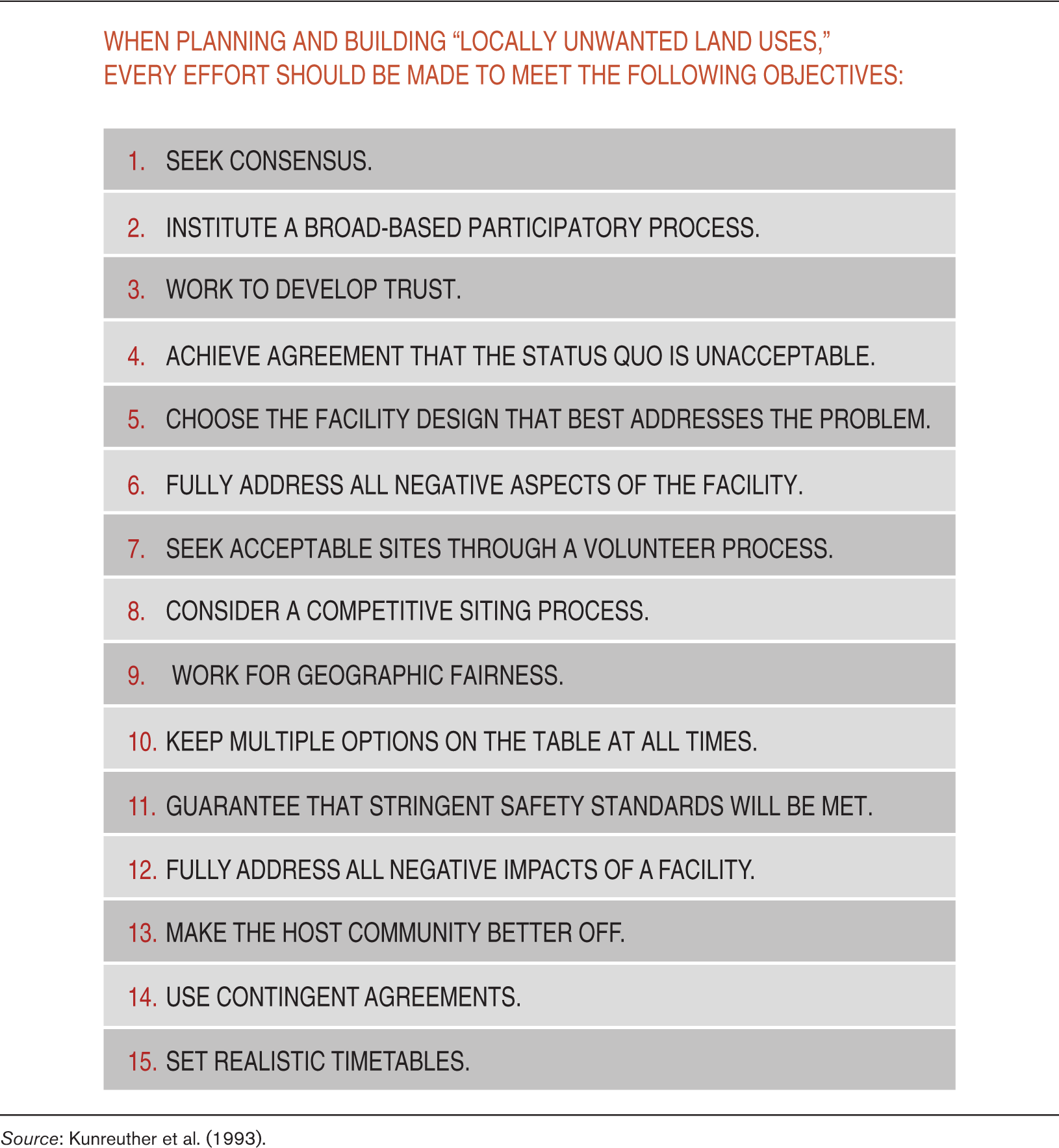
Understanding and meeting local concerns
At a local level, objections are often denigrated by developers and the media as an example of a NIMBY (“not in my backyard”) response, which is the idea that people support a development in principle, as a common good, but selfishly object to it near their home because they see local detriment and little benefit. 11 As such, one response is for industries and governments to offer communities material local benefits in return for hosting facilities, 12 or through various community-driven renewable-project co-ownerships. For example, co-ownership has proved successful in Scotland on the Isle of Gigha, where a wind-energy project is now owned and operated by the community; this ownership structure has had a positive psychological effect on the local population, 13 in contrast to the often more-contested developer-owned projects, which can have damaging and disruptive effects on communities (Warren and McFadyen, 2010).
To listen effectively to communities, it is imperative that governments and industry managers consider how local publics view their locales; by doing so, they can understand the emotional attachments to, and meanings of, a place, as well as how physical and symbolic attributes of a place contribute to a collective sense of identity (Devine-Wright, 2011; McLachlan, 2010). Depending on these meanings, introducing novel aspects such as a wind farm, for example, creates changes that will interact with the public’s existing experiences, which can then produce both positive and negative reactions. How to incorporate this more personal, value-based knowledge into participatory approaches is a fundamental research objective in environmental decision making.
Conclusion
Although new low-carbon technologies and fiscal instruments for curbing emissions at a community or individual level will become increasingly important, it is uncertain whether they, alone, can deliver either the degree or pace of change that is required to ensure that the global society avoids the dangers of climate change. But, indeed, they are a start.
Over the coming decades, almost every country around the world must profoundly transform its national and international approach to energy production and consumption. These energy-system changes bear upon multiple long-term public policy goals, including the need for genuinely sustainable economies; the provision of energy security, as well as affordable energy for everyone, everywhere; and the mitigation of the environmental impacts of energy production and use.
Above all, countries cannot continue their unabated use of fossil fuels as they have in the past; they must establish national objectives, despite the current poor progress of international negotiations. This isn’t impossible: The United Kingdom has set a goal of an 80 percent reduction in its national carbon emissions by the year 2050, and other countries have made equally ambitious national targets.
Avoiding catastrophic climate change is the single most pressing environmental problem facing the world community today. Without addressing this successfully, governments will be unlikely to meet other fundamental objectives such as poverty alleviation, clean development, and basic health care provision for all. An orderly way to meet this challenge is by remodeling the global energy system. But this requires full engagement by all of us—scientists, engineers, industry leaders, financial institutions, and, above all, governments and their communities—to pull off the most extensive socio-technical transformation the world has yet seen.
Footnotes
Funding
The authors would like to acknowledge the support of the Leverhulme Trust (F/00 407/AG), the Economic and Social Research Council (RES-066-27-0013), and the UK Energy Research Centre (NE/G007748/1).
Notes
Author biographies
 ). His research looks at public perception and acceptability, risk communication, and the governance of environmental and technological risks, including nuclear power, renewable energy, climate change, and the emerging issues of nanotechnology and climate geoengineering. He is particularly interested in how trust in risk regulation can be built and in mechanisms for public involvement in responsible innovation processes for controversial emerging technology and risk issues. He was a member of the Royal Society/Royal Academy of Engineering nanotechnology study group in 2004 and is currently a science adviser to both the UK Department of Energy and Climate Change and the Department for Environment, Food and Rural Affairs. He authored the chapter “Risk Perception” in the 1992 UK Royal Society report Risk Analysis, Perception and Management, and is co-editor with Roger Kasperson and Paul Slovic of The Social Amplification of Risk (Cambridge University Press, 2003) and with the late Barry Turner of the 2nd edition of Man Made Disasters (Butterworth Heinemann, 1997).