To introduce the Bulletin of the Atomic Scientists’ special issue marking the start of its 70th year of publication, Bulletin executive director Kennette Benedict interviewed Frank von Hippel, one of the United States’ most prominent scientists in the nuclear policy arena, about his career as it evolved over decades of commitment to nuclear arms control and nonproliferation efforts. The interview includes discussion of a vast range of arms control and nonproliferation efforts that Hippel and allied scientists have been able to move toward success, including a US-Soviet agreement not to conduct nuclear tests that continues today.
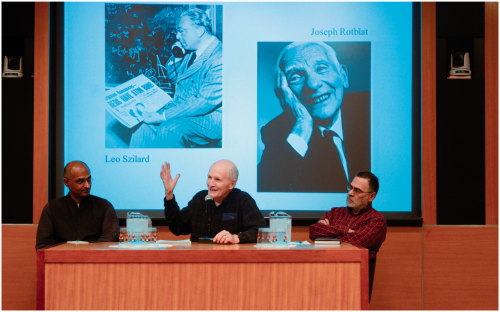
Frank von Hippel (center) talking with Princeton colleagues Zia Mian (left) and Hal Feiveson
For decades, Frank von Hippel has been one of the United States’ most prominent scientists working—within and outside the government—in the nuclear policy arena. Now retired from teaching and a senior research physicist on the staff of the Program on Science and Global Security, which he co-founded at Princeton University’s Woodrow Wilson School of Public and International Affairs, von Hippel also co-chairs the International Panel on Fissile Materials, an independent, international group of arms control and nonproliferation experts dedicated to policy initiatives aimed at securing and reducing worldwide stockpiles of the key ingredients in nuclear weapons, highly enriched uranium and plutonium.
Von Hippel has been a major figure in efforts to foster cooperation among scientists in the United States, Russia, China, and other countries, in hopes they can convince their governments to follow policies that reduce the size of nuclear arsenals, secure nuclear materials, and dampen international tension. A Rhodes Scholar, winner of a MacArthur Foundation “genius” fellowship, a former chairman of the Federation of American Scientists, and assistant director for national security in the White House Office of Science and Technology Policy during the Clinton administration, von Hippel has written regularly for major scholarly publications and in top-tier outlets in the popular press. He also has a long association with the Bulletin of the Atomic Scientists and now is a member of its Board of Sponsors.
To help celebrate the Bulletin’s 70th year of publication, Bulletin executive director Kennette Benedict interviewed von Hippel about his career as it evolved from an original focus on particle physics to a long-term commitment to science in the public interest. Their conversation covers a vast range of arms control and nonproliferation efforts that von Hippel and like-minded scientists have been able to move toward success, working with other scientists, advocates, and government officials over the course of years and decades. It is a history particularly worth reviewing now, in a time of renewed East-West tension and continuing political attack on the role of science in policy making.
BAS: Let me turn to the question of your collaborations with other scientists. You have published with a lot of co-authors at different times. You’ve worked with physicists from around the world, too, not only in the United States. And I wondered why you felt it was important to engage those from outside the United States, from Russia, India, Pakistan, Korea …
von Hippel: China.
BAS: … yes, and China. Can you say something about how all that came about? And it looks so important, at least from the outside, to your program at Princeton and to a lot of the work you’ve done.
von Hippel: It was really an insight that I got from working with [prominent Russian physicist Evgeny] Velikhov during the [Soviet leader Mikhail] Gorbachev period. You know, there was no way to get through to the Reagan administration directly except by the people in the streets. The freeze movement actually did get to the Reagan administration. But in terms of them listening to people like me, there was no possibility. But there was an audience in Moscow. So basically [I was] working with Velikhov to try to brainstorm and generate ideas for things for Gorbachev to do to end the nuclear arms race. Well, it is an extraordinary experience, the synergism of working with people in other countries.
And so the idea—which became embodied in the International Panel on Fissile Materials (IPFM)—was to get people from all these countries and try to develop those kinds of synergisms between the access that the scientists had in their own countries to their respective governments and to their media, and combine that with the greater pool of expertise that we could mobilize from around the world in the panel. And that’s been working pretty well. And so it was that extraordinary experience during the Gorbachev time that really suggested this as a systematic approach.
BAS: And what measures specifically would you point to that came from that collaboration with Velikhov during the Reagan administration and then the immediate post-Cold War years?
von Hippel: Actually, it’s funny. Velikhov was using me to say to Gorbachev, “You know, the American scientists agree with this idea of nuclear disarmament.” I was chairman of the Federation of American Scientists at the time. And the title didn’t sound like the small [nongovernmental organization] in Washington that it actually is. It sounded like maybe this is the organization of the American scientists that we’re talking to. And so there may have been a little subterfuge in this, but Velikhov would bring me to pitch these ideas to Gorbachev. And the first initiative, which began before I was directly involved with Gorbachev, was the moratorium on nuclear testing.
BAS: Right.
von Hippel: But then there was a lot of pressure, when the Reagan administration didn’t reciprocate and stop testing, for the Soviets to renew testing. And Velikhov brought me in and brought other people in to try to persuade Gorbachev that it was working and that he should keep the moratorium going. And he did for quite a long time.
And then Congress responded and started working on what turned into an amendment. It was [US Sen. Mark] Hatfield, [US Sen. George] Mitchell, and [US Sen. James] Exon, the Hatfield-Mitchell-Exon amendment, which required that the US—possibly after a few final tests if needed (which were never carried out)—have a moratorium as long as no other country tested.
And that ended US testing. Gorbachev’s moratorium started in 1985 and the last US test was in 1992, so it took a long time, but there really was a causal connection.
BAS: Yes.
von Hippel: So that was the first thing. And then the second thing was on the Soviet response to Star Wars and getting them not to launch their own Star Wars program, which would have kept our Star Wars program alive. And [US physicist and security expert Richard] Garwin educated Velikhov (though I think they had already largely figured it out themselves) about how easy countermeasures would be. So [they] persuaded Gorbachev to pursue what they called an “asymmetric response.” And then, you know, the criticisms in the United States slowly took their toll. Although Reagan’s program has an afterlife in our ongoing $10 billion-a-year missile defense program which was launched by [President George W.] Bush.
BAS: I don’t know if you were at the Pugwash meeting, Frank, where it was a workshop, and I think we met with Velikhov. I remember being in the room and talking about missile defense and the [Strategic Defense Initiative]. And I think Velikhov at one point said—I think I’m going to get this right—“Oh well, you know, it’s easy to counter. You know, missile defense is really simple. You know, you just put a nuclear warhead on the end of the missile, and you know, you blow out anything that comes your direction.” You know, and everybody in the room was just kind of horrified… And I think he said it with a small glint in his eye. But not everybody understood.
von Hippel: Well, he did backslide, you know, I think, later on somewhat. But, you know, he certainly was good. But by the way, when [Nobel laureate Hans] Bethe and Garwin wrote their Scientific American article in 1968 about the Johnson and then the Nixon [antiballistic missile] systems, they had nuclear warheads. In fact that’s what did these systems in. It was a rejection by the suburban voters of nuclear-armed interceptors that resulted in the ABM treaty. Because, again, a public uprising got the Congress to pay attention to the scientists.
BAS: Is there anything you’d like to say about your service in the Clinton White House in the Office of Science and Technology Policy (OSTP)?
von Hippel: Well, you quote me as saying that I could accomplish more on the outside than on the inside of government. And I did say it at the event that you organized here last April.
But before I got to that point, I actually did feel like I accomplished something. When I went in I wanted to work on the test ban and on curtailing ballistic missile defense. And I learned that the National Security Council—I was in OSTP—that they had that turf. And they were absolutely uninterested in what I had to say. But then I did discover a piece of turf that they hadn’t found yet, which was working with Russia to secure its nuclear materials.
BAS: Right.
von Hippel: And I helped start that program up … And that was very satisfying and something I certainly couldn’t have done on the outside. So you can, if the system will let you, do great things on the inside. Usually it doesn’t let you. (There was actually another thing where we were able to do, work out a deal to shut down three Russian plutonium production reactors.) And what I found was—after 16 months—that any ideas that I had that the system was receptive to had been accepted. But all my other ideas, it wasn’t receptive to. And so it was really at that point that I thought, well, maybe it’s time to start working from the outside again. And in that connection, by the way, historically I’ve found Congress more receptive than the administrations. Because there’s so much more diversity in Congress. You can find people who are interested in your ideas. And if you’re lucky enough that they’re well placed, they can do something about it.
BAS: Yes.
von Hippel: And even if there’s not a majority in the Congress, you can start something which (usually later on) may bear fruit. And that’s what I’ve been doing on the naval reactors, working with a woman—well, a couple of women—first Madelyn Creedon on the Senate side, who was a staffer for the Senate Armed Services Committee, to try to get the Navy to think about low-enriched uranium instead of weapons-grade uranium fuel for its next reactors. And it went into committee language, but the Office of Naval Reactors ignored it. But then, it’s timing that really often is crucial. I was working with Leonor Tomero. I don’t know whether you’ve ever run into her?
BAS: I have, actually.
von Hippel: She’s now a staffer in the House Arms Services Committee. And we brainstorm every once in a while. And one of the things that I keep coming back to that I’ve been working on for 20 years has been this naval reactor thing. Actually, I happened on it first when Pete Stark, a representative from California, put in an amendment asking the Navy to look at using low-enriched uranium fuel in naval reactors. And they called up the White House to get support for this amendment, and for some reason the call was referred to me, and I said, “It sounds like a good idea to me.”
And the Office of Naval Reactors did a study saying, “This is a stupid idea. It will cost us money. We don’t see the point.”
And so Leonor put in a request for an update on that study. And it came back saying, “Yeah, we have an idea how to do this. And if you give us a couple billion dollars over 10 or 15 years, you know, we might be able to do it.” And so, based on that, some staffers are interested in funding the Office of Naval Reactors to work on this.
BAS: For those who may not know much about naval reactors, tell us why this is such an important issue and how it fits in the larger picture of nuclear security and maybe even nuclear disarmament.
von Hippel: Well, it used to be that weapons-grade uranium wasn’t good enough for the US navy’s propulsion reactors. They actually had even more highly enriched uranium. And that was produced until 1992, the end of the Cold War. Since then, they’ve had to be satisfied with excess weapons-grade uranium for naval reactor fuel.
The US has put aside a huge amount of material for future use in naval reactors, 150 tons of weapons-grade uranium. That’s enough to make 6,000 nuclear weapons. And this stuff circulates. Actually, the biggest theft we know about of highly enriched uranium (HEU) was from a naval fuel fabrication facility. It was back in the ’60s, I think. It’s a long ways back, but then also the first theft we heard about in Russia of fissile material was naval fuel, published in the Bulletin by Oleg Bukharin and Bill Potter. “Potatoes Were Guarded Better” was the title, I think.1
So anyway, there is a concern… that weapons-usable uranium could be stolen out of the naval fuel cycle. And, down the road, I think it will become an impediment to disarmament … People will look at our stockpile of 6,000 bombs’ worth of potential weapons in this 150 tons of HEU and say, “Well, we’ve got to take into account the possibility that you could turn that into weapons.” So shifting to low-enriched uranium would take care of both those problems.
BAS: So it’s like a jigsaw puzzle, and you’ve seen one corner that will, in the future, become a stumbling block, and you can work on that now. It’s something that can use attention and may not be at the center of a lot of policy debates, but it’s something that can be accomplished now.
von Hippel: Well, actually that’s exactly right. And that’s something else I wanted to say… You know, the Reagan administration was very frustrating for arms controllers, and so was the George W. Bush administration. But there were other opportunities developed during both those administrations. In the case of the Reagan administration it was the freeze movement. And in the case of the Bush administration it was the focus on nuclear terrorism. And so on nuclear terrorism we could agree that we don’t like research reactors fueled by weapons-usable uranium. And so that was an agenda we could move forward, while at the same time opposing them on their ideas about reprocessing.
BAS: So maybe we could jump to, then, the Obama administration. What’s your take so far on how well the Obama administration has been able to move forward especially on nuclear security issues?
von Hippel: Well, I think they’ve been doing well on the research reactor agenda [converting them to low-enriched uranium]—although, during both the Bush and Obama administrations, that agenda was pushed more by Congress than by the administrations. Congress would always push up the budgets in both administrations. But it’s been moving forward. And they got a lot of attention to that agenda with these nuclear security summits.
On arms control, unfortunately, it reminds me of the late Carter administration, where the Committee on the Present Danger and the developing Reagan campaign stampeded Carter into the buildup that Reagan wanted. The Reagan buildup started under President Carter.
BAS: Right.
von Hippel: And it felt like the right-wing pressure of Congress, the pressure from Republicans, and especially in the context of getting the ratification of New START, Obama has paid a huge price. There’s a joke about the honest politician. Honest politicians, once you buy them, stay bought.
BAS: You don’t have to buy them over and over again, in other words.
von Hippel: And in a way Obama’s an honest politician. He made this deal with the Republicans and although their leader on this matter, Senator Jon Kyl, ended up voting against ratification, President Obama has been delivering on his side in terms of trying to fund a whole new generation of nuclear weapons.
And so it’s a very mixed story.
BAS: Yes, it is.
von Hippel: And, you know, you wonder where [presidential science adviser] John Holdren has been. I think he’s been sidelined on that issue. And I think he was sidelined for a long time on climate change, but now he’s in the game [there].
BAS: Yeah, he seems to be now. Well, given the frustrations—and, you know, you’ve pointed to your accomplishments and successes, but there have been a lot of frustrations—what motivates you? I mean what keeps you going, getting up every day and tackling these issues again—and some of them the same issues of 30 years ago?
von Hippel: Well, [former Federation of American Scientists president] Jeremy Stone once said to me, “You know, this is so much fun, I would do it even if it wasn’t doing any good.” And somehow, the mixture of analysis and activism suits me. It suits me much better than staring at the wall and trying to develop theories of elementary particles. And you know, the colleagues are great. Having dedicated, hardworking, and really sweet colleagues is really wonderful. It’s just a wonderful group of people that work on these issues.
So it really has been great. You know, it’s also being married to Pat. I’ve had many fewer depressions since I married her than before. Depressions only last for a couple minutes now. But it is a lot about who you work with and what a positive and idealistic community it is.
BAS: And that includes not only the researchers and academics but, as you say, the public-interest groups and the congressional members who want to do the right thing—journalists, everybody.
von Hippel: Yeah, the activists are great. They really are. But we really need another movement to move this agenda forward. And the question is, “Are we going to get one?” I think we have one really, not as big as it should be, in the area of climate change. But that’s another question: Why is this agenda important, and why should we still try to get people excited about it? People are feeling that, with the end of the Cold War, nobody’s going to blow up anybody. And I remember, actually, [former Bulletin editor] Ruth Adams telling me, you know, “Frank, why don’t you move on?” Did you know that?
BAS: No. Tell me.
von Hippel: “There isn’t going to be a nuclear war, Frank. Why don’t you work on something else.”
BAS: Really?
von Hippel: Yeah.
BAS: Amazing. But, you know, I worked with her for a long time too, and we did do other things at the MacArthur Foundation besides nuclear disarmament. But after she left the foundation—and I guess it must have been like late 1990s—she said, “Well, we’ve just got to do something about these nuclear weapons.” This is in the late 1990s, early 2000s when we should have moved on to something else. I guess everyone assumed that at the end of the Cold War we’d all just pack up the weapons and put them away. But I think she realized that that wasn’t going to happen.
von Hippel: Yeah, the famous question that [came], I guess, from the University of Maryland polling operation, where they asked people how many weapons do you think the United States has? You know that one?
BAS: They said 200.
von Hippel: Yes. And how many did they think we needed? About a hundred.
BAS: Yeah, right. Would that we could get to that.
von Hippel: [Nuclear security expert] Bruce Blair, who’s here with us now [at Princeton], has been trying to get a movement going with Global Zero. And that’s the question you asked—what are the issues you try to get people excited about? And he’s back to de-alerting nuclear missiles, which I think is a good one. And he’s working with the Austrian government, which is going to host the next [Conference on the Humanitarian Impact of Nuclear Weapons] and to make de-alerting a major part of that agenda.
BAS: Are there other promising ideas that are circulating now about nuclear disarmament and nonproliferation?
von Hippel: One thing I think more and more about is the combination of hackers and alert nuclear missiles. It’s something that people should be able to understand. And you know, why the hell do we have these missiles on alert?
BAS: Yeah.
von Hippel: I think the fissile material agenda is really a fundamental agenda. So let’s get rid of it. It’s something that people can understand. Get rid of weapons material.
BAS: Let me ask you maybe one more question—well, two more questions, OK? Many people say that nuclear power really does increase the risk of nuclear weapons proliferation, and that’s the biggest danger really from nuclear power. I guess I’ve heard you say in public that the safety issues are there, but compared to other energy sources they may not be as dangerous as some people would make it to be. So are there circumstances under which nuclear power would be acceptable to you?
von Hippel: Yes. I’m actually glad you asked that, because I want to clarify that. You know, when people ask me if I’m antinuclear, I say, “I’m not antinuclear; I’m anti pro-nuclear.”
BAS: Right.
von Hippel: The nuclear power establishment has tried to treat real problems as public relations problems. But I think in principle if we have a once-through fuel cycle, so you have no plutonium separation, and multinationalized enrichment, that [nuclear power] would be fine. I mean I’d like it to be safer, but it’s pretty safe. These accidents are very traumatic when they happen, but they’re very infrequent.
BAS: Looking back or even ahead, what would you say were the high points of your career? What are you most proud of accomplishing?
von Hippel: Well, chronologically by decade, I think working with the Carter administration on ending reprocessing (of spent nuclear fuel) in the United States and helping to get the United States into the position where we could say to other countries, “We don’t reprocess; you won’t need to either.” That was great. That was really great. So I guess that was the ‘70 s. And then the ‘80 s, the Gorbachev-Velikhov thing was just fantastic, you know, helping end the Cold War.
BAS: Yes, that’s a big achievement, I’d say.
von Hippel: And by the way, just for your amusement—I don’t know whether I’ve ever told you this—once I came back and the Trenton Times interviewed me about this. They said, “He’s talking with Gorbachev.” And they made it a headline story. The headline said, “Von Hippel Is Willing to Meet with Reagan.” (Laughs.)
BAS: That would be a high point.
von Hippel: I saved that one. Then I guess in the ’90 s I think being in the White House was a very interesting experience and an education that made me understand much better how government works.
And then I think the [International Panel on Fissile Materials], it’s really been—I’m really proud of [Princeton’s] program on Science and Global Security and the IPFM both as institutions, and I hope we can keep them going. Working with the nuclear weapons freeze movement and in particular my part was reviving the idea of the fissile material cutoff treaty, which is an old idea. And then it would be all the careers we’ve started with our program [at Princeton], another generation.
And then right now another high for me is working with [former Iranian diplomat Seyed Hossein] Mousavian, where we’re talking basically directly with the foreign minister of Iran and with [high officials] on the US side and have been able to inject some ideas which have made a difference in terms of negotiations [on Iran’s nuclear program].
BAS: I think that last point’s important: The role of new ideas, or ideas that may help solve a problem in these negotiations, I think is sometimes overlooked. I mean the advocacy’s important, the communication’s important, but being able to have the right idea at the right time also is pretty important too.
von Hippel: And these ideas are really simple ideas. But the people who are involved in the policy-making process—that’s something I learned when I was in the Clinton administration—they don’t have the time. I mean they’re just in meetings all the time, being briefed about stuff they don’t want to be briefed about, and are unable to dig into things. And so when you have an opportunity, like we have now, to say, “Look, here’s something pretty simple you could do that would make a difference”—it really is a service that, despite the huge resources available to government, they need.