




Abstract
The antinuclear movement has fluctuated between gigantic (in the 1980s) and almost nonexistent (the 1970s, now). What accounts for these remarkable variations? Is it possible to identify the factors that touched off the remarkable surges in participation in the 1960s and 1980s? If it were possible, could such factors be put into play today?
Keywords
There is, today, remarkable governmental interest in nuclear disarmament. An ongoing series of international meetings—in Oslo in March 2013, in Nayarit, Mexico, in February 2014, and in Vienna in December 2014—has focused attention on nuclear weapons in a way not seen since the 1980s. Each subsequent meeting has drawn official delegations from more and more countries—almost 160 countries at the last. There is a persistent rumor and quiet talk that there might be a treaty banning nuclear weapons in the offing. All of which is to say that official government concern about nuclear disarmament has never been greater.
Popular interest, however, is largely dormant. What interest there is remains focused on the importance of keeping nuclear weapons for security, rather than banning them. In the United States, for example, most ordinary citizens who are talking about nuclear weapons are not discussing a ban; they’re worried that Iran will build a nuclear arsenal or concerned that without a nuclear arsenal Ukraine cannot stand up to Russia. There are few protests against nuclear weapons, and those that occur are very small. This is not to say that the civil society efforts of some nongovernmental organizations—the International Campaign to Abolish Nuclear Weapons, for example—have been ineffective. For the most part, they have not aimed at sparking large-scale protest but have focused on lobbying organizations with connections to the issue that have previously not been involved, like the Red Cross, or speaking out at United Nations forums, rather than energizing large segments of civil society.
The contrast with the past is striking. In the 1960s, hundreds of thousands of people protested against nuclear weapons. There were marches in cities across the United States. In the 1980s, millions of people opposed nuclear weapons. More than a million people signed a petition calling for a freeze in the number of nuclear weapons in the United States. And more than a million more participated in mass protests in Germany, the United Kingdom, and other countries in Europe.
The contrast between the large involvement of people in the 1960s and 1980s versus today raises an interesting question: Why are ordinary people so uninvolved in nuclear weapons issues now? Is the danger from nuclear weapons any less? Clearly not. Has the world situation evolved to a point where conflict is unimaginable? Hardly. So then why, if the danger is still clear, don’t more ordinary citizens concern themselves with nuclear weapons issues? There appears to be a very serious move afoot to do something substantial about these weapons. Why do most people in the United States and Europe have so little interest? I think there is evidence from past movements that shows that certain political conditions are necessary for mass protest against nuclear weapons to develop.
Mass protests matter because they are arguably the prerequisite for real progress on nuclear weapons. The entrenched interests whose livelihoods depend on the weapons and the nuclear believers who so fervently argue that they are the source of our safety and status will not give way before clever argument or insistent pleading. Political pressure must be applied. Understanding the source of past movements makes political pressure in the current situation a possibility.
How the antinuclear movement compares to other social protests
To understand the political circumstances that lead to large-scale involvement, I think it makes sense to examine the shape of the participation in the nuclear weapons issue over time. (Yes, I’m a historian.) If you drew a graph of the number of people involved in the issue, you would notice that the shape of the interest is peculiar. Such a graph for participants in the United States, for example, might look something like Figure 1 (this an imagined approximation).
Approximated participation in anti-nuclear movement worldwide, 1950--2015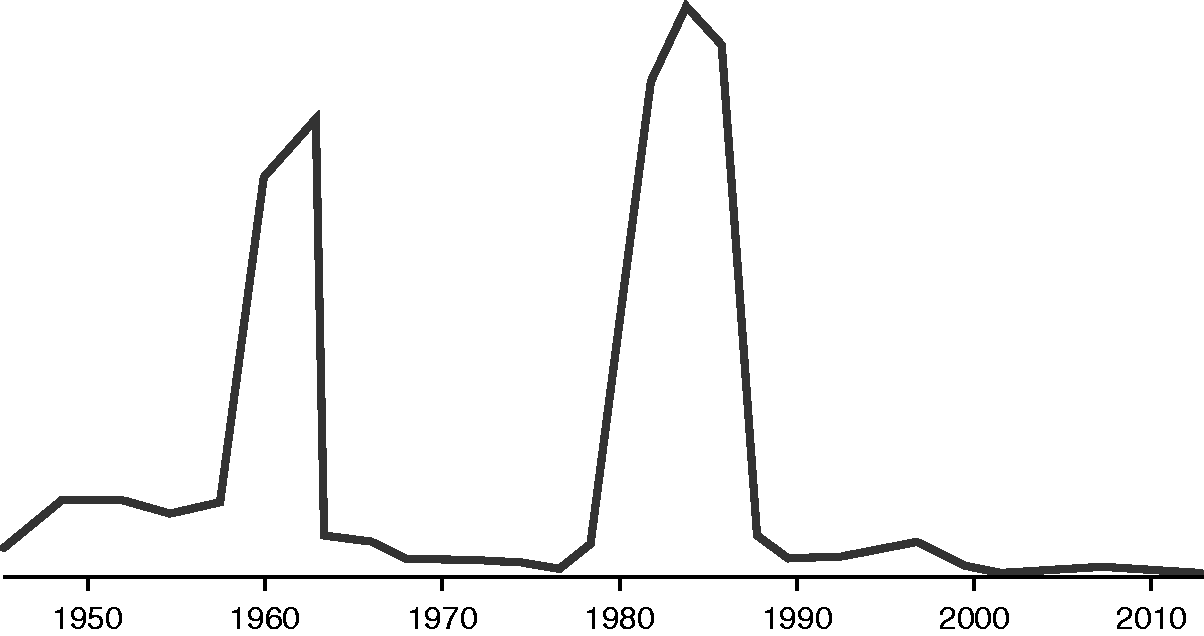
The antinuclear movement began in the 1950s with widespread concern but little active involvement. There were scholarly debates and warnings from physicists, there was a lot of writing in newspapers, but there was not a lot of marching in the streets. In the early 1960s, however, that simmering concern broke out into sign-carrying protest: There was a sudden increase in interest and commitment. Participation in those protests reached up to hundreds of thousands or perhaps a million people. But a few years later—around the end of 1963 or 1964—interest in the issue suddenly collapsed. And it remained low for 15 years. During the second half of the 1960s and throughout the 1970s, there was a good deal of political activism, and protests were common. But they were protests about civil rights, women’s rights, Vietnam, and other issues. Nuclear weapons organizations languished. And then, inexplicably, the whole cycle happened all over again. Beginning in about 1980, concern in the United States grew rapidly (if anything, surpassing the size of the protests of the 1960s), and there were massive demonstrations in Europe as well. And just like in the 1960s, there came a moment when interest and participation dropped precipitously. After about seven years, interest plunged to almost zero.
The odd, double-peak shape of public concern about the nuclear threat is unique, as far as I know, in the history of social movements. The shape of the protests against the Vietnam War, for instance, is much more typical of the norm: a slow beginning, a steady increase over time, and then, of course, a falloff when US participation in the war ended in 1975. Or, again, the shape of the movement to prohibit the sale of alcohol in the United States is similar. Slow beginnings in the 1880s with temperance movements, then steady growth in the 1910s and 1920s. It is a relatively steady line. Beginning in small towns, the movement spread slowly to cities, counties, and states, and eventually ended with the passing of the 18th amendment to the Constitution in 1920. (Again, Figure 2 is for purposes of illustration and does not reflect actual data.)
Approximated participation in prohibition movement in the US, 1878--1920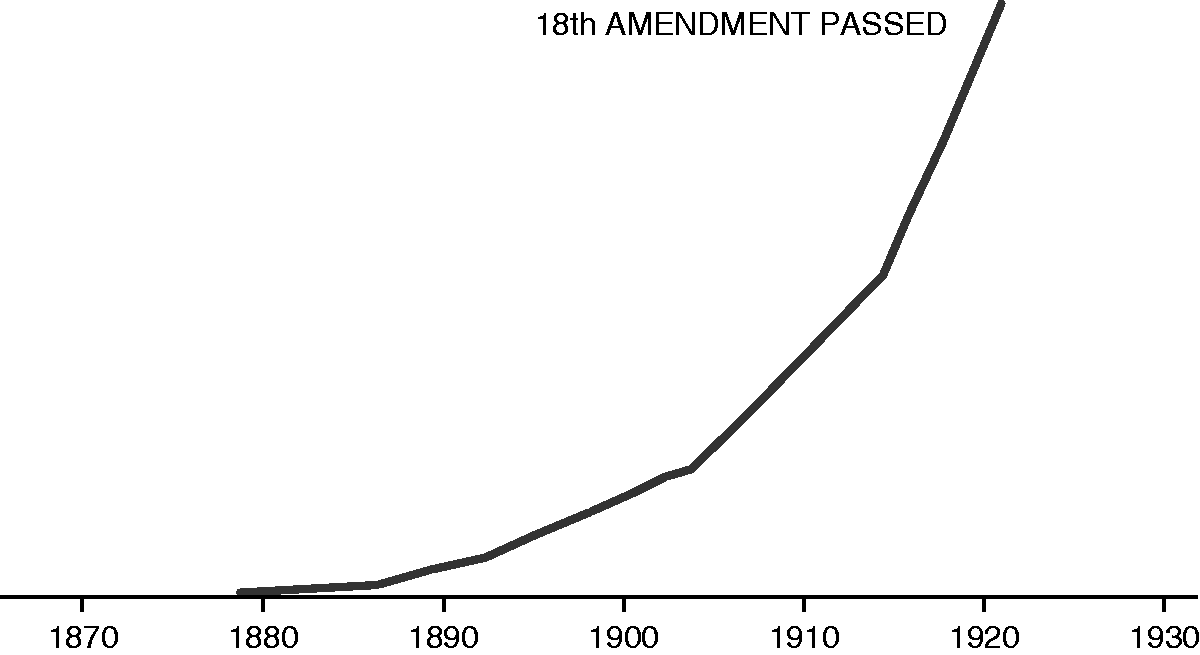
When one thinks of all the other protest movements, the Bactrian camel-like double hump of the antinuclear movement is extremely strange. How can it be explained? Why are most movements steady lines, while the antinuclear movement has this odd shape? Are the people of the United States strangely inconstant? Fickle? Or have there been changing factors that can explain this roller-coaster ride of involvement?
One possibility has to do with danger. Danger is an obvious choice as a driver of nuclear protest—given that enormous danger is one of the salient characteristics of the problem. So let us begin by comparing the shape of ordinary peoples’ involvement with the size of nuclear arsenals. It would be reasonable to expect that the more weapons there are, the more danger there is, and the more people would care about the issue. But the size of the arsenal doesn’t seem to explain the double-peak pattern.
The size of the combined arsenals of the United States and Soviet Union were highest throughout most of the 1970s (see Figure 3). This, however, was a period when people hardly exhibited any interest in nuclear weapons issues at all. While environmental protests raged, while the early gay rights movement got its start and people marched in feminist protests, there were few protests having to do with nuclear weapons, and certainly nothing like the massive protests of the 1960s or the even larger protests that were to come in the 1980s. So arsenal size (and danger) doesn’t seem to be the factor that has caused antinuclear movements to rise and fall.
Approximated participation with US and Soviet nuclear arsenal sizes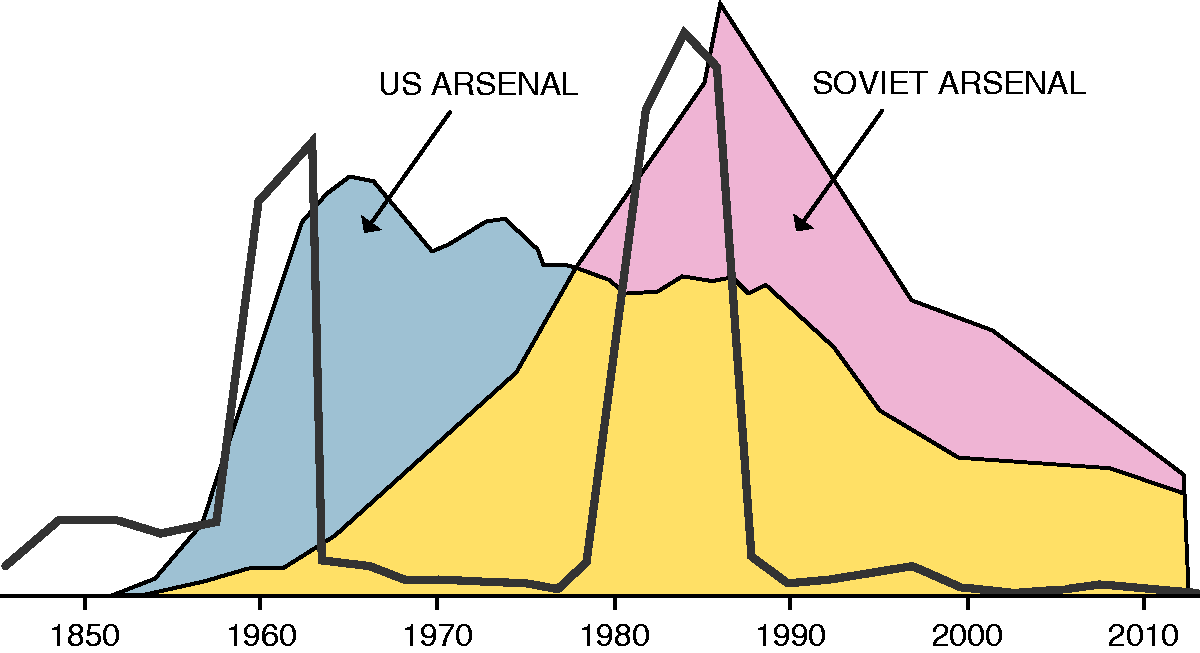
Another sensible factor to look at as a trigger for widespread involvement might be budgetary spending. After all, people tend to be strongly motivated by issues that affect their pocketbooks. Perhaps the pressure of military expenditures was related to these sudden surges of nuclear weapons protest.
But there is no obvious match between spending levels on nuclear weapons and the shape of the protests. Again, budgets (the green line in Figure 4) were highest during a period—the 1970s—when protests were thin.
Approximated participation with US defense spending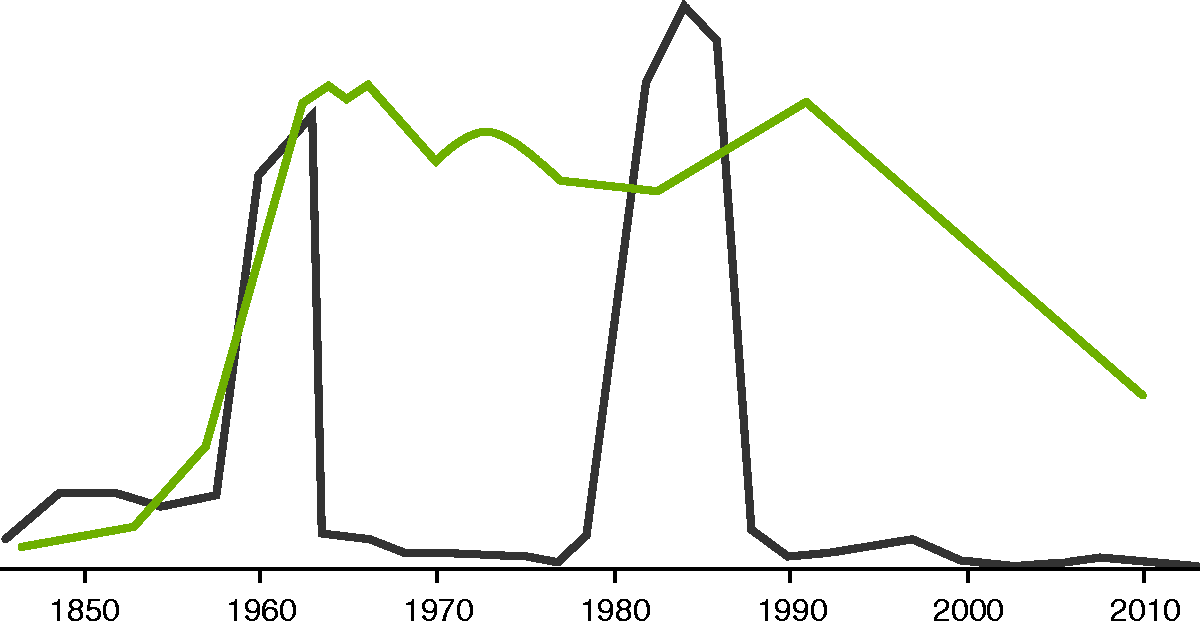
Since danger and costs don’t seem to be driving forces, perhaps it makes sense to change categories. Instead of looking to indexes that reflect things (numbers of missiles, numbers of dollars), maybe the answer can be found by looking toward events. Focusing on moments when nuclear weapons came vividly to life in headlines and news reports might uncover a correlation.
Consider the imaginary chart of the perceived danger of various crises depicted in Figure 5. Again, these are not hard numbers for widespread perception of nuclear weapons danger; I’m not even sure such numbers exist. This is my impression based on years of reading the history. Others would surely draw slightly different trend lines. But the chart can serve as a rough guide for first-cut thinking.
Approximated fear levels generated by US foreign policy crises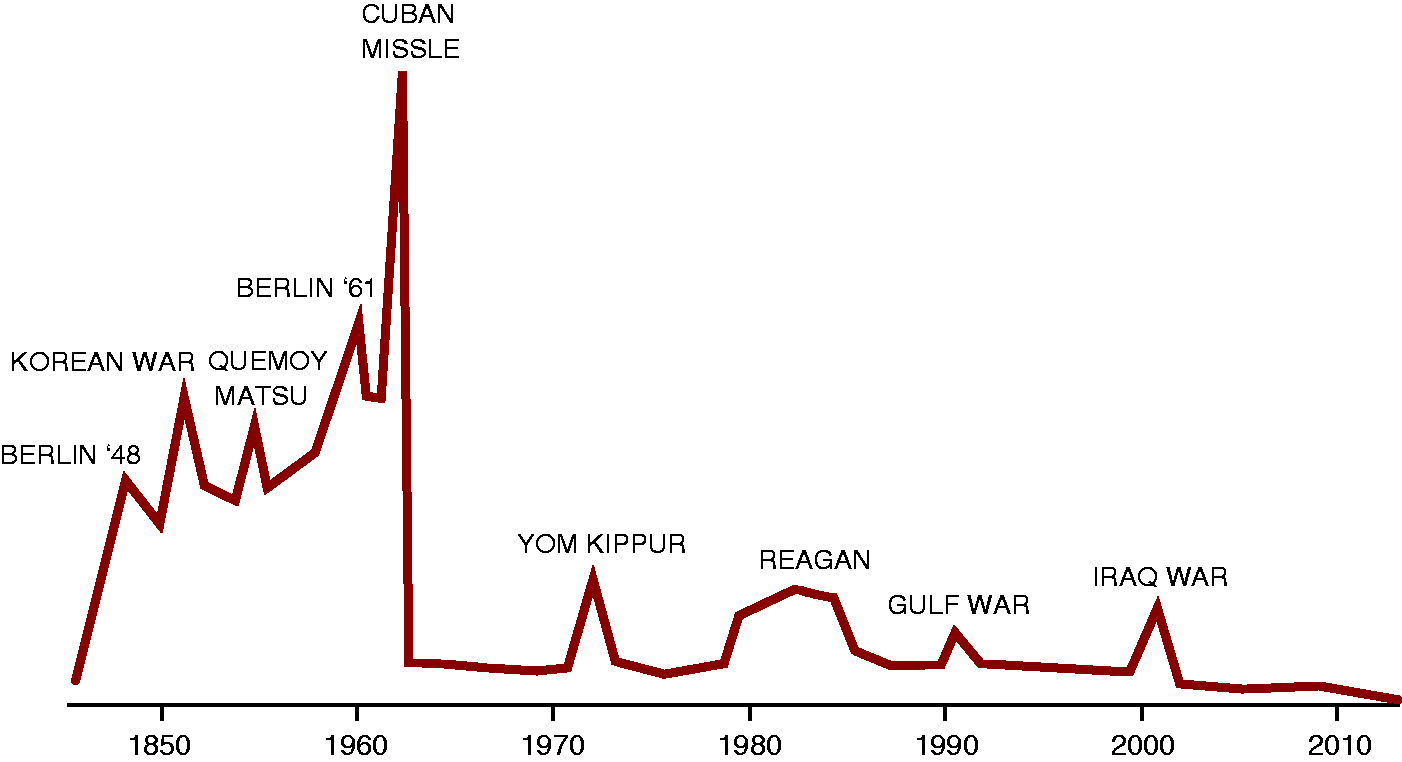
So how should we expect fear connected with nuclear weapons crises to match up with the unusual double-peak shape of antinuclear protest? If the connection between crisis and protest is strong, then you would expect that there would be an especially sharp rise in protest following each crisis (when the danger was more vivid), and the increase would be proportionate to the danger. So, for example, after the most dangerous crisis in the Cold War, the Cuban Missile Crisis, protest would spike up and stay high for some years. Greater involvement ought to follow each crisis. But frustratingly, the participation line does not seem to match the crisis line (see Figure 6).
Approximated participation with approximated fear levels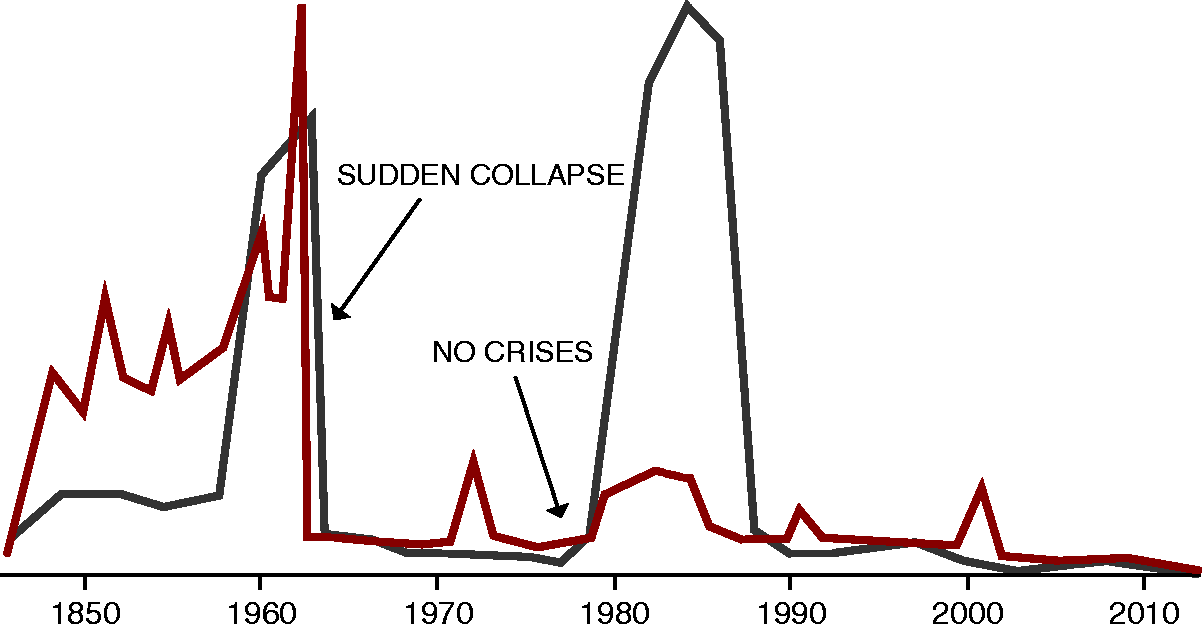
There is some correlation between heightened fear and the Cuban Missile Crisis in the 1960s and also fear associated with the increased Cold War tensions that accompanied Ronald Reagan’s presidency in the 1980s. But the crises of the 1950s don’t seem to have generated large-scale protest. The Cuban Missile Crisis, although it led to protest while it was happening, also seems to have triggered an inexplicable collapse in participation. And prior to the sudden upsurge in the 1980s there are no appreciable crises that might have served as triggers at all. The somewhat heightened tension of the early 1980s can’t explain the huge spike in protest of the 1980s. There is some similarity to the two lines, but there are troubling anomalies that undermine any sense that this might be an explanative cause.
The key to understanding antinuclear protest
Even though the crisis line and the participation line don’t correlate closely, this line graphing the danger from crises does hold the key. The sudden drop in participation after the Cuban Missile Crisis is such a remarkable anomaly that it raises what turn out to be crucial questions. What could have happened during the crisis, or at almost the same time as the crisis, that would have led to a collapse in protests?
A moment’s reflection brings to mind a couple of very suggestive possibilities. For example, the installation of a communications hotline between Washington and Moscow in June of 1963 could potentially be connected to reduced protest. If people felt that the hotline “solved” the danger somehow, that might have undercut their felt need to participate. (During the crisis it had taken some six to eight hours to transmit proposals back and forth between President Kennedy and Premier Khrushchev. With the world teetering on the brink of destruction, that seemed unacceptably long. Eventually the Kennedy administration began releasing proposals to the press, counting on the media to quickly carry these messages around the globe.) Another event that might have led people to lose interest was the ratification of the Limited Nuclear Test Ban Treaty in the fall of 1963. Aboveground testing was spreading radiation and caused many people to feel unsafe. A treaty banning it might have been seen as real progress.
And, interestingly, even the Cuban Missile Crisis itself might be thought of as reassuring. It might seem contradictory to think of the most dangerous nuclear weapons crisis in history as reassuring, but consider the story line that emerged from the crisis for Americans: The president had been in control, he had been pragmatic and cautious, there was a careful, week-long group discussion in which all options were explored, and, most important, the process had worked—the crisis was successfully resolved. All three events—the crisis, the hotline, and the treaty banning aboveground testing—therefore, tended to reassure Americans that the government was handling nuclear weapons responsibly. It is easy to see how citizens could have told themselves that the government would be likely to handle these problems responsibly in the future.
And, of course, all three occurred almost at exactly the moment when the antinuclear movement in the United States collapsed. So we might speculate, provisionally, that reassuring moves by the government triggered the collapse of nuclear disarmament protest in the 1960s. If this is so, it makes sense to ask: Were there any similar moves by government figures that preceded the collapse of the 1980s antinuclear movement?
And there were: The sudden and unexpected summit at Reykjavik in 1986 between President Reagan and President Gorbachev that nearly resulted in the total abolition of all nuclear weapons and the resulting agreement to cut the arsenals in half were both enormously reassuring events. The signing of the INF Treaty in the fall of 1987, which banned medium-range nuclear missiles from Europe, might have also led ordinary citizens to believe that the government was moving to handle the nuclear weapons situation in a responsible manner.
So there seems to be a correlation: Antinuclear movements contract sharply when people have faith that the officials in government understand the nuclear weapons problem and are carrying forward steps to manage the problem effectively. The moral seems clear: Reassure people that the government has the nuclear weapons issue “handled,” and they return home or turn to protesting other things.
The triggers of protest
Understanding (or at least having a provisional theory that explains) the cause of the collapse of antinuclear protest in the 1960s and 1980s might then point the way to an understanding of why nuclear protests sometimes shoot up into mass protests. If antinuclear movements are undermined by a sense that the government has things under control, could protests be sparked by a loss of faith that government has the problem handled? Once one conceives of the problem in this way, the results are striking.
The key event in the growth of the antinuclear movement in the United States in the 1960s was the discovery of strontium 90 in cow’s milk across the country. Aboveground testing was spreading fallout that was being carried thousands of miles by winds, deposited on grass that was being eaten by cows, and measurable amounts of radioactivity were discovered in the milk that children all across the country drank every day. One can imagine people saying to themselves, “The government says they’ve got this problem handled, but they’re actually poisoning my children!” Combined with the obvious danger that the weapons posed—which the continuing crises over them only served to highlight—it would not take long for people to lose faith that the government knew what it was doing. Huge protests resulted.
In the 1980s, it was not a single, stunning revelation but a collection of four events that triggered a loss of faith in the government. First was the meltdown of a reactor at Three Mile Island in Pennsylvania in 1979. Government officials had said that nuclear reactors were safe, but one had come perilously close to melting down completely (as the reactor at Chernobyl eventually did seven years later, in 1986). The effects of this domestic disaster combined with three other factors related to international relations: Ronald Reagan’s bellicose language during the 1980 presidential campaign; the increased defense spending (including on nuclear weapons) that followed his election; and the decision to put new, intermediate-range missiles into Europe. Some Americans were, of course, reassured by Reagan’s strong defense policies. But a considerable portion of the electorate was unnerved. In the end, Three Mile Island and Reagan’s decisions (taken together) sparked the largest antinuclear protests the United States and Europe have ever seen. The protest march in New York in June 1982 is still the largest mass rally (an estimated one million participants) of any sort, for any cause, in the history of the United States.
Faith in government
Although this is merely a preliminary thought experiment, intended to point the way toward future research, the experiment does reveal the outlines of a finding: The rise and fall of mass movements against nuclear weapons policy depend on people’s faith in government. When people feel that their government is either acting irresponsibly in connection with nuclear weapons or has failed to understand the problems associated with nuclear weapons in some fundamental way (at least from the perspectives of the protesters), they become motivated to participate in political efforts around the issue.
It makes sense that faith in government would be a key element in people’s decisions about whether to protest against nuclear weapons. After all, it is not the size of the danger that matters; what matters is whether the people in charge seem to have it under control. Even after watching the most hair-raising video about the potential dangers the weapons pose, an individual could well respond, “Yes, everything you say is true. I can see that if they fell into the wrong hands or got out of control that it would be a catastrophe. The danger is certainly great. But I think the people in government have this under control, don’t you?” As long as people have faith the government can handle a problem, the size of the problem alone will not motivate them to get involved.
In fact, the larger the problem, the more likely people are to hand it off to government and put it out of their minds. Big problems are by definition something that big institutions have to handle. Most everyday citizens, for example, don’t imagine that it is their responsibility to administer the national highway system. It is only when things seem to be going seriously wrong that large numbers of citizens get involved. Overcoming this sense that government has things effectively managed is the key to large-scale citizen involvement.
Paradoxically, this means that when antinuclear groups exaggerate the danger they actually discourage people from getting involved. As the size of the danger increases, the desire to let the government handle it also increases. Fortunately, it’s not necessary to exaggerate the dangers of nuclear war. After all, if the danger of killing 300 million people and deeply damaging world civilization isn’t enough to elicit a sober respect and concern for the problem, you’re not doing it right. The strongest arguments for getting people involved, if this analysis is correct, would be that the government is deeply confused and mistaken in its analysis and approach to the problem, and that the danger is not “the end of the world” but a limited, specific, and factually describable set of results. Terrible, but not the apocalypse. Because the apocalypse, by definition, is something only God can prevent.
Even though non-nuclear-armed governments and nongovernmental organizations are working on a broad-based effort to reduce the threat of nuclear weapons, those efforts are not currently targeted at generating the kind of mass movement against nuclear weapons seen in the 1960s and the 1980s. It may be that pressure from NGOs like the Red Cross, combined with pressure from non-nuclear-armed states, will be enough to dislodge the nuclear believers from their positions of influence in the nuclear-armed states. It may be that banning nuclear weapons can happen without mass movements applying political pressure. History shows, however, that battling large, entrenched interests without widespread support is difficult. Will new arguments or events force ordinary people to confront the dangers of nuclear weapons? We’ll have to wait and see. For now, ordinary citizens are missing from the equation, apparently because they still have faith that their government is satisfactorily managing the problem.
Just because ordinary citizens have decided to put the problem of nuclear weapons out of their minds doesn’t mean that the danger no longer exists. Nuclear weapons remain the gravest threat of sudden catastrophe that we face. Warlike emotions are growing, not fading. Sudden foreign policy crises seem to come with increasing frequency. The danger of the use of nuclear weapons, in such an emotionally unstable time, is perhaps greater than it has ever been. For those who see this danger clearly, the need to understand and activate the sources of strength in the antinuclear movement are more important than ever.
Footnotes
Funding
This research received no specific grant from any funding agency in the public, commercial, or not-for-profit sectors.