




Abstract
In this Nuclear Notebook the authors highlight the key milestones and facts regarding the nuclear pursuits of the first five states to develop nuclear weapons—the United States, the Soviet Union and Russia, Britain, France, and China.
Though we are in the seventh decade of the nuclear age, the discipline of nuclear history is still in its infancy. Whereas the US Manhattan Project has been treated extensively, the role of nuclear weapons during and after the Cold War remains a fertile research area. More information is needed to understand the role of nuclear weapons in foreign policy and diplomatic relations. Better understanding the development of nuclear weapons programs could help to predict or prevent the rise of new ones. Additionally, incorporating the role of nuclear weapons into historical accounts not only greatly enriches, but also is essential to, our understanding of the past and present; for example, one cannot consider the US–Japanese relationship without examining the aspect of nuclear weapons.
After the Soviet Union collapsed, details of the development of the Soviet atomic bomb program came to light, revealing many interesting, previously unknown personalities. Descriptions also emerged of an archipelago of entire secret cities where Soviet scientists developed, tested, and built the bomb. Before the new Russian government imposed more restrictive information policies, many enlightening memoirs, official histories, and articles on the Soviet bomb program were published in the 1990s. Thanks to this information, researchers were able to evaluate how accurate US intelligence had been in understanding and interpreting the Soviet program before the end of the Cold War.
Britain continues to release a steady stream of primary documents related to the evolution of its nuclear weapons arsenal; these files supplement its excellent official histories by Margaret Gowing and Lorna Arnold. Even China, generally tight-lipped about its nuclear plans, has divulged essential information about its nuclear developments. Bringing up the rear among the original five nuclear weapon states is France, which has yet to publish an official account of its atomic bomb program.
The four newest nuclear weapon states—Israel, India, Pakistan, and North Korea—have so far disclosed very little information about their nuclear pursuits. In a future Nuclear Notebook we will attempt to outline what is known about the nuclear programs of these states.
Nuclear pursuits, 2012
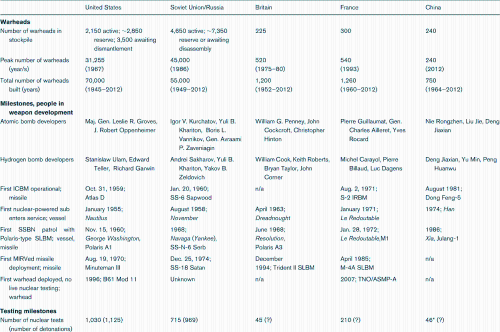
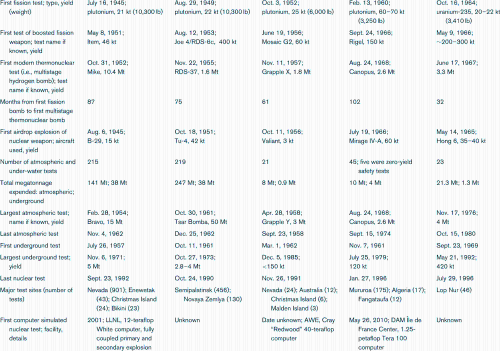
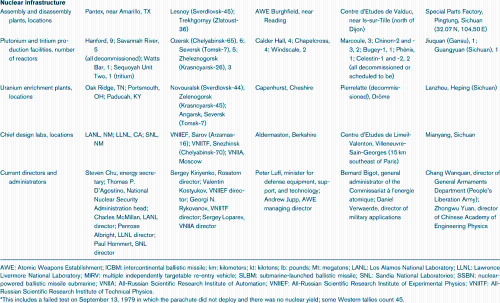
AWE: Atomic Weapons Establishment; ICBM: intercontinental ballistic missile; km: kilometers; kt: kilotons; lb: pounds; Mt: megatons; LANL: Los Alamos National Laboratory; LLNL: Lawrence Livermore National Laboratory; MIRV: multiple independently targetable re-entry vehicle; SLBM: submarine-launched ballistic missile; SNL: Sandia National Laboratories; SSBN: nuclear-powered ballistic missile submarine; VNIIA: All-Russian Scientific Research Institute of Automation; VNIIEF: All-Russian Scientific Research Institute of Experimental Physics; VNIITF: All-Russian Scientific Research Institute of Technical Physics.
This includes a failed test on September 13, 1979 in which the parachute did not deploy and there was no nuclear yield; some Western tallies count 45.
Footnotes
Funding
This research was done with a grant from the Ploughshares Fund and Carnegie Corporation of New York.
Author biographies
Inquiries should be directed to FAS, 1725 DeSales St., NW, Sixth Floor, Washington, DC, 20036 USA; +1 (202) 546-3300.