




Abstract
Some risk events, assessed as relatively minor by technical experts, can elicit strong public concerns and result in substantial impacts on society and the economy. This is especially true in cases involving low-level radiation exposure. Social amplification is a conceptual framework that seeks systematically to link technical assessments of health and safety impacts with assessments of individual and social risk perceptions and risk-related behaviors. Individuals and social groups can amplify (or in some cases, attenuate) risk as they process information about events, and events can produce secondary ripple effects that may spread far beyond the initial impact and may even affect unrelated technologies or institutions. Events that are highly dreaded, poorly understood, or both have high potential for these second-order effects. Social distrust of institutions and their managers plays an important part in amplifying risk. Understanding how trust is shaped, altered, lost, or rebuilt in the processing of risk by individuals and groups is a priority need in social amplification research. The social amplification of risk has become an essential part of an integrated assessment of risk. Recent changes in nuclear energy policy cannot be understood without serious examination of the social amplification and attenuation processes at work.
A week after the tsunami of March 11, 2011, as the effort to restore cooling to Japan’s Fukushima Daiichi Nuclear Power Station seemed to be losing ground, there was no salt to be found at grocery stores throughout many major Chinese cities. In the places where salt was still available, customers waited in long lines to purchase it, and prices reportedly rose by 500 percent or more in some cities (Wang and Li, 2011).
Many customers were under the mistaken impression that iodized salt—the type of table salt commonly sold in China—would protect them from radioactivity released in Fukushima, should it drift their way. Others believed that the radioactivity would mean contaminated sea salt in the future, and that they should stock up on uncontaminated salt while it was still available. Still others feared that the sudden run on salt foretold a coming shortage, and they too rushed to buy salt. China ordered a crackdown on hoarding of daily necessities, and the intense buying subsided within days—followed by a second wave of shoppers hoping to return salt that they no longer wanted.
The Chinese salt incident is a dramatic example of one of the most perplexing problems in risk analysis: Some risks or risk events, assessed as relatively minor by technical experts, often elicit strong public concerns and result in substantial impacts upon society and economy. Is that because experts are overconfident or because publics are wary? “Social amplification” is a conceptual framework that seeks to analyze this question by systematically linking technical assessments with risk perception and risk-related behavior. The salt incident, and radioactive risks generally, illustrate how hazards can interact with psychological, social, institutional, and cultural processes in ways that may amplify or attenuate public responses to risks or risk events to shape societal responses and produce secondary ripple effects.
The framework
The starting points in a social amplification framework are “risk events,” which might include actual or hypothesized accidents and incidents—or even new reports on existing risks (Kasperson et al., 1988; Pidgeon et al., 2003). These events are largely irrelevant or localized in their impact unless human beings observe them and communicate them to others. A key part of the communication process is that risks and risk events, and the characteristics of both, are portrayed through various risk signals (images, signs, and symbols), which in turn interact with a wide range of psychological, social, institutional, or cultural processes in ways that intensify—or attenuate—perceptions of risk and its manageability. The experience of risk therefore is not only an experience of physical harm but also the result of processes by which groups and individuals learn to acquire or create interpretations of risk. A risk experience can be properly assessed only by studying multiple impacts: the interaction among the physical harms attached to a risk event and the social and cultural processes that shape interpretations of that event, the secondary and tertiary consequences that emerge, and the actions taken by managers and the public.
Social amplification of risk thus occurs in two stages: the transfer of information about the risk and the response mechanisms of society. First, individual and social “amplification stations”—including the scientist who communicates the risk assessment, the news media, politicians and government agencies, cultural groups, interpersonal networks, and others—process and amplify signals about the risk. The amplified risk then leads to behavioral responses, which, in turn, have secondary impacts or what we term “ripples” (see Figure 1). This amplification framework must be considered when trying to understand public and regulatory reactions to the risks of low-level exposure to radiation, as well as to other risk issues.
Social amplification of risk framework.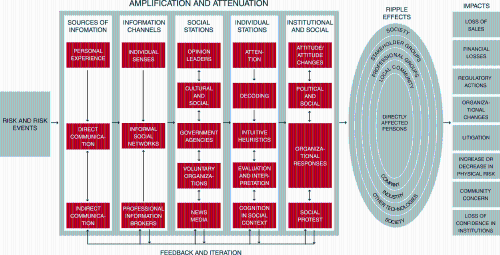
The metaphor of amplification comes from classical communications theory and can be used to analyze the ways in which various social agents generate, receive, interpret, and pass on risk signals. Such signals are subject to predictable transformations as they filter through various social and individual amplification stations. These transformations can increase or decrease the volume of information about an event, heighten the salience of certain aspects of a message, or reinterpret and elaborate the available symbols and images, thereby leading to particular interpretations and responses by other participants in the social system.
Social stations of amplification, such as scientific institutions and social groups, influence the amplification or attenuation of risk signals. Even the individuals within institutions do not simply pursue their personal values and social interpretations; they also perceive risks, those who manage risks, and the risk “problem” according to the cultural biases and values of their organization or group (Dietz and Stern, 2008).
Individual stations of amplification are affected by considerations such as public perceptions, qualitative aspects of the risks, prior attitudes, blame, and trust. These same individuals are also members of cultural groups and other social units that affect the dynamics and social processing of risk.
In the second stage of the framework, after individual and social stations have amplified or attenuated risk signals, social amplification can also account for the observation that some events produce ripples: secondary and tertiary consequences that may spread far beyond the initial impact of the event and may even eventually impinge upon previously unrelated technologies or institutions. Such secondary impacts include market impacts (perhaps through consumer avoidance of a product or related products), demands for regulatory constraints, litigation, community opposition, loss of credibility and trust, investor flight, and stigmatization of a product, facility, or community. For example, the Chinese salt incident had secondary impacts on the price and availability of a basic commodity, and revealed a stigma surrounding products harvested from the ocean, where much of the radioactivity from Fukushima was deposited.
The analogy of dropping a stone into a pond (see Figure 1) illustrates the spread of higher-order impacts associated with the social amplification of risk. The ripples spread outward, first encompassing the directly affected victims or the first group to be notified, then touching the next higher institutional level (a company or an agency), and, in more extreme cases, reaching other parts of the industry or other social arenas with similar problems. This rippling of impacts is an important element of risk amplification, because it suggests that response processes can extend the temporal, sectoral, and geographical scales of impacts. It also points out that each order of impact, or ripple, may not only allocate social and political effects but also trigger managerial interventions for risk reduction.
The same framework also applies to the social attenuation of risk: Individual and social stations process and transfer information about a risk event, constraining the perception of risk instead of amplifying it. This creates ripples that further weaken the impacts of the risk event. For example, the risks of low-level radiation from sunbathing and medical exposures are often attenuated, whereas radiation risks from nuclear power plants, fuel fabrication facilities, and nuclear waste storage are often amplified.
The Chinese salt incident had elements of both amplification and attenuation of risk. Individual consumers amplified the risk by posting misleading messages on Internet chat boards and other social media, warning that nuclear plumes were spreading from Japan throughout Asia, and suggesting that iodized salt could offer some protection. In response to this social amplification, a number of institutions and individuals tried to allay the fears that led to widespread buying. Chinese officials, meteorologists, and media outlets reported that radiation levels across the country fell within the normal range. Chinese health experts explained that iodized salt, unlike potassium iodide tablets, has no protective benefits unless consumed in enormous doses. The state-owned National Salt Industry Corporation (the country’s biggest salt producer) assured the public that it had ample reserves of salt, and government experts pointed out that most Chinese salt is produced from onshore deposits rather than seawater. Eventually these messages spread through the same social networks that had spread the “buy salt” messages and attenuated the perceived risk.
The concept of signal
Risk events with potentially high signal values
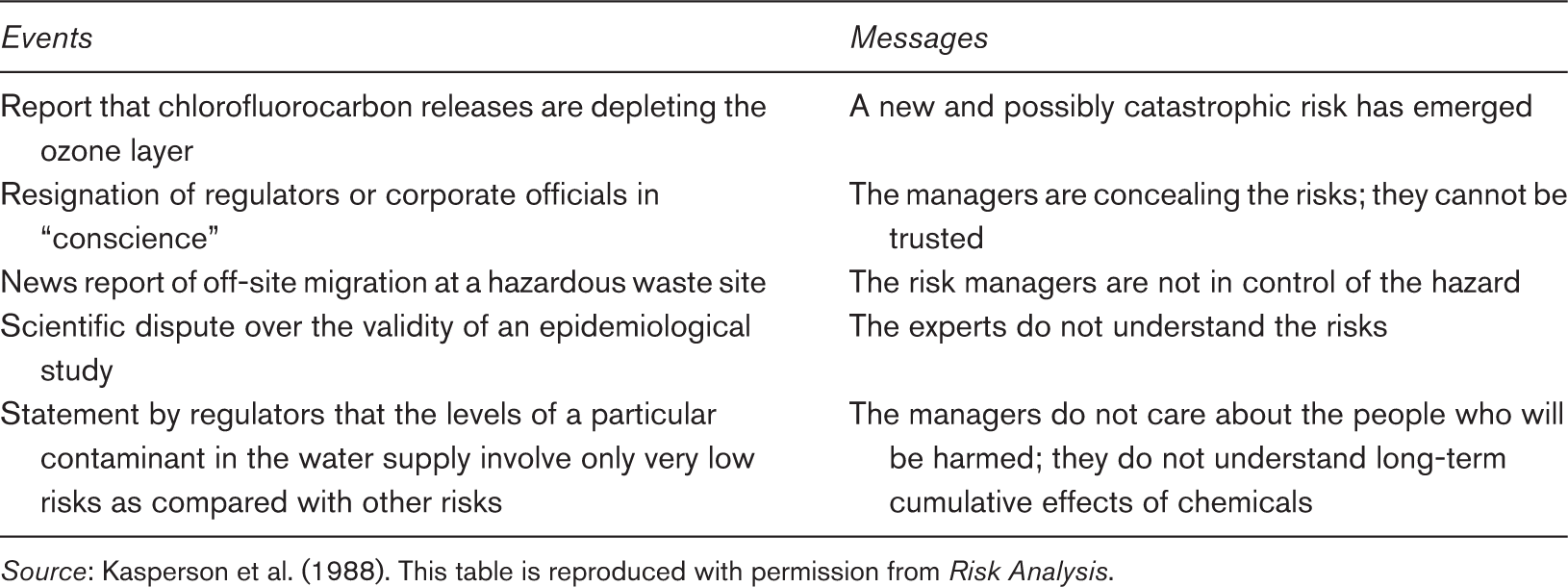
Source: Kasperson et al. (1988). This table is reproduced with permission from Risk Analysis.
Building upon Slovic’s work on risk signals, a detailed methodology has emerged for identifying, classifying, and assessing risk signals. Risk signals may be defined as “messages about a hazard or hazard event that affect people’s perceptions about the seriousness or manageability of the risk.”
The importance of social trust
The framework of social amplification hypothesizes four major pathways or mechanisms for amplifying risk: public perceptions and values, social group relationships, signal value, and stigmatization. High, or growing, social distrust of responsible institutions and their managers is certainly a fifth. A broad literature now indicates that recurrent failures in risk management stem in no small part from a failure to recognize the importance of supporting public values in a democratic society and especially the need for social trust (Cvetkovich and Löfstedt, 1999). Risk-control efforts have frequently gone awry because of a lack of openness and transparency, a failure to consult or involve interested and affected persons, a loss of social trust in managers, inadequacies in due process, a lack of responsiveness to public concerns, or an insensitivity to questions of environmental justice. Trust is often low in a wide spectrum of environmental and risk debates: global warming, biodiversity, genetic engineering, cleanup of defense and other hazardous wastes, siting of hazardous waste facilities, and protection of wetlands (NRC, 2009).
Slovic (1993) has argued that trust emerges slowly, is fragile, and is easily destroyed. And once lost, it is likely to be extremely difficult to recover. He posits an “asymmetry principle” to explain why it is easier to destroy than to create trust: negative (trust-destroying) events are more visible or noticeable than positive (trust-building) events. Negative events often take the form of specific, well-defined incidents such as accidents, lies, discoveries of errors, or other mismanagement. Positive events, although sometimes visible, are often fuzzy or indistinct. Events that are invisible or poorly defined carry little weight in shaping our attitudes and opinions. And even when events do come to our attention, negative events carry much greater weight than positive events.
From a social amplification perspective, trust is highly interrelated with other components and mechanisms in what we think of as “amplification dynamics.” Understanding how trust is shaped, altered, lost, or rebuilt in the processing of risk by social and individual stations of risk is a priority need in social amplification research. This is especially true for issues like low-level radiation hazards, where there is often a large gap between scientific assessments and public perceptions. The reasons for how low-level radiation is perceived are complex and undoubtedly related to the use of nuclear energy in deadly weapons.
Issues of social trust are clearly important components of the dynamics of social amplification. We know that distrust heightens risk perceptions, intensifies public reactions to risk signals, contributes to the perceived unacceptability of risk, and stimulates political activism to reduce risk. But a host of questions surround the interpretation of trust, how it evolves in the social amplification process, and how it may be overcome. Further investigations of this process may help reveal, for example, whether public distrust of government or industry statements played any part in the Chinese salt incident.
Conclusion
The social amplification of risk has become an essential part of an integrated assessment of risk, and this may be true for risk assessments of low-level radiation. Risk is more than a technical assessment of health and safety impacts: The ways in which health and environmental risks interact with social and political processes are essential elements of the total risks of events, disasters, and reports. Radiation risks show these differences very well. Low-level radiation risks from natural sources and medical exposures are often attenuated and underrated, whereas radiation risks from nuclear power facilities, whether energy production plants, fuel fabrication, or nuclear waste storage, may be amplified. These attenuation and amplification processes need to be examined closely. A climate of social distrust has also emerged, in which management decisions have become filled with controversy (US Energy Department, 2012). In the aftermath of Fukushima, for example, Germany has decided to phase out its nuclear industry by 2020, and Japan has only two reactors still functioning of its 54 nuclear plants, and even those might be pulled offline this year. The Fukushima accident has resulted in widespread global impacts, which are continuing. Meanwhile, other low-level radiation exposures, particularly from medical diagnostic technologies, continue to grow. These changes cannot be understood without serious examination of the social amplification and attenuation processes at work.
Footnotes
Funding
This research received no specific grant from any funding agency in the public, commercial, or not-for-profit sectors.