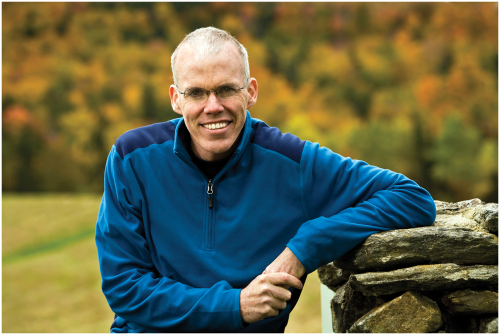
Bill McKibben has written about climate change for general audiences for more than two decades and in recent years has become the most prominent American environmentalist on this issue. Through his writings and grassroots campaigns, McKibben has helped organize tens of thousands of rallies around the world to demand stronger, faster government action on climate change. In this interview, he describes founding 350.org to raise consciousness about climate change and explains why the organization has a number as its name. McKibben lays the blame for climate change—and for the lack of political action to mitigate it—squarely at the feet of a fossil fuel industry reluctant to part with its biggest subsidy: the privilege to dump its waste products into the atmosphere at no charge. He argues that educational efforts alone are not enough to address global warming and that organizing is the best thing people can do to help reduce climate change. He explains why the Keystone XL pipeline, which would transport oil from Canada’s tar sands to refineries in the United States, became the focal point for a social movement that erupted in civil disobedience at the White House—and became a political football—in late 2011 and early 2012. McKibben shares his thoughts about the best ways to communicate with the public about climate change. He identifies cost, along with the risks apparent in places such as Fukushima, as impediments to an expansion of nuclear power and calls for a price on carbon as the quickest and surest way to reduce emissions. And he reflects on developments in China and Australia that could lead to progress on climate change, even in the absence of American leadership.
Author, educator, and environmentalist Bill McKibben wrote the first book for a general audience on climate change, The End of Nature, in 1989. It has since been published in 24 languages. McKibben has written 11 other books about the environment, including the best sellers Eaarth: Making a Life on a Tough New Planet and Deep Economy: The Wealth of Communities and the Durable Future. He is the editor of The Global Warming Reader, a collection of seminal writings on climate change published last year. In 2010, Time magazine called McKibben, a former staff writer at The New Yorker and a frequent contributor to many other magazines, “the world’s best green journalist.”
Currently the Schumann Distinguished Scholar at Middlebury College in Vermont, McKibben has come to national prominence as the founder of several grassroots climate campaigns. In 2006, he helped lead a five-day walk across Vermont to demand action on global warming. The following year, he founded Step It Up 2007 to press Congress to enact curbs on carbon emissions; the group organized 1,400 demonstrations across all 50 US states on April 14, 2007. The following year, McKibben founded the international grassroots climate campaign 350.org, which has since coordinated some 20,000 rallies and demonstrations in every country except North Korea.
Last year, 350.org led protests in Washington against the proposed Keystone XL pipeline, which would carry crude oil from Canadian tar sands to refiners in the United States. In late August and early September, two weeks of sit-ins outside the White House culminated in the arrests of 1,253 people. In November, an estimated 12,000 protesters formed a circle around the White House in a huge civil disobedience action. President Obama responded by calling for further environmental review of the pipeline and a decision in 2013. When Congress gave him only 60 days to decide, he rejected the pipeline permit request. The New York Times gave McKibben much of the credit for the success of the demonstrations, calling him “a man not quite of the traditional green establishment … a journalist turned advocate.” The Bulletin spoke with McKibben about his work on climate change as a writer, a teacher, and an organizer.
BAS: Some of your critics say you’re an activist, not a journalist. Do you find it difficult to be both?
McKibben: Not really. At some point, it became clear to me that writing alone wasn’t getting the job done fast enough. We needed to build some movements, and it didn’t make sense to wait around for others to build them. When I was at The New Yorker, Jonathan Schell and I took turns writing “Notes and Comment” there. He’s one of the greatest journalists of our time, but at some level he’s an activist, too. Certainly he’s not an objective reporter, in that he has a strong opinion about whether it would be a good idea to have a nuclear war or not and a set of ideas about what you might do to prevent it. When I wrote The End of Nature, it was the first large-scale reporting about climate change, but it was also a philosophical essay. I took sides: I didn’t want the planet to burn up.
BAS: You organized a huge grassroots campaign, 350.org, around the notion that we must reduce the amount of carbon dioxide in the atmosphere to below 350 parts per million. Did you rely on any particular studies or scientific advisers in picking that number?
McKibben: We needed a number because we were working globally, and slogans don’t translate. Arabic numerals do. And so it was a device—not unlike the hands on the clock that the Bulletin employs—to get across a sense of where we were. Jim Hansen is the planet’s premiere climatologist and a very brave man who has stood up to endless attack from politicians over the years without giving an inch and without becoming anything other than an objective scientist. I said to Jim in the fall of 2007, “We’re going to try to do this global campaigning. To make it work, we need a number. What’s the number?” He and his team went to work, and in December 2007, he gave a presentation at the American Geophysical Union, where he first announced that number. No one really paid any attention, and then in January 2008, he published a paper, and that’s when we founded 350.org. His paper said that any value for carbon in the atmosphere greater than 350 is not compatible with the planet on which civilization developed and to which life on Earth is adapted. Since then, a number of other lines of investigation have pointed to roughly the same number.
BAS: It has been more than two decades since you wrote The End of Nature, and for most of that time you have been warning people that we don’t have much time left to turn things around. Hansen recently said it is “essentially game over” if Canada’s tar sands are thrown into the mix. Do urgent, apocalyptic warnings like these resonate with the public?
McKibben: If you could burn all the oil in Alberta overnight, you would increase the atmospheric concentration of CO2 from its current 390 parts per million to something like 540 parts per million. It’s the second biggest pool of carbon on Earth. And even if we never tapped the tar sands, we’re already increasing carbon in the atmosphere at an ever-accelerating rate. Last year was the largest increase in carbon emissions since the beginning of the industrial revolution. My instinct has never been to be alarmist or apocalyptic; it’s merely been to tell the truth. When we started 350.org, people said it wouldn’t work because we were already past 350 and hence people would be depressed by it. We haven’t found that to be the case. We’ve found it to be the opposite, and the analogy that occurs to me is: When the doctor says, “Keep eating like this, and someday your cholesterol will be too high and you’ll have a problem,” no one does much of anything about it. But when the doctor says: “Look, your cholesterol is already in that zone where people have heart attacks. You might already have had a small stroke. You’ve got to get things under control right now.” That’s when people start changing their diet and taking their pills.
BAS: Do you really believe that the general public can understand a parts-per-million number that doesn’t directly relate to other measurements in their lives?
McKibben: It seems to have worked. It became the first big grassroots climate movement. To go back to the cholesterol example, if a doctor says your cholesterol is 263, very few people then respond by saying, “I’d like a disquisition now on the whole lipid system and how it works.” Most people say, “That’s too high, right? It’s supposed to be 200 or below.” So when we say 350.org, and we say right now it’s 390 parts per million and it’s going up 2 parts per million per year, you don’t have to be a research scientist to get that there’s too much. It helps people understand that this is not some future crisis, but one that’s upon us now.
BAS: Some experts say it’s a mistake to focus on a number—such as 350 parts per million or 2 degrees Celsius—because those goals emphasize some future condition rather than concrete actions that can be taken today. Do you have any regrets about picking a specific number as your focal point?
McKibben: It helps people understand that if we’re going to deal with climate, we’re going to have to deal with it systemically and globally. Whatever particular solution one’s got in mind—turning your city bike-friendly, for example—is a very good thing to do, and that’s exactly the kind of people we work with all over the world. We’ve set up ourselves as a way for people to work easily in their local communities. We don’t tell everybody to come to one place; we do it at thousands of places around the world.
BAS: Looking back on the four years since you founded 350.org, what has worked well or not worked?
McKibben: What’s worked enormously well is that we’ve found talented, energetic people all over the world who want to be involved. When we started, it was me and seven college kids. Each of them took a continent; the guy who took the Antarctic had to take the Internet, too. Our first day of action in October 2009 had 5,100 demonstrations in 181 countries. You can’t organize that in the traditional way; it’s just too big and sprawling. The model that we’ve worked out is like a giant potluck dinner: We set the date and the theme, and then everybody brings what they can. And it’s possible to make that work because of new technology. In the end, the problem is not, at its root, lack of understanding. There’s a lack of will to act, and it comes from the enormous power of the fossil fuel industry—the most profitable enterprise humans have ever engaged in. Since we’re never going to have the money to match them, we’re going to have to figure out other currencies to work in. Some of them we’re learning now. When 1,253 people got arrested in front of the White House, almost no one in the country had heard of this Keystone thing outside of Nebraska and a few other places along the pipeline route. We may well lose the Keystone battle, but we’ve certainly learned a lot about where power lies and how to take it on.
BAS: Have you seen any patterns in who has supported or opposed your campaign?
McKibben: The people who oppose it work for fossil fuel companies, and they’ve spent millions upon millions of dollars running TV ads and lobbying. The supporters of 350.org have been much more diverse. Those 1,253 people came from every state in the union. We didn’t want it to be just college kids, so I was very gratified when lots of older people turned up.
BAS: Edward Luce, the Washington bureau chief for the Financial Times, recently wrote that the United States is entering a new “age of plenty” in which tar sands, shale gas, and advances in offshore drilling “have transformed America’s energy outlook” and “may well swamp what little appetite America has to take a meaningful lead on tackling global warming.” Do you agree?
McKibben: There was this thought, a few years ago, that peak oil would make it easier to make this transition. We clearly have peaked in terms of easy-to-get-at oil, where you just stick a drill bit in the ground and it comes gushing up. But there seems to be an ungodly amount of what you might call “extreme energy.” And if we’re willing to rip apart the world to get at it, then we’ve got the carbon equivalent of overkill.
BAS: If the United States is unwilling to take action on global warming, where is that leadership likely to come from?
McKibben: We have to work very hard here and everywhere around the world. Earlier this year, Australia became the first nation to put a price on carbon, despite the fact that it’s an economy dominated by miners and fossil fuel production. It happened because two members of the Green Party who were elected to the Australian Senate held the balance of power, and the price for their willingness to form a coalition was a price on carbon. It was organizing that made it happen, and that’s what it will take everywhere. When people wonder about what they should do to help control carbon, I always say job number one is to organize.
BAS: Climate communicators have generally focused on the science to try to get the message across to the general public. Do you think that’s the best approach?
McKibben: A lot of people made the mistake of trying to happy-talk the whole thing and focus entirely on green jobs or the clean-energy future. All of which we work on, but you’ve got to be square with people and just tell them what’s going on. So we talk a lot about science and especially about extreme weather events and all the manifestations of climate change we can see already.
BAS: What should be the role of nuclear power in a movement away from fossil fuels?
McKibben: Aside from the obvious problems with the current generation of reactors, the kind of nuclear power plants we have now are ungodly expensive, and most of the modeling I’ve seen indicates that you get more kilowatt-hours for your buck putting up renewable energy. Perhaps the science will develop so we’ll have some other possibilities to choose from that might be less dangerous and less expensive. In renewable technology, the good news is that the prices are dropping like a stone. We don’t have unlimited resources with which to engage this problem. And if we spend an enormous amount of them on nuclear power, then that’s money we’re not going to have for other things. The Chinese are building nuclear power faster than anybody right now, but even they can’t afford to build it at a rate that really matters.
BAS: In your book and in an article you wrote for Scientific American in 2010, you called for “a green Manhattan Project.” What would that focus on, and how would it be similar to the original Manhattan Project, which began modestly and without the knowledge or consent of the population at large?
McKibben: I’m not convinced that we’re at the point where a green Manhattan Project is going to carry the day, though it would be a good thing to try pouring all of our resources into this energy transition. If we did, it would look like the beginning of World War II. The place where we won the war was less on the battlefield than on the home front, where we managed, in the course of a year or two, to convert large parts of our industrial economy. My guess is that the logic of the world after fossil fuel isn’t in the direction of huge centralized anything, including nuclear reactors; it’s more in the direction of distributed generation and a robust network. Just as we have farmers’ markets emerging in food, the kind of farmers’ market in electrons that’s represented by everybody having solar panels all over their roofs is at least part of the answer. Another big part of the answer is for everybody to get serious about conservation, because we waste immense amounts of energy. The good news is that the very first part of this job, the first 20 or 30 percent, is going to be easy—like losing weight by cutting your hair.
BAS: The Manhattan Project involved some of the biggest industries of that day. Do you see a necessity to get large corporations involved in climate efforts today?
McKibben: I think large corporations will play a role on the day after we finally put a price on carbon. That’s something the energy industry is resisting like crazy, because they make so much money now. Literally, ExxonMobil made more money each of the last few years than any company in the history of money. So they have a very strong incentive to keep the status quo.
BAS: Most of the leading climate solutions focus on developing new or improved technology, but some experts are now saying that behavioral changes are humanity’s best hope. Whose side are you on?
McKibben: Behavioral changes will come on the same day, too, when there’s a price on carbon. If we had 100 years, it would make sense to do a slow process of education. A lot of us worked on SUVs over the years and made small progress. It took six weeks in the summer of 2008, when the price of gasoline went over four bucks a gallon, for people to suddenly say, “Huh, perhaps I don’t actually need a semi-military vehicle to go to the grocery store.” The best idea for how to put a price on carbon is one that Jim Hansen and others have talked about: fee and dividend. You put a big honkin’ tax on energy collected at the mine gate or wellhead, drive the price of energy up to European levels, and then send everybody in America a check for their share of the pie every month.
BAS: Regardless of whether we’re talking about oil pipelines or electrical transmission lines, almost everyone agrees that we will need to build a lot of new energy infrastructure in the coming years—infrastructure that local residents often don’t want in their backyards. How do you see that happening?
McKibben: I think there’s a big difference between energy infrastructure to help destroy the planet and energy infrastructure to help save it. That doesn’t mean you put windmills every place on Earth. It does mean that renewable energy gets the benefit of the doubt. I think a better rallying cry than “NIMBY” [not in my backyard] would be “NOOP”: Not on our planet.
BAS: How did the Keystone XL pipeline become the signature policy issue of a social movement, and what other options did you consider?
McKibben: One thing that made it attractive, from an organizing point of view, was that President Obama, himself, was charged with making this decision. His rhetoric on climate change was good, his performance less so. He made a reasonably good call: to take a real serious look at this, and that was good. Now Congress is doing its best to insert itself into the whole thing, at the behest of the oil industry, and together they may figure out some way to ram it down our throats.
BAS: What’s your evaluation of the recent climate talks in Durban?
McKibben: International climate talks are painful; they become about trying to keep the process going. This year, the contrast between what the scientists said and what the policy people said was particularly strong. The American delegation cheerfully proclaimed that we could wait until 2020 to make serious international agreements. That flies in the face of what every scientist who looks at this has been saying for quite a while.
BAS: What’s next from an international perspective?
McKibben: What happens internally in some of the key nations is probably more important. If we can’t break the power of the fossil fuel industry in several places around the world, then we can’t make any serious progress. China is an interesting place: It has a huge fossil fuel industry. On the other hand, the Chinese are well aware that they’re facing all kinds of climate catastrophe, and they’re also well aware that there’s a business opportunity in being pioneers of green energy. So they’re torn between green energy and black energy, and for the moment, black energy is winning. They’re building an awful lot of coal-fired power plants. They’re also building an awful lot of windmills and doing a lot to knock the price of renewable energy technology through the floor.
BAS: You started Step It Up 2007 as a grassroots campaign, and it succeeded in getting some action on global warming by the US Congress. Today is a different story. What changed?
McKibben: Big business got highly organized and won a bunch of congressional seats. The biggest donor in the last congressional cycle, by far, was the Chamber of Commerce. They gave more money than the Republican National Committee and the Democratic National Committee combined, and 93 percent of it went to climate deniers. They’re basically a front for huge energy companies. They’ve got the Congress they paid for, and it’s doing what they want it to do.
BAS: Do you think it would make any difference to the issues you care about if the president in 2013 is a Democrat or a Republican?
McKibben: Everybody running on the Republican ticket is a climate denier, so it would be a whole different cadre of people in Washington. We’d be making even less progress than we’ve been making.
BAS: Considering that a majority of Americans accept that climate change is real, why hasn’t Obama been able to accomplish more?
McKibben: Look at how power is distributed in our society. The rhetoric about the one and the 99 is not just rhetoric; it’s essentially true. That’s why we’re going to work very hard to take away subsidies from the fossil fuel industry, including their greatest subsidy: They get to use the atmosphere as an open sewer, for free, in which to dump their carbon. No other business has that. If you run a restaurant, you have to pay someone to take your trash away; you’re not allowed to just shovel it into the street at the end of the evening. If you were, your profit margin would go up but your city would be unlivable, and that’s roughly what’s happening with our planet.
BAS: You’ve encouraged people to recognize that the future will be a very different place from the past—so different that the planet needs a new name: Eaarth. Why two As?
McKibben: It’s already a different place—same number of continents, gravity still there, but powerfully different in other ways. Those first pictures that came back from the Apollo mission are as out of date as my high school yearbook picture; there’s 40 percent less summer ice in the Arctic than there was then. That’s with 1 degree or so of global temperature rise. The climatologists seem quite confident that we’re looking at 3 or 4 degrees unless we get our act together very, very fast. There’s not some moment when someone’s going to wave a flag and say it’s over. It’s all on a spectrum, but that spectrum gets ever more dangerous the further down it you go.