In this interview, outspoken climatologist James E. Hansen reflects on his 30-plus years of studying climate change and warning the public about its dangers. He talks about the most recent developments in climate science and the questions still to be answered. Hansen endorses a gradually rising fee on carbon—with all proceeds refunded to the public—as the most expedient way to stabilize Earth's climate by the end of the century. A carbon fee would, he says, spur innovation in clean energy technologies and energy efficiency. Hansen talks about the continued constraints on scientific communication under the Obama administration and explains why the Keystone XL pipeline remains a focal point for protesters. Although recently retired as NASA's top climate scientist, Hansen intends to continue with both his science and his activism. He explains why efforts at geoengineering may soon become inevitable. He shares his concerns about the irreversible effects of continued climate change and the growing fears among many climate experts that it may already be too late to turn things around.
James E. Hansen is arguably the world's best-known climate scientist. One reason for his high public profile is perseverance: He issued his first public warnings about climate change in the 1980s and has continued those efforts ever since, raising awareness not only of the scientific evidence that human activity is causing climate change but also of attempts to suppress that evidence. Always seemingly one step ahead of most other climatologists, the outspoken Hansen has sometimes ventured into the gray area that lies beyond scientific certainty, but has been proved right, time after time.
Hansen is an adjunct professor of Earth and Environmental Sciences at Columbia University's Earth Institute and a member of the Bulletin's Science and Security Board. He recently retired as head of the NASA Goddard Institute for Space Studies, where he worked for more than four decades. Trained in physics and astronomy, Hansen began his career studying the clouds of Venus, the planet made uninhabitable by a runaway greenhouse effect billions of years ago. In the 1970s, he turned his attention to the impact of greenhouse gases here on Earth. Since then he has used computer models, satellite measurements, and other tools to study the causes and consequences of global climate change.
Hansen made headlines in 1988, when he testified to Congress about the dangers of global warming. The 19 hottest years on record have occurred since his testimony.
In early 2006, Hansen was in the news again, tangling with a political appointee who had tried to control his statements to reporters. After Hansen went public with evidence of censorship, the George W. Bush administration revised its media policy.
In recent years, Hansen has become an activist, joining protests against the proposed Keystone XL pipeline and mountaintop-removal coal mining. He has been arrested at a coal preparation plant in West Virginia, at the Boston Commons, and—on three occasions—in front of the White House.
Hansen's outspokenness has made him a lightning rod for criticism from vitriolic climate skeptics. He has also irked many environmentalists by speaking out against their preferred climate solution—cap-and-trade legislation, which remains bottled up in Congress—and by advocating nuclear power.
The winner of numerous awards, Hansen published his first book, Storms of My Grandchildren, in 2009. He is working on a second book on climate change, written in the form of letters to his oldest granddaughter. He spoke with the Bulletin about his plans to continue doing climate science and his thoughts on how to reduce greenhouse gas emissions to a safe level.
BAS: In 1988, after testifying to a congressional committee, you told reporters: “It is time to stop waffling so much and say that the evidence is pretty strong that the greenhouse effect is here.” Fast-forward 25 years and you seem to be saying much the same thing. Has anything changed?
Hansen: We've wasted that 25 years. Our knowledge of the impacts of greenhouse gases has had very little effect on what the world has done. Now we need to decrease emissions about as radically as is practical if we're going to keep global climate close to the Holocene level—the climate of the last 10,000 years.
BAS: An entire movement has grown up around a number that you came up with: 350 parts per million. What are your thoughts now about that number and what it means?
Hansen: Our estimate five years ago was right on the mark. Since then we've obtained accurate information on the Earth's energy imbalance: If you want to stabilize climate, you need to remove that imbalance, so that the planet is radiating as much energy as it's absorbing. Knowledge of the imbalance allows us to assess how much we would have to reduce carbon dioxide if other climate forcings [the factors that drive changes in the climate system] remained the same, and it turns out that we have to decrease to 350 parts per million. That is, of course, very difficult to achieve, since we're already at about 395. To get back to 350 by the end of the century, we would need to reduce emissions approximately 6 percent a year, and we would need to improve agricultural and forestry practices substantially—enough to store 100 gigatons of carbon in the soil and biosphere. It's a very tall order. It's still technically possible but extremely difficult.
BAS: What are the most important recent developments in climate science?
Hansen: The continuing issue is the role of atmospheric aerosol. Although we're measuring greenhouse gases very precisely, we are not measuring the second-largest forcing, which is due to particles in the atmosphere. The mission that was designed to make those measurements was launched two years ago and ended up in the ocean when the spacecraft failed to separate from the rocket, and there are still no firm plans for a new mission. That's a big complication in trying to interpret ongoing climate change, because we know that emissions in China and India, for example, have increased over the last couple of decades, but we don't have quantitative measurements that allow us to determine the effect of the aerosols. Sulfur in fossil fuels ends up as sulfur dioxide and then sulfuric acid, and that's the summer haze you see from pollution—the biggest components are sulfates. Aerosols also include black carbon, which absorbs sunlight, so it has a different effect than sulfur. But the net effect is clearly one of an overall cooling, which partially mitigates the warming effect of greenhouse gases, although it's not a bargain that you can make over the long run because the aerosols are more temporary than greenhouse gases. An important advance in climate is that there are now several thousand Argo floats that have been distributed around the world. These dive to a depth of two kilometers and measure the heat content of the ocean. That's how we've been able to determine that the climate is out of balance and it's going to continue to get warmer. More data will help us make projections about what we have to do to stabilize the climate.
BAS: Many physicists are skeptical about climate models, and some who are not climate “deniers” nevertheless oppose the modeling assertions made by the Intergovernmental Panel on Climate Change. How do you respond to critics who see climate models as illustrative but not predictive?
Hansen: Our assessments of climate sensitivity are based mainly on empirical data, not climate models. Earth's paleoclimate history provides accurate information on the equilibrium climate response to changes of atmospheric and surface properties. Models help us understand details, but they are not the principal basis of our understanding.
BAS: You famously said that burning the oil in Canada's tar sands would mean “game over” for the climate. But even if the Keystone XL pipeline is not approved, carbon dioxide emissions will continue rising. Why place so much emphasis on one pipeline?
Hansen: Because it's the first huge leap into unconventional fossil fuels. Once you set up that pipeline, it practically guarantees that a large fraction of that resource will be exploited. The problem is that fossil fuels at present appear to be a cheap source of energy, partly because they're subsidized but mainly because they don't have to pay their cost to society. The air and water pollution that kills more than a million people a year is totally off the books for the fossil fuel companies. If your child gets asthma or any other disease from pollution, you can't ask the fossil fuel industry to pay. And for climate impacts such as extreme weather, either you just suffer these impacts or the government may come to the rescue and provide some relief, but that's the taxpayer footing the bill. The way to deal with this is to add a fee to fossil fuels and let that fee increase over time until you get to the point where fossil fuels are paying their cost to society. If you did that, you would encourage energy efficiency and clean energies. By the time that fee got to even a modest level, tar sands would fall off the table. They would just be too expensive to burn.
BAS: Would this be a fee for pollution in the traditional sense, or for greenhouse gas emissions?
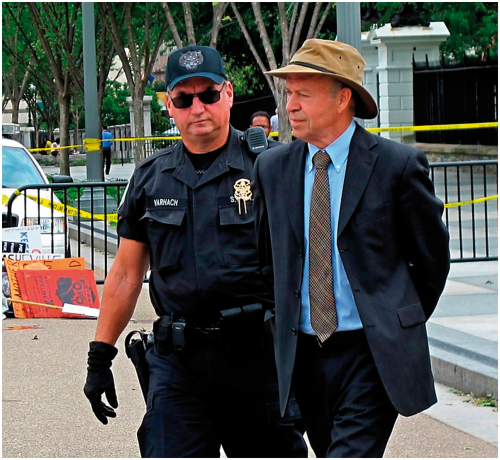
Hansen getting arrested outside the White House during a 2011 protest of the Keystone XL pipeline.
Hansen: It would be a fee for carbon dioxide emissions proportional to the amount of carbon in the fossil fuel. A suggested starting amount is $10 per ton of carbon dioxide for the first year, and this would go up $10 a ton per year, so at the end of 10 years it would be $100 a ton. That would add a cost to fossil fuels: for gasoline, equivalent to about $1 a gallon. At the current level of fossil fuel use in the United States, that would generate $600 billion a year. If you distributed that money to legal residents of the country, it would be about $2,000 per person. That would allow most people to more than cover their increased energy costs, and it would be a strong incentive for people to minimize their carbon footprint. It would also be a huge incentive to entrepreneurs to develop clean energies and energy efficiency. The economic models—for example, by Charles Komanoff at the Carbon Tax Center—show that, by the end of 10 years, a gradually rising fee would reduce US carbon emissions by 30 percent. That would be much more valuable for energy independence than the Keystone XL pipeline would be.
BAS: You call this a carbon fee rather than a carbon tax, which you have opposed. Aren't they basically the same thing?
Hansen: No, because the fee is revenue-neutral. It's collected at a very small number of sources—the domestic mines and the points of entry—so it's simple to collect, and you know exactly how much you've got. You just divide this by the number of legal residents and distribute it electronically to their bank accounts or debit cards. That's why it's not a tax; it's not making the government bigger. It's designed to allow the market to determine the appropriate strategy for reducing our climate problem and providing the energy that we need for the economy. It's much better than the government deciding everybody has to have solar panels or windmills or whatever. We don't know what the most economic energy sources will be and what the proportion of energy efficiency and new clean energies will be. Let the marketplace help guide the decisions.
BAS: You have been especially critical of the coal industry. Replacing some coal-burning plants with natural gas has already reduced US emissions significantly. Can natural gas be an effective bridge to a stable climate?
Hansen: That's what it should be. But what's actually happening is that the government is allowing the industry to go after every fossil fuel they can find. It makes sense to use gas instead of coal in power plants, but you can't do that indefinitely; there's way too much carbon in potential gas reserves. The way to make gas a bridge to a clean future, rather than a bridge to disaster, is to have this gradually rising price on carbon that will temporarily encourage replacement of coal by gas but will also put pressure on gas and eventually make it uneconomic unless you're capturing the carbon dioxide.
BAS: You have been warning about climate change, with increasing urgency, for decades. Why have you failed to get your message across?
Hansen: Getting it across to the public is difficult given the static that we get from people who do not want to see a reduction in fossil fuel use. There's no way that environmentalists can compete against the amount of money spent on public advertisements for clean coal, clean tar sands, energy independence, all the arguments that they make. There are also physical reasons that make it difficult to get the message across. The magnitude of existing global warming—less than 1 degree Celsius; over land areas it's about 1.5 degrees Celsius, or about 2.5 degrees Fahrenheit—is small compared to weather fluctuations, so it's not obvious to people that there are important climate changes. The most important effects, in my opinion, are those that are irreversible on any practical time scale. For example, if the ice sheet begins to disintegrate substantially, then you can get to a point where sea level is going to go up a lot and it will be beyond your control. We know that in the last interglacial period that was warmer than the present one—the Eemian, 120,000 years ago—sea level was at least 6 meters higher and the temperature was only 2 degrees Celsius warmer than the preindustrial level, so we're already halfway there. And we can see that Greenland and Antarctica are beginning to lose ice faster and faster. If we don't begin to reduce emissions pretty promptly, we're probably going to guarantee sea level rise of several meters. It's hard to say exactly how fast that will be, and that's what scientists argue about. The other irreversible effect is the danger that shifting climate zones will drive a substantial fraction of species to extinction.
BAS: The new film Pandora's Promise tells the stories of “environmentalists and energy experts who have undergone a radical conversion from being fiercely anti- to strongly pro-nuclear energy, risking their careers and reputations in the process.” Did you ever reconsider your conclusions or policy recommendations, in light of changing policy directions?
Hansen: A scientist always re-examines his conclusions in light of changing data and other information. I have realized that focusing on a global strategic approach, namely recommending that coal emissions be phased out and unconventional fossil fuels be left in the ground, although rational, is fruitless. Instead it is more important to focus on policies that could cause that to happen. That has led me to emphasize the need to put an honest price on fossil fuels, one that makes them pay their costs to society.
BAS: Looking back over your career, is there anything you wish you had done differently?
Hansen: After my 1988 testimony, I realized that I emphasized the drought and that I should have given equal emphasis to the fact that a warmer atmosphere holds more water vapor, which will also cause heavier rainfall and greater floods. That was why I testified again a year later. At the later testimony, the science kind of got lost, because I complained that the White House changed that [1989] testimony, so that became the issue rather than the science itself.
BAS: When a political appointee tried unsuccessfully to hush you, you went public with your claims about censorship in early 2006. Are things different for government employees today? Would you advise a young person to go into climate science, knowing what you now know?
Hansen: I'd certainly advise them to go into the field. If they're going to work for the government, they will find that there are still restrictions on communication. The two things that I objected to most strongly are still in place. The requirement for a “minder” to be present when I talked to the media only existed for a matter of weeks. Once I complained publicly about it, that restriction was removed. But the public affairs offices in the science agencies are still headed by political appointees who feel that their job is to make the president look good. I don't understand why, in our democracy, we have such a system. We should have professionals heading public affairs offices, and not have them change when the political party in power changes. I was hoping that the new administration would change that practice, but they didn't. The other thing is that when a government scientist testifies to Congress, the testimony must be approved by the White House. Again, I see no basis for that in a democracy. The information should be the best that the scientist can provide, without screening and censorship by the White House.
BAS: What are your plans for retirement? Are you going to focus your efforts on a particular organization or project?
Hansen: I only did one interview at the time I retired, and it left the impression that I was going to become an activist. Actually, if I don't continue to do science and stay on top of that, my voice will become very ineffective. So I'll be spending most of my time on science. However, I will also work with Our Children's Trust, and on things like the Keystone pipeline and the coal exports from the West Coast. I'm planning to go to Europe to try to help persuade the governments to put an appropriate tax on tar sands, because the carbon footprint of tar sands oil is greater than that of conventional oil.
BAS: Why did you become an activist?
Hansen: The point is to draw attention to an injustice. We older people are burning the fossil fuels, getting the benefit from the energy, and leaving the problems for younger people and future generations. In specific cases like mountaintop removal and tar sands, it's doubly stupid because you get all this local pollution. It doesn't make sense to be chopping up the environment just to get the last bits of fossil fuels.
BAS: What do you tell your five grandchildren about climate change?
Hansen: Very little. I'm beginning to interact with the oldest, Sophie, who is now 14. I hope this year to write the book I call Sophie's Planet, which began as letters to her. With the younger ones, I just try to introduce them to nature. There's no reason to worry children about the world's problems, but there's every reason to try to make them appreciate nature and the remarkable planet that we have. One specific thing we do is to plant milkweeds for monarch butterflies. The number of butterflies has decreased dramatically because of herbicides that farmers use to kill weeds, and because the drought in the last two years has reduced the food supply for migrating butterflies.
BAS: When you and like-minded climate experts get together to talk about this rather intractable problem, what do you say to each other?
Hansen: I was at a meeting recently with some of the real experts, and the interesting thing is that there's basic agreement that we're almost to the point where there will have to be geoengineering of some sort to avoid disastrous consequences. The main topic in the meeting was: What are the chances of sucking the carbon dioxide out of the atmosphere at a cost that would be achievable? And so we've gone from a point where the scientific community was basically saying, “We're not certain yet how important this is,” to a point where “it's too late now.” And yet the public has not been adequately informed and persuaded of the situation, so that's disconcerting.
BAS: You have opposed geoengineering in the past. Do you feel differently about it after that meeting?
Hansen: I think we're going to have to do what I call “soft geoengineering,” to figure out ways to get the biosphere to draw down as much carbon dioxide as possible. But there's a limit to how much you can hope to store in the soil and the forests. That's why it's so urgent that we not continue to increase emissions, because it will get to a point where the only way you can save the ice sheet is by a crazy scheme like putting sulfur aerosols into the stratosphere. Trying to cover up one pollutant with another is likely to have unforeseen and undesirable consequences. The inertia of the system is not our friend; it minimizes the short-term effects that people can see but makes it more difficult to solve the problem over the long run.