




Abstract
The natural sciences are doing an admirable job of describing the geophysical aspects of climate change. The science behind global warming is well established. But designing an effective political and economic strategy to control climate change will require the second culture—the social sciences—to analyze how to harness our economic and political systems to achieve our climate goals effectively and at low cost. This second task requires examining questions such as the impacts on the economy and on non-market activities, the costs of slowing or mitigating climate change, the strength and timing of emissions reductions with an eye to the costs and benefits of slowing climate change, the risks of asymmetric and irreversible damages, and the policy instruments for implementing such emissions reductions. The author addresses this final question: how to devise policy instruments. The 2009 United Nations Climate Change Conference in Copenhagen meeting failed to reach a consensus on a successor agreement to the Kyoto Protocol, the global agreement that provides for emissions reductions for participating countries. This agreement has not resulted in global emissions reductions; its model creates inefficient and opaque mechanisms, akin to mortgage-backed securities, that have to date produced minimal emissions reductions. Only a harmonized global price on carbon—most easily implemented by a carbon tax—can achieve significant emissions reductions by sending a consistent signal to the governments, innovators, corporations, and individual consumers across all sectors and geographic boundaries.
For global warming policy, the December 2009 United Nations Climate Change Conference—also called the Copenhagen Summit—was a major disappointment. The meeting was designed to negotiate a successor to the Kyoto Protocol, the 1997 international agreement on emissions reductions that expires in 2012. The Copenhagen Summit concluded without a binding agreement because of deep divisions on the distribution of emissions reductions and costs. It did lead to the “Copenhagen Accord,” which aims to limit the increase in global mean temperature, “recognizing the scientific view that the increase… should be below 2 degrees Celsius.” Those looking for a silver lining behind the cloudy outcome have pointed to the fact that developing countries joined the accord. A closer look reveals, however, that developing countries committed themselves to very little. They agreed to announce their “nationally appropriate mitigation actions seeking international support efforts” but no binding targets for developing countries were set.
The reality behind the accord is not encouraging. To begin with, even if the high-income countries fulfilled their commitments, these would almost surely not achieve anything close to the target of 2 degrees Celsius. Meanwhile, progress on reaching a binding agreement has been glacial at best. Currently, a global agreement is waiting for the United States to take credible legislated steps. Legislation has stalled in the US Senate because of the need for a supermajority to pass any major legislation. Keeping in mind not only the resurgence of anti-tax movements in the United States, but the fact that the 2010 elections cut the number of supporters of climate change legislation in both chambers, it is difficult to believe that strong legislation could be enacted in the United States in the near future. Continued delay in adoption of climate change policies by the United States is likely to lead to a domino effect in which other countries follow the US example of inaction.
Given the evident failure of the current economic approach to slowing climate change, it is useful to step back and ask if the flaw lies, not in the stars, but in the protocol. The Kyoto Protocol allows a system of emissions trading schemes to encourage 39 developing nations and the European Union to reduce their collective greenhouse gas emissions by 5.2 percent from the 1991 levels. These countries could earn some of their “reductions” by subsidizing emissions-reductions projects in developing countries, a strategy known as the clean development mechanism (CDM). The current approach embodied in the Kyoto Protocol will not accomplish the goals of slowing climate change—and, as currently designed, it is both economically inefficient and ineffective and should be supplemented or replaced.
An inconvenient economic truth
The economics of climate change is straightforward. Virtually every human activity directly or indirectly involves the combustion of fossil fuels, producing emissions of carbon dioxide—the most important greenhouse gas—into the atmosphere. Emissions of carbon dioxide are externalities, i.e., social consequences that are not accounted for in the market place. They are market failures because people do not pay for the current and future costs of their emissions.
If economics provides a single bottom line for policy, it is that we need to correct this market failure by ensuring that all people, everywhere, and for the indefinite future, face a market price for the use of carbon that reflects the social costs of their activities. Economic participants—thousands of governments, millions of firms, billions of people, all making trillions of decisions each year—need to face realistic prices for the use of carbon if their decisions about consumption, investment, and innovation are to be appropriate.
It is worth unpacking this idea. Raising the market price of carbon provides strong incentives to reduce carbon emissions through four mechanisms. First, it provides signals to consumers about what goods and services produce high carbon emissions and should therefore be used more sparingly. Second, it provides signals to producers about which inputs (such as electricity from coal) use more carbon, and which inputs (such as electricity from wind) use less or none. It thereby induces producers to move to low-carbon technologies. Third, high carbon prices provide market signals and financial incentives to inventors and innovators to develop and introduce low-carbon products and processes that can eventually replace the current generation of carbon-intensive technologies. Finally, and most subtle of all, the use of carbon pricing provides simple, straightforward information that market participants need to undertake each of these three tasks. Of course, placing a market price on carbon use will not work magic. There remain many further externalities and market imperfections in energy and other markets. But without a strong price signal, there is simply no hope for making the vast number of decisions in a remotely efficient manner.
This is the inconvenient truth from economics: Raising the price of carbon is a necessary condition for implementing carbon policies in a way that will have an impact on everyday human decisions, as well as on decision makers at every level in every nation and sector.
The high cost of non-participation
Economics leads to a second important truth about climate change policies. The analytical basis for an efficient global warming policy is extremely simple. Because global warming affects everyone in the world, it follows that everyone, everywhere must face the same carbon price if policy is to be effectively implemented.
The difficulty arises because there are widely disparate incentives to participate in measures to mitigate the damages, including income levels, political structures, environmental attitudes, country sizes, and assessments of potential damages at the national and regional level. For example, Russia may believe that it will benefit from limited warming because of the possible expansion of agriculture, while low-lying countries such as the Netherlands may believe they face a major threat from rising sea levels. Within the United States, some states are exporters of carbon-heavy fuels and resist measures to tax them, while others, such as California, are environmentally oriented and have enacted legislation to limit carbon emissions.
Current international agreements differentiate among countries in their responsibilities to undertake measures to limit emissions. Under the Kyoto Protocol, Annex I countries (which include 39 industrialized countries and the European Union) must limit their emissions, while non-Annex I countries (the developing nations) have a variety of non-binding commitments, as well as the ability to participate in the CDM. Moreover, while some countries have implemented strong internal mechanisms to control emissions, these often cover only a limited part of national emissions. For example, the European Trading Scheme—Europe’s effort to initiate a cap-and-trade structure—covers only about half of EU emissions.
The current international control regime is a patchwork affair with limited participation. New evidence from economic studies suggests that the costs of such limited participation are much higher than was earlier thought (Nordhaus, 2008, 2009).
1
Annex I countries, including the United States, produced about two-thirds of global carbon dioxide emissions in 1990. However, by 2010, only one-third of global emissions were from participating countries—the decline was a result of the US withdrawal from the Kyoto Protocol and the increased emissions from developing countries. The cost with incomplete participation is estimated to be about seven times the cost of the same global emissions reduction with complete international participation (see Figure 1).
Penalty of non-participation in Kyoto Protocol. This figure shows the estimated cost penalty incurred in a regime with two groups, participants and non-participants. The current version of the Kyoto Protocol (Annex I without the United States) has a cost penalty of more than 600 percent over an efficient design with universal participation.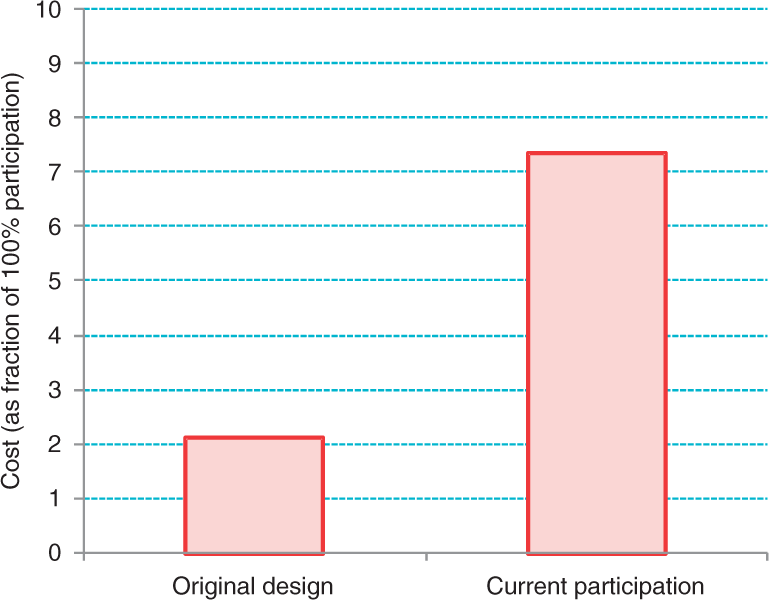
We have also estimated the required participation to attain ambitious targets, such as cost of limiting emissions sufficiently to keep global temperature change within the 2 degrees Celsius target of the Copenhagen Accord. Our modeling indicates that it will be necessary to attain close to universal participation by the middle of the twenty-first century to reach this goal (Nordhaus, 2008, 2009).
One response to the criticism about non-participation is that the cap-and-trade system under the Kyoto Protocol actually extends participation through subsidizing emissions-reductions projects in developing countries through the CDM. There is a substantial likelihood that the emissions reductions from the CDM could prove to be minimal. Despite the fact that there is no way of verifying that the projects in fact reduced emissions in the host countries, the CDM has been a major source of accounting emissions reductions. By one reckoning, most of the emissions reductions in the European Union have come from the CDM. Many firms are springing up to provide CDM credits. It would be a nightmare if we were heading down the road to another set of opaque instruments that are the environmental equivalent of mortgage-backed securities. 2
It is clear that non-participation will be an issue under any international agreement on climate change, whether the agreement follows the Kyoto model or one based on carbon taxes. The unfortunate feature of the Kyoto model is that it pretends to solve the problem of bringing developing countries into the regime, whereas in fact we have no idea of the actual emissions reductions that have been achieved in developing countries under the CDM.
So here is the second bottom line from economics: Near-universal participation at a harmonized price is a critical part of an efficient global warming regime. The cost of non-participation is extremely high.
Harmonized carbon taxes
Perhaps the most controversial policy question is what economic instruments should be used to control global warming: Should the international community rely primarily on quantity-based or price-based constraints? More specifically, the question concerns the relative advantage of a cap-and-trade system (such as is embodied in the Kyoto model), or a carbon tax system (such as is used for limiting gasoline or cigarette consumption).
The quantity-type system of the Kyoto model is well known. Under this approach, countries would agree to penalize carbon emissions at an internationally harmonized “carbon price” or “carbon tax.” The carbon price might be determined by estimates of the price necessary to limit greenhouse gas concentrations or temperature changes below some level thought to be “dangerous interference.” A central feature is that the tax (or price on carbon) should be equal in all countries and sectors. In reality, as with any system, reality will depart from the ideal, but it is useful to keep the conceptual ideal in mind when designing the system. Revenues would be collected and retained domestically, with countries retaining the right to use the revenues according to domestic priorities. 3
All this leaves the appropriate size of the carbon tax as an open question, which has been explored in a series of modeling exercises. Figure 2 provides an estimate of carbon prices under three policy regimes: an “optimal” cost–benefit approach, an approach that limits an additional rise in global temperature to 2 degrees Celsius, and a version of the Copenhagen Accord where all countries meet their objectives relatively quickly (Nordhaus, 2010). No matter which regime we choose, the social cost of carbon and the appropriate carbon tax will rise sharply in the years ahead.
Carbon price for different policy scenarios. The figure shows the calculated carbon prices for three different policy scenarios. Note that the carbon price under the optimistic Copenhagen Accord is lower than the other scenarios for the first quarter century, and does not come close to attaining the objective of limiting global temperature increase to 2 degrees Celsius. (These are prices per ton of carbon not carbon dioxide. Carbon dioxide prices are lower by a factor of 3.67.)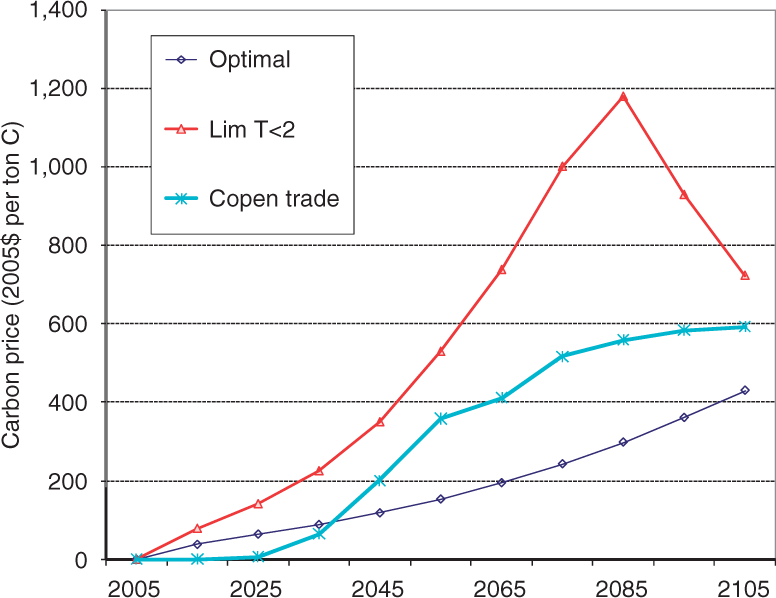
Comparison of carbon taxes and cap-and-trade
The debate about the relative merits of cap-and-trade versus carbon taxes has moved from the academic journals to legislatures and scientific congresses. It is not a simple matter, but the difficulties of the Kyoto model approach are insufficiently appreciated. 4 Price-type approaches such as a harmonized carbon tax would be far more effective.
To begin with, tax systems are mature and universally applied instruments of policy. Countries have used taxes for centuries, and their properties are well understood. Every country uses taxes, has an administrative tax system, has tax collectors, and needs revenues. By contrast, there is no experience—as in zero—with international cap-and-trade systems. Just as it would be dangerous for military planners to use a completely untested weapon to defend against grave threats, it would be similarly perilous for the international community to rely on an untested system like international cap-and-trade to prevent climate change.
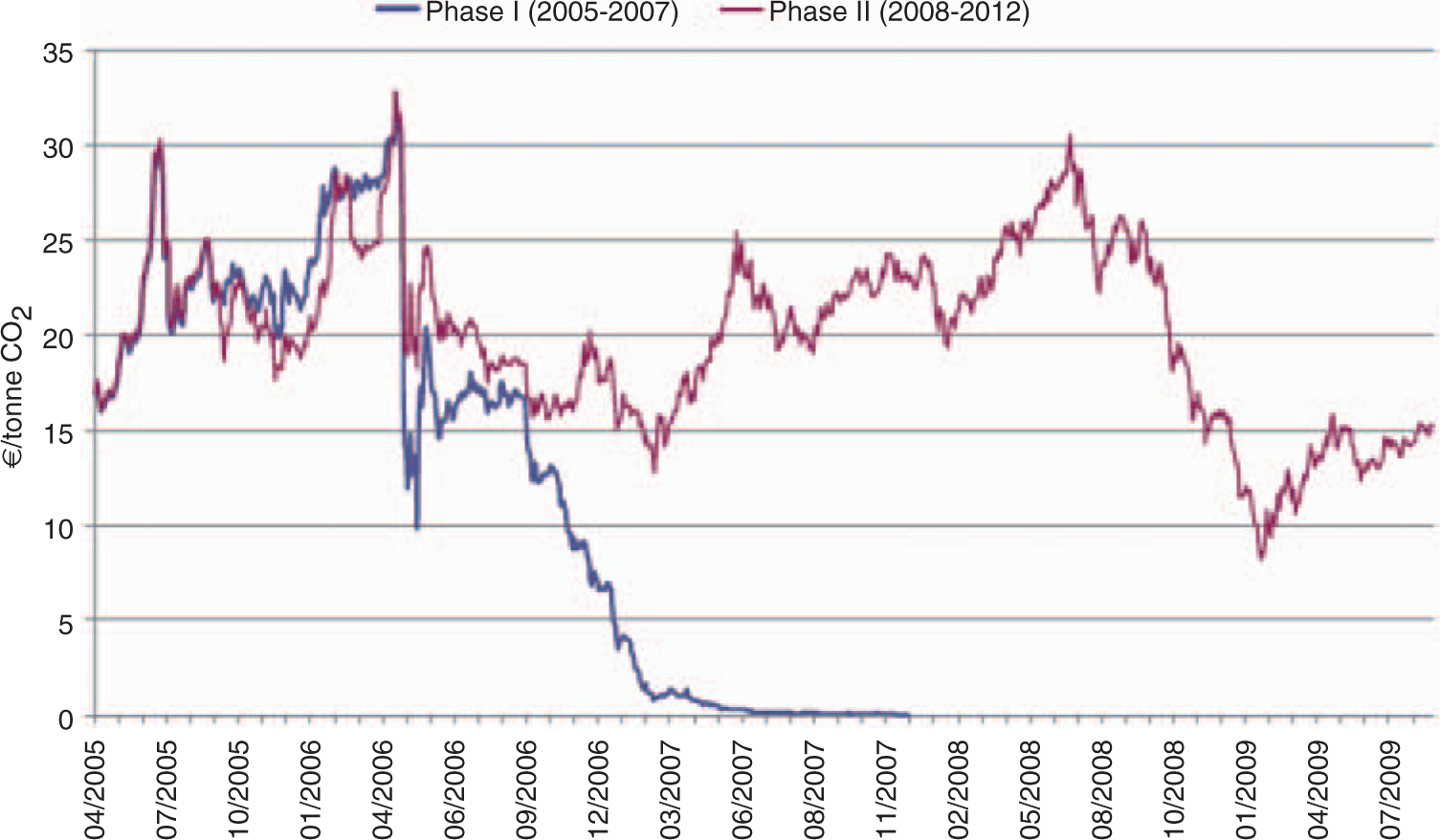
A related point is that quantitative limits have proven to produce severe volatility in the market price of carbon under an emissions-targeting approach. The volatility arises because of the inelasticity of both supply and demand for permits. The history of the market prices of tradable permits for both the sulfur dioxide trading system in the United States and the carbon dioxide system in the EU shows an extremely high level of volatility—even within single countries. The sulfur dioxide trading regime in the United States has a relatively stable set of rules, is a mature system, and has almost two decades of experience. Despite all of this, the prices of US sulfur dioxide emissions allowances has been almost three times as volatile as stocks, and more than half as volatile as oil (see Figure 3). The volatility of carbon dioxide allowances in the EU emission trading system is similarly large: In the period from October 2008 to February 2009 alone, carbon prices varied between 9 euros and 24 euros per ton of carbon dioxide (see Figure 4).
Prices of sulfur emissions allowances show high volatility. Cap-and-trade systems lead to high volatility of the prices of emissions, as is exemplified by sulfur dioxide prices. This figure shows the estimated volatility of three prices from 1995 to 2009. These are, from left to right, the stock price index for the Standard and Poor 500 (Stocks), the price of crude oil (Oil), and the price of sulfur dioxide allowances under the US acid rain program (SO2). Volatility is calculated as the average absolute value of year-to-year changes. (Calculations by the author.) Volatility of prices under a cap-and-trade regime. This figure shows the history of CO2 prices under the EU Emissions Trading Scheme from 2005 through 2009. The volatility is representative of trading prices for allowances under cap-and-trade systems, as is seen in Figure 3. Source:
UK Committee on Climate Change (2009).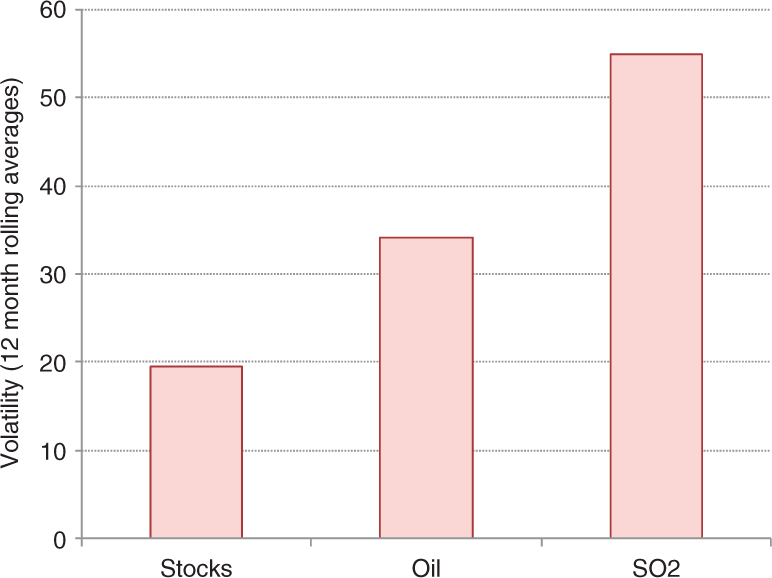
It should be emphasized that the volatility of allowances is not due primarily to technical or policy errors. It is inherent in this kind of instrument. The high level of volatility is economically costly and provides inconsistent signals to private-sector decision makers. By contrast, a carbon tax would provide consistent signals and would not vary so widely from year to year, or even day to day.
In addition, a tax approach can capture the revenues more easily than quantitative approaches can, and a price-type approach will therefore cause fewer additional tax distortions. The tax approach also provides less opportunity for corruption and financial finagling than do quantitative limits, because the tax approach creates no artificial scarcities to encourage such behavior.
Carbon taxes have the apparent disadvantage that they do not steer the world economy toward a particular climatic target, such as a carbon dioxide concentration limit or a global temperature limit. This suggests that a carbon tax cannot ensure that the globe remains on the safe side of “dangerous anthropogenic interferences” with the climate system. This advantage of quantitative limits is largely illusory, as we do not currently know what emissions would actually lead to these dangerous interferences or even what global climate change will be implied by a system such as the Kyoto model. We might make a large mistake—either on the high or the low side—and impose much too rigid and expensive quantitative limits, or much too lax ones.
This leads to a final point about the two systems. A carbon-tax model provides a friendly way for countries to join a climate treaty. Currently, countries joining the Kyoto limitations would need to enter into highly politicized and uncertain negotiations on the extent of their emissions reductions. Consider a country with a medium-sized open economy that is closely tied to the United States, Russia, or Europe: If this country were deciding whether to join the Kyoto Protocol under the current model, it might be concerned about the long-term impacts of climate change and might even be willing to join the effort to ensure its success. But it also would be realistically wary of the heavy pressures that big countries could apply. Since emissions commitments are poorly defined under the Kyoto model, new signatories could be under pressure to make sharp reductions, so that larger countries could make smaller ones.
So it is not a puzzle that countries have not been flocking to join the Kyoto Protocol since its original negotiations in 1997. Under the carbon-tax model, by contrast, countries would need only to guarantee that their domestic carbon price would be at least at the level of the international norm. It would not be a painless choice to agree to a minimum carbon price, but it would at least be a transparent and relatively straightforward one, and one in which countries contemplating joining would know what they were signing up for.
The perils of the current cap-and-trade system
The international community is making a huge wager on the Kyoto model. The wager is that the cap-and-trade structure contained in the Kyoto model will do the job of slowing global warming. The Obama administration advocated that the United States adopt this system as its contribution to solving the global problem, and the primary legislation in the US Congress is firmly in the cap-and-trade camp.
But, as has been mentioned above, the cap-and-trade approach is a poor choice of mechanism. It is untested in the international context; it has been unable to attain anything close to universal participation; and it has the inherent flaws just described. It is unlikely that the Kyoto model, even if strengthened, can achieve its climate objectives in an efficient and effective manner. To bet the world’s climate system and global environment on an untested approach with such clear structural flaws would appear a dangerous gamble.
Given the advantages of tax-type systems, as well as the problems inherent in the Kyoto model, an important question is how to modify the Kyoto Protocol to include tax-type models. Some have suggested a hybrid approach that could combine the strengths of both quantity and price approaches. An example of a hybrid plan would be a traditional cap-and-trade system combined with a floor carbon tax and a safety-valve price. For example, the initial carbon tax might be $30 per ton of carbon with safety-valve purchases of additional permits available at a 50 percent premium. These would be an improvement on a pure cap-and-trade system, but we would be wary that a hybrid system would have low-or-non-existent floors and high-and-vanishing caps, in which case it would differ little from a cap-and-trade system.
One approach that might meet climate, economic, and political objectives more effectively would be to broaden the Kyoto treaty to allow countries to fulfill their treaty obligations if they have a domestic regime with a minimum carbon price attached to all emissions. This would require international negotiations about the minimum price and its trajectory, but such an approach would allow a much broader set of policy regimes.
Closing budget gaps with carbon taxes
One possible outcome of the current stalemate is that advocates of climate change policies will rethink their reliance on cap-and-trade techniques in favor of carbon taxation. The case for carbon taxes was discussed above. One further hope for climate change legislation comes from a most unanticipated source: the need to curb the growing budget deficits in many high-income countries. Along with most other high-income countries, the United States faces a major increase in government debt relative to GDP. A report by the Congressional Budget Office in June 2010 estimated that the debt–GDP ratio will be between 65 percent and 72 percent in 2015 under alternative assumptions about the baseline fiscal policy. The debt ratio is increasing rapidly as a result of the collapse of revenues in the current extended downturn, as well as stimulus programs.
An important source of revenues to reduce the future budget deficit would be a carbon tax. A carbon tax is the closest thing to an ideal tax that can be imagined. It is the only tax under consideration in the deficit reduction studies that will increase economic efficiency because it reduces the output of an undesirable activity (carbon dioxide emissions). It moves a long way to implement the Congress’s and the administration’s goals for climate change policy. It will help meet international obligations that the United States has undertaken to reduce its carbon dioxide and other greenhouse gas emissions. It will have substantial public health benefits because it will reduce harmful emissions, particularly those associated with burning coal. A carbon tax can buttress or replace many inefficient regulatory initiatives and will thereby provide yet another improvement in economic efficiency. From a fiscal point of view, it has the distinct advantage of scooping up the rents that would accrue to those who receive free allocations of emissions permits under a cap-and-trade plan.
It is just possible that a convergence of fiscal conservatives and environmental activists will converge on a carbon tax as a way to reduce the growing fiscal deficits, slow global warming, and do both of these in a market-friendly manner.
It is important to emphasize how difficult it is to design durable and effective international economic systems. They are complex ecosystems, full of hidden prey and predators, with many unforeseen results. History is littered with failed institutions, from cholera conventions in the nineteenth century to disarmament pacts in the twentieth century to international currency regimes stretching back for many decades. One need only look today at the fragile international financial system to see the latest example of the effects of failed regulatory and risk-management design.
So, if the Kyoto model turns out to be another failed model, it has lots of company. But it would be better to recognize and change it now, rather than after one or two more decades of ineffective and inefficient efforts to slow emissions. The international community should move quickly to replace the current cap-and-trade structure by one in which the central economic mechanism is a tax on greenhouse-gas emissions.
Footnotes
1
For a more complete discussion of the costs of non-participation, see Nordhaus, (2008,  .
.
2
For trends in the CDM, see Capoor and Ambrosi (2008). For an analysis of the shortcomings, see .
3
For a more complete discussion of a carbon tax, see Cooper (1998), Metcalf (2007a,
2009), and .
4
There has been extensive discussion of the relative merits of cap-and-trade systems versus carbon taxes. The discussion here draws upon Chapter 8 in Nordhaus (2007, 2008). The alternative point of view has been elaborated in Stavins (2007) and .
Author biography